
When searching for 5-axis machining services, many people come across two machining methods: 3+2-axis machining and simultaneous 5-axis machining.
Both use 5-axis CNC machine tools and are capable of machining complex parts, so many people assume they are simply different names for the same thing.
In reality, their machining principles are completely different, and they are suited for different types of parts. Choosing the right machining method affects not only production costs but also machining efficiency, surface finish, lead time, and the final part quality.
If you are designing a new product or looking for a 5-axis machining supplier, this article will help you quickly understand the differences between the two and determine which machining method to choose in different situations.
What Is 3+2 Axis Machining?
3+2-axis machining is also known as indexed 5-axis machining or positional 5-axis machining.
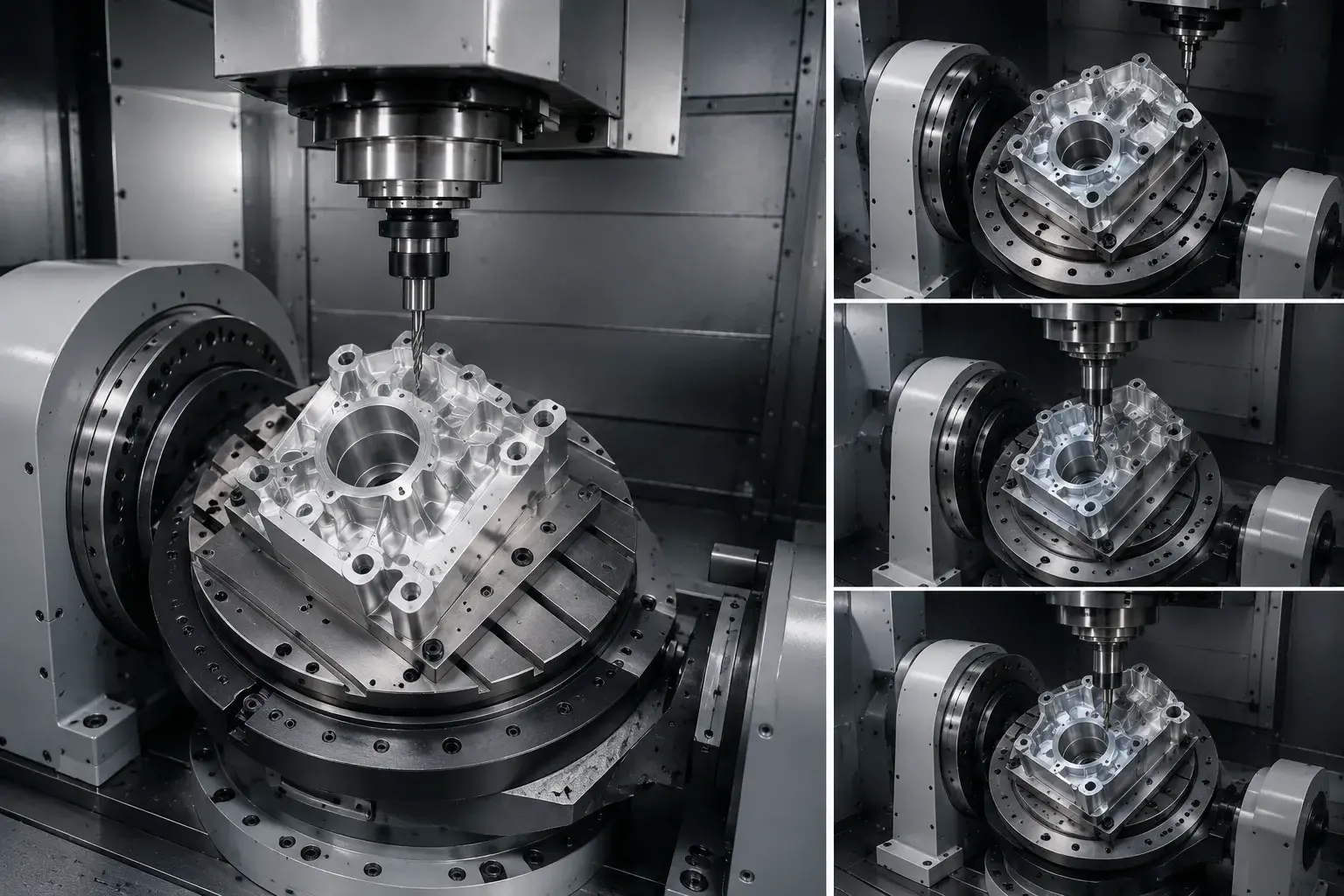
During machining, the machine tool first uses two rotary axes to position the workpiece at a specified angle, then locks the rotary axes in place, and finally uses three linear axes to perform the cutting operations.
This can be understood as “adjusting the orientation first, then starting machining.” Throughout the entire cutting process, the rotary axes do not move continuously, so programming is relatively simple, and the machining process is more stable.
Compared to traditional 3-axis machining, its greatest advantage is the ability to machine features at multiple angles in a single setup—commonly referred to as multi-sided machining. This reduces the need for repeated setups and minimizes positioning errors.
For most prismatic parts, angled holes, inclined surfaces, and multi-angle structural components, 3+2-axis machining is sufficient to meet machining requirements while balancing efficiency and cost.
What Is Simultaneous 5-axis CNC machining?
Simultaneous 5-axis CNC machining is also known as Continuous 5-Axis Machining.
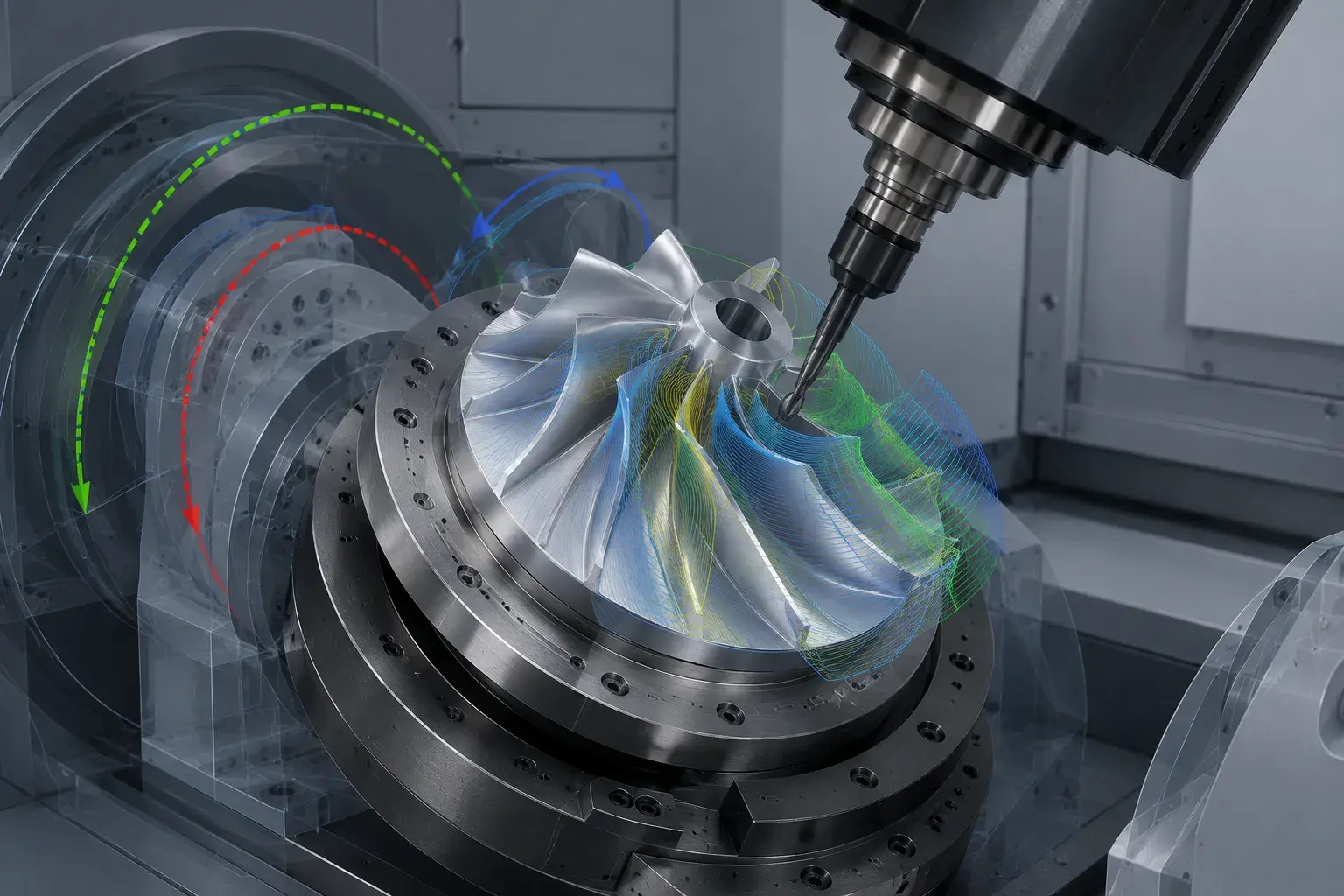
Unlike 3+2-axis machining, during the machining process, the three linear axes and two rotary axes move simultaneously. The tool continuously adjusts its orientation to maintain the optimal cutting angle at all times.
The key advantage of this method is its ability to continuously machine complex surfaces without frequent machine stops or repositioning.
Parts such as aircraft engine impellers, medical implants, robotic joints, and complex molds all require the cutting tool to constantly change its machining orientation. If 3+2-axis machining were still used, machining efficiency would drop significantly, and it might even be impossible to achieve the desired machining results.
Although multi-axis machining offers greater machining capabilities, it places higher demands on CAM software, machine tool performance, and programming expertise; therefore, the overall machining cost is typically higher.
3+2-Axis Machining vs. Multi-axis machining
Many people ask, “Which machining method is better?”
In reality, neither is inherently superior; the real difference lies in the part itself.
The table below will help you quickly understand the main differences between the two machining methods.
| Comparison Item | 3+2 Axis Machining | Simultaneous 5 Axis Machining |
|---|---|---|
| Rotary Axis Movement | Stops after positioning | Moves continuously during machining |
| Tool Orientation | Fixed during cutting | Adjusted in real time |
| Programming Difficulty | Lower | Higher |
| Cycle Time | Short | Shorter for complex parts |
| Surface Finish | Good | Better |
| Curved Surface Capability | Limited | Excellent |
| Complex Geometry | Medium complexity | High complexity |
| One-Setup Machining | Suitable for many parts | Better for complex parts |
| Machining Cost | Lower | Higher |
| Best For | Housings, brackets, structural parts | Impellers, medical, aerospace, molds |
As can be seen, both machining methods fall under the category of 5-axis machining, but they address different challenges.
If the complex part machining has a relatively regular structure, 3+2-axis machining is usually sufficient. If the part features continuous surfaces or complex spatial contours, multi-axis machining is more appropriate.
When Should You Choose 3+2 (Indexed) Axis Machining?
Many customers assume that whenever they use a 5-axis CNC machine tool, they should opt for multi-axis machining.
In reality, most parts do not require such a complex machining method.
If a complex part machining consists primarily of flat surfaces, inclined surfaces, holes, and prismatic structures, 3+2-axis machining is often sufficient to complete the machining process—and at a lower cost.
For example, common aluminum alloy housings, automation equipment parts, mechanical brackets, and tooling fixtures all fall into this category. With indexed 5-axis machining, engineers can machine multiple surfaces in a single setup, which not only reduces positioning errors but also improves overall machining efficiency.
For these types of parts, choosing 5-axis simultaneous machining does not significantly improve quality; rather, it may increase programming time and machining costs. Therefore, as long as the part meets the drawing specifications, 3+2-axis machining is often the more economical and efficient choice.
When Is Simultaneous (Continuous) 5-Axis CNC Machining the Better Choice?
Although simultaneous 5-axis CNC machining offers greater machining capabilities, this does not mean it is suitable for all parts.
Parts that are truly suited for multi-axis machining are typically those with complex geometries. Examples include continuous surfaces, deep cavities, complex spatial contours, or products that require the tool to constantly change its machining angle to complete the cut.
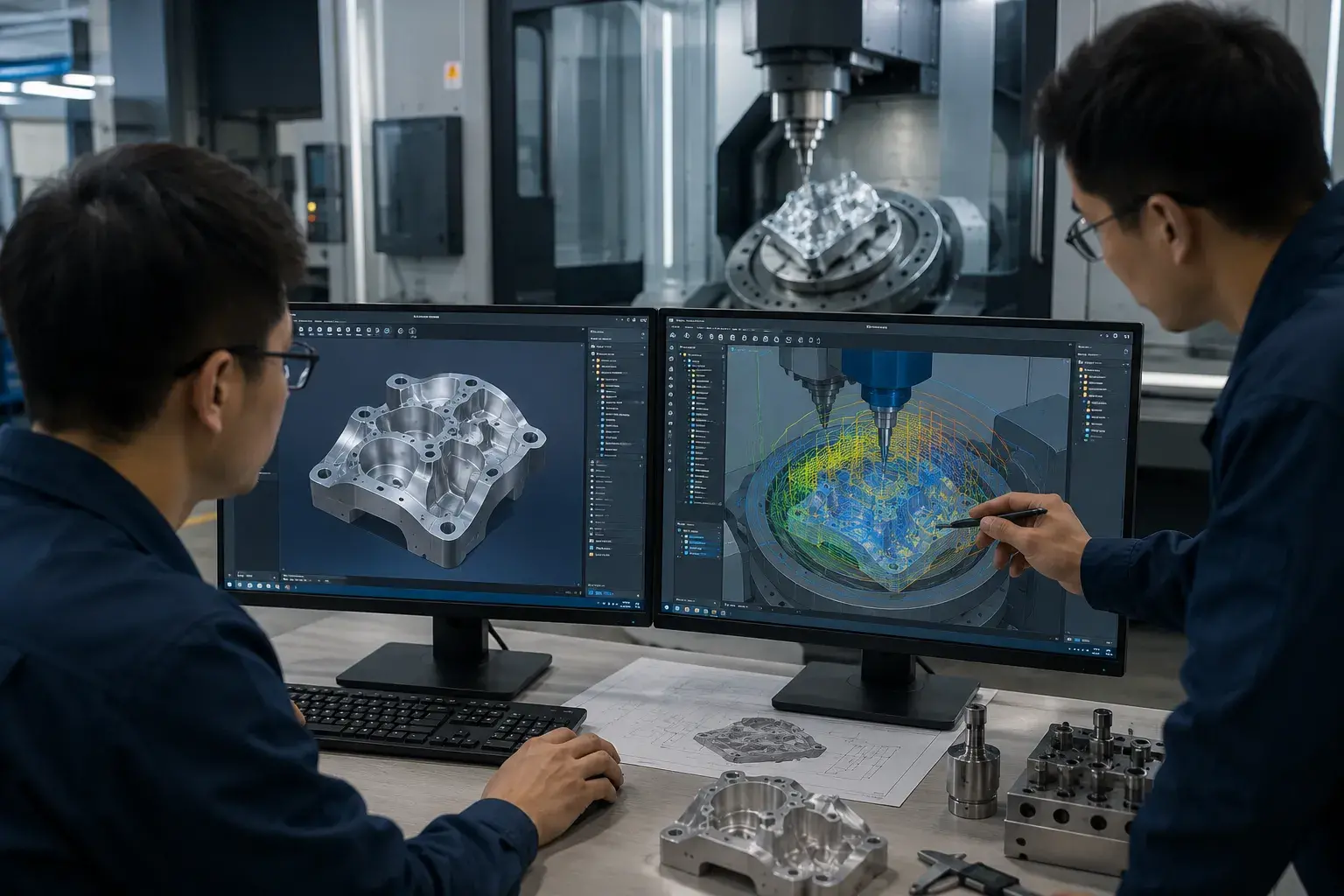
Aviation engine impellers, medical implants, robotic joints, and mold cavities are all typical examples. These parts are not only difficult to machine but also have higher requirements for surface finish and dimensional consistency. If the tool orientation cannot be continuously adjusted during machining, problems such as interference, tool vibration, or inconsistent surface quality can easily arise.
The advantage of Simultaneous 5-Axis Machining lies in its ability to adjust tool orientation in real time, ensuring the tool always maintains the optimal cutting angle. This not only results in smoother cutting but also shortens cycle time and reduces the need for subsequent polishing and finishing work.
If your part features complex surfaces or if you wish to complete more machining operations in a single setup, simultaneous 5-axis machining is typically the better choice.

How YUANYI Chooses the Right 5-Axis Machining Strategy
At YUANYI, we do not recommend a single machining method; instead, we develop machining solutions based on the specific requirements of each project.
Upon receiving the drawings, our engineers first evaluate the part’s geometry, machining locations, tolerance requirements, material, and production volume before determining whether 3+2-axis machining or simultaneous 5-axis CNC machining is more suitable.
For parts with relatively simple geometries, we typically prioritize Indexed 5-Axis Machining to help customers reduce machining costs while ensuring machining accuracy. If a part includes complex surfaces, deep cavities, or continuous spatial contours, we use specialized CAM software to optimize toolpaths and combine this with machine simulation and collision detection to ensure a more stable and safe machining process.
Our goal is not to use the most complex machining methods, but to help our customers find the optimal balance between quality, efficiency, and cost.
Need Help Choosing the Right 5-Axis Machining Method?
Upload your CAD files and our engineers will recommend the most suitable
machining strategy for your project.
Conclusion
Both 3+2-axis machining and simultaneous 5-axis CNC machining fall under the category of 5-axis machining, but they are suitable for different types of parts.
If a part primarily consists of flat surfaces, multi-angle holes, and structural features, 3+2-axis machining is usually sufficient to meet machining requirements while also reducing machining costs.
If a part features complex curved surfaces, deep cavities, or has higher requirements for surface finish, Simultaneous 5-Axis Machining often delivers better machining results.
Frequently Asked Questions
Yes. 3+2 Axis Machining uses all five machine axes, but the two rotary axes are indexed and locked before cutting begins. Unlike Simultaneous 5 Axis Machining, all five axes do not move at the same time.
Yes. Most modern 5-axis CNC machines support both 3+2 Axis Machining and Simultaneous 5 Axis Machining. The machining method is determined by the CAM program and machining strategy rather than the machine itself.
No. Many complex parts can be machined efficiently using 3+2 Axis Machining. Simultaneous machining is usually recommended only when continuous tool movement is required to machine complex surfaces or improve surface finish.
Not necessarily. For many precision parts, 3+2 Axis Machining can achieve the same dimensional accuracy. The biggest advantage of simultaneous machining is its ability to machine complex geometries more efficiently while maintaining smooth tool movement.
Both methods work well for aluminum. If the part mainly contains flat surfaces, angled holes, or prismatic features, 3+2 Axis Machining is usually sufficient. For aluminum parts with freeform surfaces or deep cavities, Simultaneous 5 Axis Machining is often the better choice.
Yes. Compared with simultaneous machining, 3+2 Axis Machining usually requires simpler programming and shorter setup time, making it a more cost-effective solution for many precision components.
Engineers typically evaluate the part geometry, tolerance requirements, surface finish, material, and production volume before selecting the machining strategy. The goal is to achieve the required quality while keeping machining time and cost under control.



