

Tooling in manufacturing refers to the tools, fixtures, molds, and other equipment used to make parts accurately and consistently. These tools help manufacturers hold materials in place, guide cutting operations, shape components, and check finished parts.
Think about a CNC machine cutting a metal part. The machine provides the movement and cutting power, but something still needs to hold the part in the right position. The cutting tool needs to be selected, and the finished part needs to be checked. That’s where tooling comes in.
Some tooling is ready to use right out of the box. Other tooling is designed specifically for one part or production job. Choosing the right setup can make a big difference in machining time, part quality, and overall manufacturing costs.

What's the Difference Between Tooling and Machinery?
A simple way to understand the difference is that machinery does the work, while tooling helps it do the work correctly.
For example, a CNC milling machine can cut many different kinds of metal parts. But it still needs a cutting tool to remove material and a fixture to hold the workpiece in position.
Change the tooling, and the same machine can produce an entirely different part.
Standard tooling, such as machine vises and chucks, can be used for many different jobs. Custom tooling, on the other hand, is designed around a particular part or operation.
Why would a manufacturer pay extra for custom tooling?
Imagine machining 100 identical aluminum housings. With a standard vise, an operator might need to carefully position and align every part. A custom fixture could make loading much faster by locating each housing in the same position.
That means less setup time, more consistent results, and fewer opportunities for mistakes.
Tooling isn’t just an extra expense. It’s part of what makes repeatable manufacturing possible.
What Are the Main Types of Manufacturing Tooling?
Not all tooling does the same job. Some tools hold parts, some shape materials, and others help check whether the finished product meets its requirements.
Here are six common types.
| Tooling Type | What It Does | Common Examples |
|---|---|---|
| Jigs | Guide a cutting tool to the correct position | Drill jigs, drill guides |
| Fixtures | Hold and position parts during production | Milling fixtures, soft jaws |
| Molds | Shape materials into finished products | Injection molds, casting molds |
| Dies | Cut or form materials into specific shapes | Stamping dies, forming dies |
| Cutting tools | Remove material from a workpiece | Drills, end mills, turning tools |
| Inspection tools | Check dimensions and part quality | Go/no-go gauges, checking fixtures |
Jigs
A jig helps guide a tool to the correct location.
A drilling jig, for example, may have hardened guide bushings that keep a drill in the right position. Instead of measuring and marking every hole by hand, the operator can use the same jig repeatedly.
This is useful when making multiple parts with identical hole locations.
Fixtures
A fixture holds a part securely while it’s being machined, welded, or assembled.
In CNC machining, a fixture keeps the workpiece from moving while the cutting tool removes material.
Common examples include machine vises, clamping plates, and custom soft jaws.
For simple parts, a standard vise may be enough. For unusual shapes or thin-walled components, a custom fixture can provide better support and reduce the risk of movement or deformation.
Molds
Molds are used to shape materials into a specific form.
Think of a plastic phone case. Molten plastic is injected into a mold, cools, and comes out in the required shape.
Making the mold takes time and money, but the same mold can often produce thousands of parts or more.
That’s why molds are commonly used when manufacturers need large quantities of identical products.
Dies
Dies are used to cut, bend, or shape materials, often with a press.
For example, a stamping die can cut and form sheet metal into brackets, covers, or automotive components.
Unlike a CNC cutting tool that removes material gradually, a stamping die can form certain features in a single press stroke.
Cutting Tools
Cutting tools remove material to create the required part shape.
Examples include drills for holes, end mills for pockets and surfaces, and turning tools for round components.
Different materials and shapes require different tools. A cutting tool that works well on aluminum may not be suitable for machining hardened steel.
Inspection Tools
Making a part is only half the job. Manufacturers also need to confirm that it was made correctly.
Inspection tools include calipers, micrometers, go/no-go gauges, and specially designed checking fixtures. More advanced measuring equipment, such as a coordinate measuring machine (CMM), can also be used to inspect complex parts.
These tools don’t shape the product, but they help confirm that its dimensions meet the drawing requirements.
What's the Difference Between a Jig and a Fixture?
People sometimes use these two terms interchangeably, but they don’t mean exactly the same thing.
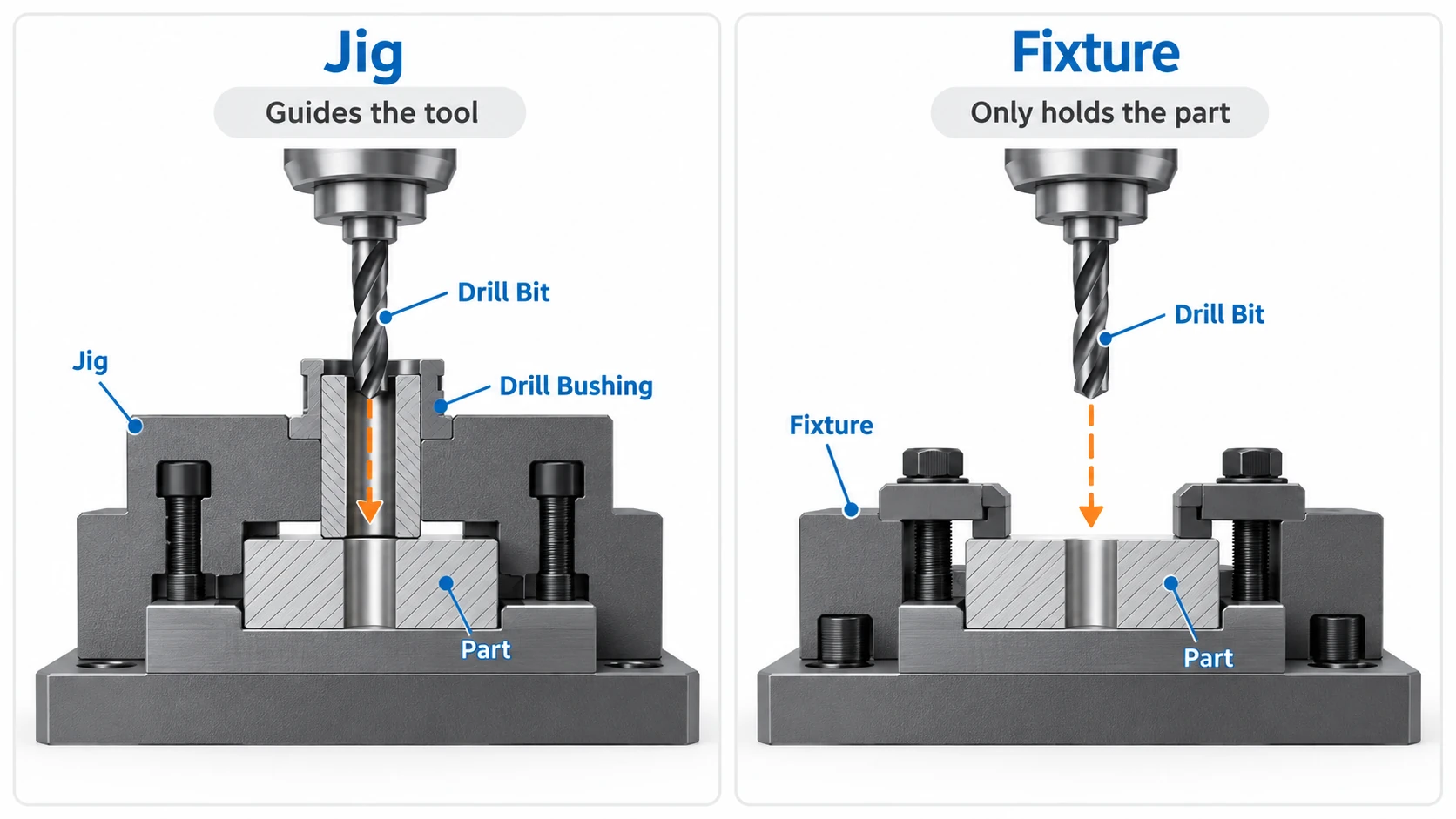
A jig guides the tool. A fixture holds the part.
Imagine you need to drill four holes in 200 identical metal brackets.
With a drilling jig, the operator places each bracket into the jig and drills through the guide holes. The jig helps keep the holes in the correct locations.
Now imagine milling the outside shape of those brackets on a CNC machine.
The brackets need to be held securely, but the machine program controls where the cutting tool moves. In this case, a fixture is used.
The main difference is what each device controls:
- A jig helps control where the tool goes.
- A fixture controls where the workpiece sits.
A drilling jig can also hold the part, so the functions sometimes overlap. But a fixture doesn’t normally guide the cutting tool directly.
Standard Tooling vs. Custom Tooling: Which Is Better?
Standard tooling is usually cheaper and faster to get started with. Custom tooling takes more time and money upfront, but it can make repeated production much easier.
The better choice depends on what you’re making and how many parts you need.
| Factor | Standard Tooling | Custom Tooling |
|---|---|---|
| Initial cost | Usually lower | Usually higher |
| Setup time | May require more adjustment | Often faster for repeated jobs |
| Flexibility | Works with many part designs | Made for specific parts |
| Part geometry | Best for simpler shapes | Useful for complex or unusual shapes |
| Repeatability | Depends on setup and locating method | Can provide more consistent positioning |
| Best suited for | Prototypes and varied jobs | Repeated or difficult production jobs |
Let’s look at a simple CNC machining example.
Suppose a shop needs to produce 100 identical aluminum parts.
With a standard vise, each part takes five minutes to load, position, and align. That’s 500 minutes of setup time.
Now imagine a custom fixture reduces that process to 30 seconds per part. The total setup time drops to 50 minutes.
That’s 450 minutes, or 7.5 hours, saved.
If the shop values that machine time at $100 per hour, the time savings would be worth approximately $750.
If the fixture costs $500 to make, it could pay for itself during the first production run.
Of course, these are example numbers, not guaranteed savings. Actual results depend on the part, setup process, and fixture cost. A custom fixture may also require initial design and machine setup time.
The point is simple: the cheapest tooling isn’t always the cheapest way to manufacture a part.
A standard vise may be perfectly fine for five prototype parts. But if a shop makes the same part every month, a custom fixture could save time on every production run.
How Is Tooling Used in CNC Machining?
Tooling plays an important role in CNC milling, turning, and 5-axis machining. Each process uses it a little differently.
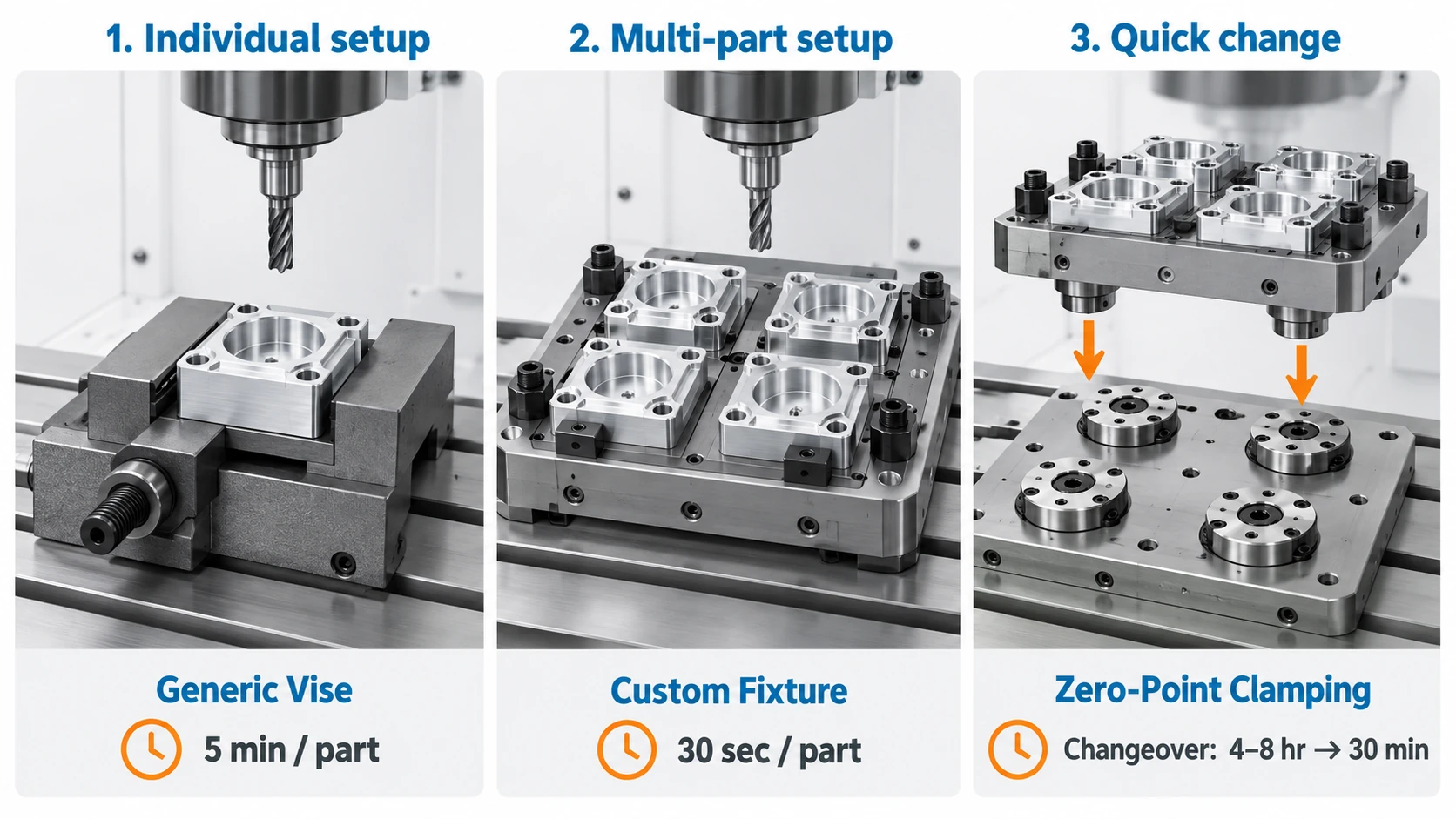
In 3-axis milling, parts are commonly held in machine vises or fixtures mounted to the machine table.
For a simple rectangular aluminum block, a standard vise may be all that’s needed.
Things get more complicated when a part must be flipped over to machine the opposite side. Every time the operator removes and repositions it, there’s a chance of introducing a small alignment error.
A well-designed fixture can make it easier to locate the part in the same position each time. This is especially useful when features on different sides need to line up accurately.
CNC lathes normally hold round workpieces using chucks or collets.
For regular shafts and cylindrical parts, standard workholding often works well.
But what about a thin-walled aluminum ring?
If the chuck grips it too tightly, the ring may bend slightly. Once it’s removed from the machine, it can spring back and end up outside the required tolerance.
Custom soft jaws or specially designed holding fixtures can help distribute the clamping force and reduce distortion.
Tooling becomes especially important when machining complex parts from multiple directions.
A 5-axis machine can approach a workpiece from different angles, often reducing the need to remove and reposition it.
But there’s a catch: the fixture must not block the cutting tool.
Imagine machining a robotic joint housing with angled holes, deep pockets, and curved surfaces. A large conventional vise might cover areas that the cutting tool needs to reach.
A compact custom fixture can hold the housing securely while leaving more of its surfaces accessible.
Quick-change workholding systems can also reduce the time needed to switch between jobs. Instead of repeatedly adjusting and aligning a fixture from scratch, the operator can use a repeatable locating system.
For some production jobs, manufacturers also use fixtures that hold several parts at once. This allows the machine to process multiple components before the next loading cycle.
The main goal is the same across all these processes: keep the part secure, make it easy to position, and allow the cutting tool to reach the areas that need machining.
How Much Does Manufacturing Tooling Cost?
There’s no single price for manufacturing tooling.
A standard machine vise might cost a few hundred dollars, while a complex custom fixture or production mold can cost thousands or much more.
The price depends on several factors.
1. Part Complexity
A simple flat plate is relatively easy to hold in place. A thin-walled housing with curved surfaces and holes on multiple sides is much harder.
Complex parts often require more careful fixture design, additional machining, and specialized locating features.
2. Accuracy Requirements
A fixture used for general drilling doesn’t necessarily need the same precision as one holding a part with tightly controlled hole locations.
Tighter requirements may mean more accurate locating surfaces, better materials, or additional inspection of the tooling itself.
3. Production Volume
For one or two parts, spending heavily on custom tooling may not make sense.
But when the same part is produced hundreds or thousands of times, saving even a minute per part can add up.
The more often a fixture is used, the easier it becomes to spread its upfront cost across production.
4. Tooling Material and Service Life
Tooling can be made from aluminum, steel, tool steel, and other materials.
Aluminum fixtures are relatively lightweight and easy to machine. Steel fixtures may offer greater wear resistance and durability for more demanding production environments.
However, material choice alone doesn’t determine service life. Clamping loads, contact surfaces, maintenance, and production conditions matter too.
5. Hidden Production Costs
The purchase price isn’t the only cost worth considering.
A cheaper fixture may take longer to set up, require more manual adjustments, or make it harder to inspect and remove finished parts.
Over time, those extra steps can become more expensive than the fixture itself.
That’s why manufacturers should look at the total cost of using tooling, not just the initial price.
How Do You Choose the Right Manufacturing Tooling?
You don’t need to be a tooling specialist to understand the basic decision. Start with four questions.
1. What Does the Part Look Like?
A simple square or rectangular part can often be held with standard equipment.
Parts with unusual shapes, thin walls, deep pockets, or multiple angled features may need custom support.
The first question is whether standard tooling can hold the part securely without blocking the machining operations.
2. How Accurate Does the Part Need to Be?
Not every surface needs the same level of precision.
A decorative cover may have relatively forgiving dimensions, while a bearing housing may require closely controlled hole positions.
The fixture needs to hold and locate the part accurately enough to meet its functional requirements.
Pay particular attention to surfaces and features that must align with other components during assembly.
3. How Many Parts Will You Make?
Production quantity makes a big difference.
For a prototype or a small batch, standard tooling is often the easiest and most affordable option.
For repeated production, custom tooling may reduce setup time and improve consistency.
There’s no universal rule that says custom tooling becomes worthwhile at 20, 50, or 100 parts. A difficult part might justify a custom fixture even for a small order, while a simple part could be produced in large quantities using standard tooling.
The best way to decide is to compare the upfront tooling cost with the time and money it could save during production.
4. How Often Will You Change Jobs?
Some CNC shops run the same part for days or weeks. Others switch between different parts several times a day.
If changeovers happen frequently, quick-change fixtures and repeatable locating systems may be worth the investment.
If the same part stays on the machine for a long production run, fixture stability and durability may matter more than changing jobs quickly.
A good tooling decision balances part geometry, accuracy, production volume, and setup time.
Frequently Asked Questions
Not necessarily. Tooling is usually separate from the machine, although it may be installed on or integrated with it during production. The machine provides the main manufacturing capability, while tooling helps perform specific operations.
Sometimes. A simple part may not need any custom tooling, even in a fairly large batch. But a complex or delicate part might require a special fixture to be machined accurately, even if only a few pieces are needed.
They can share some functions, but their main purposes are different. A jig guides a tool, while a fixture holds and locates the workpiece. Some devices combine both functions.
Molds may need accurately machined cavities, complex moving features, cooling channels, and materials capable of handling repeated production cycles. These requirements can make them more expensive to design and manufacture than a basic holding fixture. However, a complex precision fixture can also be expensive, so the cost depends on the specific design.
Soft tooling generally refers to tooling made for lower-volume production or shorter service life, often using materials that are easier or cheaper to machine. Hard tooling is usually designed for longer production runs and greater durability, often using hardened steel or other wear-resistant materials. The exact meaning can vary depending on the manufacturing process.


