

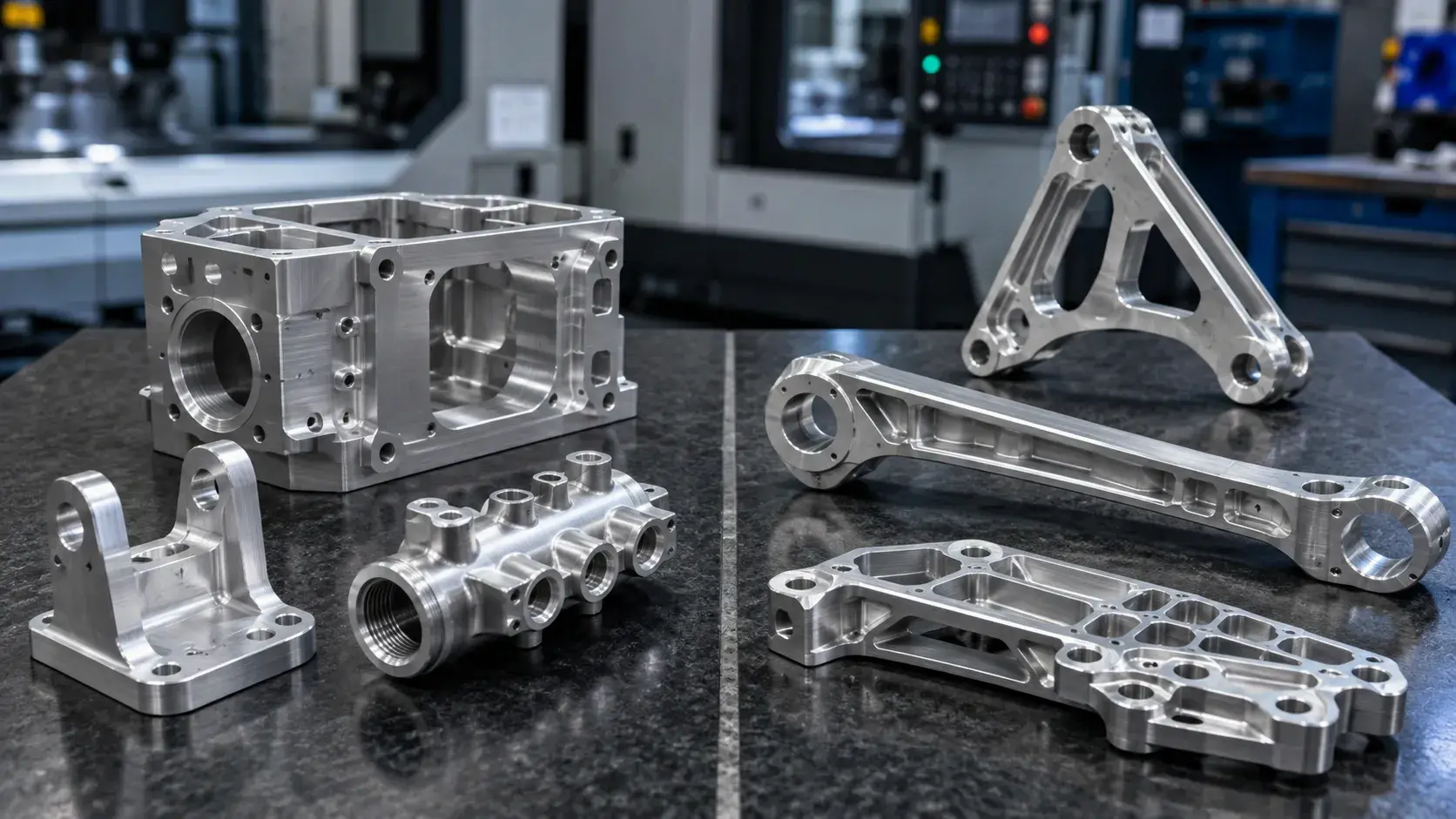
Choosing between 6061 vs 7075 aluminum usually comes down to one question: do you need better overall practicality, or maximum strength?
For most general CNC machined parts, 6061 aluminum is the more practical choice. It costs less, resists corrosion better, welds more easily, and anodizes well. 7075 aluminum is much stronger and harder, making it a better fit for aerospace, robotics, motorsport, and other high-load parts where strength-to-weight ratio matters.
6061 vs 7075 Aluminum: Quick Comparison
The table below shows the main differences between the two alloys in their commonly used T6 condition.
| Property | 6061-T6 Aluminum | 7075-T6 Aluminum |
|---|---|---|
| Density | ~2.70 g/cm³ | ~2.81 g/cm³ |
| Tensile Strength | ~310 MPa | ~570 MPa |
| Yield Strength | ~276 MPa | ~500 MPa |
| Brinell Hardness | ~95 HB | ~150 HB |
| Corrosion Resistance | Very Good | Moderate |
| Weldability | Good | Poor |
| Machinability | Very Good | Excellent |
| Anodizing | Easy and consistent | Possible, but less consistent |
| Material Cost | Lower | Higher |
| Best For | General CNC parts | High-strength structural parts |
The biggest difference is strength. 7075-T6 can provide roughly 80% more tensile strength than 6061-T6, while its density is only about 4% higher.
That makes 7075 attractive when designers need more strength without a large weight increase.
However, the stronger alloy also comes with trade-offs. 7075 usually costs more, has lower corrosion resistance, and is generally not recommended for welded structures.6061 vs 7075 Strength: How Much Does It Matter?
The strength difference between 6061 and 7075 aluminum is significant, but the stronger alloy is not always the better choice.
In the T6 condition, 6061-T6 has a typical tensile strength of about 310 MPa, while 7075-T6 is around 570 MPa. Yield strength also increases from roughly 276 MPa for 6061-T6 to about 500 MPa for 7075-T6.
That is a major difference on paper.
In practice, the benefit depends on how the part is designed.
If a bracket, arm, or structural part is limited by material strength, 7075 may allow the designer to reduce wall thickness or remove more material while still meeting the required load. This is one reason 7075 is common in aerospace and other weight-sensitive applications.
However, many CNC parts are not limited by tensile strength.
Their dimensions may instead be controlled by:
- required stiffness;
- bolt or bearing sizes;
- mounting surfaces;
- minimum wall thickness for machining;
- assembly requirements;
- vibration or deformation limits.
In those cases, changing from 6061 to 7075 may not allow the part to become much smaller or lighter.
6061 vs 7075 Weight and Density
There is much less difference in weight than there is in strength.
Typical density is approximately:
- 6061 aluminum: 2.70 g/cm³
- 7075 aluminum: 2.81 g/cm³
That means 7075 is only around 4% denser than 6061.
For two parts with exactly the same geometry, the 7075 part will therefore be slightly heavier.
However, this does not mean 6061 always produces the lighter final design.
Because 7075 is much stronger, a properly redesigned part may use thinner walls, smaller sections, or more material removal. In strength-limited applications, this can reduce overall component weight even though 7075 itself has slightly higher density.
So when comparing 6061 vs 7075 weight, it is better to look at the complete part design rather than density alone.
Which Is Easier to CNC Machine: 6061 or 7075?
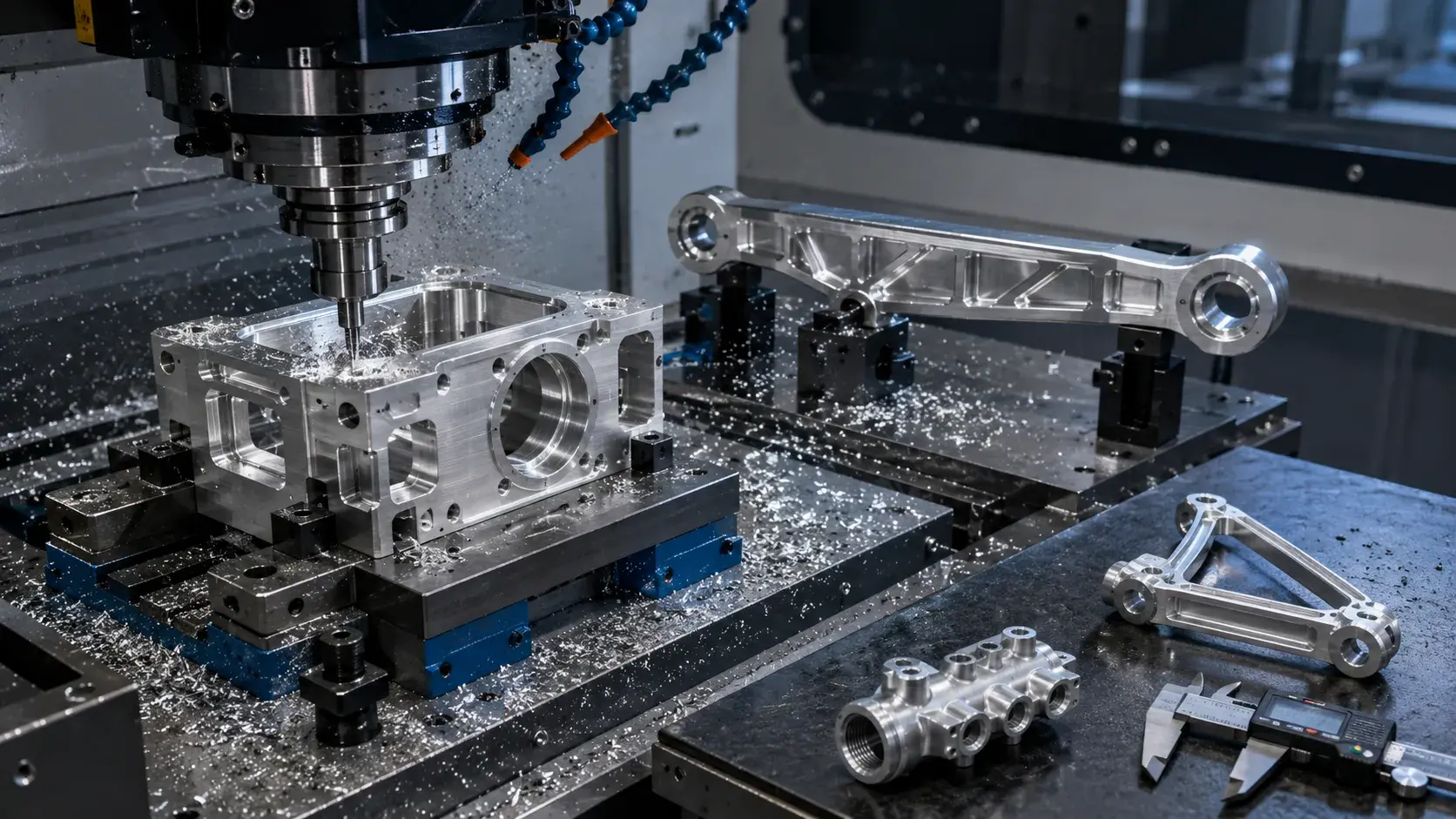
Both alloys are very suitable for CNC machining.
6061 is one of the most commonly machined aluminum grades because it cuts easily, is widely available, and gives good surface finishes. It works well for general milling, turning, drilling, and tapping.
7075 also machines very well. Its higher hardness often helps produce clean chips and sharp machined features, making it suitable for precision milling and high-quality finished surfaces.
So, in terms of cutting performance alone, 7075 should not be considered a difficult aluminum alloy to machine.
The bigger differences appear elsewhere.
Material Cost and Scrap
7075 stock is normally much more expensive than 6061.
For parts with a high material-removal ratio, such as a component machined from a thick billet with deep pockets, a large amount of expensive 7075 may end up as chips.
This makes material utilization and nesting more important.
Thin Walls and Distortion
Thin-wall parts require careful machining regardless of alloy.
When a large amount of material is removed from aluminum plate or billet, residual stress can cause the part to move or distort. This is especially important for:
- large pockets;
- thin frames;
- aerospace brackets;
- flat precision plates;
- parts requiring tight flatness or parallelism.
For these parts, using stress-relieved tempers such as 6061-T651 or 7075-T651 can help improve dimensional stability.
Machining strategy also matters. Roughing the part in stages, leaving finishing allowance, controlling clamping force, and allowing the part to relax before final finishing can often make a bigger difference than simply choosing one alloy over the other.
6061 vs 7075 for Threads
Both 6061 and 7075 can be machined with internal and external threads, but they behave differently in service.
Because 7075 aluminum is harder and stronger, its threads generally resist deformation and pull-out better under higher loads. This can be useful for structural parts, aerospace components, fixtures, and assemblies that require higher clamping forces.
6061 threads are still suitable for many general-purpose parts, including housings, brackets, manifolds, and equipment components.
The main question is not whether 6061 can be threaded. It is whether the thread will experience enough load, repeated assembly, or wear to justify a stronger material.
For frequently assembled parts, threaded inserts such as Helicoil or key-locking inserts can also be used to improve thread durability without changing the entire component to 7075.
6061 vs 7075 Corrosion Resistance
For corrosion resistance, 6061 is generally the better choice.
6061 contains less copper than 7075, which helps it perform better in humid, outdoor, and mildly corrosive environments.
7075 can still be used successfully, but it usually benefits more from protective surface treatments such as:
- anodizing;
- hard anodizing;
- conversion coating;
- painting or other protective finishes.
This matters when the part will be exposed to moisture, condensation, salt, or outdoor service.
For example, if two alloys both meet the mechanical requirements of a machine bracket used in a normal industrial environment, 6061 may offer a better balance of corrosion resistance and cost.
For high-strength 7075 parts, surface protection should be considered early in the design instead of being treated as an afterthought.
6061 vs 7075 Weldability
If the part needs to be welded, 6061 is usually the clear choice.
6061 has good weldability and is widely used in welded frames, structures, brackets, and assemblies.
7075 is generally not recommended for conventional fusion welding. Its alloy composition makes it much more susceptible to cracking in and around the weld zone.
Welding can also significantly change the mechanical properties near the joint.
For this reason, 7075 parts are more commonly joined using:
- bolts;
- screws;
- rivets;
- pins;
- other mechanical fastening methods.
So if welding is an important part of the design, there is usually little reason to choose 7075 unless the engineering requirements specifically justify it.
Which Is Better for Thin-Wall CNC Parts?
7075 can be very useful for thin-wall parts because its higher strength allows designers to reduce section thickness while maintaining load capacity.
This is especially valuable in weight-sensitive parts such as:
- aerospace brackets;
- drone structures;
- robotic components;
- motorsport parts;
- lightweight structural frames.
However, a thinner design is also more difficult to machine.
Thin walls can flex under cutting forces or clamping pressure, and large amounts of material removal can release residual stress from the stock.
As a result, a thin-wall 7075 part may require:
- staged roughing;
- light finishing cuts;
- controlled clamping force;
- extra support during machining;
- stress-relieved material such as 7075-T651;
- intermediate inspection.
The stronger material gives the designer more freedom, but it does not remove the manufacturing challenges of thin-wall machining.
For general housings and covers where extreme strength is not required, 6061 often remains the more economical choice.
6061 vs 7075 Cost
7075 is normally more expensive than 6061.
As a general purchasing reference, comparable 7075 plate or billet may cost roughly 50% to 100% more than 6061, although actual pricing changes with thickness, stock form, certification, order quantity, and supplier.
For CNC parts, raw material price is only one part of the total cost.
You also need to consider:
- billet size;
- material removal;
- machining time;
- tool access;
- scrap rate;
- finishing;
- inspection requirements.
A small 7075 part may only add a modest amount to the final price.
A large component machined from thick billet can be very different because much more expensive material may be removed as chips.
This is why 7075 is usually most cost-effective when its extra strength provides a real design benefit.
If the part performs equally well in 6061, the lower-cost alloy is often the better engineering decision.
Which Aluminum Is Better for Different CNC Parts?
The best alloy depends on what the part actually needs to do.
For many general-purpose CNC components, 6061 provides enough strength at a lower cost. 7075 becomes more useful when the design is limited by strength, fatigue, or weight.
| CNC Part | Better Choice | Why |
|---|---|---|
| Machine housing | 6061 | Lower cost, good corrosion resistance, easy anodizing |
| Equipment bracket | 6061 | Sufficient strength for most general loads |
| Electronic enclosure | 6061 | Good finish and cosmetic anodizing |
| Manifold | 6061 | Easy machining and good corrosion resistance |
| Heat sink | 6061 | Better thermal conductivity |
| Welded frame | 6061 | Better weldability |
| Aerospace bracket | 7075 | Higher strength-to-weight ratio |
| Drone structural part | 7075 | High strength with low weight |
| Motorsport component | 7075 | Better for high mechanical loads |
| High-load robotic arm | 7075 | Higher strength and fatigue resistance |
| Precision fixture | Depends | Load, wear, and dimensional requirements matter |
For example, a machined enclosure rarely benefits much from switching to 7075 because its wall thickness may already be controlled by mounting features, connectors, or minimum machining thickness.
A lightweight aerospace bracket is different. If strength is the main design limit, 7075 may allow more material to be removed while still meeting the required load.Can 6061 Replace 7075?
Sometimes, but not automatically.
If a part was originally designed in 7075, replacing it with 6061 means the mechanical requirements should be checked again.
6061 has much lower yield and tensile strength, so a direct material substitution may reduce the load capacity of the part.
Before replacing 7075 with 6061, engineers should review:
- operating load;
- safety factor;
- fatigue requirements;
- wall thickness;
- stress concentration areas;
- operating temperature;
- corrosion exposure;
- industry or drawing requirements.
In some cases, the design can be modified by increasing wall thickness or adding ribs so that 6061 still meets the required strength.
That can make sense when lower material cost, better corrosion resistance, or easier anodizing is more important than minimum weight.
However, if a drawing specifically calls for 7075 in a safety-critical aerospace, motorsport, or structural application, the material should not be changed without engineering approval.
6061-T6 vs 7075-T6 vs T651
The temper condition matters almost as much as the alloy itself.
T6 means the aluminum has been solution heat treated and artificially aged to improve strength.
For CNC machining, you will also often see T651.
T651 starts with a T6-type heat treatment but adds a stress-relieving process. This reduces internal residual stress in plate material and can help improve dimensional stability during machining.
Typical CNC material callouts include:
- 6061-T6;
- 6061-T651;
- 7075-T6;
- 7075-T651.
For small, relatively rigid parts, the difference between T6 and T651 may not create a noticeable machining issue.
For large plates, thin-wall parts, or components with deep pockets and heavy material removal, T651 is often preferred because distortion control becomes more important.
So when sourcing material for precision CNC machining, checking the temper is just as important as checking whether the alloy is 6061 or 7075.
How to Choose Between 6061 and 7075 Aluminum
A simple way to decide is to start with the part requirements.
Choose 6061 aluminum when:
- the part has normal mechanical loads;
- lower cost is important;
- corrosion resistance matters;
- welding is required;
- cosmetic anodizing is important;
- the part is a housing, bracket, fixture, manifold, or general machine component.
Choose 7075 aluminum when:
- the part is exposed to high mechanical loads;
- reducing weight is important;
- high strength-to-weight ratio is required;
- fatigue resistance matters;
- the part is used in aerospace, robotics, motorsport, or other demanding structural applications.
If both alloys meet the engineering requirements, 6061 is usually the more economical choice.
If the design cannot meet the required strength or weight target with 6061, then 7075 becomes much easier to justify.
The key is to choose based on the finished part, not just the material datasheet.
Final Thoughts
The choice between 6061 vs 7075 aluminum is not simply about selecting the stronger alloy.
6061 gives a better overall balance of cost, corrosion resistance, weldability, anodizing, and CNC machinability. That makes it suitable for a large percentage of general mechanical parts.
7075 makes more sense when high strength, fatigue resistance, and weight reduction are important enough to justify the higher material cost.
For CNC projects, the best material should be selected together with the part geometry, load, tolerance, surface finish, and production quantity.
If you are unsure whether 6061 or 7075 is more suitable for your part, YUANYI can review your drawing and material requirements before machining and help identify a practical option for production.
Need Help Choosing 6061 or 7075 for Your CNC Parts?
Send us your drawing, required quantity, tolerance, and application requirements. Our engineering team can review the part and provide a machining recommendation together with a quote.



