

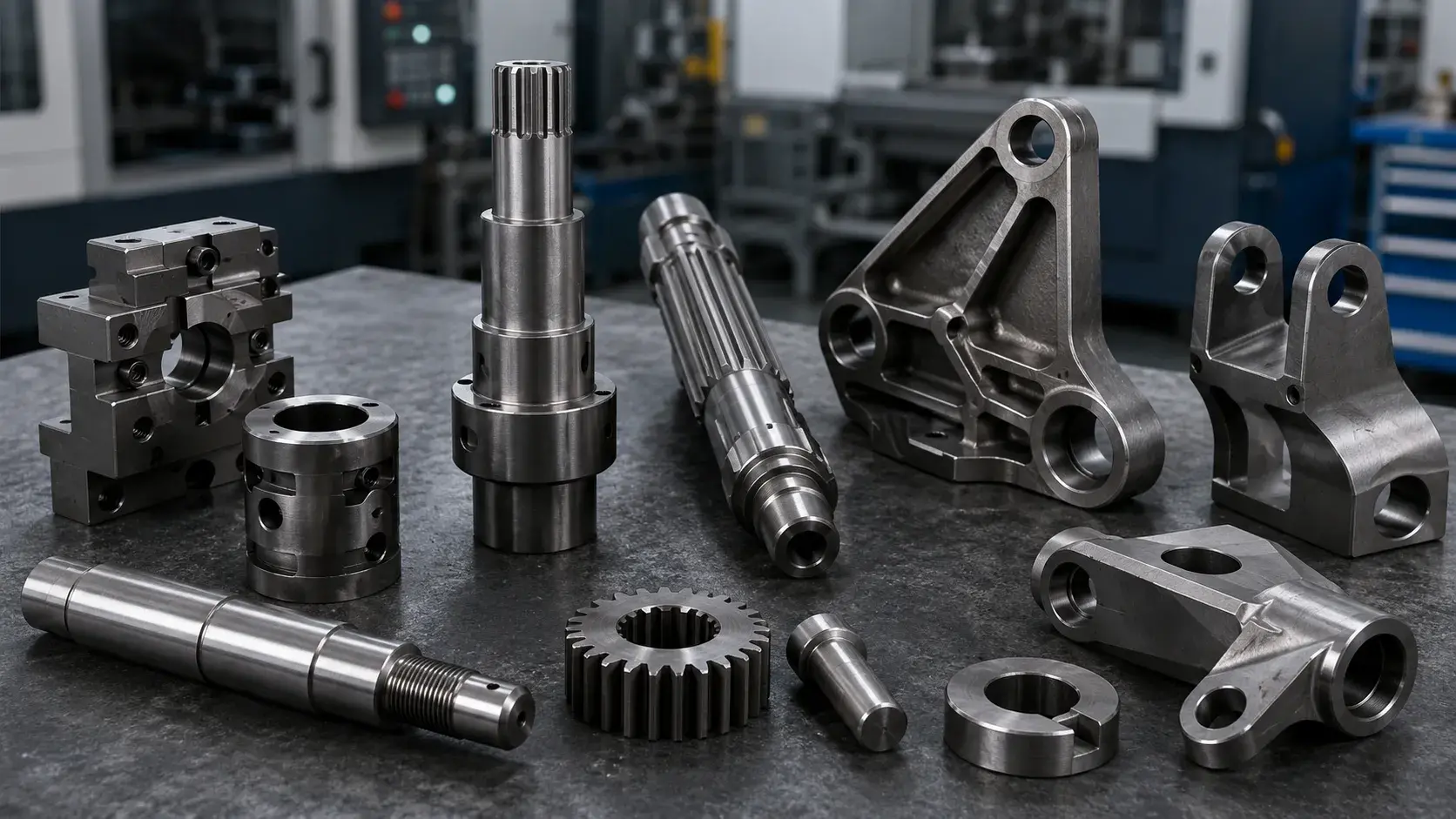
Alloy steel CNC machining is commonly used for parts that need higher strength, wear resistance, fatigue resistance, or heat-treatment capability than standard carbon steel.
However, not all alloy steels machine the same way. A 4140 part in an annealed condition is much easier to cut than the same material at 30 HRC. Grades such as 4340 or carburized 8620 may require different tooling, cutting parameters, and machining sequences.
For CNC projects, the most important factors are usually the steel grade, hardness, heat-treatment condition, part geometry, and required tolerance.
In general:
- 4140 is a practical all-around choice for shafts, fixtures, gears, and machine components.
- 4340 is better suited to high-load parts that need greater strength and toughness.
- 8620 is often used when a hard wear-resistant surface and tougher core are required after carburizing.
- 4130 is useful for structural parts where strength and weldability are both important.
Common Alloy Steel Grades for CNC Machining
The following grades are commonly used for CNC machined mechanical parts.
| Alloy Steel Grade | Main Advantage | Machinability | Typical CNC Parts |
|---|---|---|---|
| 4140 | Good balance of strength, toughness, and cost | Good to moderate | Shafts, fixtures, gears, machine parts |
| 4340 | Higher strength and toughness | Moderate | Heavy-duty shafts, aerospace parts, structural components |
| 8620 | Excellent for carburizing | Good before hardening | Gears, pins, shafts, wear parts |
| 4130 | Good strength and weldability | Good | Brackets, structural parts, mechanical components |
| 4140 Pre-Hardened | Avoids some post-machining heat treatment | More |
4140 Alloy Steel
4140 alloy steel is one of the most common choices for CNC machining.
It contains chromium and molybdenum and offers a useful balance of strength, toughness, wear resistance, and availability.
In an annealed or softer condition, 4140 machines relatively well. Once supplied pre-hardened or heat treated to around 28–32 HRC, cutting forces and tool wear increase noticeably.
Typical 4140 CNC parts include:
- shafts;
- machine fixtures;
- gears;
- couplings;
- bearing components;
- heavy-duty brackets.
For many general mechanical applications, 4140 is usually the first alloy steel worth considering.
4340 Alloy Steel
4340 alloy steel contains nickel in addition to chromium and molybdenum.
It offers higher strength, toughness, and fatigue resistance than 4140, especially in demanding or heavily loaded parts.
The trade-off is that 4340 is generally more expensive and can be more difficult to machine, particularly after heat treatment.
It is commonly used for:
- high-load shafts;
- aerospace components;
- landing gear parts;
- drivetrain components;
- highly stressed structural parts.
If 4140 already meets the mechanical requirements, moving to 4340 may add cost without providing a practical benefit.
8620 Alloy Steel
8620 alloy steel is commonly selected for parts that require a hard wear-resistant surface but a tougher, more ductile core.
It machines reasonably well before heat treatment and is often carburized after rough machining.
Typical parts include:
- gears;
- sprockets;
- pins;
- shafts;
- wear components.
A common production sequence is:
rough machining → carburizing → finish machining or grinding
This helps maintain critical dimensions after heat treatment.
4130 Alloy Steel
4130 alloy steel provides moderate strength with better weldability than many higher-strength alloy steels.
It is frequently used for structural and mechanical components that may require both CNC machining and welding.
Typical applications include:
- brackets;
- frames;
- fittings;
- structural components;
- equipment parts.
For very high-load components, 4140 or 4340 may be more suitable, but 4130 remains a practical choice when weldability matters.
How Easy Is Alloy Steel to Machine?
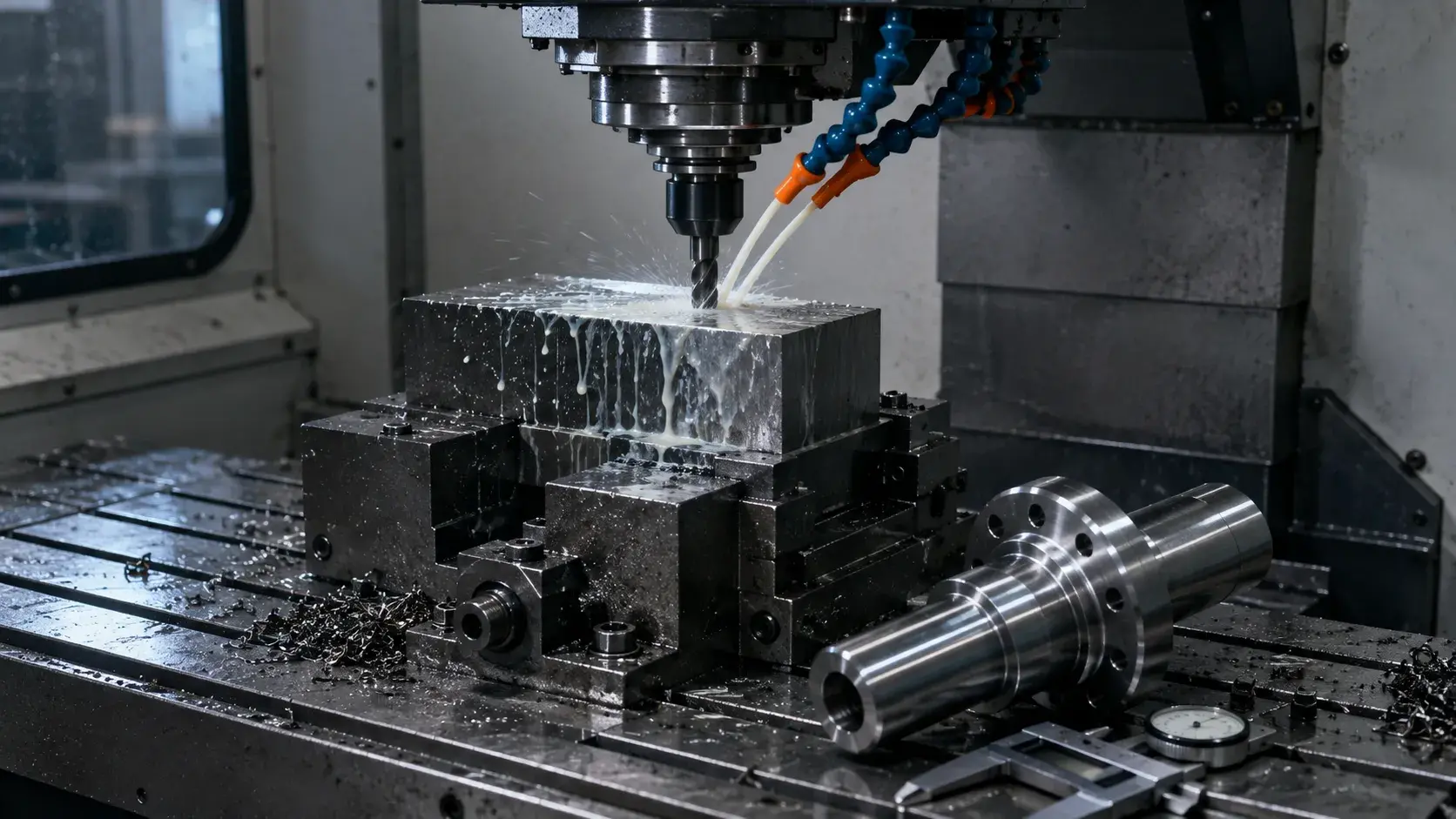
The machinability of alloy steel depends heavily on grade and hardness.
A softer annealed steel can usually be milled and turned with standard carbide tooling. Once the same material is heat treated, cutting forces increase, tool life drops, and machining time becomes longer.
This is why quoting a part simply as “4140 steel” is not enough. The material condition matters.
For example:
- 4140 annealed is relatively easy to machine.
- 4140 pre-hardened at 28–32 HRC requires more rigid setups and more careful cutting parameters.
- 4340 after heat treatment can be significantly harder on tools.
- 8620 after carburizing may have a very hard surface that is better finished by grinding than conventional cutting.
In practice, hardness often affects machining cost more than the alloy grade name itself.
Why Hardness Matters So Much
As hardness increases, several things change during CNC machining.
Cutting forces become higher, tools wear faster, and more heat is generated at the cutting edge. Small cutters and long-reach tools also become more prone to deflection or chatter.
This is especially important for:
- deep pockets;
- thin walls;
- long shafts;
- small internal features;
- tight-tolerance bores.
For pre-hardened alloy steel, coated carbide tools are commonly used because they provide better wear resistance than high-speed steel.
For very hard surfaces, grinding, EDM, or other finishing processes may be more practical than trying to remove all material with conventional milling or turning.
Common CNC Machining Challenges with Alloy Steel
Tool Wear
Tool wear is one of the biggest differences between machining aluminum and alloy steel.
Higher hardness and stronger alloying elements increase load at the cutting edge. If cutting parameters are too aggressive, tool life can drop quickly.
Using sharp, rigid carbide tooling and avoiding excessive tool overhang helps improve stability.
Heat Generation
Alloy steel generates more cutting heat than aluminum.
If heat is not controlled, it can shorten tool life, affect surface finish, and increase dimensional variation.
Coolant, proper chip evacuation, and suitable cutting speed all help manage temperature during machining.
Cutting Force and Deflection
Higher cutting forces can push the tool or workpiece away from its intended position.
This becomes more noticeable when machining:
- thin walls;
- long parts;
- deep cavities;
- small diameter tools.
For precision components, roughing and finishing are often separated so that the final dimensions can be machined with lighter cutting loads.
Distortion After Material Removal
Alloy steel can also move when a large amount of material is removed.
Residual stress from raw material production or heat treatment may cause flatness, straightness, or bore position to change during machining.
Large plates, long shafts, and asymmetric parts may therefore require staged roughing, stress relief, or intermediate inspection before final finishing.
Machining Before or After Heat Treatment?
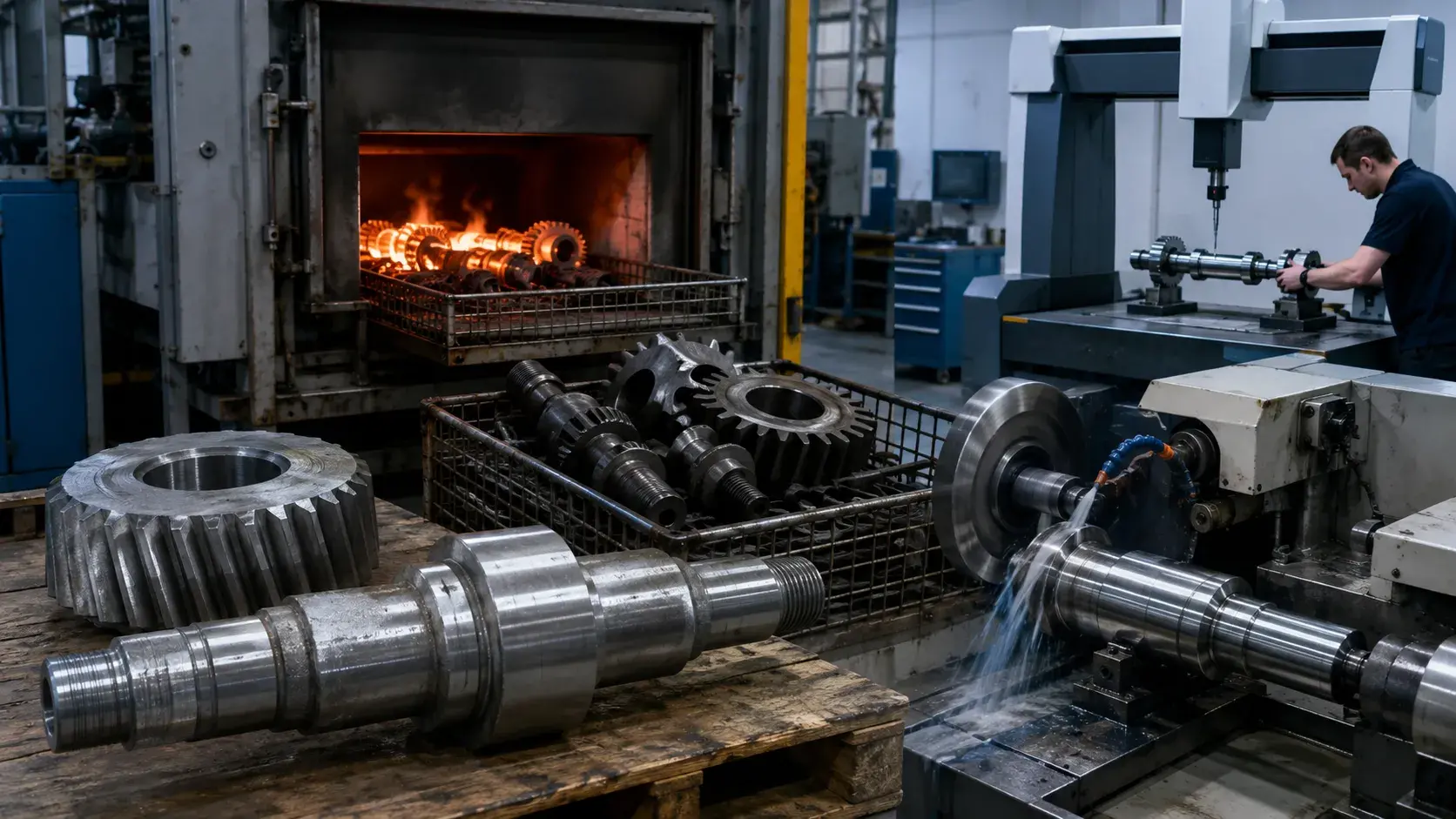
For many alloy steel parts, the best process is not to finish everything before heat treatment.
A common sequence is:
rough machining → heat treatment → finish machining or grinding
The reason is simple: heat treatment can distort the part.
If a shaft, bore, bearing seat, or sealing surface is finished before quenching and tempering, its final dimension may move outside tolerance after heat treatment.
Rough machining removes most of the material first. Heat treatment is then completed, and the critical surfaces are brought to final size afterward.
This approach is especially useful for:
- 4140 and 4340 quenched and tempered parts;
- carburized 8620 gears and shafts;
- precision bearing seats;
- hardened wear surfaces.
Not every part needs this process. If the material is already supplied pre-hardened and the required hardness is acceptable, the component may be machined directly from pre-hard stock.
That can eliminate one heat-treatment step, although machining will generally be slower than working with softer material.
Common Heat Treatments for Alloy Steel
Quench and Temper
Quenching and tempering is widely used for grades such as 4140 and 4340.
It increases strength and hardness while maintaining useful toughness.
The exact hardness should be specified on the drawing, because machining a 28 HRC component is very different from machining one at 45 HRC.
Carburizing
Carburizing is commonly used with 8620 alloy steel.
Carbon is added to the surface and then hardened, creating a hard wear-resistant case while leaving the core tougher.
This is useful for gears, pins, shafts, and parts exposed to repeated surface contact.
Nitriding
Nitriding creates a hard surface layer without heating the entire part to the same extent as conventional quench hardening.
It is often used for:
- shafts;
- spindles;
- gears;
- wear surfaces.
Because dimensional change can be lower than some other heat-treatment processes, nitriding can be useful for precision parts where wear resistance is required.
CNC Machining Strategies for Alloy Steel
Machining alloy steel successfully depends less on one “perfect” cutting parameter and more on keeping the whole setup stable.
Use Rigid Workholding
Alloy steel creates higher cutting forces than aluminum, so the workpiece needs solid support.
A weak setup can lead to vibration, chatter, poor surface finish, or dimensional error. This is especially important for long shafts, thin walls, and parts with deep pockets.
Keep Tool Overhang Short
Long tool overhang increases deflection.
For deep cavities or internal features, using the shortest practical tool helps improve accuracy and tool life.
Separate Roughing and Finishing
For tighter-tolerance parts, it is usually better to remove most of the material first and leave a small allowance for finishing.
This reduces the effect of cutting force and residual stress on the final dimensions.
Control Heat and Chip Evacuation
Alloy steel machining generates significant heat.
Proper coolant delivery and chip evacuation help protect the cutting edge and prevent chips from being recut, especially during deep-hole drilling, pocket milling, and turning.
Match Tooling to Hardness
Annealed material and pre-hardened material should not be treated the same way.
As hardness increases, coated carbide tooling, lower cutting speeds, and lighter finishing cuts become more important.
For hardened surfaces, grinding or EDM may be more efficient for critical features.
Tolerances and Surface Finish for Alloy Steel Parts
Alloy steel can be machined to tight tolerances, but the achievable accuracy depends on part size, hardness, geometry, heat treatment, and finishing process.
For many precision CNC parts, tolerances around ±0.01 mm are achievable with proper machining and inspection.
Critical features may be held to around ±0.005 mm when the geometry and process allow it.
Typical CNC-machined surface finishes are around:
- Ra 1.6–3.2 μm for general machined surfaces;
- Ra 0.8 μm for finer finishing;
- Ra 0.2–0.8 μm for ground bearing or shaft surfaces.
Heat-treated parts need extra attention because distortion can affect:
- bore size;
- shaft diameter;
- flatness;
- straightness;
- parallelism;
- positional accuracy.
For this reason, critical dimensions are often finished after heat treatment.
4140 vs 4340: Which Should You Choose?
4140 and 4340 are both widely used alloy steels, but 4340 is not automatically the better option.
For most general mechanical parts, 4140 is usually the more practical choice.
It offers good strength, toughness, wear resistance, availability, and cost.
Typical applications include shafts, fixtures, couplings, gears, and machine components.
4340 becomes more useful when the part needs:
- higher strength;
- higher fatigue resistance;
- greater toughness;
- better hardenability through thick sections.
This is why 4340 is more common in highly loaded aerospace, drivetrain, and heavy-duty structural components.
If 4140 already meets the required load and safety factor, switching to 4340 may only increase material and machining cost.
Typical Alloy Steel CNC Machined Parts
Alloy steel is commonly used for parts that need to carry high loads or resist wear.
Typical CNC machined components include:
- drive shafts;
- gears and sprockets;
- spindles;
- couplings;
- hydraulic components;
- bearing housings;
- machine fixtures;
- tooling components;
- pins and bushings;
- heavy-duty brackets;
- drivetrain parts;
- industrial machine components.
The best grade depends on whether the main requirement is strength, wear resistance, toughness, weldability, or heat-treatment response.
For example, 8620 may be a better fit for a carburized gear, while 4140 may be more practical for a general-purpose shaft.
What Affects the Cost of Alloy Steel CNC Machining?
The cost of machining alloy steel depends on more than raw material price.
Important factors include:
- alloy grade;
- hardness;
- stock size;
- material removal;
- machining time;
- tool wear;
- heat treatment;
- grinding;
- tolerance;
- inspection requirements.
Hardness can have a major effect on cost.
A 4140 part in an annealed condition may machine relatively quickly, while the same geometry in pre-hardened 4140 can require slower cutting speeds, more tool changes, and longer cycle times.
Heat treatment also adds cost if the part must be rough machined, treated, then returned for finish machining or grinding.
For accurate quoting, the drawing should therefore include both the alloy grade and required material condition.
How to Specify Alloy Steel on a CNC Drawing
Avoid specifying only:
4140 Steel
That leaves several important questions unanswered.
A more complete material callout might look like:
AISI 4140, quenched and tempered, 28–32 HRC
You can then add any required finishing or critical dimensions, for example:
Black oxide, critical bore ±0.01 mm
Useful information to include on the drawing or RFQ includes:
- alloy grade;
- hardness or heat-treatment condition;
- required tolerance;
- surface finish;
- coating or plating;
- critical dimensions;
- inspection requirements.
The clearer the material condition is, the easier it is for a CNC supplier to plan tooling, machining sequence, heat treatment, and final inspection accurately.
Final Thoughts
Successful alloy steel CNC machining starts with choosing the right grade and material condition.
4140 is a practical choice for many shafts, fixtures, gears, and general machine components. 4340 is better suited to higher-load applications, while 8620 is commonly selected for carburized wear parts such as gears and shafts.
The alloy grade alone does not determine machining difficulty. Hardness, heat treatment, geometry, tolerance, and finishing requirements can have just as much impact on tooling, cycle time, and cost.
For precision parts, these requirements should be defined before production so the machining and heat-treatment sequence can be planned correctly.
Need Alloy Steel CNC Machined Parts?
YUANYI provides CNC machining for alloy steel parts including 4140, 4340, 8620, and 4130.
Send us your drawing, material grade, hardness requirement, quantity, and tolerance. Our engineering team can review the machining process and provide a quote for your project.



