

CNC milling cost depends on machining time, material, programming, setup, part complexity, tolerances, and order quantity. A simple aluminum part may require relatively little machine time, while a complex housing with deep pockets, tight tolerances, and multiple setups can cost considerably more. The final cost per part includes both one-time preparation expenses and recurring production costs.
To estimate CNC milling costs accurately, engineers and buyers need to understand how these expenses are calculated, how batch size affects unit cost, and which design changes can reduce machining time without compromising functionality.
How Much Does CNC Milling Cost?
CNC milling is usually priced through a combination of machine time, setup costs, material expenses, tooling, inspection, and any secondary operations.
Manufacturers may calculate machining costs internally using hourly machine rates, but customers typically receive a quoted price per part or per production batch. A machine’s hourly rate is not the same as the final cost per part.
For example, if a component requires 30 minutes of machining at an assumed machine rate of $40 per hour, its direct machine-time allocation is $20. However, this does not include material, CAM programming, fixture setup, inspection, or surface treatment.
| Pricing Method | What It Represents | Best Use |
|---|---|---|
| Machine hourly rate | Cost or charge assigned to machine operating time | Internal process estimation |
| Cost per part | Allocated fixed and variable manufacturing costs | Comparing manufacturing methods |
| Quoted unit price | Commercial price offered by the supplier | Purchasing decisions |
| Total order price | Unit prices plus applicable one-time and order-level charges | Procurement budgeting |
There is no single hourly rate that applies to every CNC milling project. Rates differ according to machine capability, location, production volume, operating costs, and the complexity of the work. For an accurate quotation, the complete part drawing and production requirements are more useful than a generic hourly price.
How Is CNC Milling Cost Calculated?
A simplified CNC milling cost model separates fixed preparation expenses from costs incurred for each part:
Unit Cost = (Fixed Cost ÷ Order Quantity) + Variable Cost per Part
Where fixed cost includes one-time CAM programming, setup planning, and dedicated fixture preparation; order quantity is the number of acceptable parts being manufactured; and variable cost includes material, machining time, tooling consumption, inspection, finishing, and other recurring expenses.
A more detailed model is:
Unit Cost = (Programming + Setup + Fixed Tooling) / Quantity + Material + Machining + Variable Tooling + Inspection + Finishing
This is a simplified manufacturing cost model rather than a complete commercial quotation formula.
What Is Included in CNC Milling Cost?
| Cost Component | How It Is Calculated |
|---|---|
| Material | Raw stock cost, including relevant cutting waste |
| CAM programming | Time required to develop and verify toolpaths |
| Machine setup | Workholding, fixture preparation, and tool setup |
| Machining | Cycle time multiplied by the applicable machine rate |
| Tooling | Cutting tool consumption and project-specific tooling |
| Inspection | Dimensional checks and required quality documentation |
| Surface finishing | Anodizing, polishing, coating, or other specified operations |
Some suppliers incorporate portions of tooling, labor, and inspection into their machine rates rather than charging them separately. When estimating costs, these accounting differences must be considered to avoid counting the same expense twice.
What Factors Affect CNC Milling Cost?
1. Material Selection and Machinability
Material cost and machinability both influence the final price. Aluminum 6061 is commonly used for CNC housings and brackets because it offers a useful combination of mechanical properties, availability, and machinability. Stainless steel, titanium, and certain high-performance alloys may require different cutting parameters and tooling.
The least expensive raw material is not necessarily the most economical material to machine.
2. Part Geometry and Complexity
A flat mounting plate with accessible holes usually requires fewer complex operations than a housing with deep cavities, thin walls, narrow slots, and undercuts. Deep pockets, small internal corner radii, thin walls, multi-directional features, and difficult-to-reach surfaces can all increase machining time or setup complexity.
3. Dimensional Tolerances
Tighter tolerances often require more careful toolpath planning, stable machining conditions, and additional measurement through a defined quality assurance process. A tolerance of ±0.005 mm on a critical feature may be achievable under suitable conditions, but it demands different process considerations than a general dimension controlled by ISO 2768.
Apply precision where it is needed for assembly, alignment, or performance rather than across every dimension.
4. Surface Finish Requirements
General CNC-milled surfaces may be acceptable without additional finishing, depending on their application. Finer surface roughness requirements can involve smaller toolpath stepovers, finishing passes, or secondary operations. Anodizing, powder coating, and other treatments add processing and inspection requirements.
5. Setup Count and Tool Accessibility
A part that requires several separate setups generally involves additional handling, alignment, and verification. Even when actual cutting time remains similar, setup requirements can affect total manufacturing cost.
6. Order Quantity
One-time programming and preparation costs are distributed across the entire order. As quantity increases, these fixed expenses may represent a smaller portion of each part’s cost. Larger orders can also change tooling, fixture, capacity, and inspection requirements.
3-Axis vs 4-Axis vs 5-Axis CNC Milling Cost
Different machine configurations offer different levels of tool access and setup flexibility. The least expensive option is not always the machine with the lowest hourly rate.
| Process | Typical Applications | Cost Considerations |
|---|---|---|
| 3-axis CNC milling | Plates, brackets, accessible pockets and holes | Often economical for straightforward geometry |
| 4-axis CNC milling | Rotary-indexed features and multiple angular faces | May reduce repositioning and fixture requirements |
| 5-axis CNC milling | Complex curved surfaces and multi-face features | Higher equipment complexity but potentially fewer setups |
Why Can 5-Axis Milling Sometimes Cost Less Overall?
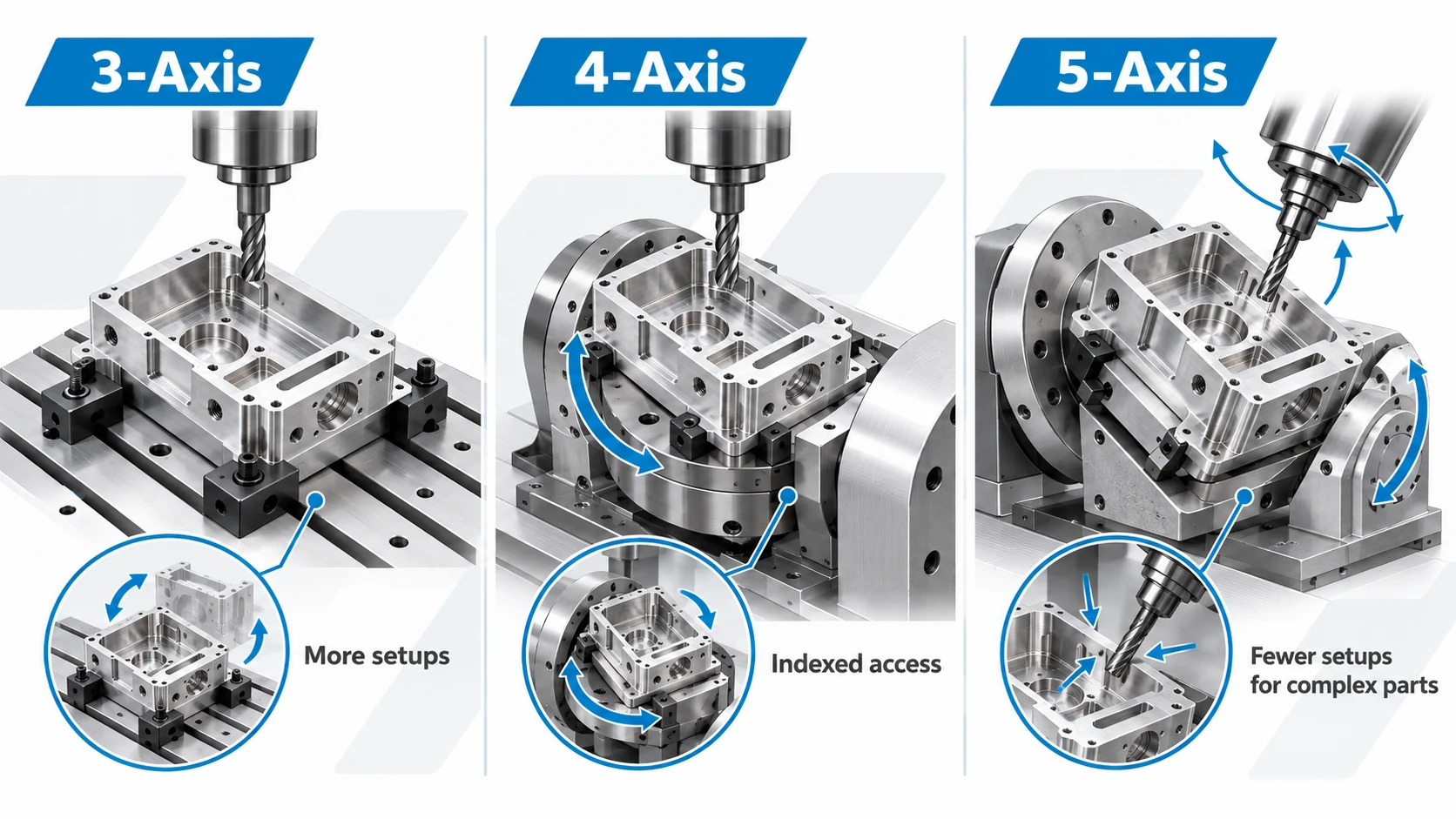
Consider an aluminum component that requires machining on five different faces. A 3-axis process may require multiple fixtures and repositioning operations. With a suitable 5-axis machining configuration, some of these features may be machined with fewer setups.
Although the 5-axis machine may have a higher hourly operating rate, savings in setup time, handling, and inspection can offset that difference. The correct comparison is total manufacturing cost—not hourly machine rate alone.
At YUANYI Precision Manufacturing, machining strategy is evaluated based on part geometry and required precision. Our CNC milling services cover conventional and multi-axis machining options.
CNC Milling Cost Example: 6061 Aluminum Housing
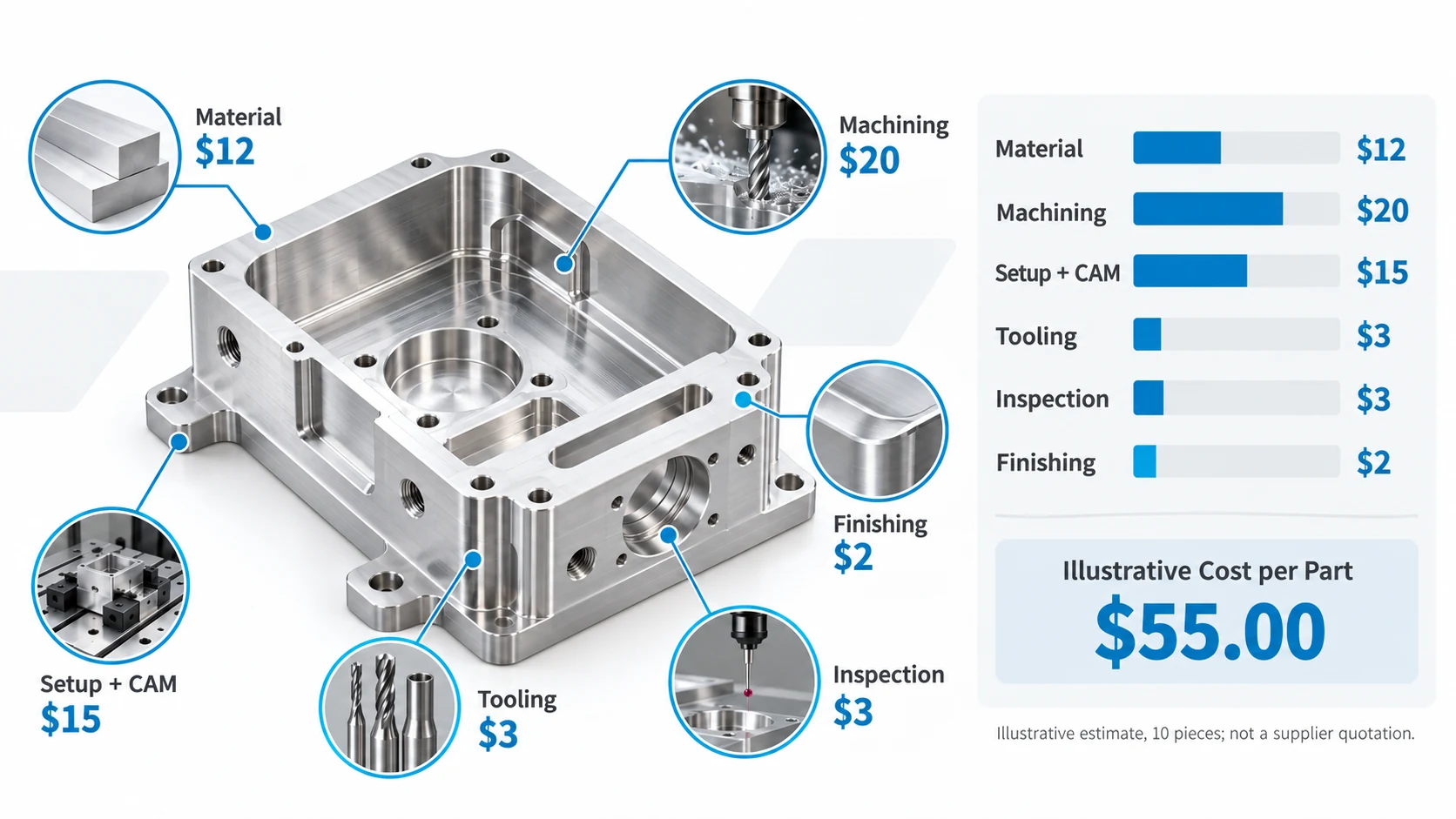
To illustrate how CNC milling costs are calculated, consider a small aluminum electronics housing manufactured from 6061 aluminum. The component has an internal pocket, mounting holes, and several machined faces. Assume an order quantity of 10 pieces.
| Cost Item | Assumed Cost |
|---|---|
| Material per part | $12.00 |
| Machining time | 30 minutes per part |
| Assumed machine rate | $40/hour |
| CAM programming and setup | $150 per order |
| Variable tooling per part | $3.00 |
| Inspection per part | $3.00 |
| Surface finishing per part | $2.00 |
The machining cost per part is 0.5 × $40 = $20.00. The fixed programming and setup allocation is $150 ÷ 10 = $15.00 per part.
The total estimated manufacturing cost is:
$12 + $20 + $15 + $3 + $3 + $2 = $55.00 per part
For 10 pieces, that equals $550 total estimated manufacturing cost.
Important: This is an illustrative cost calculation, not an actual YUANYI customer quotation or a verified current market price. Commercial pricing may include additional overhead, risk allowances, profit, shipping, taxes, and other charges.
How Does Batch Size Affect CNC Milling Cost Per Part?
Using the same aluminum housing example, assume a fixed programming and setup cost of $150 and variable manufacturing cost of $40 per part. The part design and manufacturing process remain unchanged.
Unit Cost = $150 / Quantity + $40
| Order Quantity | Fixed Cost per Part | Variable Cost per Part | Estimated Total per Part |
|---|---|---|---|
| 1 | $150.00 | $40.00 | $190.00 |
| 10 | $15.00 | $40.00 | $55.00 |
| 50 | $3.00 | $40.00 | $43.00 |
| 100 | $1.50 | $40.00 | $41.50 |
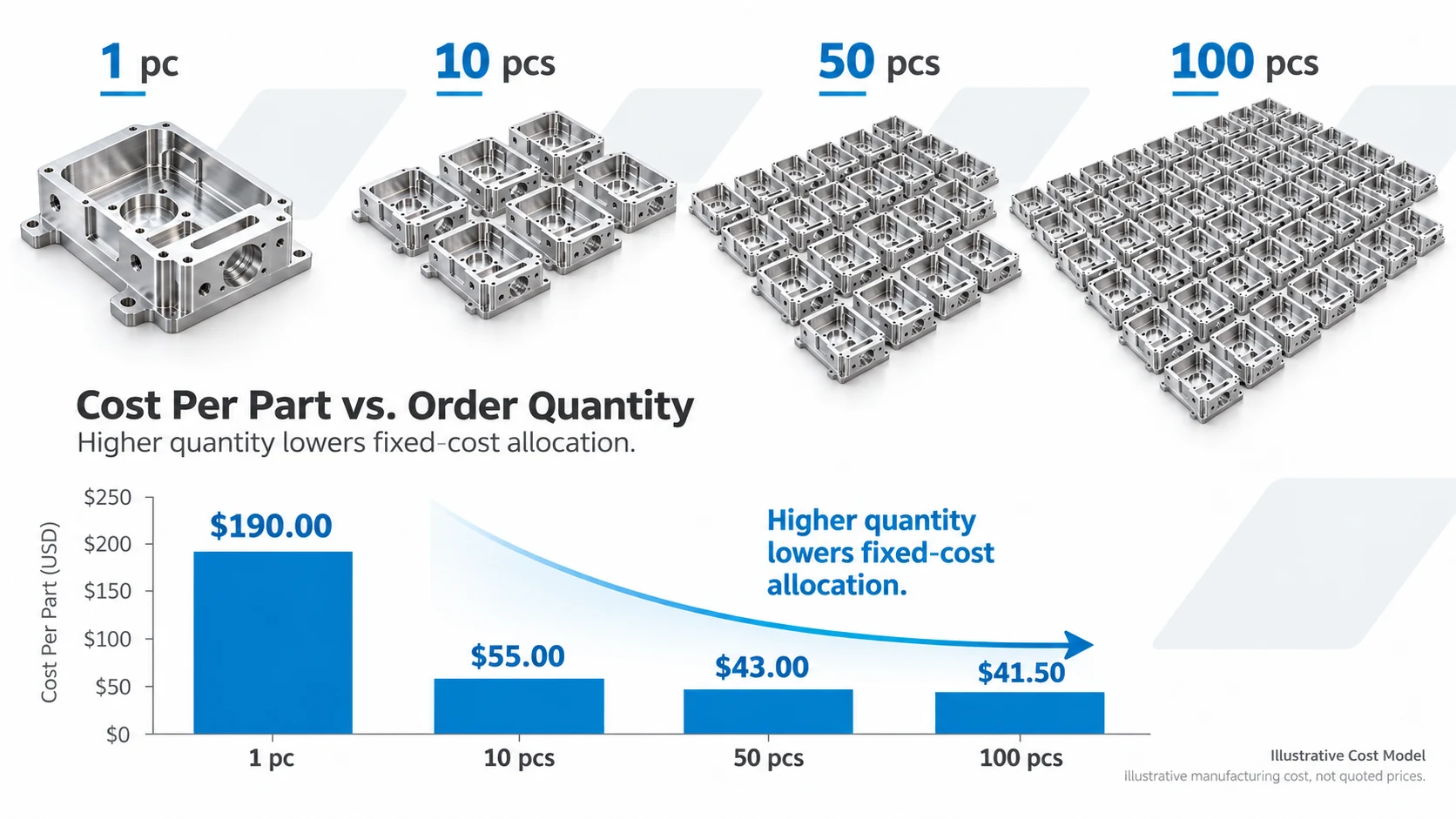
The example demonstrates that fixed-cost allocation becomes less significant as order quantity increases. However, this simplified model assumes no changes to tooling, machining strategy, production capacity, or inspection requirements.
For low-volume product development, rapid prototyping services can help evaluate design and manufacturing requirements before committing to larger production quantities.
7 Ways to Reduce CNC Milling Cost
Reducing CNC milling cost does not necessarily mean accepting lower quality. Many savings come from making parts easier to manufacture while protecting critical functional requirements.
1. Avoid Unnecessarily Tight Tolerances
Apply tight tolerances to critical mating and locating features rather than every dimension. A precision locating hole may require a narrow tolerance, while a non-critical external housing dimension may permit greater variation.
2. Increase Internal Corner Radii
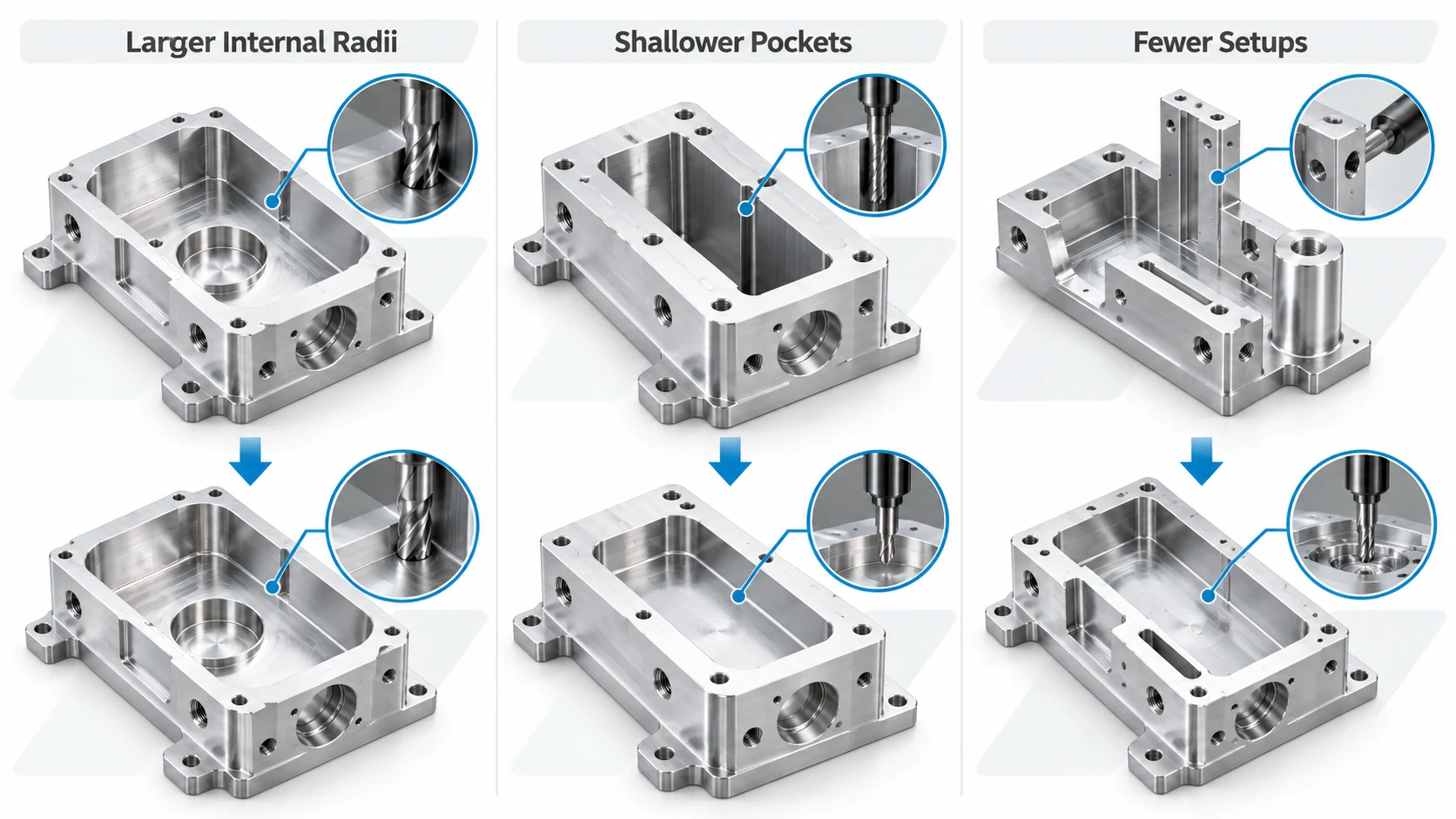
Small internal corner radii may require small-diameter end mills. Small tools generally have lower rigidity and may require reduced cutting engagement or additional passes, particularly in deep cavities. Where design requirements permit, increasing the corner radius can allow a larger cutter and more efficient material removal.
3. Avoid Unnecessarily Deep and Narrow Pockets
Deep pockets often require long tool overhang, which increases the risk of deflection and vibration. Where practical, reduce pocket depth, increase accessibility, or modify the geometry so the cutter can operate more rigidly.
4. Reduce the Number of Machining Setups
Try to arrange features so they can be accessed from fewer directions. Where design changes are not possible, four-axis or five-axis machining may reduce setup requirements.
5. Use Standard Hole and Thread Sizes
Standard drill, tap, and end mill sizes are generally easier to support with common tooling. Nonstandard hole diameters, specialized threads, and unusual slot widths may require additional tools or machining strategies.
6. Choose Materials Based on Function and Machinability
Do not select a higher-strength or more difficult-to-machine material unless its properties are necessary. Material selection should also consider corrosion resistance, thermal behavior, weight, and operating conditions.
7. Specify Fine Surface Finishes Only Where Needed
A smooth sealing or mating surface may require special finishing, while non-critical exterior areas may not. Applying the same fine roughness requirement to every surface can increase finishing and inspection costs.
How to Compare CNC Milling Quotes
When comparing CNC milling suppliers, the lowest quoted unit price is not always the lowest total procurement cost. Two quotations may differ because they include different material specifications, inspection procedures, or finishing requirements.
| Quotation Item | What to Check |
|---|---|
| Material | Exact grade and material certification requirements |
| Quantity | Quoted number of parts and any one-time charges |
| Tolerances | Confirmation of critical dimensional requirements |
| Surface finish | Machined, anodized, polished, or other specified finish |
| Inspection | Standard checks, FAI, CMM, or dimensional reports |
| Lead time | Production duration and delivery commitments |
| Additional charges | Tooling, setup, packaging, and shipping |
If one supplier offers a significantly lower price, confirm that the quotation covers the same drawing revision and acceptance requirements. It is also useful to ask whether the manufacturer can suggest design changes that reduce cost without affecting critical features.
Frequently Asked Questions
Is CNC Milling Expensive for One Part?
A single custom part can have a high unit cost because programming, setup, and preparation expenses are allocated to only one piece. The actual cost depends on geometry, material, and machining requirements.
Is 5-Axis CNC Milling More Expensive Than 3-Axis Milling?
Five-axis equipment often involves a higher operating cost, but a complex part may require fewer setups and less repositioning. Total manufacturing cost should be compared using the complete process plan.
Does Aluminum Cost Less to CNC Mill Than Stainless Steel?
Aluminum 6061 is often easier to machine than many stainless steel grades, but final cost depends on material price, part geometry, quantity, and cutting conditions. Aluminum is not automatically cheaper in every project.
Can Increasing Order Quantity Reduce CNC Milling Cost?
Yes. Higher quantities can distribute programming and setup expenses across more parts. However, tooling, machine capacity, and production requirements can affect the final price.
What Information Is Needed for a CNC Milling Quote?
A supplier typically needs a 2D drawing or 3D CAD model, material specification, quantity, critical tolerances, surface finish requirements, and any inspection or delivery requirements.
Conclusion
CNC milling cost is determined by the complete manufacturing process, not just the hourly machine rate. Material, machining time, programming, setup, tolerances, inspection, finishing, and production quantity all contribute to the final cost per part.
For prototypes and low-volume production, fixed setup expenses can have a substantial effect on unit cost. For more complex parts, the right multi-axis machining strategy may reduce setups and improve overall efficiency.
The most effective way to reduce CNC milling cost is to simplify non-critical features while maintaining the dimensions and surfaces essential to part performance.
Get a CNC Milling Quote Send your CAD files and engineering drawings to YUANYI Precision Manufacturing for DFM review and a manufacturing quote.



