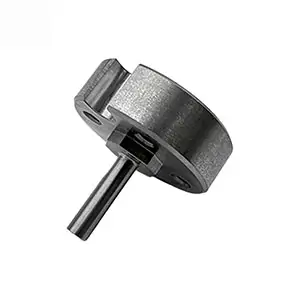
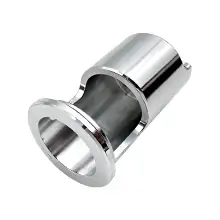
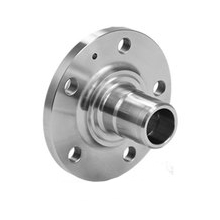
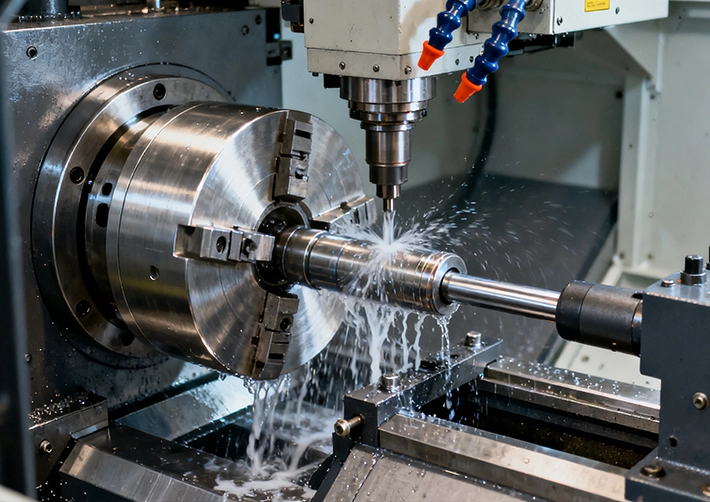
A CNC lathe is an automated turning machine that uses pre-programmed instructions to control the machine’s movements, enabling high-precision machining of cylindrical parts.
Unlike traditional manual lathes, CNC lathes use G-code programs to control:
- Workpiece rotation speed
- Tool path
- Cutting depth
- Machining sequence
This approach significantly improves machining efficiency and consistency.
How Does a CNC Lathe Machine Work?
The typical workflow for a CNC lathe is as follows:

In this process, engineers first create a part model in CAD software, then generate toolpaths in CAM software, and finally convert them into G-code programs that the machine tool can recognize.
What Operations Can a CNC Lathe Perform?
Turning
External turning is the most basic turning operation, used to remove excess material from the exterior of a workpiece to form a standard cylindrical or stepped shape. This process is widely used in the machining of shaft-type parts and is the most common machining method on CNC lathes.
Facing
Facing is used to machine the end face of a workpiece, creating a flat reference surface. This step is typically performed at the beginning of the machining process to establish an accurate reference surface, ensuring stability for subsequent operations.
Drilling
Drilling is the process of creating holes at the center of a rotating workpiece, commonly used for machining center holes or mounting holes in shaft-type parts. On CNC lathes, drilling can typically be combined with other machining operations.
Boring
Boring is used to finish or resize existing holes to improve hole accuracy and surface quality. This process is typically used for internal hole structures with high precision requirements.
Threading
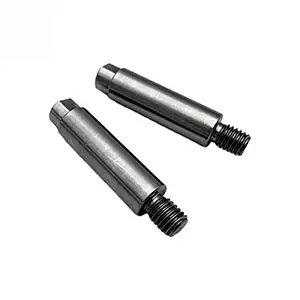
Threading is used to machine standard or non-standard threads on the interior or exterior of a workpiece, such as threaded structures in mechanical connectors or fasteners. CNC lathes can precisely control pitch and depth, ensuring consistent thread quality.
Grooving
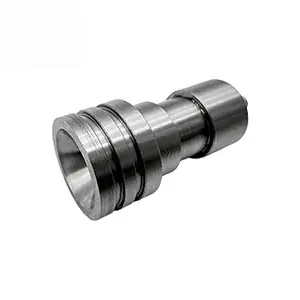
Grooving involves machining slots of specific widths and depths on the workpiece surface for the installation of O-rings, retaining rings, or other mechanical components. This type of machining requires high dimensional accuracy and is typically performed using specialized cutting tools.
What Parts Can Be Made by a CNC Lathe?
CNC lathes are primarily used to machine parts with rotationally symmetrical structures, which typically require high dimensional accuracy and surface finish.
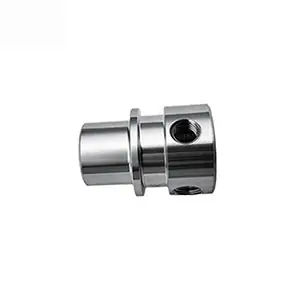
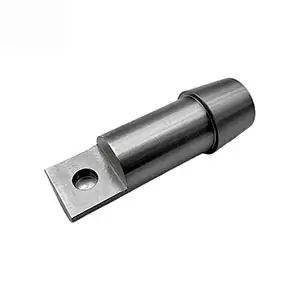
Common machined parts include shafts, pins, bushings, and spacers, which serve to support, connect, or adjust clearances in mechanical assemblies.
In addition, threaded parts and hydraulic fittings are typical turning products, commonly used to connect structures or fluid systems, and they require high machining precision and consistency.
CNC Lathe vs CNC Milling
Many users tend to confuse lathes and milling machines; the main differences between them are as follows:
| Feature | CNC Lathe | CNC Milling |
|---|---|---|
| Machining Method | Workpiece rotates | Tool rotates |
| Suitable Parts | Round parts | Complex shapes |
| Machining Efficiency | High (for shafts) | High (for 3D structures) |
| Applications | Shafts, pins, bushings | Brackets, housings |
Types of CNC Lathe Machines
CNC lathes can be classified into various types based on their structure and functionality, with each type suitable for machining parts of varying complexity and precision requirements.
2-Axis CNC Lathe
The 2-axis CNC lathe is the most basic turning machine, supporting only X-axis and Z-axis movements. It is primarily used for basic external turning and face machining. With a simple structure, this type of machine is suitable for machining standard shaft parts. It offers high production efficiency and stable operation, making it the most common type of lathe.
Multi-Axis CNC Lathe
Multi-axis CNC lathes add a power turret to the basic turning functions, enabling combined turning and milling operations. This configuration allows for the completion of more machining steps in a single setup, thereby reducing errors caused by repositioning the workpiece and improving overall machining efficiency and precision. It is suitable for parts with relatively complex structures.
Swiss-Type CNC Lathe
Swiss-type through-spindle lathes are primarily used for machining high-precision, small-diameter, and slender parts. In this type of machine, the material is fed continuously while supported by guide bushings, resulting in higher machining stability. It is particularly suitable for the manufacture of micro-parts in the medical, electronics, and precision machinery industries.
Materials Used in CNC Lathe Machining
CNC turning is suitable for a wide range of materials, including:
- Aluminum
- Stainless Steel
- Brass
- Copper
- Titanium
- Engineering plastics
Different materials require different cutting tools and machining parameters.
Applications of CNC Lathe Machining
CNC turning is widely used across various industrial sectors and is particularly well-suited for manufacturing highly precise, rotationally symmetric parts.
In the automotive industry, it is commonly used to machine drive shafts, engine components, and various fasteners;
in the aerospace sector, it is used to manufacture high-strength, high-precision structural parts;
in the medical industry, CNC turning is used to produce surgical instruments, implants, and precision fasteners; furthermore, turned parts play a critical role in hydraulic systems and industrial machinery.
CNC Lathe Machining Capabilities at YUANYI
At YUANYI, we offer high-precision CNC turning services that cover the entire manufacturing process, from prototype development to mass production.
Our machining capabilities include high-precision control of ±0.005 mm. We support Swiss-type through-spindle turning and mill-turn composite machining processes, which effectively reduce the number of setups and improve overall machining efficiency. Additionally, we offer rapid prototyping services, typically with delivery within 1–3 days and no minimum order quantity (No MOQ), making them ideal for small-batch trial production and customized projects.
Need CNC Lathe Parts for Your Project?
Upload your CAD drawings or technical requirements. Our engineering team will review your design and provide a fast quotation with manufacturability feedback.
✔ Precision up to ±0.005 mm
✔ No MOQ required
✔ Prototype & Production supported
✔ Fast turnaround (1–3 days for prototypes)
When Should You Use CNC Lathe Machining?
CNC turning is typically the best choice when parts have a distinct rotationally symmetric structure.
For example, CNC lathes are an ideal choice when parts require high roundness accuracy, good surface finish, or high-efficiency mass production. This process is particularly suitable for shaft-type parts, pins, and various circular fasteners.
If a part has a complex structure, contains numerous asymmetrical features, or involves three-dimensional surfaces, CNC milling is generally the better choice.
Advantages of CNC Lathe Machining
CNC turning offers several distinct advantages over traditional machining methods.
First, it is highly efficient for machining cylindrical parts and is particularly well-suited for mass production. Second, because the machining process is highly automated, parts exhibit excellent consistency and repeatability. Additionally, CNC turning produces a high-quality surface finish and, under appropriate process conditions, can effectively reduce overall machining costs.
Conclusion
CNC lathes are indispensable equipment in modern manufacturing, particularly suited for the high-precision machining of shafts and rotationally symmetric parts.
With their high efficiency, stability, and automation capabilities, CNC turning plays a vital role in industries such as automotive, aerospace, medical, and industrial equipment, and is one of the core processes in precision manufacturing systems.
Frequently Asked Questions
A CNC lathe rotates the workpiece while the cutting tool remains relatively fixed, making it ideal for round parts. A CNC milling machine rotates the cutting tool instead and is better suited for complex shapes and 3D geometries.
The basic operation of CNC lathe machining is relatively easy to understand. However, mastering programming, tool selection, and machining parameters requires practical experience and training.
A CNC lathe operator is responsible for setting up the machine, loading tools, adjusting workpieces, running programs, and inspecting finished parts to ensure they meet quality requirements.
A CNC machinist is a skilled operator who programs, sets up, and operates CNC machines to produce precision parts. They are responsible for ensuring machining accuracy and production efficiency.
This phrase usually refers to the lathe machine because it is considered one of the earliest and most fundamental machine tools in manufacturing history.
We can achieve machining tolerances up to ±0.005 mm depending on part geometry and material requirements. All parts are inspected before shipment to ensure consistent quality.
Yes, we support both prototype and low-volume production without minimum order quantity (No MOQ). This is ideal for product development, testing, and small batch manufacturing.
For most CNC lathe projects, prototype parts can be completed within 3–5 days depending on complexity and material availability. Urgent projects can be prioritized upon request.