

Stainless steel is not always magnetic. Some grades, such as 430 and 410 stainless steel, are magnetic, while others, such as 304 and 316 stainless steel, are usually non-magnetic or only weakly magnetic.
This is why a magnet may strongly stick to one stainless steel product but barely attract another, even though both are called stainless steel.
Whether stainless steel is magnetic depends primarily on its microstructure, alloy composition, and manufacturing process. Understanding these differences is important when selecting materials for food processing equipment, medical devices, aerospace components, and CNC-machined parts
Is Stainless Steel Magnetic?
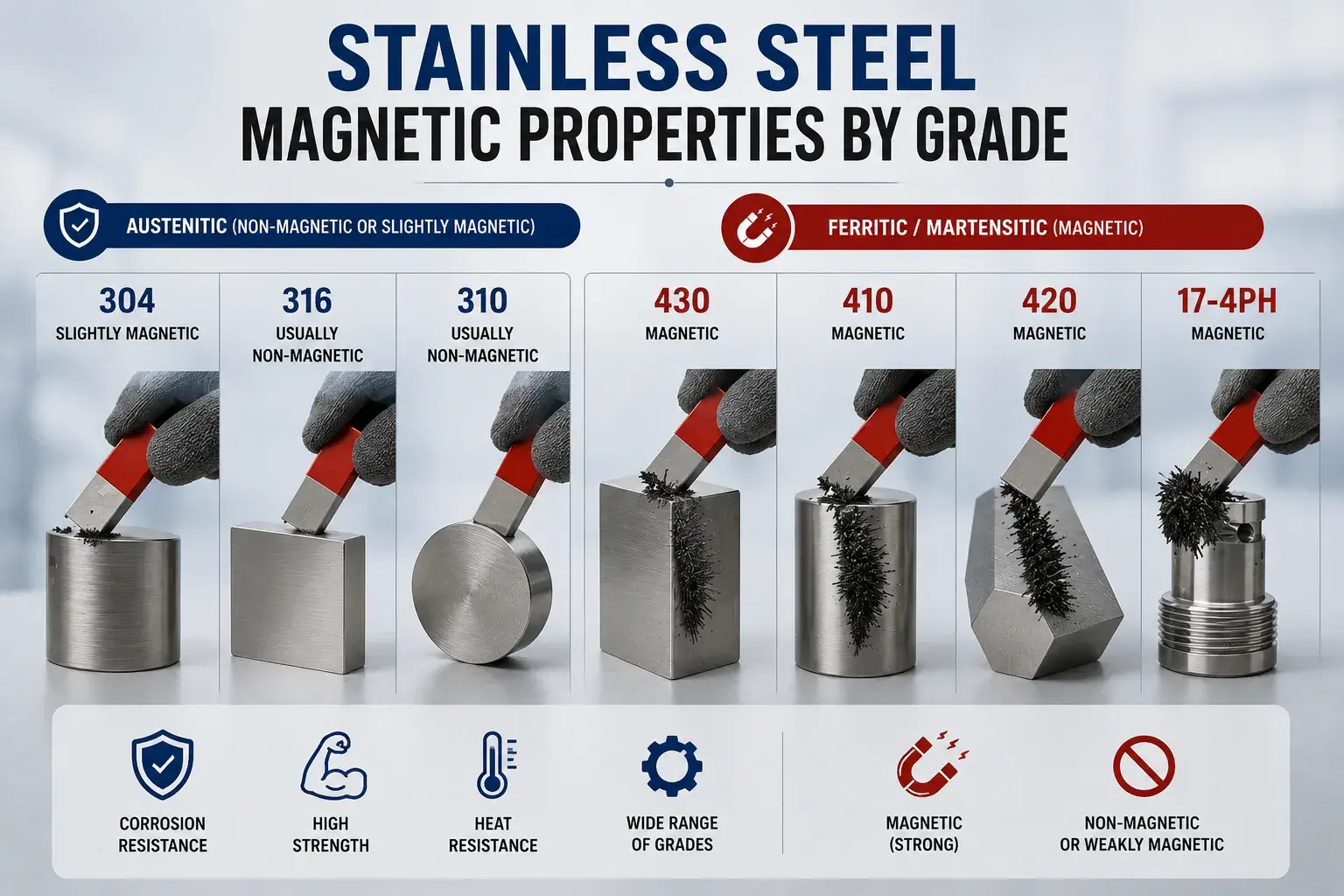
Some stainless steels are magnetic, while others do not exhibit any noticeable magnetism.
The magnetic properties of stainless steel depend primarily on the specific grade and microstructure.
The following table shows the magnetic properties of common stainless steel grades:
| Stainless Steel Grade | Magnetic? |
|---|---|
| 304 | Slightly Magnetic |
| 316 | Usually Non-Magnetic |
| 430 | Magnetic |
| 410 | Magnetic |
| 420 | Magnetic |
| 17-4PH | Magnetic |
Therefore, the most accurate answer to the question “Is Stainless Steel Magnetic?” is:
It depends on the grade of stainless steel.
Do Magnets Stick to Stainless Steel?
Many people use magnets to test stainless steel products when making a purchase.
However, the results of the magnet test are not always consistent.
For example:
- 430 stainless steel is usually strongly attracted to a magnet.
- 410 and 420 stainless steel are typically noticeably magnetic.
- 304 stainless steel may exhibit slight magnetism.
- 316 stainless steel is usually barely attracted at all
This is why products that are all referred to as “stainless steel” can yield completely different results when tested with a magnet.
It is important to note:
The magnet test can only determine whether a material is magnetic; it cannot accurately identify whether the material is 304 or 316 stainless steel.
Why Are Some Stainless Steels Magnetic?
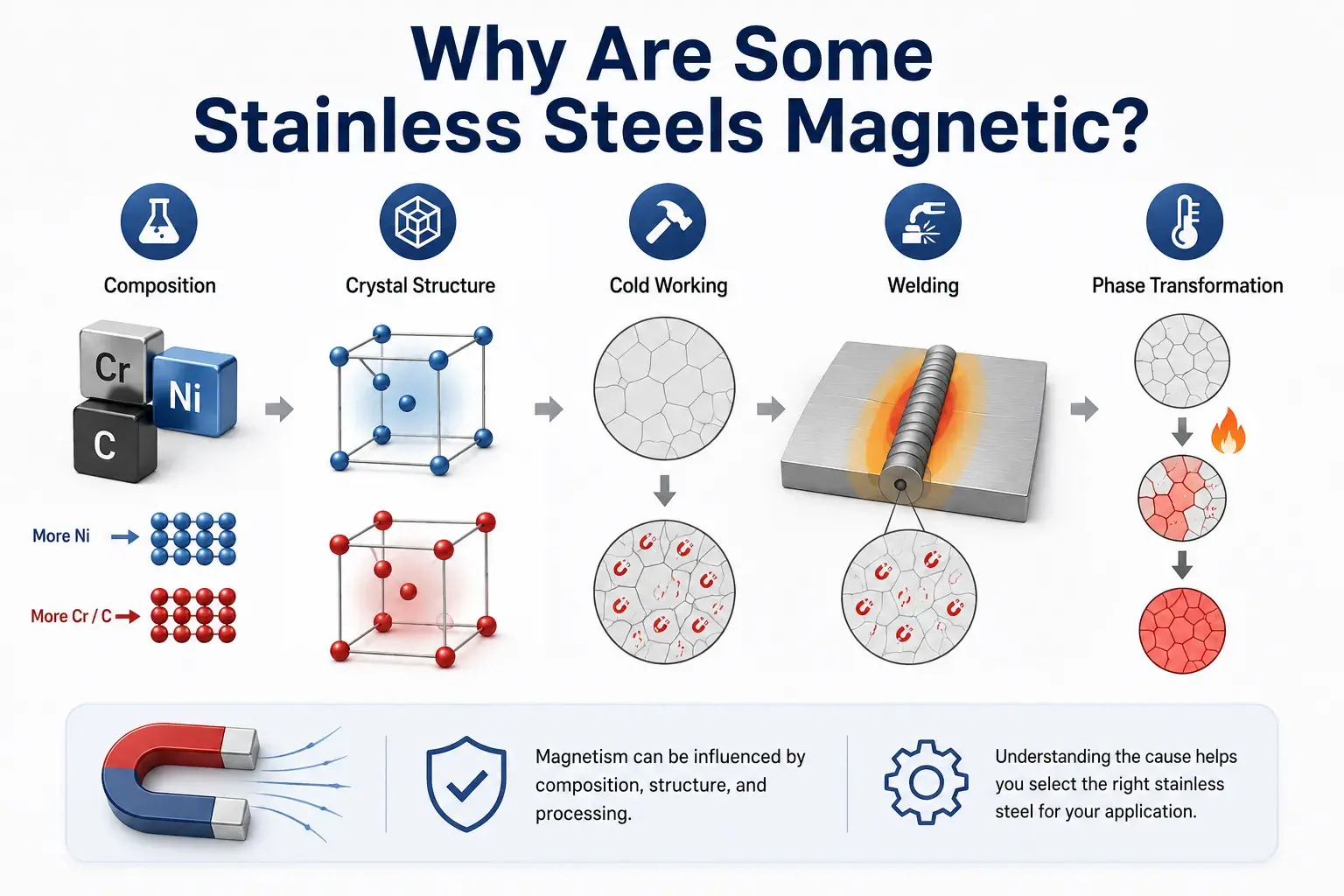
Whether stainless steel is magnetic is closely related to its internal crystal structure.
Stainless steels commonly used in industry are mainly divided into three categories:
Austenitic Stainless Steel
Common grades:
- 304
- 316
- 310
Characteristics:
- Typically non-magnetic or weakly magnetic
- Excellent corrosion resistance
- Good weldability
Therefore, they are widely used in:
- Food processing equipment
- Medical equipment
- Pharmaceutical equipment
- Equipment for marine environments
Ferritic Stainless Steel
Common grades:
430
Characteristics:
- Significantly magnetic
- Lower cost
- Good oxidation resistance
Commonly used in:
- Home appliance housings
- Kitchen equipment
- Automotive trim components
Martensitic Stainless Steel
Common grades:
410
420
Characteristics:
- Significantly magnetic
- High strength
- Can be heat-treated for strengthening
Widely used in:
- Cutlery
- Valves
- Industrial parts
- Mechanical equipment
Need Custom Stainless Steel CNC Parts?
Send us your drawing and our engineering team will review your material grade, tolerance, surface finish, and machining requirements within 24 hours.
Get a Free QuoteWhich Stainless Steel Grades Are Non-Magnetic?
Strictly speaking, no stainless steel can be guaranteed to be completely non-magnetic under all circumstances.
However, in engineering applications, the following grades are generally considered to be non-magnetic or weakly magnetic stainless steels:
| Grade | Magnetic Response | Typical Applications |
|---|---|---|
| 304 | Slightly Magnetic | Food Equipment |
| 316 | Usually Non-Magnetic | Medical & Marine Equipment |
| 310 | Usually Non-Magnetic | High Temperature Equipment |
The most common types are 304 and 316 stainless steel.
They are also the two materials most commonly used in precision manufacturing, food processing, and the medical industry.
Is 304 Stainless Steel Magnetic?
304 stainless steel is one of the most widely used stainless steel materials in the world.
Theoretically, 304 is an austenitic stainless steel and typically exhibits no or very weak magnetic properties when annealed.
However, in practical applications, many people have noticed that:
A magnet can slightly attract 304 stainless steel.
This does not indicate a problem with the material’s quality.
In fact, when 304 stainless steel undergoes the following processes:
- Cold rolling
- Stamping
- Bending
- Drawing
- CNC machining
its internal microstructure may undergo partial transformation, resulting in some magnetic properties.
Therefore:
- Freshly annealed 304 → Virtually non-magnetic
- Cold-worked 304 → May exhibit weak magnetism
This is why the magnetic properties of 304 products on the market are not entirely consistent.
Is 316 Stainless Steel Magnetic?
316 stainless steel is also an austenitic stainless steel.
Due to its higher nickel and molybdenum content, its austenitic structure is more stable, so it is generally less magnetic than 304.
In most cases:
- 316 stainless steel is hardly attracted by ordinary magnets.
- Even after machining, changes in its magnetic properties are typically less pronounced than those of 304.
In addition to its magnetic advantages, 316 also offers superior corrosion resistance.
As a result, it is widely used in:
- Medical equipment
- Pharmaceutical equipment
- Marine equipment
- Food processing equipment
For applications where magnetic interference must be minimized as much as possible, 316 is often a more ideal choice than 304.
Is 304 or 316 More Magnetic?
This is a question frequently asked by engineers and procurement professionals.
The answer is:
304 is generally more magnetic than 316.
The main reason is that 316 contains more nickel, giving it a more stable austenitic structure.
Comparison of the Magnetic Properties of 304 and 316
| Property | 304 Stainless Steel | 316 Stainless Steel |
|---|---|---|
| Magnetic Response | Slightly Magnetic | Usually Non-Magnetic |
| Corrosion Resistance | Good | Excellent |
| Cost | Lower | Higher |
| Marine Environment | Limited | Excellent |
| Medical Applications | Common | Preferred |
If a project has strict requirements for magnetic control, 316 is usually the safer choice.
Can Stainless Steel Become Magnetic?
Many people believe that:
Non-magnetic stainless steel will never become magnetic.
In fact, this is not the case.
Certain types of stainless steel that are originally weakly magnetic or non-magnetic may become magnetic during the manufacturing process.
Cold Working
Cold working is the most common cause.
For example:
- Stamping
- Drawing
- Bending
- Rolling
These processes can cause partial transformation of the austenitic microstructure, thereby increasing the material’s magnetism.
Welding
The high temperatures generated during welding and the subsequent cooling process can also lead to changes in the microstructure.
Therefore:
- Weld zone
- Heat-affected zone
Increased magnetism may sometimes occur in these areas.
Machining
Certain high-intensity machining processes can also cause localized microstructural changes.
For example:
- Heavy cutting
- Deep-hole drilling
- High-stress forming
Although the changes are usually minor, they still require attention for high-precision medical devices and semiconductor equipment.
Stainless Steel Grades and Their Magnetic Properties
The magnetic properties of different stainless steel grades vary significantly.
The following is a reference guide to the magnetic properties of common engineering-grade stainless steels:
| Grade | Magnetic? | Common Applications |
|---|---|---|
| 304 | Slightly Magnetic | Food Equipment |
| 316 | Usually Non-Magnetic | Medical & Marine Equipment |
| 310 | Usually Non-Magnetic | High Temperature Equipment |
| 430 | Magnetic | Appliances & Decorative Parts |
| 410 | Magnetic | Valves & Industrial Components |
| 420 | Magnetic | Knives & Cutting Tools |
| 17-4PH | Magnetic | Aerospace & High-Strength Parts |
For projects where magnetic interference must be avoided, austenitic stainless steels such as 304, 316, or 310 are typically the preferred choice.
Stainless Steel vs Aluminum: Magnetic Comparison
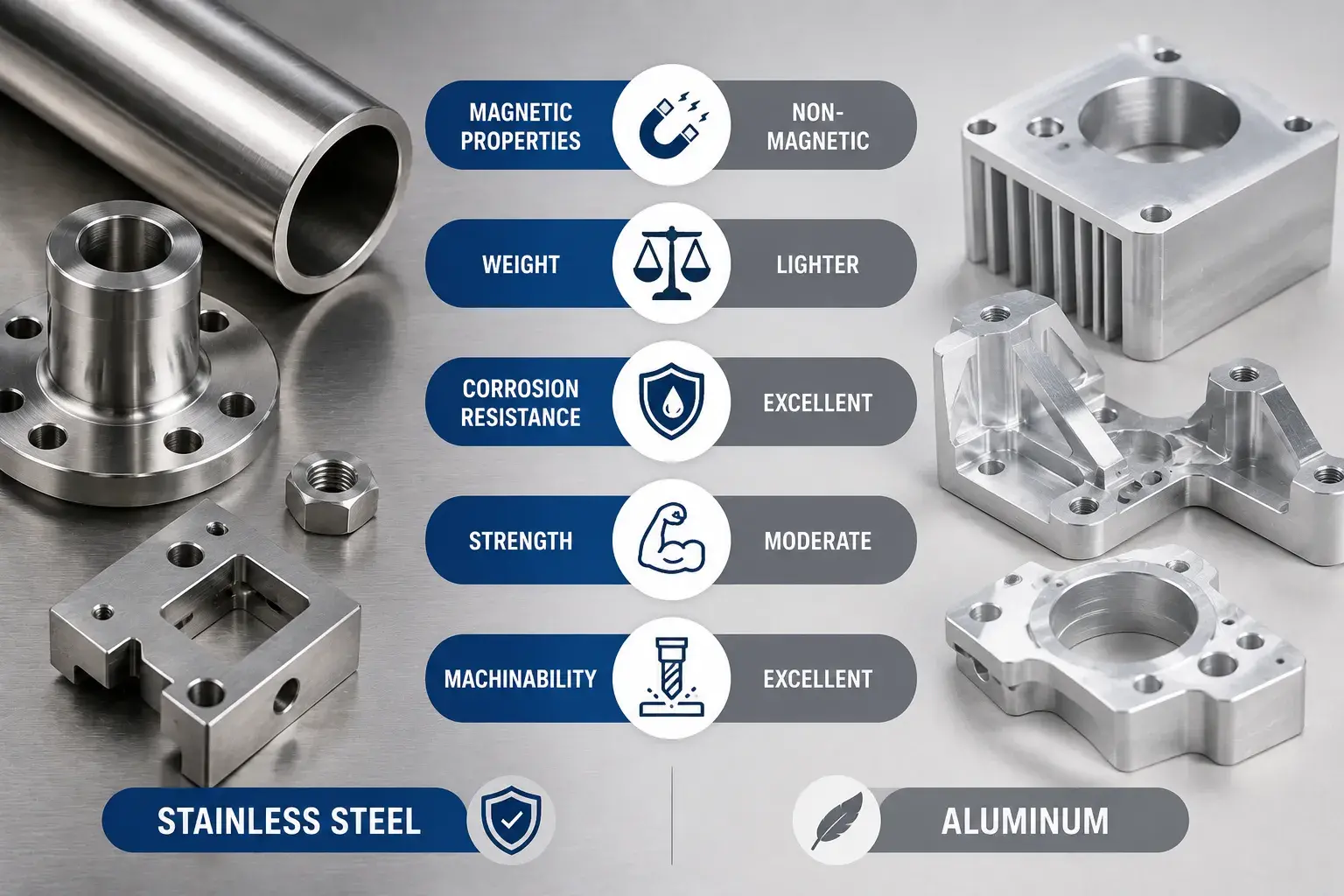
Although both stainless steel and aluminum have good corrosion resistance, their magnetic properties differ significantly.
| Property | Stainless Steel | Aluminum |
|---|---|---|
| Magnetic Properties | Depends on Grade | Non-Magnetic |
| Weight | Higher | Lower |
| Corrosion Resistance | Excellent | Excellent |
| Strength | Higher | Moderate |
| Machinability | Moderate | Excellent |
In comparison:
- Aluminum is almost always a non-magnetic material,
- While the magnetic properties of stainless steel depend on the specific grade.
Therefore, in applications where magnetic properties must be strictly controlled, engineers typically pay close attention to the material grade of the stainless steel.
Why Do Magnetic Properties Matter in Engineering Applications?
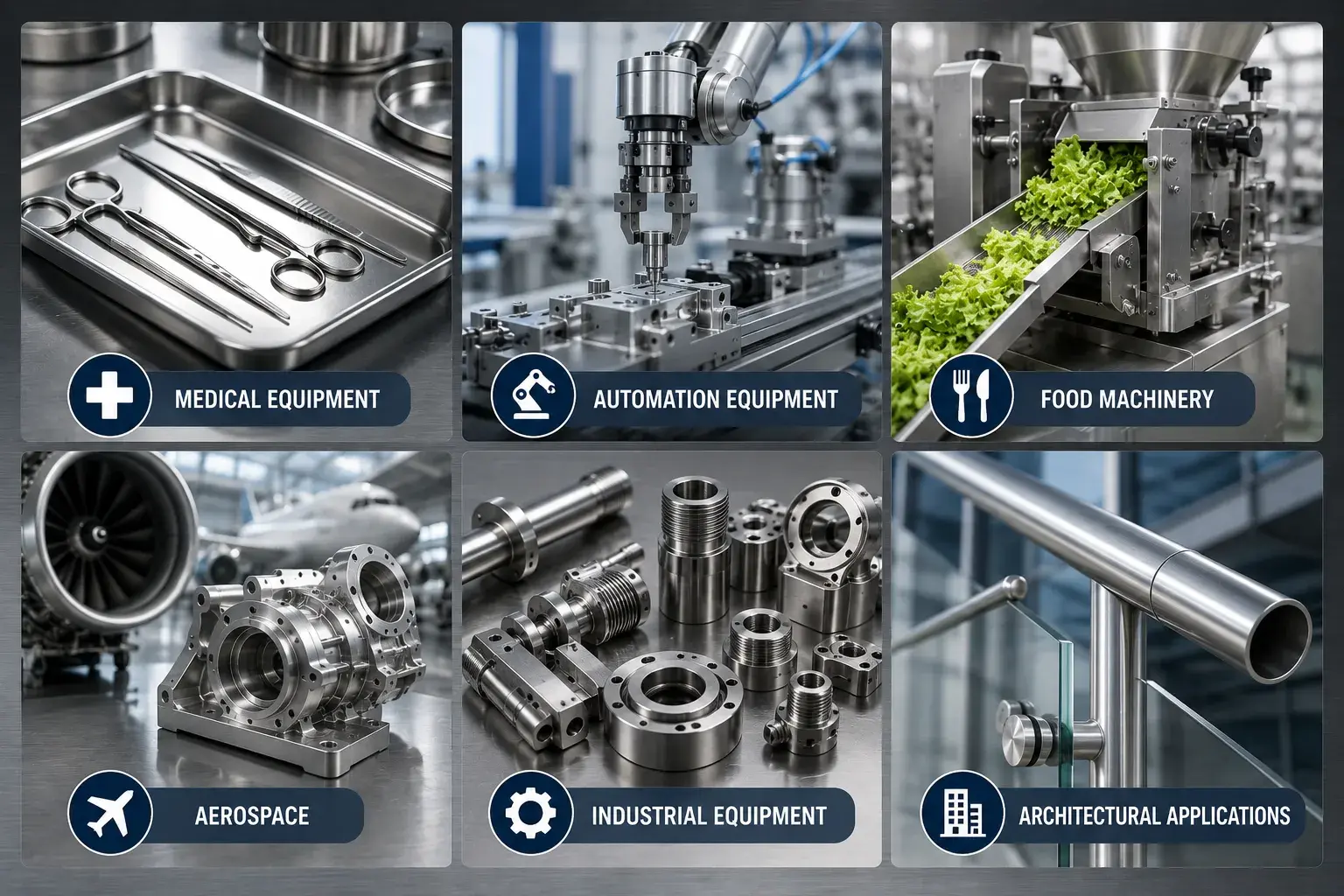
For many engineering projects, magnetism is not merely a material property; it can directly affect equipment performance and reliability.
Medical Equipment
Magnetic materials should generally be avoided as much as possible around MRI equipment.
Therefore:
- 316 stainless steel
- Titanium alloys
- Aluminum alloys
are often the preferred choices.
Food Processing Equipment
304 and 316 stainless steel are widely used in food processing equipment.
In addition to corrosion resistance, the magnetic properties of materials can also affect certain detection devices and automation systems.
Semiconductor Equipment
Semiconductor manufacturing equipment contains a large number of high-precision sensors.
Magnetic field interference can affect measurement accuracy, so material selection is particularly important.
Aerospace Components
The aerospace industry focuses not only on weight and strength but also on the impact of magnetic field environments on equipment performance.
Therefore, engineers select different grades of stainless steel or other non-magnetic materials based on actual requirements.
Why Stainless Steel Is Widely Used in CNC Machining
Stainless steel is one of the most common engineering materials used in CNC machining.
The main reasons include:
- Excellent Corrosion Resistance
- High Strength
- Good Temperature Resistance
- Wide Grade Selection
Different grades can meet the needs of various engineering projects.
Common types of stainless steel used in CNC machining include:
- 303 Stainless Steel
- 304 Stainless Steel
- 316 Stainless Steel
- 17-4PH Stainless Steel
These materials are widely used in the medical equipment, automation equipment, food processing machinery, aerospace, and industrial equipment industries.
Need Custom Stainless Steel CNC Parts?
Send us your drawing and our engineering team will review your material grade, tolerance, surface finish, and machining requirements within 24 hours.
Get a Free QuoteConclusion
There is no single answer to whether stainless steel is magnetic.
Some stainless steels, such as 430, 410, and 420, are distinctly magnetic; whereas austenitic stainless steels such as 304, 316, and 310 are typically non-magnetic or weakly magnetic.
In addition, manufacturing processes such as machining, welding, and cold forming can also alter the magnetic properties of certain stainless steels.
Therefore, when selecting stainless steel materials, it is important to consider not only strength, corrosion resistance, and cost, but also to evaluate their magnetic characteristics based on the specific application environment.
For medical devices, semiconductor equipment, food processing machinery, and precision engineering applications, selecting the correct stainless steel grade is often more important than simply determining whether the material is “magnetic” or not.
Frequently Asked Questions
304 stainless steel is generally considered non-magnetic in its annealed state. However, cold working processes such as bending, stamping, or machining can alter its microstructure and create a slight magnetic response.
Not always. Although 316 stainless steel is usually regarded as non-magnetic, certain manufacturing processes such as welding or heavy cold working may introduce a small amount of magnetism.
Yes. Welding can change the microstructure of some stainless steel grades, particularly around the heat-affected zone, which may result in increased magnetic properties.
A simple magnet test can indicate whether stainless steel is magnetic. However, it cannot reliably distinguish between grades such as 304 and 316. Material certificates or chemical analysis are required for accurate identification.
Yes. 17-4PH is a precipitation-hardening stainless steel that exhibits magnetic properties. It is commonly used in aerospace, defense, and high-strength engineering applications.
No. Both 304 and 316 may exhibit little or no magnetic attraction, making it difficult to identify them accurately using a magnet alone. Material certification or PMI testing is the preferred method.
Magnetic properties can affect material selection in industries such as medical devices, semiconductor equipment, aerospace, robotics, and food processing. Choosing the correct stainless steel grade helps ensure optimal performance and compliance with application requirements.



