

Machining tools refer to the tools and equipment used in the machining process to cut material, secure workpieces, and perform various machining operations.
In CNC machining, common CNC machining tools include milling cutters, drill bits, taps, boring bars, and various turning tools. These tools collectively determine the machining accuracy, surface quality, and production efficiency of parts.
Common Types of Tools in CNC Machining
Modern manufacturing uses hundreds of different machining tools, but most can be categorized into the following types.
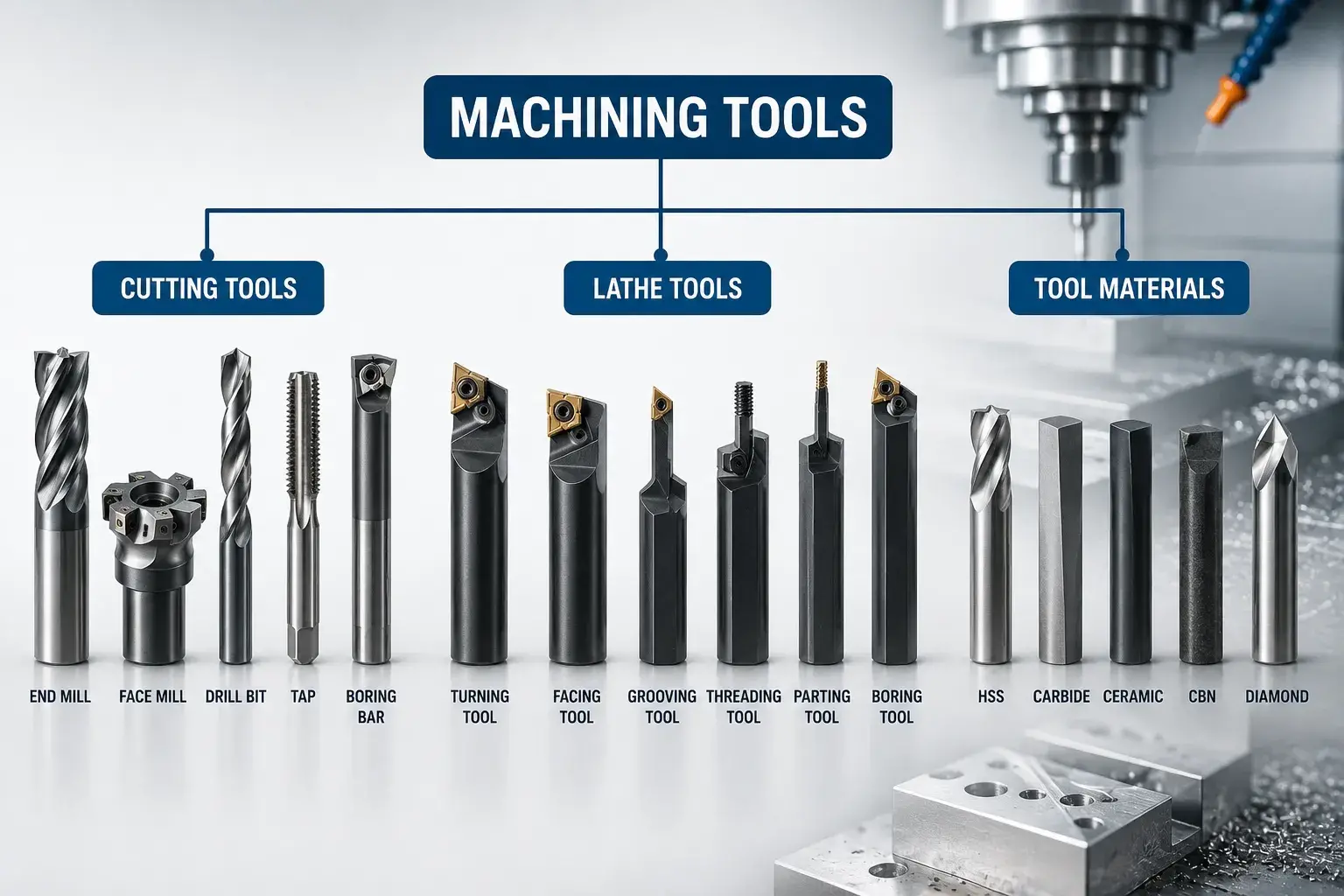
Cutting Tools
Cutting tools are the most common types of CNC machining tools.
Their function is to gradually machine the raw blank into the shape and dimensions specified in the design drawings by removing material.
Common cutting tools include:
End Mill:The end mill is one of the most widely used tools in CNC milling.
It is primarily used for:
- Flat machining
- Contour machining
- Cavity machining
- Grooving
Depending on machining requirements, end mills can be further classified into types such as flat-bottom end mills, ball-nose end mills, and round-nose end mills.
Face Mill:Face mills are primarily used for machining large flat surfaces.
Compared to standard end mills, face mills offer higher material removal rates and are therefore commonly used for rough machining and machining large parts.
Drill Bit:Drill bits are used to machine various types of holes.
Whether for screw holes, locating holes, or mounting holes, drilling is a nearly universal part of the CNC part manufacturing process.
Reamer:When high dimensional accuracy is required for a hole, drilling alone is often insufficient.
In such cases, a reamer is used for finishing to achieve a more precise hole diameter and better surface quality.
Tap:Taps are used to cut internal threads.
In mechanical equipment, automation systems, and electronic products, a large number of threaded holes are machined using taps.
Boring Bar:Boring bars are used to enlarge existing holes and improve their dimensional accuracy and concentricity.
For high-precision parts, boring is often one of the key machining operations.
CNC Machining Tools List
Here are some of the most common tools found in a CNC machining shop:
| Tool Name | Primary Function |
|---|---|
| End Mill | Milling Operations |
| Face Mill | Surface Milling |
| Ball Nose End Mill | 3D Surface Machining |
| Drill Bit | Hole Drilling |
| Spot Drill | Hole Positioning |
| Reamer | Hole Finishing |
| Tap | Internal Threading |
| Thread Mill | Thread Milling |
| Boring Bar | Hole Enlargement |
| Countersink Tool | Chamfering & Deburring |
These tools make up almost the entire list of CNC machining tools.
Depending on the part’s geometry and machining requirements, engineers will select different combinations of cutting tools to complete the machining task.
Common Lathe Machining Tools
In addition to milling, turning is one of the most common processes in CNC machining. The lathe machining tools used on lathes differ significantly from milling cutters, with different turning tools designed for different machining tasks.
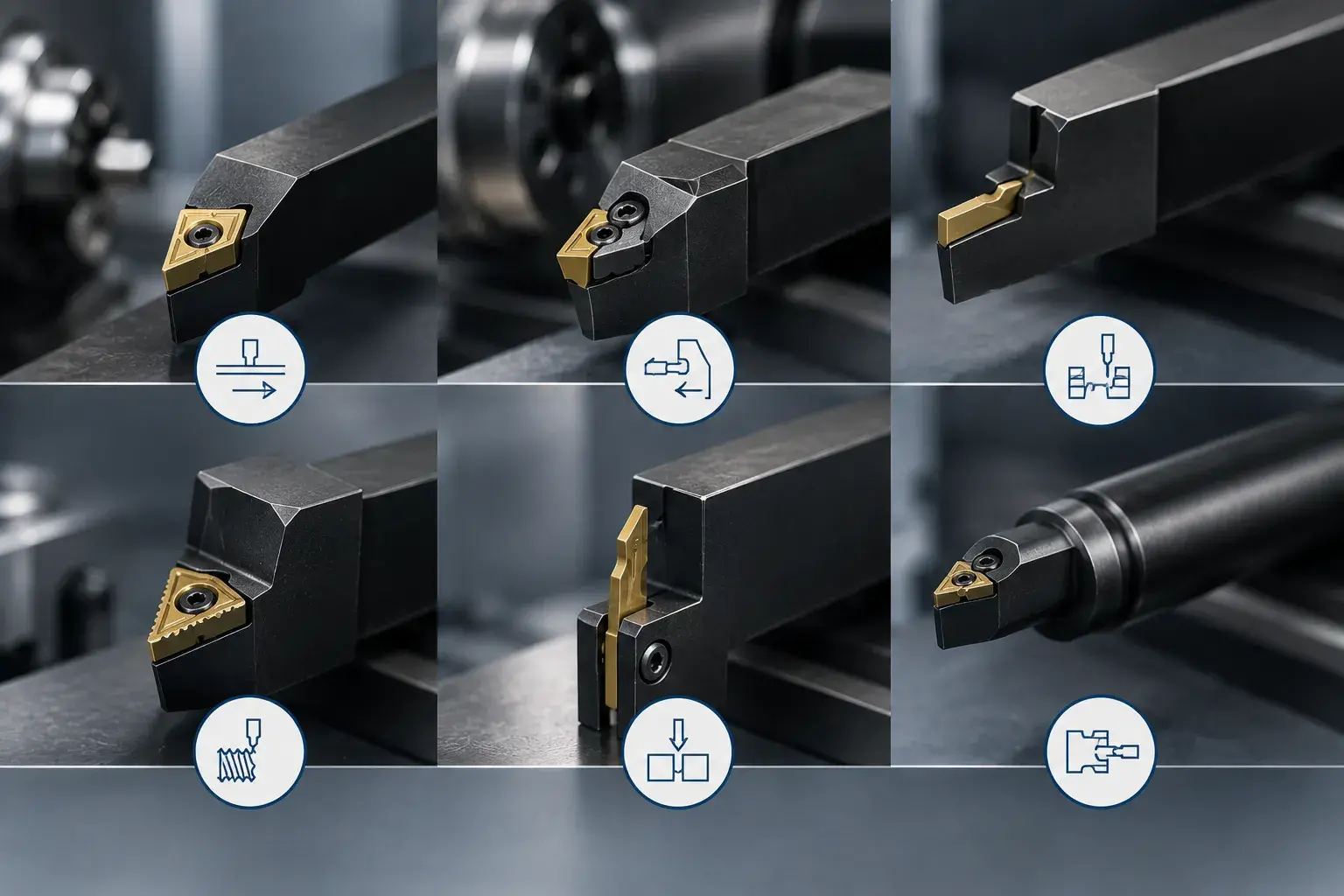
Turning Tool
Cylindrical turning tools are primarily used to machine the outer diameter and profile of workpieces and are among the most common tools in turning operations. Cylindrical parts such as shafts, pins, and sleeves are typically machined using cylindrical turning tools.
Facing Tool
Facing tools are used to machine the end faces of workpieces, helping parts achieve precise length dimensions and flat surfaces. In many turning operations, end-face machining is typically the first step.
Grooving Tool
Grooving tools are used to machine various annular grooves, retaining ring grooves, and sealing grooves. These features are widely used in mechanical equipment, hydraulic systems, and automotive parts.
Threading Tool
Threading tools are used to machine internal and external threads. Through turning operations, a variety of metric, imperial, and special-specification thread profiles can be produced.
Parting Tool
Parting tools are used to separate finished parts from the raw material and are typically the final step in the turning process.
Boring Tool
Boring tools are used to enlarge existing hole diameters and improve the dimensional accuracy and surface quality of the holes. When drilling cannot meet precision requirements, a boring operation is typically added.
Together, these lathe machining tools form a complete turning system, enabling CNC lathes to machine a wide variety of high-precision cylindrical parts.
Why Do Different Parts Require Different Machining Tools?
Many customers ask:
Why are different cutting tools needed for CNC machining, even though the process is the same?
The reason is simple.
Different parts have different requirements for material, precision, and surface quality.
For example:
Aluminum alloy parts
Typically require sharp tools with a large helix angle.
This improves cutting efficiency and chip evacuation.
Stainless steel parts
Since the material is hard and prone to work hardening, cutting tools made of more wear-resistant materials are required.
Titanium alloy parts
Titanium alloys have poor thermal conductivity.
High-rigidity, high-heat-resistant cutting tools are typically required.
High-Precision Parts
For parts requiring a precision of ±0.005 mm or higher, higher-grade precision machining tools must be used in conjunction with appropriate machining strategies.
Therefore, selecting the right tools not only affects machining quality but also directly impacts production costs and lead times.
What Materials Are Machining Tools Made Of?
In addition to the workpiece material, the material of the cutting tool itself directly affects machining efficiency, tool life, and machining quality. Manufacturers select different types of cutting tool materials based on specific machining requirements.
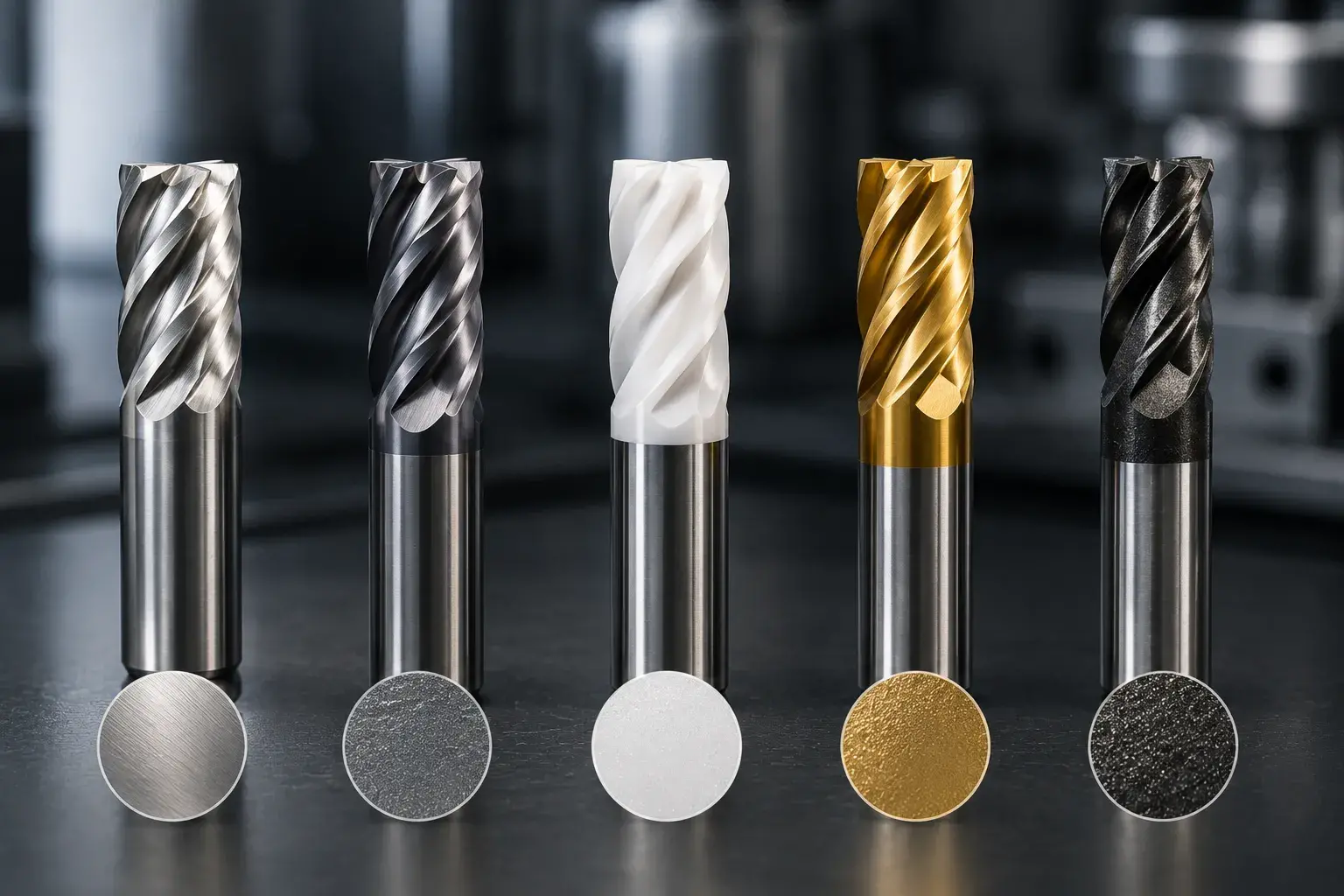
High-Speed Steel (HSS)
High-speed steel is a traditional tool material that offers good toughness and low cost. Although its cutting speed is not as high as that of carbide tools, it is still widely used in some low-speed machining and general drilling applications.
Carbide Tools
Carbide is currently the most common tool material. Compared to high-speed steel, carbide offers higher hardness, better wear resistance, and a longer service life, enabling higher cutting speeds. Most modern Precision Machining Tools are manufactured from carbide.
Ceramic Tools
Ceramic tools possess excellent heat resistance, making them suitable for high-speed cutting and high-temperature machining environments. They are commonly used for machining materials such as cast iron and heat-resistant alloys.
CBN Tools
CBN (cubic boron nitride) tools possess extremely high hardness and are primarily used for machining hardened steel and high-hardness materials; they are one of the key alternatives in grinding processes.
Diamond Tools
Diamond tools offer outstanding wear resistance and surface finishing capabilities. They are widely used in the machining of graphite, aluminum alloys, copper alloys, and composite materials, and are particularly well-suited for ultra-precision machining applications.
How We Select CNC Machining Tools for Precision Parts
At YUANYI, we select the appropriate CNC machining tools for each project based on the part’s material, structural characteristics, tolerance requirements, surface roughness, and production volume. Different materials and machining requirements typically call for different tool types and machining strategies, so tool selection is one of the key factors influencing machining quality and efficiency.
Combining our capabilities in 3-axis, 4-axis, and 5-axis CNC machining, CNC turning, and through-spindle machining, we are able to develop optimal machining solutions for our customers. Through strict process control and quality inspection, we ensure that parts meet precision requirements as tight as ±0.005 mm and maintain consistent, stable machining quality.
Need Help Choosing the Right CNC Machining Process?
Send us your CAD files or drawings. Our engineering team will review your part structure, material, tolerance requirements, and provide machining suggestions with a fast quotation.
Get a Free CNC Machining QuoteConclusion
Machining tools are an indispensable and vital component of modern manufacturing.
From end mills and drill bits to turning tools, different tools perform different machining tasks. Selecting the right CNC machining tools not only improves machining efficiency but also enhances part quality, reduces production costs, and shortens lead times.
For the manufacture of precision parts, tool selection is often just as important as the capabilities of the equipment. Only by properly matching cutting tools, machining parameters, and machine tools can stable and reliable machining results be achieved.
Frequently Asked Questions
Tool life depends on the tool material, workpiece material, cutting parameters, and machining conditions. Carbide tools generally last much longer than HSS tools, while hard materials such as stainless steel and titanium usually cause faster tool wear than aluminum.
Common signs include poor surface finish, dimensional inaccuracies, excessive cutting forces, unusual vibration, and visible wear on the cutting edge. Replacing worn tools at the right time helps maintain part quality and reduce scrap.
In some cases, yes. However, most CNC machining tools are optimized for specific materials. A tool designed for aluminum may not perform efficiently when machining stainless steel or titanium, so selecting the correct tool is important for both quality and productivity.
Tool selection directly impacts machining efficiency, cycle time, tool life, and part quality. Using the right tool can reduce production costs, while an unsuitable tool may increase machining time and lead to premature tool wear.
Coated tools have a thin protective layer that improves wear resistance, heat resistance, and tool life. They are commonly used for machining difficult materials and high-volume production, while uncoated tools are often suitable for softer materials and general-purpose applications.
Professional CNC machining suppliers evaluate the material, geometry, tolerance requirements, surface finish, and production quantity of a part before selecting tooling. This process helps optimize machining efficiency while ensuring consistent quality and precision.



