

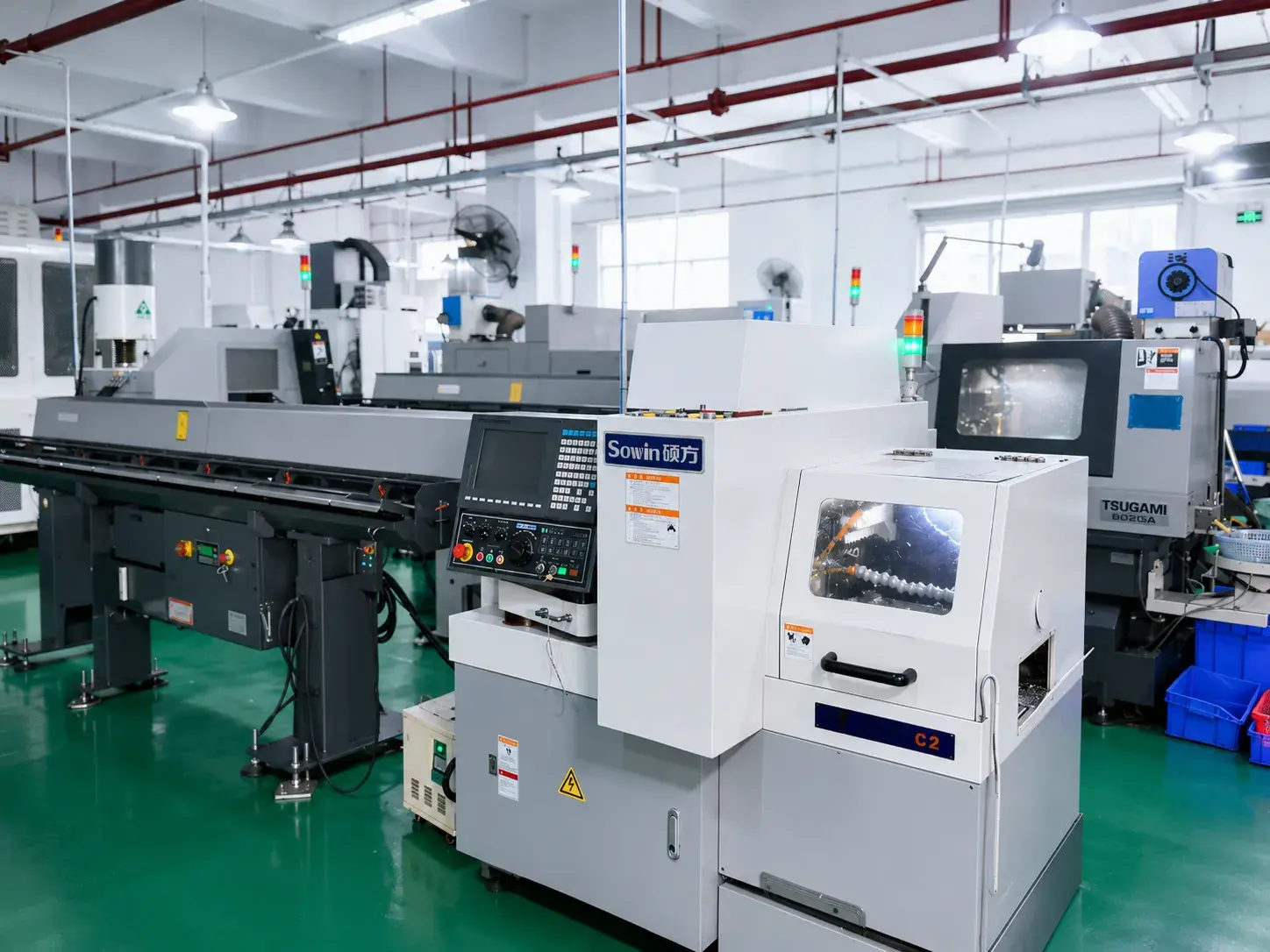
Swiss Machining is a CNC turning process specifically designed for manufacturing small, high-precision, and slender parts. Unlike traditional CNC lathes, Swiss Machining uses a guide bushing to support the workpiece, ensuring that the cutting action remains close to the support point at all times. This significantly reduces material deformation and vibration, thereby improving machining accuracy.
How Does Swiss Machining Work?
The main difference between a swiss screw machining and a conventional lathe lies in the way the material moves.
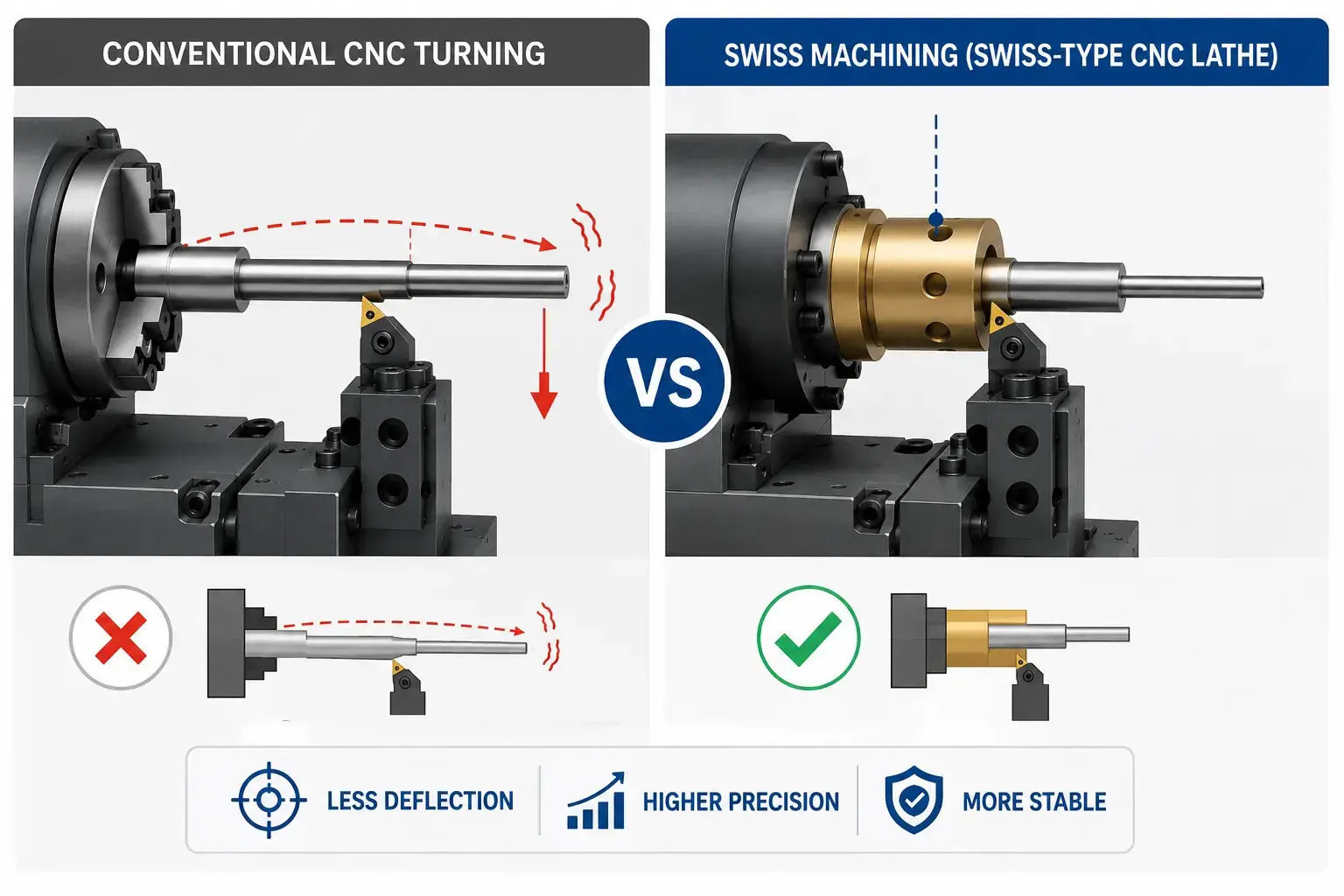
In conventional swiss turning machine, the workpiece is typically clamped in a chuck and rotates, while the tool moves in various directions to perform the machining.
In a Swiss-type machine, however, the material extends through a guide bushing, the spindle moves the material along the Z-axis, and the tool is fixed to the machine to perform the cutting.
The entire machining process typically proceeds as follows:
Because the guide bush remains in close proximity to the cutting zone, excellent rigidity and stability are maintained even for parts with very small diameters and long lengths.
Modern Swiss-type CNC machines are also typically equipped with live tools, sub-spindles, and multi-station tool turrets, enabling operations such as turning, drilling, tapping, and milling to be completed in a single setup.
Why Is Swiss Machining More Accurate?
The greatest advantages of Swiss machining lie in its precision and consistency.
Compared to conventional swiss turning machine, its precision advantages stem primarily from the following aspects.
Guide Bushing Support
The guide bushing supports the material near the cutting position.
This effectively reduces material deflection and vibration during machining, making it particularly suitable for slender shaft-type parts.
Reduced Material Deflection
For workpieces with a high length-to-diameter ratio, traditional lathes are prone to bending.
Swiss machines can significantly reduce this risk of deformation, resulting in more stable dimensional accuracy.
Continuous Bar Feeding
Material is fed continuously through an automatic bar-feeding system.
This method ensures higher consistency during mass production.
Fewer Setups
Many Swiss machines can complete multiple machining operations in a single setup.
Reducing the number of setups not only improves production efficiency but also minimizes human error.
Therefore, for high-precision parts in the medical, aerospace, and electronics industries, Swiss machining often delivers more consistent machining quality than conventional turning.
What Types of Parts Are Best Suited for Swiss Machining?
Not all parts require Swiss machining.
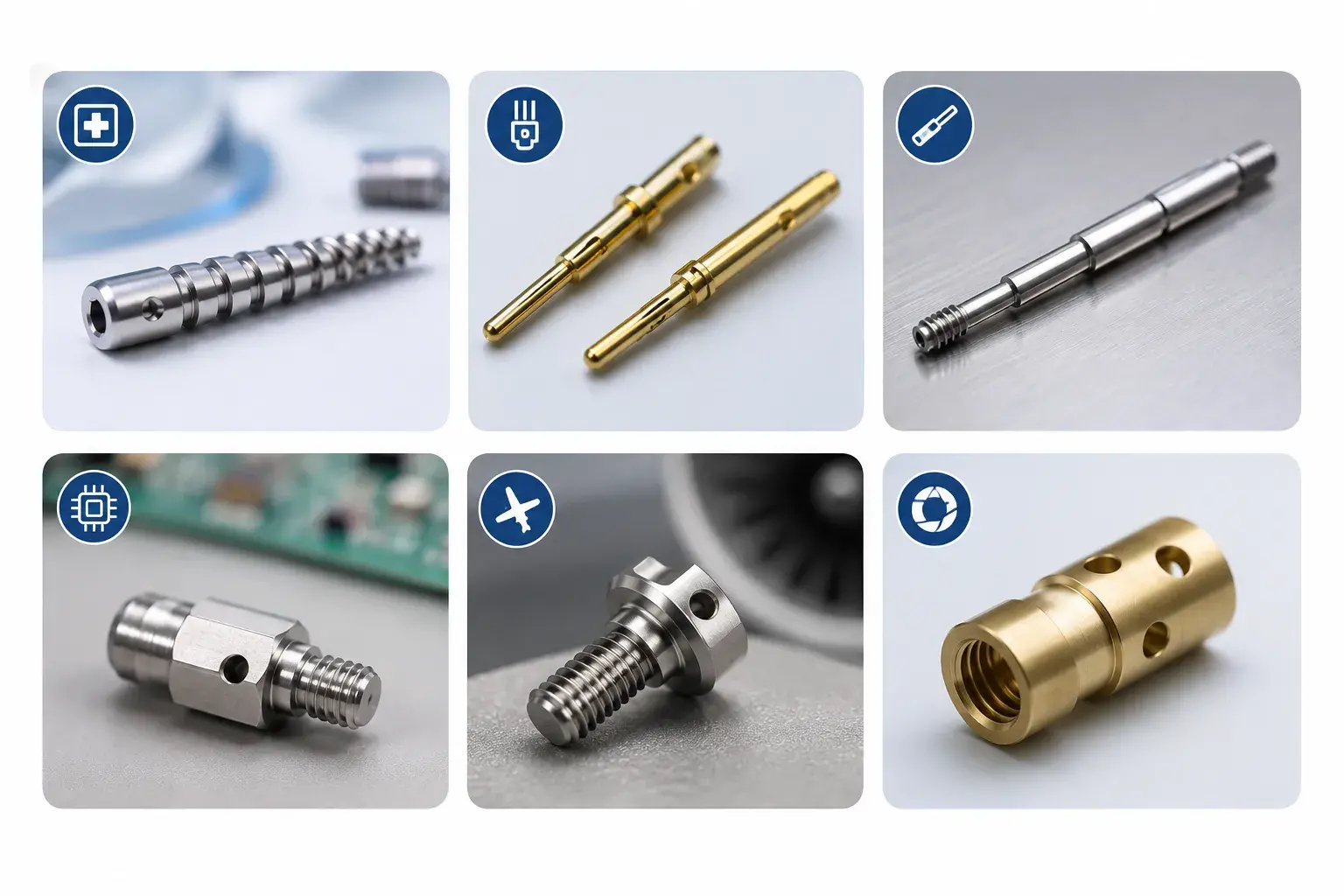
Swiss machining is best suited for the following types of parts.
Medical Components
The medical industry frequently uses a large number of small, high-precision parts, such as:
- Bone pins
- Bone screws
- Dental implants
- Surgical instrument components
These parts typically have strict dimensional and surface quality requirements.
Precision Shafts
Various micro-shaft components are ideally suited for Swiss machining.
For example:
- Motor shafts
- Drive shafts
- Encoder shafts
- Instrumentation shafts
- Connector Pins
Connector pins in the electronics industry are typically small in size and require excellent dimensional consistency.
Swiss machining is one of the mainstream processes for producing these types of parts.
Aerospace Fasteners
The aerospace industry makes extensive use of high-precision fasteners and specialized structural connectors.
Swiss machining can consistently achieve complex contours and meet strict tolerance requirements.
Sensor Components
Sensor housings, probes, and internal structural components are typically small in size and feature complex geometries.
These parts are also well-suited for production using Swiss machining.
Optical Components
Lens mounts and precision connectors in many optical devices require high coaxiality and dimensional accuracy.
Swiss machining is capable of meeting these requirements.
Need Precision Swiss Machining Parts?
Send us your drawing or CAD file. Our engineers will review your part structure, tolerance requirements, and material needs to recommend the right machining solution.
Upload Your DrawingWhen Should You Choose Swiss Machining?
If a part meets the following characteristics, Swiss Machining is generally recommended as the preferred option.
| Requirement | Swiss Machining |
|---|---|
| Diameter below 25 mm | ✓ |
| Long slender parts | ✓ |
| Tight tolerances | ✓ |
| Complex features | ✓ |
| High production volume | ✓ |
| Excellent surface finish | ✓ |
In general, Swiss Machining is often a more suitable choice than traditional swiss turning machine when a part has a small diameter, is long in length, requires high precision, or requires the machining of multiple complex features in a single setup.
For medical devices, electronic connectors, aerospace parts, and precision components in automation equipment, Swiss machining often achieves the optimal balance between precision, efficiency, and consistency.
When Is Swiss Machining Not Necessary?
Although Swiss machining is ideal for small, high-precision, and slender parts, not all parts require this process.
If a part has a relatively simple structure, is large in size, or does not have strict requirements for concentricity, surface quality, and dimensional tolerances, standard CNC turning or CNC milling can often meet the machining needs at a lower cost.
| Situation | Better Option |
|---|---|
| Large diameter parts | CNC Turning |
| Flat or plate-shaped parts | CNC Milling |
| Simple shaft parts | Conventional CNC Turning |
| Low precision parts | Standard Turning |
| Large housing components | CNC Milling |
| Very low-volume simple parts | CNC Turning or Manual Setup |
Therefore, the key to choosing Swiss machining is not whether it is more advanced, but whether the part truly requires it.
For parts with small diameters, long lengths, complex features, or tight tolerances, Swiss machining usually offers greater advantages.
However, for standard shaft-type parts, large-sized round parts, or parts with simple geometries, traditional CNC turning may be the more economical choice.
Swiss Machining vs Mill-Turn Machining
Both Swiss Machining and traditional CNC turning are turning processes, but they differ significantly in terms of workpiece support, machining stability, and the types of parts they are suitable for.
Traditional CNC turning is better suited for standard shaft-type parts, sleeves, disc-type parts, and medium- to large-sized rotary parts.
Swiss Machining, on the other hand, is better suited for slender parts with small diameters, high length-to-diameter ratios, and high precision requirements.
| Feature | Swiss Machining | Conventional CNC Turning |
|---|---|---|
| Workpiece Support | Guide Bushing Support | Chuck Holding |
| Best For | Small, Long, Precision Parts | General Turned Parts |
| Long Slender Parts | Excellent | Limited |
| Small Diameter Parts | Excellent | Good |
| Complex Features | Good | Moderate |
| Setup Efficiency | Higher for Complex Parts | Good for Simple Parts |
| Production Volume | Medium to High Volume | Prototype to Production |
| Cost Advantage | Better for Complex Small Parts | Better for Simple Parts |
Simply put, if a part is prone to bending, vibration, or deformation during machining, Swiss machining is generally the better choice.
If a part is large, has a simple structure, or requires only standard turning features, traditional CNC turning is usually more cost-effective.
Real Swiss Machining Example
In actual production, the advantages of Swiss Machining are particularly evident when machining slender, high-precision parts.
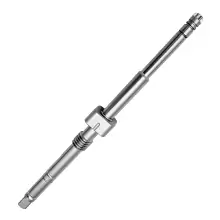
For example, we once machined a long-shaft part with a small diameter:
| Item | Details |
|---|---|
| Part Type | Precision Long Shaft |
| Diameter | Ø5 mm |
| Length | 160 mm |
| Tolerance | ±0.003 mm |
| Surface Finish | Ra 0.4 μm |
| Machine | TSUGAMI B0205-V Swiss-Type CNC Lathe |
The main machining challenge for this part was its high length-to-diameter ratio.
If machined on a conventional CNC lathe, the workpiece is prone to vibration, bending, and dimensional instability during the cutting process.
Thanks to the guide bush support and stable feed mechanism of the Swiss-type CNC lathe, the cutting area remains close to the support point at all times, effectively reducing material deflection. The final part achieved dimensional control of ±0.003 mm and a surface roughness of Ra 0.4 μm.
This case also demonstrates that Swiss machining is not merely about increasing machining speed, but rather about achieving more stable machining results when balancing small diameters, long lengths, and high-precision requirements.
YUANYI Swiss Machining Services
At YUANYI, we offer high-precision swiss machining services for slender shafts, connector pins, micro-structural components, and high-precision turned parts. Using the TSUGAMI B0205-V Swiss-Type CNC Lathe, we can achieve tolerances as tight as ±0.003 mm and a surface roughness of Ra 0.4 μm, and we support machining of stainless steel, aluminum alloys, titanium alloys, brass, copper, and engineering plastics. From prototypes and small batches to mass production, we offer no minimum order quantity (MOQ), 24-hour express quotes, 100% dimensional inspection, inspection reports, and material certificates to help customers select the most suitable machining solutions.
Need Precision Swiss Machining Parts?
Send us your drawing or CAD file. Our engineers will review your part structure, tolerance requirements, and material needs to recommend the right machining solution.
Upload Your DrawingConclusion
Swiss machining offers significant advantages for manufacturing small, high-precision, and long slender parts. By reducing vibration and material deflection, it can achieve tighter tolerances, better surface finishes, and more consistent production results than conventional turning in many applications.
Choosing the right machining process is just as important as choosing the right supplier. If you have a part drawing and would like expert advice, our engineering team can review your design and recommend the most suitable machining solution.
Frequently Asked Questions
If your part has a small diameter, long length, tight tolerance, or multiple features such as grooves, threads, cross holes, and milled flats, Swiss machining may be a better choice. If you are not sure, sending a drawing or CAD file for DFM review is the fastest way to confirm the right process.
Yes. Swiss machining can be used for prototypes, especially when the part is small, precise, or difficult to machine on a conventional lathe.
A 2D drawing or 3D CAD file is usually required. It is also helpful to provide material, quantity, tolerance requirements, surface finish, surface treatment, and any special inspection requirements.
At YUANYI, Swiss machining tolerances can reach ±0.003 mm for precision features, depending on material, part geometry, and inspection requirements. We also provide 100% dimensional inspection and inspection reports when required.
Yes. YUANYI supports prototypes, small-batch production, and volume production with No MOQ. This is useful for product development, testing, pilot production, and projects that have not yet moved into mass production.
Yes. We provide 100% dimensional inspection for precision parts and can supply inspection reports, material certificates, and other quality documents according to customer requirements.
Swiss machining is widely used in medical devices, electronics, aerospace, automation, robotics, precision instruments, and industrial equipment. It is especially valuable when parts are small, precise, and difficult to hold during machining.



