

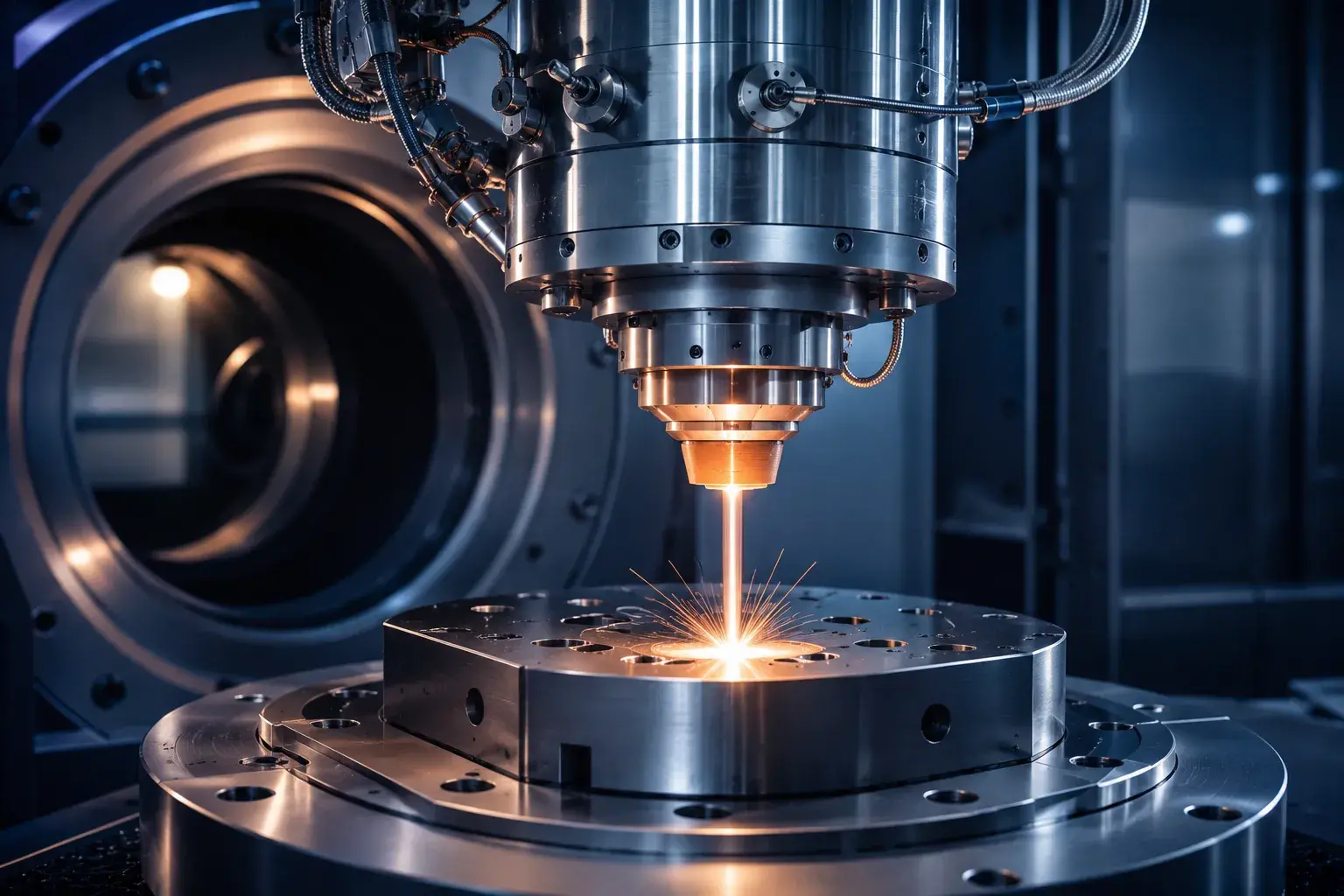
Electron Beam Machining is a high-precision, non-traditional machining process that utilizes the high energy generated by a high-speed electron beam to rapidly melt and vaporize material in a vacuum environment, thereby achieving precision machining.
Because it can machine microscopic features and high-melting-point materials, EBM is widely used in industries with extremely high precision requirements, such as aerospace, medical devices, and electronics manufacturing.
Although Electron Beam Machining offers extremely high machining precision, it is not suitable for all parts. This article will introduce the working principles, advantages, limitations, and typical applications of Electron Beam Machining, as well as its differences from CNC machining, EDM, and laser beam machining, to help you select the most appropriate machining process.
What Is Electron Beam Machining?
Electron Beam Machining is a non-traditional machining process that removes material using a high-speed electron beam. During the machining process, the electron beam is focused on the workpiece surface, rapidly converting kinetic energy into thermal energy, causing localized material to melt or vaporize instantaneously, thereby achieving high-precision machining.
Unlike traditional CNC machining, which relies on cutting tools, Electron Beam Machining is a non-contact process that generates virtually no mechanical cutting forces. As a result, it is particularly well-suited for machining micro-holes, precision slits, and difficult-to-machine materials such as titanium alloys and nickel-based superalloys.
However, because it requires operation in a high-vacuum environment and involves high equipment costs, electron beam machining is typically used for high-precision applications such as aerospace, medical devices, and electronics manufacturing, while most precision parts are still primarily produced using CNC machining.
How Does Electron Beam Machining Work?
The working principle of Electron Beam Machining can be understood as follows: the immense kinetic energy carried by a high-speed electron beam is converted into thermal energy, thereby enabling material removal.
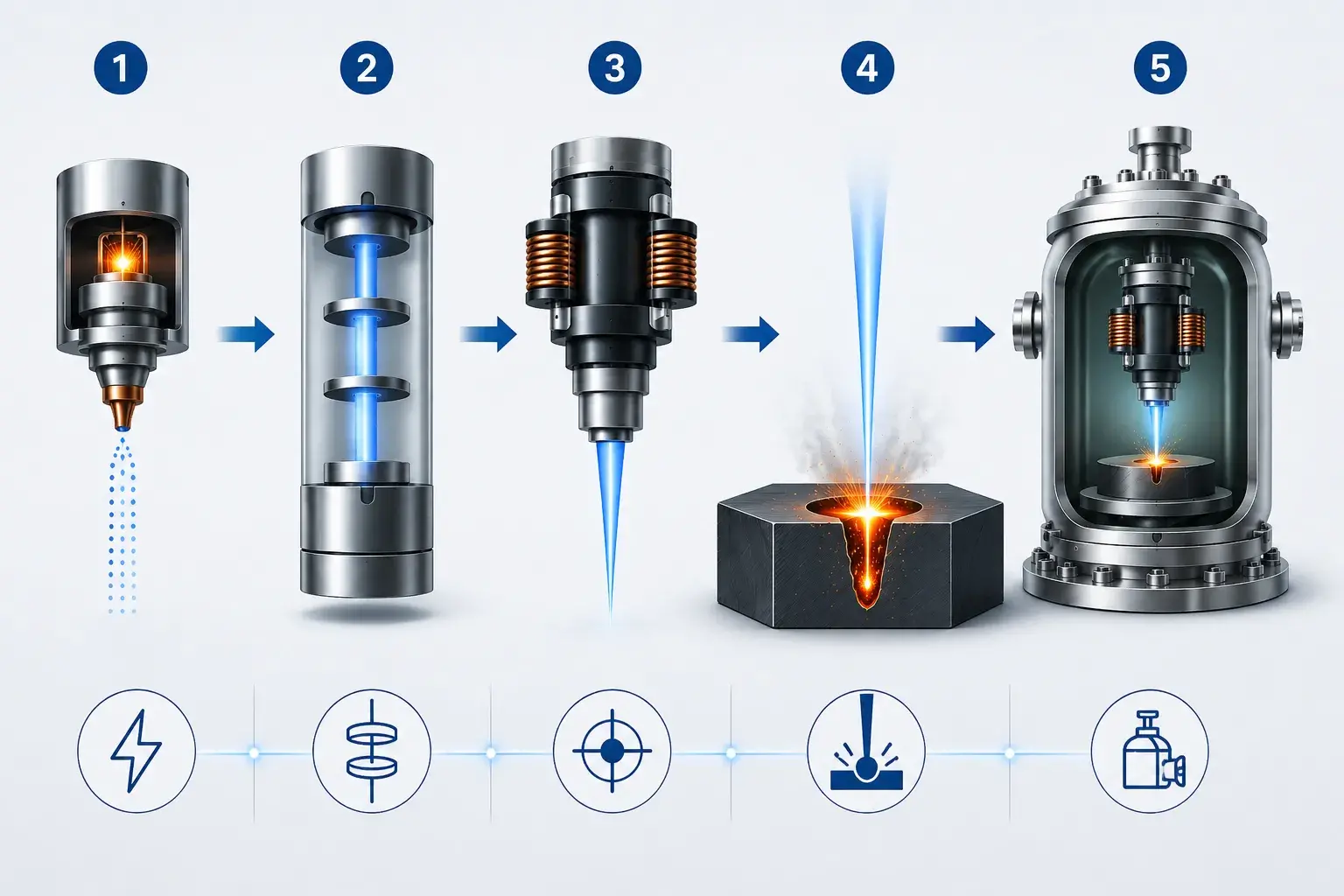
The entire machining process can generally be divided into the following steps:
Step 1 – Generate High-Speed Electrons
First, the cathode in the electron gun releases a large number of electrons under high temperatures. Subsequently, a high-voltage electric field rapidly accelerates these electrons, causing them to reach extremely high speeds.
Step 2 – Focus the Electron Beam
After passing through an electromagnetic lens, the high-speed electrons are focused into an electron beam with an extremely small diameter and highly concentrated energy. This is a key reason why electron beam machining can achieve ultra-high precision.
Step 3 – Remove Material by Melting and Vaporization
When the electron beam strikes the workpiece surface, the kinetic energy carried by the electrons is instantly converted into thermal energy, causing the local material to rapidly heat up until it melts or even vaporizes, thereby removing the material. Since the energy is concentrated in an extremely small area, the heat-affected zone surrounding the machining area is relatively small.
Step 4 – CNC-Controlled Beam Movement
During the machining process, either the electron beam or the workpiece moves precisely according to a preset program, thereby forming the desired holes, grooves, or complex contours to achieve high-precision machining.
The entire process typically must be carried out in a high-vacuum environment, as gas molecules in the air cause the electron beam to scatter, reducing machining accuracy and energy efficiency.
Main Components of an ebm machine System
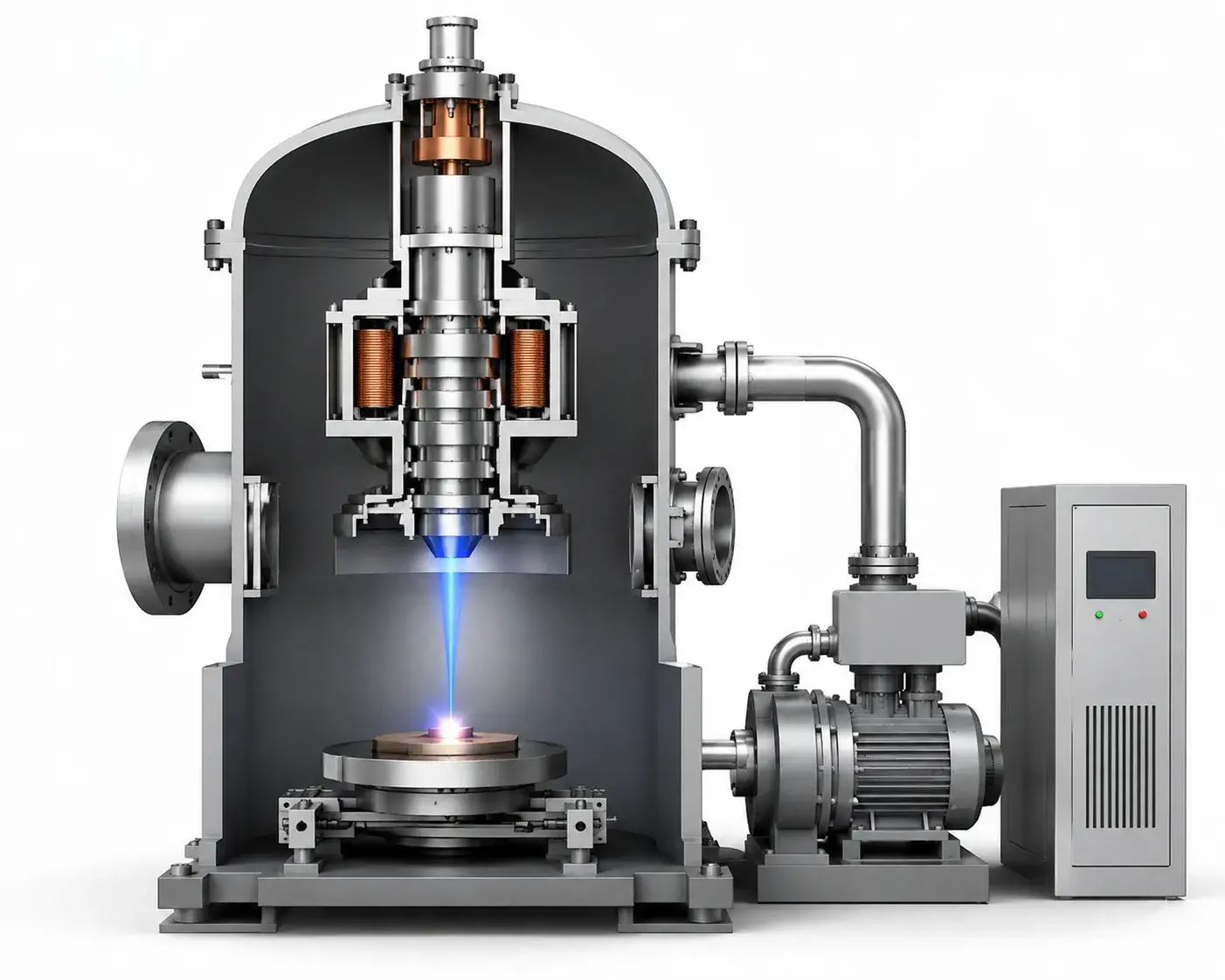
A complete ebm machine system consists primarily of several key components, which collectively determine the stability of the electron beam, its focusing capability, and the final machining accuracy.
Electron Gun
The electron gun is the core of the entire system, responsible for generating and accelerating electrons. It releases electrons from a high-temperature cathode and then uses a high-voltage electric field to accelerate them to extremely high speeds, providing the energy source for subsequent machining.
Electromagnetic Lens
The electromagnetic lens functions similarly to an optical lens; it focuses the divergent electron beam into an extremely fine beam, increasing energy density and thereby achieving micron-level machining precision.
Vacuum Chamber
Electron Beam Machining must be performed in a high-vacuum environment. The vacuum not only prevents the electron beam from colliding with air molecules but also ensures stable propagation of the electron beam, thereby improving machining quality.
Worktable and Motion System
The worktable secures the workpiece and performs precise movements according to CNC programs, enabling the electron beam to complete machining along the designed trajectory.
Control System
The control system regulates the electron beam power, machining time, focus position, and motion trajectory, ensuring excellent stability and repeatability throughout the entire machining process.
Not Sure Which Machining Process Is Right for Your Part?
Choosing the right manufacturing process can improve part quality, reduce machining costs, and shorten lead times. Our engineering team will review your drawings and recommend the most suitable solution based on your part geometry, material, tolerance, and production volume.
Get a Free Engineering ReviewAdvantages of Electron Beam Machining
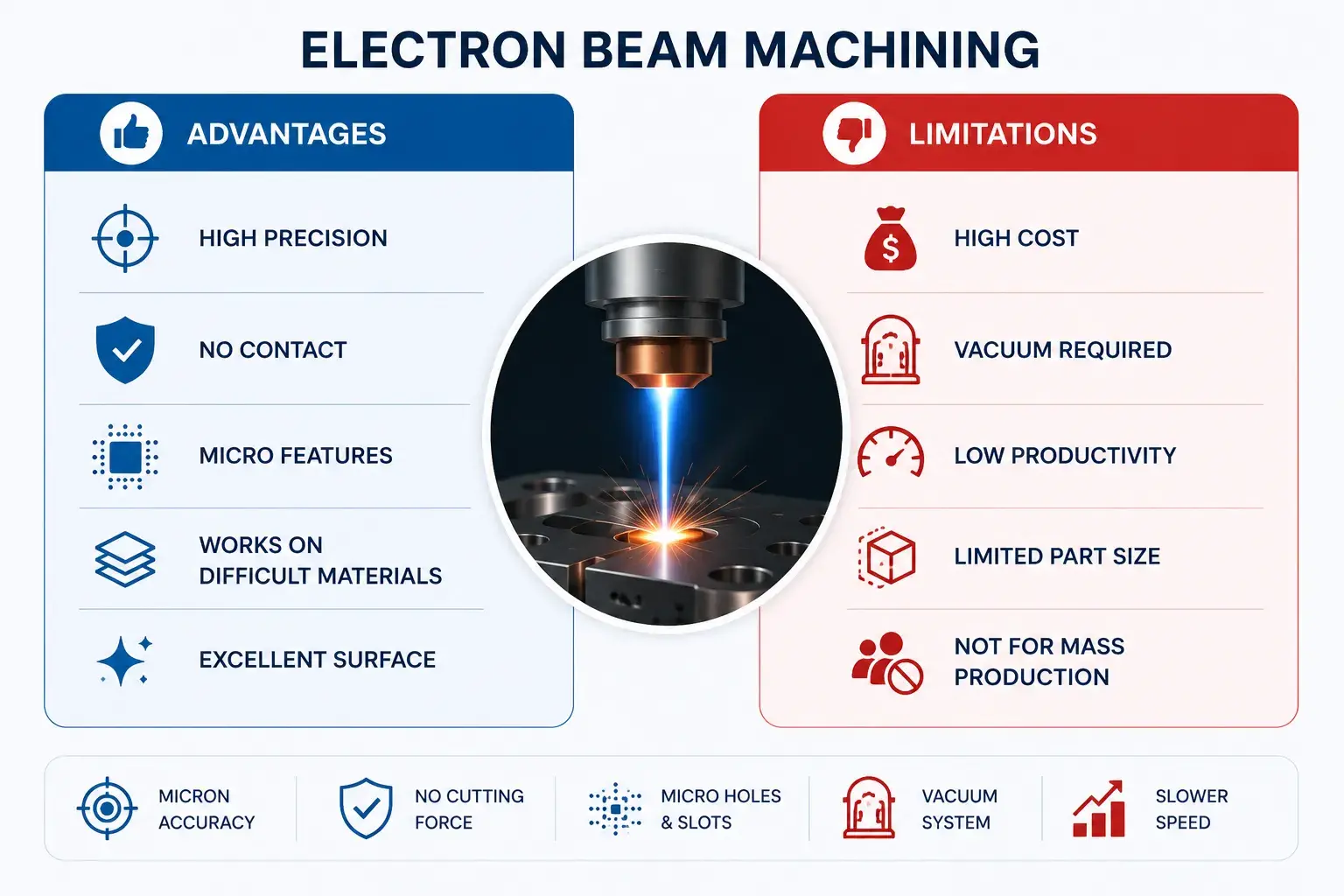
Electron Beam Machining is used in fields such as aerospace, medical devices, and electronics manufacturing, primarily because it offers many advantages in precision machining that are difficult to achieve with traditional machining methods.
Extremely High Precision: An electron beam can be focused to an extremely small diameter, enabling the machining of microscopic holes, fine grooves, and complex micro-features. Machining accuracy typically reaches the micrometer level, making it ideal for the manufacture of high-precision parts.
No Mechanical Cutting Force: Since Electron Beam Machining is a non-contact process, no cutting forces are generated throughout the entire process, thereby reducing workpiece deformation and making it particularly suitable for machining thin-walled and precision parts.
Suitable for Hard-to-Machine Materials: EBM can machine a wide range of high-melting-point and high-strength materials, such as titanium alloys, Inconel, tungsten alloys, and certain specialty stainless steels, without suffering the rapid wear associated with traditional cutting tools.
Small Heat-Affected Zone: Although Electron Beam Machining removes material using high temperatures, the electron beam’s effect is highly localized, resulting in minimal thermal impact on the surrounding material. This helps reduce thermal deformation and improves machining quality.
Burr-Free Micro Machining: For micro-holes and precision structures, Electron Beam Machining typically achieves superior edge quality, reducing the need for subsequent deburring and finishing operations.
Limitations of Electron Beam Machining
Although electron beam machining offers extremely high machining precision, it is not the optimal choice for all parts, and there are still some significant limitations in actual manufacturing.
High Equipment Cost: Electron beam machining equipment requires an electron gun, a high-voltage power supply, and a complete vacuum system; therefore, the capital investment and maintenance costs are significantly higher than those of conventional CNC machine tools.
Vacuum Environment Required: The entire machining process must be carried out in a high-vacuum environment; otherwise, the electron beam is susceptible to interference from air molecules, which affects machining accuracy. This also results in relatively long setup times.
Limited Workpiece Size: Due to the size limitations of the vacuum chamber, Electron Beam Machining is better suited for machining small or medium-sized precision parts and is not suitable for large structural components.
Lower Production Efficiency: Compared to high-speed CNC machining, electron beam machining has lower overall production efficiency and is therefore generally unsuitable for high-volume production.
High Operating Requirements: Equipment parameters, electron beam focusing, and vacuum control all require professional technicians for commissioning and maintenance, resulting in a relatively high barrier to entry.
What Materials Can Be Machined Using Electron Beam Machining?
Electron Beam Machining can process a wide range of conductive metal materials and is particularly well-suited for high-performance alloys that are difficult to machine using conventional cutting methods.
Common materials processed include:
| Material | Suitability | Typical Applications |
|---|---|---|
| Titanium | Excellent | Aerospace, Medical |
| Stainless Steel | Excellent | Medical Devices |
| Inconel | Excellent | Turbine Components |
| Tungsten | Excellent | High-Temperature Parts |
| Copper | Good | Electronics |
| Aluminum | Good | Precision Components |
Among these, titanium alloys, nickel-based superalloys, and tungsten alloys are the most common materials processed using electron beam machining. These materials typically feature high strength, high melting points, or high-temperature resistance; machining them with conventional cutting tools can easily lead to tool wear, whereas electron beam machining effectively addresses these issues.
However, for common parts made of standard aluminum alloys, stainless steel, and similar materials—provided there is no need for micro-machining—CNC machining often yields higher production efficiency and lower manufacturing costs.
Common Applications of Electron Beam Machining
Due to its extremely high machining precision, Electron Beam Machining is primarily used in industries with stringent requirements for dimensions, quality, and material properties.
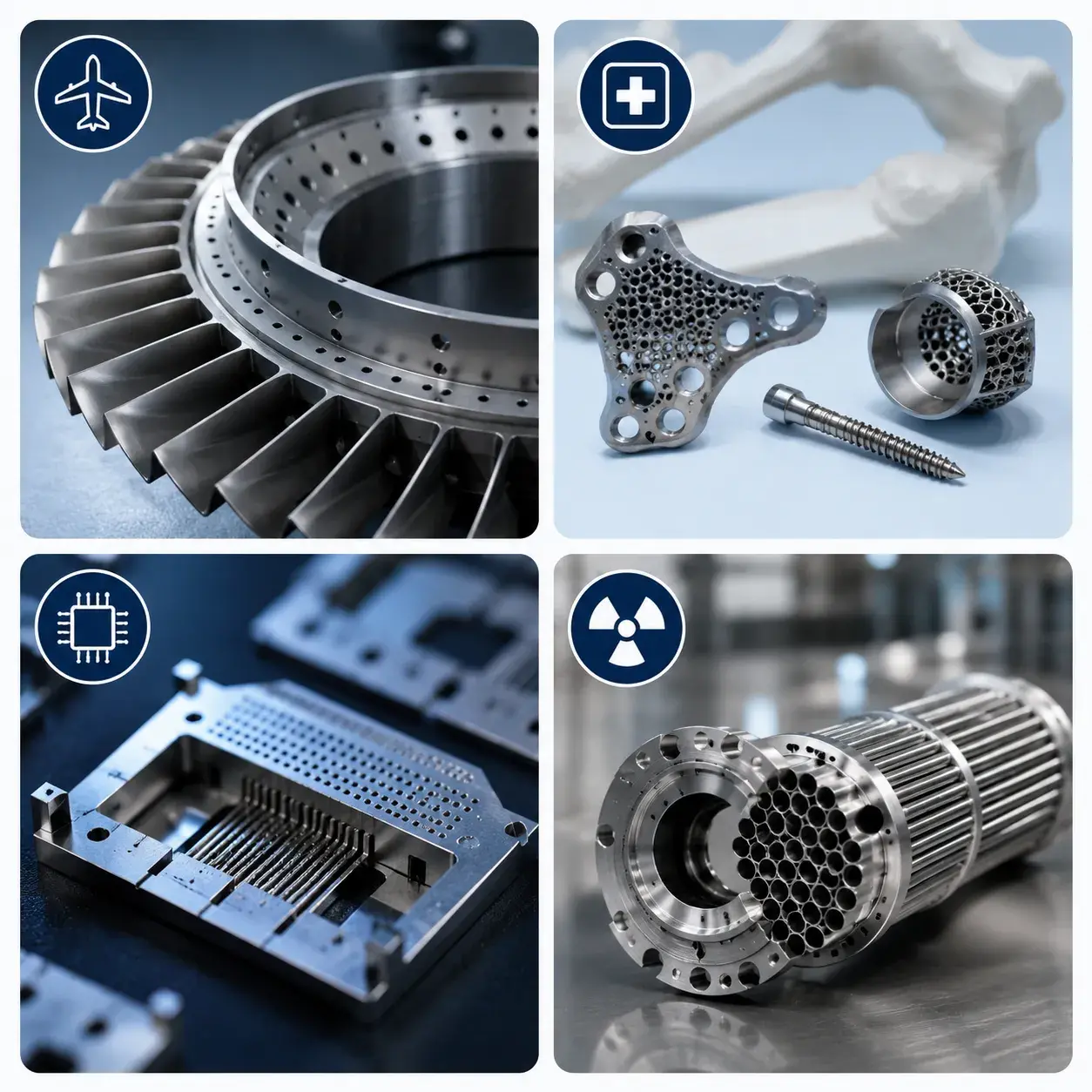
Aerospace
It is used to machine engine parts, fuel nozzles, cooling holes, and high-temperature alloy components, which typically require extremely high dimensional accuracy and high-temperature resistance.
Medical Devices
It can be used to manufacture surgical instruments, implants, and other high-precision medical components, and is particularly suitable for machining micro-holes and fine structures.
Electronics & Semiconductors
Electron Beam Machining can be used to machine electronic connectors, micro-components, and certain semiconductor devices, offering distinct advantages for small-sized parts in the electronics industry.
Nuclear Industry
It is used to machine parts made of special materials that are resistant to high temperatures and corrosion, meeting the nuclear industry’s requirements for reliability and machining precision.
Electron Beam Machining vs Other Machining Processes
Electron beam machining is not the only non-traditional machining process; it differs significantly from laser beam machining and EDM in terms of both machining principles and scope of application.
Electron Beam Machining vs Laser Beam Machining:
| Feature | Electron Beam Machining | Laser Beam Machining |
|---|---|---|
| Energy Source | Electron Beam | Laser |
| Working Environment | Vacuum Required | Air or Gas |
| Precision | Very High | High |
| Heat-Affected Zone | Smaller | Larger |
| Equipment Cost | Higher | Lower |
| Typical Applications | Micro Machining | Cutting & Welding |
Electron Beam Machining vs EDM
| Feature | Electron Beam Machining | EDM |
|---|---|---|
| Material Removal | Thermal Energy | Electrical Discharge |
| Vacuum Required | Yes | No |
| Conductive Material Required | No | Yes |
| Micro Hole Capability | Excellent | Good |
| Surface Finish | Excellent | Excellent |
Electron Beam Machining vs CNC Machining
Electron beam machining and CNC machining are not mutually exclusive; rather, each is better suited for different types of machining needs.
| Requirement | Electron Beam Machining | CNC Machining |
|---|---|---|
| Large Parts | ❌ | ✅ |
| Complex 3D Parts | △ | ✅ |
| Micro Holes | ✅ | △ |
| High-Volume Production | ❌ | ✅ |
| Cost Efficiency | ❌ | ✅ |
| Difficult Materials | ✅ | ✅ |
When Should You Choose Electron Beam Machining?
Electron beam machining is not suitable for all manufacturing projects, but for certain specialized applications, it is virtually the best choice.
Situations where electron beam machining should be considered include:
- When machining tiny holes or micro-features is required.
- When working with difficult-to-machine materials such as titanium alloys, Inconel, and tungsten alloys.
- When extremely low levels of burrs and machining distortion are required.
- The parts are small in size and require extremely high precision.
If the parts are standard mechanical structural components, are large in size, require mass production, or if cost control is a key priority for the project, then CNC machining is typically the more economical and efficient choice.
Why Most Precision Parts Are Still Manufactured by CNC Machining
Although electron beam machining offers unique advantages in the field of microfabrication, CNC machining remains the most widely used manufacturing process for most industrial parts.
Modern CNC machining not only enables high-precision machining but also offers higher production efficiency, broader material compatibility, and lower manufacturing costs. In particular, with the development of advanced equipment such as 5-axis CNC, Swiss machining, and mill-turn machines, many parts that previously required specialized processes can now be produced using CNC machining.
Not Sure Which Machining Process Is Right for Your Part?
Choosing the right manufacturing process can improve part quality, reduce machining costs, and shorten lead times. Our engineering team will review your drawings and recommend the most suitable solution based on your part geometry, material, tolerance, and production volume.
Get a Free Engineering ReviewConclusion
Electron Beam Machining is a manufacturing process particularly well-suited for high precision, micro-features, and difficult-to-machine materials, playing a significant role in fields such as aerospace, medical devices, and electronics manufacturing. However, due to high equipment costs, the need for a vacuum environment, and relatively low production efficiency, it is used more for specialized precision machining rather than routine parts manufacturing.
For most precision metal parts, CNC machining remains a more economical, flexible, and widely applicable manufacturing method. Whether for prototype development or mass production, the selection of an appropriate machining process should be based on a comprehensive evaluation of the part’s geometry, material, precision requirements, and production volume, rather than simply favoring a single machining technology.
Frequently Asked Questions
No. Electron Beam Machining (EBM) uses an electron beam to remove material through melting and vaporization, whereas Electron Beam Welding (EBW) uses an electron beam to melt the interface between two pieces of material to join them. While both utilize similar electron beam technology, their intended applications are completely different.
In air, electron beams tend to collide with gas molecules, leading to energy loss and beam divergence. A high-vacuum environment ensures stable beam focusing and improves machining precision while minimizing oxidation and contamination.
Electron Beam Machining typically achieves micron-level precision, making it ideal for producing micro-holes, precision slits, and other intricate features. However, actual precision depends on factors such as material type, equipment performance, and machining parameters.
Generally, no. Due to high equipment costs and the requirement for a vacuum environment, Electron Beam Machining is better suited for high-value, low-volume, or specialized precision components rather than mass production.
If your part is a standard mechanical structural component—characterized by large dimensions, complex 3D contours, or a need for batch production—or if you wish to control manufacturing costs, CNC machining is usually the more economical and efficient choice. For the vast majority of industrial parts, modern CNC milling, CNC turning, and 5-axis CNC machining are capable of meeting high-precision machining requirements.



