
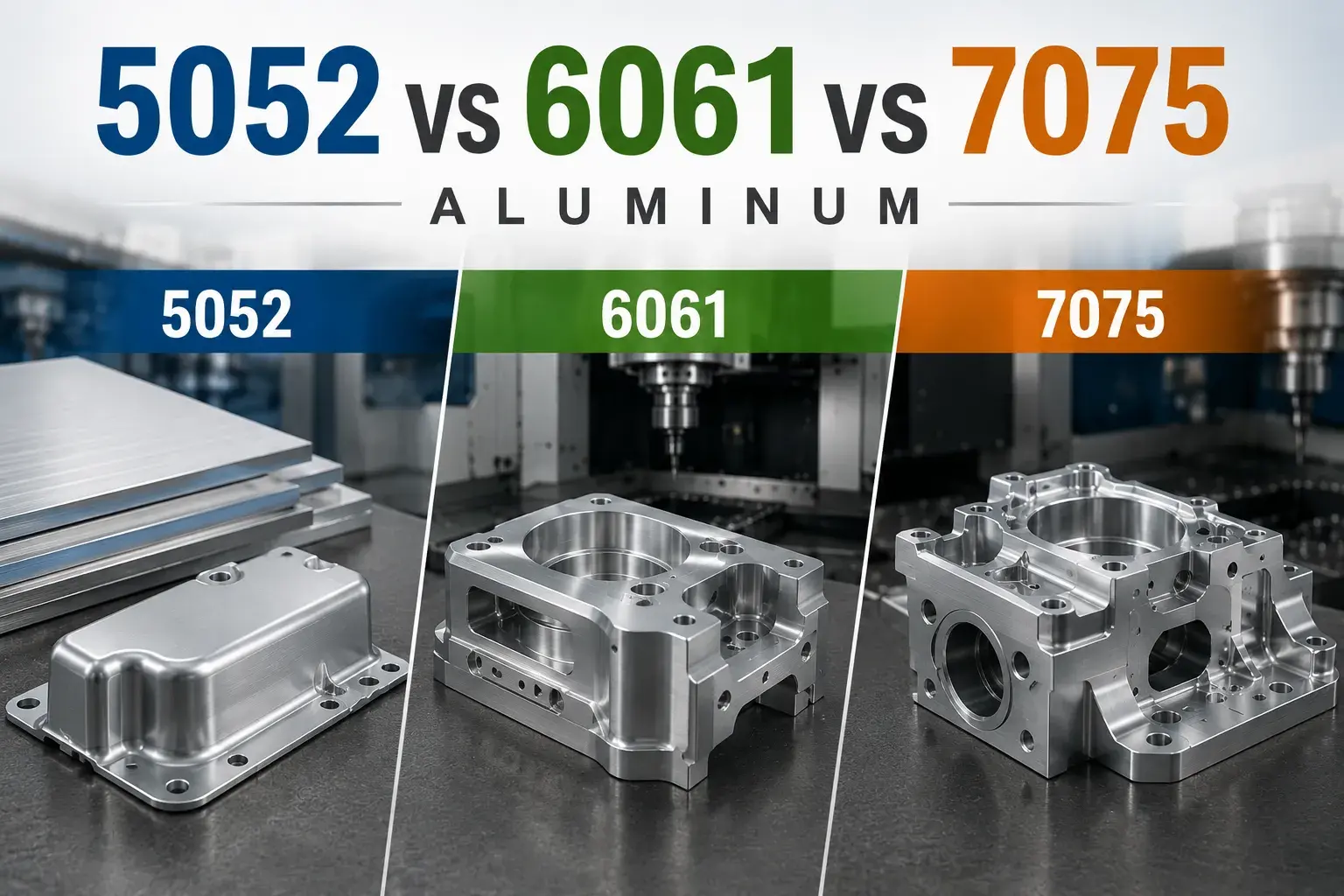
5052 vs 6061 vs 7075 Aluminum: Which Alloy Should You Choose?

When comparing 5052, 6061, and 7075 aluminum, no single material is suitable for all applications. 5052 aluminum offers excellent corrosion resistance and formability; 6061 aluminum is the most well-balanced and widely used material for CNC machining; and 7075 aluminum has the highest strength, making it suitable for high-load and aerospace applications.

This article compares the properties, machinability, cost, and applications of these three aluminum alloys to help you quickly select the material best suited to your project’s needs.

Aluminum alloy comparison chart

5052 vs 6061 vs 7075: Quick Comparison

For most engineering projects, you can start by referring to the quick comparison table below.

Property50526061-T67075-T6
Strength★★★★★★★★★★★
Machinability★★★★★★★★★★★
Corrosion Resistance★★★★★★★★★★★
Weldability★★★★★★★★★★
Formability★★★★★★★★★
Anodizing AppearanceGoodExcellentGood
CostLowMediumHigh
Typical ApplicationsMarine, Sheet MetalGeneral CNC PartsAerospace, High-Strength Parts

What Are the Main Differences Between 5052, 6061, and 7075 Aluminum?

Although 5052 aluminum, 6061 aluminum, and 7075 aluminum are all aluminum alloys, their alloying elements, heat treatment methods, and intended applications are completely different, making them suitable for different types of products.
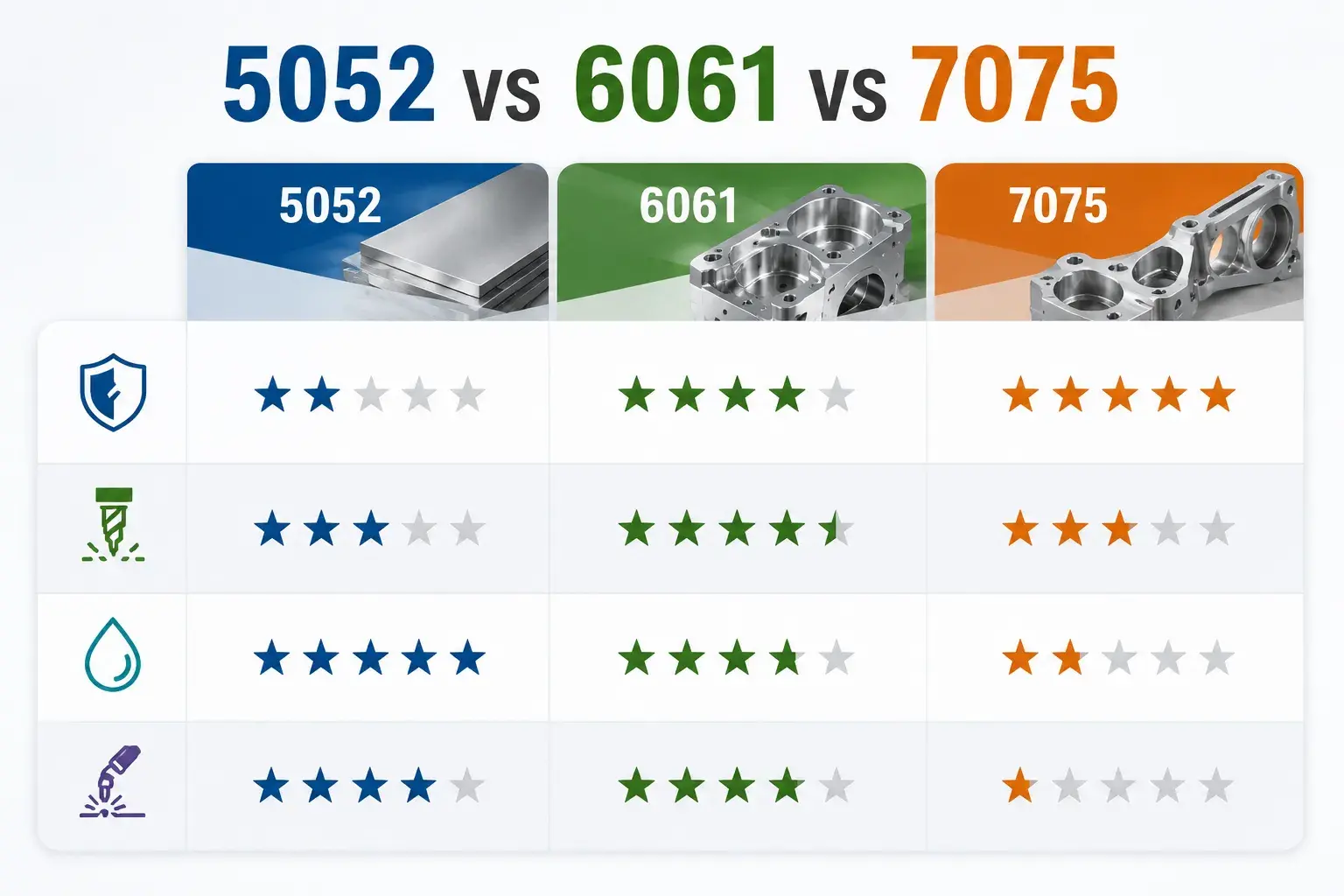
5052 vs 6061 vs 7075 comparison

5052 Aluminum

5052 is an Al-Mg (aluminum-magnesium) alloy. Its most notable feature is excellent corrosion resistance, combined with good ductility and weldability. Since its strength cannot be enhanced through heat treatment, its overall strength is lower than that of 6061 and 7075; however, it is well-suited for sheet metal parts that require bending, stamping, or welding.

Typical applications include:

  • Marine equipment
  • Fuel tanks
  • Electrical enclosures
  • Sheet metal parts
  • Chemical equipment

6061 Aluminum

6061 is one of the most widely used heat-treated aluminum alloys today and is also the most common material in CNC machining.

It strikes an excellent balance between strength, machinability, corrosion resistance, weldability, and cost, making it widely used in automated equipment, robots, medical devices, industrial equipment, and various precision mechanical parts.

Compared to 5052, 6061 offers more consistent machining accuracy; compared to 7075, it is less expensive and poses fewer machining risks, making it the default recommendation for most CNC shops.

Typical applications include:

  • CNC machined parts
  • Robotics
  • Automation equipment
  • Medical devices
  • Industrial machinery
  • Consumer products

7075 Aluminum

7075 is a high-strength aerospace-grade aluminum alloy. Its primary alloying element is zinc, which gives it extremely high strength and hardness.

In the T6 condition, the tensile strength of 7075 can approach that of some low-carbon steels, making it widely used in aerospace, racing, drones, and various high-load structural components.

However, high strength also means higher processing costs and more stringent requirements for weldability and corrosion resistance; therefore, 7075 is not suitable for all projects.

Typical applications include:

  • Aerospace components
  • Aircraft structural parts
  • Drone frames
  • Motorsport components
  • High-load fixtures
  • Defense equipment

Overall, each of these three materials has its own advantages, and there is no single “best” option in an absolute sense.

If your priority is corrosion resistance and formability, 5052 is the better choice; if you’re looking for a CNC machining material with the most balanced overall performance, 6061 is often the best option; and for applications requiring the highest strength and lightest weight, 7075 offers the greatest advantages.
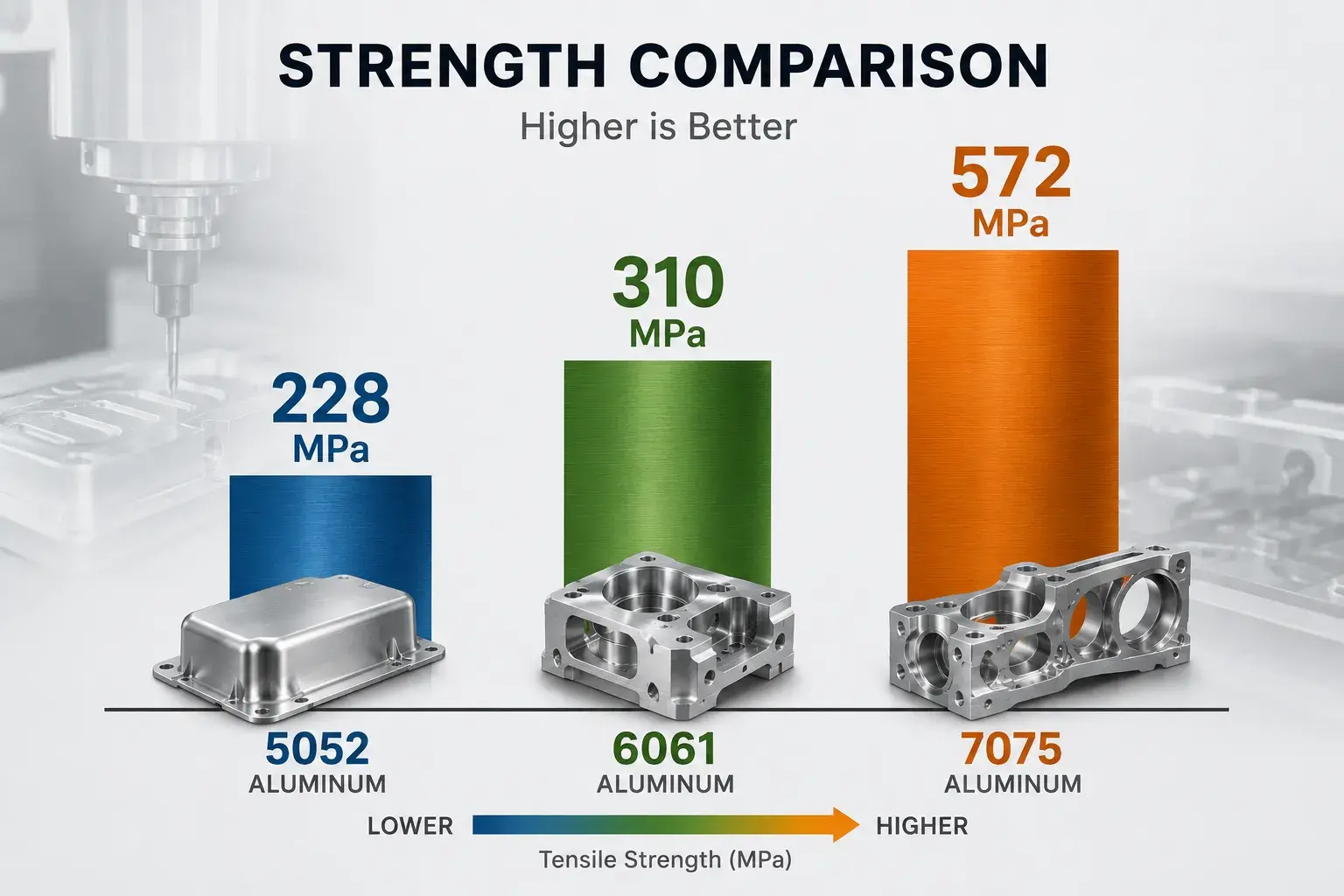
5052 vs 6061 vs 7075 Aluminum Strength Comparison

Strength comparison of aluminum alloys

Strength is one of the most important factors to consider when selecting an aluminum alloy, but it is not the only one. In addition to tensile strength and yield strength, hardness, density, fatigue properties, and heat treatability also affect a part’s service life, machining methods, and end uses.

The table below shows the typical mechanical properties of 5052 aluminum, 6061 aluminum, and 7075 aluminum in their common conditions.

Property5052-H326061-T67075-T6
Tensile Strength~228 MPa~310 MPa~572 MPa
Yield Strength~193 MPa~276 MPa~503 MPa
Brinell Hardness~60 HB~95 HB~150 HB
Density2.68 g/cm³2.70 g/cm³2.81 g/cm³
Elongation12–20%8–12%5–11%
Fatigue StrengthGoodVery GoodExcellent
Heat TreatableNoYesYes

Strength and Hardness

7075 aluminum has the highest strength and hardness among the three materials and is suitable for high-load and aerospace applications. 6061 aluminum offers the most balanced overall performance and is the most common material for CNC machining; 5052 aluminum has lower strength but offers better ductility and formability.

Weight and Fatigue Resistance

The densities of these three aluminum alloys are very similar, so differences in weight are negligible. 7075 aluminum offers the best fatigue performance; 6061 aluminum meets the requirements of most industrial applications; and 5052 aluminum is better suited for low- to medium-load environments.

Heat Treatability

Both 6061 aluminum and 7075 aluminum can have their strength enhanced through heat treatment, making them suitable for high-performance parts. 5052 aluminum cannot be heat-treated for strengthening but offers better weldability, formability, and corrosion resistance.

Which Aluminum Alloy Is Best for CNC Machining?

In CNC machining, machinability directly affects machining efficiency, tool life, and machining costs. Overall, 6061 aluminum offers the best overall machinability, 7075 aluminum is better suited for high-strength precision parts, and 5052 aluminum is more suitable for sheet metal and simple structural components.

Machining Factor505260617075
MachinabilityFairExcellentVery Good
Surface FinishGoodExcellentExcellent
Tool WearMediumLowMedium
Dimensional StabilityFairExcellentVery Good
Best ForSheet Metal PartsGeneral CNC PartsHigh-Strength Precision Parts

Overall Recommendation

  • 5052 Aluminum — Best for sheet metal and corrosion-resistant parts.
  • 6061 Aluminum — Best overall choice for most CNC Machining projects.
  • 7075 Aluminum — Best for aerospace and high-strength precision components.

5052 vs 6061 vs 7075 Corrosion Resistance, Weldability, and Anodizing Comparison

In addition to strength and machinability, corrosion resistance, weldability, and anodizing performance are also important factors in selecting an aluminum alloy. Overall, 5052 aluminum performs best in terms of corrosion resistance and weldability; 6061 aluminum offers well-balanced overall performance; and 7075 aluminum is better suited for high-strength applications, but has relatively weaker corrosion resistance and weldability.

Property505260617075
Corrosion ResistanceExcellentVery GoodGood
WeldabilityExcellentGoodPoor
Anodizing AppearanceGoodExcellentGood

Overall Recommendation

  • 5052 Aluminum — Best for marine environments and welded structures.
  • 6061 Aluminum — Best all-around choice with excellent anodizing results.
  • 7075 Aluminum — Best for strength-critical parts where welding is not required.

5052 vs. 6061 vs. 7075 Aluminum: Formability and Bending Comparison

If a part requires bending, stamping, or deep drawing, the material’s formability is critical.

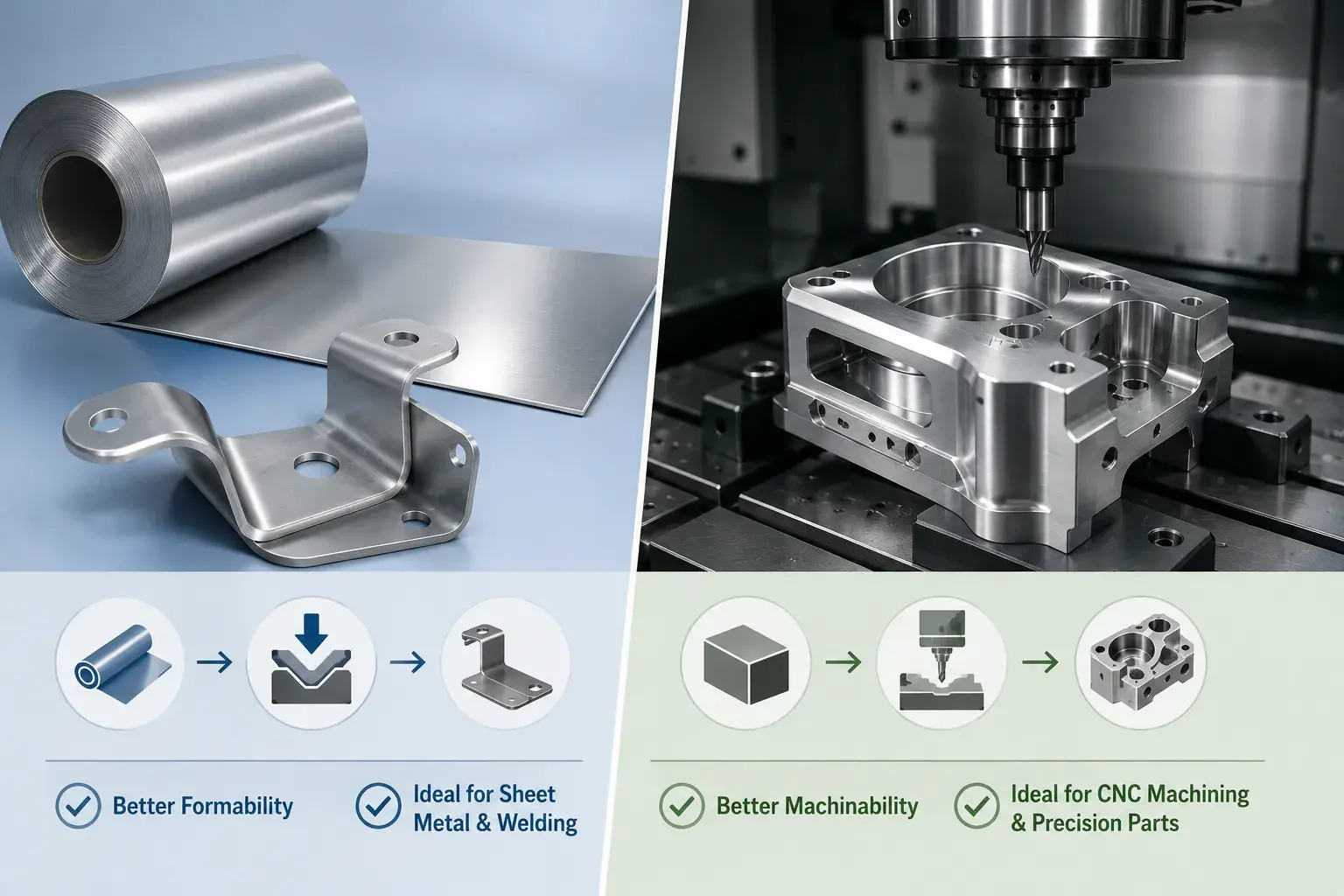
  • Among these three aluminum alloys, 5052 aluminum offers the best formability. It has high ductility and is not prone to cracking even when bent at large angles, making it ideal for various sheet metal fabrication and complex formed parts.
  • In contrast, 6061 aluminum can also be bent, but due to its higher strength, it typically requires a larger bending radius and careful control of the processing techniques; otherwise, cracks are likely to form in the bent areas.
  • 7075 aluminum is better suited for machining than for bending. Although it has high strength, its low ductility makes it more prone to cracking during forming; therefore, it is typically used for high-strength CNC-machined parts rather than sheet metal products requiring complex bending.
Sheet metal forming vs CNC machining

How to Choose Between 5052, 6061, and 7075 Aluminum

When selecting an aluminum alloy, it is not recommended to focus solely on strength; instead, you should comprehensively consider the following factors:

  • Application: The operating environment and load requirements of the part.
  • Manufacturing Process: Whether it involves CNC machining, sheet metal bending, or welding.
  • Corrosion Resistance: Whether the part will be used long-term in humid or outdoor environments.
  • Budget: High-strength materials typically entail higher material and machining costs.

If you are still unsure which material is best suited for your project, we recommend consulting a fabrication supplier early in the design phase to select the most appropriate aluminum alloy based on the part’s structure, machining process, and budget.

Not Sure Which Aluminum Alloy Is Right for Your Project?

Upload your CAD files and our engineering team will recommend the most suitable 5052, 6061, or 7075 aluminum based on your part design, application, and budget.

Get a Free Quote

Conclusion

As shown by the comparison above, 5052 aluminum, 6061 aluminum, and 7075 aluminum each have their own advantages, and no single material is suitable for all projects. Selecting the appropriate aluminum alloy based on the part’s performance requirements, machining methods, and operating environment is often more important than simply pursuing the highest strength.

Frequently Asked Questions

Yes, but the anodized color and consistency will vary between different alloys. 6061 aluminum typically yields the most uniform appearance.

6061 aluminum is the most commonly used material for prototype machining because it is easy to machine, moderately priced, and meets most functional testing requirements.

Generally, yes. High-strength aluminum alloys (such as 7075 aluminum) typically have higher material and machining costs than 5052 and 6061 aluminum. (This isn’t explained in the main text)

If parts are exposed to moisture or outdoor environments for extended periods, 5052 aluminum is generally more suitable than 7075 aluminum because it has better corrosion resistance.

Not necessarily. While 7075 aluminum is stronger, its cost, weldability, and corrosion resistance differ from 6061 aluminum. The choice should be made based on the specific application.

Yes. Based on your part design, application, and performance requirements, our engineers can recommend the most suitable aluminum alloy before production.

Yes. We support prototype machining, low-volume production, and full-scale manufacturing to help verify your design before production.

Table of Contents
Discuss Your Complex Machining Requirements

Need Custom CNC Machined Parts?

From rapid prototypes to low-volume production, our engineering team can review your drawings and provide a manufacturing quote.

  • 24-Hour Quotation
  • DFM Engineering Support
  • No Minimum Order
  • ISO 9001 Certified
Request A Quote
Upload your drawing and get a quote within 24 hours.


