
Many people assume that high-quality 5-axis machining mainly depends on the CNC machine itself.
In reality, the machine only performs the cutting. What determines how the tool moves, which angle it cuts from, and how potential collisions are avoided is the 5-axis machining software behind the process.
For simple components, the difference may not be obvious. But when machining deep cavities, freeform surfaces, or parts with multiple angled features, good software can make a significant difference. It helps improve machining efficiency, part quality, and overall production reliability.
Let’s take a closer look at what 5-axis machining software actually does and why it matters.
What Is 5 Axis Machining Software?
5-axis machining software is the system used to program and optimize machining operations for a 5-axis CNC machine.
After importing a CAD model, the software generates the machining toolpaths, calculates tool orientation, and creates the CNC program that the machine will execute. It also checks the machining process before production begins, helping engineers identify potential problems early.
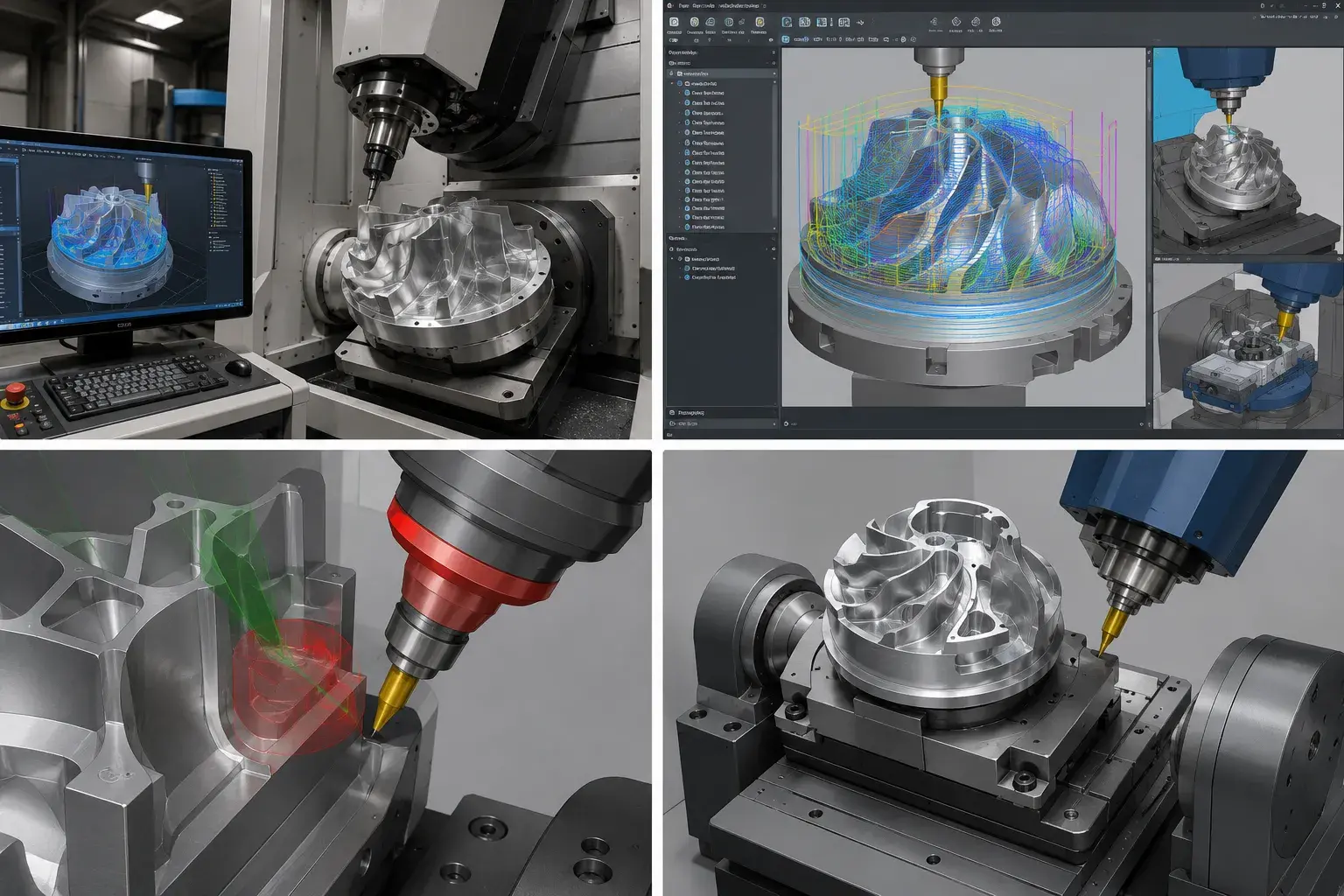
Without this planning process, machining complex parts becomes more difficult. Programming takes longer, toolpaths may be less efficient, and the risk of collisions or machining errors increases.
Key Features of 5 Axis Machining Software
While different CAM systems offer different capabilities, most modern 5-axis machining software includes several essential features.
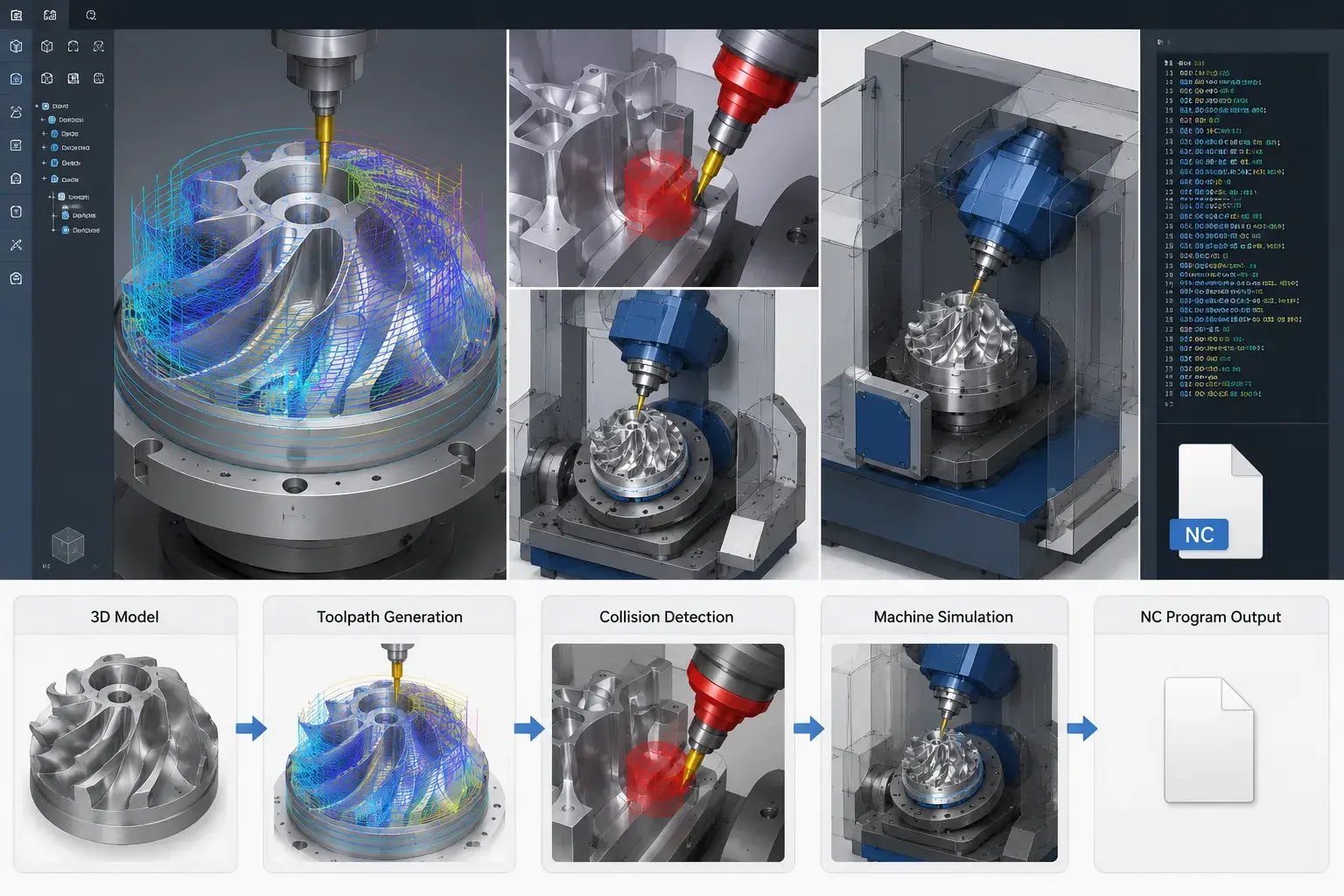
Automatic Toolpath Generation
The software automatically creates efficient toolpaths based on the part geometry. This reduces manual programming and helps keep tool movement smooth and consistent.
Collision Detection
Before machining starts, the software checks for possible collisions between the cutting tool, toolholder, fixtures, spindle, and the workpiece. This allows engineers to correct potential issues before production.
Machining Simulation
The entire machining process can be simulated in advance. Engineers can verify tool movements, machining sequences, and machine positions without running a physical test.
CNC Program Output
Once the toolpaths are complete, the software converts them into CNC programs that match different machine controllers, making it easy to transfer the program directly to the machine.
Although these features are used during programming, their biggest impact is seen in machining quality, production efficiency, and delivery performance.
How Does 5 Axis Machining Software Improve Complex Part Production?
The advantages of 5-axis machining software become much more noticeable when producing complex components.
Better Toolpath Control
Poorly planned toolpaths often result in unnecessary tool movements and longer machining cycles.
Modern 5-axis software optimizes the cutting path to keep machining smooth and continuous, helping reduce cycle time while improving productivity.
Lower Collision Risk
Deep cavities and complex geometries leave very little space between the toolholder and the workpiece.
By simulating the machining process in advance, engineers can detect potential collisions early and modify the machining strategy before production starts, reducing both downtime and material waste.
Easier Machining of Complex Surfaces
Components such as impellers, medical parts, and robotic components often contain challenging curved surfaces.
The software automatically adjusts the tool angle throughout the machining process, allowing these surfaces to be machined more accurately while maintaining a better surface finish.
Fewer Setups
Many complex parts require machining on multiple sides.
With optimized 5-axis toolpaths, more operations can be completed in a single setup. This reduces repositioning, shortens production time, and improves dimensional accuracy.

Common Applications
5-axis machining software is widely used in industries that require complex geometries and high machining precision.
Typical applications include:
- Aerospace components
- Medical devices
- Automotive parts
- Robotics components
- Mold and die manufacturing
- Industrial automation equipment
These parts often include deep pockets, curved surfaces, angled holes, and multiple machining features that benefit from advanced toolpath planning.
How YUANYI Uses 5 Axis CAM Software
At YUANYI, machining quality starts long before the machine begins cutting.
For complex components, our engineers create optimized toolpaths using professional CAM software, verify the machining process through simulation, and perform collision checks before the program reaches the CNC machine.
This workflow helps reduce setup time, improve machining stability, and deliver consistent quality for precision-machined parts.
Conclusion
5-axis machining software is much more than a programming tool. It plays a key role in planning efficient machining strategies, preventing collisions, and improving overall machining performance.
When producing complex parts, the combination of advanced software, experienced engineers, and reliable CNC equipment leads to better quality, shorter lead times, and more consistent results.
Frequently Asked Questions
In most cases, yes. A 5-axis machining software package is typically a CAM system that supports simultaneous 5-axis programming.
por incididunt ut labore et dolore magna aliqua. Ut enim ad minim veniam, quis nostrud exercitation.
It significantly reduces the risk through simulation and collision detection, but experienced engineers should always review the machining strategy before production.
For complex parts, simulation is highly recommended because it helps identify potential problems before machining begins.
Parts with deep cavities, freeform surfaces, angled features, or multiple machining faces benefit the most from advanced 5-axis toolpath planning.
Not necessarily. Software is only one part of the process. The experience of the engineering team, machining strategy, CNC equipment, and quality control all play equally important roles.



