
Manual Milling: Process, Machines, Applications & CNC Comparison

Manual milling is a machining process where an operator controls the movement of the machine instead of running a CNC program. The cutting tool rotates while the operator moves the workpiece or machine axes to remove material.

It is still widely used for simple one-off parts, repair work, fixture modification, prototypes, and jobs that do not justify CNC programming time.

We will explain how manual milling works, what it can do, and when it makes more sense than CNC milling.

What Is Manual Milling?

Manual milling is a subtractive machining process controlled directly by a machine operator. A rotating milling cutter removes material from a workpiece while the operator controls the table, spindle, feed, and cutting depth.
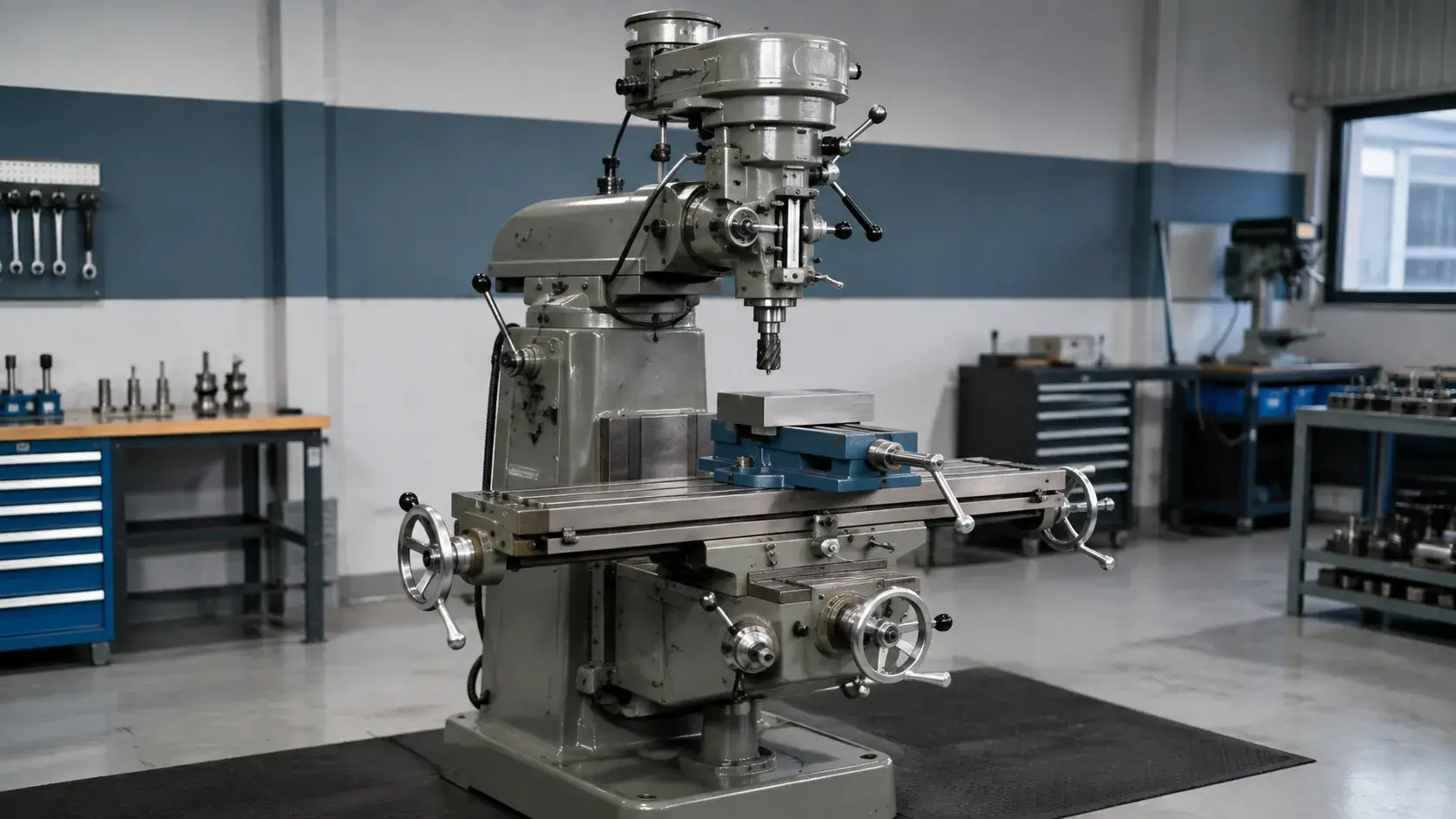
Manual milling machine in a machine shop

Most manual milling machines use handwheels to move the X, Y, and Z axes. Many modern machines also include a digital readout (DRO), power feed, and variable spindle speed to make positioning easier and more accurate.

Manual milling does not mean the machinist works by eye. Operators normally use drawings, measuring tools, edge finders, indicators, and DRO systems to locate features and control dimensions.

Compared with CNC milling, manual milling gives the operator more direct control during machining, but it depends more heavily on operator skill and is less efficient for complex or repeated parts.

How Does Manual Milling Work?

A typical manual milling job starts by securing the workpiece in a vise, fixture, or directly on the machine table.

The operator then identifies a reference point, or datum, and positions the cutting tool relative to the part. The correct cutter, spindle speed, cutting depth, and feed are selected based on the material and feature being machined.

During cutting, the operator moves the table or cutting head manually to remove material.

A basic workflow usually includes:

  1. Read the drawing and identify the required dimensions.
  2. Clamp and align the workpiece.
  3. Establish the machining datum.
  4. Install the correct milling cutter.
  5. Set spindle speed and cutting depth.
  6. Machine the required feature.
  7. Measure the part.
  8. Make additional finishing passes if needed.

Because measurements can be taken during the process, manual milling is especially useful when dimensions need to be adjusted gradually or when modifying an existing part.

Main Parts of a Manual Milling Machine

A manual milling machine has several main components that work together to position the part and cutting tool.

  • Spindle: Holds and rotates the cutting tool.
  • Worktable: Supports the vise, fixture, and workpiece.
  • Handwheels: Move the table along the X, Y, and Z axes.
  • Milling head: Supports the spindle and may allow angle adjustment.
  • Quill: Provides short vertical movement for drilling or fine depth control.
  • Vise: Holds the workpiece securely during machining.
  • DRO: Displays the machine position and helps the operator locate features more accurately.

On many modern manual mills, power feeds and variable-speed controls can also reduce operator effort.

Types of Manual Milling Machines

Several types of manual milling machines are still used in workshops today.
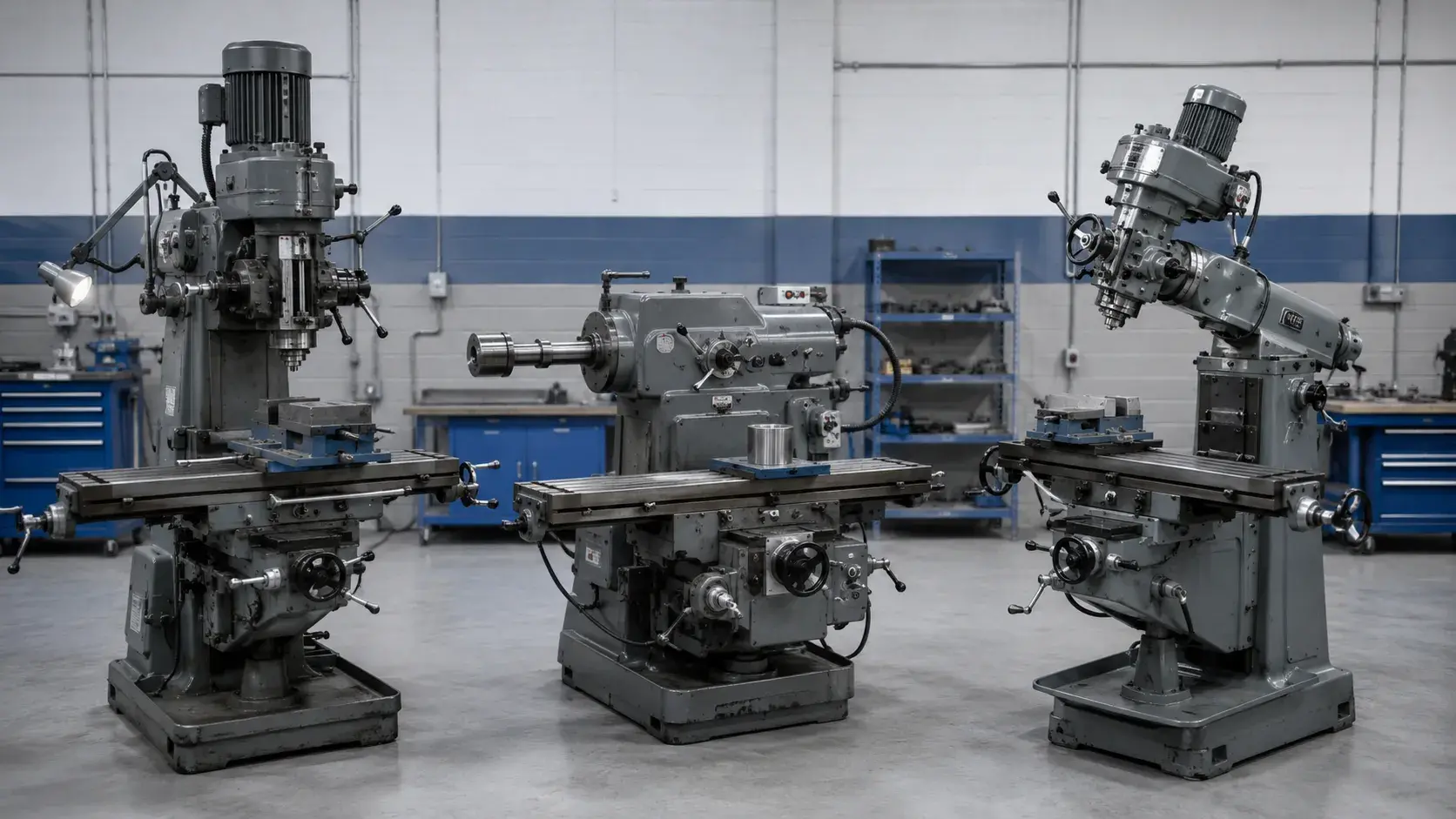
Types of manual milling machines including vertical horizontal and turret mills

Vertical Milling Machine

A vertical mill has a vertically oriented spindle. It is the most common type for general machining work such as facing, slotting, drilling, pocketing, and simple contouring.

Horizontal Milling Machine

A horizontal mill uses a horizontal spindle. Its rigid setup makes it useful for heavier material removal, deep slots, and operations using side or slab milling cutters.

Turret Milling Machine

Turret mills, including Bridgeport-style machines, are common in toolrooms and repair shops. Their adjustable head and flexible table movement make them suitable for prototypes, maintenance work, fixtures, and one-off parts.

What Operations Can Manual Milling Perform?

Manual milling can handle many common machining features, including:

  • face milling;
  • slots and keyways;
  • pockets;
  • drilling;
  • boring;
  • reaming;
  • chamfers;
  • simple hole patterns;
  • angled surfaces.

It works best when the geometry is relatively simple and the operator can reach and measure the required features directly.

For complex 3D surfaces, multiple angled features, or parts that must be repeated many times, CNC milling is usually the more practical choice.

What Materials Can Be Manually Milled?

Manual milling can be used on many common metals and plastics. The main difference is how easily each material cuts and how carefully speed, feed, and tooling need to be controlled.

MaterialMachining Notes
AluminumEasy to machine and very common for manual milling
Mild steelMachines well but usually requires lower cutting speeds than aluminum
Stainless steelCan be milled, but heat and work hardening need to be controlled
BrassCuts cleanly and is generally easy to machine
CopperRequires sharp tools because the material can be soft and ductile
PlasticsUsually easy to cut, but excessive heat can cause melting or deformation

The correct cutter, spindle speed, feed rate, and coolant strategy depend on the material and the feature being machined.

Advantages of Manual Milling

Manual milling is still useful because it is simple and flexible.

Its main advantages include:

  • short setup time for simple jobs;
  • no CNC programming required;
  • easy adjustment during machining;
  • practical for repair and rework;
  • suitable for prototypes and one-off parts;
  • cost-effective for simple, low-volume work.

For example, if a fixture slot only needs to be widened slightly, setting up a manual mill may be faster than creating and proving a CNC program.

Limitations of Manual Milling

Manual milling also has clear limitations.

Accuracy and repeatability depend heavily on the operator, machine condition, setup, and measuring method. It also becomes less efficient as part quantity or geometry becomes more complex.

Common limitations include:

  • higher dependence on operator skill;
  • slower production for multiple parts;
  • lower repeatability than CNC machining;
  • difficulty machining complex 3D shapes;
  • more manual measurement and adjustment;
  • greater risk of human error.

For these reasons, manual milling is usually best for simple and flexible machining tasks rather than complex production work.

Manual Milling vs CNC Milling

The main difference is how the machine is controlled. In manual milling, the operator controls the cutting movement directly. In CNC milling, the machine follows a programmed toolpath.

FactorManual MillingCNC Milling
ControlOperator-controlledProgram-controlled
SetupFast for simple jobsRequires programming and setup
One-off partsVery suitableMay be unnecessary for simple parts
Complex geometryLimitedVery suitable
RepeatabilityDepends on operatorHigh
Production quantityBest for low volumeBetter for repeated production
Changes during machiningEasy to adjustUsually requires program changes
3D surfacesDifficultMuch easier
Manual milling is usually better for simple, low-volume, or repair work. CNC milling is better when the part is complex, tolerance-sensitive, or needs to be produced repeatedly.

When Should You Use Manual Milling?

Manual milling makes the most sense when speed and flexibility matter more than automation.

Typical situations include:

One-Off Simple Parts

If you only need one simple plate, bracket, spacer, or similar part, manual milling may avoid unnecessary programming time.

Repair and Rework

Manual mills are useful for enlarging a hole, widening a slot, removing damaged material, or modifying an existing component.

Fixture and Tooling Work

Jigs, fixtures, soft jaws, setup plates, and shop tooling often need quick adjustments. Manual milling is well suited to this kind of work.

Prototype Changes

During prototype development, dimensions may change several times. A machinist can often make small adjustments directly on a manual mill without rewriting a CNC program.

When Is CNC Milling the Better Choice?

CNC milling is usually the better option when a part includes:

  • complex contours or 3D surfaces;
  • multiple angled features;
  • tight positional tolerances;
  • many holes or repeated features;
  • thin walls or difficult geometry;
  • multiple identical parts;
  • features that require 4-axis or 5-axis machining.

In these cases, CNC machining provides better repeatability, more consistent quality, and higher production efficiency.

How Accurate Is Manual Milling?

There is no single accuracy level for manual milling. It depends on the machine condition, operator skill, tooling, workholding, and how the part is measured.

For general manual milling work, around ±0.05 mm is a reasonable practical range for many features. With a well-maintained machine, DRO, good tooling, and an experienced machinist, tighter dimensions may be possible.

However, when a part has multiple critical features, tight positional tolerances, or needs to be repeated consistently, CNC milling is usually more reliable.

Common Applications of Manual Milling

Manual milling is still widely used for jobs that need flexibility rather than automation.
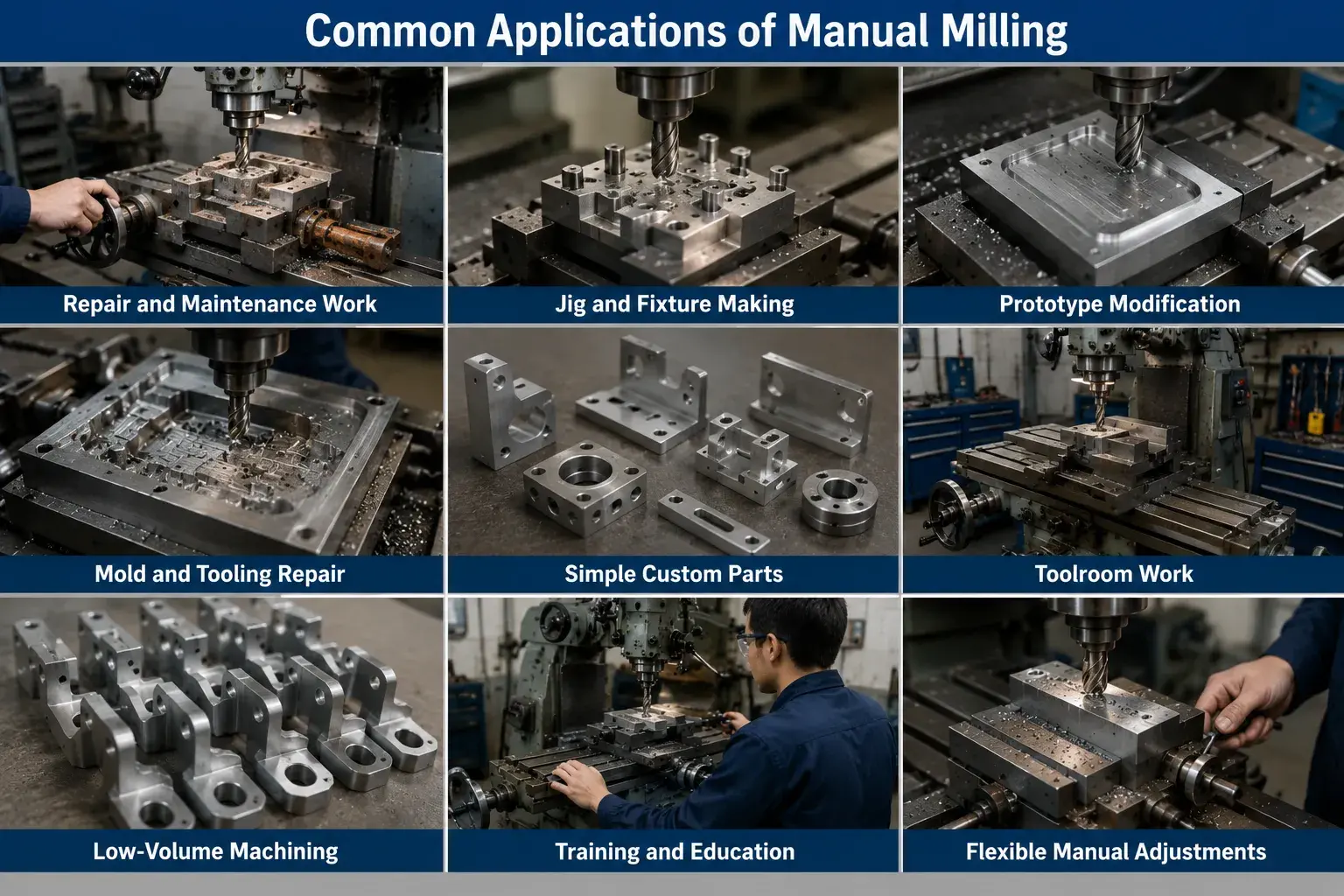
Common applications of manual milling in repair tooling prototypes and low-volume machining

Typical applications include:

  • repair and maintenance work;
  • jig and fixture making;
  • prototype modification;
  • mold and tooling repair;
  • simple custom parts;
  • toolroom work;
  • low-volume machining;
  • training and education.

It is especially useful when the part is simple and the operator needs to make small adjustments during machining.


Is Manual Milling Still Used Today?

Yes. Manual milling is still common in machine shops, maintenance departments, toolrooms, and prototype workshops.

It has not been replaced completely by CNC machining. Instead, the two processes are often used together.

CNC machines handle complex geometry, repeat production, and tighter process control, while manual mills are often used for quick repairs, simple modifications, fixtures, and one-off work.

For many workshops, keeping both types of machines provides the best balance between flexibility and production efficiency.

Conclusion

Manual milling remains useful for simple parts, repairs, fixtures, prototype adjustments, and other low-volume jobs where flexibility matters more than automation.

For complex geometry, repeat production, or tighter consistency requirements, CNC milling is usually the better choice.

The key is not deciding which process is “better” overall, but choosing the one that fits the part complexity, tolerance, quantity, and setup requirements.

Frequently Asked Questions

Yes. Manual mills can machine stainless steel, but the process usually requires lower cutting speeds, rigid workholding, sharp tools, and good heat control. Some stainless grades are also prone to work hardening if the cutter rubs instead of cutting properly.

Usually no. Traditional manual milling machines are controlled directly by the operator using handwheels, levers, and machine controls.

G-code is mainly used on CNC milling machines.

A digital readout (DRO) shows the position of the machine axes on a digital display.

It helps the operator locate holes, slots, edges, and other features more accurately without relying only on mechanical handwheel markings.

Yes. Bridgeport-style turret mills are one of the most common examples of manual vertical milling machines.

They are widely used for toolroom work, prototypes, repairs, and small custom machining jobs.

It can, especially with a skilled machinist and a well-maintained machine. However, maintaining tight tolerances across many features or multiple identical parts is usually easier and more consistent with CNC machining.

Table of Contents
Discuss Your Complex Machining Requirements

Need Custom CNC Machined Parts?

From rapid prototypes to low-volume production, our engineering team can review your drawings and provide a manufacturing quote.

  • 24-Hour Quotation
  • DFM Engineering Support
  • No Minimum Order
  • ISO 9001 Certified
Request A Quote
Upload your drawing and get a quote within 24 hours.
