

Face milling is mainly used to machine broad, flat surfaces. Peripheral milling uses the cutter’s outer edges to machine vertical walls, slots, shoulders, and profiles.
Neither method is simply better than the other. The right choice depends on the shape of the part, the surface being machined, the required finish, and how efficiently material needs to be removed.
In many CNC parts, both operations are used during the same machining setup. A face mill may first create a flat reference surface, while an end mill then uses peripheral cutting to machine the outer profile, pocket walls, or other side features.
What Is Face Milling?
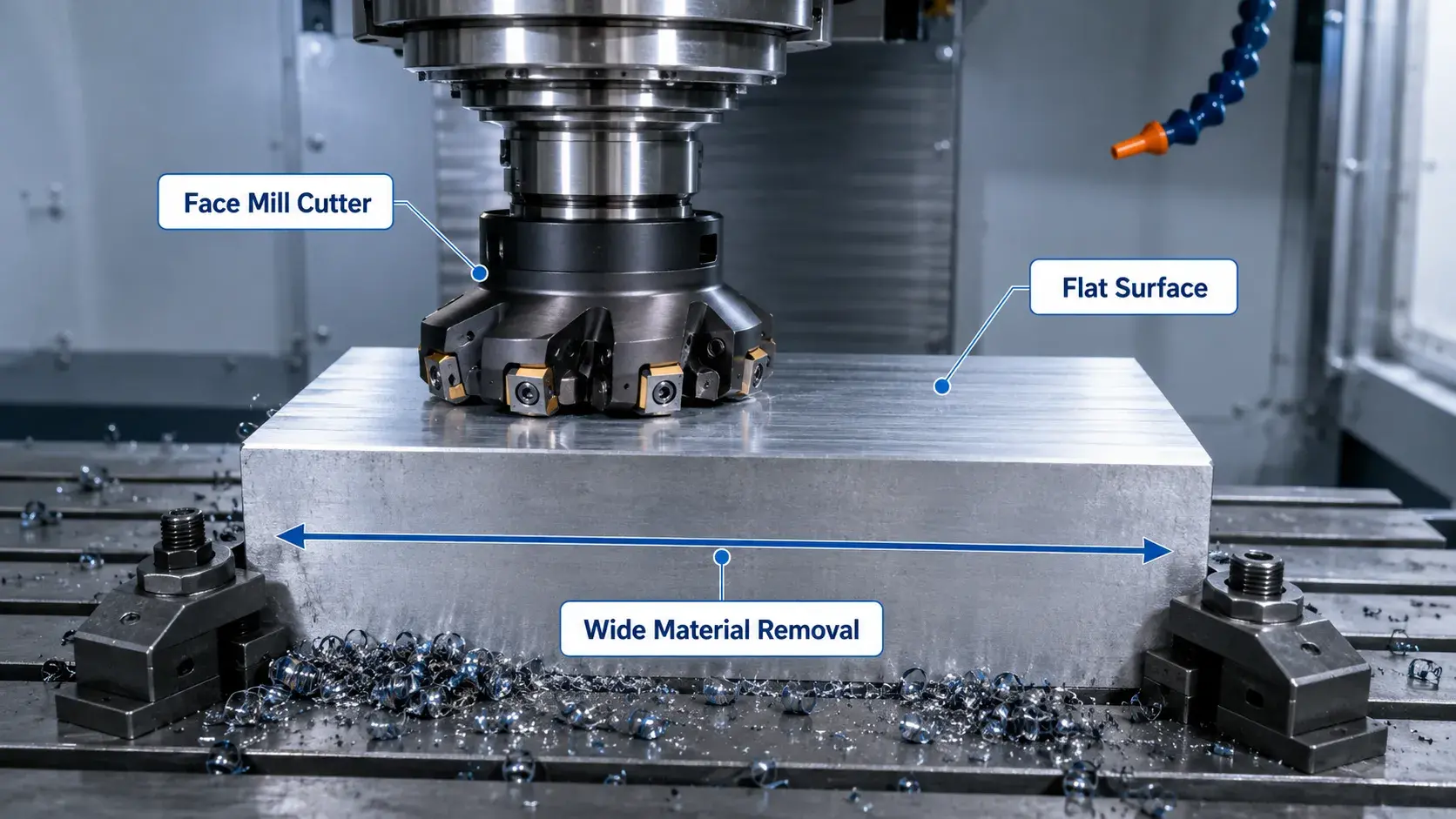
Face milling is a milling operation used mainly to produce flat surfaces across the face of a workpiece.
During face milling, the cutter rotates with its spindle axis positioned roughly perpendicular to the surface being machined. Cutting happens mainly around the cutter face and the edges of the inserts as the tool moves across the top of the workpiece.
Because a face mill can have a relatively large cutting diameter, it can cover a wide area in each pass. This makes it well suited for removing material from large flat surfaces quickly.
For example, a CNC machine shop may use face milling at the beginning of a job to remove the rough surface from an aluminum block and create a clean, flat datum for later machining.
How Does Face Milling Work?
A typical face mill contains several cutting inserts positioned around the cutter body.
As the cutter rotates, each insert removes a small amount of material. At the same time, the machine feeds the cutter across the workpiece.
The cutting action creates a flat surface underneath the cutter.
Face milling performance depends on several factors, including:
- cutter diameter;
- number of inserts;
- spindle speed;
- feed rate;
- depth of cut;
- workpiece material;
- insert geometry.
A larger face mill can often machine a wide surface in fewer passes, but the machine must have enough spindle power and rigidity to support the cut.
Common Face Milling Applications
Face milling is commonly used for:
- flattening raw stock;
- creating datum surfaces;
- machining large top or bottom faces;
- squaring blocks before further machining;
- finishing broad flat surfaces;
- machining sealing or mating surfaces;
- removing excess stock from cast or forged parts.
It is especially useful when the main goal is to create a flat and consistent surface over a relatively large area.
What Is Peripheral Milling?
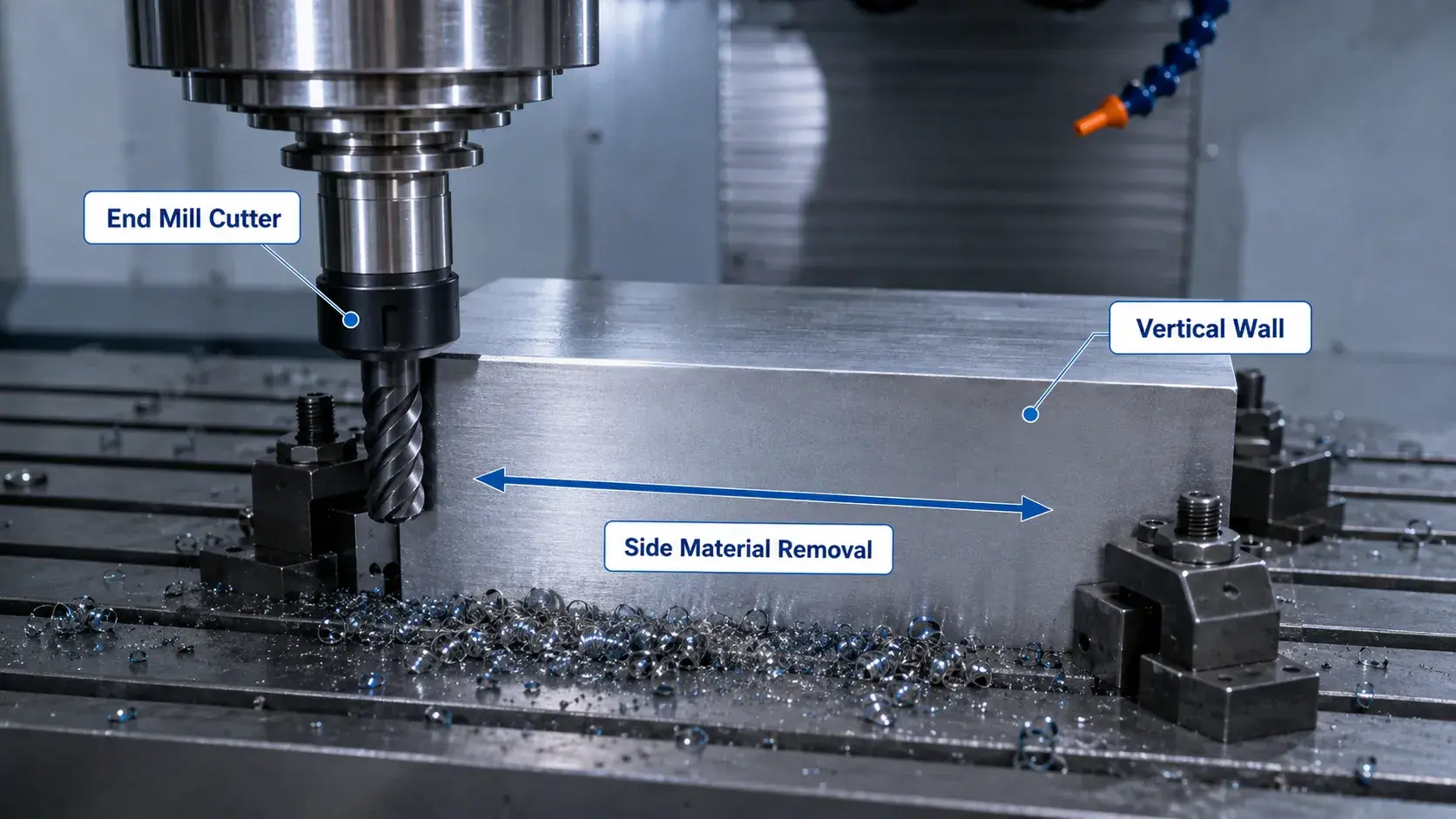
Peripheral milling is a milling operation where cutting occurs mainly along the outer circumference or side edges of the cutter.
Instead of using the cutter face to machine a broad horizontal surface, peripheral milling uses the side of the tool to remove material from features such as walls, profiles, shoulders, and slots.
The cutter axis is generally parallel to the surface being generated.
A common example is machining the outside profile of an aluminum plate with an end mill. The side cutting edges of the end mill remove material while following the contour of the part.
How Does Peripheral Milling Work?
In peripheral milling, part of the cutter circumference stays engaged with the workpiece as the tool moves along the required path.
Depending on the tool and part geometry, the cutter may remove material along:
- an external edge;
- a vertical wall;
- the side of a pocket;
- a slot;
- a shoulder;
- a curved profile.
Peripheral milling can use different cutters, including end mills, side milling cutters, and slab mills.
One important point is that peripheral milling is not exactly the same as end milling.
An end mill is a type of cutting tool. Peripheral milling describes how the cutter is being used. An end mill can perform peripheral cutting with its side edges, but it can also cut with its end teeth during other milling operations.
Common Peripheral Milling Applications
Peripheral milling is commonly used for:
- external profiles;
- vertical walls;
- shoulders;
- slots and grooves;
- pocket walls;
- side surfaces;
- straight or curved contours;
- deep features that require side cutting.
For example, after an aluminum housing has been faced flat, an end mill may use peripheral cutting to machine the outside shape and the vertical walls inside its pockets.
Face Milling vs Peripheral Milling: Key Differences
The main difference between face milling and peripheral milling is where the cutting happens and what type of surface each method is best suited for.
Face milling cuts mainly with the face and corner of the cutter to produce broad, flat surfaces. Peripheral milling relies more on the cutter’s side edges to machine walls, slots, shoulders, and profiles.
| Factor | Face Milling | Peripheral Milling |
|---|---|---|
| Main cutting area | Cutter face and corner edges | Cutter circumference or side edges |
| Cutter axis | Perpendicular to the machined surface | Parallel to the generated surface |
| Best for | Broad flat surfaces | Walls, slots, shoulders, profiles |
| Typical tools | Face mills, shell mills | End mills, side mills, slab mills |
| Main cutting force | More axial | More radial |
| Typical use | Facing, flattening, datum creation | Profiling, slotting, side-wall machining |
| Surface advantage | Large flat faces | Vertical and contoured surfaces |
Cutter Orientation
Cutter orientation is one of the easiest ways to tell the two operations apart.
In face milling, the spindle axis is positioned roughly perpendicular to the surface being machined. The cutter moves across the top of the workpiece and removes material over a relatively wide area.
In peripheral milling, the cutter axis runs parallel to the surface being generated. The side of the cutter does most of the cutting.
This difference in orientation is also why the two methods are normally used for different part features.
Surface and Part Features
Face milling works best when the goal is to produce a large, flat surface.
Typical examples include the top of an aluminum block, a mounting face, or a flat datum used for later machining and inspection.
Peripheral milling is more suitable when the cutter needs to work along the side of a feature. It is commonly used for vertical walls, outside contours, shoulders, slots, and pocket walls.
A simple CNC part may therefore use face milling on its top surface and peripheral milling around its outer edges.
Cutting Forces
Face milling and peripheral milling also load the cutter and workpiece differently.
Face milling usually creates a larger axial force directed toward the spindle and workpiece. Peripheral milling tends to produce more radial force because the side of the cutter is engaged with the material.
This becomes important when machining thin walls, deep features, or parts with limited rigidity.
For example, aggressive peripheral milling on a thin wall can push the wall sideways and cause vibration or dimensional error. In these cases, smaller cuts, better support, or a different toolpath may be needed.
Which Gives a Better Surface Finish?
Neither method always gives a better surface finish. It depends on the surface being machined.
For broad, flat surfaces, face milling usually gives a more consistent finish because the cutter covers a wider area and is designed for this type of cut.
Peripheral milling is better suited to vertical walls, edges, and profiles. With the right tool and cutting parameters, it can also produce a very smooth finish on these features.
Surface quality depends on more than the milling method itself. Important factors include:
- tool condition;
- feed rate;
- spindle speed;
- cutter geometry;
- machine rigidity;
- workpiece material;
- finishing allowance.
In CNC machining, a typical finished milled surface may fall around Ra 0.8–3.2 μm, but the final value depends heavily on the part, tool, and finishing strategy.
Which Removes Material Faster?
For large flat surfaces, face milling is usually more efficient.
A large face mill can remove material across a wide cutting area in each pass, so fewer toolpaths may be needed to flatten a plate, block, casting, or other broad surface.
Peripheral milling is more effective when material needs to be removed from the side of a part, such as around a profile, inside a pocket, or along a deep wall.
This means it is not very useful to compare material removal rate without considering the part geometry.
For example, using a 63 mm face mill to clean the top of a wide aluminum block may be much faster than scanning the same area with a small end mill. But that face mill cannot replace an end mill when machining a narrow slot or vertical pocket wall.
The faster method is therefore the one that matches the feature being machined.
Face Milling vs Peripheral Milling: Which Is More Accurate?
Both face milling and peripheral milling can achieve high accuracy when the machine, tooling, setup, and cutting parameters are properly controlled.
The main difference is what type of accuracy each operation is usually responsible for.
Face milling is commonly used to control:
- flatness;
- parallelism;
- overall face height;
- datum quality.
Peripheral milling is more commonly used to control:
- wall position;
- slot width;
- profile dimensions;
- perpendicularity;
- contour accuracy.
For example, a face-milled surface may become the primary datum for a part, while later peripheral milling operations use that datum to control the position of walls and profiles.
Because of this, accuracy should not be judged simply by asking which method is more precise. The correct method depends on the feature and tolerance that need to be controlled.
Face Milling vs Peripheral Milling Cost
Neither face milling nor peripheral milling is always cheaper.
Machining cost usually depends more on cycle time, tool size, material, tool wear, number of passes, setup, and required surface finish.
For a large flat surface, face milling is often more economical because a larger cutter can cover more area in each pass. This reduces machining time and may lower the cost per part.
For example, if the top of a 200 × 150 mm aluminum plate needs to be flattened, a face mill may finish the surface in only a few passes. Using a small end mill to cover the same area would normally require many more toolpaths and more machine time.
Peripheral milling becomes more cost-effective when machining features such as:
- vertical walls;
- slots;
- shoulders;
- external profiles;
- pocket walls;
- complex contours.
In practice, the lowest-cost machining plan often uses both methods where they are most efficient instead of trying to complete the entire part with one type of milling operation.
How to Choose Between Face Milling and Peripheral Milling
The easiest way to choose is to look at the feature you need to machine.
| Machining Requirement | Better Choice |
|---|---|
| Large flat surface | Face milling |
| Datum or reference surface | Face milling |
| Flat finishing pass | Face milling |
| Vertical wall | Peripheral milling |
| Slot or groove | Peripheral milling |
| Shoulder | Peripheral milling |
| External profile | Peripheral milling |
| Pocket wall | Peripheral milling |
| Complex CNC part | Often both |
If the part has a wide horizontal surface, face milling is usually the more efficient starting point. If the tool needs to cut along the side of the part or follow a profile, peripheral milling is generally more suitable.
Other factors also matter, including the material, machine rigidity, cutter size, wall thickness, tolerance, and required finish.
For thin walls or deep features, for example, peripheral milling may need lighter cuts to reduce vibration and part deflection. For large flat surfaces, a larger face mill may reduce cycle time significantly.
The best machining strategy is therefore based on the whole part rather than choosing one operation in isolation.Can Face Milling and Peripheral Milling Be Used Together?
Yes. In fact, this is very common in CNC machining.
A machined part often contains both flat surfaces and side features, so using only one milling method would not be practical.
For example, consider a CNC-machined aluminum housing.
The machining sequence may look like this:
- Face mill the raw block to create a flat top surface and reference datum.
- Peripheral mill the outer profile to bring the part to its final shape.
- Mill the pocket walls and shoulders using the side edges of an end mill.
- Finish critical flat surfaces if tighter flatness or surface finish is required.
Using both operations allows each tool to work on the type of geometry it handles most efficiently.
For most real CNC parts, the question is therefore not simply “face milling or peripheral milling?” but rather where each method should be used on the part.
Face Milling vs Peripheral Milling: Quick Summary
Face milling and peripheral milling serve different purposes.
Face milling is best for broad, flat surfaces, especially when creating datums, flattening stock, or finishing large faces.
Peripheral milling is better for walls, slots, shoulders, profiles, and contours, where the side of the cutter needs to remove material.
In many CNC machining projects, both operations are used together. Face milling may establish the main reference surfaces first, while peripheral milling creates the final shape and side features.
Choosing the right method for each feature can improve machining efficiency, surface quality, dimensional accuracy, and overall cost.
Frequently Asked Questions
Yes. An end mill can machine a flat surface using its bottom cutting edges, especially on smaller areas.
However, for larger flat surfaces, a dedicated face mill is usually faster and more efficient because it has a larger cutting diameter and can cover more area in each pass.
No.
Peripheral milling describes a cutting method where the outer or side edges of the cutter remove material.
End milling refers to the use of an end mill as the cutting tool. An end mill can perform peripheral milling, but it can also cut using its end teeth.
Yes.
Slab milling is a form of peripheral milling where the cutting teeth around the circumference of a cylindrical cutter remove material from the workpiece.
It is commonly used on horizontal milling machines for machining relatively large, flat surfaces.
Not efficiently.
Face mills are designed mainly for broad, flat surfaces. Vertical walls, shoulders, and profiles are usually machined with end mills or other cutters using peripheral cutting.
Both work well for aluminum.
Face milling is usually preferred for large flat aluminum surfaces, while peripheral milling is better for profiles, pockets, slots, and vertical walls.
The better choice depends more on the part geometry than on the material itself.
It depends on the feature being machined.
Peripheral milling can create significant radial cutting forces, which may push or vibrate a thin wall. In these cases, lighter passes, sharp tools, reduced engagement, and good workholding are important.
Face milling can also distort thin parts if clamping pressure or cutting forces are too high, so the overall setup still matters.
Yes.
Most CNC milling machines can perform both face milling and peripheral milling by changing the cutting tool and toolpath.
A typical 3-axis, 4-axis, or 5-axis CNC machining setup may use both operations on the same part.



