

Plaster mold casting is a metal casting process that uses a gypsum-based mold instead of sand. Molten metal is poured into the plaster cavity, where it cools and takes the shape of the mold.
This process is mainly used for aluminum, magnesium, zinc, and some copper alloys. It works well for parts that need fine surface detail, relatively thin walls, and complex shapes.
Compared with sand casting, plaster mold casting can produce smoother surfaces and capture smaller details. However, the mold takes longer to prepare and is normally destroyed after each casting.
For this reason, plaster mold casting is most suitable for prototypes, low-volume production, and complex non-ferrous metal parts rather than high-volume production.
What Is Plaster Mold Casting?
Plaster mold casting is an expendable mold casting process. This means the plaster mold is normally used once and then broken apart to remove the finished metal part.
The basic idea is similar to sand casting.
A pattern is first placed inside a container. A liquid plaster mixture is poured around the pattern and allowed to harden. Once the pattern is removed, it leaves a cavity with the required part shape.
The mold is then carefully dried to remove moisture before molten metal is poured inside.
Plaster is able to reproduce very fine details from the original pattern. Its smooth mold surface also helps produce cast parts with a better surface finish than conventional sand casting.
The process is commonly used when a part has:
- complex external shapes;
- small surface details;
- relatively thin walls;
- curved features;
- moderate dimensional accuracy requirements.
It is especially useful for aluminum castings where appearance and geometry are more important than very high production speed.
How Does Plaster Mold Casting Work?
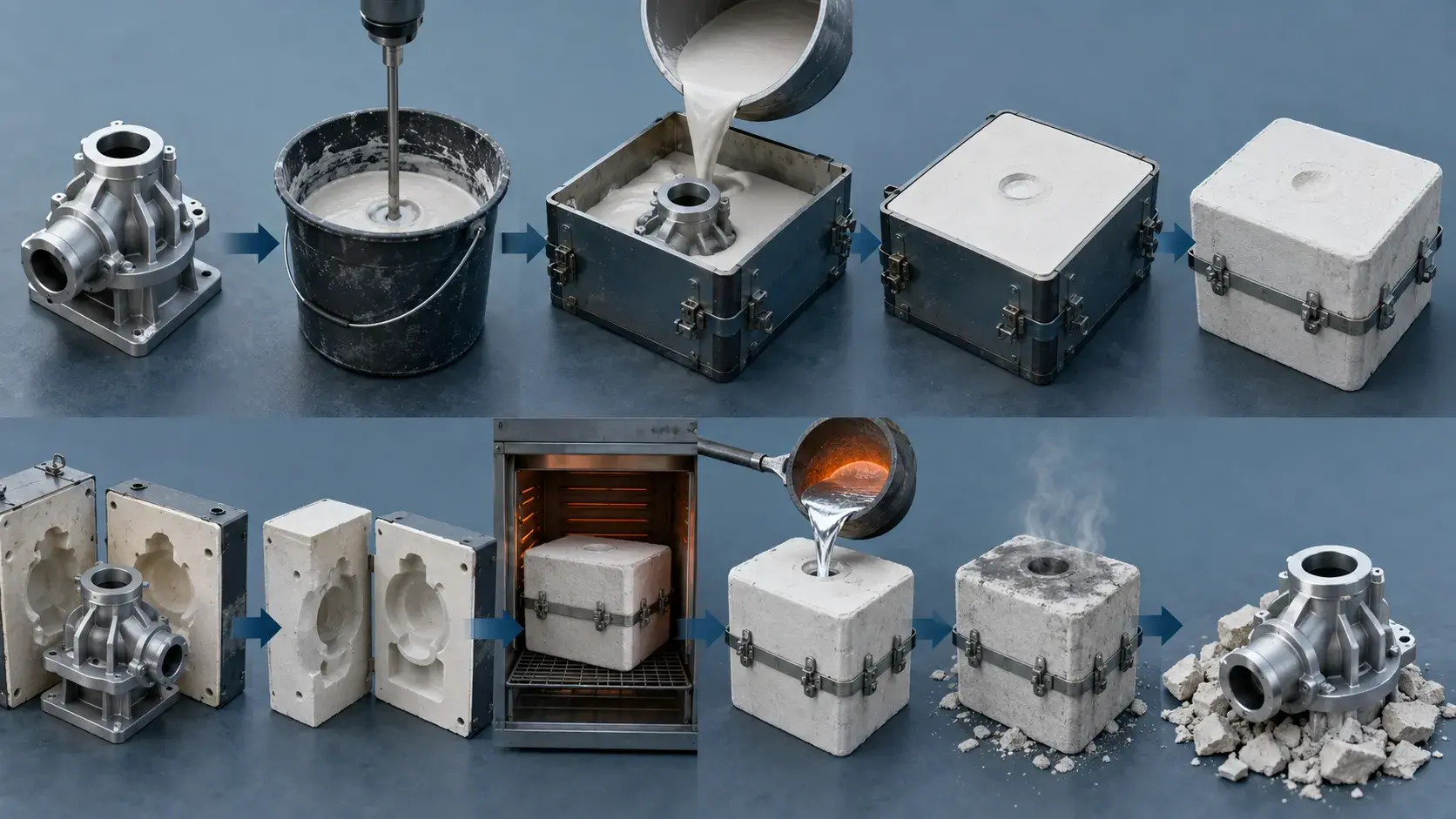
The plaster mold casting process usually involves several steps.
1. Create the Pattern
The process starts with a pattern that represents the shape of the final part.
Patterns may be made from metal, plastic, rubber, or other materials depending on the required accuracy and production quantity.
The pattern must also include allowances for metal shrinkage and any later machining.
2. Prepare the Plaster Mixture
Plaster powder is mixed with water and other additives to create a smooth slurry.
Industrial plaster molds usually contain more than ordinary plaster of Paris. Additional materials may be added to control strength, permeability, setting time, and resistance to cracking.
The mixture must flow easily enough to reach small details around the pattern.
3. Pour the Plaster Around the Pattern
The liquid plaster is poured into a flask or mold box containing the pattern.
Because the slurry is very fluid, it can reproduce small grooves, curves, and fine surface features more accurately than coarse molding sand.
The plaster is then left to set and harden.
4. Remove the Pattern
After the mold has developed enough strength, the pattern is carefully removed.
This leaves a negative cavity inside the plaster.
Gates, runners, and risers may also be created so molten metal can enter the cavity and gases can escape.
5. Dry the Mold
This is one of the most important steps.
Fresh plaster contains a large amount of moisture. If molten metal is poured into a wet mold, the water can rapidly turn into steam and cause casting defects or serious safety problems.
The mold therefore needs to be thoroughly dried or baked before casting.
Drying also improves the mold’s strength and stability.
6. Pour the Molten Metal
Once the mold is dry and properly prepared, molten metal is poured through the gating system into the cavity.
Aluminum is one of the most common metals used with this process.
Because plaster has relatively low thermal conductivity, the metal cools more slowly than it would in a metal mold. This gives the molten metal more time to flow into thin sections and small features.
7. Cool and Break the Mold
After the metal has fully solidified, the plaster mold is broken away.
The casting is removed, and the remaining plaster is cleaned from the surface.
Because the mold is destroyed during this step, a new plaster mold is required for the next casting.
8. Finish the Casting
The gates and risers are cut off, and the part may then go through additional finishing operations.
Depending on the application, this can include:
- grinding;
- deburring;
- blasting;
- heat treatment;
- surface finishing;
- CNC machining;
- inspection.
Plaster mold casting can produce a near-net-shape part, but precision features often still require machining.
What Is Plaster Mold Made Of?
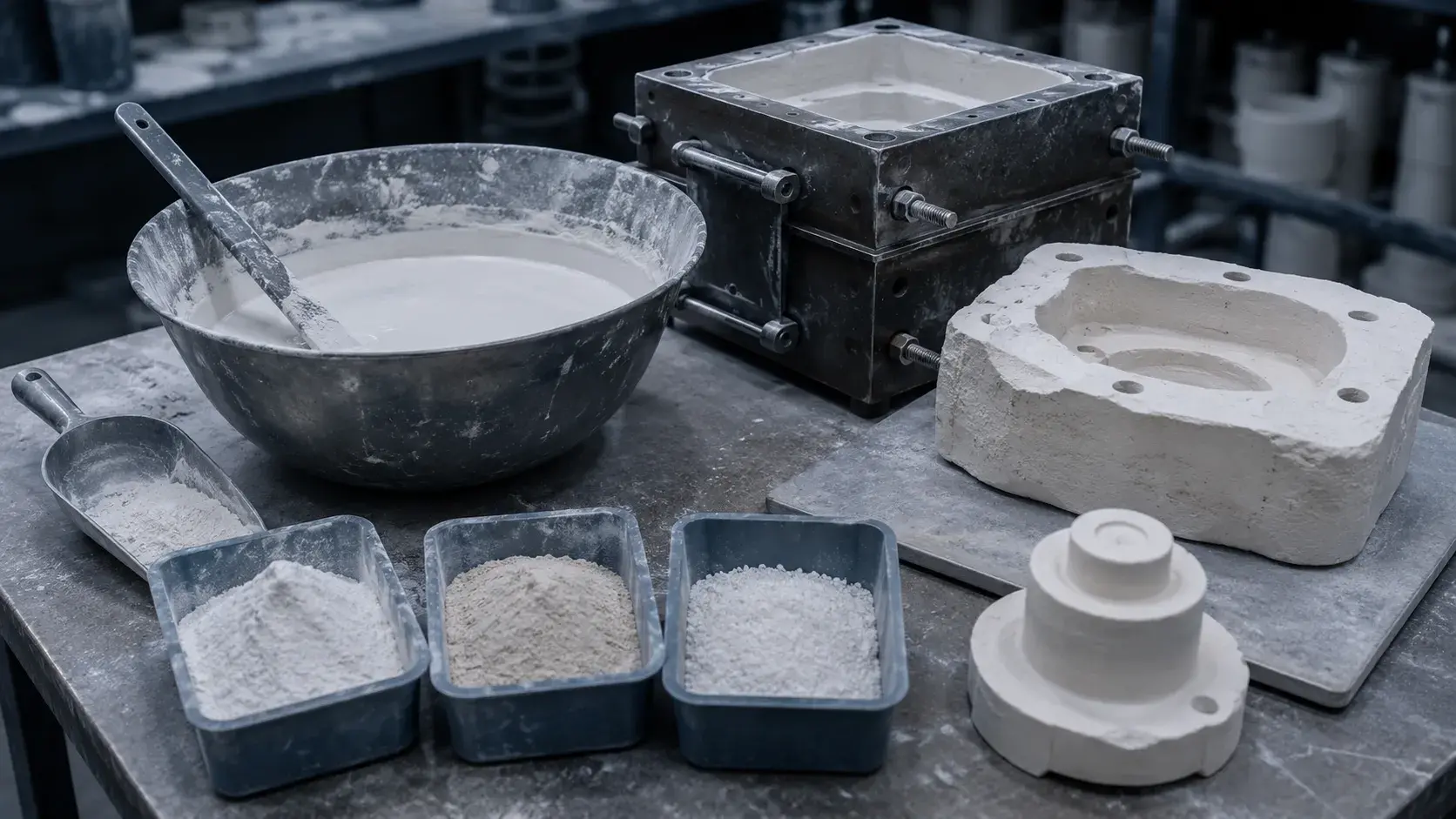
A plaster mold used for metal casting is not usually made from ordinary plaster of Paris alone.
The base material is typically gypsum, mixed with water and other additives. These additives help control how the mold sets, how strong it becomes, and how well gases can escape during casting.
Common additives may include:
- talc;
- silica;
- magnesium oxide;
- lime;
- cement;
- reinforcing fibers.
The exact mixture depends on the metal being cast and the required mold properties.
A good plaster mold needs enough strength to hold its shape during pouring, but it also needs enough permeability to allow trapped gases to escape. If the mold is too dense or contains too much moisture, defects such as porosity or incomplete filling can occur.
For this reason, mold preparation and drying are just as important as the plaster composition itself.
What Metals Can Be Cast in Plaster Molds?
Plaster mold casting is mainly used for non-ferrous metals with relatively low melting temperatures.
Aluminum is by far one of the most common choices because it flows well, is lightweight, and can reproduce complex shapes with good surface quality.
| Metal | Suitability for Plaster Mold Casting | Typical Use |
|---|---|---|
| Aluminum | Excellent | Housings, brackets, prototypes, complex cast parts |
| Magnesium | Good | Lightweight structural parts |
| Zinc | Good | Small detailed components |
| Copper alloys | Limited / application-dependent | Decorative or specialized parts |
| Steel | Generally unsuitable | Melting temperature is too high |
| Cast iron | Generally unsuitable | High pouring temperature and material compatibility issues |
The main limitation is temperature.
Plaster molds cannot handle the same extreme pouring temperatures as many sand or ceramic molds. This is why the process is rarely used for steel or cast iron.
For parts made from aluminum or magnesium, however, plaster mold casting can be a useful option when complex geometry and surface quality matter.Common Applications of Plaster Mold Casting
Plaster mold casting is mainly used for non-ferrous parts that need good surface quality, fine details, and relatively complex geometry.
Common applications include:
- aluminum housings and covers;
- brackets and structural components;
- pump and valve parts;
- decorative metal parts;
- prototype castings;
- low-volume production parts;
- aerospace and automotive development components;
- tooling and fixture components.
The process is especially useful when the part is too detailed for basic sand casting but the production quantity is too low to justify expensive die-casting tooling.
For many aluminum parts, plaster mold casting can provide a practical balance between cost, detail, and surface finish.
Plaster Mold Casting vs Sand Casting
Plaster mold casting and sand casting are both expendable mold processes, but they are used for different types of parts.
| Feature | Plaster Mold Casting | Sand Casting |
|---|---|---|
| Surface finish | Smoother | Rougher |
| Fine detail | Better | Moderate |
| Thin walls | Better capability | More limited |
| Mold preparation | Slower | Faster |
| Metal selection | Mainly non-ferrous metals | Much broader |
| Tooling cost | Moderate | Usually low |
| Production volume | Low to medium | Low to high |
| Large parts | Less common | Very common |
The biggest advantage of plaster is surface quality and detail.
Sand casting is usually the better option for larger parts, higher-temperature alloys, and applications where surface finish is less critical.
If you need a complex aluminum housing with thin walls and detailed surfaces, plaster mold casting may be more suitable.
If you need a large iron or steel casting, sand casting is usually the more practical choice.Plaster Mold Casting vs Investment Casting
Plaster mold casting and investment casting can both produce detailed metal parts, but they use very different mold-making methods.
Investment casting uses a wax pattern that is coated with ceramic. The wax is then melted out before metal is poured into the ceramic shell.
Plaster mold casting uses a reusable pattern to create a gypsum-based mold.
| Feature | Plaster Mold Casting | Investment Casting |
|---|---|---|
| Typical materials | Aluminum, magnesium, zinc | Stainless steel, aluminum, titanium, superalloys |
| Surface finish | Good | Very good |
| Fine detail | Good | Excellent |
| Complex internal geometry | Moderate | Very good |
| High-temperature alloys | Poor suitability | Excellent |
| Tooling and process cost | Usually lower | Usually higher |
| Production speed | Slow | Slow to moderate |
| Typical use | Prototypes and low-volume non-ferrous parts | Precision parts and complex high-value components |
The choice often comes down to material and part complexity.
For a detailed aluminum prototype, plaster mold casting can be a cost-effective option.
For stainless steel, titanium, or very complex precision parts, investment casting is usually more suitable.Does a Plaster Cast Part Need CNC Machining?
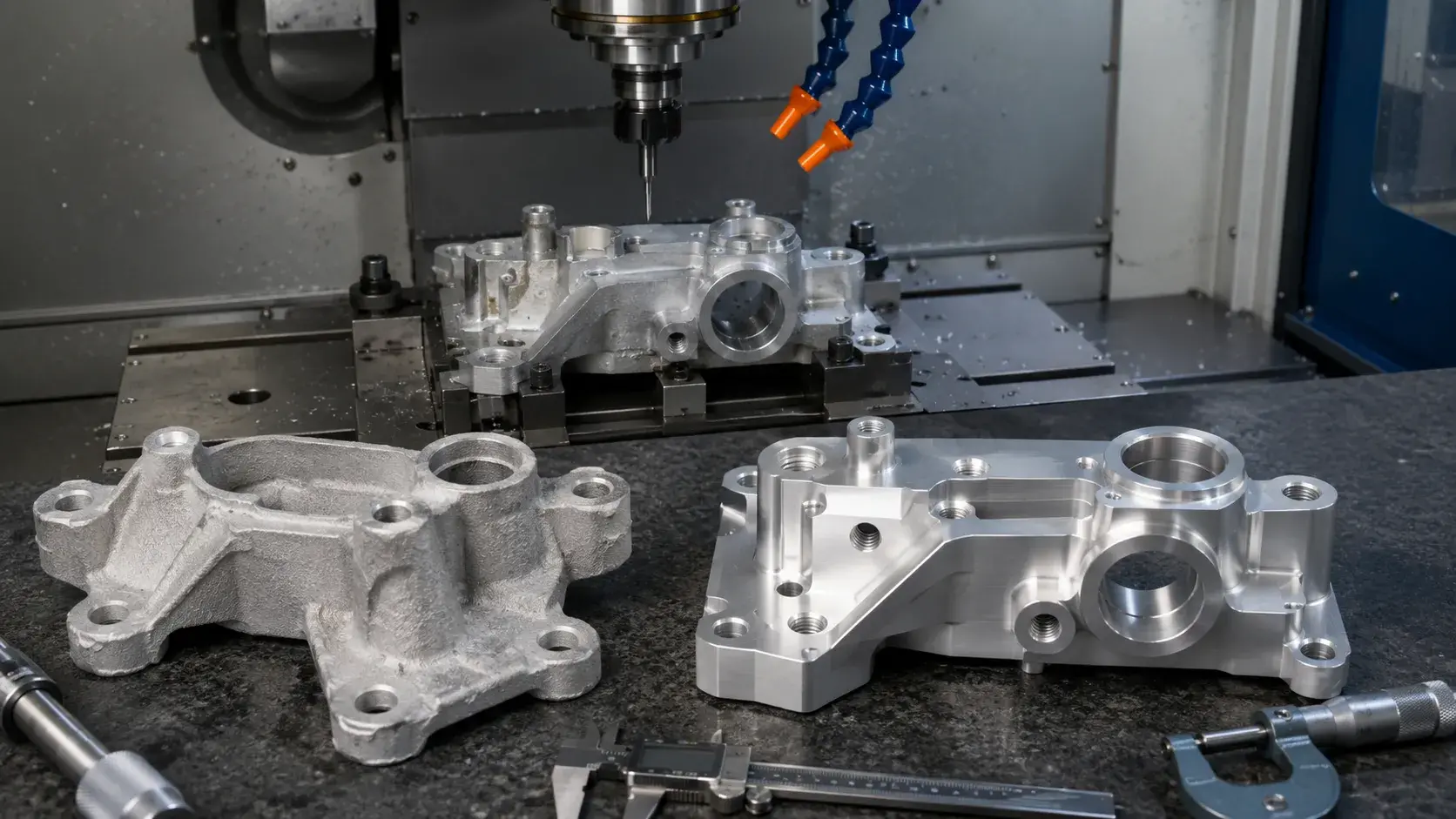
Plaster mold casting can produce a near-net-shape part, but that does not mean every feature is ready for final assembly.
Some areas usually still need CNC machining when tighter tolerances or better surface control are required.
Typical machined features include:
- precision holes;
- bearing seats;
- threaded holes;
- sealing surfaces;
- flat mounting faces;
- tight-tolerance bores;
- datum surfaces;
- mating features.
For example, an aluminum housing may be cast close to its final shape, while the mounting face, bearing bore, and threaded holes are machined afterward.
This combination can be more economical than machining the entire part from solid material, especially when the casting has large cavities or complex external geometry.
The casting process creates the overall shape, while CNC machining finishes the critical features that control fit, alignment, and assembly performance.
Need CNC Machining for Cast Aluminum Parts?
Send us your drawing or 3D model. We can machine critical holes, bores, threads, mating surfaces, and other tight-tolerance features after casting.
When Should You Choose Plaster Mold Casting?
Plaster mold casting is worth considering when you need:
- a non-ferrous metal part, especially aluminum;
- better surface finish than basic sand casting;
- fine external details;
- relatively thin walls;
- complex geometry;
- prototype or low-volume production;
- lower tooling investment than die casting.
It is usually not the best choice when you need:
- steel or cast iron parts;
- very high production volumes;
- extremely fast cycle times;
- large heavy castings;
- extremely tight final tolerances without secondary machining.
In these cases, sand casting, investment casting, die casting, or direct CNC machining may be a better option.
Final Thoughts
Plaster mold casting is a useful process for producing detailed non-ferrous metal parts, especially aluminum components in prototype and low-volume production.
Its main strengths are good surface finish, fine detail, and the ability to produce relatively complex shapes. Its main limitations are slower mold preparation, single-use molds, and limited compatibility with high-temperature metals.
For parts that also require precision holes, sealing faces, threads, or tight-tolerance mating surfaces, CNC machining is often used after casting to complete the final geometry.



