

The density of pure iron is approximately 7.87 g/cm³, equal to 7,870 kg/m³ or about 0.284 lb/in³ at room temperature.
Different forms of iron, such as gray cast iron and ductile iron, can have slightly lower densities because their carbon content, microstructure, and porosity are different.
What Is the Density of Iron?
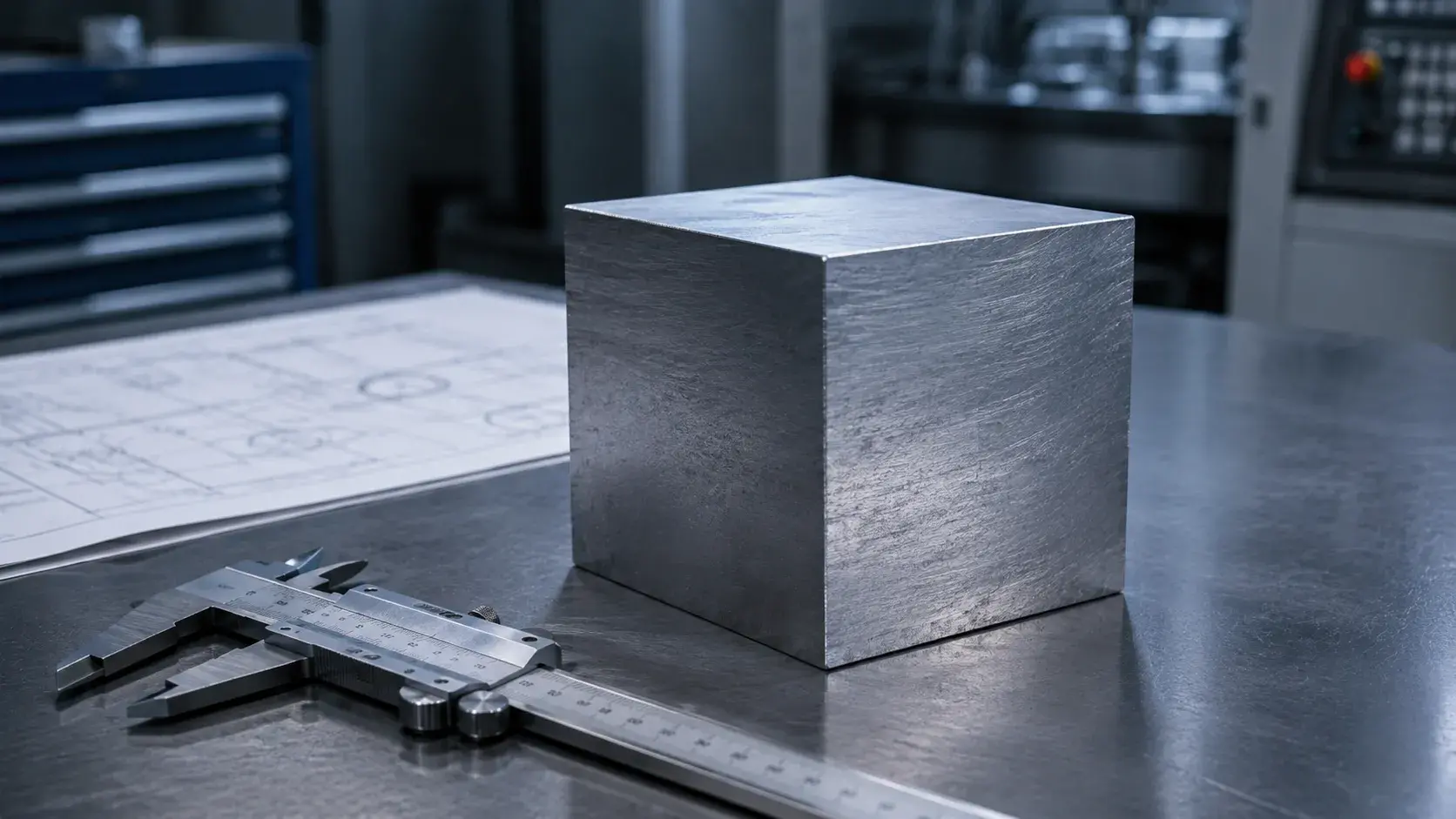
Pure iron has a density of about 7.87 g/cm³ at room temperature.
The same density can be expressed in several commonly used units:
| Unit | Density of Pure Iron |
|---|---|
| g/cm³ | 7.87 |
| kg/m³ | 7,870 |
| kg/L | 7.87 |
| lb/in³ | 0.284 |
| lb/ft³ | Approx. 491 |
For most engineering calculations, 7,870 kg/m³ or 7.87 g/cm³ is accurate enough for pure iron.
However, commercially used iron materials may have slightly different values depending on their composition and structure.
Density of Different Types of Iron
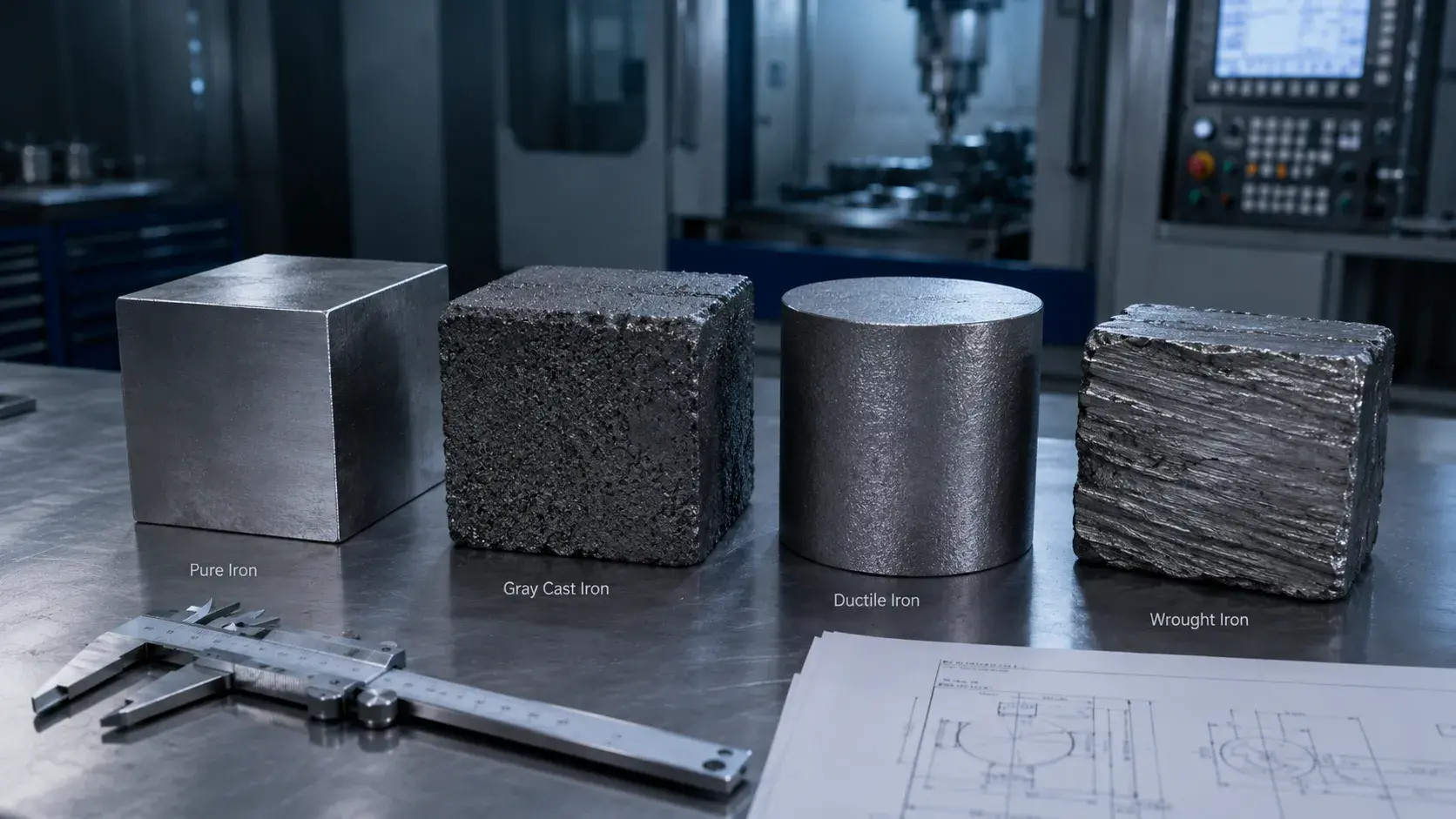
Not all iron materials have exactly the same density.
Cast irons usually contain more carbon and may contain graphite or small amounts of porosity, which makes them less dense than pure iron.
| Type of Iron | Approximate Density |
|---|---|
| Pure Iron | 7.87 g/cm³ |
| Wrought Iron | 7.7–7.8 g/cm³ |
| Gray Cast Iron | 7.0–7.3 g/cm³ |
| Ductile Iron | 7.0–7.3 g/cm³ |
| Malleable Iron | 7.2–7.4 g/cm³ |
| White Cast Iron | 7.4–7.7 g/cm³ |
These values should be treated as typical ranges rather than exact numbers because different grades and alloy compositions can produce slightly different densities.
Pure Iron
Pure iron has a density of approximately 7.87 g/cm³.
Because industrial iron normally contains carbon and other elements, completely pure iron is less common in general manufacturing than steels and cast irons.
Gray Cast Iron
Gray cast iron generally has a density of around 7.0–7.3 g/cm³.
Its graphite flakes have a lower density than the surrounding iron matrix, which helps explain why gray iron is lighter than pure iron.
Ductile Iron
Ductile iron typically has a density of approximately 7.0–7.3 g/cm³.
It contains graphite in a rounded or nodular form rather than the flakes found in gray cast iron, giving it better strength and ductility.Why Does the Density of Iron Vary?
The density of an iron material depends mainly on its chemical composition, microstructure, porosity, and temperature.
Alloy Composition
Iron products rarely consist of 100% iron.
Carbon, silicon, chromium, nickel, manganese, and other alloying elements can slightly increase or decrease the final density.
Microstructure and Porosity
Cast iron may contain graphite and small internal voids.
These features reduce the average mass contained within a given volume, so cast iron is normally less dense than pure iron.
Temperature
Iron expands as its temperature increases.
Because the same mass occupies a slightly larger volume at higher temperatures, its density decreases.
For normal workshop calculations, however, the room-temperature value is usually sufficient.
Density of Iron vs Steel
Iron and steel have very similar densities.
Pure iron has a density of approximately 7.87 g/cm³, while typical carbon steel is usually around 7.85 g/cm³.
| Material | Typical Density |
|---|---|
| Pure Iron | 7.87 g/cm³ |
| Carbon Steel | Approx. 7.85 g/cm³ |
| Stainless Steel | Approx. 7.7–8.0 g/cm³ |
| Gray Cast Iron | Approx. 7.0–7.3 g/cm³ |
The difference between pure iron and ordinary carbon steel is therefore very small for most practical weight calculations.
Stainless steels can vary more because they contain larger amounts of chromium, nickel, and other alloying elements.Iron Density Compared With Other Metals
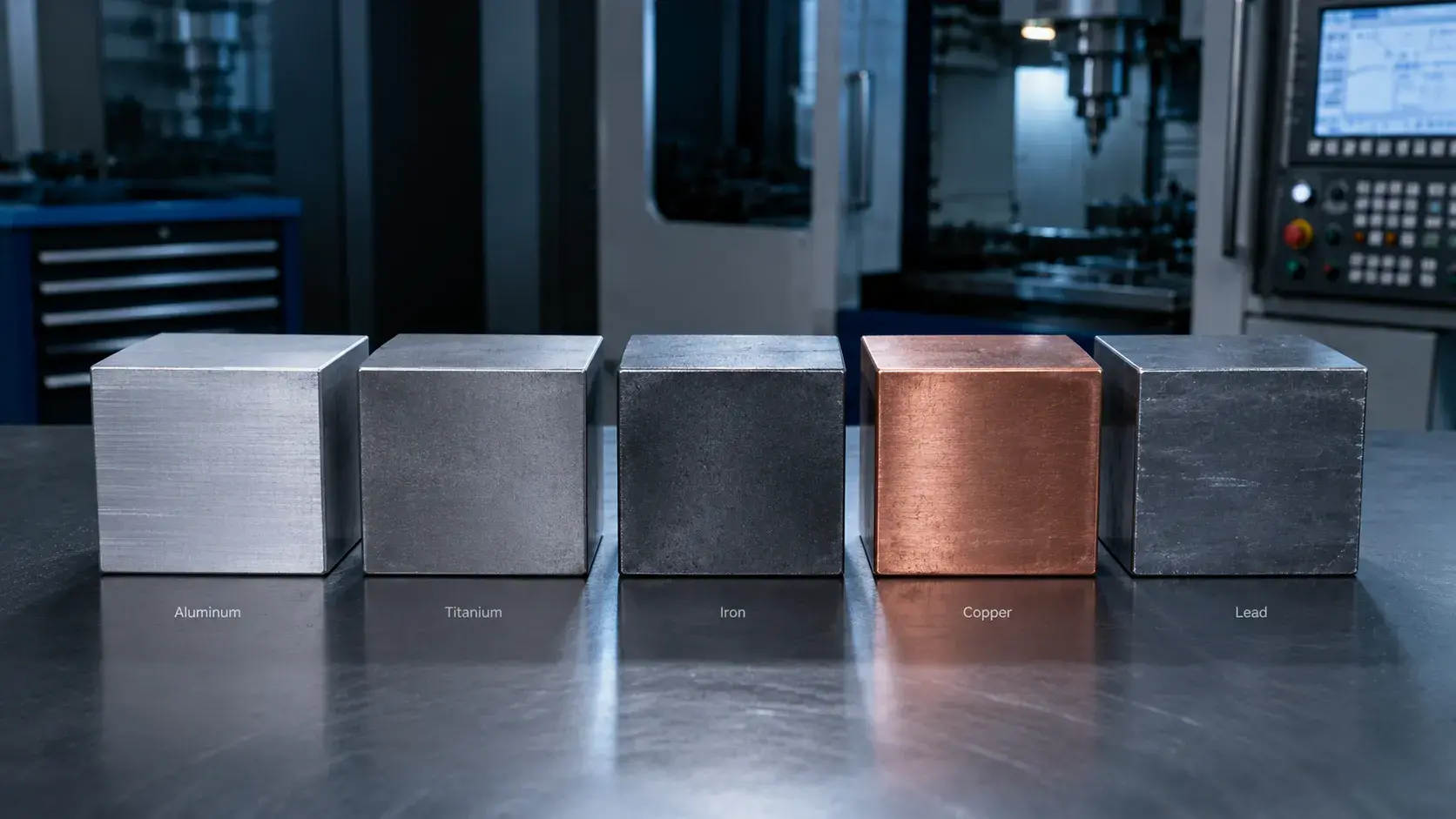
Iron is considerably heavier than aluminum and titanium but lighter than metals such as copper and lead.
| Metal | Approximate Density |
|---|---|
| Aluminum | 2.70 g/cm³ |
| Titanium | 4.51 g/cm³ |
| Zinc | 7.14 g/cm³ |
| Iron | 7.87 g/cm³ |
| Carbon Steel | 7.85 g/cm³ |
| Brass | 8.4–8.7 g/cm³ |
| Copper | 8.96 g/cm³ |
| Lead | 11.34 g/cm³ |
For example, an iron component of the same volume weighs about 2.9 times as much as an aluminum component.
This is why density becomes important when comparing material weight for structures, machinery, transportation equipment, and manufactured parts.
How to Calculate the Weight of Iron
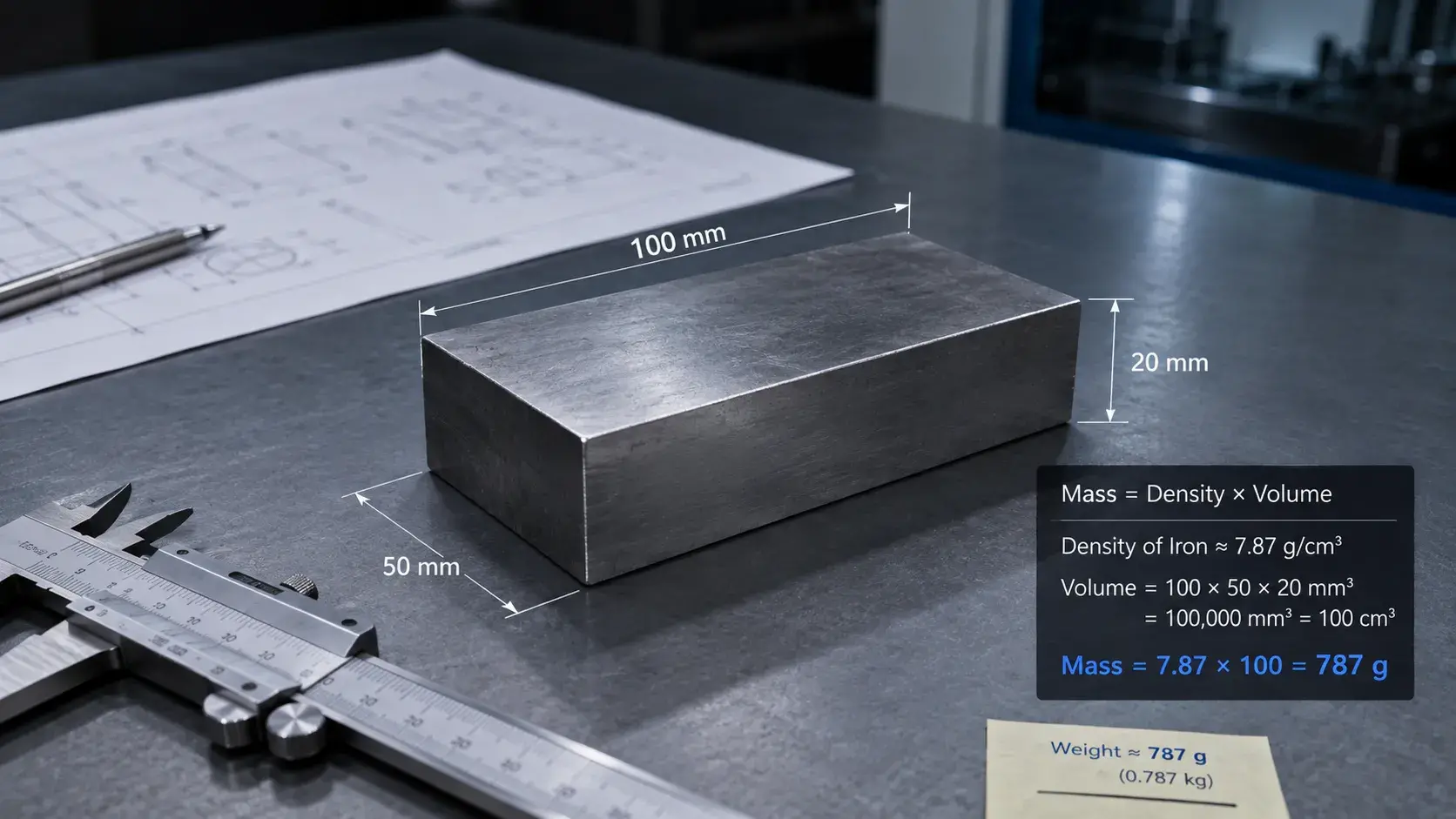
You can calculate the weight of an iron part when you know its volume and density.
Mass = Density × Volume
For example, consider a solid iron block measuring:
100 × 50 × 20 mm
Its volume is:
100 × 50 × 20 = 100,000 mm³
Since:
1 cm³ = 1,000 mm³
the volume is:
100 cm³
Using an iron density of 7.87 g/cm³:
100 × 7.87 = 787 g
So the iron block weighs approximately:
787 g or 0.787 kg
For irregular machined parts, CAD software can calculate the volume automatically. Applying the correct material density then gives a useful estimate of finished part weight.
Does Iron Density Affect CNC Machining?
Density is useful for estimating part weight, raw material requirements, fixture loads, handling, and shipping costs, but it is not the main factor used to determine CNC cutting parameters.
Machinability depends more strongly on properties such as:
- hardness;
- tensile strength;
- carbon content;
- microstructure;
- heat treatment;
- alloy composition.
For example, two steels may have almost identical densities but behave very differently during machining because one is hardened and the other is annealed.
Density should therefore be considered as one material property rather than a direct measure of how easy a material is to machine.
Conclusion
The density of pure iron is approximately 7.87 g/cm³, 7,870 kg/m³, or 0.284 lb/in³ at room temperature.
Cast irons generally have slightly lower densities, while steels remain relatively close to pure iron. Knowing these values makes it easier to estimate component weight, compare materials, and calculate raw material requirements for manufacturing applications.



