

Cesium is generally considered the softest solid metal, with a Mohs hardness of about 0.2. It is soft enough to be cut easily and has a melting point of only about 28.5°C (83.3°F).
However, “softness” can mean different things in materials science. Scratch resistance, indentation hardness, strength, ductility, and ease of deformation are not exactly the same. That is why the softest metal can depend slightly on how softness is measured.
What Is the Softest Metal?
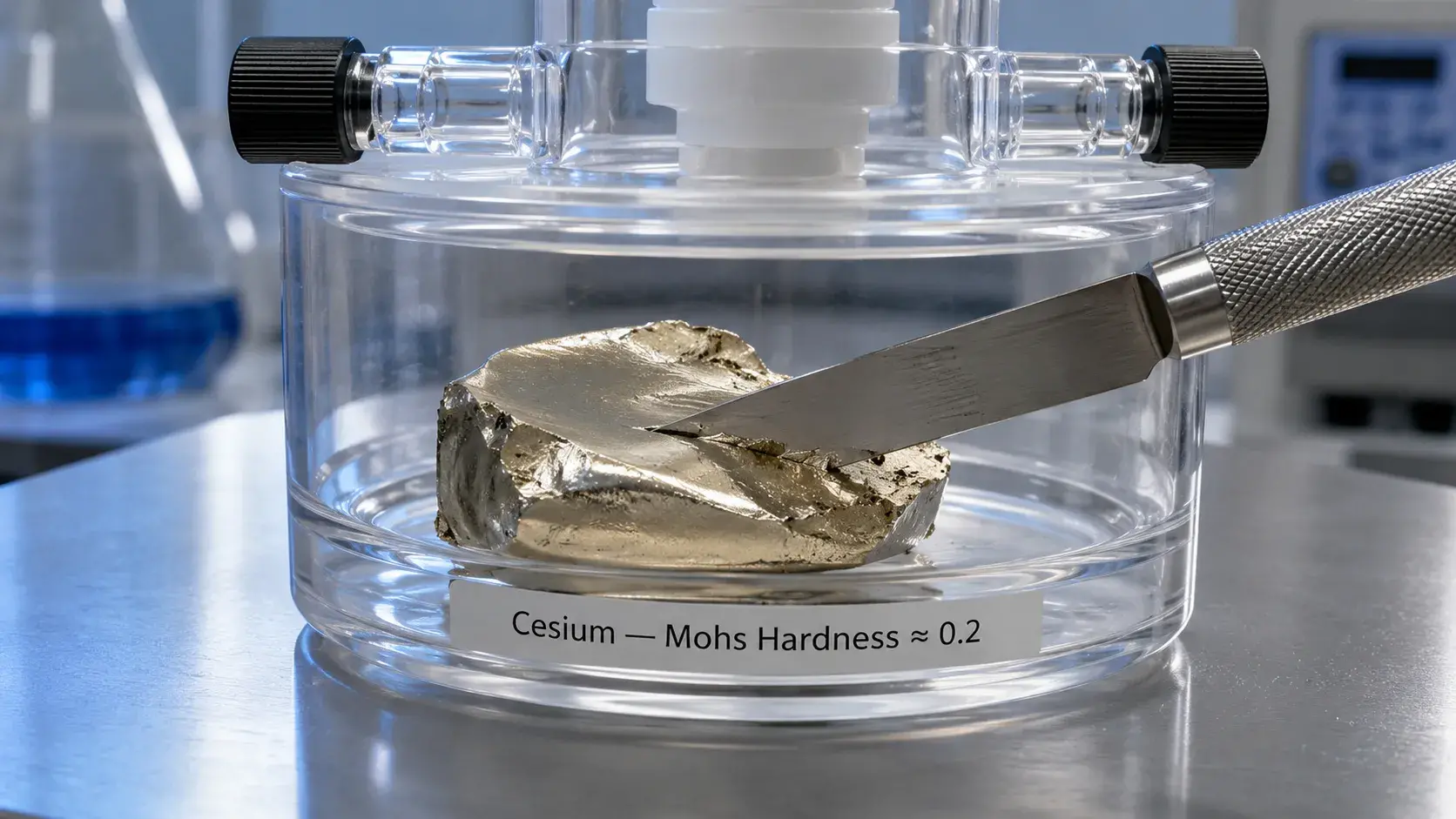
Cesium is commonly regarded as the softest solid metal.
It is an alkali metal with a very low Mohs hardness of approximately 0.2, making it softer than rubidium, potassium, sodium, lithium, lead, and most other metals.
Cesium is also unusual because its melting point is only about 28.5°C (83.3°F). In a warm environment, it can begin to melt even though it is normally discussed as a solid metal.
Pure cesium has a pale gold or silvery-gold appearance, but it is extremely reactive. It reacts rapidly with air and can react violently with water, so it is not handled like ordinary engineering metals such as aluminum, copper, or steel.
For this reason, cesium is mainly important in scientific and specialized applications rather than conventional manufacturing.
Why Is Cesium So Soft?
Cesium is extremely soft because of its atomic structure and relatively weak metallic bonding.
Cesium atoms are very large, and each atom has only one electron in its outermost shell. This outer electron is located relatively far from the nucleus, so it is held less tightly.
As a result, the metallic bonds between cesium atoms are weaker than those found in many harder metals.
This allows the atoms to move past one another more easily when force is applied, which contributes to cesium’s low hardness and easy deformation.
The same general trend can be seen in other alkali metals such as:
- rubidium;
- potassium;
- sodium;
- lithium.
These metals are also unusually soft compared with common structural metals.
How Is Metal Softness Measured?
Metal softness is usually discussed by looking at hardness, but there is no single hardness test used for every material.
Different hardness scales measure different types of resistance.
Mohs Hardness
The Mohs scale measures a material’s resistance to scratching.
It ranges from 1 for very soft reference minerals to 10 for diamond. Cesium is often listed at around 0.2, which is below the traditional Mohs reference scale.
The Mohs scale is useful for simple comparisons, but it is not normally the main hardness system used in engineering design.
Brinell Hardness
The Brinell test presses a hardened ball into the surface of a material and measures the resulting indentation.
It is commonly used for relatively soft metals, castings, and materials with larger grain structures.
Rockwell Hardness
Rockwell hardness measures how deeply an indenter penetrates a material under a specified load.
It is widely used for steels, aluminum alloys, and other engineering metals because the test is fast and easy to repeat.
Vickers Hardness
The Vickers test uses a diamond-shaped indenter and can measure a very wide range of materials.
It is especially useful for small parts, thin sections, coatings, and laboratory testing.
For a question such as “what is the softest metal,” Mohs hardness is often used for a simple comparison. For machining, heat treatment, or engineering design, Rockwell, Brinell, or Vickers hardness is usually more useful.
Top 10 Softest Metals
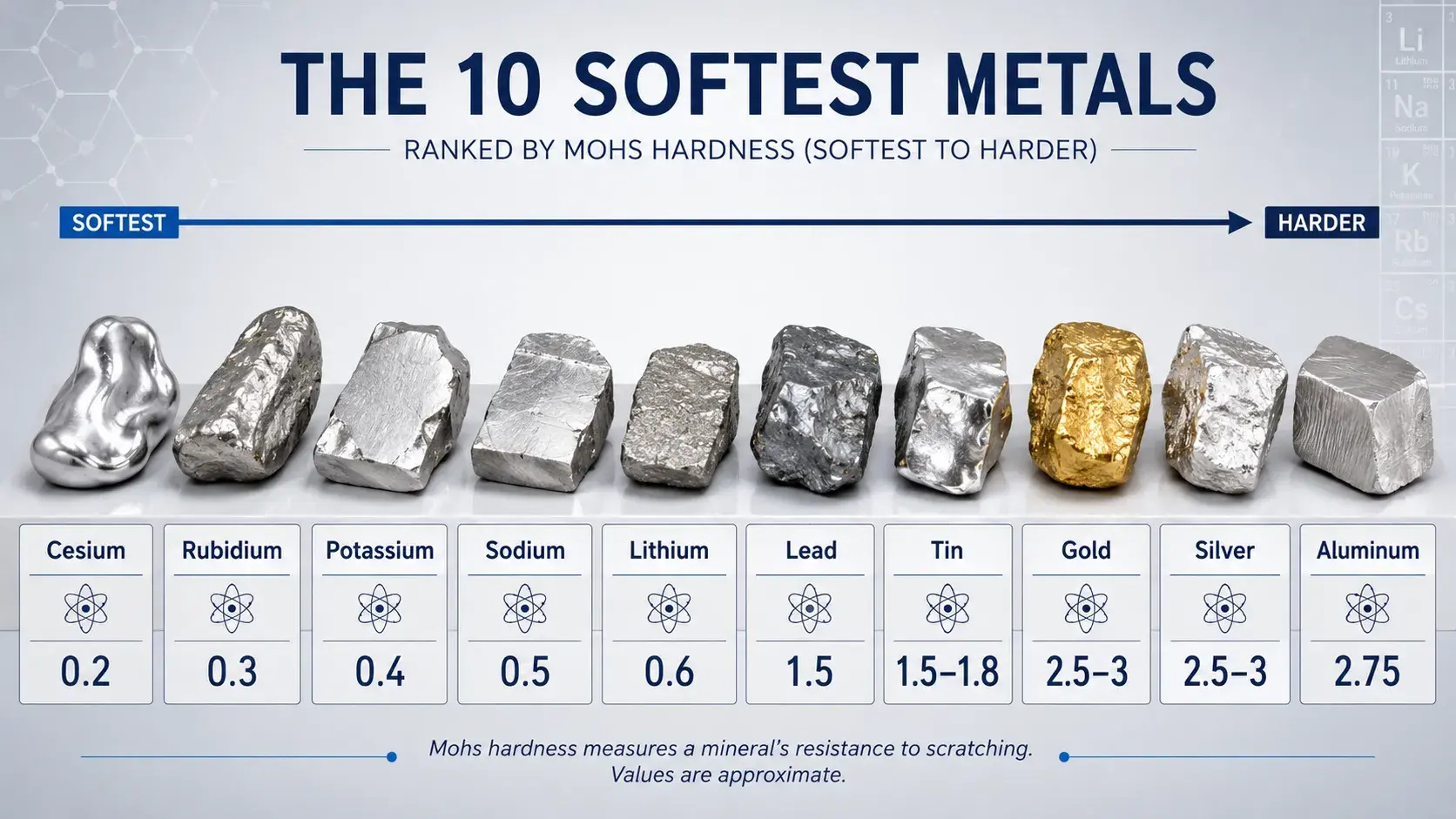
The softest metals are mostly alkali metals, but several common engineering and precious metals are also relatively soft.
The values below are approximate because reported Mohs hardness can vary slightly by source, purity, temperature, and test conditions.
| Metal | Approx. Mohs Hardness | Key Characteristic |
|---|---|---|
| Cesium | ~0.2 | Commonly regarded as the softest solid metal |
| Rubidium | ~0.3 | Very soft and highly reactive |
| Potassium | ~0.4 | Can be cut easily with a knife |
| Sodium | ~0.5 | Soft, lightweight, and highly reactive |
| Lithium | ~0.6 | Harder than most other alkali metals |
| Lead | ~1.5 | Dense, soft, and easily deformed |
| Tin | ~1.5–1.8 | Soft and commonly used in coatings and solder alloys |
| Gold | ~2.5–3 | Extremely malleable and ductile |
| Silver | ~2.5–3 | Relatively soft with high electrical conductivity |
| Aluminum | ~2.75 | Pure aluminum is soft, but alloys can be much harder |
Cesium, rubidium, potassium, sodium, and lithium are all alkali metals. Their softness is related to their atomic structure and relatively weak metallic bonding.
However, these metals are rarely used for ordinary structural components because they are chemically reactive.
In practical manufacturing, metals such as aluminum, copper, lead, tin, gold, and silver are more relevant because they combine relatively low hardness with useful mechanical, electrical, or corrosion-related properties.
Cesium vs Other Soft Metals
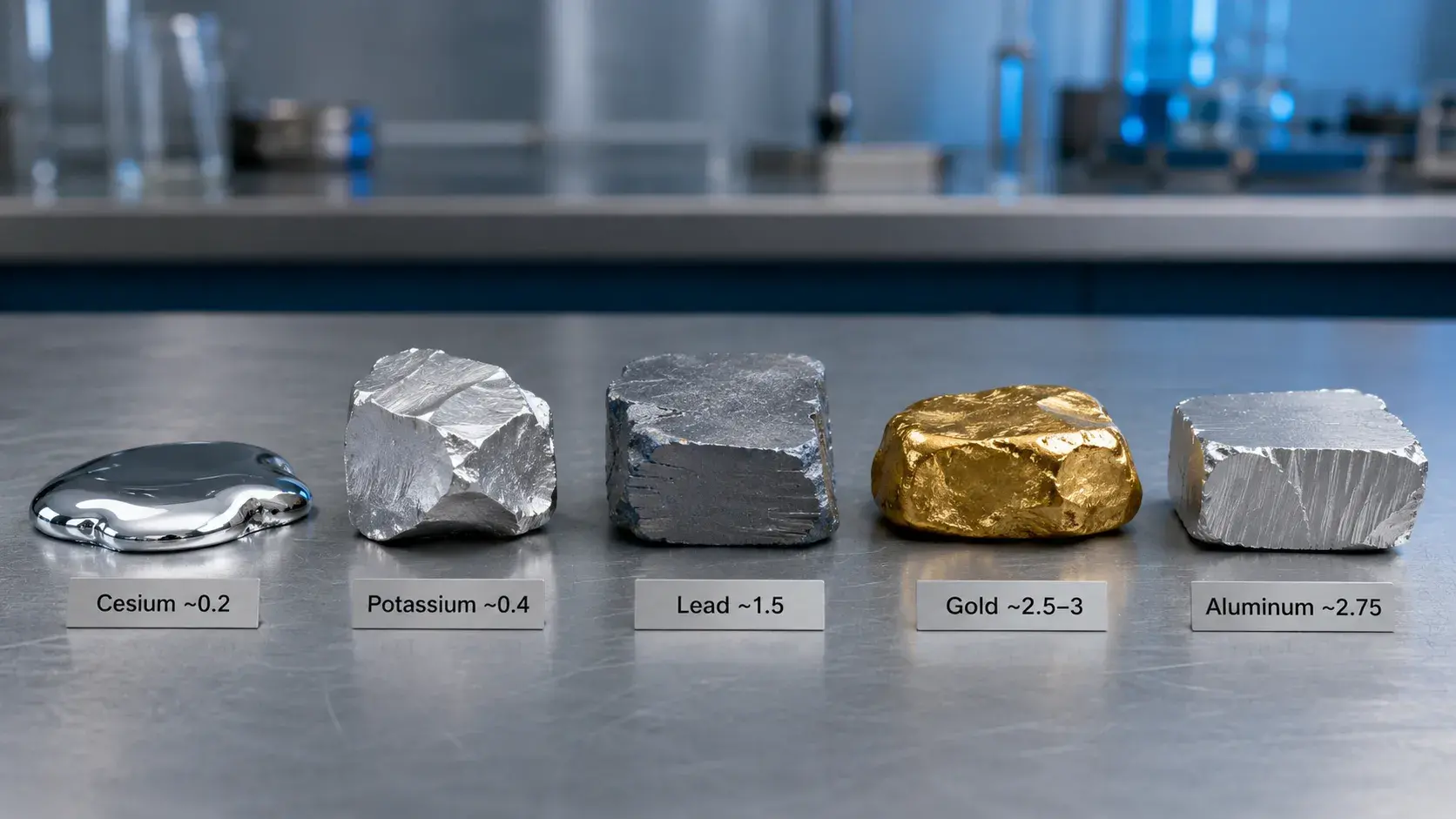
Cesium is the softest commonly cited solid metal, but several other metals are often confused with it because they are also easy to deform or have unusually low melting points.
Cesium vs Rubidium
Rubidium is another extremely soft alkali metal and has a Mohs hardness of roughly 0.3.
It is slightly harder than cesium but shares similar characteristics, including high chemical reactivity and a low melting point.
Neither cesium nor rubidium is commonly used as a structural engineering material.
Cesium vs Potassium
Potassium has a Mohs hardness of around 0.4 and can be cut easily with a knife.
It is still significantly softer than most common metals, but cesium is generally softer.
Both metals react strongly with water and must be stored and handled carefully.
Cesium vs Lead
Lead is much harder than cesium, with a Mohs hardness of approximately 1.5.
However, lead is still considered a very soft metal because it bends, scratches, and deforms easily.
Unlike cesium, lead has been widely used in batteries, radiation shielding, weights, and specialized industrial applications, although health and environmental concerns limit its use.
Cesium vs Gold
Gold has a Mohs hardness of around 2.5 to 3, so it is much harder than cesium.
What makes gold unusual is not extreme softness alone, but its exceptional malleability and ductility.
Gold can be hammered into extremely thin sheets or drawn into very fine wire without breaking.
Cesium vs Aluminum
Pure aluminum has a Mohs hardness of roughly 2.75, making it far harder than cesium.
However, aluminum is still relatively soft compared with many steels.
Its hardness can change significantly through alloying and heat treatment. For example, common engineering alloys such as 6061 and 7075 are much stronger and harder than pure aluminum.
Is Mercury the Softest Metal?
Mercury is not normally described as the softest metal because it is liquid at room temperature.
Hardness measures resistance to scratching, indentation, or permanent deformation in solid materials. Since mercury does not maintain a solid shape under normal room conditions, conventional hardness comparisons do not apply in the same way.
For this reason, discussions about the softest metal usually mean:
the softest metal that is solid under normal or near-room-temperature conditions.
Under that definition, cesium is commonly given as the answer.
Is Gallium the Softest Metal?
No. Gallium is not the softest metal.
Gallium is often mentioned because it has an unusually low melting point of about 29.8°C (85.6°F). A piece of gallium can therefore melt in a warm hand.
That does not mean it has the lowest hardness.
Cesium has a lower commonly cited Mohs hardness and is generally considered softer in its solid state.
Gallium is better known as a low-melting-point metal rather than the world’s softest metal.
What Are the Softest Metals Used in Manufacturing?
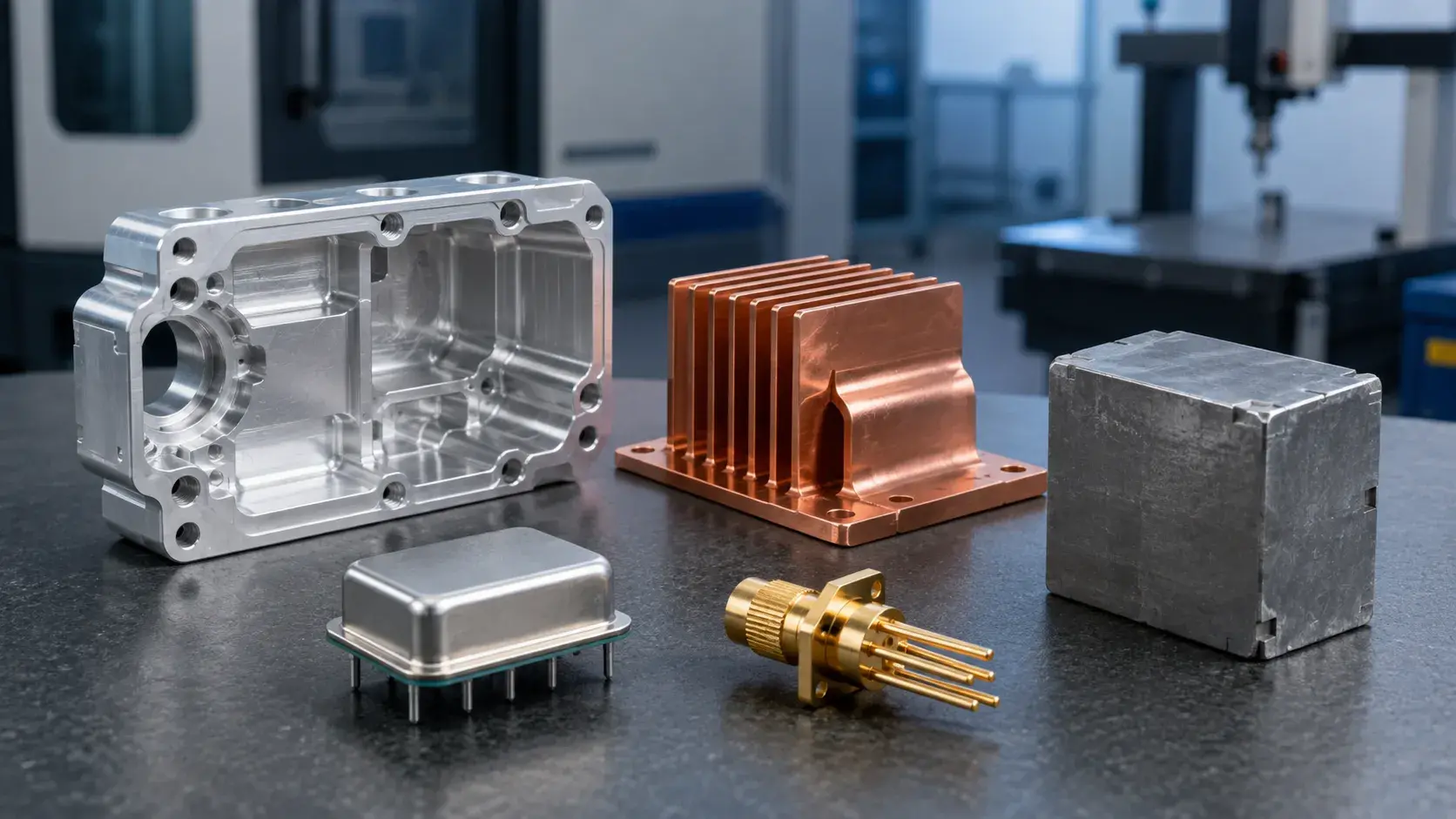
The world’s very soft alkali metals are rarely used for ordinary machined parts. In manufacturing, the more relevant soft metals are aluminum, copper, lead, tin, gold, and silver.
Aluminum
Pure aluminum is relatively soft, lightweight, and easy to form.
Most CNC parts, however, are made from aluminum alloys such as 6061, 7075, 5052, and 2024, which offer much better strength and hardness than pure aluminum.
Aluminum is widely used for housings, brackets, aerospace parts, electronics, fixtures, and lightweight structural components.
Copper
Copper is relatively soft and highly ductile, with excellent electrical and thermal conductivity.
It is commonly used for electrical contacts, busbars, heat sinks, electrodes, and thermal components.
Pure copper can be more difficult to machine cleanly than many people expect because it tends to produce burrs and can stick to cutting tools.
Lead
Lead is a very soft and dense metal that can be scratched and deformed easily.
It has been used in radiation shielding, batteries, counterweights, and vibration-control applications.
Because lead is toxic, manufacturing, handling, and disposal require stricter safety controls than many common engineering metals.
Tin
Tin is soft, corrosion resistant, and has a relatively low melting point.
It is widely used in solder alloys, protective coatings, plating, and electronic applications rather than as a primary structural material.
Gold and Silver
Gold and silver are relatively soft compared with most structural metals.
Their value comes mainly from corrosion resistance, electrical conductivity, appearance, and exceptional formability.
They are commonly found in electrical contacts, connectors, electronics, jewelry, and specialized components.
Are Soft Metals Easier to Machine?
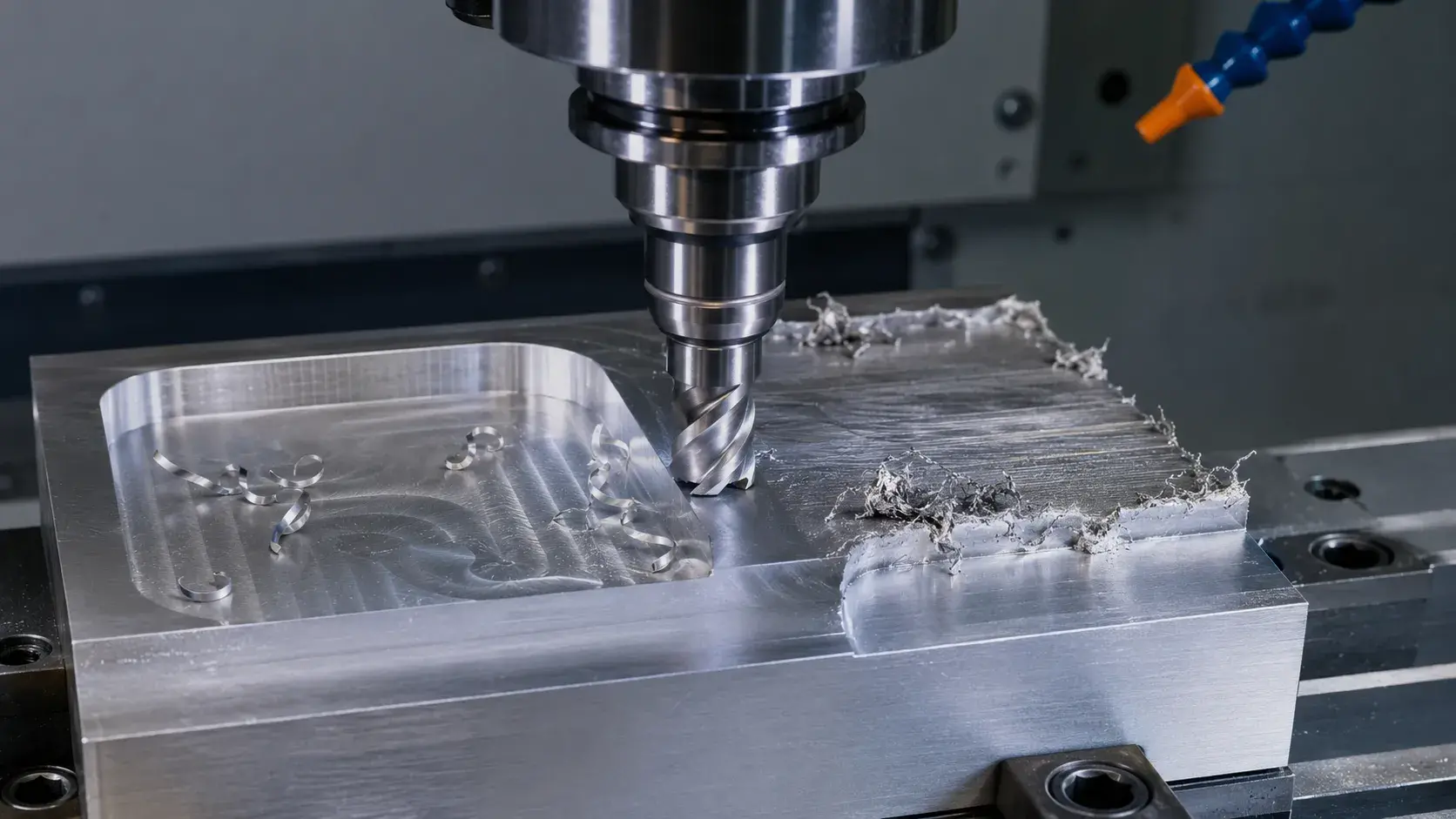
Not always.
Soft metals generally require less cutting force than harder materials, but very soft and ductile metals can create their own machining problems.
Common issues include:
- built-up edge on the cutting tool;
- long or gummy chips;
- burr formation;
- surface smearing;
- deformation during clamping;
- scratches and cosmetic damage;
- poor dimensional stability on thin features.
For example, aluminum alloys such as 6061 usually machine very well, while pure aluminum can be noticeably more gummy.
Copper is another good example. It is soft, but some copper grades can be difficult to machine because the material tends to stretch and form burrs instead of breaking into clean chips.
Tool geometry, cutting speed, lubrication, workholding, and alloy selection often matter more than hardness alone.
Does Soft Metal Mean Weak Metal?
No. Softness and strength describe different material properties.
A soft metal has relatively low resistance to scratching, indentation, or permanent surface deformation. Strength describes how much stress a material can withstand before yielding or breaking.
A metal can therefore be relatively soft while still being useful in demanding applications.
For example:
- Gold is soft but extremely ductile.
- Copper is relatively soft but performs exceptionally well in electrical applications.
- Aluminum alloys can be much stronger than pure aluminum.
- Lead is soft but useful where high density is required.
This is why material selection should not be based on hardness alone.
Engineers also consider tensile strength, yield strength, ductility, toughness, density, corrosion resistance, conductivity, temperature resistance, and machinability.
Softest Metal vs Hardest Metal
Cesium sits near one extreme of metal hardness, while very hard engineering materials sit at the opposite end.
However, it is important not to compare cesium directly with diamond when discussing the hardest metal.
Diamond is not a metal.
Among metallic elements, chromium is often cited as one of the hardest pure metals, while tungsten is better known for its extremely high melting point and high strength at elevated temperatures.
Engineering materials can become even harder when metals are combined with carbon or other elements.
For example, tungsten carbide is much harder than pure tungsten, but it is a ceramic-metal composite rather than a pure metal.
The key point is that hardness depends heavily on whether you are comparing:
- pure metals;
- metal alloys;
- heat-treated metals;
- carbides;
- or other engineered materials.
So while cesium is commonly considered the softest solid metal, the answer to “what is the hardest metal?” requires a more specific definition.
Conclusion
Cesium is generally considered the softest solid metal, with a Mohs hardness of approximately 0.2.
However, softness alone does not determine how useful a metal is. The softest metals, such as cesium and rubidium, are highly reactive and rarely used for ordinary manufactured parts.
In practical engineering, softer metals such as aluminum, copper, tin, lead, gold, and silver are more important because they combine formability with useful electrical, thermal, mechanical, or corrosion-resistant properties.
For machining and material selection, hardness should always be considered together with strength, ductility, machinability, corrosion resistance, and the final application.
Frequently Asked Questions
Several alkali metals can be cut with a knife, including cesium, rubidium, potassium, sodium, and lithium.
Potassium and sodium are well-known examples because they are soft enough to cut easily when stored and handled under controlled conditions.
Yes. Pure gold is relatively soft, with a Mohs hardness of around 2.5 to 3.
It is also extremely malleable and ductile, which means it can be formed into very thin sheets or fine wires without cracking.
Pure aluminum is relatively soft, but most industrial aluminum parts are made from stronger alloys.
Alloys such as 6061 and 7075 offer much higher strength and hardness than pure aluminum, making them suitable for CNC machining and structural applications.
Yes.
Lead has a Mohs hardness of around 1.5, while pure gold is typically around 2.5 to 3.
This means lead is generally easier to scratch and deform.



