

The chemical symbol for aluminum is Al, and its atomic number is 13. The symbol uses a capital “A” followed by a lowercase “l”.
The symbol is the same whether the element is spelled aluminum in American English or aluminium in British English.
What Is the Chemical Symbol for Aluminum?
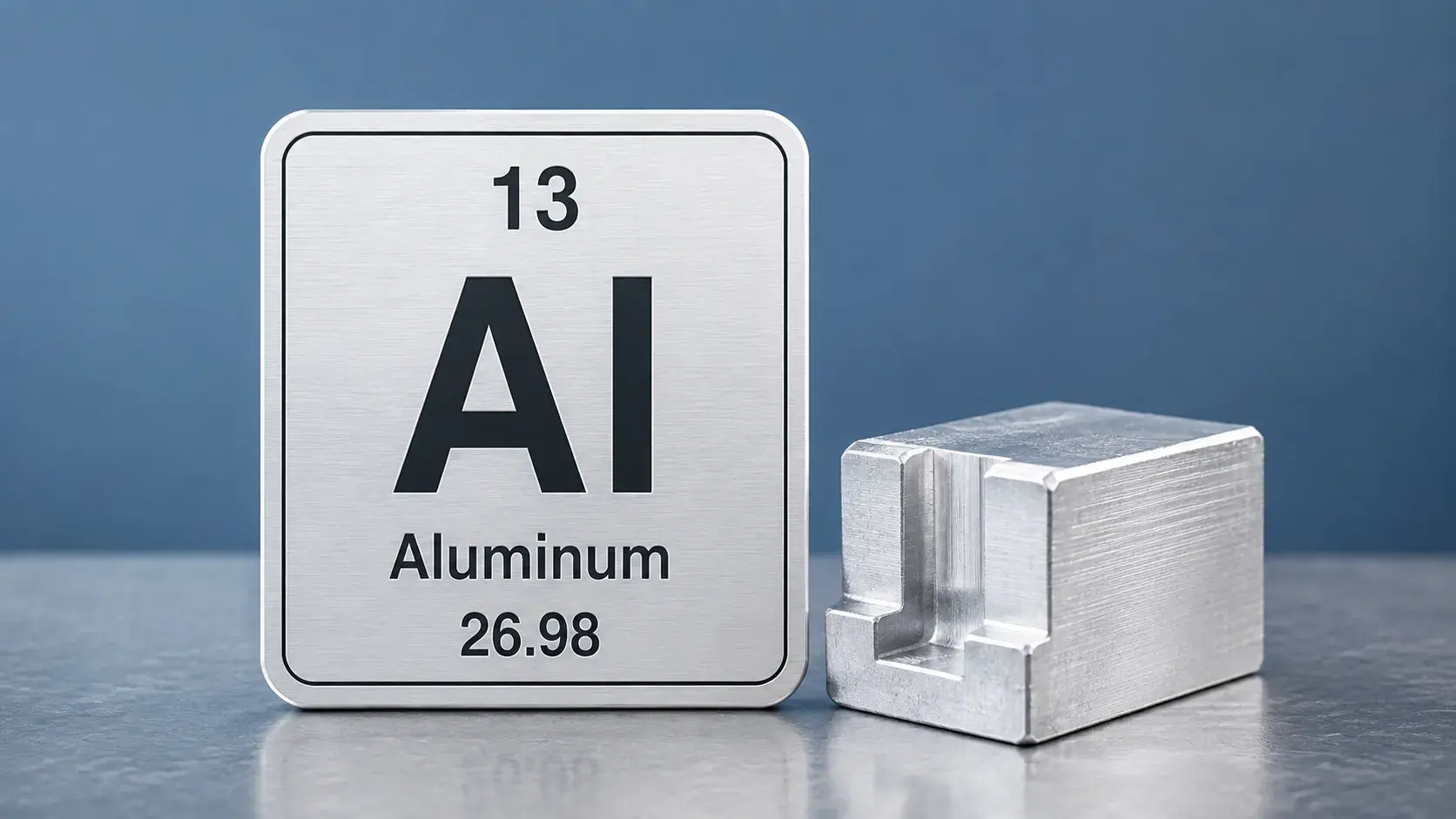
The chemical symbol for aluminum is Al.
It represents the element aluminum on the periodic table and in chemical formulas, engineering documents, material data, and scientific notation.
Here are the basic facts:
| Property | Aluminum |
|---|---|
| Chemical Symbol | Al |
| Atomic Number | 13 |
| Atomic Weight | ~26.98 |
| Group | 13 |
| Period | 3 |
| Element Type | Metal |
| Density | ~2.70 g/cm³ |
| Melting Point | ~660°C |
| Common Oxidation State | +3 |
Aluminum is a lightweight, silvery metal widely used in transportation, construction, electronics, packaging, and manufacturing.
Why Is Aluminum's Symbol Al?
The symbol Al comes directly from the name aluminum or aluminium.
Chemical element symbols normally use one or two letters. The first letter is always uppercase, while the second letter, if present, is lowercase.
That is why aluminum is written as:
Al
not:
AL
or:
al
This capitalization rule is important because chemical symbols are standardized and case-sensitive.
Is Aluminum Al or AL?
The correct chemical symbol is Al.
It uses:
- uppercase A
- lowercase l
Writing AL is not the correct chemical notation for aluminum.
In some fonts, the lowercase “l” can look similar to an uppercase “I”, which can cause confusion. The correct symbol is Al, not AI.
Aluminum vs Aluminium: Is the Symbol Different?
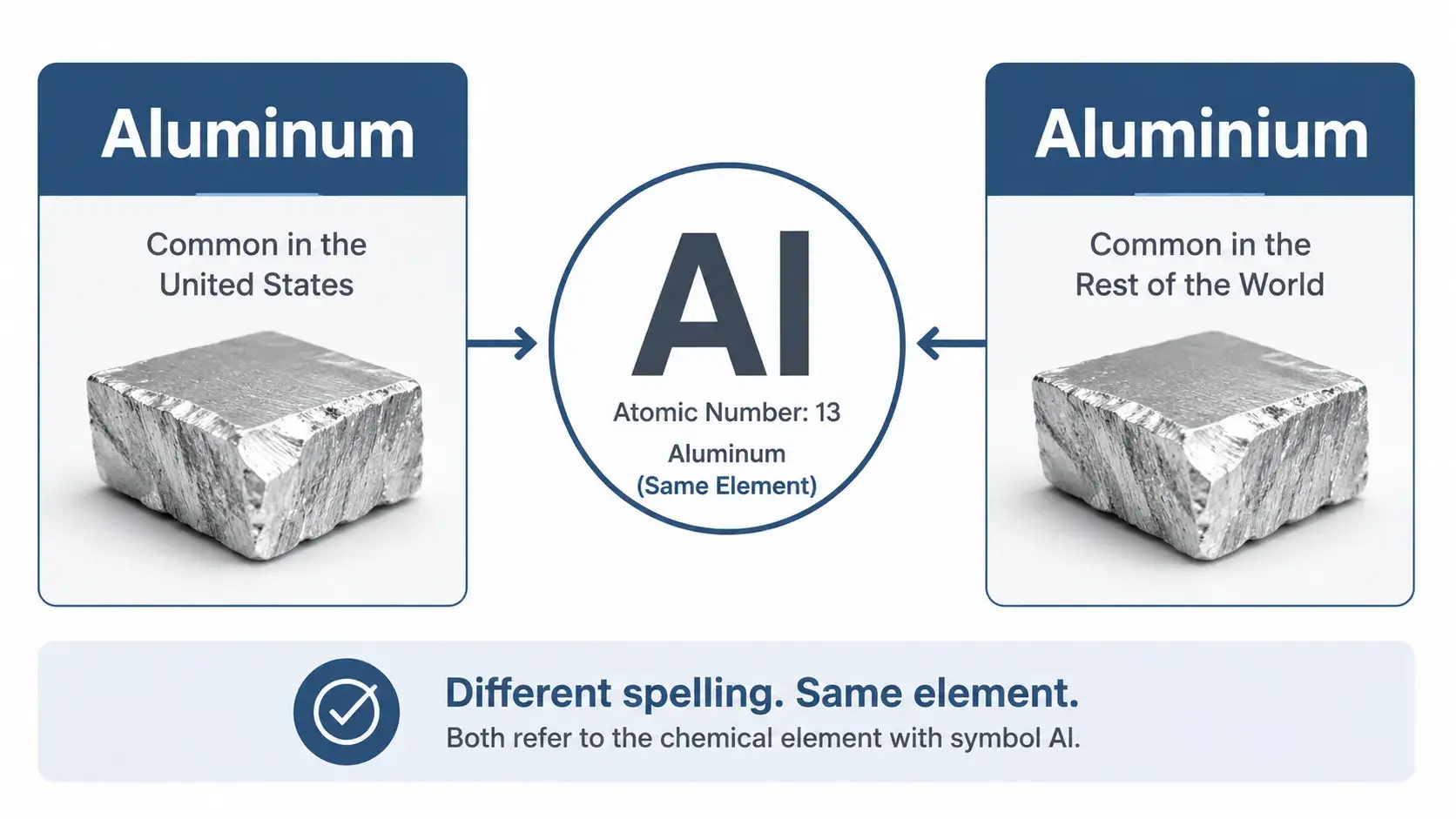
No.
Aluminum and aluminium refer to the same chemical element.
“Aluminum” is the common spelling in American English, while “aluminium” is widely used in British English and many other countries.
Both use exactly the same chemical symbol:
Al
They also have the same atomic number:
13
The difference is only in spelling, not in chemical identity.
Where Is Aluminum on the Periodic Table?
Aluminum is located in Group 13 and Period 3 of the periodic table.
Its atomic number is 13, which means a neutral aluminum atom has 13 protons and 13 electrons.
Its electron configuration can be written as:
[Ne] 3s² 3p¹
This gives aluminum three valence electrons in its outer shell.
Because aluminum commonly loses these three electrons during chemical reactions, its most common oxidation state is +3.
This is why aluminum often appears as Al³⁺ in chemical compounds.
What Does Al Mean on Engineering Drawings?
On engineering drawings and material specifications, Al usually indicates that the base material is aluminum.
However, Al alone does not identify the exact alloy, temper, strength, or machining behavior.
For example:
Al 6061-T6
can be broken down as:
- Al = aluminum;
- 6061 = aluminum alloy grade;
- T6 = heat-treated temper condition.
This distinction is important because pure aluminum and aluminum alloys can have very different mechanical properties.
Al vs 6061, 7075, and 2024 Aluminum
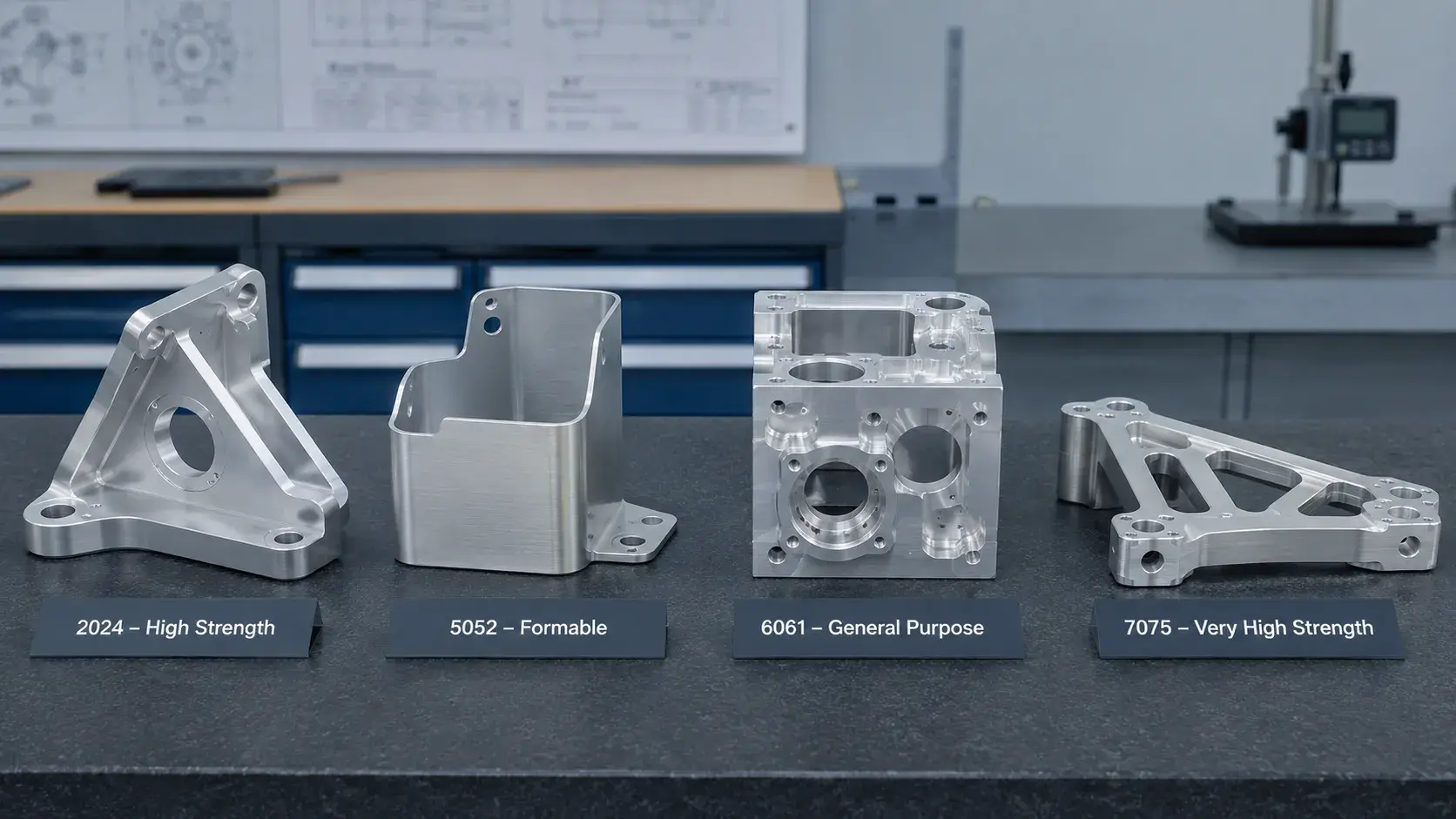
Al is the chemical symbol for the aluminum element. Numbers such as 6061, 7075, and 2024 refer to specific aluminum alloys.
These alloys contain aluminum as the main element but also include controlled amounts of other elements to improve strength, corrosion resistance, machinability, or other properties.
For example:
6061 Aluminum
6061 is a widely used aluminum alloy containing magnesium and silicon as its main alloying elements.
It offers a good balance of strength, corrosion resistance, weldability, and machinability, making it common for CNC machined parts, structural components, housings, and fixtures.
7075 Aluminum
7075 is a high-strength aluminum alloy that mainly uses zinc as its primary alloying element.
It is widely used in aerospace, high-performance mechanical parts, and applications where strength-to-weight ratio is especially important.
2024 Aluminum
2024 is an aluminum-copper alloy known for high strength and fatigue resistance.
It is commonly used in aerospace structures and other applications where mechanical performance is more important than maximum corrosion resistance.
5052 Aluminum
5052 is an aluminum-magnesium alloy with good corrosion resistance and excellent formability.
It is especially common in sheet metal, enclosures, marine components, and formed aluminum parts.
Common Aluminum Alloy Series
Aluminum alloys are commonly grouped into series based on their main alloying elements.
| Series | Main Alloying Element | Typical Characteristics |
|---|---|---|
| 1000 | Mostly pure aluminum | High conductivity and corrosion resistance |
| 2000 | Copper | High strength |
| 3000 | Manganese | Good formability and corrosion resistance |
| 4000 | Silicon | Lower melting point and good wear characteristics |
| 5000 | Magnesium | Good corrosion resistance and weldability |
| 6000 | Magnesium + Silicon | Good strength, machinability, and general-purpose use |
| 7000 | Zinc | Very high strength |
For CNC machining, 6000-series and 7000-series aluminum alloys are especially common because they offer a useful combination of strength, stability, and machinability.
Key Properties of Aluminum
Aluminum is widely used because it combines low density with useful physical and mechanical properties.
| Property | Typical Characteristic |
|---|---|
| Density | ~2.70 g/cm³ |
| Melting Point | ~660°C |
| Appearance | Silvery-white |
| Magnetism | Generally nonmagnetic |
| Corrosion Resistance | Good due to natural oxide layer |
| Electrical Conductivity | Good |
| Thermal Conductivity | Good |
| Formability | Good |
| Machinability | Good for many aluminum alloys |
Pure aluminum is relatively soft, but alloying and heat treatment can greatly increase its strength and hardness.
This is why the symbol Al alone does not tell you how a particular aluminum material will perform in an engineering application.
Why Is Aluminum Widely Used in Manufacturing?
Aluminum is widely used in manufacturing because it combines low weight, good corrosion resistance, useful strength, and relatively easy processing.
Its low density makes it especially attractive for applications where reducing weight is important.
Common advantages include:
- low density;
- good corrosion resistance;
- good thermal conductivity;
- good electrical conductivity;
- good formability;
- easy recycling;
- good machinability in many alloys;
- high strength-to-weight ratio after alloying.
This is why aluminum is common in aerospace parts, automotive components, electronics housings, industrial equipment, fixtures, brackets, and consumer products.
Is Aluminum Easy to CNC Machine?
Many aluminum alloys are very suitable for CNC machining.
Grades such as 6061-T6 and 7075-T6 can usually be machined at high cutting speeds while still producing good dimensional accuracy and surface finish.
However, machinability depends on the exact alloy and temper.
Pure aluminum and some softer grades can be more difficult to machine cleanly because they may produce:
- gummy chips;
- built-up edge;
- burrs;
- surface smearing;
- deformation in thin features.
For CNC parts, the alloy designation is therefore much more important than simply knowing that the material is aluminum.
Conclusion
The chemical symbol for aluminum is Al, and its atomic number is 13.
Al identifies the chemical element itself, while designations such as 6061, 7075, 2024, and 5052 identify specific aluminum alloys with different properties.
For engineering and CNC machining, knowing the alloy and temper is usually more useful than the chemical symbol alone.
FAQs About Aluminum's Symbol
Al is the chemical symbol for aluminum. Aluminum is element 13 on the periodic table and belongs to Group 13.
Al stands for aluminum in chemistry, the periodic table, and many engineering material specifications.
For example, in Al 6061-T6, Al identifies aluminum as the base metal.
The atomic number of Al is 13.
This means every aluminum atom contains 13 protons in its nucleus.
The element symbol for aluminum is Al, with an uppercase “A” and lowercase “l”.
The periodic table symbol for aluminum is Al. Its atomic number is 13 and its standard atomic weight is approximately 26.98.



