

NPT (National Pipe Taper) is a 60° tapered pipe thread commonly used for fluid, pneumatic, and piping connections. NPT sizes are nominal, so a 1/2 NPT thread does not measure 1/2 inch across. Use the charts below to quickly check NPT thread size, TPI, pitch, outside diameter, and tap drill information.
NPT Thread Size Chart
The table below covers the NPT sizes most commonly encountered in fittings, valves, manifolds, machine components, and CNC machined parts.
| NPT Size | Threads per Inch (TPI) | Thread Pitch | Approx. Outside Diameter | Outside Diameter (mm) |
|---|---|---|---|---|
| 1/16 NPT | 27 | 0.0370 in / 0.941 mm | 0.313 in | 7.95 mm |
| 1/8 NPT | 27 | 0.0370 in / 0.941 mm | 0.405 in | 10.29 mm |
| 1/4 NPT | 18 | 0.0556 in / 1.411 mm | 0.540 in | 13.72 mm |
| 3/8 NPT | 18 | 0.0556 in / 1.411 mm | 0.675 in | 17.15 mm |
| 1/2 NPT | 14 | 0.0714 in / 1.814 mm | 0.840 in | 21.34 mm |
| 3/4 NPT | 14 | 0.0714 in / 1.814 mm | 1.050 in | 26.67 mm |
| 1 NPT | 11.5 | 0.0870 in / 2.209 mm | 1.315 in | 33.40 mm |
| 1-1/4 NPT | 11.5 | 0.0870 in / 2.209 mm | 1.660 in | 42.16 mm |
| 1-1/2 NPT | 11.5 | 0.0870 in / 2.209 mm | 1.900 in | 48.26 mm |
| 2 NPT | 11.5 | 0.0870 in / 2.209 mm | 2.375 in | 60.33 mm |
| 2-1/2 NPT | 8 | 0.1250 in / 3.175 mm | 2.875 in | 73.03 mm |
| 3 NPT | 8 | 0.1250 in / 3.175 mm | 3.500 in | 88.90 mm |
| 4 NPT | 8 | 0.1250 in / 3.175 mm | 4.500 in | 114.30 mm |
| 6 NPT | 8 | 0.1250 in / 3.175 mm | 6.625 in | 168.28 mm |
Important: the NPT size is a nominal pipe size, not the measured thread diameter. For example, a 1/2 NPT male thread has an outside diameter of about 0.840 in (21.34 mm), not 0.500 in.
These basic NPT dimensions follow the ASME B1.20.1 pipe thread system. ASME currently lists B1.20.1-2013 (R2018) as the foundational standard covering NPT and several related American pipe thread forms.
What Is an NPT Thread?
NPT stands for National Pipe Taper. It is the standard tapered pipe thread widely used in the United States for pipes, fittings, valves, pressure connections, hydraulic components, pneumatic equipment, and machined manifolds.
An NPT thread has three important characteristics:
- a 60° included thread angle;
- a tapered thread form rather than a parallel thread;
- a nominal size that does not equal the actual thread diameter.
The standard NPT taper is 1 in 16 on diameter. This means the thread diameter changes gradually along the length of the thread.
As a male NPT thread is screwed farther into a female NPT thread, the tapered surfaces become progressively tighter.
This interference helps create a mechanically tight connection. In applications that must resist leakage, thread sealant or PTFE tape is also commonly used.
Why Is NPT Size Different From the Actual Diameter?
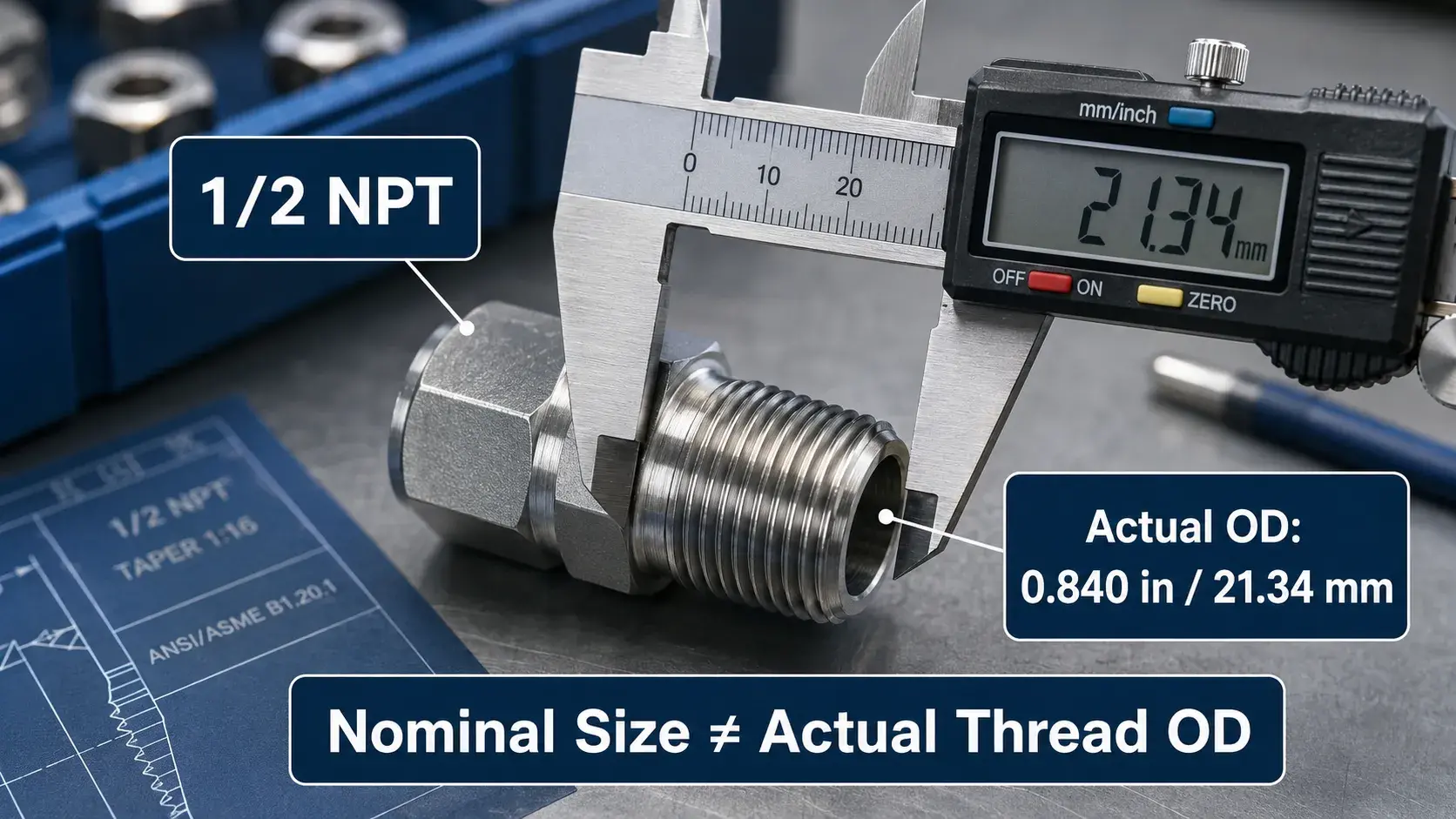
One of the most confusing things about NPT threads is that the size printed on the fitting does not describe the actual thread diameter.
For example:
- 1/8 NPT has an outside diameter of about 0.405 in (10.29 mm).
- 1/4 NPT measures about 0.540 in (13.72 mm).
- 1/2 NPT measures about 0.840 in (21.34 mm).
- 1 NPT measures about 1.315 in (33.40 mm).
So if you measure a thread with calipers and get approximately 0.84 inch, that does not mean you have a 0.84-inch NPT thread. It is normally a 1/2 NPT connection.
This happens because NPT sizes come from nominal pipe sizing rather than the outside diameter of the thread itself.
When identifying an unknown NPT thread, always compare the measured diameter and thread pitch/TPI with an NPT size chart instead of using diameter alone.
How to Measure NPT Thread Size
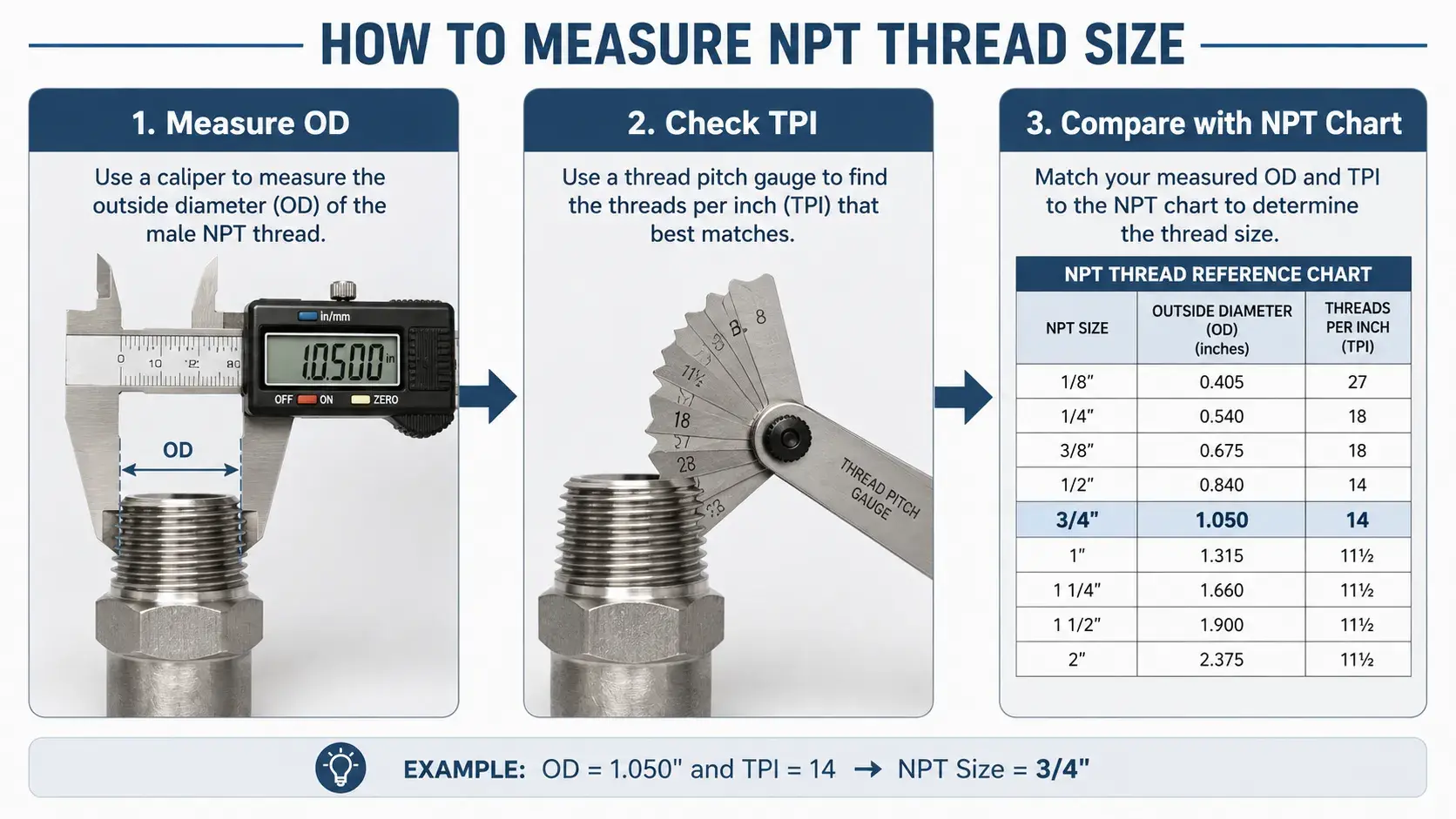
You can usually identify a common NPT thread with a caliper, thread pitch gauge, and the size chart above.
1. Measure the Thread Diameter
For an external male thread, use calipers to measure across the thread near the larger end of the tapered section.
Because NPT threads are tapered, the diameter changes depending on where you measure. The result should therefore be treated as an identification measurement rather than a precision acceptance measurement.
2. Measure the Threads per Inch
Use a thread pitch gauge or count the number of thread peaks within one inch.
Common examples include:
- 1/8 NPT = 27 TPI
- 1/4 NPT = 18 TPI
- 3/8 NPT = 18 TPI
- 1/2 NPT = 14 TPI
- 3/4 NPT = 14 TPI
- 1 NPT = 11.5 TPI
TPI alone is not enough because several NPT sizes share the same thread pitch.
For example, both 1/4 NPT and 3/8 NPT use 18 TPI, while both 1/2 NPT and 3/4 NPT use 14 TPI.
3. Compare Diameter and TPI
Match both measurements against the NPT chart.
For example, if a male thread measures approximately 0.540 in and has 18 TPI, it is likely 1/4 NPT.
If it measures approximately 0.675 in with the same 18 TPI, it is more likely 3/8 NPT.
For production inspection or critical pressure connections, calipers are not enough. Proper NPT plug or ring gauges should be used to verify thread size and engagement according to the applicable standard.
Common NPT Thread Sizes at a Glance
For quick identification, these are some of the NPT sizes most commonly seen in industrial fittings and machined components:
| NPT Size | TPI | Approx. Male Thread OD |
|---|---|---|
| 1/8 NPT | 27 | 0.405 in / 10.29 mm |
| 1/4 NPT | 18 | 0.540 in / 13.72 mm |
| 3/8 NPT | 18 | 0.675 in / 17.15 mm |
| 1/2 NPT | 14 | 0.840 in / 21.34 mm |
| 3/4 NPT | 14 | 1.050 in / 26.67 mm |
| 1 NPT | 11.5 | 1.315 in / 33.40 mm |
If you only need to identify a fitting, this short table is often enough.
The most important point is to match both OD and TPI. A thread diameter that looks close to an inch-based fraction can easily lead to the wrong NPT size if you compare diameter alone.
NPT Tap Drill Size Chart
Before cutting an internal NPT thread, the hole must first be drilled to an appropriate size.
The table below lists common tap drill sizes used for NPT threads.
| NPT Size | TPI | Recommended Tap Drill |
|---|---|---|
| 1/8 NPT | 27 | R drill / 0.339 in |
| 1/4 NPT | 18 | 7/16 in |
| 3/8 NPT | 18 | 37/64 in |
| 1/2 NPT | 14 | 23/32 in |
| 3/4 NPT | 14 | 59/64 in |
| 1 NPT | 11.5 | 1-5/32 in |
| 1-1/4 NPT | 11.5 | 1-1/2 in |
| 1-1/2 NPT | 11.5 | 1-47/64 in |
| 2 NPT | 11.5 | 2-7/32 in |
These are commonly used starting drill sizes for tapping NPT threads. Actual production processes may use a slightly different pre-hole depending on the tap manufacturer, material, thread engagement, and whether the hole is drilled straight or prepared with a tapered reamer.
For critical production work, always verify the recommended pre-hole with the specific NPT tap manufacturer and the applicable drawing or process specification.
How Does an NPT Thread Seal?
NPT threads seal differently from straight machine threads.
Both the male and female NPT threads are tapered. As they are tightened together, the flanks progressively interfere and the joint becomes mechanically tighter.
However, standard NPT threads normally have small clearance paths around the thread crests and roots.
For this reason, pressure or fluid connections commonly use:
- PTFE thread tape;
- liquid pipe thread sealant;
- anaerobic thread sealant.
The sealant fills microscopic leakage paths while also helping lubricate assembly.
NPT should therefore not automatically be treated as a dry, sealant-free thread.
NPT vs NPS: What Is the Difference?
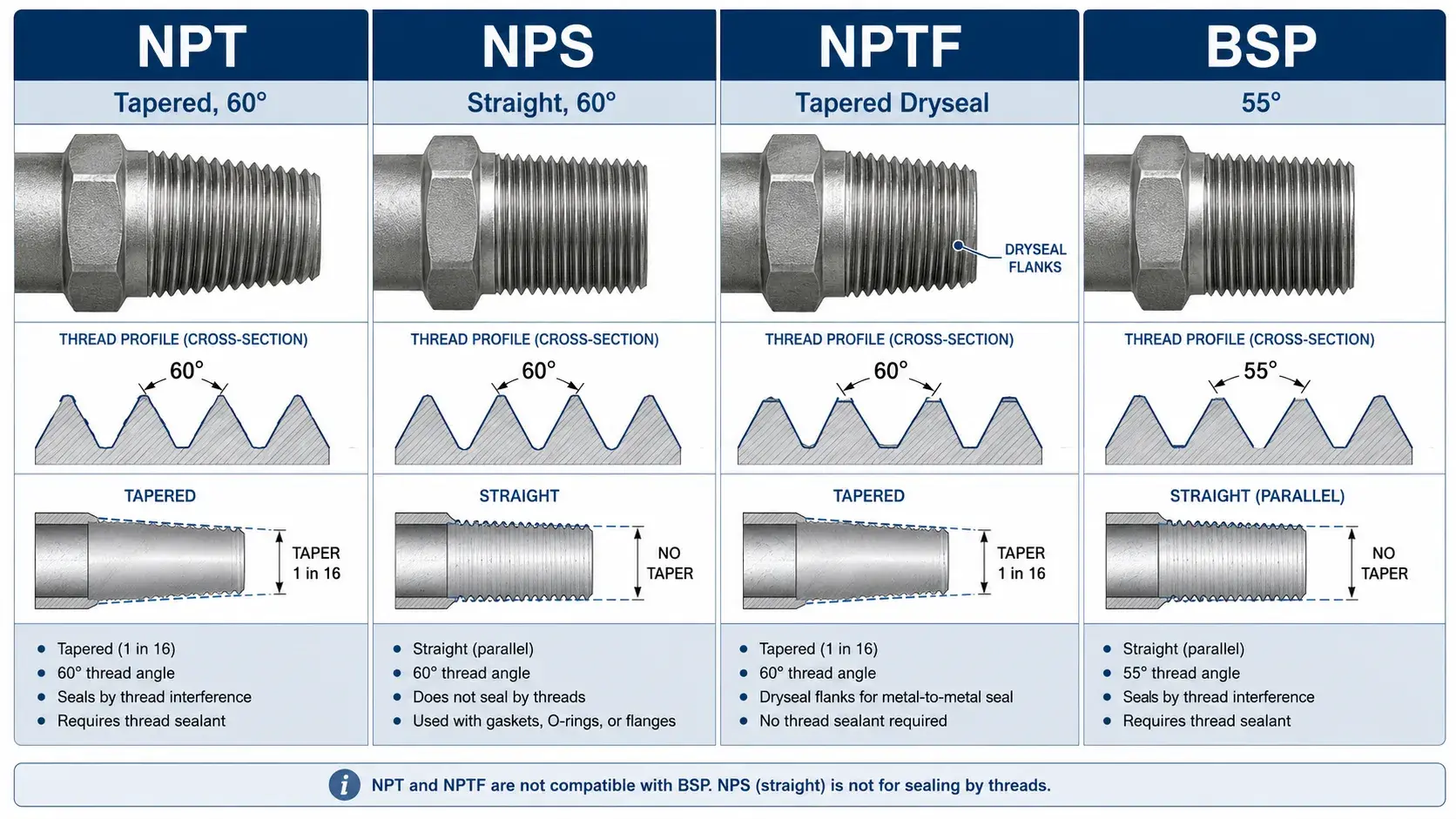
NPT and NPS use a similar 60° American pipe thread form, but their thread geometry is different.
| Feature | NPT | NPS |
|---|---|---|
| Thread Shape | Tapered | Straight / parallel |
| Thread Angle | 60° | 60° |
| Pitch | Same for corresponding sizes | Same for corresponding sizes |
| Diameter Changes Along Thread | Yes | No |
| Typical Sealing Method | Thread interference + sealant | Usually separate sealing surface or seal |
| Typical Use | Pipe and fluid connections | Straight-thread mechanical connections |
The main difference is simple:
NPT gets tighter as the threads engage because it is tapered. NPS remains the same diameter along its threaded length.
NPT and NPS should not be assumed to be interchangeable simply because their nominal size and TPI are the same.
NPT vs NPTF: What Is the Difference?
NPTF stands for National Pipe Taper Fuel, and it is commonly referred to as a Dryseal pipe thread.
Both NPT and NPTF use:
- a 60° thread angle;
- a 1:16 diameter taper;
- the same basic nominal pipe sizing.
The difference is mainly in the crest and root geometry and the tighter control of the thread form.
| Feature | NPT | NPTF |
|---|---|---|
| Standard | ASME B1.20.1 | ASME B1.20.3 |
| Thread Form | Tapered | Tapered Dryseal |
| Sealant Commonly Used | Yes | May seal without sealant when properly manufactured |
| Crest/Root Interference | Limited | Designed for greater metal-to-metal interference |
| Typical Application | General pipe connections | Applications requiring improved dry sealing |
NPTF is designed so that greater interference occurs at the thread crests and roots, reducing the spiral leakage path that can remain in a standard NPT connection.
That does not mean sealant is prohibited. Lubricant or compatible sealant may still be used where required to reduce galling or improve assembly reliability.
NPT vs BSP: Are They Interchangeable?
No. NPT and BSP threads should generally not be treated as interchangeable.
They may look similar, but they use different thread forms and, in many sizes, different pitches.
| Feature | NPT | BSP |
|---|---|---|
| Thread Angle | 60° | 55° |
| Thread Profile | Flat crest/root American form | Rounded Whitworth form |
| Common Tapered Version | NPT | BSPT / R |
| Common Parallel Version | NPS | BSPP / G |
| Common Standards | ASME B1.20.1 | ISO 7-1 / ISO 228-1 |
| Interchangeable | No | No |
For example:
- 1/4 NPT = 18 TPI
- 1/4 BSP = 19 TPI
And:
- 1/8 NPT = 27 TPI
- 1/8 BSP = 28 TPI
Even when the nominal size looks identical, the thread angle and pitch may be different.
Trying to force BSP and NPT threads together can damage the threads and may create an unreliable seal.
How Are NPT Threads Machined?
NPT threads can be produced in several ways depending on whether the thread is internal or external, the material, production quantity, and available CNC equipment.
Internal NPT Tapping
The most common method for internal NPT threads is a tapered NPT tap.
The typical process is:
Drill the hole → Chamfer the entrance → Tap the NPT thread → Clean → Gauge the thread
Because the tap itself is tapered, cutting torque increases as the tap moves deeper into the hole.
Hard materials such as stainless steel require particularly careful control of:
- cutting speed;
- lubrication;
- chip evacuation;
- tapping depth.
A tap that is driven too deep will produce an oversized effective thread, while insufficient depth may prevent the mating fitting from engaging far enough.
CNC Thread Milling
Thread milling is another option for internal NPT threads.
Instead of forcing a tapered tap into the hole, a thread mill follows a programmed helical toolpath to create the thread.
Thread milling can be useful when:
- the thread is relatively large;
- the material is difficult to tap;
- tool breakage must be minimized;
- the same tool needs to produce multiple thread diameters;
- better control of final thread size is required.
The CNC program must account for both the thread pitch and the NPT taper.
External NPT Threads
External male NPT threads are commonly produced on a CNC lathe.
The workpiece rotates while a threading insert follows the required pitch and tapered profile.
The taper must be programmed correctly so that the thread diameter gradually changes along its length.
External NPT threads may also be produced with dies or specialized threading equipment for simpler production work.
How Are NPT Threads Inspected?
A thread that looks correct with calipers may still be too deep, too shallow, or outside the permitted engagement range.
For production inspection, NPT threads are normally checked with dedicated gauges.
Common gauges include:
- NPT plug gauges for internal threads;
- NPT ring gauges for external threads.
The gauge is threaded into or onto the part until hand-tight engagement is reached.
The position of the gauge relative to its reference step indicates whether the thread engagement falls within the acceptable range.
Calipers and pitch gauges are useful for identifying an unknown NPT thread, but they are not a substitute for proper thread gauging when manufacturing parts to specification.
Quick NPT Thread Reference
If you only need to identify or manufacture a common NPT thread, remember these points:
- NPT uses a 60° tapered thread.
- The taper is 1:16 on diameter.
- NPT size is nominal, not the actual outside diameter.
- Identify an unknown thread using both OD and TPI.
- Standard NPT joints commonly use thread sealant or PTFE tape.
- NPT and BSP are not interchangeable.
- Internal NPT threads are commonly produced by tapping or thread milling.
- Production threads should be checked with the correct NPT plug or ring gauge.
For example, a thread measuring approximately 0.540 in OD with 18 TPI is typically 1/4 NPT, while a thread around 0.840 in OD with 14 TPI is typically 1/2 NPT.
Choosing the Right NPT Thread
The correct NPT thread should be selected by nominal size, TPI, actual thread diameter, sealing requirement, and the mating component.
For identification, compare both outside diameter and TPI with the NPT size chart. For manufacturing, use the correct tap drill, machining method, and thread gauge rather than relying only on caliper measurements.
Need Custom Parts With NPT Threads?
Send us your drawing, CAD file, material, and thread requirements. We can machine internal and external NPT threads and verify critical threads with appropriate inspection methods.
Get a CNC Machining Quote



