

Acetal and Delrin are closely related, but they are not exactly the same material. Acetal is the general name for POM plastics, while Delrin is a branded acetal homopolymer.
In practice, Delrin usually offers higher strength and stiffness, while acetal copolymer generally provides better chemical resistance, hot-water resistance, and lower risk of centerline porosity.
Both materials machine very well and are widely used for gears, bushings, rollers, valve parts, spacers, and other precision CNC components.
This guide explains the main differences between acetal and Delrin, their properties, machining behavior, and which material is better for different applications.
What Is Acetal?
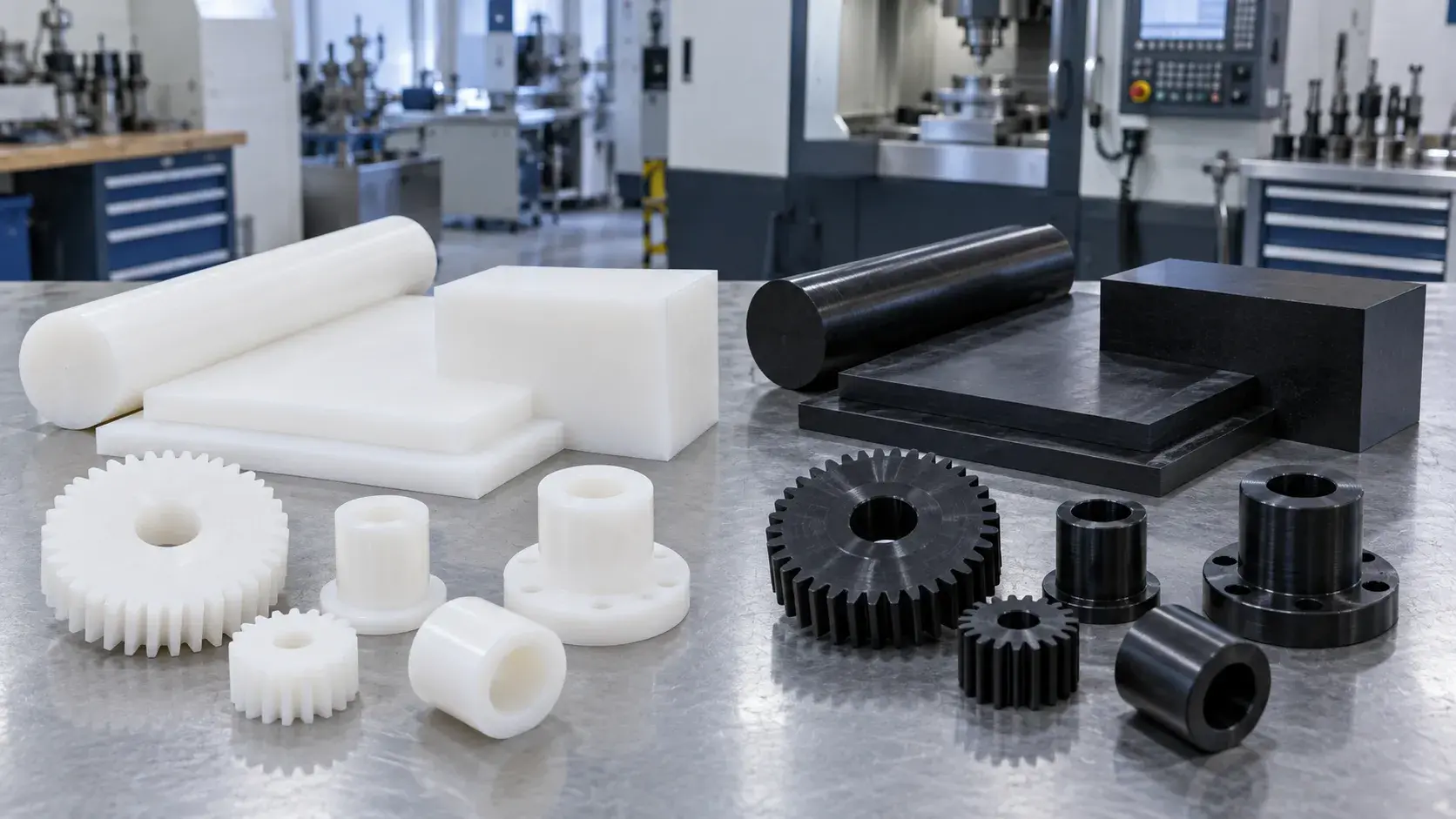
Acetal is the common name for polyoxymethylene, usually shortened to POM.
It is an engineering plastic known for:
- Low friction
- Good dimensional stability
- High strength
- Low moisture absorption
- Good wear resistance
- Excellent machinability
Acetal is commonly used for precision mechanical parts where metal may be too heavy, noisy, expensive, or unnecessary.
There are two main types of POM:
POM-H — acetal homopolymer
POM-C — acetal copolymer
When suppliers simply say “acetal,” they are often referring to acetal copolymer, although this should always be confirmed before ordering material.
What Is Delrin?
Delrin® is a brand of acetal homopolymer originally developed by DuPont.
In simple terms:
All Delrin is acetal, but not all acetal is Delrin.
Delrin belongs to the POM-H family and is known for high stiffness, good fatigue strength, low friction, and good dimensional stability.
Because of these properties, Delrin is commonly used for small precision mechanical parts such as gears, rollers, bearings, bushings, sliding components, and shafts.
Acetal vs Delrin: Quick Comparison
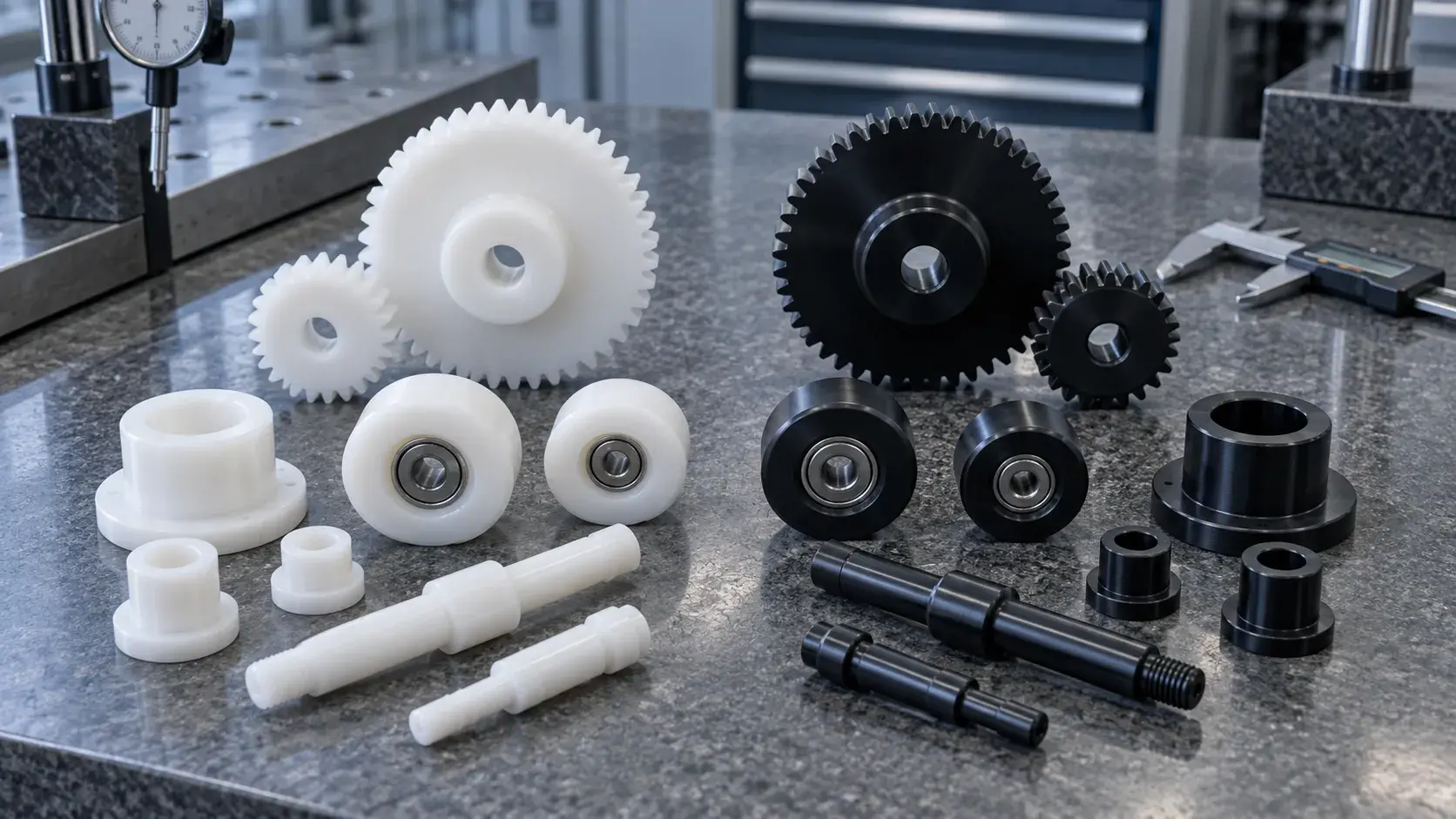
The table below shows the main differences between acetal copolymer and Delrin homopolymer.
| Property | Acetal Copolymer | Delrin |
|---|---|---|
| Material type | POM-C | POM-H |
| Strength | High | Usually higher |
| Stiffness | High | Usually higher |
| Fatigue resistance | Good | Very good |
| Chemical resistance | Usually better | Good |
| Hot-water resistance | Better | Good |
| Moisture absorption | Very low | Very low |
| Machinability | Excellent | Excellent |
| Centerline porosity | Lower risk | Higher risk in thick sections |
| Cost | Usually lower | Usually higher |
| Best suited for | Chemical, fluid, larger parts | Precision, stiff, mechanical parts |
Neither material is automatically better.
The right choice depends on the part geometry, environment, load, temperature, and manufacturing process.
Strength and Stiffness
One of the biggest differences between acetal copolymer and Delrin is mechanical strength.
Delrin generally provides higher tensile strength and stiffness than standard acetal copolymer.
This makes it useful for parts that need to hold their shape under load.
Typical examples include:
- Small gears
- Mechanical linkages
- Precision rollers
- Thin-wall parts
- Shafts
- Moving components
Higher stiffness can also be helpful during CNC machining because the material deflects less under cutting pressure.
However, maximum stiffness is not always the most important requirement. For some chemical or fluid-handling applications, acetal copolymer may still be the better choice.
Chemical Resistance
Acetal copolymer generally provides better chemical resistance than Delrin.
It performs well around many fuels, solvents, lubricants, cleaning fluids, and industrial chemicals.
This can make POM-C more suitable for:
- Valve parts
- Pump components
- Fluid-handling parts
- Chemical equipment
- Food-processing components
- Industrial fittings
Delrin still provides good chemical resistance, but copolymer acetal is often preferred when chemical exposure is an important design requirement.
Always check the actual chemical compatibility for the specific fluid, concentration, and operating temperature.
Water and Hot-Water Resistance
Both Delrin and acetal absorb very little moisture compared with many other engineering plastics.
This helps them maintain better dimensional stability in humid environments.
However, acetal copolymer generally performs better under prolonged exposure to hot water and hydrolysis.
This makes it a strong choice for components used in:
- Wet environments
- Pumps
- Water-handling equipment
- Food-processing systems
- Wash-down equipment
For applications involving continuous hot-water exposure, copolymer acetal is often preferred over homopolymer Delrin.
Centerline Porosity
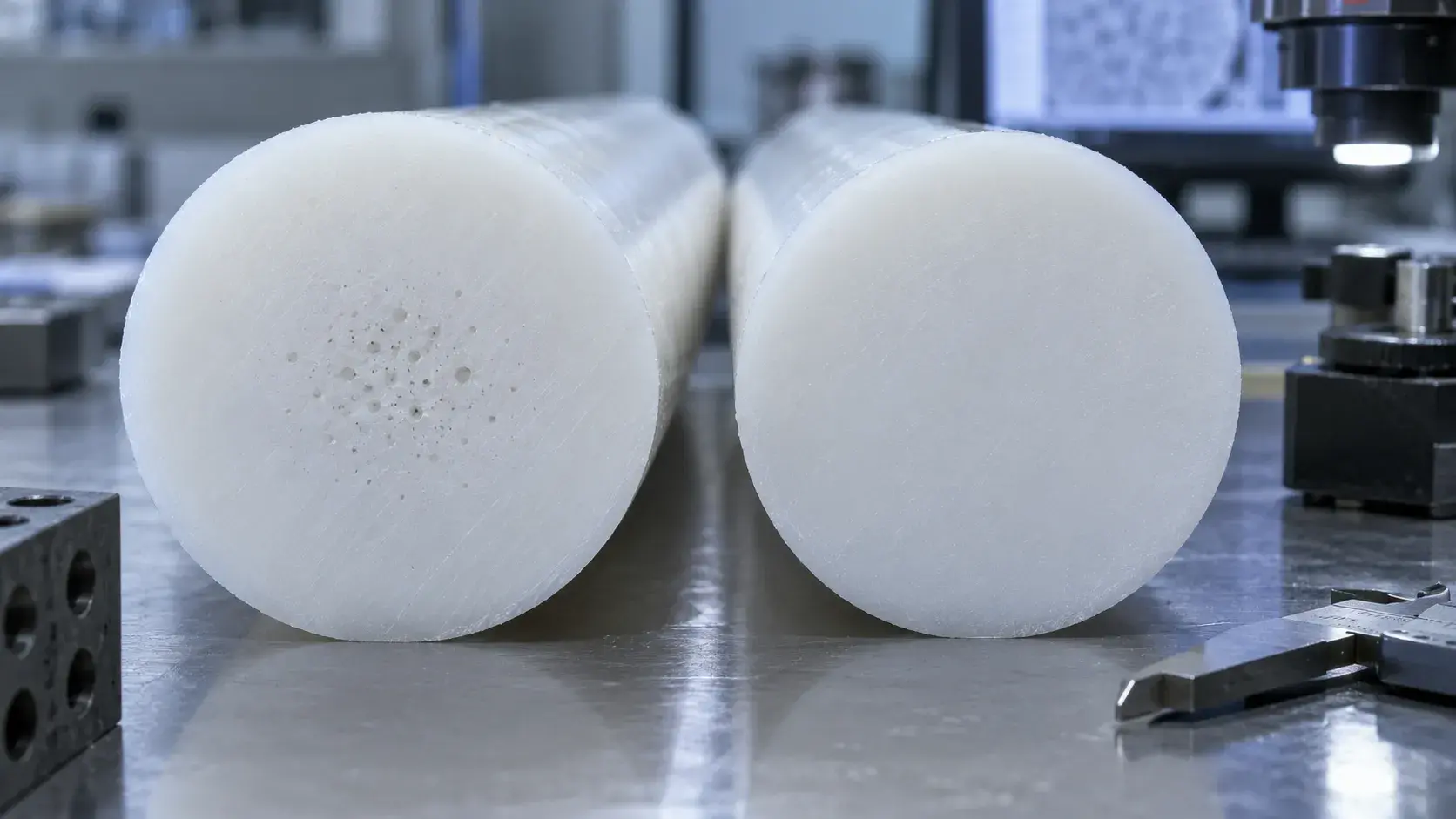
Centerline porosity is an important difference that is often overlooked.
During production of thick acetal homopolymer stock, small internal voids can sometimes form near the center of the rod or plate.
These voids may not be visible from the outside.
This can become a problem when machining:
- Thick round bars
- Large blocks
- Pressure components
- Fluid-handling parts
- Parts requiring leak-tight walls
Acetal copolymer generally has a lower risk of centerline porosity.
For this reason, POM-C is often preferred for larger cross-sections or components where internal material consistency is especially important.
For critical parts, it is always worth confirming the material grade and stock quality with the supplier.
Acetal vs Delrin Machinability
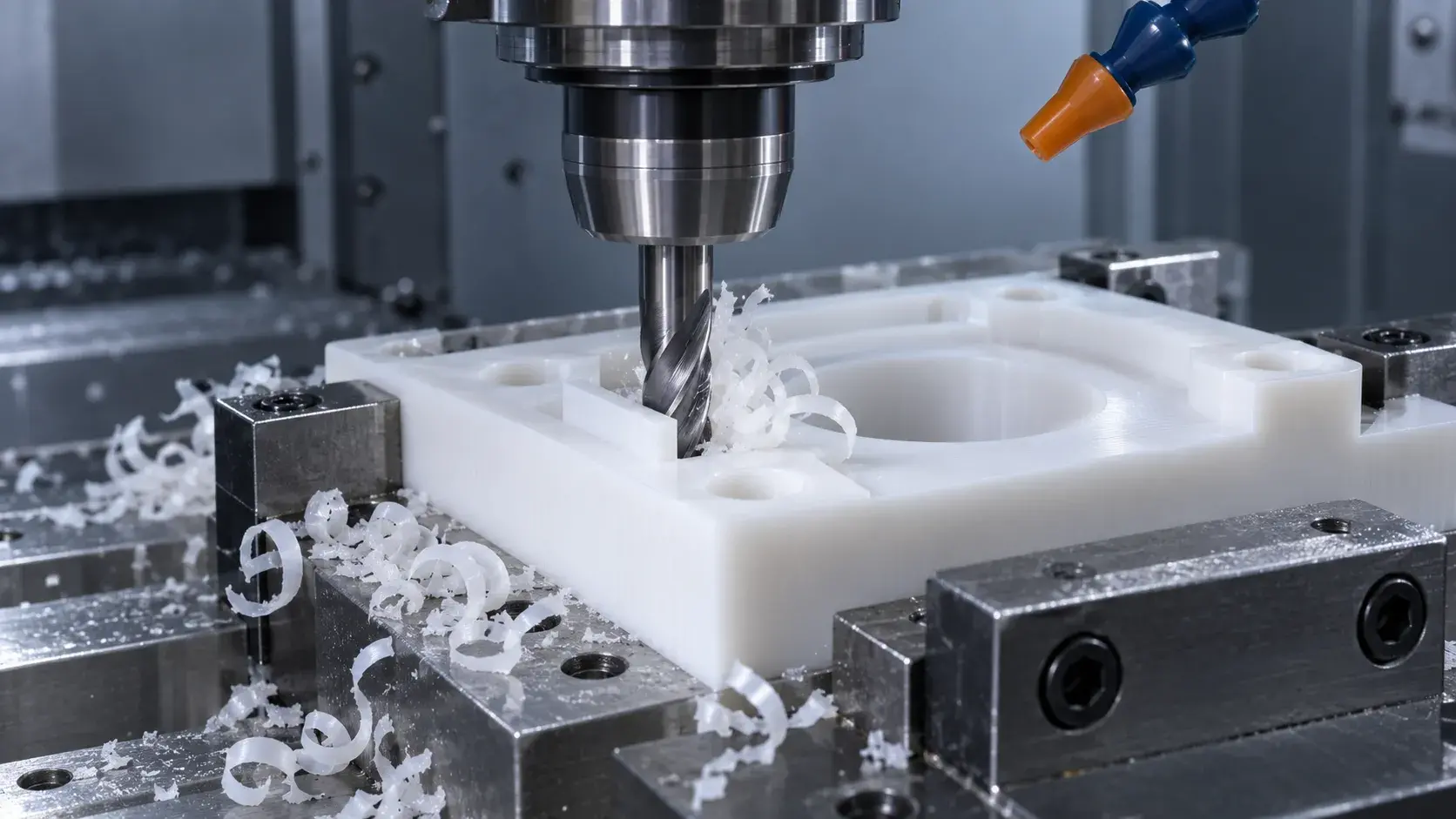
Both materials are excellent for CNC machining.
Compared with many engineering plastics, acetal and Delrin cut cleanly, produce good surface finishes, and hold dimensions well.
They are commonly machined using:
- CNC milling
- CNC turning
- Drilling
- Threading
- Boring
- Routing
Delrin Machining
Delrin’s higher stiffness can be useful when machining small or thin features.
It is well suited for:
- Small precision parts
- Thin walls
- Fine grooves
- Shafts
- Gears
- Turned components
Because the material is relatively rigid, it can resist cutting forces better than softer plastics.
Acetal Copolymer Machining
Acetal copolymer also machines very well.
It may be a better choice for:
- Larger parts
- Thick sections
- Fluid-handling components
- Chemical-resistant parts
- Parts where centerline porosity is a concern
In many CNC applications, the machining difference between the two materials is relatively small.
The final choice usually depends more on performance requirements than on machinability alone.
CNC Machining Tips for Acetal and Delrin
Although both plastics are easy to machine, process control still matters.
Use Sharp Cutting Tools
Sharp carbide or polished cutting tools help produce cleaner edges and reduce heat buildup.
Dull tools can generate friction, burrs, and poor surface finish.
Control Heat
POM has a much lower melting temperature than metal.
Too much cutting heat can cause:
- Local melting
- Poor dimensional accuracy
- Surface smearing
- Burr formation
Sharp tools, proper feeds, and good chip evacuation help control heat.
Avoid Excessive Clamping Force
Plastic parts can deform if clamped too tightly.
The part may appear accurate while held in the fixture but change shape after release.
Use only enough clamping force to hold the workpiece securely.
Consider Thermal Expansion
Acetal expands more with temperature than steel or aluminum.
For tight-tolerance parts, machining temperature and inspection conditions can affect the final measurement.
This is especially important for larger components.
Support Thin Features
Thin walls and narrow sections can move during machining.
Good fixturing and balanced cutting forces help maintain accuracy.
Acetal vs Delrin for Wear and Friction
Both materials provide low friction and good wear performance.
This is one reason they are commonly used as alternatives to metal for moving mechanical components.
Typical applications include:
- Bushings
- Bearings
- Slides
- Guides
- Rollers
- Gears
Delrin’s higher stiffness and fatigue performance can give it an advantage in repeated mechanical movement.
Acetal copolymer may be more suitable when wear performance must be combined with stronger chemical or hot-water resistance.
For high-load or high-speed applications, the exact grade, lubrication, temperature, and contact material should also be considered.
Acetal vs Delrin Cost
Acetal copolymer is usually less expensive than branded Delrin.
The exact price depends on:
- Grade
- Stock size
- Supplier
- Color
- Certification
- Quantity
- Region
For general-purpose mechanical parts, acetal copolymer may provide a better cost-performance balance.
Delrin can be worth the higher cost when higher stiffness, fatigue strength, or specific homopolymer performance is required.
For CNC machining projects, material price is only one part of the total cost. Part geometry, tolerances, machining time, inspection, and scrap risk can have a larger impact.
Common Applications of Acetal and Delrin
Both materials are widely used in precision manufacturing.
| Application | Acetal Copolymer | Delrin |
|---|---|---|
| Gears | Good | Excellent |
| Bushings | Excellent | Excellent |
| Rollers | Excellent | Excellent |
| Valve parts | Excellent | Good |
| Pump parts | Excellent | Good |
| Precision shafts | Good | Excellent |
| Wear pads | Excellent | Excellent |
| Mechanical guides | Excellent | Excellent |
| Thick machined blocks | Better choice | Possible |
| Small precision components | Excellent | Excellent |
The best material depends on the actual operating conditions rather than the part name alone.
Which Is Better for CNC Machining?
For CNC machining alone, both are very good choices.
Delrin may be better when the part requires:
- Higher stiffness
- Higher mechanical strength
- Good fatigue resistance
- Thin or detailed features
- Small precision moving parts
Acetal copolymer may be better when the part requires:
- Better chemical resistance
- Better hot-water resistance
- Lower centerline porosity
- Large or thick sections
- Lower material cost
If the operating environment is mild and both materials meet the design requirements, cost and availability may become the deciding factors.
Acetal vs Delrin: Which Should You Choose?
A simple way to choose is to start with the most important requirement.
| If You Need | Better Choice |
|---|---|
| Higher stiffness | Delrin |
| Higher strength | Delrin |
| Better fatigue resistance | Delrin |
| Small precision mechanical parts | Delrin |
| Better chemical resistance | Acetal Copolymer |
| Better hot-water resistance | Acetal Copolymer |
| Thick or large sections | Acetal Copolymer |
| Lower centerline porosity | Acetal Copolymer |
| Lower material cost | Acetal Copolymer |
| Low-friction moving parts | Both |
There is no universal winner.
For many standard machined plastic parts, both materials work extremely well.
The best choice comes down to mechanical load, chemical exposure, operating temperature, part thickness, and budget.
Conclusion
Acetal and Delrin are both POM engineering plastics with excellent machinability, low friction, good dimensional stability, and strong wear performance.
The main difference is that Delrin is an acetal homopolymer, while standard commercial acetal is often a copolymer.
Delrin generally offers higher strength, stiffness, and fatigue resistance.
Acetal copolymer generally provides better chemical resistance, hot-water performance, lower centerline porosity, and lower cost.
For CNC machining, both are excellent materials. The right choice depends on how the finished part will actually be used.



