

A bottoming tap is a thread-cutting tool with a very short chamfer, typically about 1–2 threads. It is designed to cut full threads close to the bottom of a blind hole where standard taper or plug taps cannot reach as deeply.
Bottoming taps are commonly used in CNC machining, mold making, automotive parts, aerospace components, and other applications where usable thread depth is important.
However, a bottoming tap does not cut threads completely to zero clearance at the hole bottom. Proper drill depth, chip space, tool geometry, and material conditions still need to be considered.
This guide explains how bottoming taps work, how they differ from taper and plug taps, and how to design and machine blind threaded holes reliably.
What Is a Bottoming Tap?
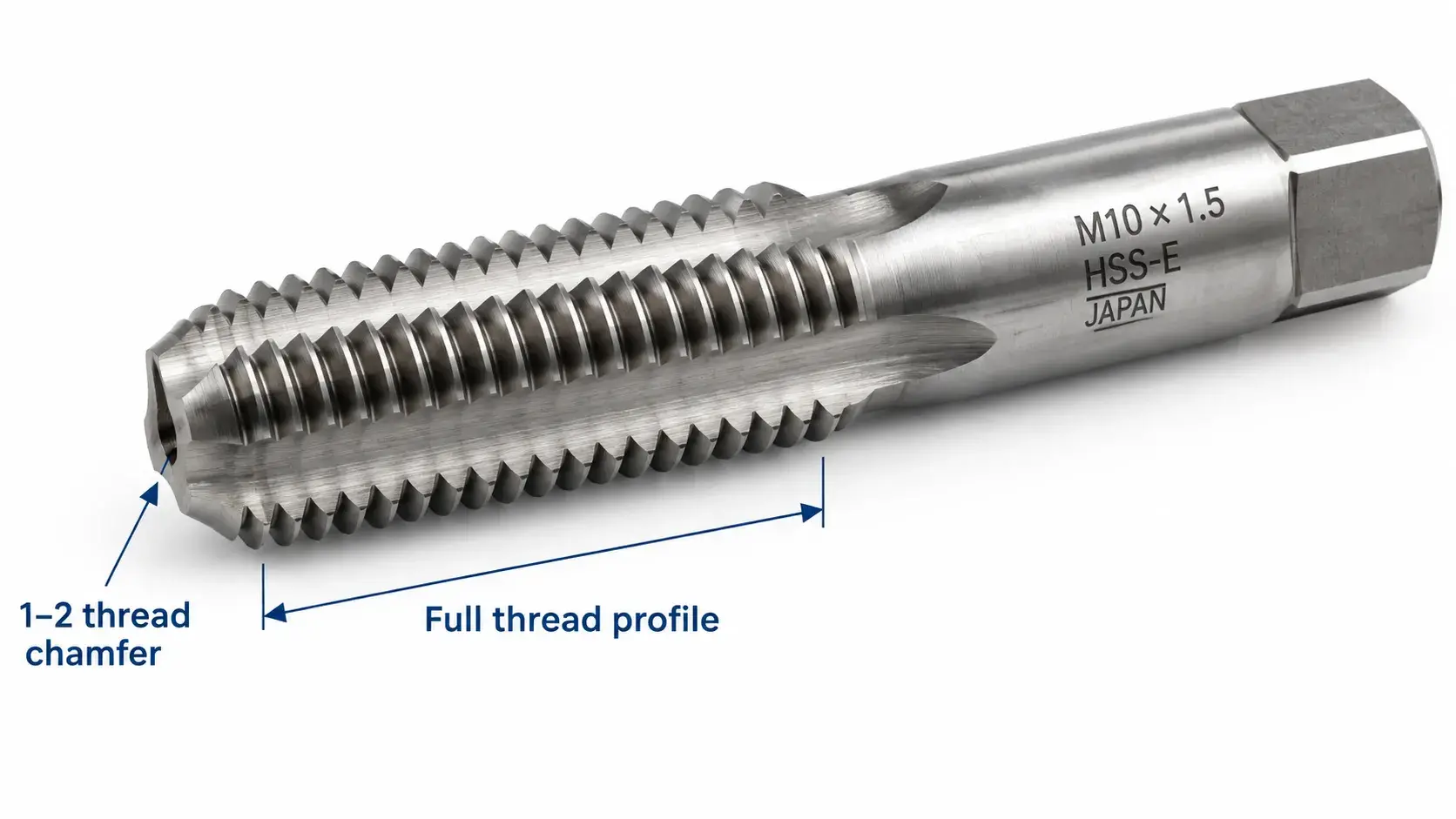
A bottoming tap is a type of tap designed to create internal threads close to the bottom of a blind hole.
Its main feature is a very short chamfer at the tip. While a taper tap may have several gradually cutting threads, a bottoming tap usually has only about one or two incomplete lead threads before reaching the full thread profile.
This allows the tap to cut usable threads deeper into the hole.
Bottoming taps are especially useful when:
- A blind hole requires maximum usable thread depth
- The component has limited available hole depth
- A standard plug or taper tap leaves too much incomplete thread
- The design requires a screw or fastener to engage deeper into the hole
They are often used as finishing taps after the thread has already been started, although some machine taps are specifically designed to cut blind holes in a single operation.
Bottoming Tap vs Taper Tap vs Plug Tap
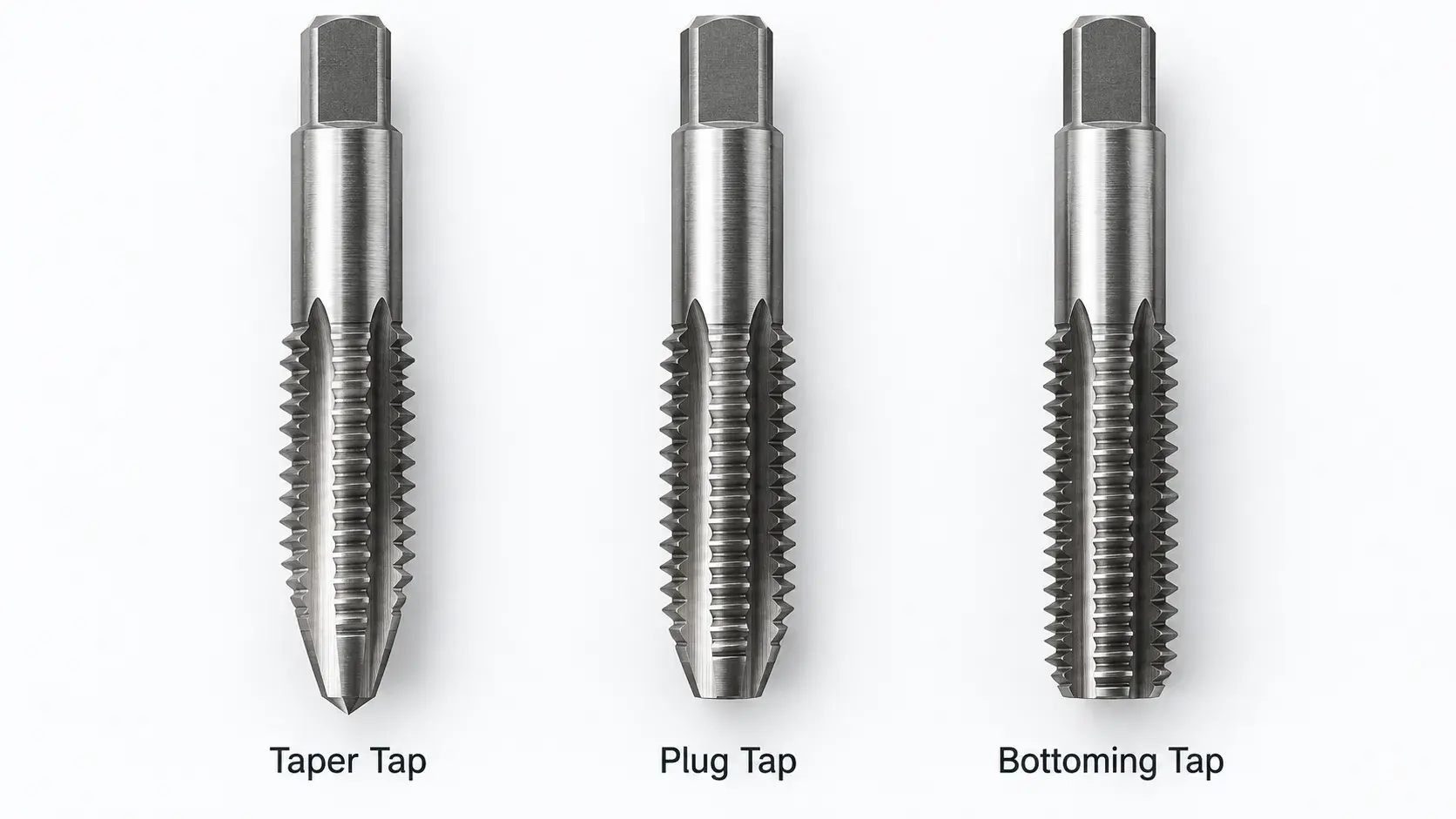
Taper taps, plug taps, and bottoming taps all produce internal threads, but the main difference is the length of the chamfered cutting section.
| Tap Type | Typical Chamfer Length | Main Use |
|---|---|---|
| Taper Tap | About 7–10 threads | Easy thread starting |
| Plug Tap | About 3–5 threads | General-purpose tapping |
| Bottoming Tap | About 1–2 threads | Deep threading in blind holes |
Taper Tap
A taper tap has the longest chamfer.
Because the cutting load is spread across several teeth, it starts easily and requires less cutting force.
Taper taps are commonly used for hand tapping and through holes, but they cannot produce full threads close to the bottom of a blind hole.
Plug Tap
A plug tap has a shorter chamfer and is the most general-purpose option.
It provides a balance between easy starting and usable thread depth.
Plug taps are often suitable for through holes and blind holes with sufficient extra depth.
Bottoming Tap
A bottoming tap has the shortest chamfer.
This allows the full thread profile to begin much closer to the end of the tap, making it useful when a blind hole requires deeper usable threads.
However, the short chamfer also means more cutting load is concentrated on fewer teeth.
For this reason, alignment, lubrication, chip evacuation, and proper hole depth become especially important.Why Are Bottoming Taps Used for Blind Holes?
A blind hole has a closed bottom, which creates an important limitation during tapping.
The tap cannot simply continue cutting beyond the threaded section as it can in a through hole.
If a plug tap has several incomplete chamfer threads at its tip, those threads take up valuable depth inside the hole.
For example, if the drawing requires 15 mm of full thread, the drilled hole must be deeper than 15 mm because space is also needed for:
- The tap chamfer
- Incomplete threads
- Chips
- Drill point geometry
- Safety clearance
A bottoming tap reduces the length of the incomplete thread zone and therefore allows the usable thread to extend closer to the hole bottom.
This is particularly useful in compact components where increasing hole depth is difficult because of wall thickness or nearby features.
How to Tap a Blind Hole

Reliable blind-hole tapping depends on more than simply selecting a bottoming tap.
The complete hole and thread design must be considered.
1. Determine the Required Full Thread Depth
Start with the amount of usable thread engagement actually required by the design.
Do not automatically specify threads all the way to the physical bottom of the hole.
In many applications, only part of the available depth is needed to achieve sufficient fastener engagement.
Reducing unnecessary thread depth can also lower machining time and tool breakage risk.
2. Select the Correct Tap Drill Size
The hole must be drilled to the correct diameter before tapping.
A hole that is too small increases cutting load and tap breakage risk.
A hole that is too large may reduce thread engagement and strength.
Tap drill size depends on the thread specification, pitch, and desired thread engagement.
When designing threaded holes, always confirm the correct drill diameter before machining.
3. Make the Drilled Hole Deeper Than the Full Thread Depth
The drill depth should normally exceed the required full thread depth.
A useful design relationship is:
Drill Depth = Full Thread Depth + Tap Chamfer Allowance + Chip Clearance + Drill Point Allowance
The exact additional depth depends on:
- Thread pitch
- Tap geometry
- Material
- Chip behavior
- Drill point angle
- Machine process
This extra clearance is essential because chips need somewhere to go and the cutting section of the tap cannot operate directly against the physical hole bottom.
4. Start the Thread Correctly
For traditional hand tapping, a common sequence is:
Taper Tap → Plug Tap → Bottoming Tap
The taper tap starts the thread easily, the plug tap deepens it, and the bottoming tap finishes the thread close to the bottom.
However, this sequence is not always required in CNC machining.
Modern machine taps can often produce the required blind-hole thread in a single operation when the correct tap geometry is selected.
The correct process depends on the material, thread depth, chip evacuation, machine rigidity, and tap design.
5. Control Chip Evacuation
Chip control is one of the biggest challenges when tapping blind holes.
Because the bottom is closed, chips cannot simply exit through the opposite side.
If chips accumulate at the bottom, they can:
- Increase torque
- Damage the thread
- Cause the tap to jam
- Break the tap
- Reduce thread quality
This is why tap flute design is especially important for blind holes.
Bottoming Tap vs Spiral Flute Tap
Bottoming taps and spiral flute taps are often discussed together, but they describe different tool characteristics.
A bottoming tap refers mainly to the length of the chamfer at the cutting end.
A spiral flute tap refers to the flute geometry used to control chip flow.
A tap can therefore be both:
Spiral Flute + Bottoming Chamfer
at the same time.
This combination is common for blind holes because the short chamfer allows deeper full threads while the spiral flutes help pull chips upward and out of the hole.
By comparison, spiral point taps generally push chips forward in the cutting direction and are therefore more commonly used for through holes.
For blind holes, chip evacuation usually favors designs that bring chips back toward the hole opening.
How Much Clearance Is Needed at the Bottom of a Blind Hole?
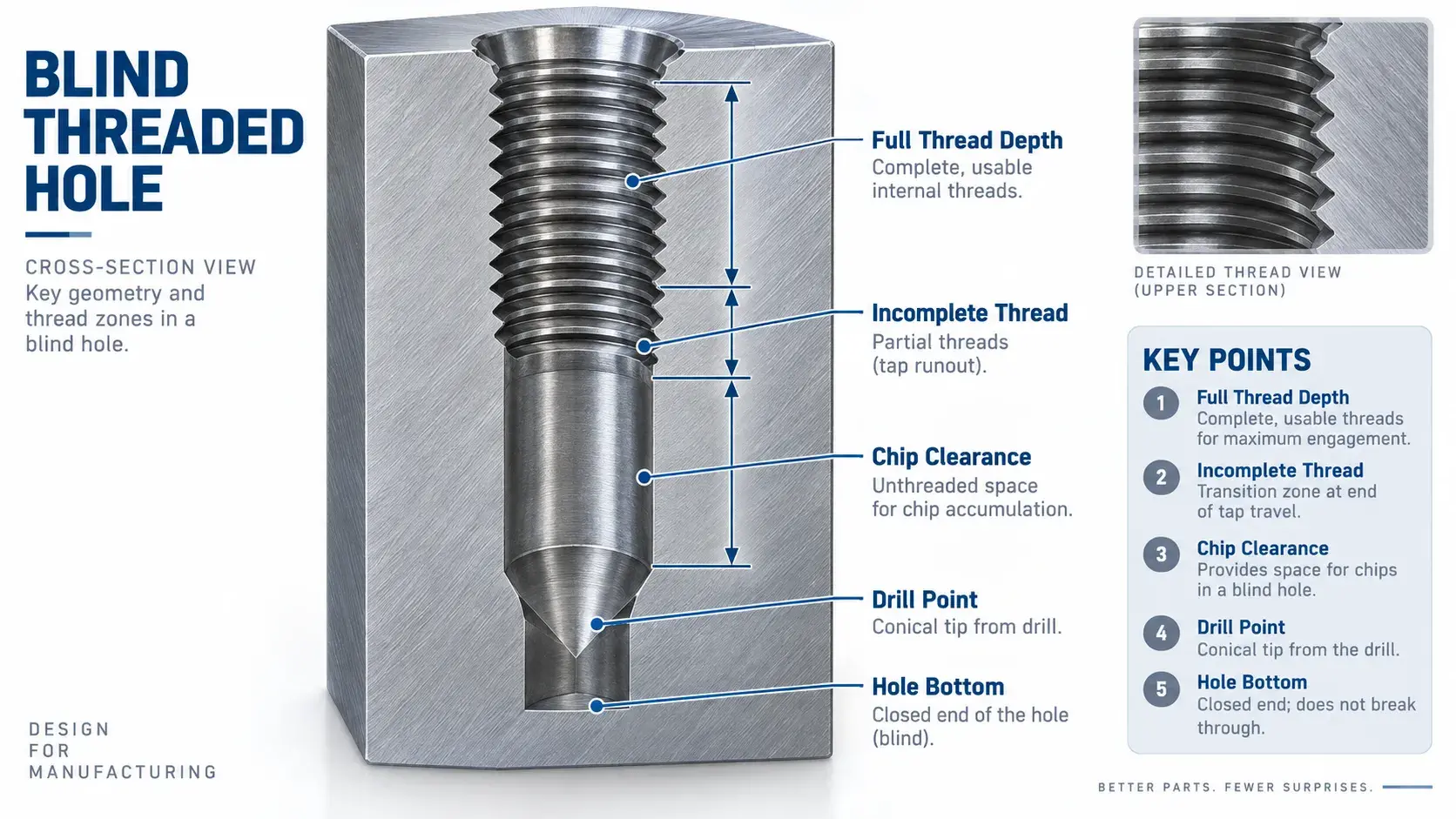
There is no single clearance value that works for every tapped hole.
The required clearance depends on the tap, thread pitch, material, chip size, and drilling geometry.
The most important design rule is:
Do not make the required full thread depth equal to the total drilled hole depth.
The drilled hole should always include extra room below the full thread section.
A simplified blind-hole stack may look like:
Hole Opening
↓
Full Thread Depth
↓
Incomplete Tap Chamfer Threads
↓
Chip Clearance
↓
Drill Point
↓
Hole Bottom
If this additional space is not available, the tap can bottom out before the required thread depth is reached.
That can result in tool breakage or damaged threads.
Common Problems When Tapping Blind Holes
Blind-hole tapping can be reliable, but several problems occur repeatedly in production.
Tap Breakage
Tap breakage is often caused by excessive torque.
Common reasons include:
- Tap drill diameter too small
- Insufficient bottom clearance
- Chip packing
- Worn tap
- Poor lubrication
- Incorrect speed or feed
- Misalignment
Because broken taps can be difficult to remove, especially from expensive components, avoiding excessive cutting load is important.
Incomplete Thread Depth
If the hole is not deep enough or the wrong tap geometry is used, the required full thread depth may not be achieved.
A bottoming tap can reduce the incomplete thread zone, but it cannot compensate for an incorrectly designed hole.
Chip Packing
Chip packing is especially common in ductile materials such as aluminum, stainless steel, and some alloy steels.
When chips accumulate at the bottom of the hole, they can increase torque rapidly.
Using the correct tap geometry and sufficient clearance can help reduce this problem.
Poor Thread Surface Finish
Poor thread quality may result from:
- Built-up edge
- Insufficient lubrication
- Tool wear
- Incorrect tap geometry
- Unstable cutting conditions
The correct tool and cutting strategy should be selected for the material.
Oversized or Undersized Threads
Thread size errors can result from tap wear, incorrect hole diameter, machine synchronization problems, runout, or tool deflection.
Thread inspection may be performed using GO/NO-GO gauges or other dimensional inspection methods depending on the specification.
Bottoming Tap Selection by Material
Different materials create different tapping challenges.
| Material | Main Consideration |
|---|---|
| Aluminum | Chip control and built-up edge |
| Stainless Steel | Work hardening and lubrication |
| Alloy Steel | Cutting load and tool wear |
| Cast Iron | Abrasive wear and dry chips |
| Titanium | Heat generation and high cutting forces |
| Brass | Generally good machinability, but correct geometry still matters |
For production CNC machining, tap coating, substrate, flute geometry, coolant, and cutting parameters should be selected together rather than choosing a tap based only on thread size.
Bottoming Tap vs Thread Milling
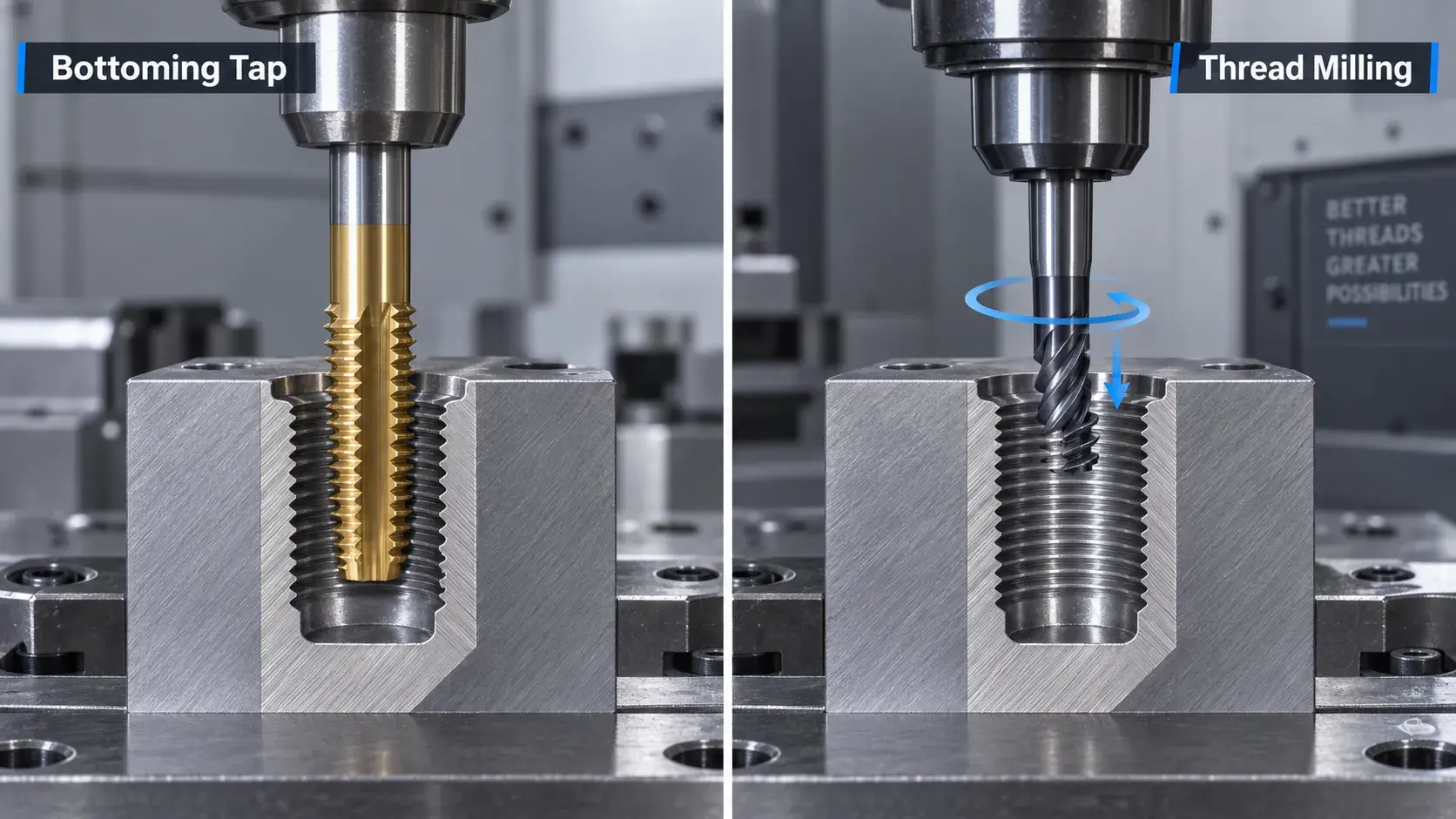
Bottoming taps are not the only option for producing blind internal threads.
CNC thread milling can also be used, especially when process control or tool breakage risk is important.
| Factor | Bottoming Tap | Thread Milling |
|---|---|---|
| Machining Speed | Faster | Usually slower |
| Tool Cost | Lower | Higher |
| Blind Holes | Good | Excellent |
| Chip Control | More difficult | Better |
| Large Threads | Good | Excellent |
| Multiple Thread Sizes | Usually separate taps | One cutter may cover several sizes |
| Tool Breakage Risk | Higher | Lower catastrophic risk |
| Prototype Work | Good | Very flexible |
When Tapping Is Better
Tapping is usually preferred when:
- The thread size is common
- Production volume is high
- Cycle time is important
- The material is suitable for tapping
- Hole depth and chip evacuation are manageable
When Thread Milling Is Better
Thread milling may be more attractive when:
- The part is expensive
- The thread diameter is large
- The material is difficult to machine
- Chip evacuation is difficult
- A broken tap would create high scrap cost
- Thread size flexibility is useful
Thread milling also produces threads by circular interpolation rather than forcing a full-profile tap through the hole.
This can provide greater control in some precision CNC applications.
DFM Tips for Blind Threaded Holes
Good blind-hole design can reduce machining cost and tool failure risk.
Avoid Specifying Full Thread to the Absolute Bottom
A thread does not usually need to continue to the physical bottom of the drilled hole.
Provide reasonable clearance whenever possible.
Specify Full Thread Depth Clearly
Engineering drawings should distinguish between:
- Full thread depth
- Total hole depth
These are not the same dimension.
Provide Extra Drill Depth
Allow enough depth for the tap chamfer, chips, and drill point.
This can significantly improve tapping reliability.
Avoid Unnecessarily Deep Threads
Very deep threads may add machining time without increasing joint strength.
Only specify the thread engagement required for the application.
Consider Chip Direction
For blind holes, use a process that removes chips toward the opening rather than packing them at the bottom.
Use Through Holes When the Design Allows
Through holes are generally easier to drill, tap, inspect, and clean.
If a blind hole is not structurally necessary, changing it to a through hole may simplify manufacturing.
Conclusion
A bottoming tap is designed to produce full internal threads close to the bottom of a blind hole by using a very short chamfer.
Compared with taper and plug taps, it provides greater usable thread depth, but it also requires careful attention to chip evacuation, drill depth, lubrication, and cutting conditions.
For CNC machining, the best solution may be a bottoming tap, a spiral flute machine tap, or thread milling depending on the material, thread size, depth, and production requirements.
The key design principle is simple:
Do not design the full thread depth all the way to the physical bottom of the hole.
Allow sufficient clearance for the tap and chips, and specify the full thread depth separately from the total hole depth.
For precision threaded features, YuanYi provides CNC milling, drilling, tapping, thread milling, and DFM support for prototypes and low-volume production parts.
Frequently Asked Questions
It is possible in some applications, but traditional bottoming taps are generally more difficult to start because they have very few chamfered cutting teeth.
For hand tapping, the thread is commonly started with a taper or plug tap first.
Modern CNC machine taps may use specialized geometry that allows blind-hole tapping in a single operation.
A bottoming tap can create full threads much closer to the bottom than a taper or plug tap because it typically has only about one or two chamfered threads.
However, some clearance is still required for the chamfer, chips, and drill point.
A plug tap usually has about 3–5 chamfered threads, while a bottoming tap typically has only about 1–2.
As a result, the bottoming tap can produce full threads deeper into a blind hole.
Spiral flute taps are commonly used for blind holes because the flute geometry helps move chips upward toward the hole opening.
The correct choice still depends on the material, thread depth, and machining conditions.
The total drilled depth should be deeper than the required full thread depth.
Extra space is needed for the tap chamfer, chip accumulation, and drill point geometry.



