

Galvanized steel generally offers higher stiffness, higher absolute strength, and lower raw material cost. Aluminum is much lighter, easier to machine, and better suited to complex CNC parts where machining speed, weight reduction, and surface finish are important.
For CNC applications, aluminum is usually the easier and faster material to machine. Galvanized steel can also be machined, but cutting, drilling, or milling removes the zinc coating from machined areas, which may require additional corrosion protection afterward.
Galvanized Steel vs Aluminum: Quick Comparison
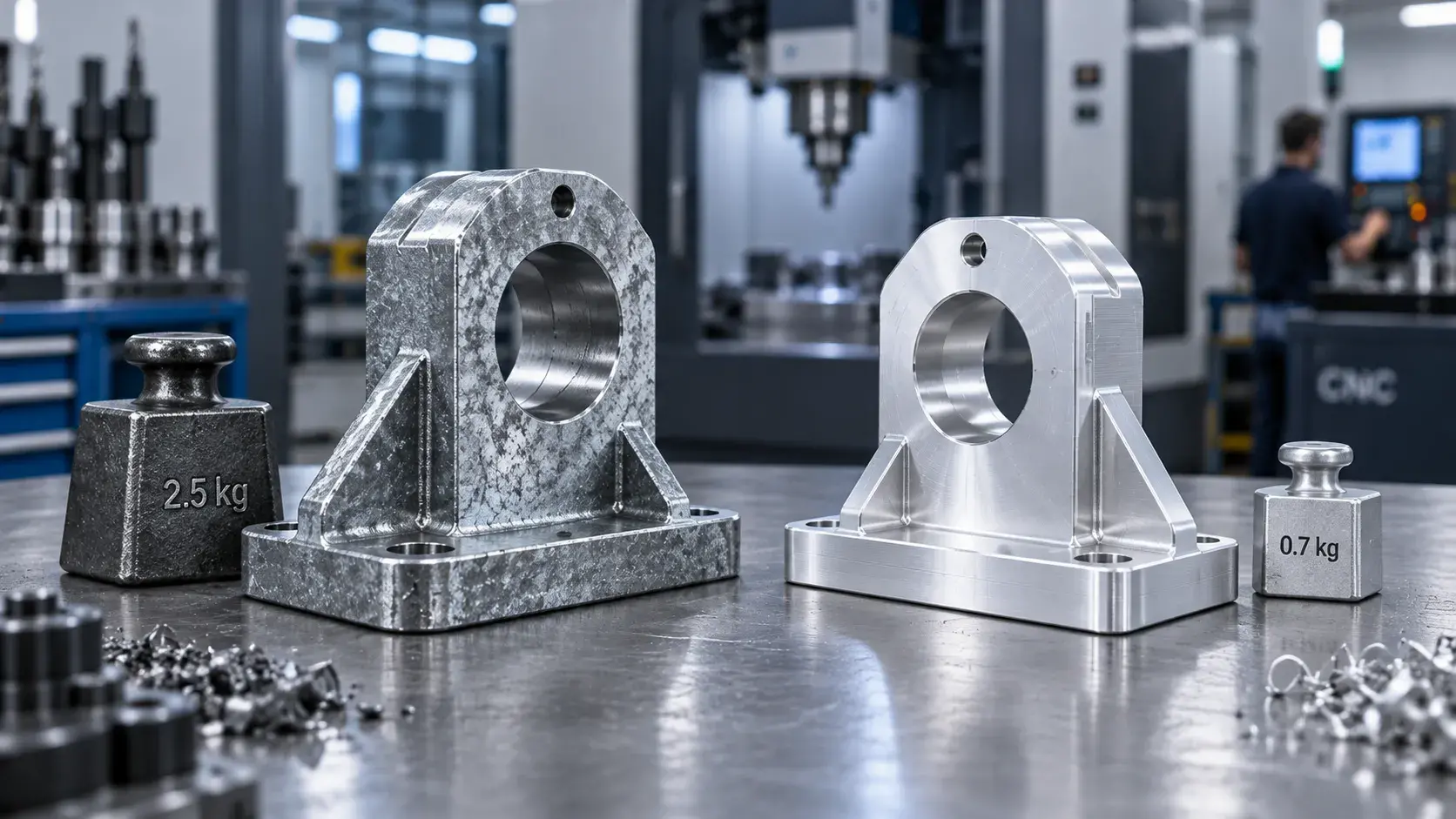
The table below summarizes the main differences when selecting either material for manufactured and CNC machined parts.
| Factor | Galvanized Steel | Aluminum |
|---|---|---|
| Density | About 7.85 g/cm³ | About 2.70 g/cm³ |
| Weight | Heavy | About one-third the density of steel |
| Strength | Generally higher | Depends strongly on alloy |
| Stiffness | Higher | Lower |
| Corrosion Resistance | Good while zinc coating remains intact | Naturally corrosion resistant |
| CNC Machinability | Moderate | Excellent |
| Machining Speed | Lower | Higher |
| Tool Wear | Higher | Lower |
| Raw Material Cost | Usually lower | Usually higher |
| Finished CNC Part Cost | Depends on machining and finishing | Often competitive due to faster machining |
| Common Surface Protection | Zinc coating / galvanizing | Natural oxide layer / anodizing |
| Best For | Heavy-duty, rigid, outdoor components | Lightweight, complex, precision CNC parts |
The most important point is that raw material price alone does not determine final part cost.
A material that costs more per kilogram may still produce a lower-cost CNC part if it machines faster, reduces tool wear, and requires fewer secondary operations.
What Is the Difference Between Galvanized Steel and Aluminum?
Galvanized steel is not a separate steel alloy. It is steel that has been protected with a zinc coating.
The zinc layer helps protect the underlying steel from corrosion by acting as a barrier and providing sacrificial protection if small areas of the coating are damaged.
Galvanized steel is commonly used for structural components, brackets, frames, outdoor assemblies, tubing, enclosures, and other parts exposed to moisture.
Aluminum, on the other hand, is naturally corrosion resistant because its surface quickly forms a thin oxide layer when exposed to air.
Common aluminum grades used in CNC machining include:
- 6061 for general-purpose CNC parts
- 7075 for high-strength applications
- 5052 for sheet and formed components
- 2024 for aerospace and structural applications
For precision CNC parts, aluminum alloys such as 6061 and 7075 are much more common machining stock than pre-galvanized steel.
Galvanized Steel vs Aluminum: Key Differences
Strength and Stiffness
Steel is generally stronger and significantly stiffer than aluminum.
Higher stiffness means a steel component is less likely to deflect under the same load and geometry. This is useful for machine brackets, structural supports, mounting plates, industrial frames, and other rigid components.
Aluminum has lower stiffness, but its much lower density gives it a strong advantage where weight matters.
For applications such as aerospace parts, robotic components, moving assemblies, electronic housings, and lightweight fixtures, aluminum often provides a better strength-to-weight balance.
The correct choice should therefore be based on load conditions rather than simply asking which material is stronger.
Weight
Weight is one of the largest differences between aluminum and steel.
Aluminum has a density of approximately 2.70 g/cm³, while steel is approximately 7.85 g/cm³.
This means aluminum is roughly one-third the density of steel.
For components with similar overall volume, switching from steel to aluminum can significantly reduce weight.
This matters in applications such as:
- robotics
- aerospace
- automation equipment
- vehicles
- portable equipment
- moving machine assemblies
Lower component weight can reduce inertia, improve motion efficiency, simplify handling, and lower transportation weight.
Corrosion Resistance
Both materials can perform well in corrosive environments, but they achieve corrosion resistance differently.
Galvanized steel depends on its zinc coating. As long as the protective layer remains intact, it offers good corrosion resistance in many outdoor and industrial environments.
Aluminum develops a natural oxide layer that helps protect the underlying material. Additional treatments such as anodizing can further improve corrosion resistance and surface durability.
A major consideration for CNC machining is that cutting galvanized steel can remove the zinc coating from machined surfaces.
After milling, drilling, threading, or turning, exposed steel may require additional corrosion protection.
Aluminum does not have the same problem because its protective oxide layer reforms naturally after machining.
Thermal Behavior
Aluminum conducts heat much better than steel.
This is useful for:
- heat sinks
- electronic housings
- thermal management parts
- lighting components
- motor housings
Steel retains heat more readily and is typically selected where thermal conductivity is not a primary requirement.
For CNC machining, aluminum’s thermal properties also contribute to its ability to be machined at higher cutting speeds when the correct tooling and parameters are used.
Which Is More Expensive: Galvanized Steel or Aluminum?
Galvanized steel is usually cheaper than aluminum when comparing raw material prices directly.
However, raw material cost is only one part of the final CNC part price.
For machining projects, manufacturers also need to consider:
- machining time
- tool consumption
- cutting speed
- setup time
- part weight
- surface finishing
- inspection
- coating requirements
- secondary operations
Raw Material Cost
Steel generally has a lower price per kilogram than aluminum.
However, aluminum’s much lower density means that a finished aluminum part often weighs considerably less than a steel part of similar size.
As a result, comparing only price per kilogram can be misleading.
The better comparison is the actual material volume required for the finished part.
Finished CNC Part Cost
Aluminum is normally much easier and faster to machine than steel.
Typical advantages include:
- higher cutting speeds
- faster material removal
- lower cutting forces
- less tool wear
- shorter cycle times
- easier production of complex geometries
Steel may have a lower material price but require longer machining time and more tool consumption.
Galvanized steel can also introduce additional finishing considerations if machining exposes the underlying steel.
For this reason:
The cheaper raw material does not always produce the cheaper finished CNC part.
For complex prototypes and precision parts, aluminum can often be cost-effective even when its material price is higher.
Which Is Easier to CNC Machine?
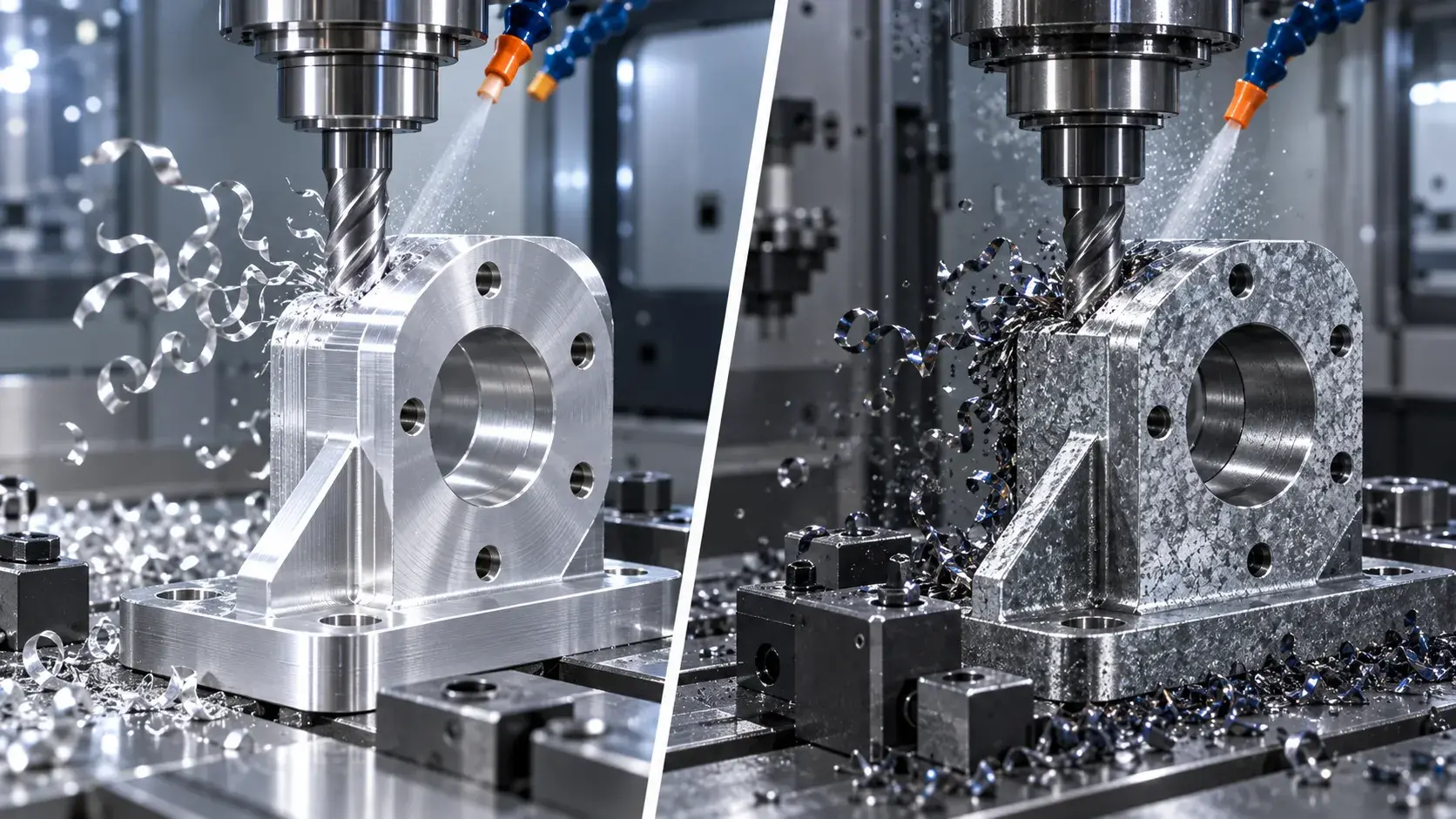
Aluminum is generally easier to CNC machine than galvanized steel.
This is one of the main reasons aluminum is widely used for precision prototypes, housings, brackets, fixtures, aerospace components, and automation parts.
Machining Aluminum
Aluminum allows relatively high cutting speeds and material removal rates.
With appropriate tooling, manufacturers can produce:
- pockets
- slots
- deep cavities
- threaded holes
- thin-wall features
- multi-axis geometries
- precision bores
with efficient cycle times.
Aluminum also places lower loads on cutting tools compared with most steels.
This can reduce tool wear and make it suitable for both prototypes and repeat production.
Machining Galvanized Steel
The machinability of galvanized steel depends mainly on the underlying steel grade.
The zinc coating itself does not define the cutting behavior of the part. The base steel determines factors such as:
- cutting force
- tool wear
- cutting speed
- chip formation
- heat generation
Compared with aluminum, steel normally requires lower cutting speeds and produces higher cutting forces.
Machining may also remove or damage the zinc coating around the cut area.
This means galvanized steel requires more consideration when both tight tolerances and corrosion protection are important.
What Happens When You CNC Machine Galvanized Steel?
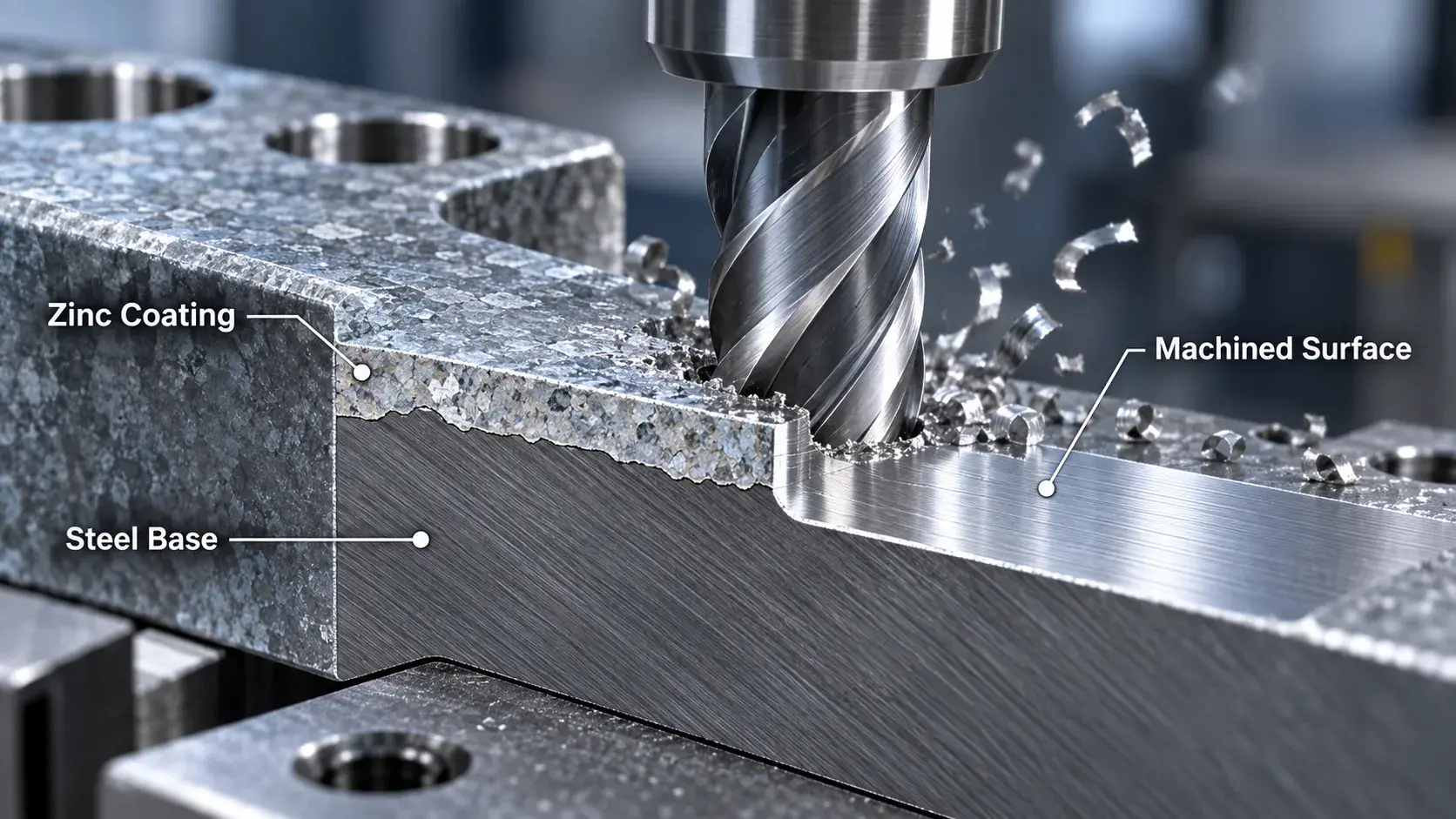
CNC machining galvanized steel is possible, but machining changes the protective coating.
Operations such as:
- milling
- turning
- drilling
- boring
- tapping
- countersinking
- facing
remove material from the part.
Where material is removed, the original zinc coating is also removed.
The newly machined surface may therefore expose the steel substrate.
If the exposed area is left untreated, corrosion resistance may be reduced.
For non-critical applications, small machined areas may sometimes be protected with an appropriate repair coating or surface treatment.
For precision components, however, a better production sequence is often to machine the steel first and apply the corrosion-resistant finish afterward.
This allows the entire finished geometry to receive a more consistent protective layer.
Should Steel Be Machined Before or After Galvanizing?
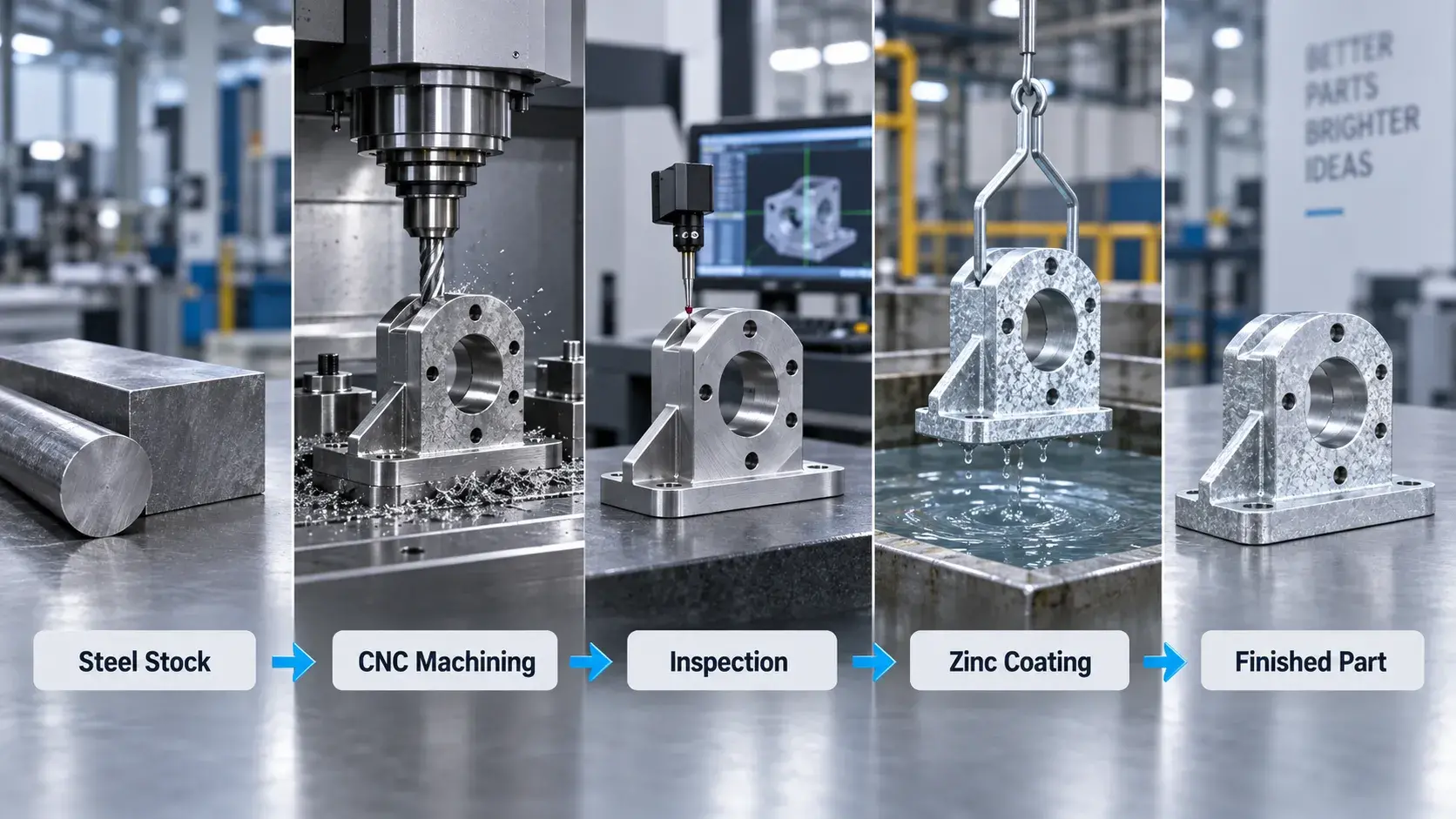
For many precision CNC parts, machining before galvanizing or zinc coating is usually the more practical manufacturing sequence.
A typical process may look like this:
Steel Stock → CNC Machining → Inspection → Cleaning → Zinc Coating or Galvanizing → Final Inspection
This approach offers several advantages.
First, CNC machining does not remove the final protective coating.
Second, all newly created surfaces receive corrosion protection.
Third, the process is easier to control for parts with complex machined features.
However, coating thickness must still be considered.
Features such as:
- precision bores
- bearing fits
- threads
- sealing surfaces
- tight-tolerance holes
- mating surfaces
may be affected by the added coating thickness.
Depending on the tolerance requirements, manufacturers may need to:
- mask critical areas
- compensate dimensions before coating
- specify coating thickness
- perform final finishing after coating
- inspect critical dimensions after finishing
For parts with very tight dimensional requirements, finishing strategy should be considered during the DFM stage rather than after machining is complete.
Galvanized Steel vs Aluminum for Different Applications
The right material depends on the functional requirements of the component.
| Application Requirement | Better Choice | Reason |
|---|---|---|
| Lightweight CNC housing | Aluminum | Low density and excellent machinability |
| Complex multi-axis part | Aluminum | Faster machining and easier material removal |
| Robotic component | Aluminum | Reduces moving mass |
| Aerospace bracket | Aluminum | High strength-to-weight potential |
| Heavy machine bracket | Steel | Higher stiffness |
| Structural frame | Galvanized Steel | Good rigidity and corrosion protection |
| Outdoor support component | Galvanized Steel | Zinc coating provides corrosion resistance |
| Precision anodized enclosure | Aluminum | Good cosmetic and protective finish options |
| Heat-dissipating component | Aluminum | High thermal conductivity |
| Tight-tolerance steel part | Machine Steel First, Then Finish | Better control of coating and dimensions |
It is also important to remember that material selection is not limited to only these two options.
Depending on the project, stainless steel, alloy steel, carbon steel, 6061 aluminum, or 7075 aluminum may provide a better combination of strength, cost, corrosion resistance, and machinability.
How to Choose Between Galvanized Steel and Aluminum for CNC Parts
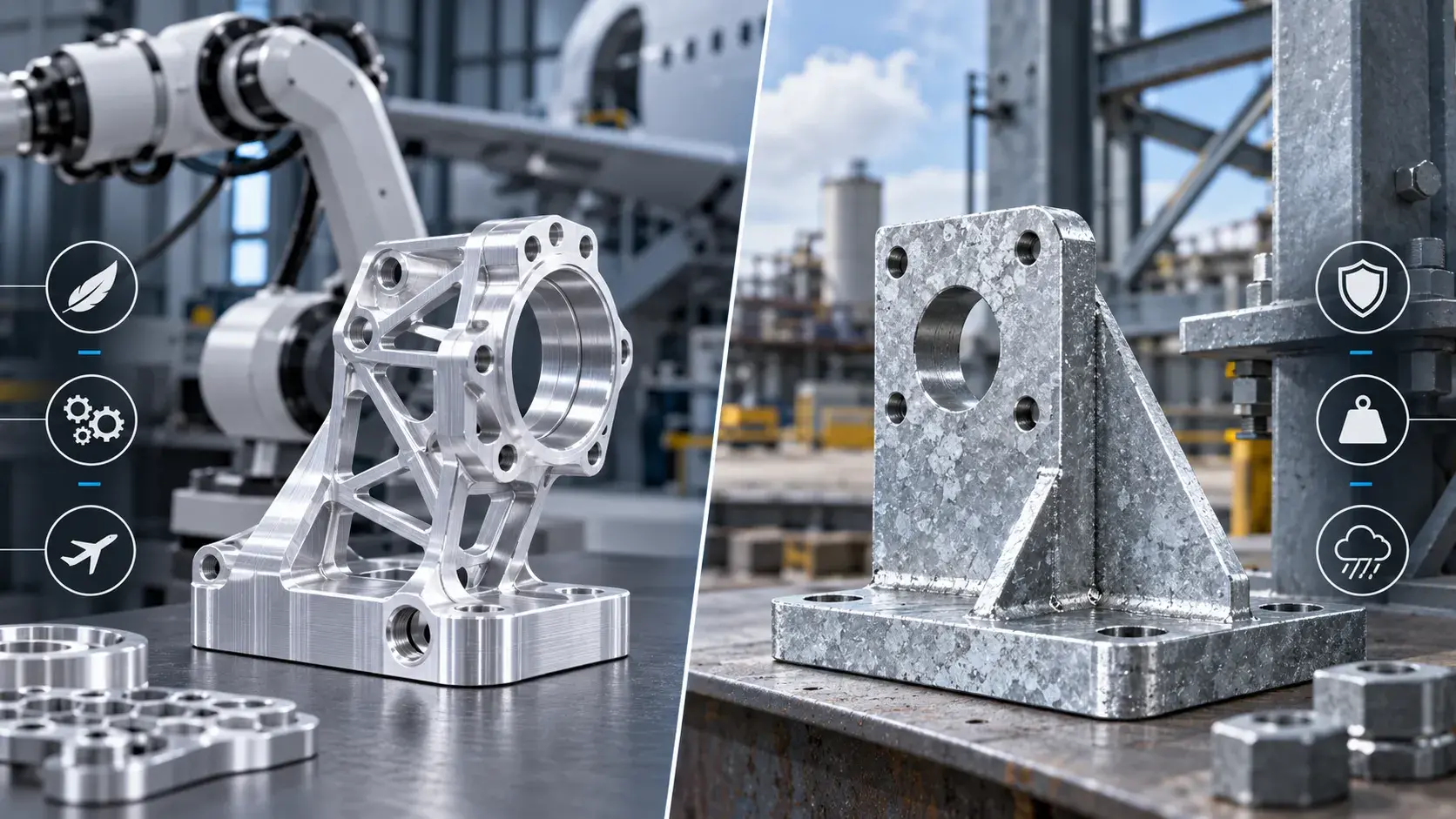
Choose aluminum when your project requires:
- low component weight
- high machining efficiency
- complex geometry
- high material removal rates
- good natural corrosion resistance
- anodized cosmetic finishes
- good thermal conductivity
- prototypes with short lead times
Choose galvanized steel or zinc-finished steel when your project requires:
- higher stiffness
- heavy-duty structural performance
- lower raw material cost
- outdoor corrosion protection
- durable brackets or frames
- resistance to mechanical loading
For precision CNC components, it is often better to compare aluminum with the actual base steel grade rather than treating galvanized steel as a machining material by itself.
For example, an engineer may compare:
- Aluminum 6061 vs 1018 steel
- Aluminum 7075 vs 4140 steel
- Aluminum vs stainless steel
- Carbon steel with zinc plating vs anodized aluminum
This produces a more accurate engineering decision than comparing coating type alone.
CNC Machining Aluminum and Steel Parts
At YUANYI Precision Manufacturing, we manufacture custom aluminum and steel parts for prototypes and low-volume production.
Our machining capabilities include:
- 3-axis CNC milling
- 4-axis CNC machining
- 5-axis CNC machining
- CNC turning
- mill-turn machining
- Swiss machining
- large-part gantry machining
Typical machining tolerances can reach ±0.005 mm depending on part geometry, material, feature size, and inspection requirements.
We work with common aluminum grades including 6061, 7075, 5052, and 2024, as well as carbon steel, alloy steel, stainless steel, brass, titanium, and engineering plastics.
Surface finishing options are also available for projects requiring corrosion protection, wear resistance, cosmetic appearance, or specific functional surfaces.
If you are not sure whether aluminum, galvanized steel, carbon steel, or another material is the best choice for your part, material selection should be evaluated together with geometry, tolerance, load, environment, and finishing requirements.
Send us your CAD drawing and project requirements. Our team can review the part and recommend a suitable CNC machining and material solution.
Frequently Asked Questions
Yes. Any machining operation that removes material will also remove the zinc coating from that area. The exposed steel may need additional protection afterward.
In many CNC applications, yes. Aluminum typically allows faster cutting speeds, lower cutting forces, and reduced tool wear. Even if aluminum stock costs more, machining cost may be lower.
Galvanized steel is generally stronger and stiffer in absolute terms. However, certain aluminum alloys provide excellent strength-to-weight performance, which is important in aerospace, automotive, and robotics applications.
They can, but direct contact in the presence of moisture may create galvanic corrosion under certain conditions. Proper isolation, coatings, fastener selection, and environmental control should be considered.
Both can perform well outdoors. Galvanized steel relies on its zinc coating for corrosion protection, while aluminum forms a natural oxide layer. The best option depends on exposure conditions, structural requirements, weight, and expected service life.



