

Alloy steel and carbon steel are both widely used for CNC-machined parts, but they serve different engineering needs.
Carbon steel relies mainly on carbon content to control strength, hardness, and ductility. Common grades such as 1018, 1045, and 12L14 are widely used for brackets, pins, shafts, fixtures, and general mechanical parts because they balance machinability, strength, and cost.
Alloy steel contains additional elements such as chromium, molybdenum, nickel, or vanadium. These improve properties such as hardenability, toughness, fatigue resistance, and wear performance. Common CNC grades include 4130, 4140, 4340, and 8620.
In general, carbon steel is the more economical choice for general-purpose parts, while alloy steel is preferred for higher loads, fatigue, wear, or more demanding heat treatment.
Alloy Steel vs Carbon Steel at a Glance
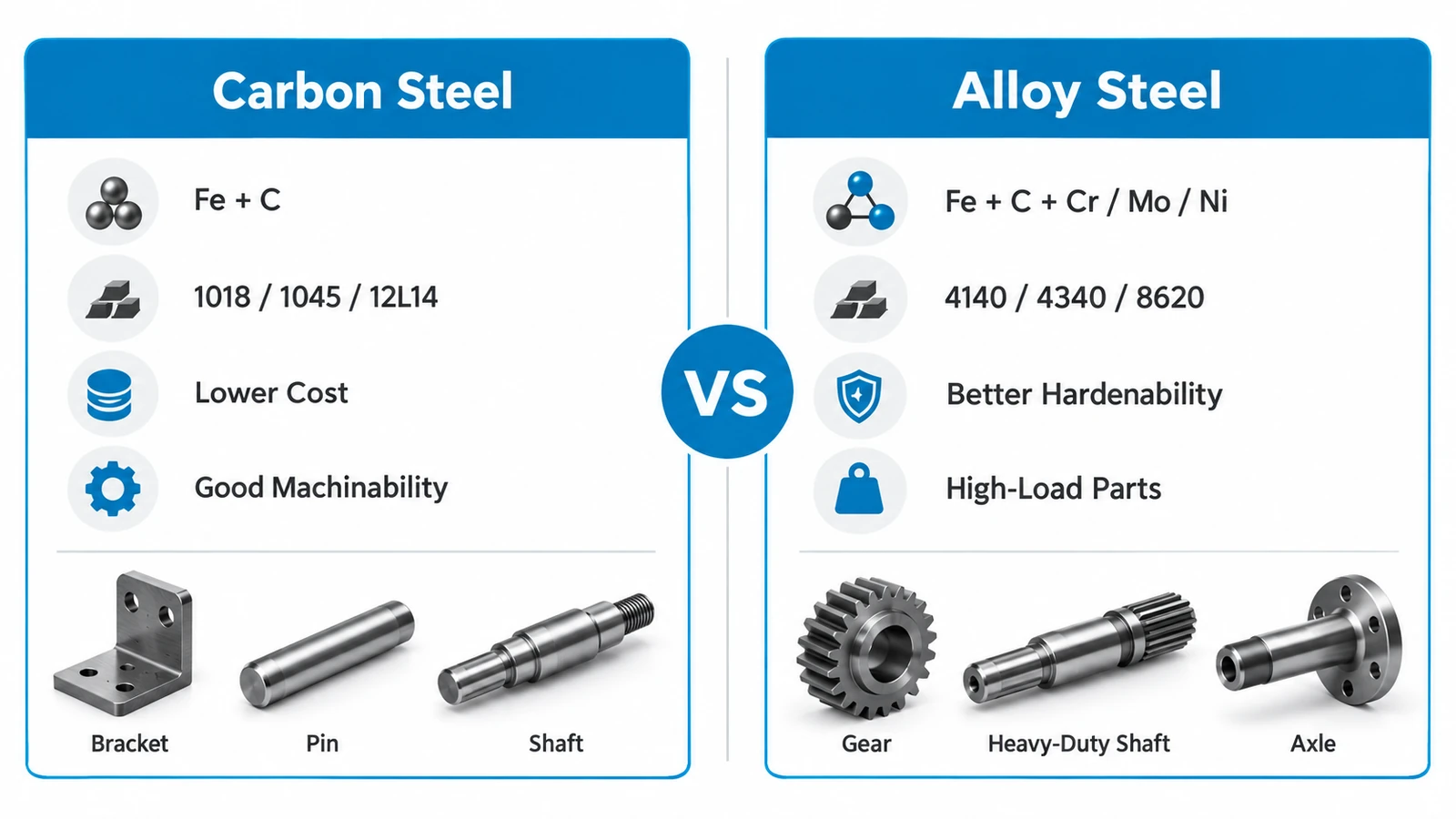
| Factor | Carbon Steel | Alloy Steel |
|---|---|---|
| Main Composition | Primarily iron and carbon | Iron, carbon + Cr, Mo, Ni, V or other additions |
| Common CNC Grades | 1018, 1020, 1045, 12L14 | 4130, 4140, 4340, 8620 |
| Strength | Low to high depending on grade | Often higher after heat treatment |
| Hardenability | Generally lower | Usually better |
| Toughness | Moderate to high | Often better at high strength |
| Wear Resistance | Depends on hardness | Often excellent after heat treatment |
| Corrosion Resistance | Limited | Usually limited for common low-alloy steels |
| Machinability | Often good | Depends strongly on hardness |
| Weldability | Best in low-carbon grades | More grade dependent |
| Heat Treatment | Moderate response | Broader heat-treatment capability |
| Cost | Usually lower | Usually higher |
| Typical Parts | Brackets, fixtures, pins, shafts | Gears, axles, high-load shafts, wear parts |
A useful comparison is 1045 vs 4140. Normalized 1045 typically has tensile strength around 620 MPa, while annealed 4140 is around 655 MPa. Pre-hardened or quenched-and-tempered 4140 can commonly reach roughly 930–1,100 MPa.
The specific grade and heat-treatment condition therefore matter more than the material family alone.
What Is Carbon Steel?
Carbon steel uses carbon as the main element controlling its mechanical properties.
Low-carbon grades such as 1018 and 1020 are economical, weldable, and easy to manufacture. Medium-carbon grades such as 1045 provide higher strength and hardness.
Typical cold-drawn 1018 properties are approximately:
- Tensile strength: 420–440 MPa
- Yield strength: 345–370 MPa
- Hardness: 120–130 HB
Typical normalized 1045 is around:
- Tensile strength: 620 MPa
- Yield strength: 410 MPa
- Hardness: 187 HB
1045 can also be quenched and tempered to increase strength and wear resistance.
Common CNC applications include:
- Brackets
- Pins
- Fixtures
- Shafts
- Rollers
- Fittings
For machining details and available grades, see our Carbon Steel CNC Machining Services.
What Is Alloy Steel?
Alloy steel contains elements such as chromium, molybdenum, nickel, or vanadium to improve strength, toughness, hardenability, fatigue resistance, or wear performance.
Common CNC grades include:
- 4130
- 4140
- 4340
- 8620
4140 typically contains about 0.38–0.43% carbon, 0.8–1.1% chromium, and 0.15–0.25% molybdenum, giving it better hardenability than plain carbon steels with similar carbon content.
4340 adds nickel and is commonly used where higher strength and toughness are required.
8620 is mainly selected for carburized components requiring a hard wear-resistant surface and tougher core.
For these materials, see our Alloy Steel CNC Machining Services.
Alloy Steel vs Carbon Steel: Key Differences
Strength
Strength depends mainly on the specific grade and heat treatment.
| Grade & Typical Condition | Tensile Strength | Yield Strength | Typical Hardness |
|---|---|---|---|
| 1018 Cold Drawn | ~440 MPa | ~370 MPa | ~126 HB |
| 1045 Normalized | ~620 MPa | ~410 MPa | ~187 HB |
| 4140 Annealed | ~655 MPa | ~415 MPa | ~197 HB |
| 4140 Pre-Hardened | ~930–1,000 MPa | ~690–760 MPa | ~28–34 HRC |
| 4340 Q&T | ~920–1,170 MPa | ~785–1,100 MPa | ~27–37 HRC |
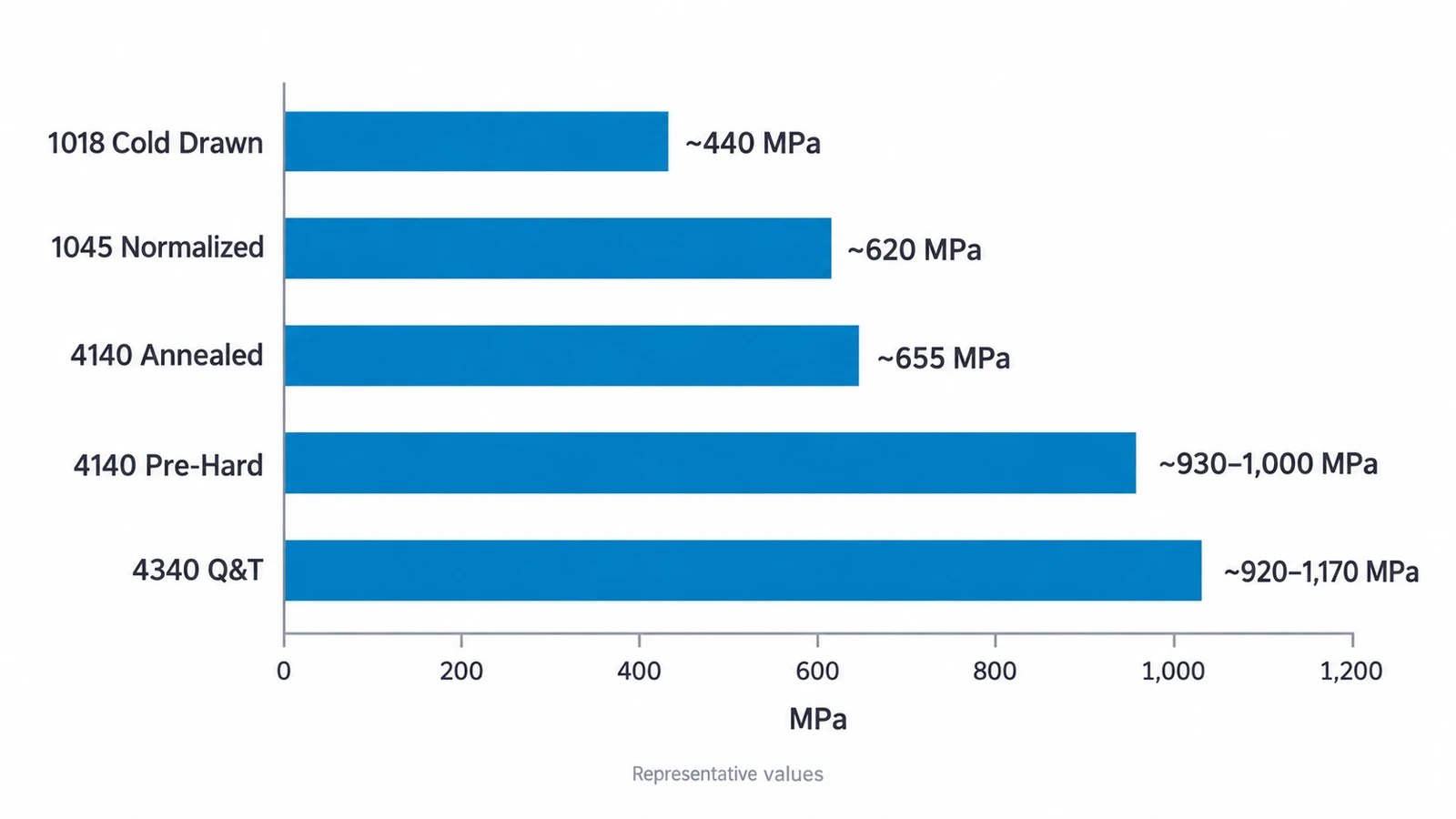
These are representative values only. Actual properties vary with heat-treatment cycle, section size, stock condition, and material specification.
For moderate loads, 1045 may be sufficient. For high-load or fatigue-critical parts, heat-treated 4140 or 4340 is often more suitable.
Hardness vs Hardenability
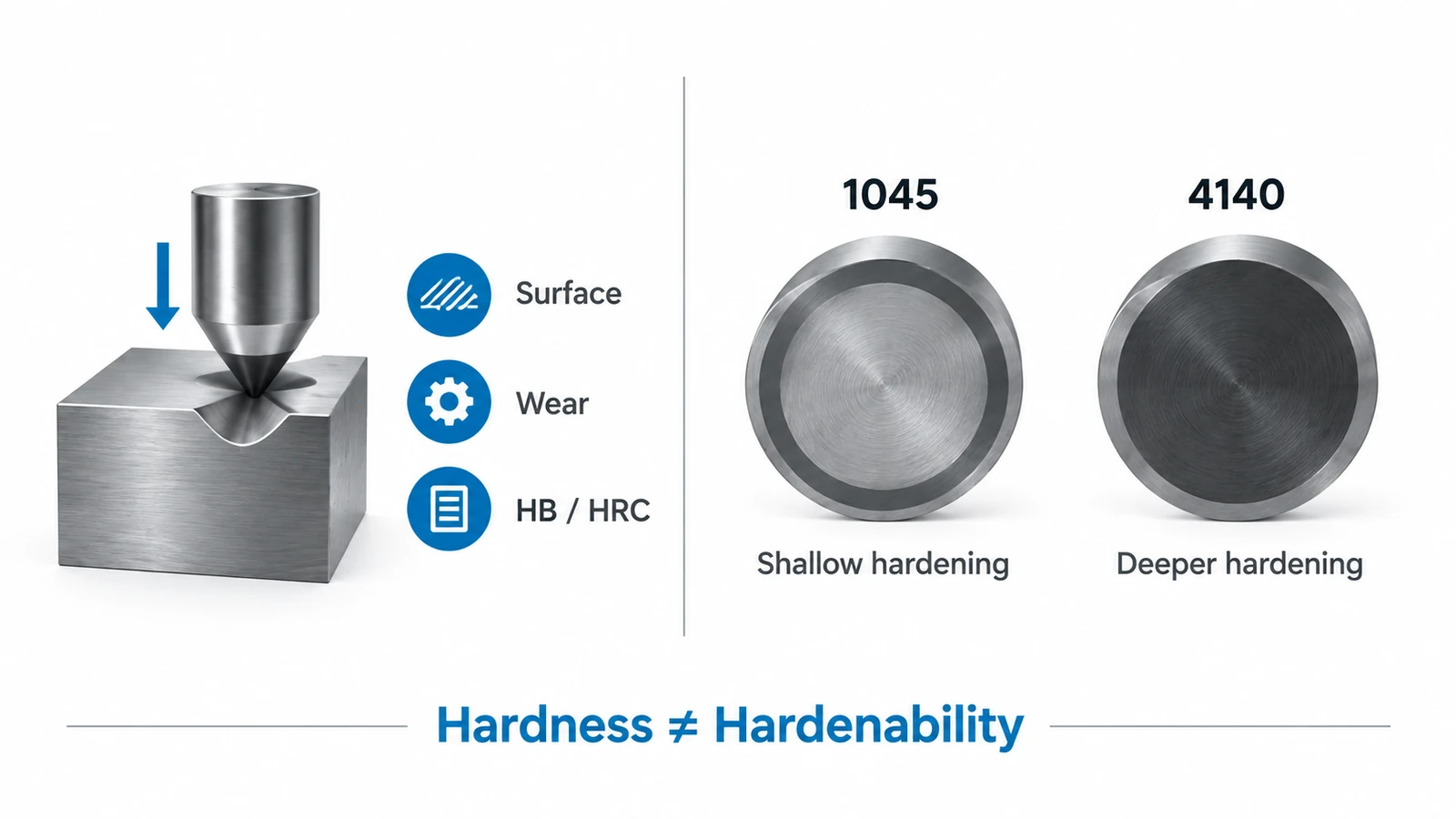
Hardness measures resistance to indentation and wear.
Hardenability describes how deeply hardness can develop through a steel section during heat treatment.
1045 can achieve high surface hardness, but 4140 and 4340 generally provide better hardenability. This matters for thicker shafts, axles, gears, and other parts that need more consistent properties through the section.
Toughness and Fatigue Resistance
Alloy steels are commonly used when parts experience repeated loading, impact, vibration, or high torque.
4340 is particularly well known for combining high strength with useful toughness after proper heat treatment, making it suitable for highly loaded shafts, axles, and mechanical components.
Wear Resistance
Wear resistance depends mainly on hardness and heat treatment.
4140 is often through-hardened for wear-resistant mechanical components.
8620 is commonly carburized and can achieve approximately 58–62 HRC at the surface while retaining a tougher core. This makes it suitable for gears, pinions, and contact-loaded parts.
For case-hardened parts, see our Carburizing Services.
Corrosion Resistance
Common alloy steels such as 4140, 4340, and 8620 are not corrosion-resistant substitutes for stainless steel.
They may still require:
- Black oxide
- Zinc plating
- Nickel plating
- Painting
- Powder coating
- Protective oil
If corrosion resistance is a primary requirement, stainless steel may be the better material family.
Weldability
Low-carbon steel such as 1018 generally offers better weldability.
Higher carbon content, alloy content, and hardness increase the risk of cracking and may require preheating, controlled cooling, or post-weld heat treatment.
For heavily welded structures, low-carbon steel is often preferred unless higher strength is necessary.
Machinability
Machinability depends strongly on grade and hardness.
12L14
Excellent chip control and machinability; ideal for high-volume turning.
1018
Easy to machine, but its ductility can cause stringy chips and built-up edge.
1045
Requires more cutting force than 1018 but remains practical for milling and turning.
4140 Annealed
Generally machines well with carbide tooling.
4140 Pre-Hardened
Higher cutting force, greater tool wear, and more demanding workholding.
4340 Hardened
More difficult to machine as hardness increases.
For CNC planning, always specify both the steel grade and supplied hardness condition.
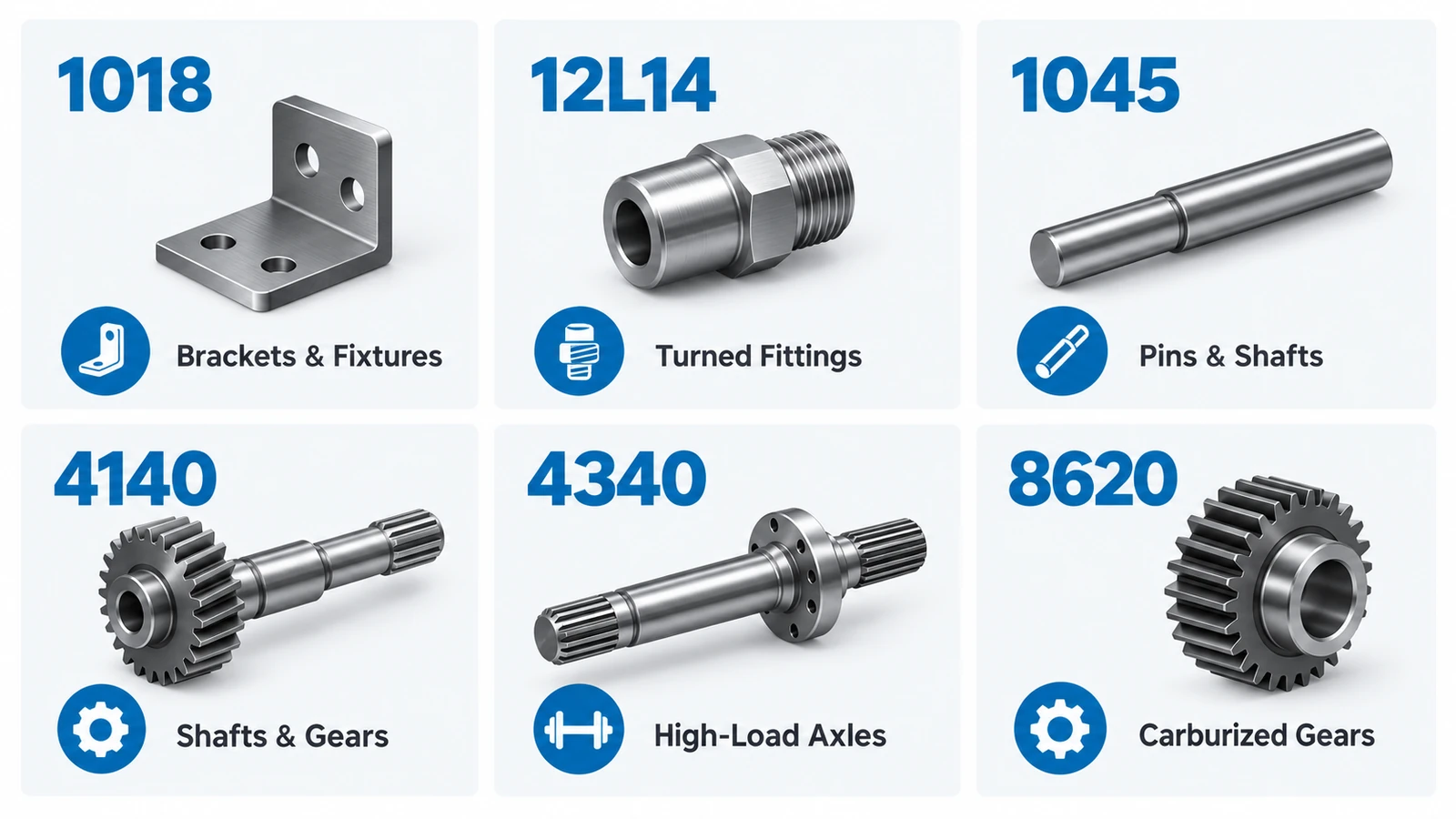
Common Carbon and Alloy Steel Grades for CNC Machining
| Grade | Type | Main Advantage | Typical Treatment | Typical CNC Parts |
|---|---|---|---|---|
| 1018 | Carbon | Low cost, weldability | As rolled / cold drawn | Brackets, pins, fixtures |
| 12L14 | Carbon | Excellent machinability | As supplied | Bushings, fittings |
| 1045 | Carbon | Higher strength | Normalized / Q&T | Shafts, rollers, pins |
| 4130 | Alloy | Strength + weldability | Normalized / Q&T | Structural parts |
| 4140 | Alloy | Strength + toughness | Annealed / pre-hard / Q&T | Shafts, gears, tooling |
| 4340 | Alloy | High strength + fatigue resistance | Q&T | High-load shafts, axles |
| 8620 | Alloy | Excellent case hardening | Carburized | Gears, pinions |
Alloy Steel vs Carbon Steel Heat Treatment
Heat treatment can change steel performance dramatically.
1018 has limited through-hardening capability but can be case hardened.
1045 responds well to quenching and tempering and is often used when higher strength or wear resistance is needed without moving to an alloy steel.
4140 can be supplied in annealed, normalized, pre-hardened, or quenched-and-tempered conditions. Annealed material is typically around 197 HB, while commercial pre-hardened 4140 is commonly around 28–32 HRC.
8620 is commonly carburized to combine a hard surface with a tougher core.
For annealing, normalizing, quenching, tempering, and stress relief, see our Heat Treatment Services.
Alloy Steel vs Carbon Steel for CNC Machining
For CNC machining, three questions matter most:
- What grade is being machined?
- What is its hardness?
- Will heat treatment occur before or after final machining?
For hardened parts, a common process is:
rough machining → heat treatment → finish machining or grinding
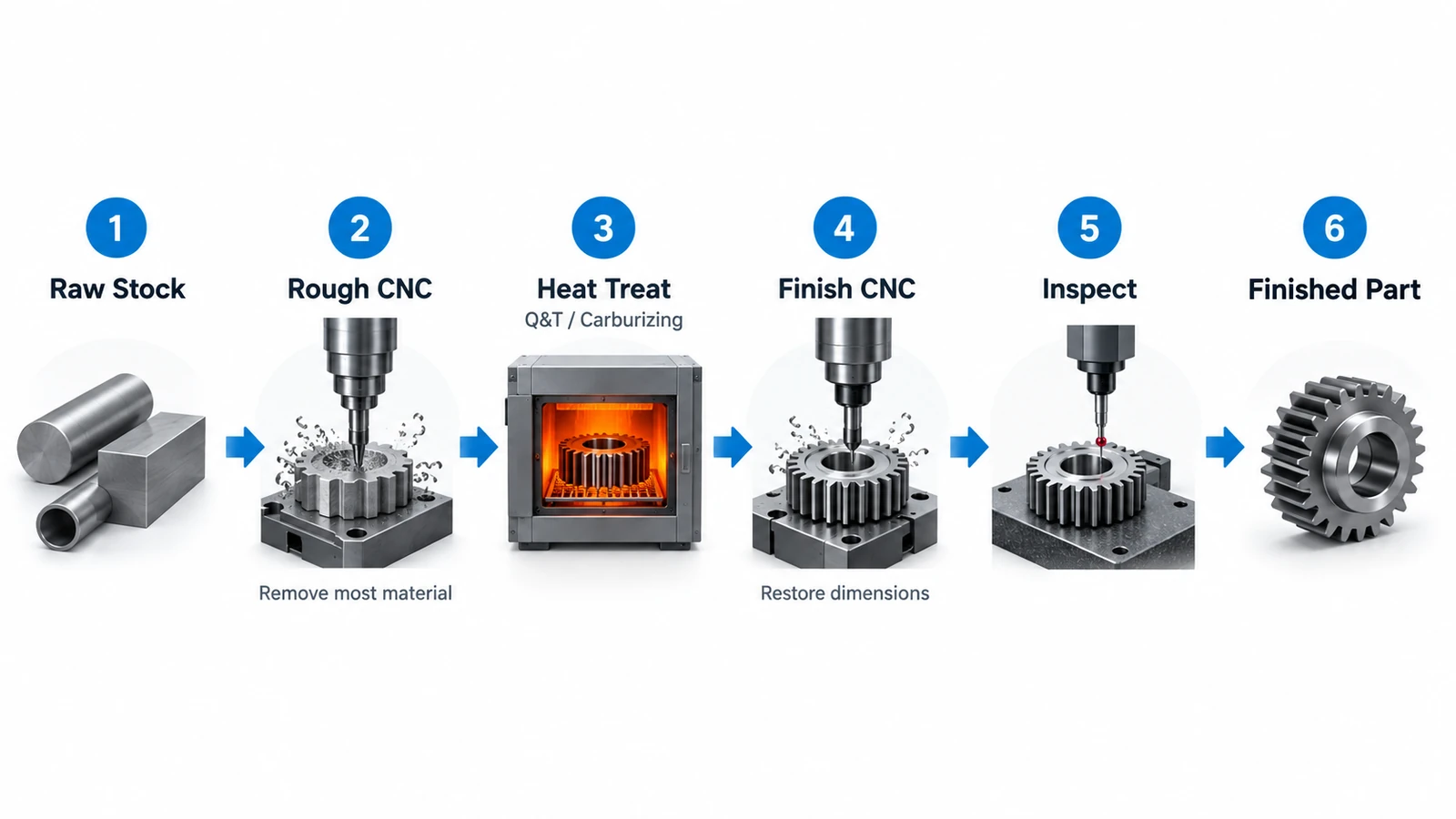
Rough machining removes most material while the steel is still relatively soft. Final machining then corrects dimensional changes caused by heat treatment.
When machining pre-hardened or quenched-and-tempered steel:
- Cutting forces increase.
- Tool wear increases.
- Heat generation rises.
- Machine and fixture rigidity become more important.
Carbide tooling is typically preferred for harder steels.
Which Steel Should You Choose for Common CNC Parts?
| CNC Part | Typical Starting Choice | Why |
|---|---|---|
| General Bracket | 1018 | Low cost and weldability |
| Fixture | 1018 / 1045 | Cost vs strength |
| High-Volume Turned Fitting | 12L14 | Excellent machinability |
| Pin | 1045 | Strength and wear resistance |
| General Shaft | 1045 / 4140 | Depends on load |
| High-Load Shaft | 4140 / 4340 | Strength and fatigue resistance |
| Axle | 4140 / 4340 | High load and cyclic stress |
| Hardened Gear | 4140 | Strength and hardenability |
| Case-Hardened Gear | 8620 | Hard case with tough core |
| Pinion | 8620 | Wear and contact-fatigue performance |
These are starting points rather than universal specifications.
Which Should You Choose: Alloy Steel or Carbon Steel?
Choose carbon steel when:
- Cost is important.
- Loads are moderate.
- Weldability is important.
- High-volume machining is required.
- Deep hardening is unnecessary.
Choose alloy steel when:
- Higher strength is required.
- Fatigue loading is significant.
- The part has a thicker section.
- Greater hardenability is needed.
- Wear resistance is critical.
- Heat treatment is central to performance.
For many general-purpose CNC parts, 1018 or 1045 is sufficient. For higher loads and fatigue, 4140 or 4340 is often the better starting point. For carburized gears, 8620 is a common choice.
Alloy Steel vs Carbon Steel: Final Comparison
Neither material is universally better.
1018 is suitable for economical general-purpose parts.
1045 offers more strength and wear resistance.
4140 provides better hardenability, strength, and toughness.
4340 suits higher-load and fatigue-critical parts.
8620 is especially useful for carburized gears and wear components.
The best choice depends on the grade, hardness, heat-treatment condition, service load, geometry, environment, and manufacturing process.
Frequently Asked Questions
Not always. Heat-treated 4140 or 4340 can be much stronger than mild carbon steel, but strength depends on the specific grade and heat-treatment condition.
Carbon steel is often easier, especially free-machining grades such as 12L14. Annealed 4140 also machines well, while hardened 4140 and 4340 require more rigid setups and greater tool-wear control.
1045 works well for many moderate-load shafts. 4140 is usually preferred for higher torque, fatigue loading, thicker sections, or greater hardenability.
4140 is commonly used for through-hardened gears, while 8620 is well suited to carburized gears requiring a hard 58–62 HRC surface and tougher core.
Not necessarily. Common alloy steels such as 4140 and 4340 still rust and usually require surface protection in corrosive environments.



