

Deburring removes unwanted raised material from CNC-machined edges, holes, and intersecting surfaces. Burrs typically form when cutting tools push or separate material at an edge, particularly where a drill exits a hole or a milling cutter leaves a workpiece surface.
The best deburring method depends on burr location, material, accessibility, and dimensional requirements. External edges may be finished using chamfering tools or brushes, while cross-holes and internal passages often require specialized tools.
Effective CNC deburring removes unwanted material without damaging precision bores, sealing surfaces, or functional edges.
What Is Deburring in CNC Machining?
Deburring is a finishing operation used to remove burrs left by manufacturing processes such as CNC milling, CNC turning, drilling, and tapping.
A burr is unwanted material that extends beyond the intended geometry of a component. It may appear as a thin raised lip, a folded edge, a sharp projection, or partially attached material. Burrs are particularly common where a cutting tool enters or exits a surface.
Removing burrs helps prevent assembly interference, poor mating-surface contact, seal damage, loose particles in internal passages, handling injuries, and inconsistent dimensional inspection.
Deburring should not be treated as unrestricted material removal. A precision-machined component may require a nearly sharp functional edge, a controlled edge break, or a specific chamfer.
Common Types of Machining Burrs
| Burr Location | How It Forms | Potential Problem |
|---|---|---|
| Milled edges | Material deforms as a cutter enters or exits | Sharp edges and assembly interference |
| Drilled hole exits | Material is pushed outward during drill breakthrough | Protrusions around the hole |
| Turned shoulders | Material remains near tool exit or diameter transitions | Poor seating against mating parts |
| Thread entrances | Tapping or thread milling leaves displaced or cut material | Difficult fastener installation |
| Cross-hole intersections | Two drilled passages intersect internally | Loose particles and restricted flow |
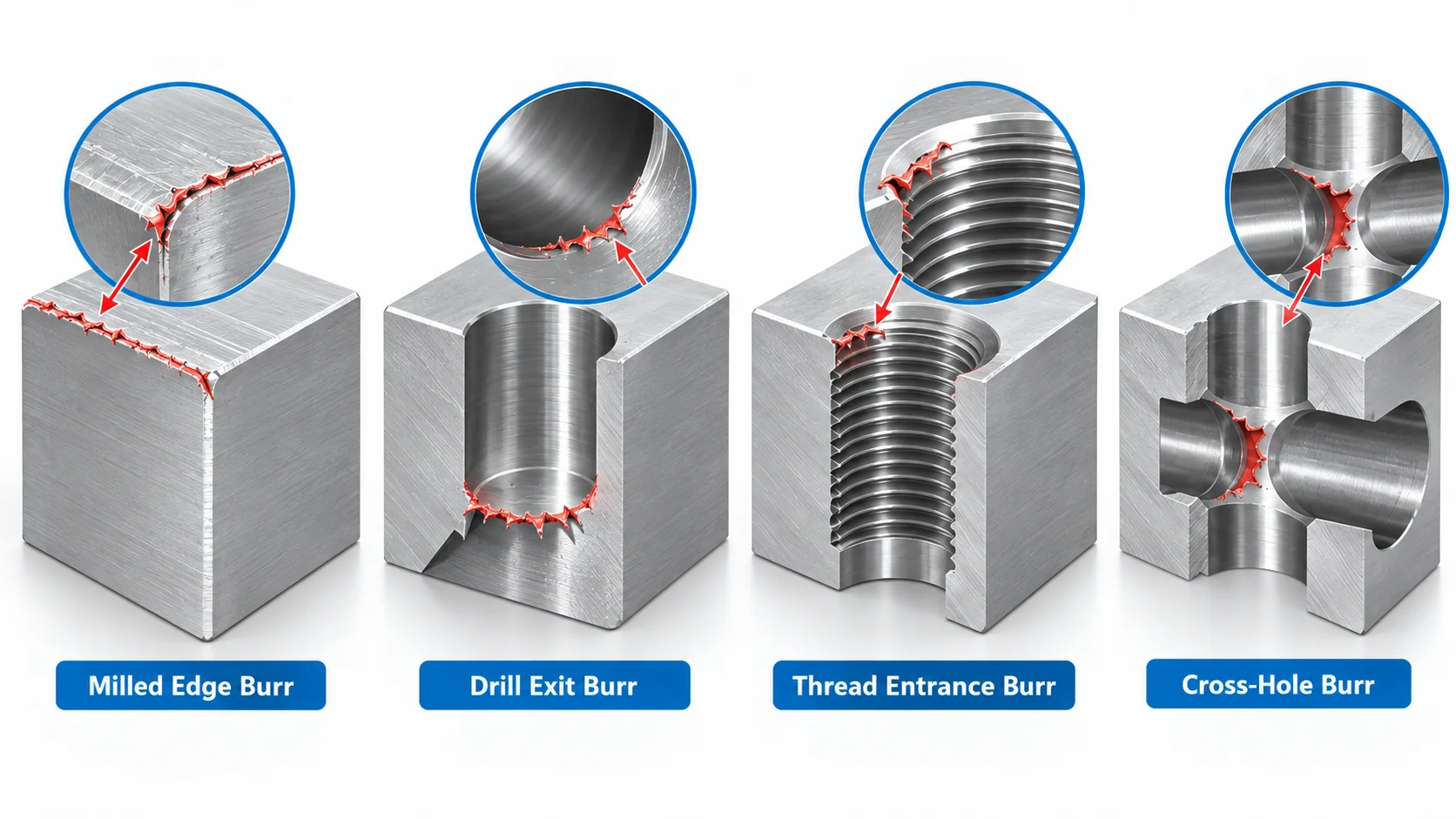
Milling Burrs
Milling burrs commonly develop along pocket edges, slot openings, and external contours. Their size and shape depend on the material, cutter geometry, toolpath direction, tool condition, and cutting parameters. A simple external milling burr may be accessible to a chamfering tool or brush, while burrs inside deep pockets or narrow slots are more difficult to reach.
Drilling Exit Burrs
Exit burrs form when the drill breaks through the opposite side of a workpiece. In precision mounting plates, these burrs can prevent a component from seating flat even when the hole diameter is correct.
Internal Cross-Hole Burrs
Cross-hole burrs occur where two drilled passages intersect inside a component. They are particularly important in hydraulic manifolds, pneumatic components, and fluid-handling equipment because a partially attached burr may restrict a passage or detach during service.
CNC Deburring Methods and Tools
| Deburring Method | Suitable Features | Main Advantage | Main Limitation |
|---|---|---|---|
| Manual Deburring | Accessible external edges | Flexible and simple | Operator-dependent consistency |
| CNC Chamfering | Accessible hole entrances and edges | Programmable, repeatable geometry | Requires tool access |
| Brush Deburring | Edges, holes, and some intersections | Can reach complex surfaces | Brush selection and wear matter |
| Vibratory Finishing | Multiple small components | Processes many exposed edges | May affect surfaces and dimensions |
| Abrasive Flow Machining | Suitable internal passages | Reaches internal surfaces | Process control and cleaning required |
| Thermal Deburring | Certain small hard-to-reach burrs | Removes burrs at multiple locations | Material and process limitations |
| Electrochemical Deburring | Selected conductive-metal features | No mechanical cutting forces | Specialized tooling and control required |
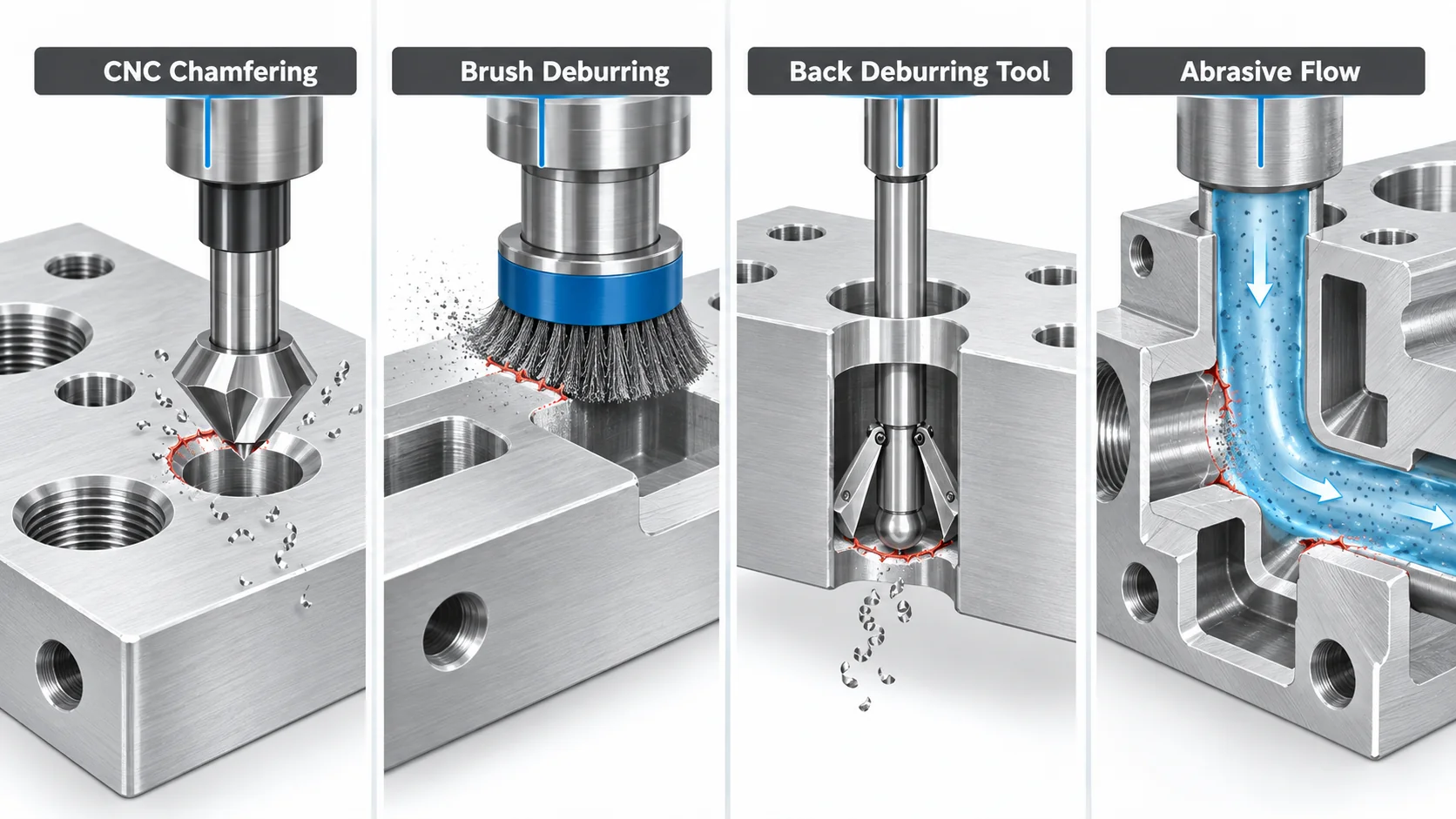
Manual Deburring
Manual deburring uses handheld blades, files, scrapers, or abrasive tools. It is useful for prototypes and low-volume components with accessible edges, but the result can vary if the required edge condition is not clearly defined.
CNC Chamfering and Contour Deburring
A CNC machine can use a chamfer mill, countersink, or suitable deburring tool to remove burrs from accessible edges. This method is useful when a repeatable edge geometry is required, but it does not automatically remove a burr on an inaccessible opposite edge.
Brush and Specialized Deburring
Abrasive brushes and specialized hole-deburring brushes can remove light burrs from accessible surfaces. Vibratory finishing, abrasive flow, thermal, and electrochemical processes may be appropriate for specific geometries. Their suitability depends on material, geometry, cleanliness requirements, and dimensional limits.
How to Deburr Holes and Internal Features
Deburring Through-Holes
For an accessible through-hole, both the entrance and exit should be evaluated. Chamfer mills, countersinks, back-deburring tools, and specialized brushes are common options. For precision locating or close-fit holes, an oversized chamfer or aggressive brushing operation may damage the functional geometry.
Deburring Blind Holes
Blind holes do not have a conventional exit edge at the bottom, but machining can still produce burrs at the entrance or around intersecting features. Cleaning also matters because chips and abrasive residue can remain trapped.
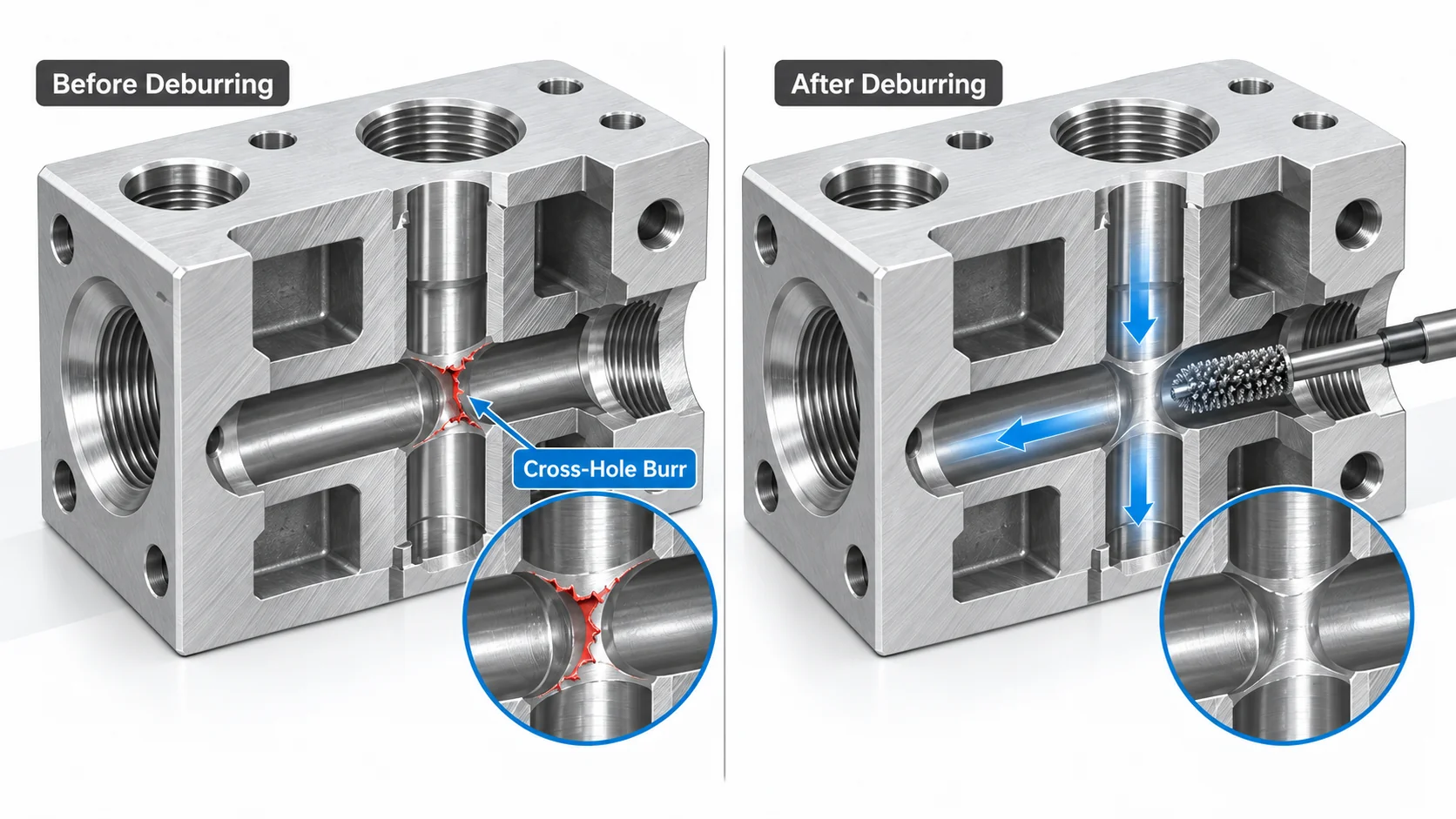
Cross-Hole Deburring: Aluminum Manifold Example
Consider a CNC-machined aluminum manifold containing several drilled fluid passages. When a vertical passage breaks through into a horizontal passage, a burr can remain around the internal intersection.
- Identify critical intersections. Use the CAD model and drawing to locate each passage intersection.
- Select an appropriate internal tool. Cross-hole tools, flexible brushes, or specialized finishing methods may be suitable depending on geometry.
- Control material removal. Remove the projection without enlarging the passage or reshaping the intersection.
- Clean internal passages. Remove detached burrs, chips, abrasive particles, and residue.
- Verify the result. Borescopes, gauges, cleanliness tests, or flow testing may be appropriate depending on the functional risk.
For critical internal passages, inspection should be matched to the part’s function and CNC quality assurance requirements.
Deburring vs Edge Breaking vs Chamfering
| Operation | Primary Purpose | Result |
|---|---|---|
| Deburring | Remove unwanted raised material | Burr removed without a necessarily defined edge shape |
| Edge Breaking | Reduce edge sharpness | Small controlled rounding or material removal |
| Chamfering | Create a specified angled surface | Geometrically defined chamfer |
| Rounding | Create a specified edge radius | Defined or controlled rounded profile |
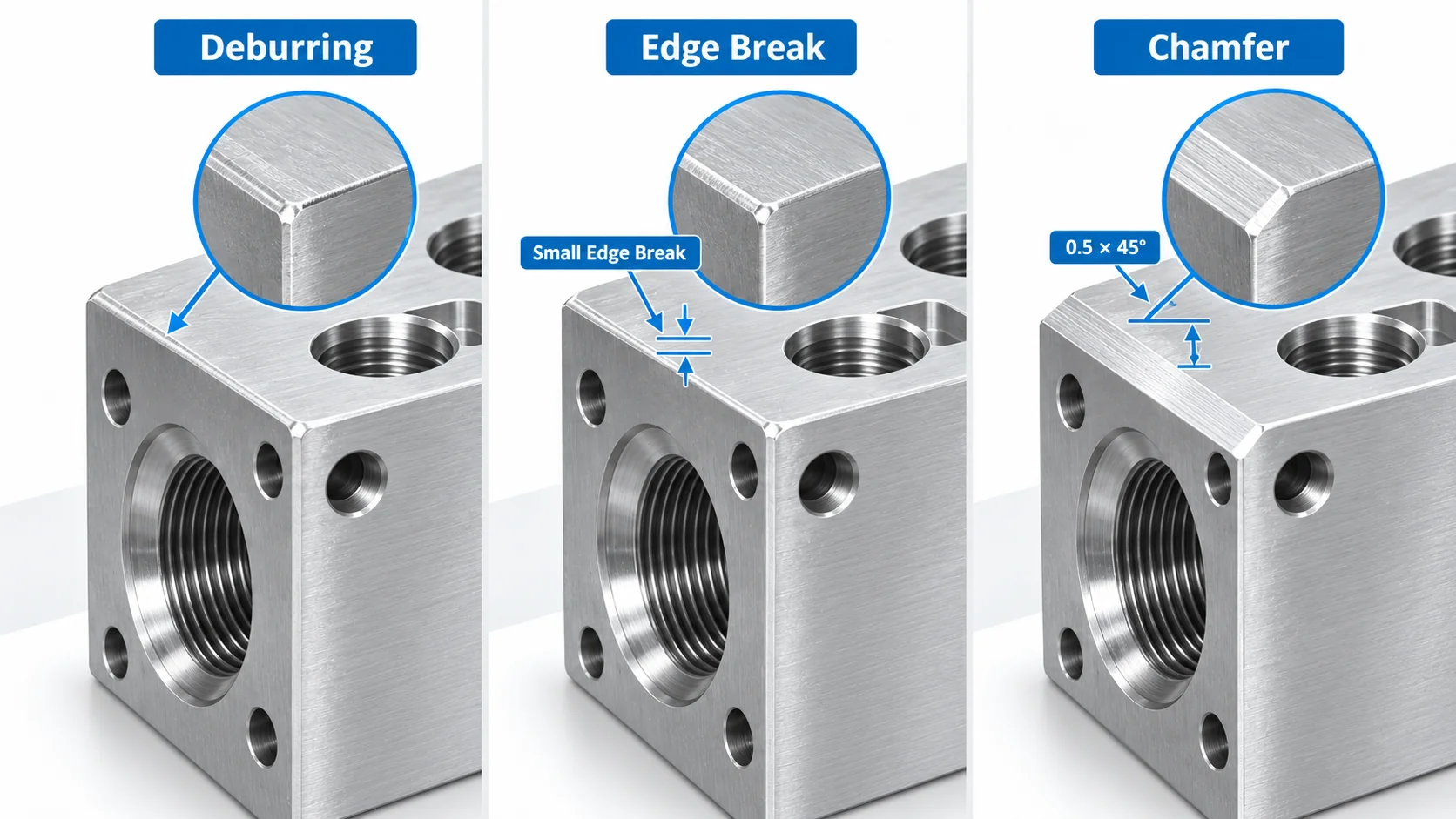
Deburring removes unwanted material without necessarily creating a visible chamfer. Edge breaking intentionally reduces sharpness with a small controlled break. Chamfering creates a measurable angled feature such as 0.5 × 45°.
For edges of undefined shape, ISO 13715 provides a standardized approach for specifying permissible edge deviations. A burr-free requirement does not automatically authorize a large chamfer.
CNC Deburring Design Guidelines
1. Define Critical Edge Requirements
External handling edges, precision seating surfaces, seal-contacting edges, and nonfunctional edges may need different treatments.
2. Design for Tool Accessibility
Narrow slots, deep pockets, and internal intersections can prevent conventional tools from reaching the affected edges. Where function permits, improve access through suitable passage geometry.
3. Protect Precision Holes and Mating Surfaces
Deburring should not compromise dowel pin holes, bearing seats, precision hydraulic bores, sealing surfaces, or threaded connections.
4. Avoid Unnecessarily Restrictive Requirements
Identify where burrs could affect assembly, safety, cleanliness, or performance rather than applying the same strict requirement to every edge.
5. Include Cleaning and Inspection
For internal cavities, detached material can remain after deburring. Define cleaning and verification where contamination could affect reliability.
6. Use Clear Drawing Notes
- Remove burrs from all machined edges.
- 0.5 × 45° chamfer where indicated.
- Internal passage intersections shall be free of loose burrs and machining debris.
Common Deburring Problems and Solutions
| Problem | Possible Cause | Recommended Solution |
|---|---|---|
| Residual Burrs | Tool cannot reach the complete edge | Review access and select suitable tooling |
| Excessive Edge Rounding | Aggressive brushing or prolonged abrasive finishing | Control process intensity and duration |
| Oversized Chamfer | Incorrect tool offset or drawing interpretation | Verify chamfer dimensions and toolpath |
| Precision Hole Damage | Deburring tool contacts the functional bore | Protect bore geometry and validate the process |
| Internal Particle Contamination | Detached burrs remain inside passages | Use appropriate cleaning and cleanliness inspection |
| Inconsistent Results | Manual variation or tool wear | Define acceptance criteria and monitor tooling |
Deburring defects are not limited to remaining burrs. Over-deburring can also damage precision bores, sealing lands, and locating features. For manifolds and enclosed components, deburring and cleanliness verification should be considered together.
Conclusion
Deburring is an essential part of producing functional CNC-machined components. External edges, drilled-hole exits, and internal cross-hole intersections present different challenges and may require different tools or finishing methods.
The correct process removes unwanted material while preserving critical dimensions, mating surfaces, and designed edge geometry. For complex parts such as aluminum manifolds, effective deburring must also include internal cleaning and suitable inspection.
Frequently Asked Questions
Can CNC machines perform deburring automatically?
Yes. CNC machines can use programmed chamfering tools, brushes, and specialized deburring cutters to process accessible features. Some internal burrs may still require dedicated finishing equipment or additional operations.
Can deburring affect machining tolerances?
Yes. Excessive finishing can change edge geometry, hole entrances, and nearby surfaces. Critical dimensions should be protected by selecting an appropriate process and verifying the finished part.
Is abrasive finishing suitable for precision aluminum parts?
It can be, but the abrasive type, exposure, and processing conditions must be controlled. Some finishing methods may alter surface appearance, edge radii, or dimensional characteristics.
Are burr-free parts always free from loose particles?
No. A part may have no visible attached burrs while still containing detached chips or finishing residue. Cleaning and cleanliness inspection are separate requirements where contamination matters.
Should deburring be performed before anodizing?
Machining burrs are generally addressed before anodizing so unwanted edge defects are not left beneath the coating. Edge condition and final dimensions should be coordinated with the finishing process.



