

CNC cutting is a computer-controlled manufacturing process in which cutting tools, laser beams, plasma arcs, or high-pressure waterjets follow programmed paths to remove or separate material into the desired shape. It can be used to cut not only metals but also plastics, wood, and composites.
Metal parts come in many forms, from flat sheet profiles and cylindrical shafts to complex housings with internal cavities. Different CNC cutting processes are used depending on the part’s geometry, material, and machining requirements.
What Is CNC Cutting?
CNC stands for Computer Numerical Control. Instead of relying on an operator to manually guide a cutting tool, CNC machines use digital instructions to control the precise movement of machine axes. Because these movements are programmed, the repeatability of machining one part or a thousand parts is nearly the same.
From a manufacturing standpoint, CNC cutting is a form of subtractive manufacturing. This means removing unwanted material from a workpiece until the desired part geometry remains. It differs fundamentally from manufacturing processes such as casting, forging, and 3D printing.
It’s important to understand that CNC cutting doesn’t refer to a single type of machine. CNC mills, lathes, laser cutters, plasma cutters, and waterjet machines can all fall under the broader category of CNC cutting equipment, provided their movements are controlled by a CNC system.
Therefore, a “CNC cutting machine” isn’t one specific piece of equipment. It’s a general term for several types of machines, each using a different cutting method.
How Does CNC Cutting Work?
Although CNC cutting machines use different technologies, their basic workflow follows five main steps.
Step 1: CAD Design
Engineers use computer-aided design (CAD) software to create a 3D model of the part, including its dimensions, tolerances, and critical features. This step defines what needs to be manufactured.
Step 2: CAM Programming
The CAD model is imported into computer-aided manufacturing (CAM) software, where the programmer selects cutting tools, toolpaths, and machining parameters. The software then generates the machine instructions required to produce the part. This step determines how the part will be manufactured.
Step 3: Machine Setup and Workholding
The raw material is secured to the machine table, the cutting tools are installed, and the workpiece coordinate system is established. Proper clamping and accurate reference points are essential for achieving the required dimensions.
Step 4: CNC Cutting
The machine automatically follows the programmed toolpath, removing material with a cutting tool or a concentrated energy source. During machining, the operator monitors cutting conditions, chip evacuation, temperature, and abnormal vibrations.
Step 5: Inspection
After machining, the finished part is checked using calipers, micrometers, coordinate measuring machines (CMMs), or other inspection equipment. If necessary, tool offsets are adjusted before additional machining.
The accuracy of the first two steps and the reference setup in the third step often have the greatest influence on part quality. The final inspection step verifies the results.
Can a CNC Machine Cut Metal?
Yes. Metal cutting is one of the most common applications of CNC equipment.
Mechanical cutting tools remove metal layer by layer through cutting forces generated by tool rotation or feed movement. Laser and plasma cutting use concentrated energy to melt or vaporize localized areas of metal, while a gas stream removes the molten material. Waterjet cutting uses a high-velocity stream of water, often mixed with abrasive particles, to cut through the workpiece.
Although these methods operate differently, they all remove or separate material to achieve the required shape.
Different metals have different machinability characteristics, so cutting methods and machining parameters must be selected accordingly.
| Metal | Machining Characteristics |
|---|---|
| Aluminum | Generally easy to machine, with relatively low cutting forces and the ability to use high cutting speeds. Built-up edges and part deformation should be considered. |
| Carbon Steel | Requires adequate machine rigidity, appropriate depths of cut, and suitable cooling conditions. |
| Stainless Steel | Prone to work hardening and concentrated cutting heat. Feed rates must be controlled to prevent excessive rubbing. |
| Titanium Alloys | Low thermal conductivity concentrates heat near the cutting edge. Heat management, tool wear, and relatively low cutting speeds are important considerations. |
| Brass and Copper | Tool selection and chip control are essential. Soft copper can stick to cutting tools, making sharp cutting edges particularly important. |
So, the question isn’t really whether CNC machines can cut metal. The more important questions are which cutting method to use, what tooling is required, and which machining parameters are appropriate.
What Are the Different Types of CNC Cutting?
Several CNC cutting processes are commonly used in metal manufacturing, each with its own applications and limitations.
| CNC Cutting Process | Best Suited For | Main Limitations |
|---|---|---|
| CNC Milling | Precision 3D components, pockets, slots, and complex features | More programming and setup may be required for simple profiles. |
| CNC Turning | Shafts, bushings, and cylindrical components | Primarily suited to rotational geometries. |
| Laser Cutting | Precision profiles in sheet metal | Heat-affected zones and material thickness limitations. |
| Plasma Cutting | Cutting electrically conductive metal plates | Generally lower edge quality and precision than laser cutting in many applications. |
| Waterjet Cutting | Thick sections and heat-sensitive materials | Slower cutting speeds and additional abrasive-related costs. |
The basic selection principle is straightforward: use sheet-metal cutting processes for flat profiles, CNC milling for complex 3D features, and CNC turning for cylindrical parts.
These processes aren’t necessarily interchangeable. In many manufacturing environments, they’re used together. For example, a metal plate may first be laser-cut into a rough profile, then transferred to a CNC milling machine to produce precision pockets, holes, and other features.
CNC Cutting vs. CNC Machining: What's the Difference?
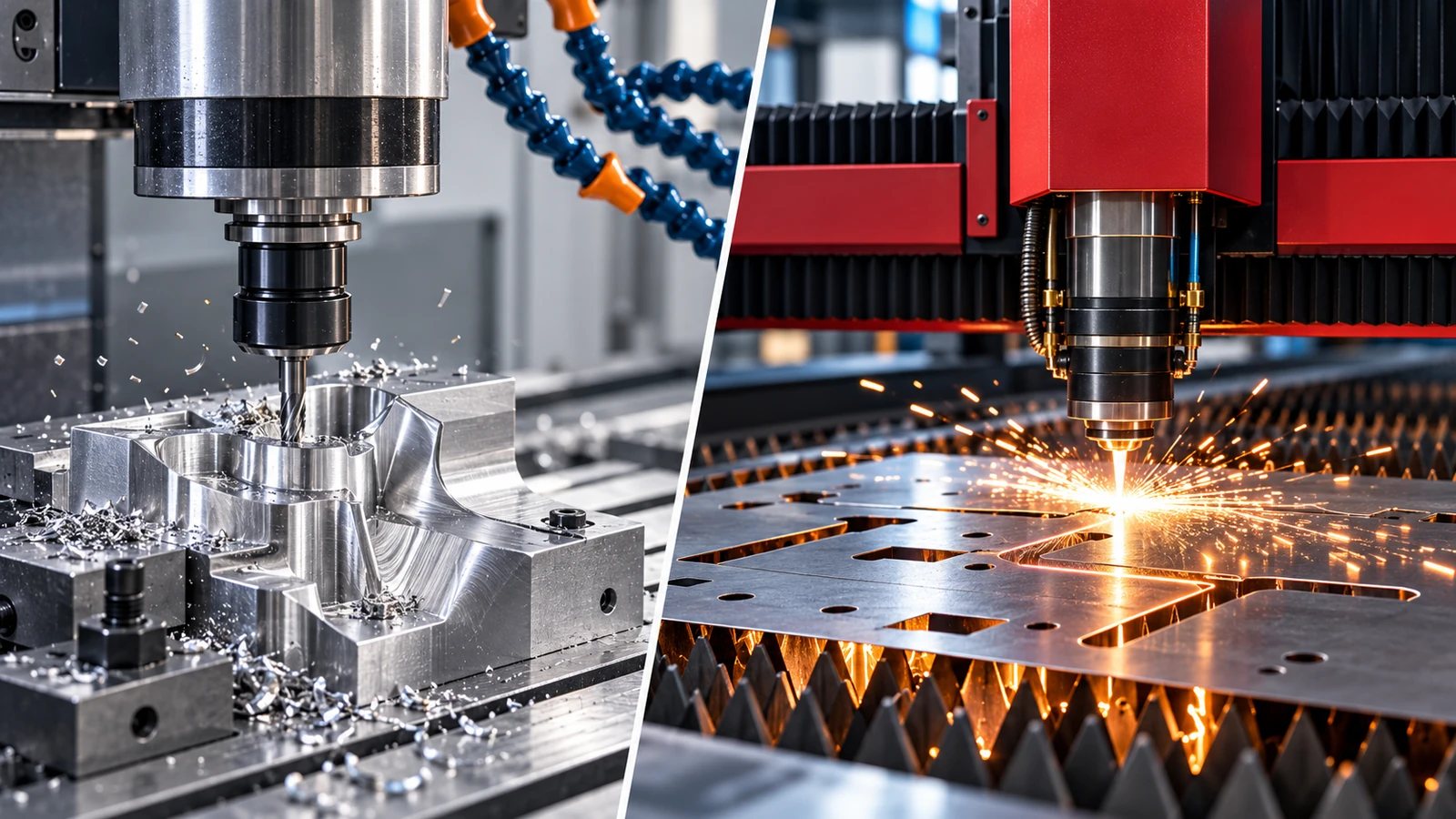
CNC cutting is a broad term that can describe material removal using mechanical cutting tools, lasers, plasma, or waterjets. It primarily refers to the process of cutting or separating material.
CNC machining has a narrower meaning in engineering and manufacturing. It typically refers to precision material removal processes such as milling, turning, and drilling, with greater emphasis on dimensional accuracy, geometric tolerances, and surface finish.
Two examples help explain the difference.
Example 1: Cutting a Steel Plate Profile
Suppose you need to cut a flat steel plate into a specific 2D shape with a uniform thickness and clean edges. A laser or plasma cutter can complete this operation in minutes without requiring a CNC machining center.
This is a typical CNC cutting application.
Example 2: Machining a Metal Housing
Now consider a metal housing with threaded holes, counterbores, deep pockets, and specific positional tolerances and surface finish requirements.
Simple profile cutting cannot produce all these features. The part requires CNC milling to remove material in controlled passes, along with drilling and tapping operations.
This is a typical CNC machining application.
How to Choose the Right CNC Cutting Process for Metal Parts
Selecting the right CNC cutting process comes down to three main factors.
1. Part Geometry
Does the part have a simple 2D profile, or does it include angled surfaces, internal pockets, and complex 3D features?
If only a flat profile is needed, sheet-metal cutting methods are generally the most efficient option. Once a part requires three-dimensional features, CNC milling is often the most practical choice.
2. Material and Thickness
Is the part made from aluminum, carbon steel, stainless steel, or titanium?
For thin sheet-metal profiles, laser cutting offers fast processing speeds and narrow kerf widths.
For medium-to-thick conductive metal plates, plasma cutting can be a more economical option, especially when cost is a major consideration.
For heat-sensitive materials, thick sections, or applications where a heat-affected zone must be avoided, waterjet cutting is often preferred.
3. Tolerance and Surface Finish Requirements
Does the process only need to produce a rough blank for further machining, or must the part meet final dimensional and surface finish requirements?
If the part only requires rough cutting, a profile-cutting process may help reduce costs.
If the part needs to meet tight tolerances and specific surface finish requirements, CNC milling or turning is typically required.
Here are three common manufacturing scenarios:
- Cutting steel plate profiles: laser or plasma cutting is generally the first option to consider.
- Manufacturing complex aluminum housings or precision metal components: CNC milling is usually more appropriate.
- Producing shafts, bushings, and other rotational parts: CNC turning is often the most efficient choice.
Start by evaluating the part geometry, then consider the material and thickness. Finally, verify that the selected process can meet the required tolerances and surface finish.
Following this sequence helps avoid choosing an unsuitable cutting method.
Conclusion
CNC cutting isn’t a single manufacturing process. It refers to a group of computer-controlled methods used to remove or separate material.
The right process depends on the part’s geometry, material properties, and precision requirements. For complex metal components with tight tolerances, CNC milling and turning are often the most suitable options.
Frequently Asked Questions
Yes, but conventional carbide cutting tools may struggle with hardened steel. Depending on the material hardness and application, manufacturers may use cubic boron nitride (CBN) or ceramic cutting tools for hard turning and hard milling.
Alternatively, processes such as wire EDM, laser cutting, or grinding may be considered.
The key is matching the cutting tool material and machining parameters to the hardness of the workpiece.
Yes, in certain applications.
High-speed milling of aluminum alloys and dry machining of cast iron are established practices. Minimum quantity lubrication (MQL) and compressed air can also be used as alternatives to conventional flood coolant.
However, machining titanium alloys, stainless steel, and deep cavities often requires effective cooling to maintain tool life and surface quality.
Yes. One of the main advantages of CNC cutting is that it doesn’t require dedicated molds or dies.
Once the program is prepared, manufacturers can produce individual parts or small batches. This often makes CNC manufacturing more cost-effective and faster than traditional tooling-based manufacturing methods for low-volume production.
As production volume increases, the cost per part generally decreases because programming and setup costs are spread across more parts.



