

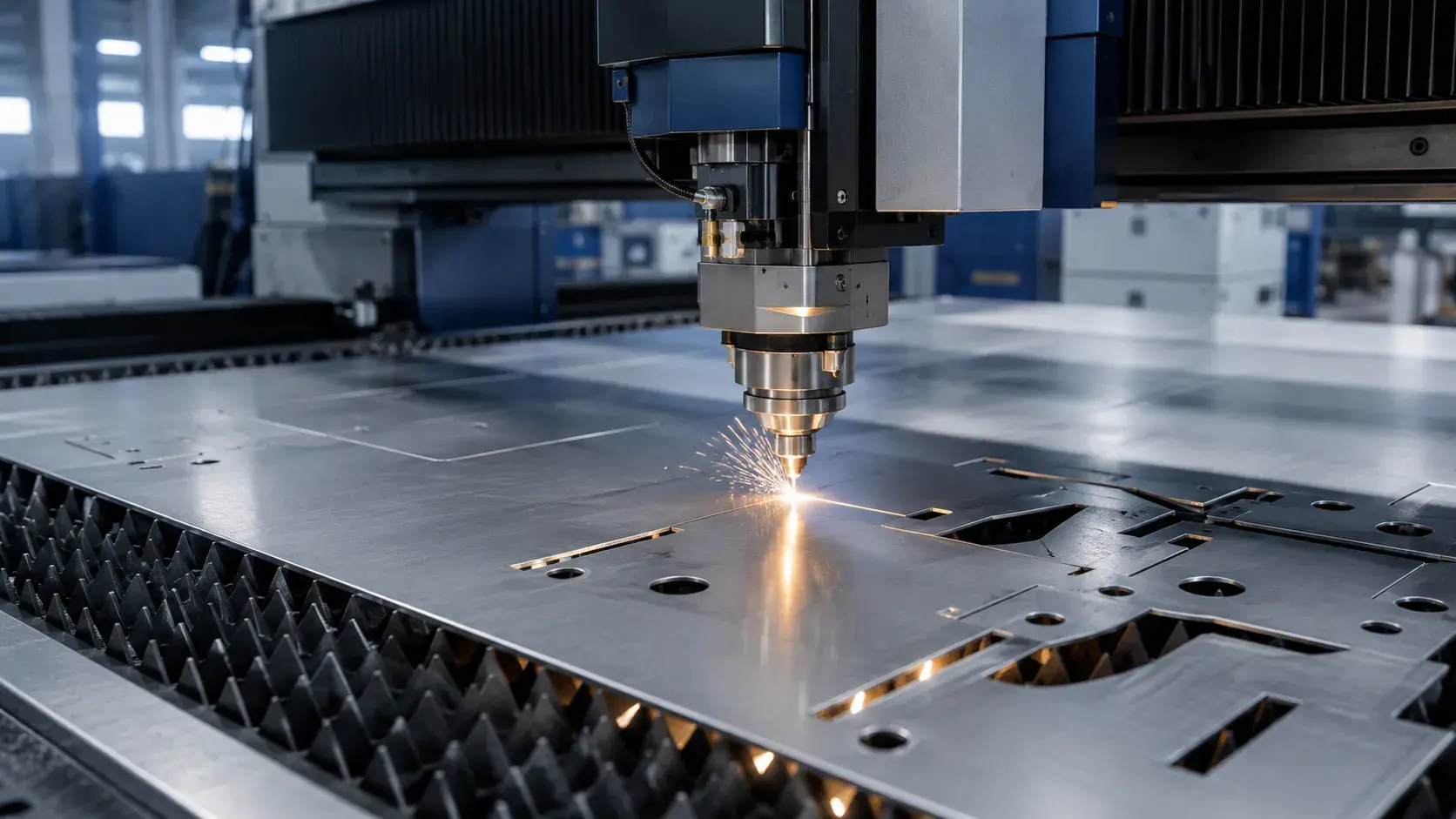
Laser cutting aluminum is widely used for sheet metal parts because it can produce clean 2D profiles quickly and with good repeatability. However, aluminum is not always as easy to cut as mild steel.
Its high reflectivity and thermal conductivity affect how efficiently the material absorbs laser energy. The final result depends on several factors, including laser type, sheet thickness, alloy, cutting speed, focus position, and assist gas.
Understanding these factors helps you choose the right cutting method and avoid common problems such as burrs, excessive heat, or poor edge quality.
Can Aluminum Be Laser Cut?
Yes, aluminum can be laser cut.
Modern laser systems can cut thin and medium aluminum sheet efficiently, and higher-power equipment can also handle thicker plate. The exact cutting capacity depends on the laser power, machine setup, alloy, and required edge quality.
Laser cutting is especially suitable when the part mainly consists of flat 2D features such as:
- outer profiles;
- holes;
- slots;
- cutouts;
- panels;
- brackets;
- covers and enclosures.
Because the laser does not physically contact the workpiece, there is very little cutting force on the sheet. This makes it useful for thin materials and detailed profiles that could be difficult to produce with conventional mechanical cutting methods.
However, laser cutting is not ideal for every aluminum part. If the design includes deep pockets, threads, precise bores, complex 3D surfaces, or very tight dimensional features, CNC machining may still be required after the initial cutting process.
How Does Aluminum Laser Cutting Work?
The process starts by focusing a high-energy laser beam onto a very small area of the aluminum surface.
The concentrated energy heats the material until it melts. At the same time, assist gas flows through the cutting nozzle and pushes the molten aluminum out of the kerf.
The cutting head then follows a programmed CNC path to create the required geometry.
A typical aluminum laser cutting process involves four basic steps:
- The laser beam is focused on the material surface.
- The aluminum absorbs enough energy to melt locally.
- Assist gas removes molten material from the cut.
- The cutting head moves along the programmed profile.
Because the beam is narrow, laser cutting can produce a relatively small kerf and detailed shapes without using a dedicated cutting tool for each geometry.
This is one of the main reasons aluminum sheet laser cutting works well for prototypes, custom sheet metal parts, and repeat production.
Why Is Aluminum More Difficult to Laser Cut?
Aluminum can produce excellent laser-cut edges, but its material properties make parameter control especially important.
High Reflectivity
Aluminum reflects a significant amount of laser energy, particularly when the surface is smooth and bright.
If the material does not absorb enough energy, the cut can become unstable or require more power to maintain.
Modern fiber lasers perform much better with reflective metals than many older laser systems, but machine configuration still matters.
High Thermal Conductivity
Aluminum transfers heat quickly away from the cutting zone.
This can make it harder to keep enough heat concentrated at the exact location of the cut.
If the cutting speed is too high or the laser power is too low, the beam may not fully penetrate the sheet. If too much heat is introduced, the edge quality may deteriorate.
Molten Aluminum Can Stick to the Edge
During cutting, molten material must be removed cleanly from the kerf.
If gas pressure, focus, speed, or power is not properly adjusted, some of the molten aluminum can remain attached to the lower edge.
This creates burrs or dross that may require additional deburring.
Aluminum Alloys Behave Differently
Not every aluminum alloy responds exactly the same way to laser cutting.
Differences in alloy composition, hardness, thickness, and surface condition can affect:
- energy absorption;
- cutting speed;
- edge roughness;
- burr formation;
- required laser power.
For this reason, process parameters should be adjusted to the actual material rather than using one setting for every aluminum sheet.
Fiber Laser vs CO2 Laser for Aluminum
Both fiber and CO2 lasers can cut aluminum, but fiber lasers are generally better suited to modern aluminum sheet cutting.
The main reason is wavelength. Fiber lasers use a shorter wavelength that aluminum absorbs more efficiently, which helps improve cutting speed and process stability.
| Factor | Fiber Laser | CO2 Laser |
|---|---|---|
| Aluminum absorption | Better | Lower |
| Cutting speed | Usually faster | Usually slower |
| Thin sheet performance | Excellent | Good |
| Energy efficiency | Higher | Lower |
| Reflective metal handling | Better | More challenging |
| Current industrial use | Very common | Less common for aluminum |
Fiber Laser Cutting Aluminum
Fiber laser cutting aluminum is widely used for thin and medium sheet because it combines high speed with good edge quality.
It works especially well for:
- sheet metal panels;
- brackets;
- enclosures;
- covers;
- slots and openings;
- repeated production parts.
Higher-power fiber lasers can also cut thicker aluminum, although cutting speed and edge quality will depend heavily on the machine and process settings.
CO2 Laser Cutting Aluminum
CO2 lasers can also cut aluminum, but the material reflects more of the laser energy at this wavelength.
As a result, the process often needs more careful setup and may be less efficient than fiber laser cutting.
CO2 systems can still be useful in certain applications, but for most new aluminum sheet cutting projects, fiber lasers are usually the more practical choice.
How Thick Can Aluminum Be Laser Cut?
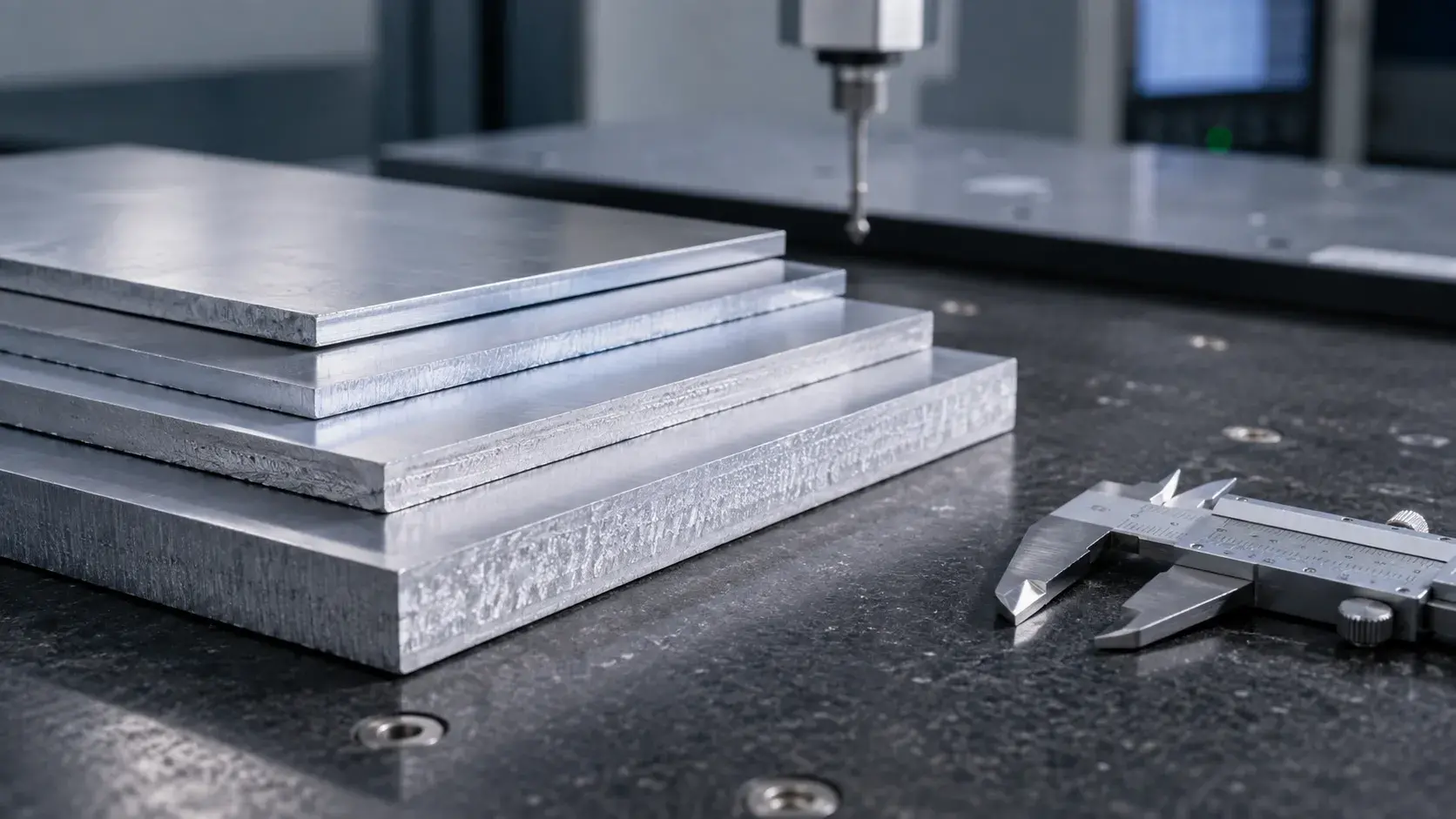
There is no single maximum thickness for laser cutting aluminum.
Cutting capacity depends on several factors:
- laser power;
- machine design;
- aluminum alloy;
- sheet thickness;
- assist gas;
- cutting speed;
- required edge quality.
Thin sheet is generally easier to cut and allows higher cutting speeds. As the material becomes thicker, more laser power is required and the process window becomes narrower.
For thicker aluminum, problems such as incomplete penetration, rough edges, and dross become more likely if the settings are not well controlled.
This is why the maximum thickness listed by a machine manufacturer should be treated as a capability limit, not necessarily the thickness that gives the best production quality.
If a project requires thick aluminum plate with very tight tolerances or precision features, laser cutting may be used only for rough profiling before CNC machining.
Which Aluminum Alloys Can Be Laser Cut?
Many common aluminum alloys can be laser cut successfully.
Typical examples include:
- 1050;
- 5052;
- 5754;
- 6061;
- 6082;
- 7075;
However, different alloys do not always cut the same way.
Alloying elements can affect thermal behavior, melting characteristics, edge quality, and burr formation. Surface condition can also make a difference, especially with highly reflective or coated material.
For this reason, the cutting parameters should be matched to the actual alloy and thickness rather than using the same setup for every grade.
What Affects Aluminum Laser Cutting Quality?
A clean cut depends on more than laser power alone.
Several process parameters work together to determine whether the edge is smooth, square, and free from excessive burrs.
Laser Power
The laser must provide enough energy to melt through the material consistently.
Too little power may cause incomplete cutting. Too much power can increase the heat-affected area and reduce edge quality.
Cutting Speed
Cutting speed must match the material thickness and laser power.
If the cutting head moves too quickly, the beam may not fully penetrate the sheet. If it moves too slowly, excessive heat can build up along the edge.
Focus Position
The position of the laser focus affects how energy is distributed through the material thickness.
An incorrect focus position can lead to:
- wider kerf;
- rough edges;
- incomplete penetration;
- increased dross.
Assist Gas
Assist gas helps remove molten aluminum from the cut.
The gas type, pressure, and nozzle condition all influence edge quality. Poor gas flow can leave more molten material attached to the lower edge.
Material Thickness and Surface Condition
Thicker material generally requires more careful parameter control.
Surface coatings, oxidation, contamination, and reflectivity can also affect how consistently the laser interacts with the sheet.
How to Reduce Burrs and Poor Cut Edges
Burrs are one of the most common problems in aluminum laser cutting.
They usually form when molten material is not removed cleanly from the bottom of the cut. The cause is often a combination of incorrect speed, power, focus, gas pressure, or nozzle condition.
To improve edge quality:
- match cutting speed to material thickness;
- use sufficient laser power for full penetration;
- check and adjust the focus position;
- maintain stable assist gas pressure;
- keep the nozzle clean and properly aligned;
- make sure the sheet surface is free from heavy contamination.
A small amount of burr may be acceptable for general fabrication, but precision parts often require secondary deburring or machining.
If the edge will become a final mating surface, datum, or precision feature, laser cutting alone may not provide the required finish.
What Tolerances Can Aluminum Laser Cutting Achieve?
Aluminum laser cutting tolerance depends on the machine, material thickness, part size, geometry, and process settings.
Laser cutting can produce accurate 2D profiles, especially on thin and medium sheet. However, tolerance should not be treated as one fixed number for every part.
Features that can affect accuracy include:
- long cut paths;
- very small holes;
- narrow slots;
- sharp internal corners;
- thick material;
- heat buildup;
- part movement after cutting.
Laser cutting is usually well suited to general sheet metal profiles, but tighter dimensional requirements may need secondary CNC machining.
For example, a laser can quickly produce the outside profile of an aluminum bracket, while CNC milling can later finish precision holes, pockets, threads, or datum surfaces.
How Much Does Aluminum Laser Cutting Cost?
The cost of aluminum laser cutting can vary significantly, but small custom sheet metal orders often start at around $100 once setup, material, and machine time are included. For production quantities, the cost per part can drop substantially as setup and programming costs are spread across more pieces.
For simple aluminum sheet parts, a small bracket or flat plate may cost only a few dollars per piece in volume production, while low-volume prototypes can cost $20–$100+ per part depending on size, thickness, and geometry. Large plates, thick material, or parts with many holes and piercings can cost considerably more.
The biggest factors affecting price are:
- aluminum alloy and sheet thickness;
- total cutting length;
- number of piercings and small holes;
- part size and geometry;
- production quantity;
- sheet nesting efficiency;
- deburring or secondary finishing;
- inspection requirements.
Material utilization also matters. Suppliers usually nest multiple parts onto one aluminum sheet to reduce scrap, and better nesting can noticeably lower the material cost per part. Some online laser-cutting suppliers specifically use fully nested pricing and volume discounts for this reason.
As a rough purchasing reference, you might see:
| Order Type | Typical Cost Range |
|---|---|
| Simple small prototype part | $20–$100+ each |
| Small sheet-metal order | Around $100+ total |
| Medium-volume simple parts | Often a few dollars to tens of dollars each |
| Thick or complex aluminum parts | $50–$200+ each depending on size and cutting time |
These are only general market ranges, not fixed prices. The most reliable quote still requires a DXF, STEP, or drawing together with material grade, thickness, quantity, and tolerance requirements.
Aluminum Laser Cutting vs CNC Milling
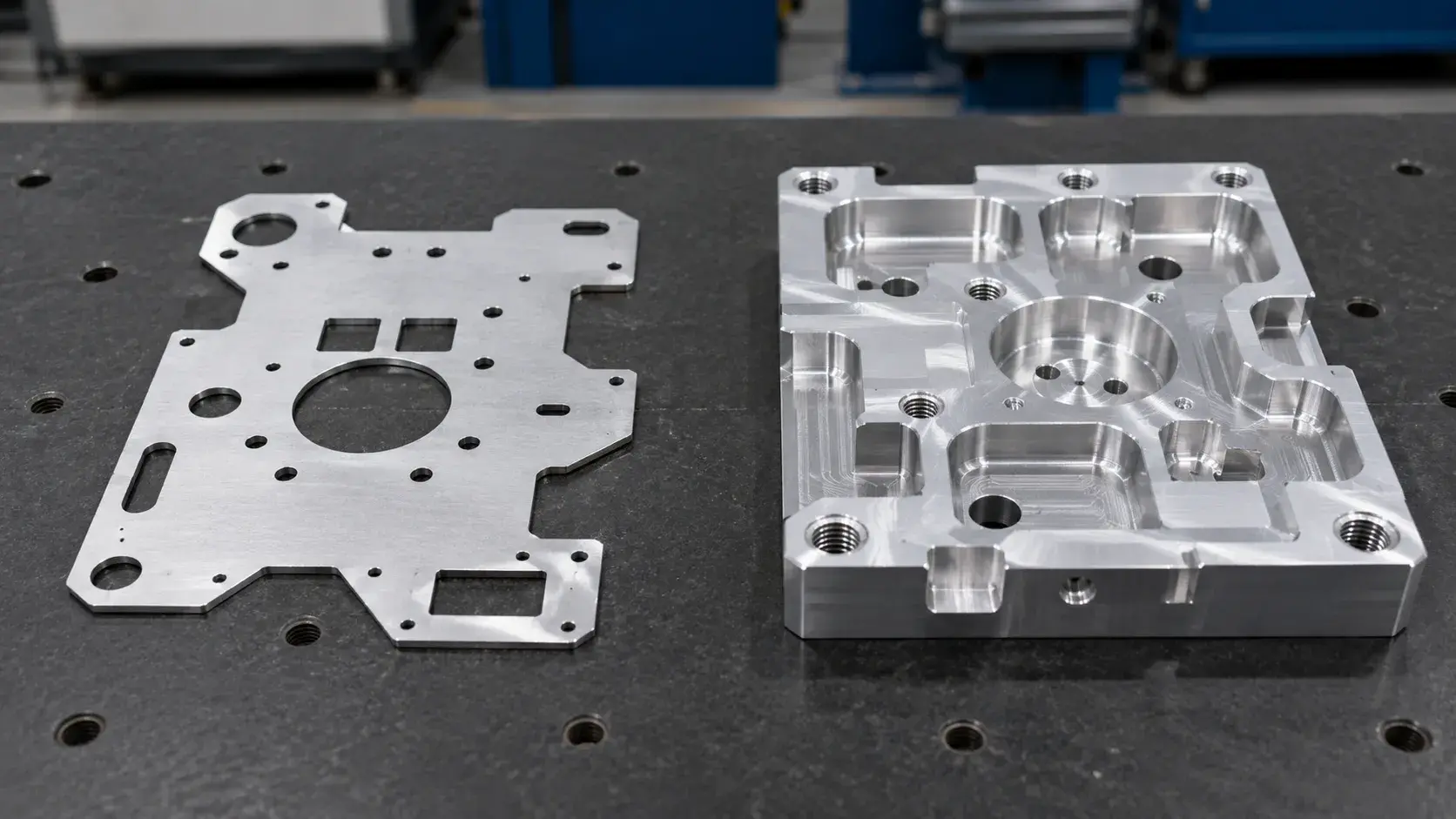
Laser cutting and CNC milling are both useful for aluminum, but they solve different manufacturing problems.
| Requirement | Laser Cutting | CNC Milling |
|---|---|---|
| Flat 2D profiles | Excellent | Good |
| Thin sheet production | Excellent | Less efficient |
| Complex outer contours | Excellent | Excellent |
| Deep pockets | Not suitable | Excellent |
| Threads | Not suitable | Excellent |
| 3D surfaces | Not suitable | Excellent |
| Tight precision features | Limited | Better |
| Fast sheet cutting | Excellent | Slower |
| Tool contact with part | No | Yes |
When Laser Cutting Makes More Sense
Laser cutting is usually the better choice when the part is mostly flat and only needs external profiles, holes, slots, or cutouts.
It is especially efficient for sheet metal production because many parts can be nested on one sheet and cut quickly without dedicated tooling.
When CNC Milling Makes More Sense
CNC milling is more suitable when the part requires:
- pockets;
- threads;
- counterbores;
- precise hole locations;
- tight dimensional tolerances;
- flat datum surfaces;
- 3D contours.
For many aluminum components, the most efficient process is not choosing one method over the other, but combining both.
When Is CNC Machining Needed After Laser Cutting?
Laser cutting is often used as an initial profiling step.
After the basic shape is cut, CNC machining may be used to finish features that require higher precision or more complex geometry.
Typical secondary machining features include:
- precision holes;
- tapped threads;
- pockets;
- slots with tight width tolerance;
- chamfers;
- sealing surfaces;
- mounting faces;
- critical datums.
For example, an aluminum plate can first be laser cut close to its final outline. The part can then be CNC milled to finish important dimensions and functional features.
This approach can reduce machining time when a large amount of material would otherwise need to be removed from a full plate.
Conclusion
Laser cutting aluminum is an efficient way to produce flat profiles, holes, slots, and other 2D features from aluminum sheet.
The best results depend on the right combination of laser type, power, cutting speed, focus, assist gas, alloy, and material thickness.
For simple sheet metal parts, laser cutting may be enough. When tighter tolerances, threads, pockets, or complex 3D features are required, CNC machining can be used as a secondary process to bring the part to its final dimensions.
Need Precision Aluminum Parts?
YUANYI provides custom CNC machining for aluminum parts that require tight tolerances, complex features, and reliable surface quality.
Send us your drawing and requirements for a fast engineering review and quote.



