

Black anodizing and black paint can both give aluminum parts a black finish, but they work in very different ways.
Black anodizing converts the aluminum surface into a protective aluminum oxide layer and then colors it black. Paint adds a separate coating on top of the metal. Because the anodized layer grows from the aluminum itself, it does not chip or peel like a conventional paint film.
For precision aluminum parts, black anodizing is usually the better choice when wear resistance, dimensional control, and a metallic appearance matter. Paint is often more practical when you need more color and gloss options, easier repair, or a finish for materials other than aluminum.
Black Anodizing vs Paint: Quick Comparison
| Feature | Black Anodizing | Black Paint |
|---|---|---|
| How the finish forms | Converts the aluminum surface into aluminum oxide | Adds a separate coating over the surface |
| Suitable materials | Mainly aluminum and certain other anodizable metals | Aluminum, steel, plastics, composites, and many other materials |
| Wear resistance | Generally better | Depends heavily on the paint system |
| Peeling | Does not peel like conventional paint | Can chip or peel if adhesion is lost |
| Dimensional impact | Relatively controlled, but coating thickness still matters | Full coating builds on top of the part |
| Metallic appearance | Retained | Usually covered |
| Color and gloss options | More limited | Very flexible |
| Local repair | Difficult to match | Usually easier |
| Precision CNC parts | Often preferred | Requires more attention to coating buildup |
| Typical reason to choose | Durability and precision | Appearance flexibility and repairability |
Neither finish is automatically better for every part. The right choice depends on the material, required appearance, tolerance, wear conditions, environment, and cost of the finished component.
What Is Black Anodizing?
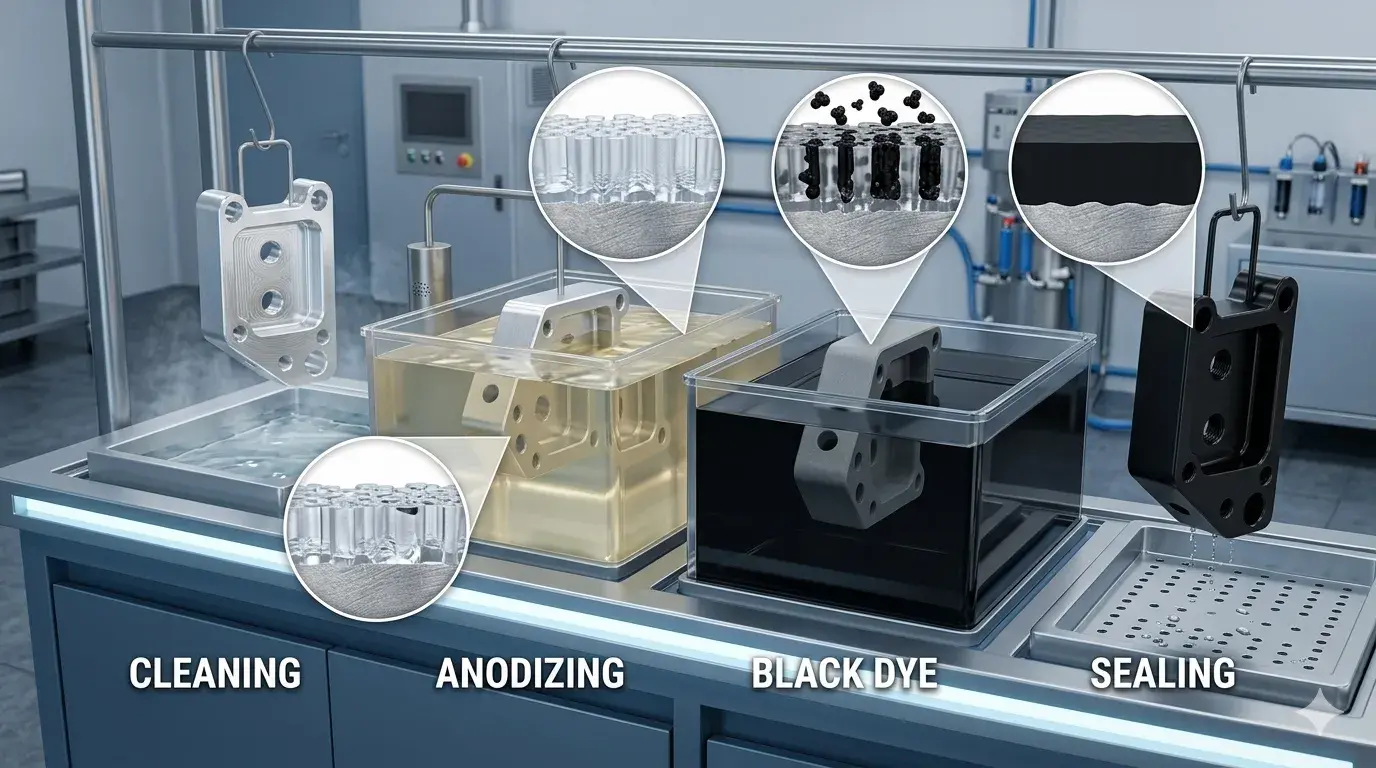
Black anodizing is an electrochemical surface treatment most commonly used on aluminum.
During anodizing, the aluminum part acts as the anode in an electrolytic bath. Controlled oxidation converts the surface into a porous aluminum oxide layer rather than depositing a completely separate film on top of it.
For a typical dyed black finish, the basic process is:
- Clean and prepare the aluminum
- Anodize the surface
- Introduce black coloring into the porous oxide
- Seal the pores
The Aluminum Anodizers Council notes that sealing helps close the pores and improves resistance to staining, abrasion, and color degradation.
This is different from simply spraying black material onto aluminum. The oxide structure originates from the aluminum substrate itself.
That difference is the main reason anodized surfaces do not normally flake or peel in the same way as paint.
Is black anodizing always dyed black?
Not necessarily.
Black anodized finishes can be produced using different coloring methods. Organic or inorganic dyes may be absorbed into the porous oxide, while some processes use electrolytically deposited metals to create darker bronze-to-black colors.
The exact process should therefore be specified when color consistency, outdoor exposure, or appearance is important.
What Is Black Paint on Aluminum?
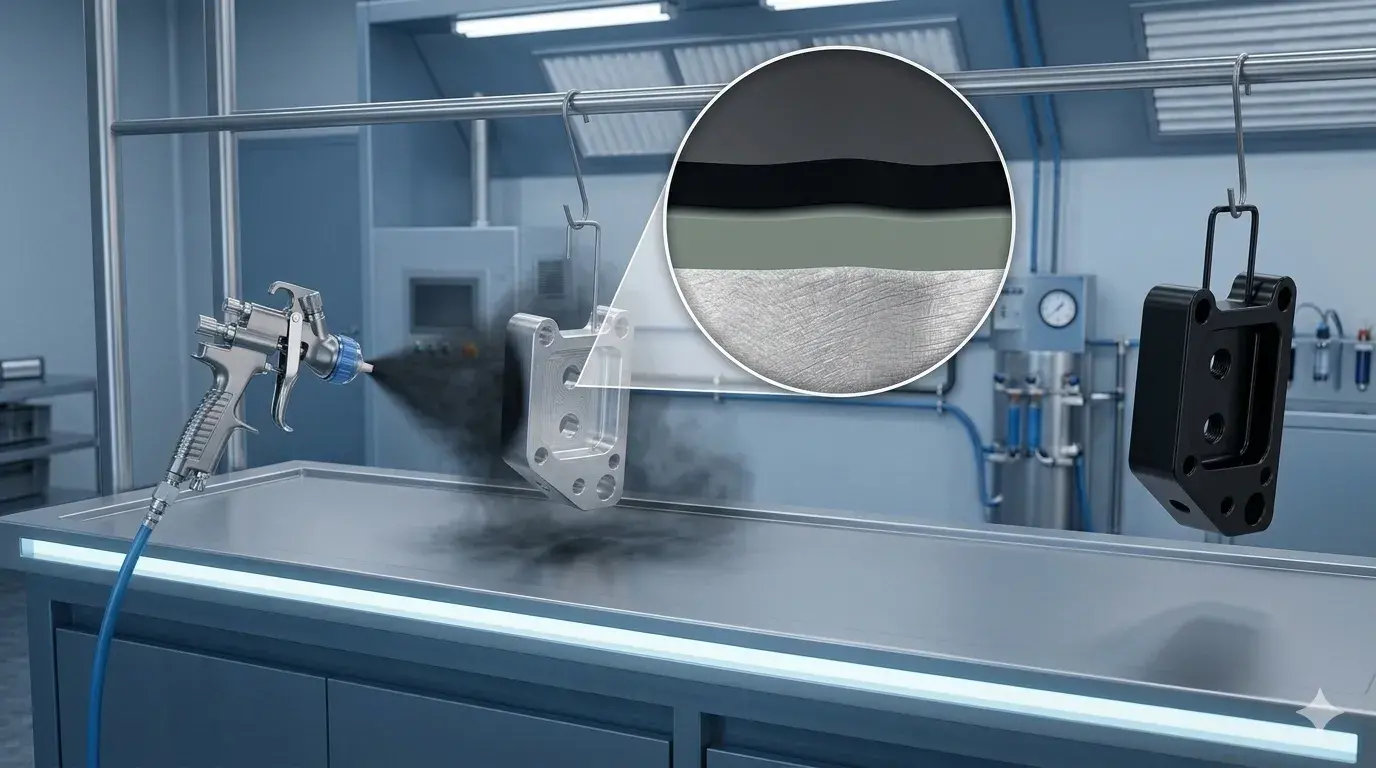
Black paint creates a separate protective and decorative film over the aluminum.
Depending on the application, this may include liquid industrial paint, epoxy, polyurethane, enamel, or another coating system. Surface preparation is normally required so the coating adheres properly to the aluminum.
Unlike anodizing, paint does not convert the aluminum itself.
This gives paint an important advantage: it is much less limited by the base material and can offer a much wider range of colors, gloss levels, and textures.
Paint is often useful when a part needs:
- a specific brand color;
- a high-gloss appearance;
- a textured finish;
- easy cosmetic repair;
- coating on aluminum together with other materials;
- a finish that completely hides the underlying metal.
What does “black anodized paint” mean?
“Black anodized paint” is sometimes used informally to describe black paint designed to imitate the appearance of anodized aluminum.
It is not the same thing as true black anodizing.
If a drawing or purchase specification uses this term, it is worth confirming whether the requirement is an actual anodic coating or simply an anodized-look paint finish before production starts.
Which Is More Durable: Black Anodizing or Paint?
For aluminum parts exposed to repeated handling or abrasion, black anodizing generally provides better surface durability than ordinary paint.
Anodizing creates aluminum oxide, which is harder than the underlying aluminum. Because this oxide is integrated with the substrate, normal wear cannot cause it to peel away as a separate film.
Paint durability varies much more.
A properly prepared industrial coating can perform very well, but once the film is cut through, chipped, or loses adhesion, damage can spread around the exposed area.
This difference becomes important on parts such as:
- machine controls;
- camera components;
- tool bodies;
- brackets;
- fixtures;
- frequently handled housings;
- mechanical assemblies.
However, anodizing is not scratch-proof.
A hard object can still scratch through the anodic coating, particularly on decorative Type II finishes. The difference is that a scratch usually remains localized rather than causing the surrounding finish to peel.
Which Gives Better Corrosion Protection?
Both black anodizing and paint can protect aluminum from corrosion, but neither should be judged only by its color.
For anodizing, corrosion performance depends on the alloy, coating thickness, sealing quality, anodizing process, and service environment.
For paint, performance depends on surface pretreatment, primer, coating chemistry, dry-film thickness, application quality, and whether the coating remains intact.
This means statements such as “anodizing lasts 1,000 hours” or “paint lasts 500 hours” are not useful without specifying the actual process and test conditions.
For engineering parts, corrosion requirements are better defined through the required coating specification and test standard rather than a general marketing claim.
How Thick Is Black Anodizing?
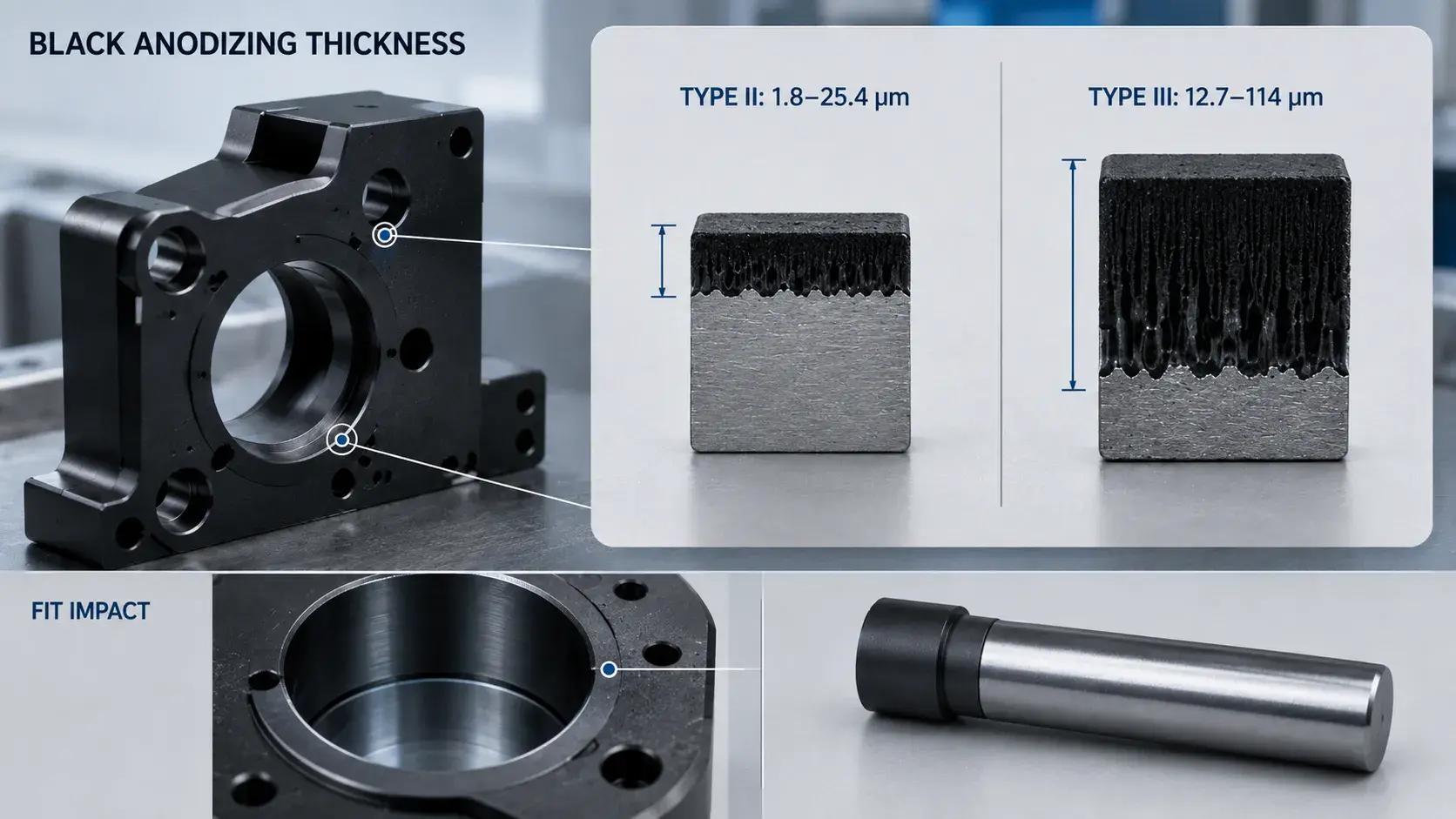
Anodizing thickness varies considerably depending on the process.
MIL-PRF-8625F Amendment 2, an active U.S. specification for anodic coatings on aluminum, lists broad coating-thickness ranges of:
- Type II: 0.00007–0.0010 in, approximately 1.8–25.4 μm
- Type III: 0.0005–0.0045 in, approximately 12.7–114 μm
These are allowable specification ranges, not recommended target thicknesses for every CNC part. The required thickness should be defined according to the application and preferably called out on the engineering drawing.
The Aluminum Anodizers Council also emphasizes that anodic coating thickness should be selected according to the intended service conditions rather than using one thickness for every product.
For a precision component, this matters because even a few microns can affect a close fit.
Does Anodizing Change CNC Part Dimensions?
Yes.
This is one of the most important differences to consider when specifying black anodizing for precision CNC parts.
The anodic layer does not grow entirely outward from the original surface. Part of the aluminum is converted into oxide and part of the resulting coating grows above the original surface.
For Type III hard anodizing, NASA’s PRC-5006 process specification states that a typical anodic coating consists of roughly half penetration into the original aluminum and half outward growth.
As a simplified example, if a process produces a 50 μm Type III coating, the surface may grow outward by roughly 25 μm.
That is only a design approximation. Actual growth depends on the alloy and anodizing process, so critical dimensions should be agreed with the anodizer rather than calculated from a general rule.
Which CNC features need special attention?
Coating buildup matters most around:
- precision bores;
- bearing seats;
- shaft fits;
- locating diameters;
- threads;
- sealing surfaces;
- sliding fits;
- electrical contact areas.
These areas may need masking, pre-anodize dimensional compensation, or post-finish machining depending on the drawing requirements.
Type III hard anodizing deserves particular attention because its coating is much thicker than normal decorative anodizing. NASA specifically warns that Type III anodizing can have a significant effect on design dimensions.
Does Paint Change Part Dimensions?
Yes, and the dimensional effect works differently.
Paint is deposited on top of the original surface, so its dry-film thickness contributes directly to coating buildup.
For decorative covers and non-critical exterior surfaces, that may have little practical effect.
For a precision hole or mating surface, however, coating on both sides of a feature can reduce clearance enough to cause assembly problems.
This is why painting a precision CNC component should not simply be treated as the final cosmetic step.
The finishing process needs to be considered during part design and machining.
Which Finish Looks Better?
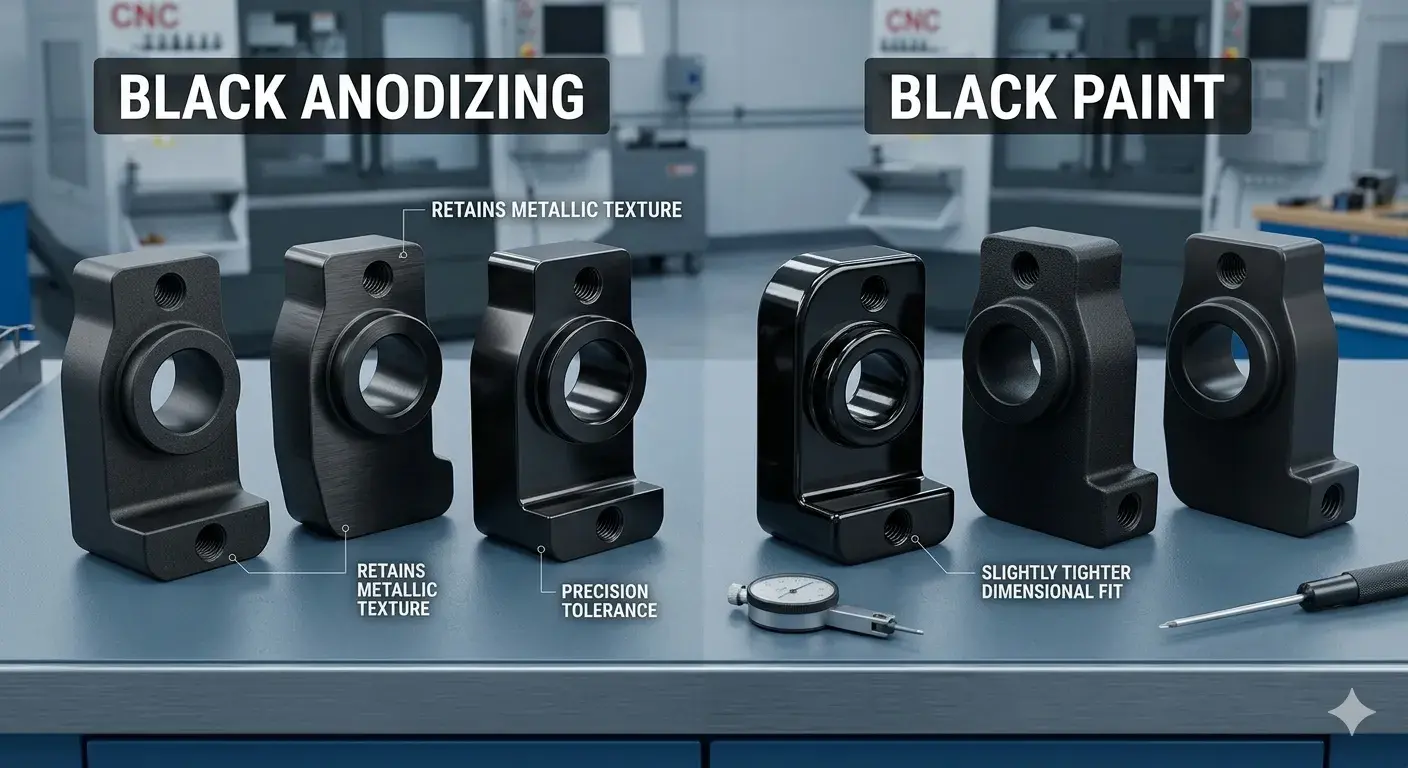
This depends on what appearance you want.
Black anodizing usually retains more of the metallic character of aluminum. Machining patterns, brushing, polishing, or bead blasting can still influence the final appearance.
A bead-blasted aluminum part, for example, normally produces a softer matte appearance after black anodizing than a smooth-machined surface.
Paint covers the underlying surface more completely and gives the designer greater control over:
- gloss;
- texture;
- exact color;
- visual uniformity;
- decorative effects.
If you want a part to still look and feel like metal, anodizing is usually the better fit.
If you want a very specific cosmetic appearance, paint gives you more options.
Why Can Black Anodized Parts Have Slight Color Differences?
Black anodizing is affected by more than the black dye itself.
According to the Aluminum Anodizers Council, anodized appearance can vary with factors such as the aluminum alloy, temper, gloss, surface structure, and coloring process. For appearance-critical projects, an acceptable color range should be agreed between the customer and anodizer.
This matters when several CNC parts are assembled into one visible product.
For better color consistency, try to keep the following consistent:
- aluminum alloy;
- material temper where possible;
- surface preparation;
- bead-blast or machining finish;
- anodizing specification;
- anodizing batch.
For example, using 6061 for one housing panel and a different aluminum alloy for an adjacent cosmetic panel can make exact black matching more difficult even when both parts receive the same nominal finish.
For high-visibility assemblies, physical finish samples are often more useful than specifying only the word “black.”
Is Paint Easier to Repair Than Black Anodizing?
Yes.
This is one area where paint has a clear practical advantage.
If a painted part is scratched or chipped, the damaged area can often be prepared and touched up. A complete repaint is also relatively straightforward when appearance must be restored.
Localized anodizing repair is more difficult.
Because anodizing is an electrochemical conversion process, you cannot simply brush new anodizing onto a scratch and expect it to match the surrounding finish.
Small marks can sometimes be cosmetically concealed, but a repaired area may remain visible.
For products expected to receive repeated field repairs, paint can therefore be the more convenient choice.
Which Costs More: Black Anodizing or Paint?
There is no reliable universal price difference.
Cost depends on the actual part and finishing specification rather than the word “anodized” or “painted.”
Important cost factors include:
- part dimensions;
- batch quantity;
- aluminum alloy;
- surface preparation;
- anodizing or paint specification;
- coating thickness;
- masking requirements;
- cosmetic requirements;
- inspection and testing;
- packaging requirements.
A simple painted component may have a lower initial finishing cost.
However, for aluminum parts that need good abrasion resistance and long-term appearance, anodizing may reduce the risk of chipped coating and later touch-up.
For production quoting, it is better to send the supplier the CAD model or drawing together with the material, quantity, finish specification, masking areas, and cosmetic requirements.
Black Anodizing or Paint: Which Is Better for CNC Parts?
For most precision CNC machined aluminum components, black anodizing is usually the first option to consider.
It works particularly well when the part needs a combination of:
- a black metallic appearance;
- wear resistance;
- corrosion protection;
- relatively small coating buildup;
- long-term surface stability.
Paint becomes more attractive when appearance flexibility or material compatibility matters more than wear resistance.
A useful way to decide is:
| Part Requirement | Better Starting Choice |
|---|---|
| Tight-tolerance aluminum component | Black anodizing |
| Frequently handled aluminum housing | Black anodizing |
| Wear-resistant machine component | Hard anodizing |
| Metallic black appearance | Black anodizing |
| Exact custom color | Paint |
| High-gloss finish | Paint |
| Easy field touch-up | Paint |
| Steel or mixed-material assembly | Paint |
| Large decorative component | Paint may be more practical |
| Precision aluminum housing with many fits | Anodizing, with masking planned |
This is only a starting point. Critical dimensions, corrosion environment, cosmetic standards, and expected wear should still be considered before the finish is specified.
Type II vs Type III Black Anodizing: Which Should You Choose?
For CNC aluminum parts, the two anodizing types you will most often encounter are Type II sulfuric acid anodizing and Type III hard anodizing.
MIL-PRF-8625 identifies Type II as conventional sulfuric acid anodizing and Type III as hard anodic coating.
Their intended use is different.
| Feature | Type II Anodizing | Type III Hard Anodizing |
|---|---|---|
| Main purpose | Decorative finish and general protection | Higher wear resistance |
| Coating | Generally thinner | Generally thicker |
| Dimensional effect | Smaller | More important to control |
| Black cosmetic finish | Common | Possible, but appearance may be less predictable |
| Typical parts | Housings, brackets, panels, consumer components | Wear surfaces, machine parts, mechanical components |
For a black CNC housing where appearance is important, Type II black anodizing is often the more practical choice.
For a component exposed to higher abrasion or mechanical wear, Type III may be preferable.
Do not choose Type III simply because “harder must be better.” The thicker coating can create more dimensional and cosmetic challenges.
What About Black Powder Coating?
Powder coating is another common option for black aluminum parts and should not be confused with ordinary liquid paint.
Powder is electrostatically applied and then cured to form a continuous coating. It can provide a durable finish with a wide range of colors, textures, and gloss levels.
Compared with anodizing, however, powder coating creates a separate film over the metal and normally produces more coating buildup.
That makes it particularly useful for:
- large housings;
- outdoor enclosures;
- frames;
- panels;
- products requiring a specific texture;
- parts where exact metallic appearance is not required.
For very tight CNC fits and small precision features, anodizing is usually easier to manage.
For larger cosmetic parts, powder coating may be a better alternative to both liquid paint and anodizing.
When Should You Choose Black Anodizing?
Choose black anodizing when:
- the part is made from a suitable aluminum alloy;
- you want the surface to retain a metallic appearance;
- the component will be handled frequently;
- wear resistance matters;
- peeling or chipping would be unacceptable;
- the part contains precision CNC features;
- coating buildup needs to remain relatively controlled.
Common examples include CNC housings, optical components, aerospace brackets, robotics components, fixtures, electronic enclosures, and precision mechanical parts.
If wear is especially severe, consider whether Type III hard anodizing is necessary rather than automatically specifying ordinary black Type II.
When Should You Choose Black Paint?
Choose paint when:
- you need a specific color or gloss;
- the component is not made from aluminum;
- several different materials need the same appearance;
- the surface may need future touch-up;
- the part is primarily cosmetic;
- you want to hide the metallic appearance;
- coating thickness will not interfere with critical fits.
Paint can also make more sense when the product design changes frequently and the finish needs to be easily refinished or recolored.
Conclusion
Black anodizing and black paint may look similar, but they solve different problems.
Choose black anodizing when you need a durable black finish on precision aluminum parts, especially where wear resistance, metallic appearance, and dimensional control matter. Choose paint when color flexibility, material compatibility, high-gloss appearance, or easy repair is more important.
For CNC machined parts, the finish should be considered before machining is complete. Coating thickness, masking, threads, bearing fits, sealing surfaces, and cosmetic requirements can all affect the final dimensions and appearance of the part.
Need the Right Black Finish for Your CNC Parts?
Not sure whether black anodizing, paint, or powder coating is the better choice for your part? Send us your drawing, material, quantity, tolerance, and finish requirements. Our team can review the part and recommend a suitable surface treatment before production.
Frequently Asked Questions
True anodizing does not peel in the same way as paint because the aluminum oxide originates from the aluminum substrate instead of being applied as a separate film. It can still scratch, crack, or wear through under severe conditions.
Yes. Anodizing improves surface hardness and wear resistance, but it does not make aluminum impossible to scratch.
A deep scratch may penetrate through the black anodic layer and expose the lighter aluminum underneath, making the damage visually noticeable.
It can.
Color stability depends on the coloring method, dye quality, anodic coating thickness, sealing, UV exposure, and environment. The Aluminum Anodizers Council notes that some organic dyes have limited lightfastness, while certain inorganic or electrolytic colors can offer better color stability.
If the part will remain outdoors for years, specify the expected environment instead of simply requesting “black anodize.”
Steel is not normally anodized using the same process used for aluminum.
Common black finishes for steel include black oxide, painting, powder coating, phosphate coating, PVD, and other conversion or surface treatments depending on the application.
Yes, anodized aluminum can be painted when the surface is prepared correctly.
In fact, some anodizing processes are intentionally used as a base for subsequent paint systems. The exact preparation depends on the anodizing condition and the paint specification.
It is better to describe anodizing as corrosion-resistant rather than “waterproof.”
A properly sealed anodic coating helps protect aluminum in wet environments, but performance still depends on the coating specification, sealing, alloy, exposure conditions, and part design.
No.
Hard anodizing can naturally produce gray, dark gray, bronze, brown, or very dark finishes depending on the alloy, coating thickness, and process. A specific black appearance should therefore be defined rather than assuming every hard-anodized part will come out the same black.



