

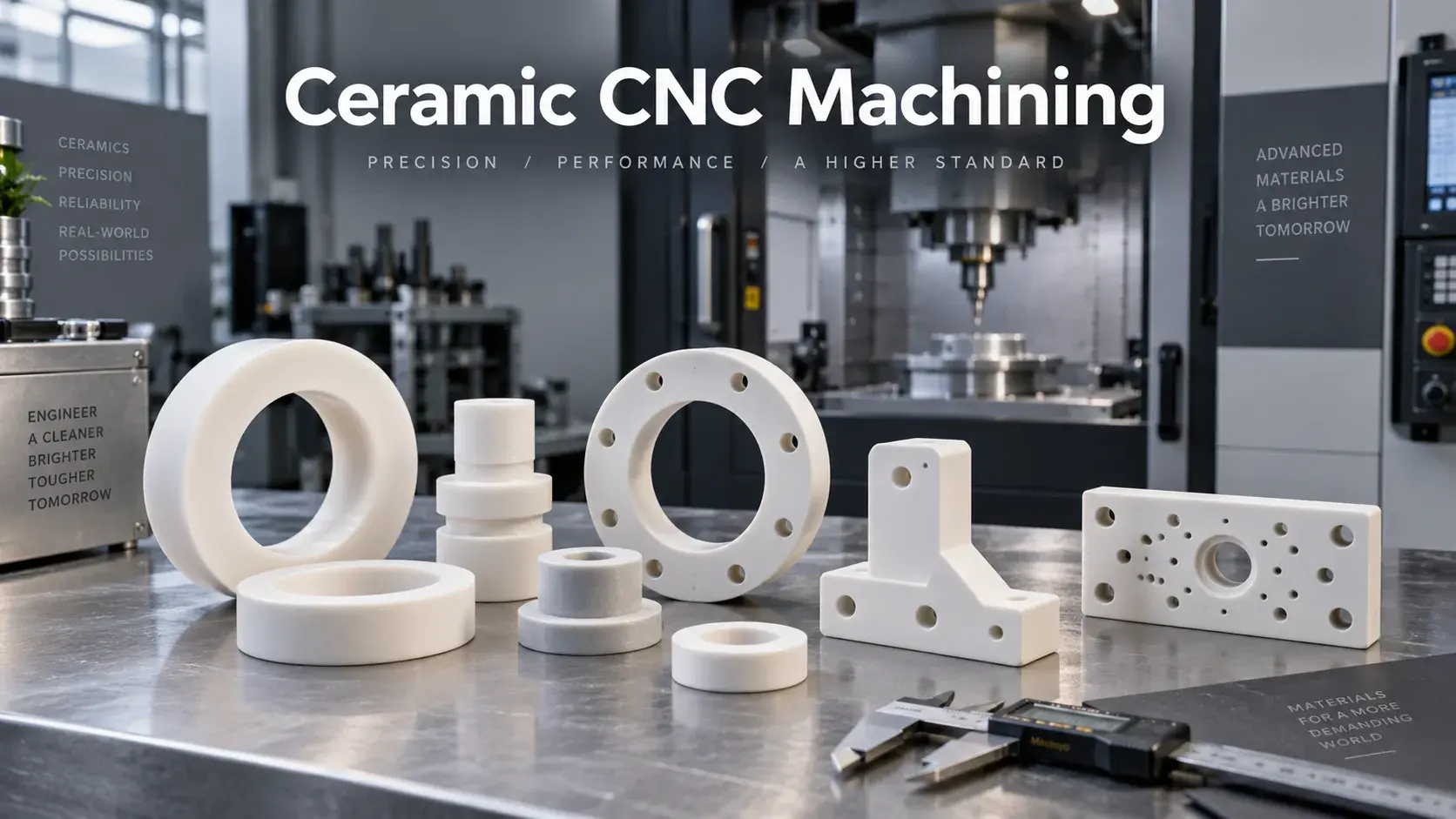
Ceramics offer excellent wear resistance, electrical insulation, chemical stability, and high-temperature performance, but they are also much harder and more brittle than common metals.
The key to ceramic CNC machining is choosing the right machining stage. Green ceramics are easier to mill and drill before sintering, while fully sintered ceramics such as alumina, zirconia, and silicon carbide usually require diamond grinding or other abrasive processes.
For engineers and buyers, the wrong process can increase tool wear, chipping, scrap risk, and machining cost.
This guide explains which ceramics can be machined, how green and sintered machining differ, what tolerances are realistic, and how to design ceramic parts for better manufacturability.
What Is Ceramic CNC Machining?
Ceramic CNC machining is the controlled machining of technical ceramic materials using CNC equipment and precision finishing processes.
Depending on the material and its state, ceramic machining may include:
- CNC milling
- drilling
- turning
- diamond grinding
- lapping
- polishing
- ultrasonic-assisted machining
Unlike aluminum or steel, ceramics are generally hard, brittle, and resistant to plastic deformation.
This means machining forces must be carefully controlled to reduce cracking, edge chipping, and subsurface damage.
The term “ceramic CNC machining” therefore covers several different manufacturing routes rather than one single machining process.
Can Ceramics Be CNC Machined?
Yes, ceramics can be CNC machined, but the correct process depends strongly on whether the ceramic is green, partially sintered, fully sintered, or specifically designed to be machinable.
Some ceramics can be cut using conventional carbide or diamond tooling in a relatively similar way to engineering plastics or soft metals.
Others become so hard after sintering that material removal is mainly performed by diamond grinding rather than traditional milling.
This is why ceramic machining should always begin with three questions:
- What ceramic material is being used?
- What state is the material in?
- Which features require final precision after sintering?
These decisions affect cost, dimensional accuracy, tool wear, and fracture risk.
Green vs Bisque vs Fully Sintered Ceramic Machining
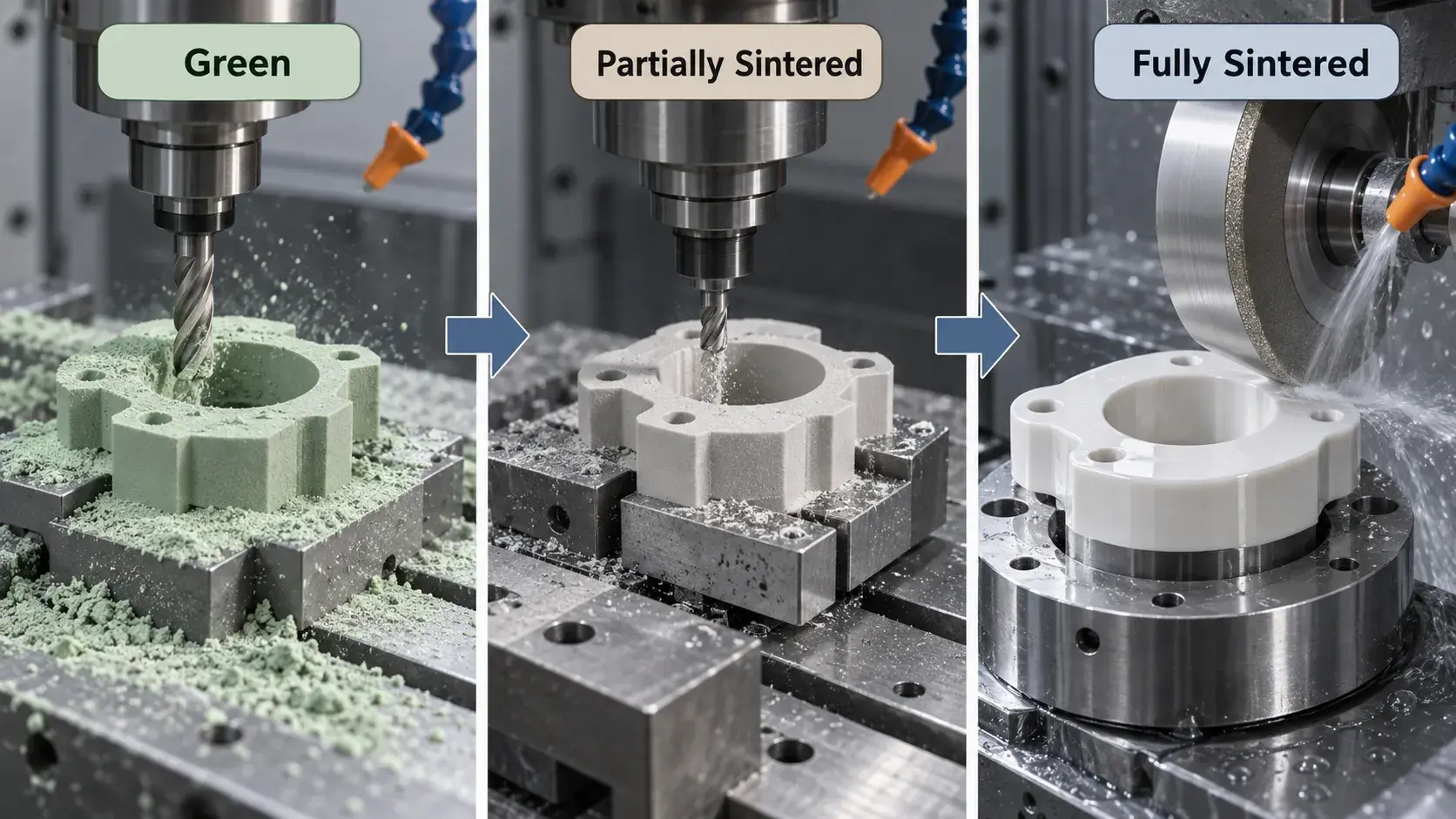
The stage at which the ceramic is machined has a major impact on manufacturability.
| Ceramic State | Machinability | Typical Process | Main Consideration |
|---|---|---|---|
| Green | Relatively easy | Milling, drilling, turning | Must compensate for sintering shrinkage |
| Bisque / Partially Sintered | Moderate | CNC machining, grinding | More stable than green ceramic |
| Fully Sintered | Difficult | Diamond grinding, lapping, polishing | High hardness and brittleness |
| Machinable Ceramic | Relatively easy | Conventional CNC machining | Limited to specific ceramic grades |
Green Machining
Green ceramic is shaped before final sintering.
At this stage, the material is softer and easier to machine.
Features such as:
- holes
- pockets
- slots
- contours
- threads in some materials
can often be produced more efficiently before full densification.
The main challenge is shrinkage.
During sintering, the part contracts as the ceramic densifies. The amount of shrinkage depends on the ceramic composition and manufacturing process.
This means dimensions created during green machining must be intentionally oversized and compensated for expected shrinkage.
Green machining is often cost-effective when a part contains significant material removal or complex geometry.
Bisque or Partially Sintered Machining
Partially sintered ceramics are stronger and more dimensionally stable than green parts while remaining easier to machine than fully sintered ceramics.
This stage can provide a useful balance between:
- machinability
- handling strength
- dimensional stability
It may be selected for parts that are too fragile to handle reliably in the green state but would be too difficult or expensive to machine after full sintering.
Fully Sintered Machining
After full sintering, technical ceramics can become extremely hard.
At this stage, conventional cutting tools may no longer be practical.
Processes such as:
- diamond grinding
- ID and OD grinding
- surface grinding
- lapping
- polishing
are commonly used for final precision features.
Fully sintered machining is usually reserved for:
- tight-tolerance dimensions
- critical bores
- precision flatness
- parallel surfaces
- sealing surfaces
- final surface finish requirements
Because material removal is slower and tooling is more expensive, fully sintered machining can significantly increase part cost.
Which Ceramic Materials Can Be CNC Machined?
Different ceramics have very different properties and machining behavior.
| Ceramic Material | Key Properties | Typical Machining Route | Relative Difficulty |
|---|---|---|---|
| Alumina | Wear resistance, electrical insulation, chemical resistance | Green machining + diamond grinding | High |
| Zirconia | High toughness for a ceramic, wear resistance | Pre-sinter machining + grinding | High |
| Silicon Carbide | Extreme hardness, thermal stability | Diamond grinding | Very High |
| Silicon Nitride | High strength, thermal shock resistance | Diamond grinding | Very High |
| Aluminum Nitride | High thermal conductivity, electrical insulation | Controlled grinding | High |
| MACOR | Machinable glass ceramic | Conventional CNC machining | Low |
| Boron Nitride | High-temperature insulation, low friction | Conventional machining for many grades | Low–Medium |
Alumina
Alumina is one of the most widely used technical ceramics.
It offers:
- high hardness
- good wear resistance
- electrical insulation
- chemical resistance
- high-temperature capability
However, fully sintered alumina is difficult to machine and typically requires diamond tools.
Zirconia
Zirconia is tougher than many traditional ceramics and provides excellent wear resistance.
It is used in applications such as:
- medical components
- precision wear parts
- valve components
- mechanical parts
Although tougher than alumina, it is still difficult to machine after sintering.
Silicon Carbide
Silicon carbide is extremely hard and offers excellent wear and temperature resistance.
Its hardness also makes it one of the more difficult ceramics to machine.
Diamond grinding is generally required for precision finishing.
Silicon Nitride
Silicon nitride combines strength, wear resistance, and thermal shock resistance.
It is used in demanding mechanical and high-temperature applications.
Machining fully sintered silicon nitride is difficult and usually relies on precision grinding.
Aluminum Nitride
Aluminum nitride is especially valuable where high thermal conductivity and electrical insulation are both required.
It is commonly used in electronics and semiconductor applications.
Machining must be carefully controlled because the material is brittle and can chip easily.
MACOR
MACOR is a machinable glass ceramic that can be processed using conventional CNC equipment.
Compared with fully sintered alumina or silicon carbide, it is much easier to:
- mill
- drill
- turn
- thread
This makes it useful for prototypes and low-volume precision parts.
Boron Nitride
Many boron nitride grades are relatively machinable.
The material provides:
- high-temperature performance
- electrical insulation
- low friction
Machinability still depends on the specific grade and binder system.
How Are Ceramics CNC Machined?
Ceramic machining may involve several different processes depending on material condition and geometry.
CNC Milling
CNC milling is most suitable for:
- green ceramics
- machinable ceramics
- some partially sintered materials
It can produce:
- pockets
- slots
- profiles
- planar features
- multi-sided geometries
For fully sintered technical ceramics, conventional milling is much more limited.
Drilling
Holes can be produced in green or machinable ceramics using controlled drilling processes.
For fully sintered ceramics, diamond drilling or grinding-based methods are more common.
Hole geometry should be carefully designed because deep holes and holes close to edges can increase fracture risk.
Diamond Grinding
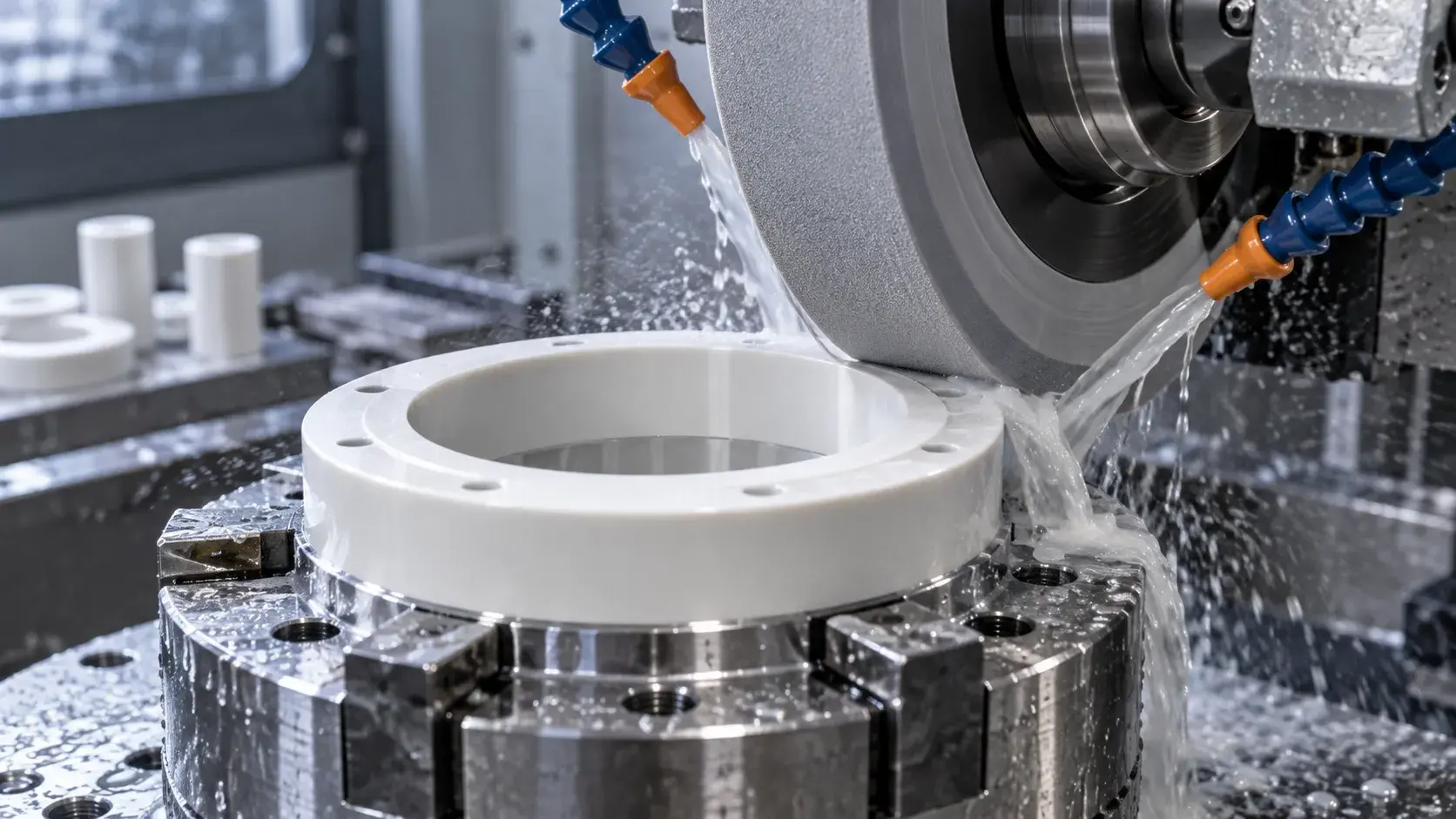
Diamond grinding is one of the most important processes for fully sintered ceramics.
It is used for:
- flat surfaces
- outside diameters
- bores
- thickness control
- precision dimensional finishing
Diamond abrasive tools are required because conventional cutting materials wear rapidly against hardened ceramics.
Lapping
Lapping is used where very high flatness and fine surface finish are required.
Typical applications include:
- seal faces
- precision mating surfaces
- optical or semiconductor components
Polishing
Polishing can further reduce surface roughness after grinding or lapping.
It is normally applied only to surfaces where the functional requirement justifies the additional cost.
Ultrasonic-Assisted Machining
Ultrasonic assistance can reduce machining forces when processing hard and brittle materials.
It may be useful for:
- small holes
- complex features
- brittle advanced ceramics
However, not every ceramic part requires this process.
What Tools Are Used for Ceramic Machining?
Tool selection depends on the ceramic material and its condition.
For machinable or green ceramics, manufacturers may use:
- carbide tools
- diamond-coated tools
- PCD tools
For fully sintered ceramics, the most important tools are usually:
- diamond grinding wheels
- diamond drills
- diamond abrasive tools
Diamond is preferred because of its extremely high hardness and wear resistance.
However, tool performance still depends on:
- grit size
- bond type
- spindle speed
- coolant
- depth of cut
- feed rate
- workpiece rigidity
There is no single cutting parameter that applies to every ceramic.
What Tolerances Can Ceramic Machining Achieve?
Ceramic machining can achieve very tight tolerances, but there is no universal tolerance that should be applied to every feature.
Tolerance capability depends on:
- ceramic material
- part size
- material state
- feature geometry
- grinding access
- inspection method
- surface finish requirement
- wall thickness
For this reason, tolerance should be specified feature by feature.
For example:
- a precision bore may require grinding
- a sealing face may require lapping
- a non-critical outer contour may allow a wider tolerance
- a locating surface may require tight flatness and parallelism
Applying tight tolerance to every dimension can increase cost significantly without improving part function.
A better design approach is to identify critical functional features and apply precision only where it is necessary.
Why Are Ceramics Difficult to Machine?
Ceramics are difficult to machine because they combine high hardness with brittle fracture behavior.
Unlike metals, ceramics do not normally deform plastically before failure.
When local tensile stress exceeds the material’s fracture resistance, cracks can form and propagate quickly.
This can cause:
- edge chipping
- micro-cracking
- corner breakage
- surface damage
- catastrophic fracture
High Hardness
Many technical ceramics are significantly harder than common steels.
This causes:
- high tool wear
- low material removal rates
- increased grinding time
Brittleness
Ceramics have low tolerance for impact and tensile stress.
Sudden cutting forces or poor fixturing can cause cracking.
Edge Chipping
Sharp corners and unsupported edges are particularly vulnerable.
Chipping can occur during:
- drilling breakthrough
- milling near edges
- grinding
- handling
Subsurface Damage
Even when the surface looks acceptable, aggressive grinding can create micro-cracks below the surface.
For high-performance parts, finishing parameters must control this damage.
Design Guidelines for CNC Machined Ceramic Parts
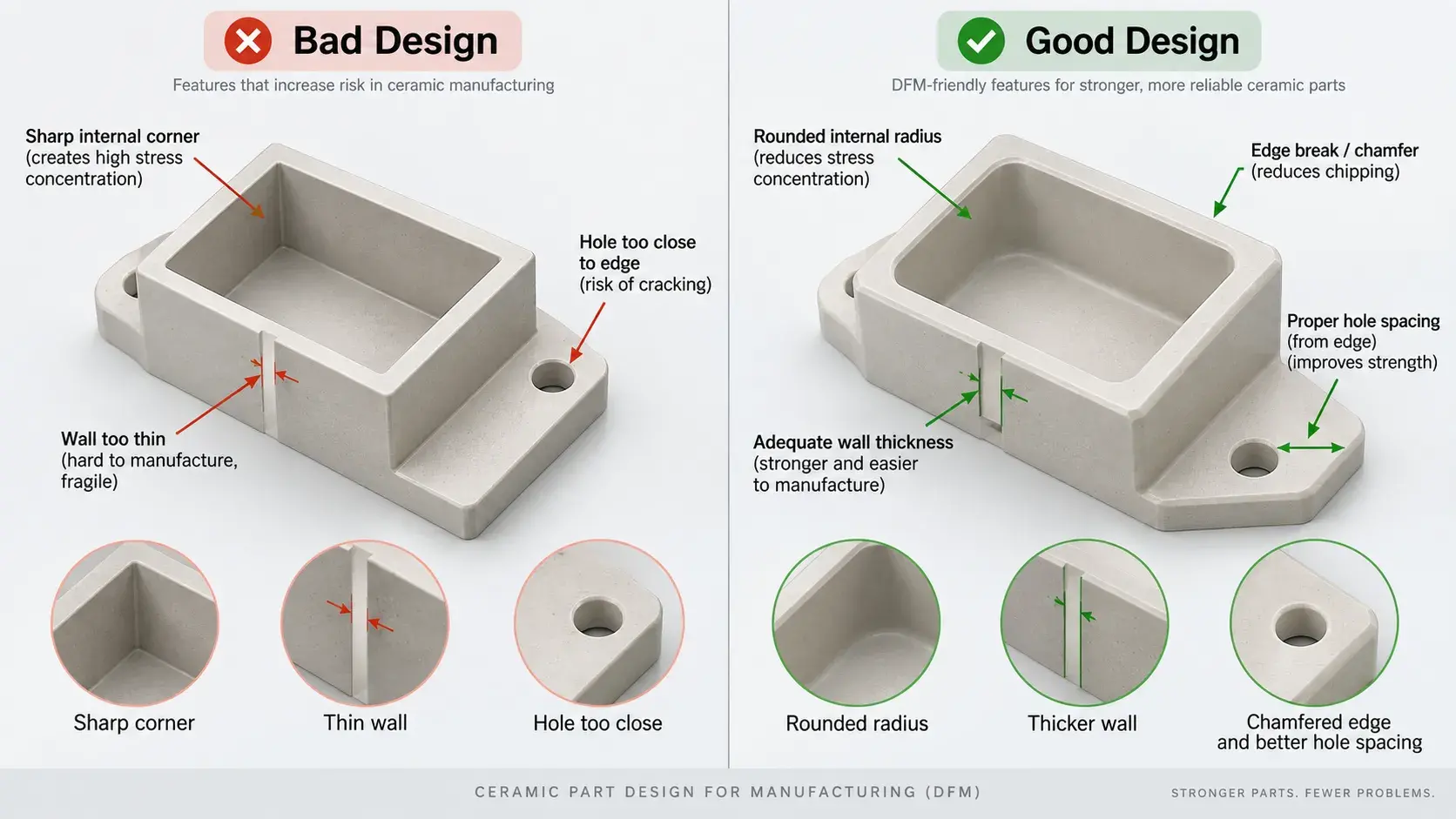
Good ceramic DFM can reduce machining cost and fracture risk significantly.
Use Radii Instead of Sharp Internal Corners
Sharp internal corners create stress concentration.
Where possible, use internal radii to reduce local stress and improve tool access.
Add Chamfers or Edge Breaks
External sharp edges are easy to chip.
Small chamfers or edge radii can improve durability during:
- machining
- inspection
- assembly
- transport
Avoid Extremely Thin Walls
Thin walls are difficult to support and can fracture during machining.
Where possible, increase wall thickness or provide additional support.
Keep Holes Away From Fragile Edges
Holes placed too close to an outside edge can weaken the surrounding ceramic.
Increasing edge distance helps reduce cracking and breakout.
Avoid Deep Narrow Features
Deep slots, deep blind holes, and narrow cavities are difficult to machine in brittle materials.
They also increase:
- tool deflection
- grinding difficulty
- inspection difficulty
- scrap risk
Provide Grinding Access
If a critical dimension will require grinding after sintering, the geometry must allow the grinding tool to reach it.
This is often overlooked during initial design.
Use Tight Tolerances Only Where Needed
Do not apply the same tight tolerance to the entire drawing.
Instead, identify:
- critical fits
- datum surfaces
- sealing faces
- precision bores
and apply strict tolerances only to those features.
This can reduce cost substantially.
Why Do Ceramics Chip During Machining?
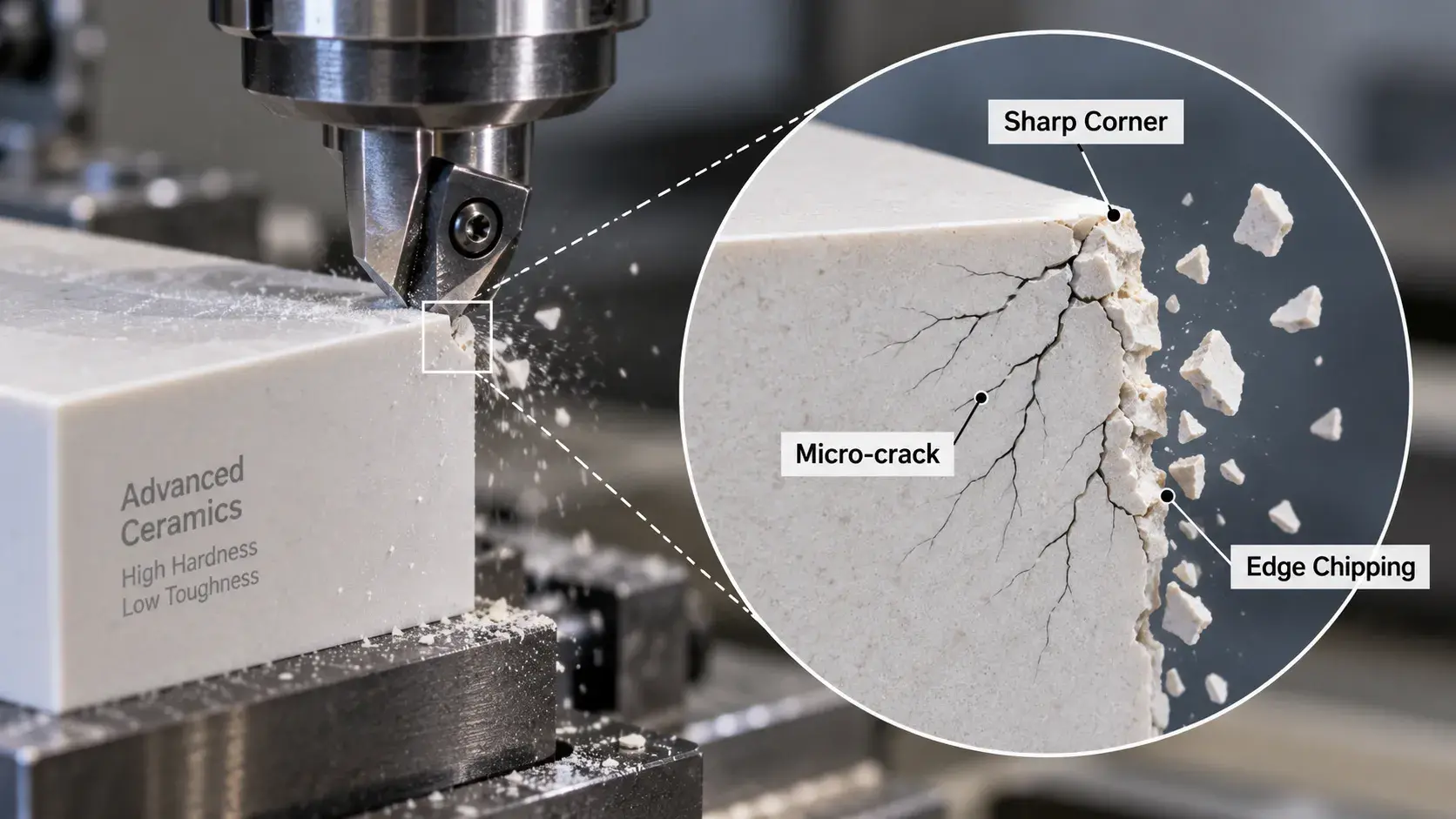
Ceramic chipping occurs because brittle materials fail differently from metals.
During machining, local stresses develop around the cutting zone.
If tensile stress becomes too high, microscopic cracks can begin at:
- sharp corners
- pores
- grain boundaries
- surface defects
These cracks can then propagate rapidly.
The result may be:
- small edge chips
- flaking
- corner fracture
- complete part breakage
Factors that increase chipping risk include:
- sharp geometry
- excessive machining force
- poor fixturing
- interrupted cutting
- thin unsupported features
- drilling breakthrough
- aggressive material removal
Reducing these stresses is one of the main goals of ceramic machining strategy.
What Drives Ceramic Machining Cost?
Ceramic machining cost is often driven more by machining risk and finishing requirements than by raw material volume alone.
Important cost factors include:
- ceramic material cost
- blank preparation
- green machining requirements
- sintering compensation
- diamond tool wear
- grinding time
- scrap risk
- part fragility
- surface finish
- lapping or polishing
- inspection
- special handling
Fully Sintered Machining Costs More
The more material that must be removed after full sintering, the higher the cost usually becomes.
This is because fully sintered ceramics require slower, abrasive finishing processes.
Whenever possible, major geometry should be created before final sintering.
Tight Tolerances Increase Cost
A tolerance that requires final grinding, lapping, or high-end inspection increases manufacturing time.
This is why tolerance optimization is one of the most effective ways to control cost.
Fragile Geometry Increases Scrap Risk
Thin walls, sharp edges, deep features, and complex unsupported shapes are more likely to crack.
Higher scrap risk is reflected in manufacturing cost.
Advantages of CNC Machined Ceramics
Ceramic components are selected when conventional metals cannot provide the required performance.
Main advantages include:
- high wear resistance
- electrical insulation
- chemical resistance
- high-temperature stability
- low thermal expansion in selected grades
- low density in some materials
- dimensional stability
- non-magnetic behavior
- low friction in selected ceramics
The exact benefits depend on the ceramic grade.
Common Applications of CNC Machined Ceramics
| Industry | Typical Ceramic Components |
|---|---|
| Semiconductor | Wafer handling parts, insulating fixtures, precision guides |
| Electronics | Insulators, substrates, heat management components |
| Medical | Wear-resistant components, instrument parts, insulating parts |
| Aerospace | High-temperature insulators, wear components |
| Industrial Equipment | Nozzles, guides, bushings, wear plates |
| Pumps and Valves | Seats, sleeves, seal faces |
| Automation | Electrical isolation parts, wear-resistant components |
Ceramics are especially valuable where a component must combine electrical insulation, wear resistance, or temperature resistance in ways that metals cannot.
Frequently Asked Questions
Yes. Green and machinable ceramics can often be drilled using conventional or diamond tooling. Fully sintered ceramics typically require diamond drilling or grinding-based methods.
Some machinable ceramics can be threaded directly. For brittle or fully sintered ceramics, threaded features must be designed carefully because thread roots create stress concentration.
In most cases, yes. Fully sintered technical ceramics are often much harder and more brittle than steel, which increases tool wear and fracture risk.
Yes. Alumina can be machined before sintering and precision ground after sintering. Fully sintered alumina usually requires diamond tooling.
Ceramics are brittle and have limited plastic deformation. Local tensile stress can initiate cracks, which can propagate into edge chips or larger fractures.
Green machining is performed before full densification, when the ceramic is easier to cut. Sintered machining is performed after the material reaches high hardness and usually requires diamond grinding or other abrasive processes.



