

CNC machining cost depends on material selection, part geometry, machining time, setup requirements, tolerances, and order quantity. A simple aluminum component produced in a batch can cost significantly less per part than a complex prototype requiring multiple setups and precision machining.
There is no fixed price for every CNC machined part. Manufacturers estimate production costs based on material, programming, machine time, tooling, inspection, and surface finishing, then account for overhead and commercial requirements when preparing a quotation.
Understanding these factors helps engineers and purchasing teams estimate manufacturing budgets, compare quotations, and identify practical ways to reduce costs without compromising part quality.
How Much Does CNC Machining Cost Per Part?
The cost of CNC machining varies widely depending on the component’s size, complexity, material, and production volume.
A small aluminum bracket with standard tolerances may be relatively inexpensive to manufacture in volume, while a complex stainless steel housing with deep cavities and precision bores may require considerably more machining time.
Order quantity also has a substantial impact on unit cost. A one-off prototype must absorb programming and setup expenses, whereas batch production distributes these fixed costs across multiple parts.
For example, under a simplified manufacturing cost model, one aluminum bracket could cost $138 to produce, while a batch of 100 identical brackets could reduce the calculated cost to $19.20 per part.
These figures are illustrative rather than actual market prices or supplier quotations. The detailed calculation is provided below.
Actual CNC machining quotations depend on the complete drawing specifications, manufacturing process, quantity, and supplier pricing structure.
How Is CNC Machining Cost Calculated?
CNC machining cost estimation involves both fixed preparation expenses and variable production costs.
A simplified manufacturing cost formula is:
Total Manufacturing Cost = Fixed Preparation Costs + (Variable Cost Per Part × Quantity)
The manufacturing cost per part is:
Unit Manufacturing Cost = Fixed Preparation Costs ÷ Quantity + Variable Cost Per Part
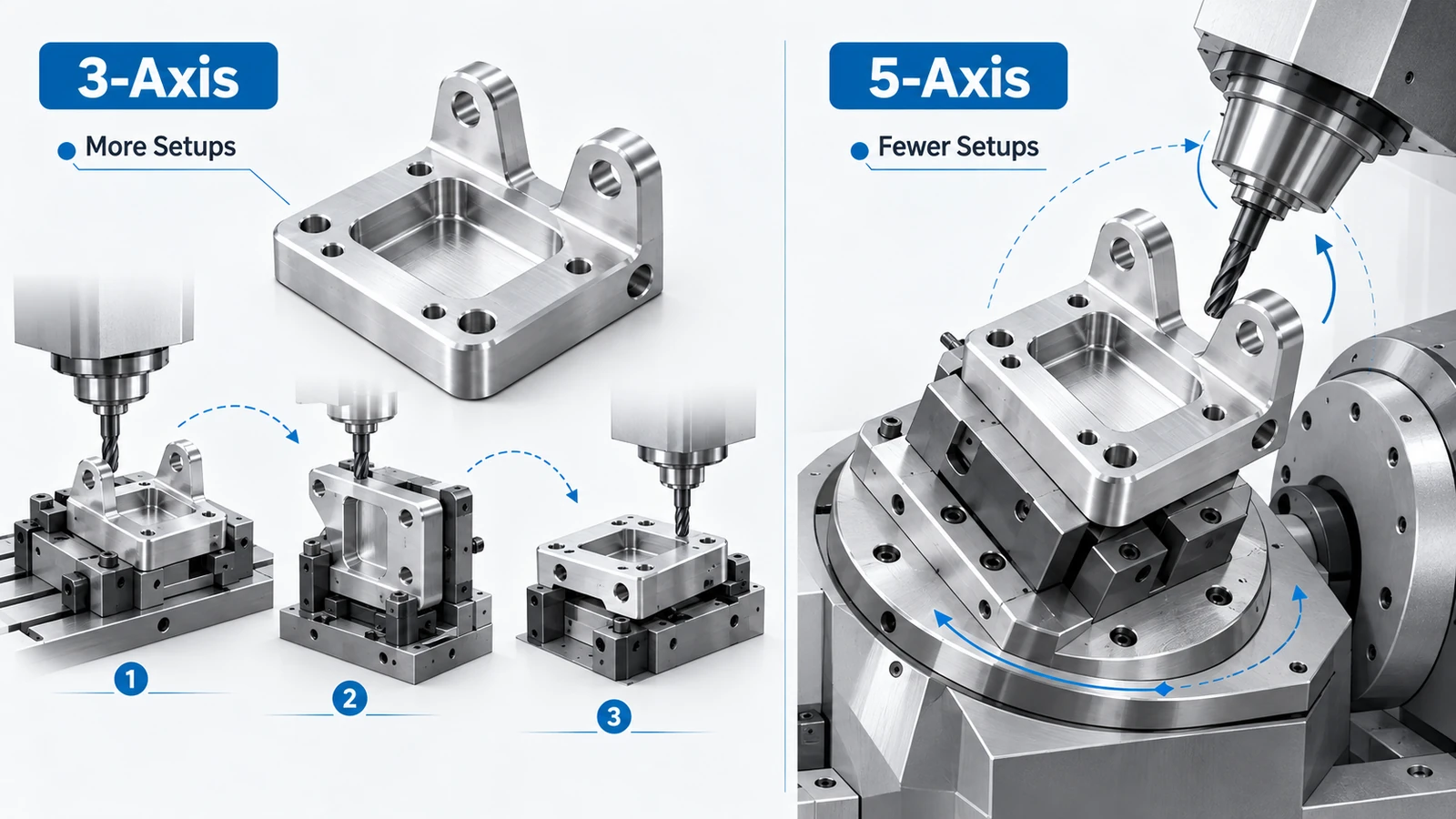
Fixed preparation costs typically include CAM programming, fixture preparation, and machine setup. Variable costs include raw material, machining time, cutting tool consumption, and routine inspection.
CNC Machining Cost Breakdown
| Cost Component | What It Includes | Main Cost Driver |
|---|---|---|
| Raw material | Stock material and machining allowance | Material grade, dimensions, and waste |
| Programming | CAM programming and toolpath planning | Part complexity and manufacturing operations |
| Machine setup | Workholding, tool preparation, and alignment | Number and complexity of setups |
| Machining time | Roughing, finishing, drilling, and other operations | Cycle time and machine hourly rate |
| Cutting tools | End mills, drills, inserts, and tool wear | Workpiece material and machining conditions |
| Inspection | Dimensional checks and quality documentation | Tolerance and reporting requirements |
| Surface finishing | Anodizing, polishing, passivation, and coating | Finish type and processing requirements |
Manufacturing Cost vs. Quoted Price
Manufacturing cost and the selling price quoted to a customer are not necessarily the same.
A supplier’s quotation may also account for overhead allocation, profit margin, order risk, packaging, shipping, taxes, and other commercial requirements.
For example, a calculated manufacturing cost of $30 per part does not mean the supplier will necessarily quote $30.
When comparing suppliers, buyers should review the complete quotation scope rather than focusing exclusively on the unit price.
What Factors Affect CNC Machining Cost?
Six major factors influence how much a CNC machined component costs to produce.
1. Material Selection and Machinability
Material costs include more than the price of raw stock. Machinability, cutting speed, tool wear, and material waste also affect the total production expense.
Aluminum 6061 is widely used for CNC machined components because it offers good machinability and a useful balance of mechanical properties.
Stainless steel and titanium alloys can require more demanding cutting conditions, increasing machining time and tooling requirements.
| Material | General Machinability | Main Cost Consideration |
|---|---|---|
| Aluminum 6061 | Good | Efficient machining and stock availability |
| Aluminum 7075 | Good | Higher raw material cost than many 6061 products |
| Stainless Steel 304 | More demanding | Work hardening and cutting forces |
| Stainless Steel 316 | More demanding | Material expense and machining time |
| Titanium Grade 5 | Challenging | Heat control, tool wear, and cutting parameters |
| Brass | Good | Alloy grade and material price |
| POM (Acetal) | Good | Dimensional stability and deformation control |
A material with a lower purchase price does not always produce the lowest finished-part cost.
Engineers should consider mechanical requirements, corrosion resistance, machinability, and material availability together.
2. Part Geometry and Complexity
Complex geometry can substantially increase CNC machining time.
Features that commonly affect manufacturing cost include:
- Deep, narrow pockets requiring long cutting tools.
- Small internal radii that restrict tool selection.
- Thin walls that are susceptible to machining deflection.
- Undercuts requiring specialized cutters or additional operations.
- Features located on multiple sides of a component.
- Deep holes and difficult-to-access internal surfaces.
For example, a pocket with very small internal corner radii may require a small-diameter end mill and additional finishing passes.
Increasing the corner radius, where the design permits, may allow a larger cutting tool and more efficient material removal.
3. Machining Process and Setup Requirements
Machine selection affects both hourly operating costs and the number of operations needed to complete a part.
A simple prismatic component may be efficiently produced using 3-axis milling. More complex parts with angled surfaces or features on multiple sides may benefit from 4-axis or 5-axis machining.
CNC turning is generally suitable for cylindrical components such as shafts, bushings, and threaded parts.
Although advanced CNC machines may have higher hourly rates, they can sometimes reduce total manufacturing costs by minimizing setups, fixtures, and handling.
The most economical process is therefore the one that meets the part requirements with an efficient overall production workflow.
4. Dimensional Tolerances and Surface Finish
Tight dimensional tolerances typically require more controlled machining conditions and additional quality inspection.
A precision bearing bore, for example, may require tighter dimensional control than a noncritical external surface.
Similarly, achieving a fine machined surface finish can require additional finishing passes, appropriate tooling, and optimized cutting parameters.
Unnecessarily restrictive specifications may increase machining time, inspection effort, and the risk of rejected parts.
Designers should identify critical features and apply appropriate general tolerances to noncritical dimensions.
5. Production Quantity
Order quantity influences how programming and setup expenses are distributed across the finished parts.
For prototypes, these fixed costs are assigned to a small number of components.
In batch production, the same preparation expenses can be distributed across more units, reducing their contribution to the unit cost.
However, the relationship is not always linear. Larger orders may introduce additional tooling replacement, equipment maintenance, production scheduling, and quality control requirements.
Suppliers may also obtain better material purchasing conditions or improve cycle times for repeat orders.
6. Finishing, Inspection, and Delivery Requirements
Secondary operations can contribute significantly to the final quotation.
Examples include anodizing, bead blasting, polishing, passivation, and powder coating.
Additional inspection services, such as first article inspection (FAI), detailed dimensional reports, and material certifications, may also affect cost.
Urgent lead times can increase expenses when expedited material procurement, schedule changes, or overtime are required.
Providing these requirements during the initial quotation stage helps prevent unexpected cost adjustments.
CNC Machining Cost Example: 1 vs. 10 vs. 100 Parts
Consider a hypothetical 6061-T6 aluminum mounting bracket manufactured using 3-axis CNC milling.
The bracket contains a simple pocket, several drilled holes, and standard dimensional tolerances. No additional surface treatment is required.
For this example, assume the following manufacturing costs.
| Cost Component | Estimated Cost |
|---|---|
| CAM programming and machine setup | $120 per batch |
| Aluminum stock | $5 per part |
| Machining (12 minutes at $50/hour) | $10 per part |
| Tooling and routine inspection | $3 per part |
| Total variable cost | $18 per part |
The estimated manufacturing cost is calculated as follows:
Total Cost = $120 + ($18 × Quantity)
The table below shows how order quantity affects the calculated unit cost.
| Order Quantity | Total Manufacturing Cost | Manufacturing Cost Per Part |
|---|---|---|
| 1 part | $138 | $138.00 |
| 10 parts | $300 | $30.00 |
| 100 parts | $1,920 | $19.20 |
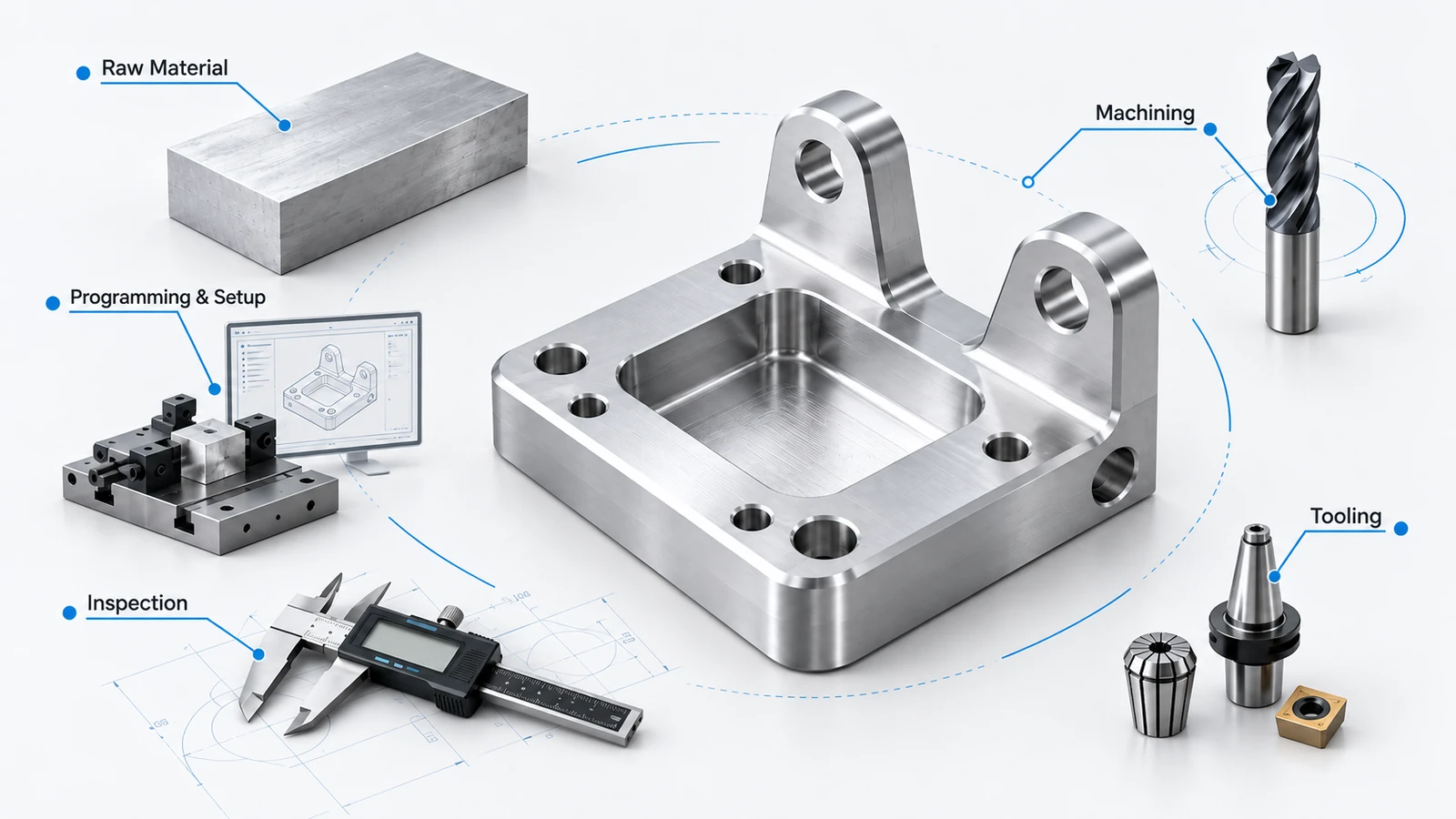
Increasing the order from one to 100 parts reduces the calculated manufacturing cost per unit by approximately 86%.
The reduction occurs primarily because the fixed $120 preparation expense is distributed across more parts.
For a one-piece prototype, the entire setup cost is assigned to that component. For 100 pieces, the fixed preparation expense contributes only $1.20 per part.
Important: These values are hypothetical examples, not actual YUANYI quotations or industry-average prices. The calculation assumes a constant variable cost and excludes additional overhead, profit margin, shipping, taxes, and other commercial charges. Real production costs may vary with quantity.
CNC Milling vs. CNC Turning vs. 5-Axis Machining Costs
Different CNC machining processes have different operating characteristics and cost structures.
| CNC Process | Suitable Components | Main Cost Considerations |
|---|---|---|
| 3-Axis CNC Milling | Brackets, plates, simple housings | Tool access, setup count, cycle time |
| 4-Axis CNC Milling | Multi-sided components, rotary features | Rotary workholding and reduced repositioning |
| 5-Axis CNC Machining | Complex housings, angled surfaces, aerospace parts | Programming complexity and fewer setups |
| CNC Turning | Shafts, bushings, cylindrical components | Diameter, length, cycle time, secondary operations |
| Mill-Turn Machining | Rotational parts with milled features | Combined operations and reduced transfers |
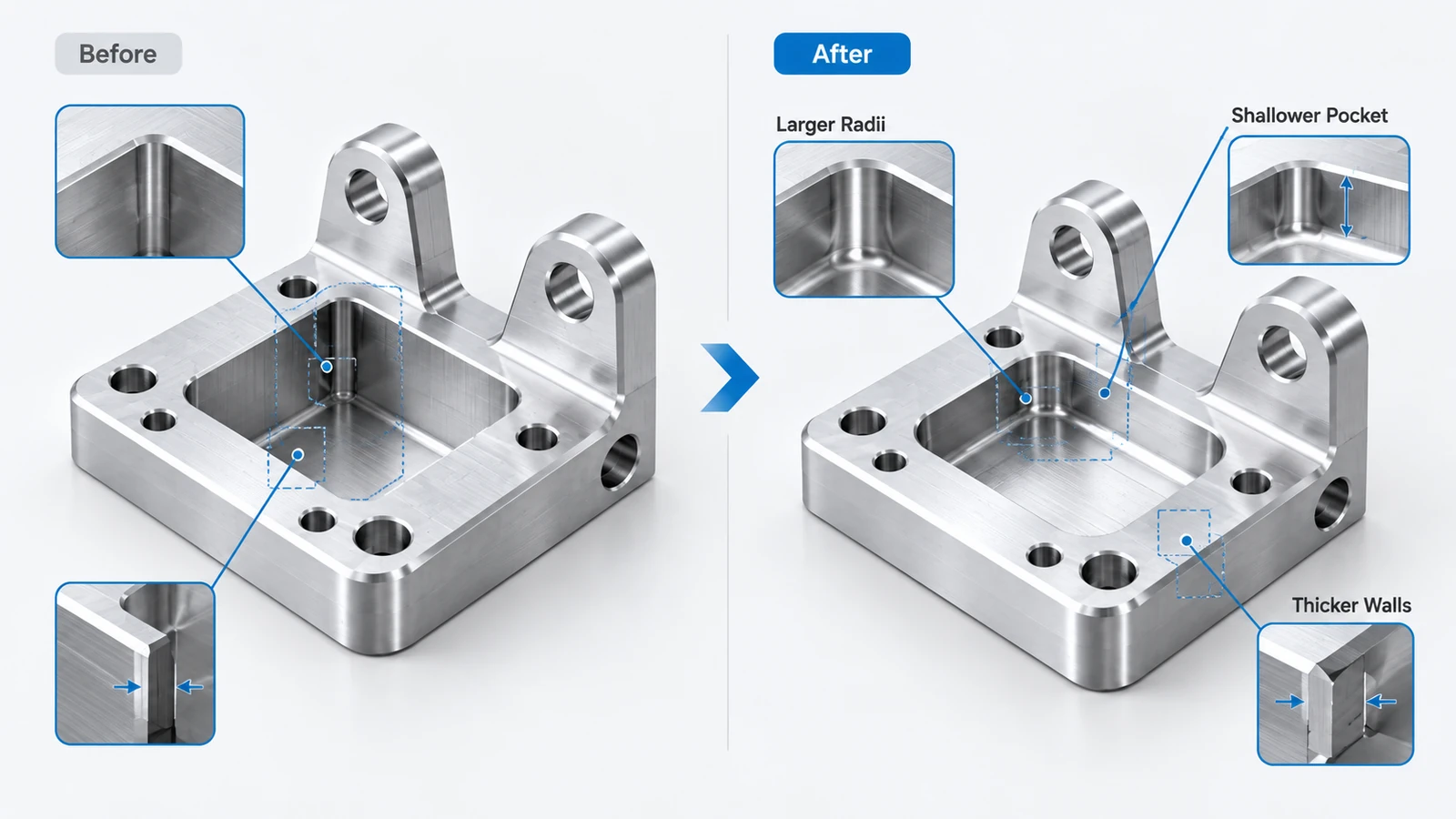
Three-axis milling is often cost-effective for components that can be machined using straightforward tool access and conventional workholding.
For complex parts, five-axis machining may reduce production time by allowing multiple surfaces to be accessed with fewer setups.
Similarly, CNC turning is usually more efficient than milling when the component consists primarily of rotational features.
A higher machine hourly rate does not automatically mean a higher total manufacturing cost.
For example, if a complex part requires several setups on a 3-axis machine, a 5-axis machine may reduce fixture preparation and handling time sufficiently to offset its higher operating rate.
Process selection should consider the total manufacturing sequence, not machine rates alone.
How to Reduce CNC Machining Cost Without Sacrificing Quality
Cost reduction is most effective when manufacturing requirements are considered during the design stage.
The following design-for-manufacturability (DFM) adjustments can help reduce unnecessary machining expenses.
Apply Tight Tolerances Only Where Necessary
Specify close tolerances for critical mating surfaces, bearing locations, and other functional features.
Use suitable general tolerances for dimensions that do not require high precision.
This approach can reduce additional finishing operations, inspection effort, and manufacturing risk.
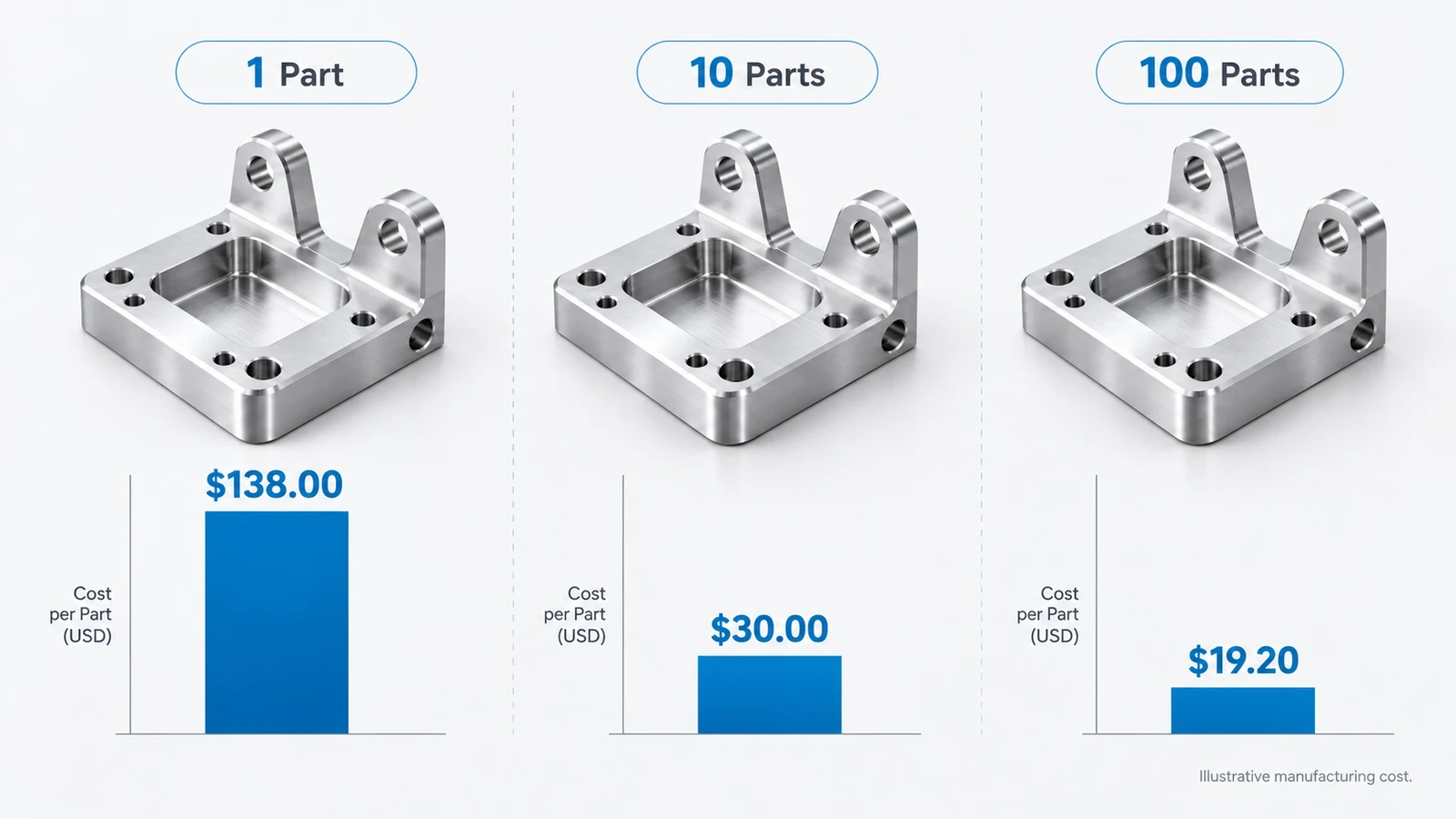
Increase Internal Corner Radii
Conventional end mills cannot produce perfectly sharp internal corners.
Small internal radii often require smaller cutting tools and longer machining cycles.
Where functionality permits, larger internal radii can improve tool accessibility and machining efficiency.
Avoid Unnecessarily Deep Pockets and Thin Walls
Deep pockets can require long cutting tools, increasing the risk of deflection and vibration.
Thin walls may also need lighter cutting conditions to maintain dimensional accuracy.
Reducing pocket depth or increasing wall thickness, where practical, can improve machining stability and reduce cycle time.
Minimize Setups and Repositioning
Each additional setup introduces preparation, handling, and alignment work.
Designing components for access from fewer orientations can reduce these costs.
For complex geometry, multi-axis machining may achieve similar benefits by combining operations.
Choose Readily Available Materials and Stock Sizes
Standard material grades and stock dimensions are often easier to source.
Choosing a suitable stock size can also reduce material waste and unnecessary machining.
Material substitutions should always be evaluated against mechanical, environmental, and functional requirements.
Compare Different Order Quantities
When future demand is predictable, requesting quotations at several quantities can help identify the most economical production approach.
For example, comparing quotations for 10, 50, and 100 parts may reveal whether combining orders would provide meaningful savings.
However, reduced unit costs should be weighed against inventory expenses and actual production demand.
The objective is to achieve the required dimensional accuracy, part performance, and quality at a reasonable total cost.
What Should You Include in a CNC Machining RFQ?
A complete request for quotation (RFQ) allows a CNC machining supplier to evaluate the part accurately and prepare a quotation with fewer assumptions.
| RFQ Information | Why It Matters |
|---|---|
| 3D CAD file | Defines the component geometry |
| 2D engineering drawing | Specifies tolerances, critical features, and technical notes |
| Drawing revision | Ensures the quotation uses the correct design version |
| Material grade | Determines stock requirements and machinability |
| Order quantity | Affects production planning and unit cost |
| Surface finish | Defines machining finish and secondary treatments |
| Inspection requirements | Specifies dimensional reports, FAI, or certifications |
| Delivery deadline | Supports production scheduling |
| Shipping destination | Helps clarify logistics requirements |
| Commercial requirements | Clarifies packaging, shipping, taxes, and quotation inclusions |
When possible, provide both the immediate prototype quantity and the anticipated production quantity.
If some technical requirements are flexible, indicate which features are critical and which may be reviewed for cost optimization.
Request a CNC Machining Quote
YUANYI Precision Manufacturing provides CNC milling, CNC turning, multi-axis machining, rapid prototyping, and small-batch production services.
Our engineering team can review drawings, material specifications, dimensional requirements, and production quantities to identify suitable manufacturing approaches.
Send us your CAD files, engineering drawings, and quantity requirements for a project-specific CNC machining quotation.
Frequently Asked Questions
A single CNC machined part must absorb programming, fixture preparation, machine setup, and inspection expenses. These fixed costs cannot be distributed across multiple components, which often makes prototypes more expensive per unit than batch-produced parts.
CNC turning is often more economical for cylindrical components because it efficiently produces rotational features. Milling is generally better suited to prismatic shapes, pockets, and nonrotational features. Actual cost depends on the part design, material, tolerances, and quantity.
No. Five-axis machining may involve higher machine operating rates, but it can reduce setup time, fixtures, and part repositioning. For certain complex parts, these savings can result in a lower total manufacturing cost.
A preliminary quotation may be possible using a 3D CAD model alone. However, a 2D engineering drawing is recommended when the component requires specific tolerances, threads, surface finishes, inspection requirements, or other manufacturing notes. Complete documentation helps suppliers provide more accurate quotations.



