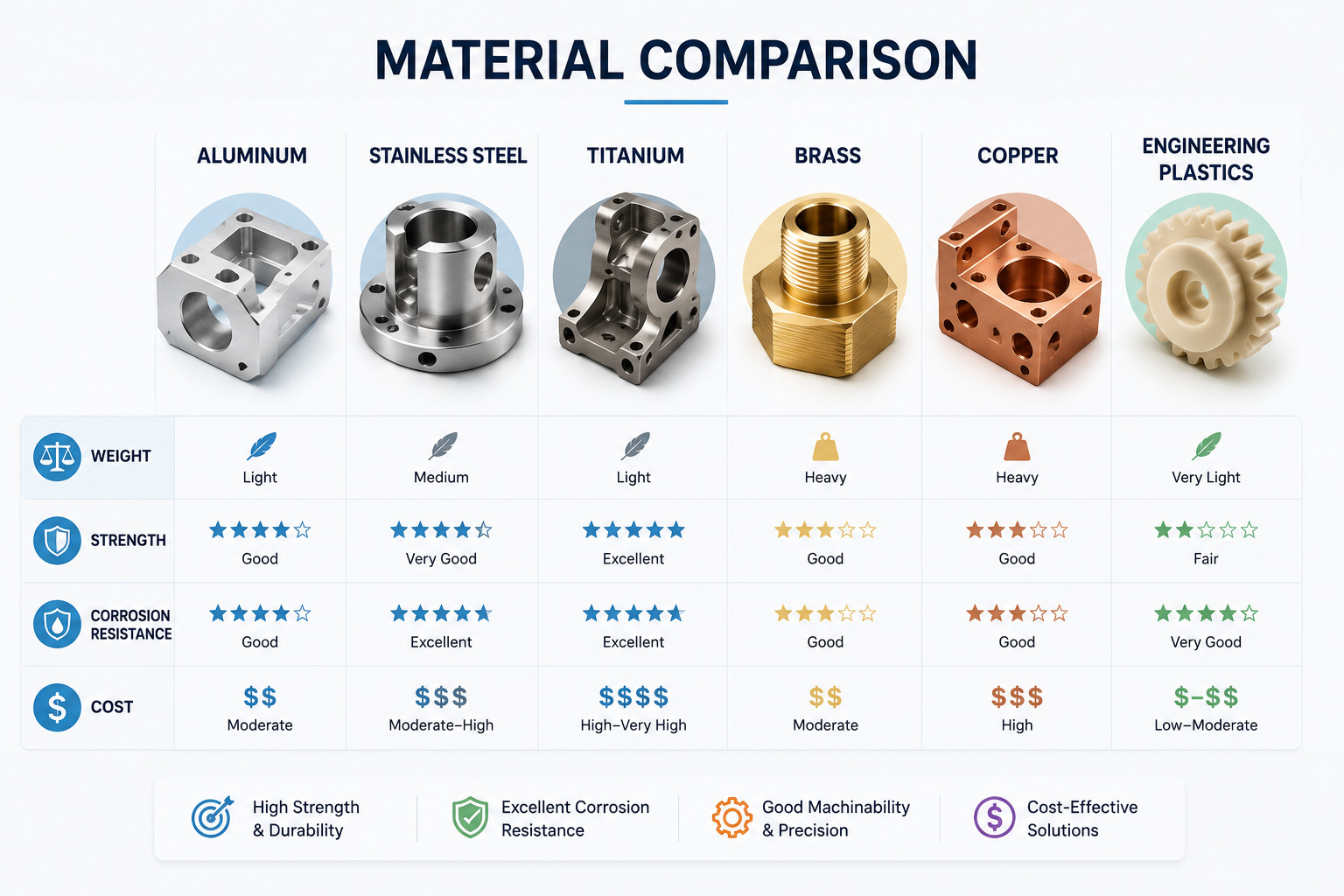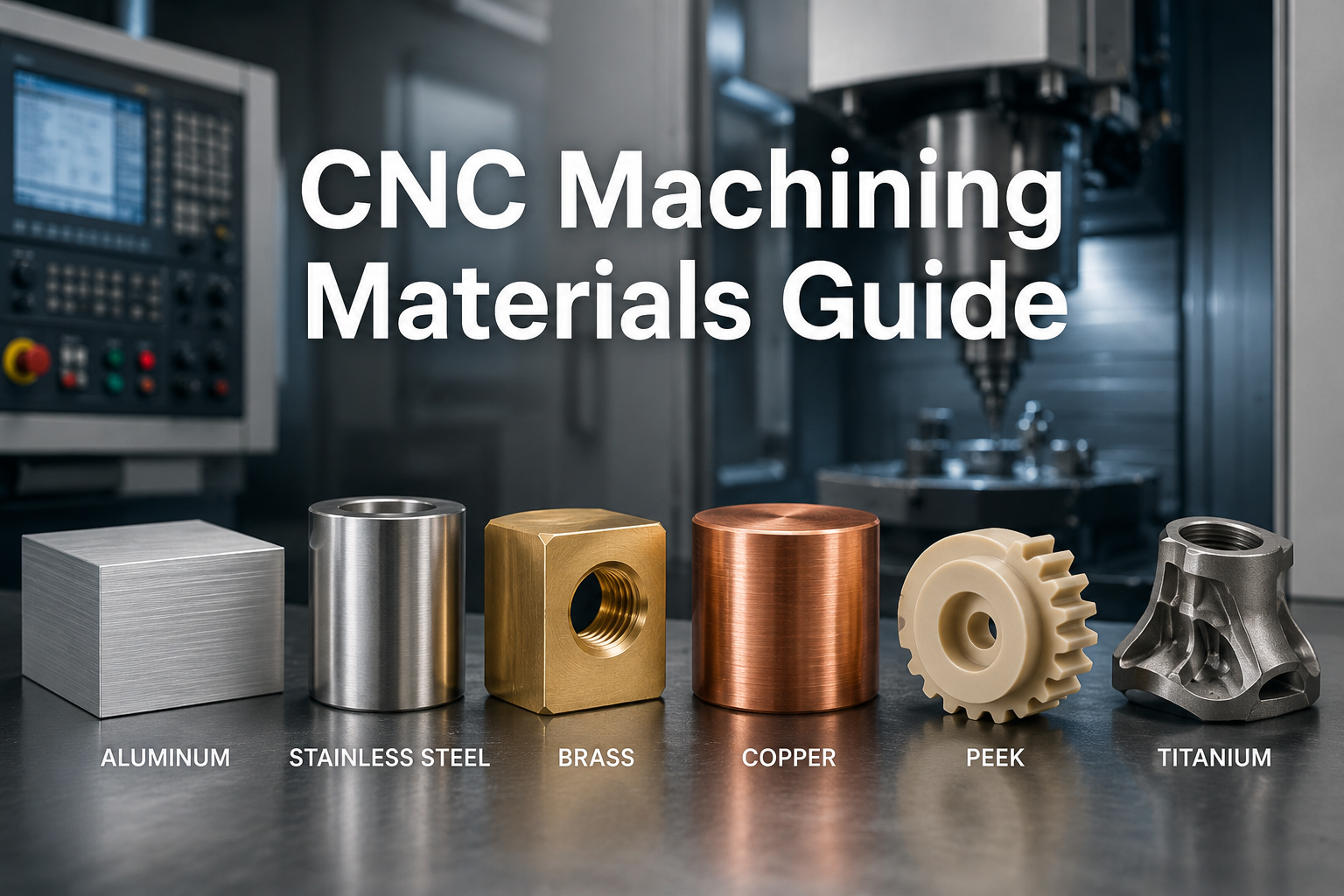
CNC machining can process a wide variety of metals, engineering plastics, composites, and other engineering materials. Different materials vary in terms of properties, machinability, cost, and applications; therefore, selecting the right material is often more important than choosing the machining process.
Whether you’re developing a product prototype or engaging in mass production, material selection directly impacts part performance, manufacturing costs, and lead times. This guide introduces common material types used in CNC machining and helps you select the most suitable material for your specific project requirements.
Why Material Selection Matters in CNC Machining
CNC materials selection not only determines the final performance of a part but also affects the entire CNC machining process. From product design to mass production, different materials exhibit significant differences in machinability, manufacturing costs, and service life. For most CNC machining projects, appropriate material selection can typically reduce manufacturing risks and improve overall production efficiency. 
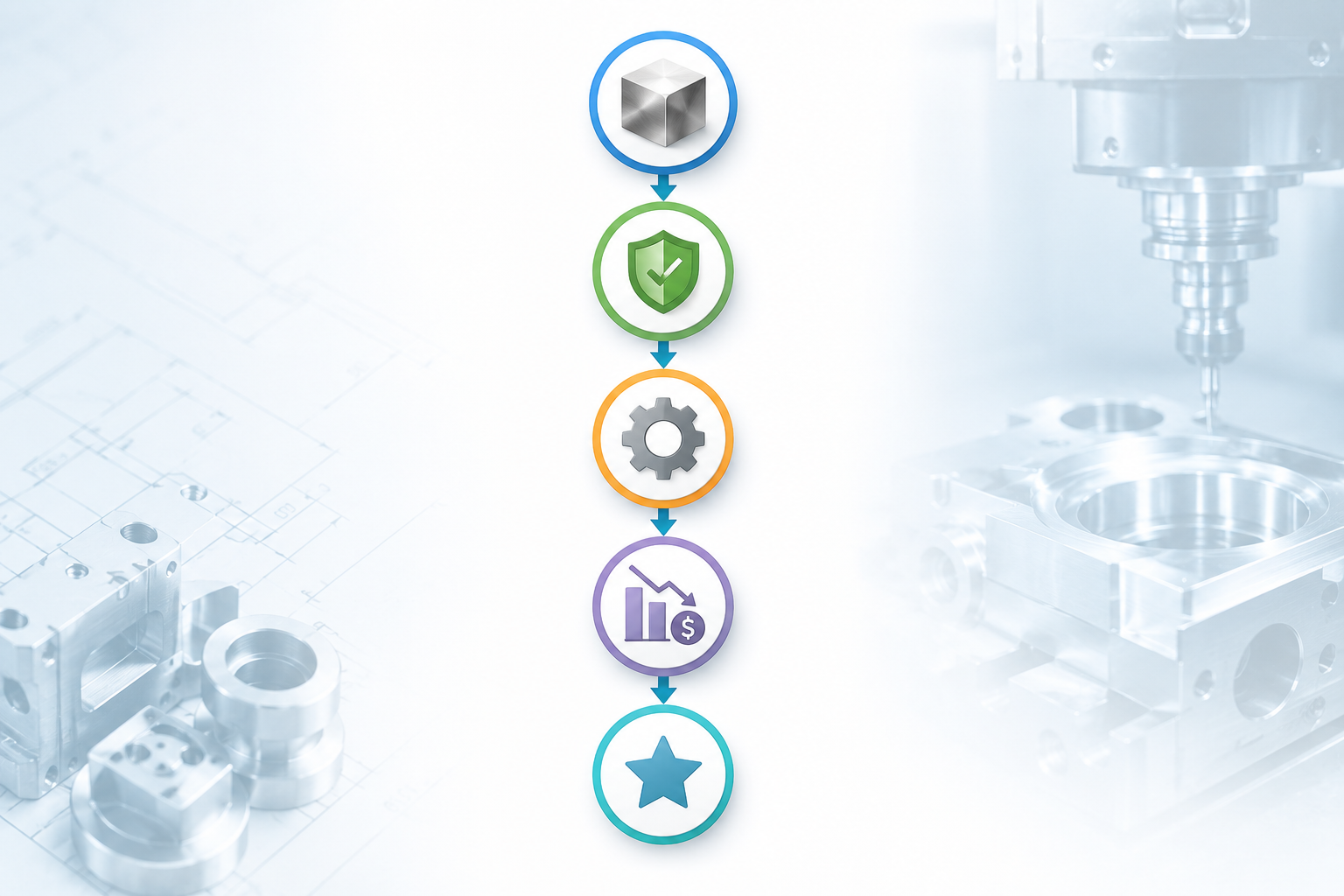
In actual machining, materials primarily affect the following aspects.
Mechanical Performance Requirements
First and foremost, the material must meet the functional requirements of the part, including strength, hardness, wear resistance, fatigue resistance, and high-temperature resistance. If the material itself cannot withstand the operating conditions, it will be difficult to ensure the product’s long-term stable operation, no matter how high the machining precision may be.
Machining Accuracy and Surface Quality
The machinability of different materials directly affects dimensional accuracy and surface quality. Materials with good machinability typically yield more consistent dimensions, while also reducing machining time and tool wear. Materials with high hardness or poor thermal conductivity, on the other hand, require more conservative machining parameters and higher-quality tools to ensure machining quality.
Operating Environment
The operating environment in which a part is used often determines whether the CNC materials can be used reliably over the long term. Humid conditions, salt spray, chemical agents, or high-temperature environments all place different demands on the material.
Manufacturing Costs
Material costs are only part of the manufacturing cost; machining efficiency often has a greater impact on the final quote.
Some materials have lower procurement costs but require longer machining times and result in faster tool wear, leading to higher overall manufacturing costs. In contrast, certain materials with better machinability—though they have a higher unit price—can shorten production cycles and improve machining efficiency, offering a greater cost advantage in mass production.
Material Supply and Lead Times
Material procurement also affects project schedules. Certain specialty alloys, high-performance engineering plastics, or aerospace-grade materials may be subject to long lead times, limited inventory, or minimum order quantity requirements.
Subsequent Processing and Surface Treatment
The choice of materials must not only meet the requirements of CNC machining but also take into account subsequent manufacturing processes, such as anodizing, electroplating, heat treatment, welding, or polishing.
Types of CNC Machining Material

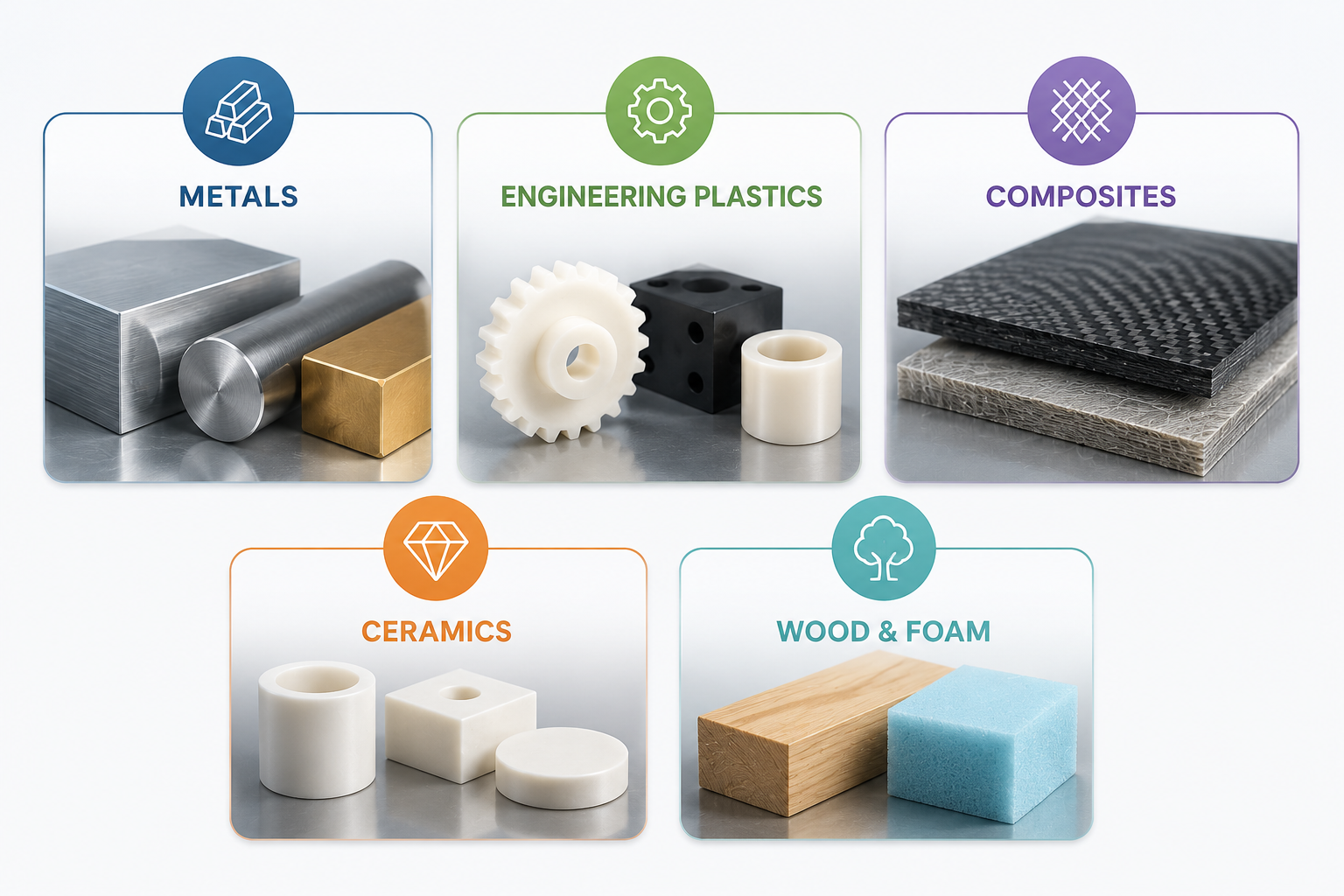
CNC machining can process a very wide range of CNC materials, from common metals to high-performance engineering plastics, all of which can be machined into high-precision parts according to product requirements. Based on CNC machining material properties and application scenarios, materials used in CNC machining are typically classified into several major categories: metals, engineering plastics, composites, ceramics, as well as wood and foam.
In precision mechanical manufacturing, metals and engineering plastics account for the vast majority of applications and are currently the two most widely used material categories in CNC machining. Although materials such as composites, ceramics, and wood can also be CNC-machined, they are typically used only in specific industries or for specialized products.
The following section introduces several of the most common types of materials used in CNC machining.
| Material Category | Common Materials | Typical Applications |
|---|---|---|
| Metals | Aluminum, Stainless Steel, Carbon Steel, Alloy Steel, Titanium, Brass, Copper | Aerospace, Automotive, Robotics, Industrial Equipment |
| Engineering Plastics | POM, PEEK, ABS, Nylon, PC, PTFE | Electronics, Medical Devices, Automation Equipment |
| Composite Materials | Carbon Fiber, G10, Fiberglass | Aerospace, Robotics, Sporting Goods |
| Ceramics | Alumina, Zirconia | Medical, Semiconductor, Electronics |
| Wood & Foam | MDF, Hardwood, PU Foam | Prototypes, Fixtures, Furniture, Display Models |
Although CNC technology can machine a wide variety of materials, there are significant differences among them in terms of machinability, manufacturing costs, and end uses. Therefore, in actual projects, it is usually necessary to select the most appropriate specific material based on the product’s performance requirements and operating environment.
Most Common CNC Machining Materials
Aluminum
Aluminum alloys are among the most widely used materials in CNC machining. They are lightweight, offer high machining efficiency, and are moderately priced, making them suitable for both prototype development and mass production.
Common Grades
6061, 7075, 5052
Key Advantages
- Lightweight
- Excellent machinability
- Easy to anodize
- High cost-effectiveness
Typical Applications
Aerospace, robotics, consumer electronics, automation equipment
Stainless Steel
Stainless steel offers excellent strength and corrosion resistance, making it one of the most common materials used in medical and food equipment, as well as industrial machinery.
Common Grades
303, 304, 316, 17-4PH
Key Advantages
- High strength
- Good corrosion resistance
- Excellent wear resistance
- Long service life
Typical Applications
Medical devices, food processing equipment, industrial equipment, marine equipment
Carbon Steel & Alloy Steel
Carbon steel and alloy steel offer a balance of mechanical properties and cost-effectiveness, making them suitable for a wide range of mechanical parts and industrial structural components.
Common Grades
1018, 1045, 4140, 4340
Key Advantages
- High strength
- Low cost
- Good wear resistance
- Easy to heat treat
Typical Applications
Machine parts, fixtures, transmission systems, industrial equipment
Titanium
Titanium alloys offer an excellent strength-to-weight ratio and corrosion resistance, making them essential materials for high-performance parts.
Common Grades
Grade 2, Grade 5 (Ti-6Al-4V)
Key Advantages
- High strength, lightweight
- Corrosion resistance
- Good biocompatibility
- High-temperature resistance
Typical Applications
Aerospace, medical implants, high-end industrial equipment
Brass
Brass offers excellent machinability and is one of the easiest metals to CNC machine.
Common Grades
C360, C260
Key Advantages
- High machining efficiency
- Good surface quality
- Corrosion resistance
- Good electrical conductivity
Typical Applications
Valves, fittings, instruments, decorative parts
Copper
Copper offers excellent electrical and thermal conductivity and is widely used in the electronics and power industries.
Common Grades
C101, C110
Key Advantages
- Excellent electrical conductivity
- High thermal conductivity
- Corrosion resistance
Easy to weld
Typical Applications
Electronic components, busbars, heat sinks, power equipment
Engineering Plastics
Engineering plastics are lightweight, corrosion-resistant, and have good insulating properties, making them important alternatives to metal parts.
Common Materials
POM, PEEK, ABS, Nylon, PC, PTFE
Key Advantages
- Lightweight
- Good insulation
- properties
- Corrosion resistance
- Low coefficient of friction
Typical Applications
Electronic products, medical devices, automation equipment, insulated parts
Quick CNC Materials Selection Guide

If you’re still unsure which CNC machining material to choose, you can start by narrowing down your options based on the product’s core requirements. The comparison table below summarizes commonly recommended materials for different applications and can serve as a quick reference when selecting materials.
| If Your Project Needs... | Recommended Materials | Why |
|---|---|---|
| Lightweight | Aluminum 6061, Aluminum 7075 | Lightweight, efficient to machine, excellent strength-to-weight ratio |
| High Strength | Alloy Steel, Titanium | Strong load-bearing capacity for high-stress structural parts |
| Corrosion Resistance | 316 Stainless Steel, Titanium | Suitable for humid, chemical, or marine environments |
| High Wear Resistance | Tool Steel, 4140 Alloy Steel | Good wear resistance for long-term friction or sliding applications |
| Electrical or Thermal Conductivity | Copper, Brass | Excellent electrical and thermal conductivity |
| Cost-Sensitive Projects | Aluminum 6061, Carbon Steel | Lower overall cost with good machining efficiency |
| High-Precision Machining | Aluminum, Brass, POM | Good dimensional stability and easier tolerance control |
| Electrical Insulation | POM, PEEK, PTFE | Excellent insulation properties and chemical resistance |
| Medical or Food Contact | 316 Stainless Steel, PEEK, Titanium | Good biocompatibility or corrosion resistance |
| High-Temperature Environments | Titanium, PEEK | Maintains stable performance under high-temperature conditions |
In actual projects, the selection of materials typically requires a comprehensive consideration of performance, ease of processing, cost, and lead time, rather than relying on a single factor.
Common Mistakes When Selecting CNC Machining Materials
When selecting materials for CNC machining, many issues do not arise during the machining stage, but rather stem from potential problems already present at the material selection stage. The following are some of the most common pitfalls in material selection.
Focusing solely on material price:A low material price does not necessarily mean the lowest overall manufacturing cost.
Blindly pursuing high-performance materials:Higher performance does not necessarily mean better suitability; over-engineering will only increase costs.
Ignoring the Product’s Operating Environment:Environments such as humidity, high temperatures, and chemical exposure can all affect a material’s long-term performance.
Neglecting a Material’s Machinability:Materials that are difficult to machine typically result in longer processing times and higher manufacturing costs.
Failing to Consider Subsequent Processing Steps:Processes such as anodizing, electroplating, and heat treatment all influence material selection.
Ignoring Production Volume:Materials suitable for prototyping may not be suitable for mass production.
How YUANYI Helps You Choose the Right CNC Machining Material
Selecting the right material requires not only an understanding of the material’s inherent properties but also a comprehensive evaluation that takes into account the part’s structure, machining processes, operating environment, and budget. For complex parts, there can be significant differences in machining difficulty and manufacturing costs among different materials; therefore, professional material recommendations can help reduce project risks and improve manufacturing efficiency.
At YUANYI, our engineering team provides sound material selection recommendations based on customers’ drawings, application scenarios, and technical requirements, helping them strike a balance between performance, cost, and manufacturability.
Not Sure Which Material Is Right for Your Project?
Need help selecting the right CNC machining material? Our engineers are ready to recommend the best material for your application and budget.
Get a Free Material RecommendationFrequently Asked Questions
Aluminum and brass are generally considered the easiest CNC machining materials due to their excellent machinability, high cutting efficiency, and ability to achieve good surface finishes.
Titanium and alloy steels offer some of the highest strength among common CNC machining materials. The best choice depends on the required balance between strength, weight, and cost.
Materials with good corrosion resistance, such as 316 stainless steel, aluminum, and titanium, are commonly used for outdoor environments where moisture and weather resistance are important.
In some applications, yes. Engineering plastics such as POM, PEEK, and Nylon can replace metal components when lightweight, electrical insulation, or corrosion resistance is more important than maximum strength.
Choosing materials with good machinability, avoiding unnecessary high-performance materials, and selecting readily available grades can help reduce overall machining costs.
No. Many parts can be manufactured from multiple materials. Engineers usually compare performance, cost, machinability, and application requirements before making the final selection.
Providing a 2D drawing or 3D CAD file, application details, required tolerance, production quantity, and operating environment helps engineers recommend the most suitable material.
Yes. Our engineering team can recommend suitable materials based on your part design, performance requirements, production volume, and budget to achieve the best balance between quality and cost.