

CNC machining and 3D printing can both produce prototypes and end-use parts, but they are best suited to different requirements.
CNC machining is usually better for tight tolerances, production-grade materials, smooth surfaces, and repeatable functional parts. 3D printing is often better for complex geometry, fast design iteration, internal channels, and one-off prototypes.
The right choice depends on your part geometry, material, tolerance, surface finish, quantity, and budget.
CNC Machining vs 3D Printing: Quick Comparison
| Factor | CNC Machining | 3D Printing |
|---|---|---|
| Manufacturing method | Subtractive | Additive |
| Material form | Solid block, bar, or plate | Filament, resin, powder, or wire |
| Accuracy | Usually higher | Depends strongly on process |
| Tight tolerances | Excellent | More limited in many processes |
| Surface finish | Usually smoother directly from machining | Often shows layer lines or powder texture |
| Complex internal geometry | Limited by tool access | Excellent |
| Material options | Broad range of engineering metals and plastics | Depends on printing technology |
| Material properties | Similar to stock material | Can vary by process and build direction |
| One-off prototypes | Good | Often very good |
| Functional prototypes | Excellent | Good when process and material are suitable |
| Low-volume production | Excellent | Good for selected applications |
| Material waste | Higher | Lower |
| Post-processing | Often limited | Frequently required |
| Repeatability | High | Process-dependent |
Neither process is simply better in every situation.
CNC machining is usually the stronger choice when the final part must behave like a conventionally manufactured production component. 3D printing becomes more attractive when geometry or design speed is more important than machining access or very tight dimensional control.
What Is the Main Difference Between CNC Machining and 3D Printing?
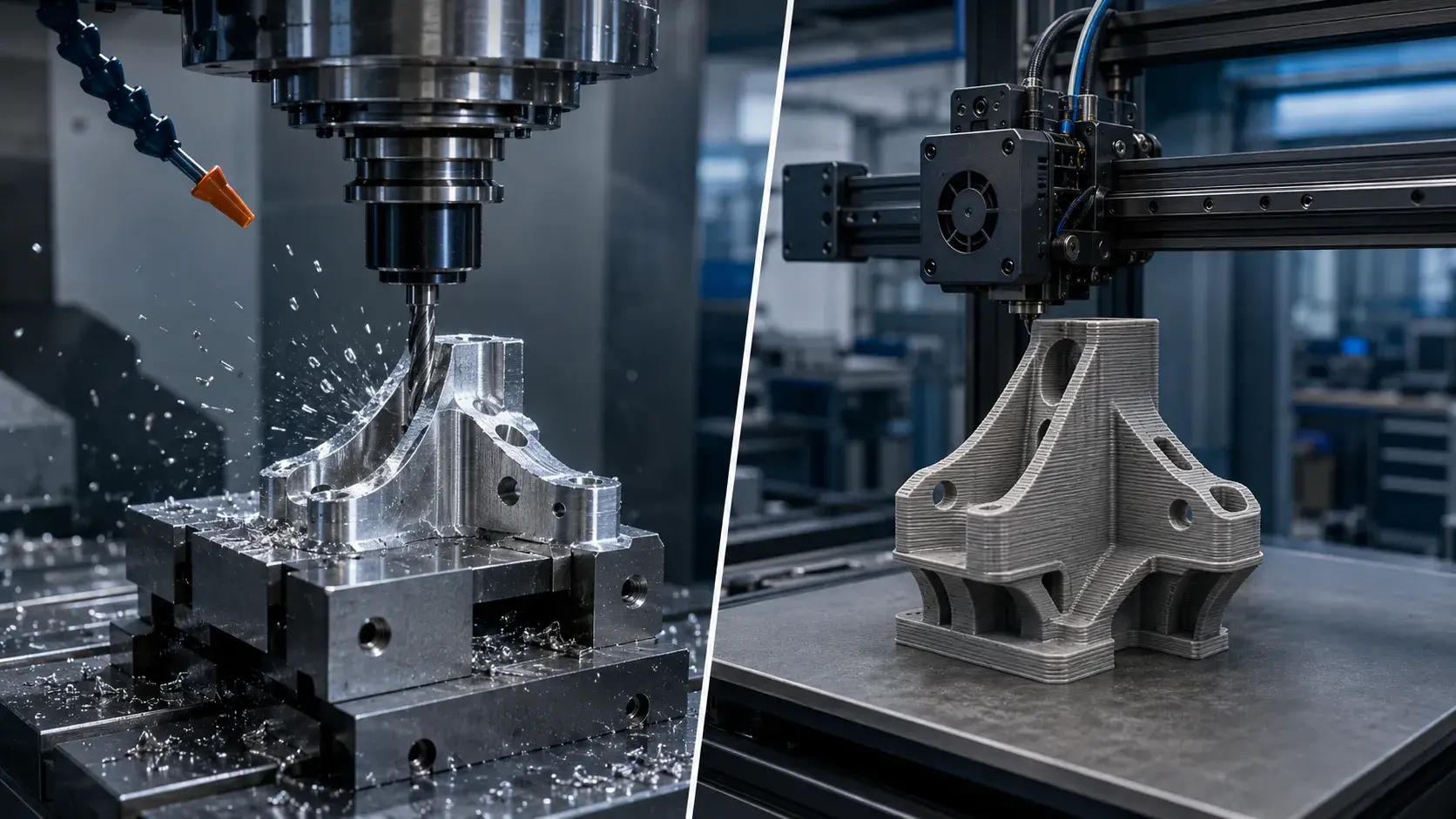
The biggest difference is how the part is created.
CNC machining removes material from a solid workpiece.
3D printing builds the part layer by layer.
CNC is therefore called a subtractive manufacturing process, while 3D printing is an additive manufacturing process.
In CNC machining, cutting tools remove unwanted material from aluminum, steel, titanium, plastic, or another stock material until the final geometry remains.
In 3D printing, material is deposited, cured, fused, or melted only where the part is needed.
This fundamental difference affects nearly everything else, including geometry, waste, material properties, accuracy, cost, and surface finish.
CNC Machining vs 3D Printing Accuracy and Tolerance
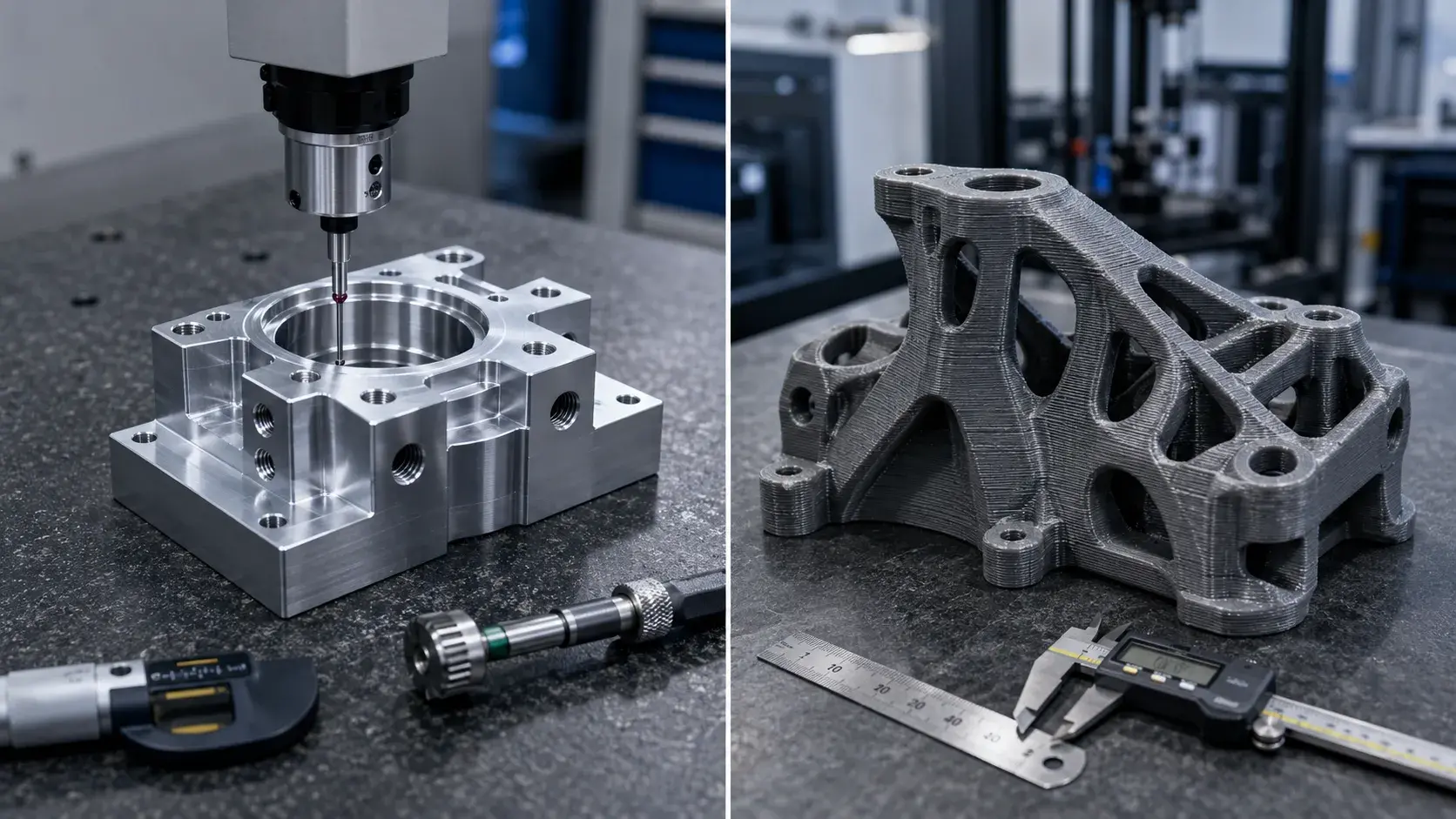
For most precision mechanical parts, CNC machining has an advantage in dimensional accuracy and tight tolerances.
Modern CNC machines can control cutting tools very precisely, making them suitable for features such as:
- Precision bores
- Bearing fits
- Threads
- Mating surfaces
- Sealing features
- Datum surfaces
- Closely controlled hole locations
3D printing accuracy varies much more because “3D printing” includes many different processes.
For example:
- FDM builds parts from extruded thermoplastic
- SLA cures liquid resin
- SLS and MJF fuse polymer powder
- Metal LPBF fuses metal powder with a laser
Each process has different dimensional capabilities, shrinkage behavior, support requirements, and post-processing needs.
A high-quality industrial 3D printing process may produce accurate parts, but very tight holes, threads, sealing surfaces, or bearing interfaces are often machined afterward.
This is especially common with metal 3D printed components.
If a drawing contains many critical tolerances, CNC machining is usually the more predictable choice.
CNC Machining vs 3D Printing Surface Finish
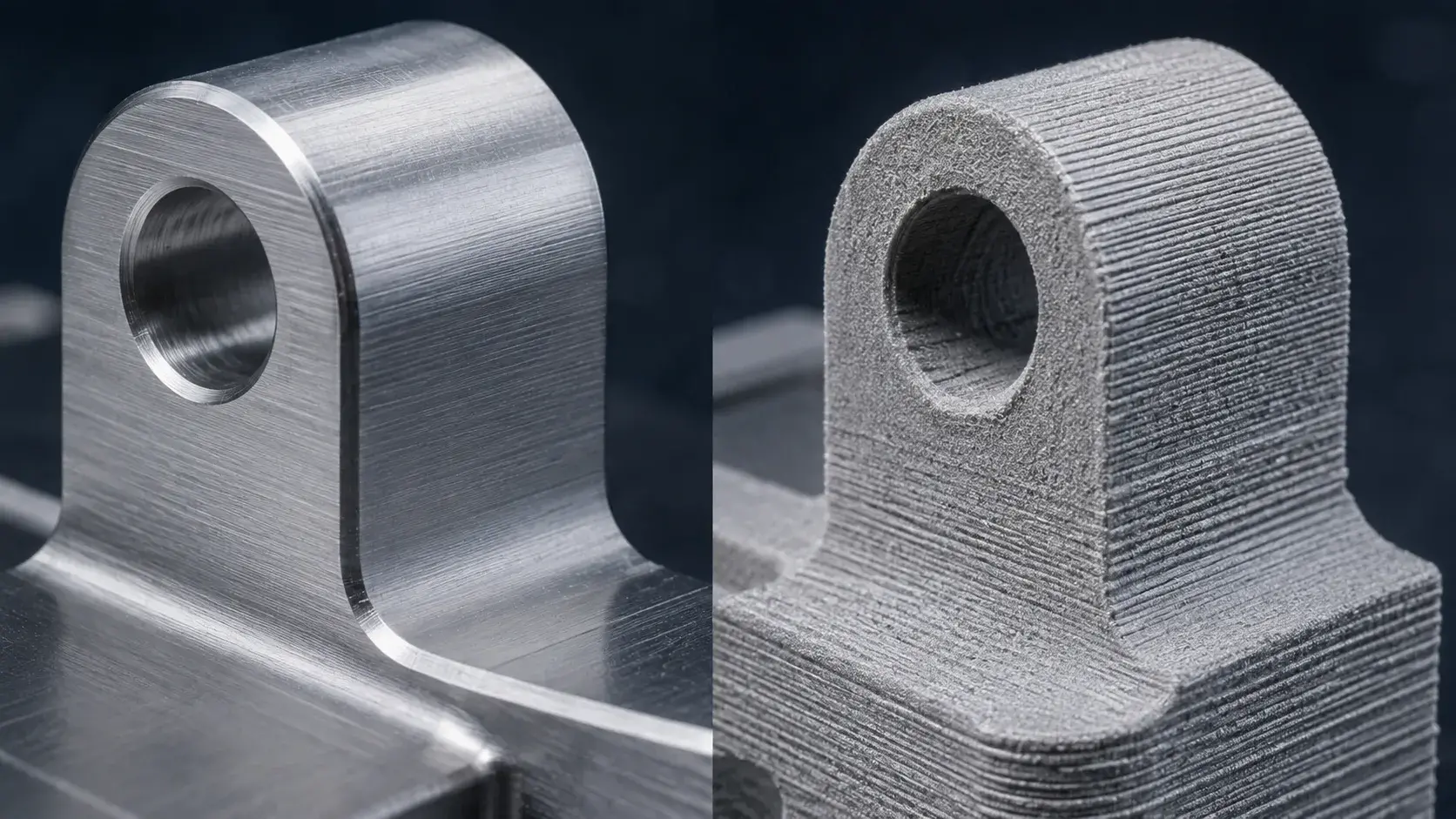
CNC machining usually produces a smoother surface directly from the manufacturing process.
A machined part may still show cutter marks, but these are typically more controlled and uniform than the layer lines, powder texture, or support marks found on many 3D printed surfaces.
Typical 3D printing surface characteristics include:
- Layer lines
- Stair-stepping on angled surfaces
- Powder texture
- Support attachment marks
- Resin support marks
- Build-direction patterns
These can often be improved through sanding, bead blasting, polishing, vapor smoothing, coating, or machining.
However, every additional finishing step adds time and cost.
CNC machining also allows critical surfaces to be finished selectively. For example, a housing may have a standard machined finish overall while sealing faces or bearing bores receive a finer surface requirement.
If surface roughness is important, CNC usually gives the designer more direct control over the finished functional surface.
CNC Machining vs 3D Printing Materials
CNC machining has a major advantage when a part must be made from a standard engineering material with well-known properties.
Common CNC materials include:
- Aluminum 6061, 7075, and 2024
- Stainless steel 303, 304, 316, and 17-4 PH
- Carbon and alloy steels
- Titanium
- Brass
- Copper
- POM
- PEEK
- Nylon
- Polycarbonate
- PTFE
Because CNC machining starts with standard plate, bar, or billet material, the finished part generally retains the properties of the stock material, aside from effects caused by machining and any later heat treatment or finishing.
3D printing materials depend heavily on the printing process.
Available options include:
- Thermoplastic filament
- Photopolymer resin
- Nylon powder
- Metal powder
- Composite-filled polymers
The important issue is not simply whether a material has the same name.
A 3D printed nylon part and a machined nylon part may behave differently because the manufacturing process affects density, internal structure, layer bonding, moisture response, and mechanical directionality.
For functional engineering parts, the actual material data from the printing process matters more than the material label alone.
Which Produces Stronger Parts?
There is no universal answer, but CNC machining often has an advantage when comparing parts made from similar engineering materials.
A CNC-machined part is cut from solid stock, so it generally has more uniform material properties.
Many 3D printed parts can be anisotropic, meaning their strength changes depending on the direction in which they were printed.
This is especially noticeable with some polymer processes where bonding between layers may be weaker than strength within the layer.
Metal additive manufacturing can produce very strong parts, but final performance depends on:
- Printing parameters
- Build orientation
- Density
- Residual stress
- Heat treatment
- Surface condition
- Internal defects
- Post-machining
For structural or load-bearing parts, engineers should compare actual mechanical data rather than assuming all CNC parts are stronger or all printed parts are weaker.
Which Process Offers More Design Freedom?
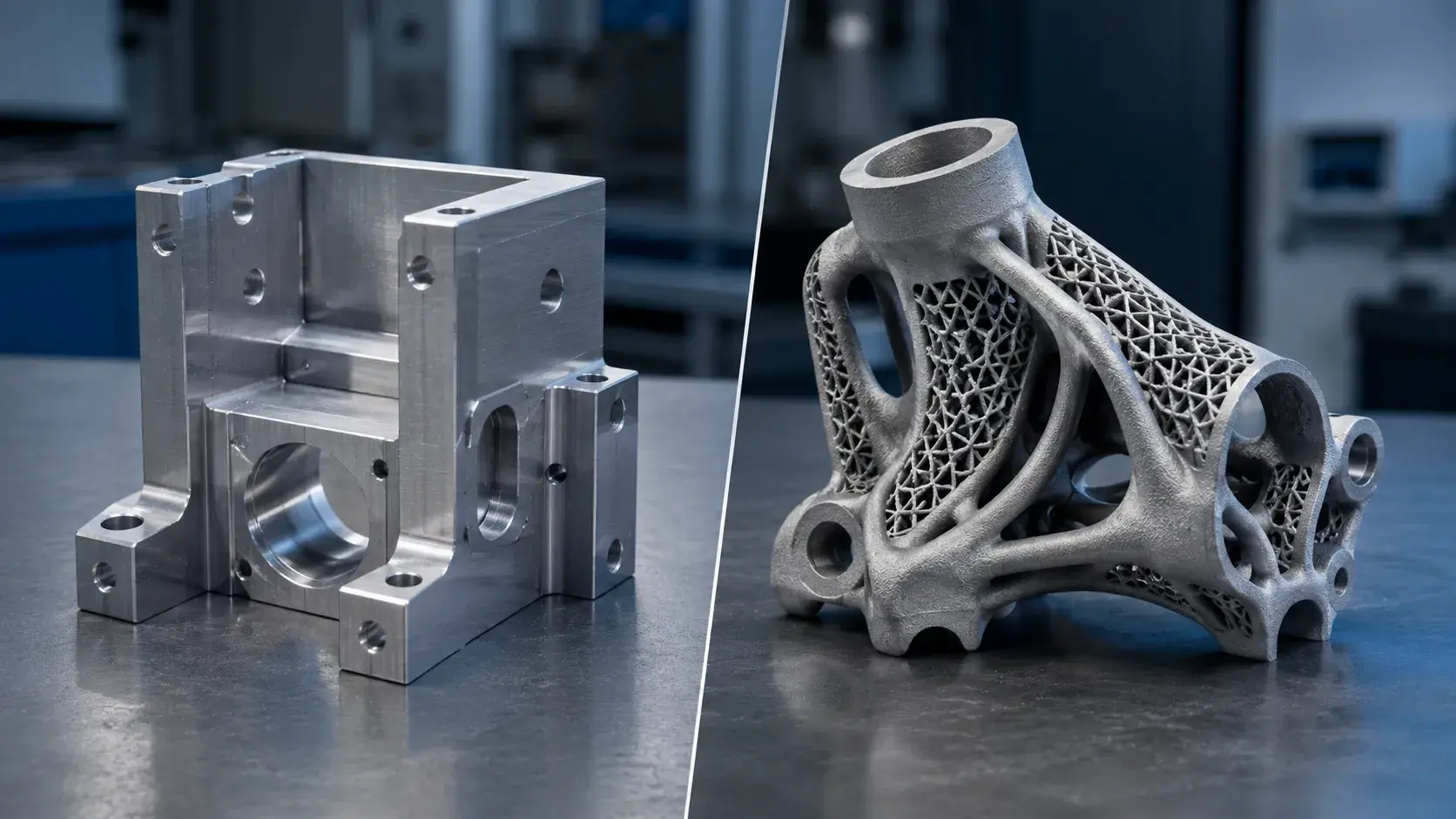
3D printing has the clear advantage in geometric freedom.
Because the part is built layer by layer, additive manufacturing can create shapes that would be extremely difficult or impossible to machine from solid stock.
Examples include:
- Internal cooling channels
- Lattice structures
- Topology-optimized parts
- Organic shapes
- Complex fluid passages
- Internal cavities
- Consolidated assemblies
CNC machining is limited by cutting-tool access.
A tool must physically reach the surface being machined.
This makes features such as fully enclosed internal channels or deeply hidden geometry difficult or impossible without splitting the part into multiple components.
However, CNC machining is often better for conventional mechanical features such as:
- Flat datum surfaces
- Precision holes
- Threads
- Pockets
- Slots
- Bores
- Shafts
- Mating features
The best design is therefore not always the most complex one. It is the geometry that matches the manufacturing process.
CNC vs 3D Printing Cost
Neither CNC machining nor 3D printing is always cheaper.
Cost depends on:
- Material
- Part size
- Geometry
- Quantity
- Tolerance
- Surface finish
- Setup
- Support structures
- Machining time
- Printing time
- Post-processing
- Inspection
When 3D Printing May Cost Less
3D printing can be cost-effective when you need:
- One or a few prototypes
- Complex geometry
- Frequent design changes
- No special tooling
- Lightweight or hollow structures
- Parts that would require multiple CNC setups
Because no dedicated cutting tools or complex fixtures may be required, a printed prototype can sometimes be produced quickly after the digital model is ready.
When CNC Machining May Cost Less
CNC machining can be more economical when you need:
- Standard engineering materials
- Tight tolerances
- Simple or moderate geometry
- Repeated low-volume production
- Smooth functional surfaces
- Parts requiring less post-processing
For a straightforward aluminum bracket, for example, CNC machining may be cheaper and faster than metal 3D printing.
So the cost comparison should always be based on the actual part rather than the process name.
Which Is Faster: CNC Machining or 3D Printing?
3D printing is often associated with rapid prototyping, but it is not always faster.
For a highly complex one-off plastic prototype, 3D printing may require very little setup and can be an excellent option.
However, printing itself can take many hours, and the part may still require:
- Support removal
- Washing
- Curing
- Depowdering
- Heat treatment
- Sanding
- Machining
A simple CNC-machined part may be completed very quickly if the machine, material, and tools are already available.
Speed depends heavily on geometry.
A useful rule is:
3D printing tends to reduce setup difficulty for complex parts, while CNC machining can be extremely fast for geometry that is easy to machine.
CNC Machining vs 3D Printing for Prototyping
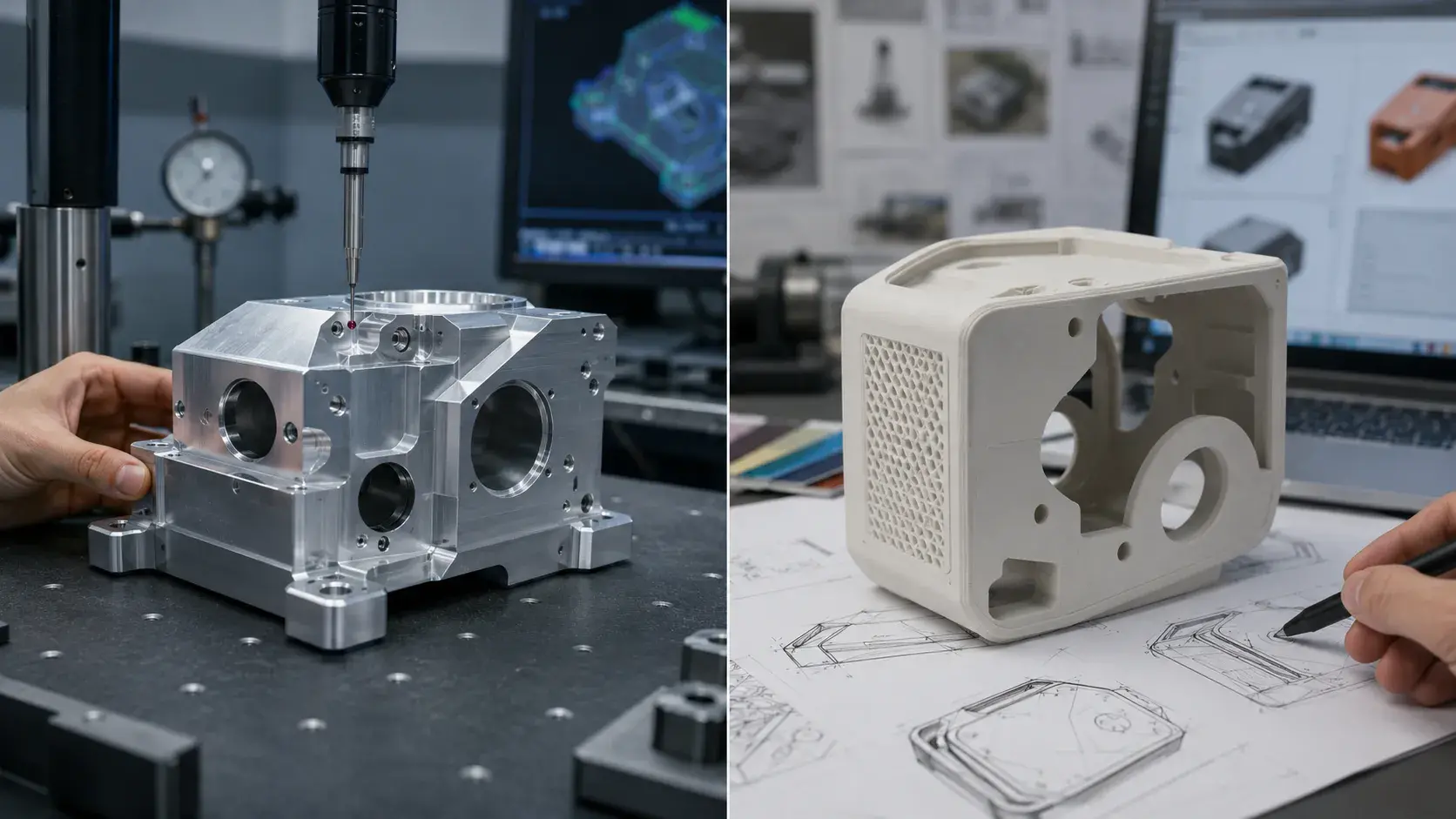
Both processes are widely used for prototypes, but they serve different goals.
| Prototype Goal | Usually Better Choice |
|---|---|
| Visual concept model | 3D Printing |
| Early design iteration | 3D Printing |
| Complex internal geometry | 3D Printing |
| Basic fit check | Either |
| Production-material prototype | CNC Machining |
| Tight-tolerance prototype | CNC Machining |
| Functional metal prototype | CNC Machining |
| Precision holes and threads | CNC Machining |
| Organic or lattice geometry | 3D Printing |
| Prototype that closely represents final machined production part | CNC Machining |
For early concept development, 3D printing is often attractive because engineers can change the design and print another version quickly.
But once the prototype needs to simulate the mechanical behavior, material, tolerance, and surface quality of a production CNC part, machining usually becomes more useful.
This is why many product development projects use both.
CNC Machining vs 3D Printing for Production
3D printing can be used for production, especially when parts are highly complex, customized, lightweight, or difficult to manufacture conventionally.
However, CNC machining remains highly competitive for low- and medium-volume production of precision mechanical parts.
CNC is especially suitable when production parts require:
- Stable tolerances
- Standard engineering materials
- Machined sealing surfaces
- Threads and precision bores
- Repeatable inspection
- Consistent surface quality
3D printing may be the better production method when the geometry provides enough value to justify additive manufacturing.
Examples include optimized aerospace structures, medical implants, custom patient-specific parts, and components with internal cooling channels.
The question is therefore not whether 3D printing can produce end-use parts. It can.
The more useful question is whether additive manufacturing gives the specific part an advantage that CNC machining cannot provide efficiently.
When Should You Choose CNC Machining?
CNC machining is usually the better choice when your part requires:
- Tight dimensional tolerances
- Production-grade metal or plastic
- Precision holes and bores
- Threads
- Smooth functional surfaces
- High repeatability
- Controlled mating surfaces
- Strong material performance
- Low-volume production
- Dimensional inspection
It is especially suitable for mechanical components that must fit, slide, seal, rotate, or carry load.
Examples include housings, brackets, shafts, manifolds, fixtures, robotic components, aerospace parts, and medical components.
When Should You Choose 3D Printing?
3D printing is often a better choice when you need:
- Very complex geometry
- Internal channels
- Lattice structures
- Rapid design changes
- One-off prototypes
- Custom parts
- Lightweight structures
- Part consolidation
- Minimal material waste
- Geometry that is difficult to access with cutting tools
It is particularly valuable when design freedom creates a functional advantage.
If the same part can be made easily with CNC machining, additive manufacturing may not automatically provide a cost or performance benefit.
Can CNC Machining and 3D Printing Be Used Together?
Yes.
In many applications, the best solution is not CNC or 3D printing, but a combination of both.
Common hybrid workflows include:
3D print first, CNC machine later
A metal part may be printed near its final shape and then CNC machined on critical surfaces such as:
- Datum faces
- Threads
- Precision holes
- Bearing seats
- Sealing surfaces
3D print prototypes, CNC machine production parts
This is common during product development.
Early designs can be printed quickly for visual and fit testing. Once the design is validated, CNC machining can produce functional prototypes or production parts using the final material.
Combine printed and machined components
A product may use a complex printed housing together with machined shafts, inserts, brackets, or precision interfaces.
Using each process where it performs best can reduce cost and improve overall part performance.
Final Decision: CNC or 3D Printing?
The best process depends on what matters most for your part.
| If You Need… | Better Choice |
|---|---|
| Tight tolerances | CNC Machining |
| Smooth functional surfaces | CNC Machining |
| Production-grade stock material | CNC Machining |
| Precision metal parts | CNC Machining |
| Threads and bearing fits | CNC Machining |
| Repeatable low-volume production | CNC Machining |
| Complex internal channels | 3D Printing |
| Lattice structures | 3D Printing |
| Rapid concept iteration | 3D Printing |
| One-off visual prototypes | 3D Printing |
| Organic geometry | 3D Printing |
| Both complexity and critical machined surfaces | Hybrid approach |
If both methods can make the part, compare geometry, tolerance, material, quantity, surface finish, and final function before choosing.
In many engineering projects, CNC machining is the stronger option for precision functional parts, while 3D printing is the stronger option for geometric freedom and rapid iteration.
Need Help Choosing the Right Manufacturing Process?
Send us your CAD files, material, quantity, and tolerance requirements. Our engineers can review your part and recommend the most suitable CNC machining approach for your project.
Frequently Asked Questions
Often, yes. CNC-machined parts are cut from solid stock, so they usually have more uniform mechanical properties. Some 3D printed parts can be weaker in the build direction, although industrial metal 3D printing can also produce high-strength parts with proper processing and heat treatment.
It depends on the part. 3D printing can be cheaper for highly complex one-off prototypes, while CNC machining is often more economical for simple metal parts, tight-tolerance components, and repeatable low-volume production.
Not completely. 3D printing is excellent for complex geometry and rapid iteration, but CNC machining is still preferred for tight tolerances, precision bores, threads, sealing surfaces, and many production-grade metal parts.
CNC machining is often the better choice for conventional metal parts because it offers broad material options, good surface finish, and tight dimensional control. Metal 3D printing is more useful when the design includes complex internal channels, lightweight structures, or shapes that are difficult to machine.
Yes. CNC machining is commonly used as a secondary operation on 3D printed parts to improve holes, threads, flat surfaces, bores, datum features, and sealing surfaces. This hybrid approach is especially common with metal additive manufacturing.



