

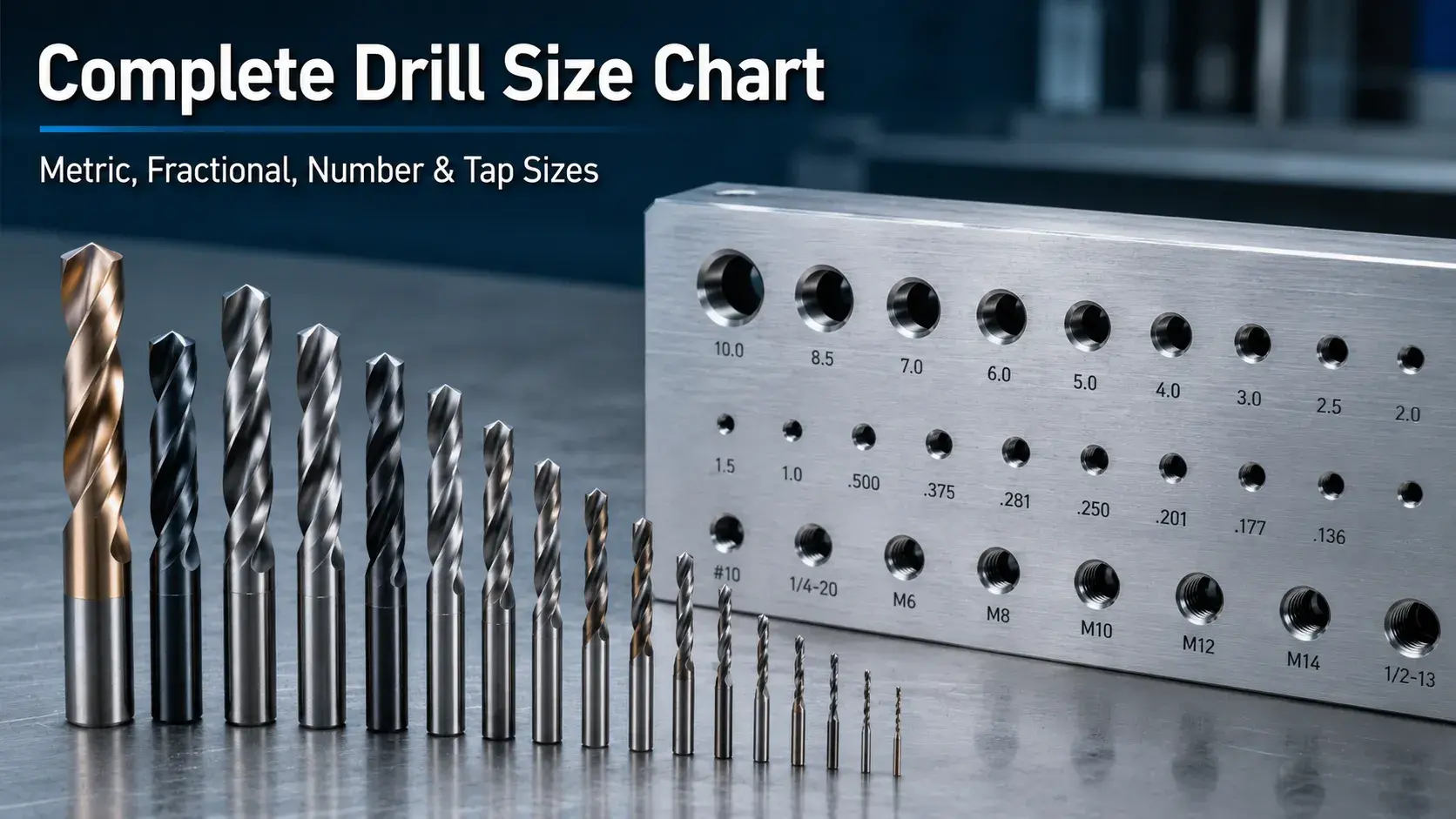
Drill sizes are commonly specified in metric millimeters, fractional inches, number sizes, or letter sizes. For threaded holes, the correct tap drill size also depends on the thread diameter and pitch.
Use the charts below to quickly compare common drill sizes in mm and inches and find typical tap drill sizes for metric, UNC, and UNF threads.
The table below compares common metric and fractional drill sizes.
| Metric Size | Decimal Inch | Nearest Common Fraction |
|---|---|---|
| 1.0 mm | 0.0394″ | — |
| 1.5 mm | 0.0591″ | ≈ 1/16″ |
| 2.0 mm | 0.0787″ | ≈ 5/64″ |
| 2.5 mm | 0.0984″ | ≈ 3/32″ |
| 3.0 mm | 0.1181″ | ≈ 1/8″ |
| 3.175 mm | 0.1250″ | 1/8″ |
| 3.5 mm | 0.1378″ | ≈ 9/64″ |
| 4.0 mm | 0.1575″ | ≈ 5/32″ |
| 4.5 mm | 0.1772″ | ≈ 11/64″ |
| 5.0 mm | 0.1969″ | ≈ 13/64″ |
| 5.5 mm | 0.2165″ | ≈ 7/32″ |
| 6.0 mm | 0.2362″ | ≈ 15/64″ |
| 6.35 mm | 0.2500″ | 1/4″ |
| 7.0 mm | 0.2756″ | ≈ 9/32″ |
| 8.0 mm | 0.3150″ | ≈ 5/16″ |
| 9.0 mm | 0.3543″ | ≈ 23/64″ |
| 9.525 mm | 0.3750″ | 3/8″ |
| 10.0 mm | 0.3937″ | ≈ 25/64″ |
| 11.0 mm | 0.4331″ | ≈ 7/16″ |
| 12.0 mm | 0.4724″ | ≈ 15/32″ |
| 12.7 mm | 0.5000″ | 1/2″ |
The ≈ symbol means nearest common size, not an exact equivalent.
For example:
3 mm = 0.1181″, while 1/8″ = 0.125″ = 3.175 mm.
They are close, but they are not the same size.Metric drill bits are specified directly by diameter in millimeters.
Common sizes include:
| Drill Size | Inch Equivalent |
|---|---|
| 1.0 mm | 0.0394″ |
| 1.5 mm | 0.0591″ |
| 2.0 mm | 0.0787″ |
| 2.5 mm | 0.0984″ |
| 3.0 mm | 0.1181″ |
| 3.2 mm | 0.1260″ |
| 3.3 mm | 0.1299″ |
| 3.5 mm | 0.1378″ |
| 4.0 mm | 0.1575″ |
| 4.2 mm | 0.1654″ |
| 4.5 mm | 0.1772″ |
| 5.0 mm | 0.1969″ |
| 5.5 mm | 0.2165″ |
| 6.0 mm | 0.2362″ |
| 6.5 mm | 0.2559″ |
| 6.8 mm | 0.2677″ |
| 7.0 mm | 0.2756″ |
| 7.5 mm | 0.2953″ |
| 8.0 mm | 0.3150″ |
| 8.5 mm | 0.3346″ |
| 9.0 mm | 0.3543″ |
| 9.5 mm | 0.3740″ |
| 10.0 mm | 0.3937″ |
| 10.2 mm | 0.4016″ |
| 10.5 mm | 0.4134″ |
| 11.0 mm | 0.4331″ |
| 11.5 mm | 0.4528″ |
| 12.0 mm | 0.4724″ |
| 12.5 mm | 0.4921″ |
Metric drill sizes such as 2.5 mm, 3.3 mm, 4.2 mm, 5.0 mm, 6.8 mm, 8.5 mm, and 10.2 mm are also commonly encountered as tap drill sizes.
Fractional drills are commonly used in inch-based machining and are normally specified in fractions of an inch.
| Fraction | Decimal Inch | Metric |
|---|---|---|
| 1/64″ | 0.0156″ | 0.397 mm |
| 1/32″ | 0.0313″ | 0.794 mm |
| 3/64″ | 0.0469″ | 1.191 mm |
| 1/16″ | 0.0625″ | 1.588 mm |
| 5/64″ | 0.0781″ | 1.984 mm |
| 3/32″ | 0.0938″ | 2.381 mm |
| 7/64″ | 0.1094″ | 2.778 mm |
| 1/8″ | 0.1250″ | 3.175 mm |
| 9/64″ | 0.1406″ | 3.572 mm |
| 5/32″ | 0.1563″ | 3.969 mm |
| 11/64″ | 0.1719″ | 4.366 mm |
| 3/16″ | 0.1875″ | 4.763 mm |
| 13/64″ | 0.2031″ | 5.159 mm |
| 7/32″ | 0.2188″ | 5.556 mm |
| 15/64″ | 0.2344″ | 5.953 mm |
| 1/4″ | 0.2500″ | 6.350 mm |
| 9/32″ | 0.2813″ | 7.144 mm |
| 5/16″ | 0.3125″ | 7.938 mm |
| 11/32″ | 0.3438″ | 8.731 mm |
| 3/8″ | 0.3750″ | 9.525 mm |
| 13/32″ | 0.4063″ | 10.319 mm |
| 7/16″ | 0.4375″ | 11.113 mm |
| 15/32″ | 0.4688″ | 11.906 mm |
| 1/2″ | 0.5000″ | 12.700 mm |
Fractional drill sets commonly increase in increments such as 1/64″.
A common quick estimate for metric cutting taps is:
Tap Drill ≈ Major Diameter − Thread Pitch
For example:
M6 × 1.0
6.0 − 1.0 = 5.0 mm
Common metric tap drill sizes include:
| Metric Thread | Pitch | Common Tap Drill |
|---|---|---|
| M2 × 0.4 | 0.4 mm | 1.6 mm |
| M2.5 × 0.45 | 0.45 mm | 2.05 mm |
| M3 × 0.5 | 0.5 mm | 2.5 mm |
| M4 × 0.7 | 0.7 mm | 3.3 mm |
| M5 × 0.8 | 0.8 mm | 4.2 mm |
| M6 × 1.0 | 1.0 mm | 5.0 mm |
| M8 × 1.25 | 1.25 mm | 6.8 mm |
| M10 × 1.5 | 1.5 mm | 8.5 mm |
| M12 × 1.75 | 1.75 mm | 10.2 mm |
| M14 × 2.0 | 2.0 mm | 12.0 mm |
| M16 × 2.0 | 2.0 mm | 14.0 mm |
The simple diameter-minus-pitch rule is useful for estimating many standard metric cutting-tap holes, but final drill size should follow the thread requirement and tap manufacturer’s recommendation.
For Unified inch threads, recommended tap drills frequently use number, letter, or fractional drill sizes.
| Thread | Series | Common Tap Drill |
|---|---|---|
| #6-32 | UNC | #36 |
| #8-32 | UNC | #29 |
| #10-24 | UNC | #25 |
| #10-32 | UNF | #21 |
| 1/4-20 | UNC | #7 |
| 1/4-28 | UNF | #3 |
| 5/16-18 | UNC | F |
| 3/8-16 | UNC | 5/16″ |
| 7/16-14 | UNC | U |
| 1/2-13 | UNC | 27/64″ |
These common tap-and-drill pairings are also found in standard machinist tap drill sets and reference charts.
Number drills are widely used for smaller inch-based holes and tap drilling.
They are identified by numbers from #80 to #1.
One important point is that the numbering runs in reverse:
#80 is the smallest and #1 is the largest.
Some commonly used number drills are:
| Number Drill | Diameter (inch) | Diameter (mm) |
|---|---|---|
| #60 | 0.0400″ | 1.02 mm |
| #55 | 0.0520″ | 1.32 mm |
| #50 | 0.0700″ | 1.78 mm |
| #47 | 0.0785″ | 1.99 mm |
| #43 | 0.0890″ | 2.26 mm |
| #40 | 0.0980″ | 2.49 mm |
| #36 | 0.1065″ | 2.71 mm |
| #30 | 0.1285″ | 3.26 mm |
| #29 | 0.1360″ | 3.45 mm |
| #25 | 0.1495–0.1500″ | ≈ 3.80 mm |
| #21 | 0.1590″ | 4.04 mm |
| #16 | 0.1770″ | 4.50 mm |
| #10 | 0.1935″ | ≈ 4.91 mm |
| #7 | 0.2010″ | 5.11 mm |
| #3 | 0.2130″ | 5.41 mm |
| #1 | 0.2280″ | 5.79 mm |
Number drills are especially common in Unified thread tap drill recommendations. Standard number drill references list sizes from #80 at 0.0135″ up to #1 at 0.228″.
Letter drills cover sizes from A to Z and are larger than most number drills.
Unlike number drills, letter sizes increase normally:
A is the smallest and Z is the largest.
| Letter | Diameter (inch) | Diameter (mm) |
|---|---|---|
| A | 0.234″ | 5.94 mm |
| B | 0.238″ | 6.05 mm |
| C | 0.242″ | 6.15 mm |
| D | 0.246″ | 6.25 mm |
| E | 0.250″ | 6.35 mm |
| F | 0.257″ | 6.53 mm |
| G | 0.261″ | 6.63 mm |
| H | 0.266″ | 6.76 mm |
| I | 0.272″ | 6.91 mm |
| J | 0.277″ | 7.04 mm |
| K | 0.281″ | 7.14 mm |
| L | 0.290″ | 7.37 mm |
| M | 0.295″ | 7.49 mm |
| N | 0.302″ | 7.67 mm |
| O | 0.316″ | 8.03 mm |
| P | 0.323″ | 8.20 mm |
| Q | 0.332″ | 8.43 mm |
| R | 0.339″ | 8.61 mm |
| S | 0.348″ | 8.84 mm |
| T | 0.358″ | 9.09 mm |
| U | 0.368″ | 9.35 mm |
| V | 0.377″ | 9.58 mm |
| W | 0.386″ | 9.80 mm |
| X | 0.397″ | 10.08 mm |
| Y | 0.404″ | 10.26 mm |
| Z | 0.413″ | 10.49 mm |
These dimensions match commonly published letter drill references.
Tap Drill Size Chart
A tap drill is the hole drilled before internal threads are cut with a tap.
The hole must be smaller than the thread’s major diameter so enough material remains to form the thread.
A common quick estimate for metric cutting taps is:
Tap Drill ≈ Major Diameter − Thread Pitch
For example:
M6 × 1.0
6.0 − 1.0 = 5.0 mm
Common metric tap drill sizes include:
| Metric Thread | Pitch | Common Tap Drill |
|---|---|---|
| M2 × 0.4 | 0.4 mm | 1.6 mm |
| M2.5 × 0.45 | 0.45 mm | 2.05 mm |
| M3 × 0.5 | 0.5 mm | 2.5 mm |
| M4 × 0.7 | 0.7 mm | 3.3 mm |
| M5 × 0.8 | 0.8 mm | 4.2 mm |
| M6 × 1.0 | 1.0 mm | 5.0 mm |
| M8 × 1.25 | 1.25 mm | 6.8 mm |
| M10 × 1.5 | 1.5 mm | 8.5 mm |
| M12 × 1.75 | 1.75 mm | 10.2 mm |
| M14 × 2.0 | 2.0 mm | 12.0 mm |
| M16 × 2.0 | 2.0 mm | 14.0 mm |
The simple diameter-minus-pitch rule is useful for estimating many standard metric cutting-tap holes, but final drill size should follow the thread requirement and tap manufacturer’s recommendation.
For Unified inch threads, recommended tap drills frequently use number, letter, or fractional drill sizes.
| Thread | Series | Common Tap Drill |
|---|---|---|
| #6-32 | UNC | #36 |
| #8-32 | UNC | #29 |
| #10-24 | UNC | #25 |
| #10-32 | UNF | #21 |
| 1/4-20 | UNC | #7 |
| 1/4-28 | UNF | #3 |
| 5/16-18 | UNC | F |
| 3/8-16 | UNC | 5/16″ |
| 7/16-14 | UNC | U |
| 1/2-13 | UNC | 27/64″ |
These common tap-and-drill pairings are also found in standard machinist tap drill sets and reference charts.
How to Calculate Tap Drill Size
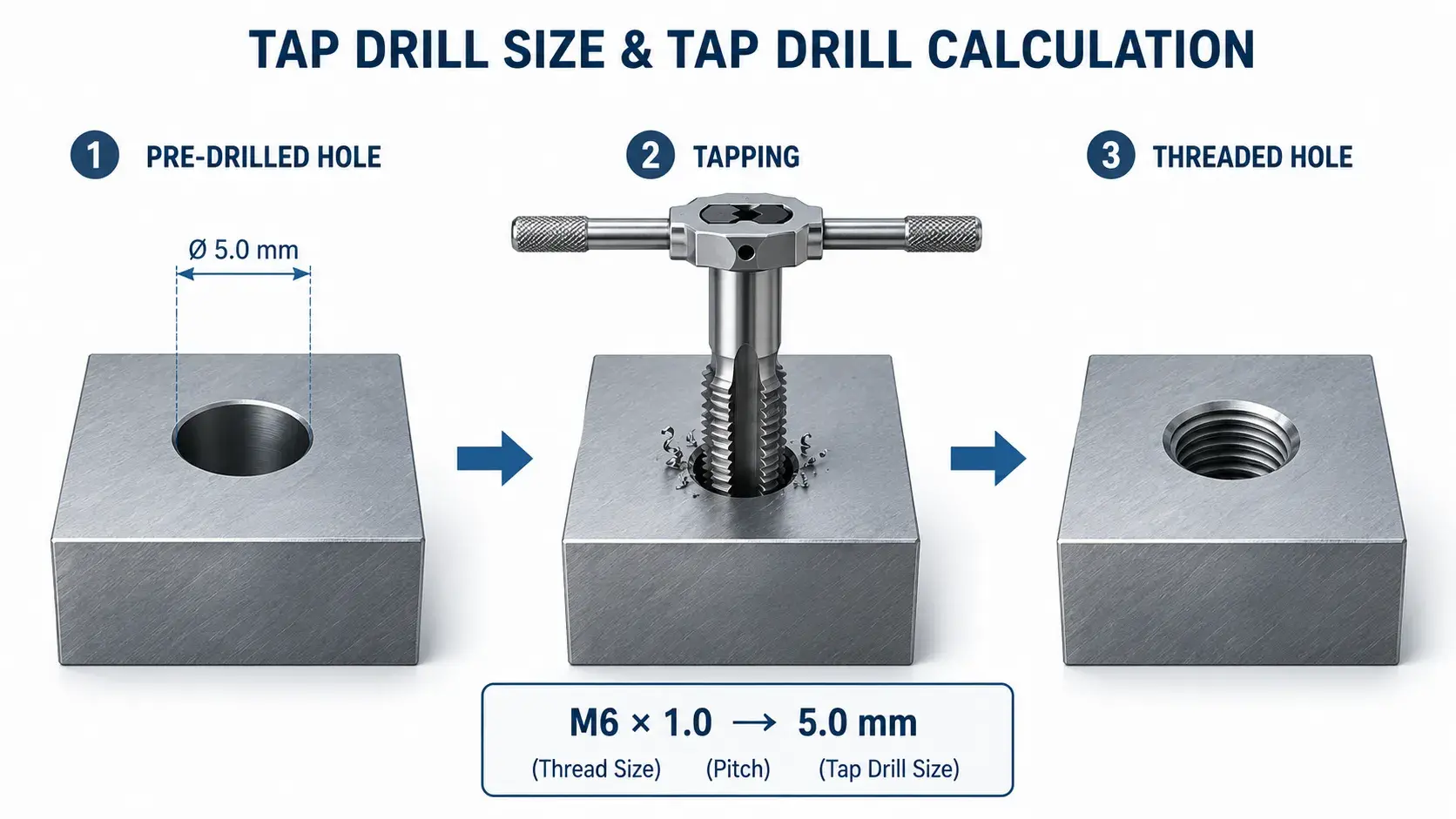
For standard metric cutting threads, a practical approximation is:
Tap Drill Diameter = Major Diameter − Pitch
Example:
M10 × 1.5:
10 − 1.5 = 8.5 mm
This gives the familiar 8.5 mm tap drill for M10 × 1.5.
For inch threads, a rough calculation can also be made from thread pitch, but it is usually easier and safer to use a verified tap drill chart.
The selected hole size affects:
- Thread engagement
- Tapping torque
- Tap life
- Risk of tap breakage
- Thread strength
A smaller tap drill leaves more material for the thread, but it also increases tapping torque.
A larger tap drill reduces tapping load but produces less thread engagement.
The correct choice therefore depends on the thread standard, workpiece material, tap type, and application.
How to Choose the Right Drill Size for CNC Machining
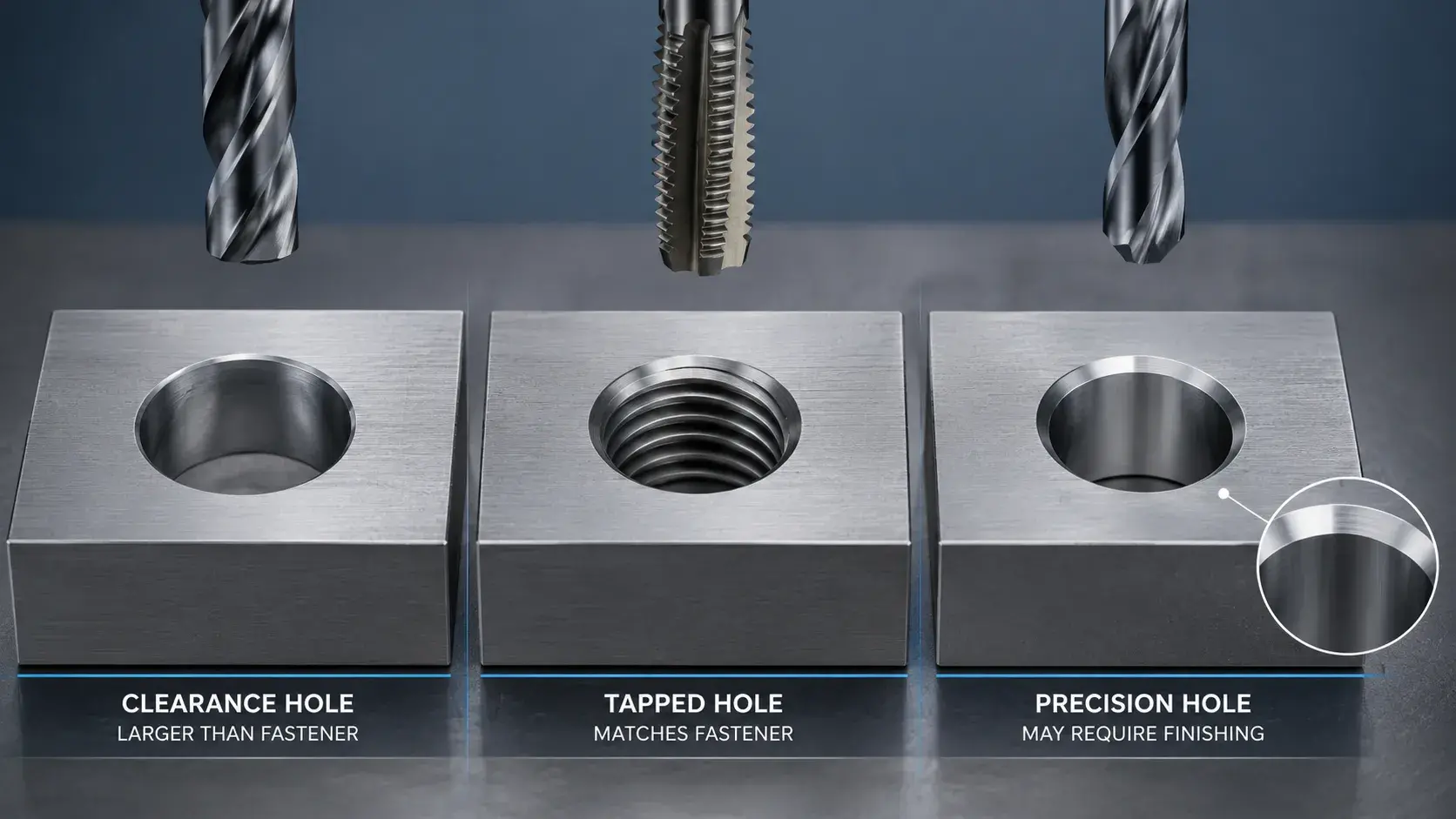
The drill diameter on a drawing is not always simply the nearest drill bit available.
Several factors should be considered.
1. Hole Function
Ask what the hole actually needs to do.
A hole for a loose clearance bolt can tolerate much more variation than:
- A dowel pin hole
- A bearing bore
- A precision locating hole
- A tapped hole
The functional requirement should determine the manufacturing method.
2. Standard Drill Availability
Using common standard drill sizes usually makes CNC machining easier and more economical.
Unusual diameters may require:
- Special tooling
- Interpolation with an end mill
- Boring
- Reaming
- Custom drills
If a non-standard diameter does not provide a functional advantage, a nearby standard size may simplify production.
3. Hole Tolerance
A drill is primarily a material-removal tool.
It does not automatically produce a highly precise finished hole.
If the drawing requires tight diameter, roundness, straightness, or positional accuracy, an additional finishing process may be required.
4. Thread Requirement
For tapped holes, never choose the drill based only on the thread’s nominal diameter.
An M6 thread does not use a 6 mm tap drill.
A standard M6 × 1.0 cutting thread commonly uses approximately a 5.0 mm pre-drilled hole.
Drilling vs Reaming: When a Drill Size Is Not Enough
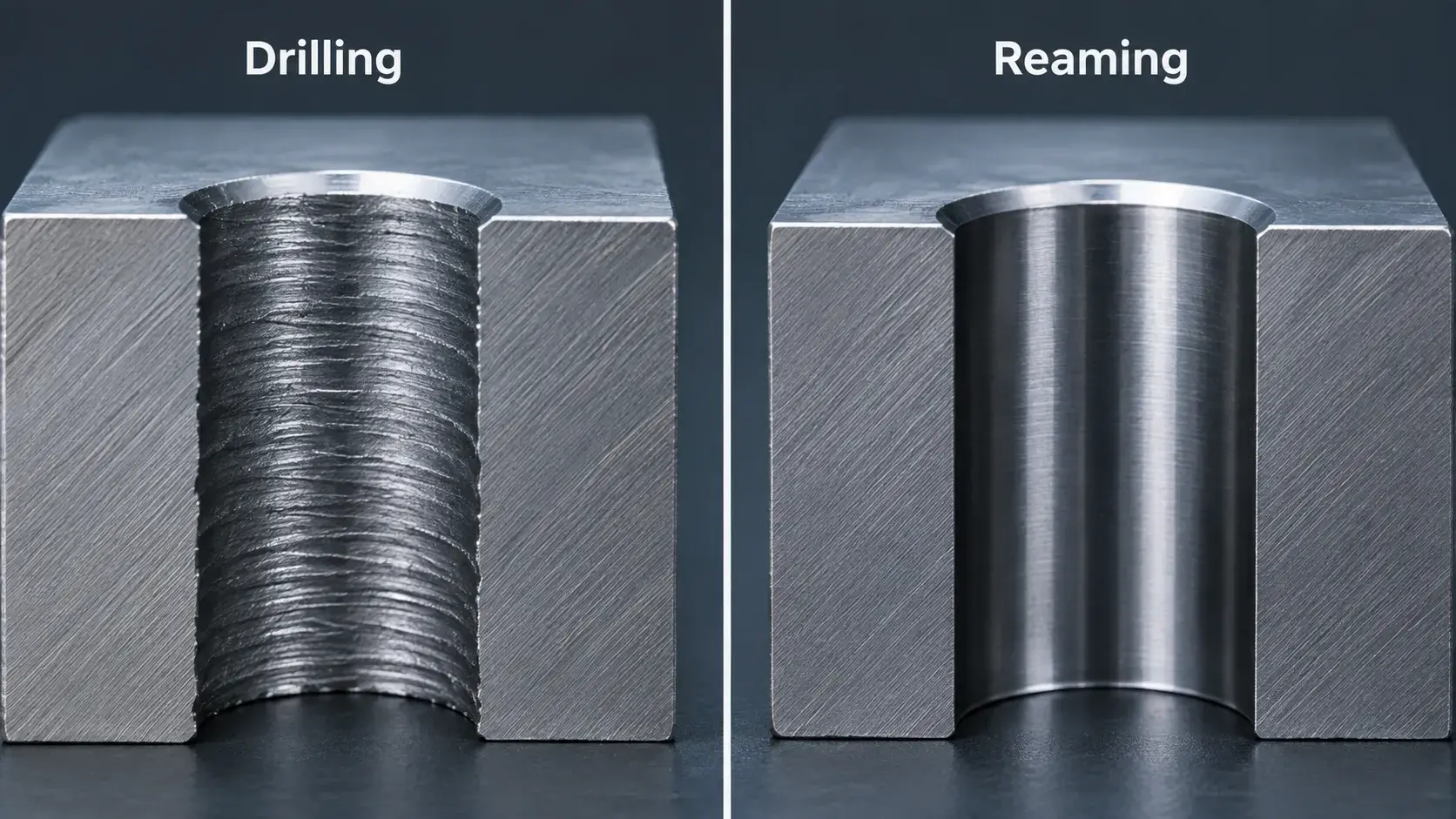
Drilling is fast and efficient, but it is not always the final operation for a precision hole.
A drilled hole can vary because of:
- Drill runout
- Tool wear
- Material behavior
- Machine rigidity
- Chip evacuation
- Drill geometry
When a hole needs tighter dimensional control or better surface finish, it may first be drilled slightly undersize and then reamed to the final diameter.
For example, precision features such as:
- Dowel pin holes
- Locating holes
- Precision fits
- Some bearing interfaces
may require reaming, boring, or another finishing operation rather than drilling alone.
A useful design rule is:
Use drilling to create the hole; use reaming or boring when the final hole itself is a precision feature.
Conclusion
A drill size chart helps convert between metric, fractional, number, and letter drill sizes, while a tap drill chart helps select the correct hole before threading.
The most important points are:
- Metric and fractional sizes that look similar are not always equivalent.
- Number drills run from #80 at the small end to #1 at the large end.
- Letter drills increase from A to Z.
- Tap drill size depends on thread diameter and pitch.
- A drilled hole is not automatically a precision finished hole.
- Reaming or boring may be required when the final hole has tight tolerance or fit requirements.
For CNC machining, choose the drill size based on the actual function, tolerance, thread, and available tooling, not simply the closest nominal diameter.
FAQ
No. 1/4 inch equals 6.35 mm, while 6 mm equals approximately 0.2362 inch. They are close, but not interchangeable for precision holes, fits, or fasteners.
For a standard M6 × 1.0 cutting thread, a common tap drill size is 5.0 mm. Other M6 thread pitches may require different drill sizes.
A #7 drill is 0.2010 inch, or approximately 5.11 mm. It is commonly used as a tap drill for 1/4-20 UNC threads.
Use drilling for general holes. Use reaming when you need tighter diameter control, better roundness, smoother finish, or a controlled fit such as a dowel pin hole.
Drill size simply refers to the diameter of a drill or hole. Tap drill size is the smaller hole drilled before cutting an internal thread. For example, an M6 × 1 thread commonly uses a 5.0 mm tap drill.



