

Honing is a precision abrasive machining process mainly used to finish internal bores. A honing tool rotates and moves back and forth while abrasive stones remove a small amount of material, improving bore size, roundness, straightness, and surface finish.
It is commonly used after drilling, boring, reaming, or grinding when a hole needs tighter dimensional control or a more functional surface.
What Is Honing?
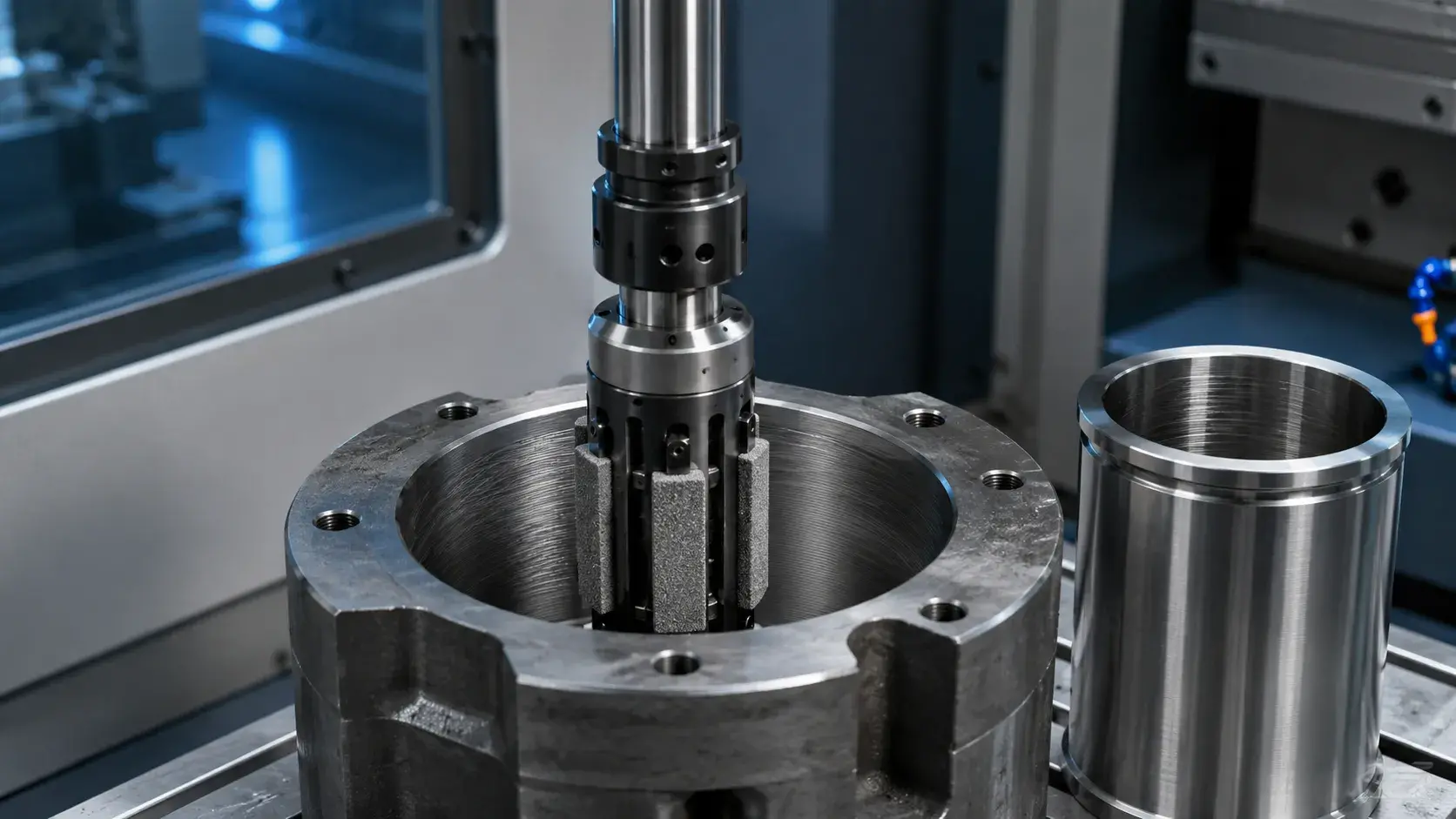
Honing is a finishing process that uses abrasive stones or similar cutting elements to remove very small amounts of material from a workpiece.
It is most commonly used on cylindrical internal surfaces such as bores, sleeves, cylinders, and bearing holes.
Unlike drilling or boring, honing is not normally used to create a hole from solid material. Instead, it improves a hole that has already been machined close to its final size.
Typical goals of honing include:
- improving bore diameter accuracy;
- correcting roundness;
- improving straightness;
- reducing taper;
- improving cylindricity;
- producing a controlled surface texture.
Because honing removes only a small amount of material, it is usually one of the final machining operations performed on a precision bore.
How Does the Honing Process Work?
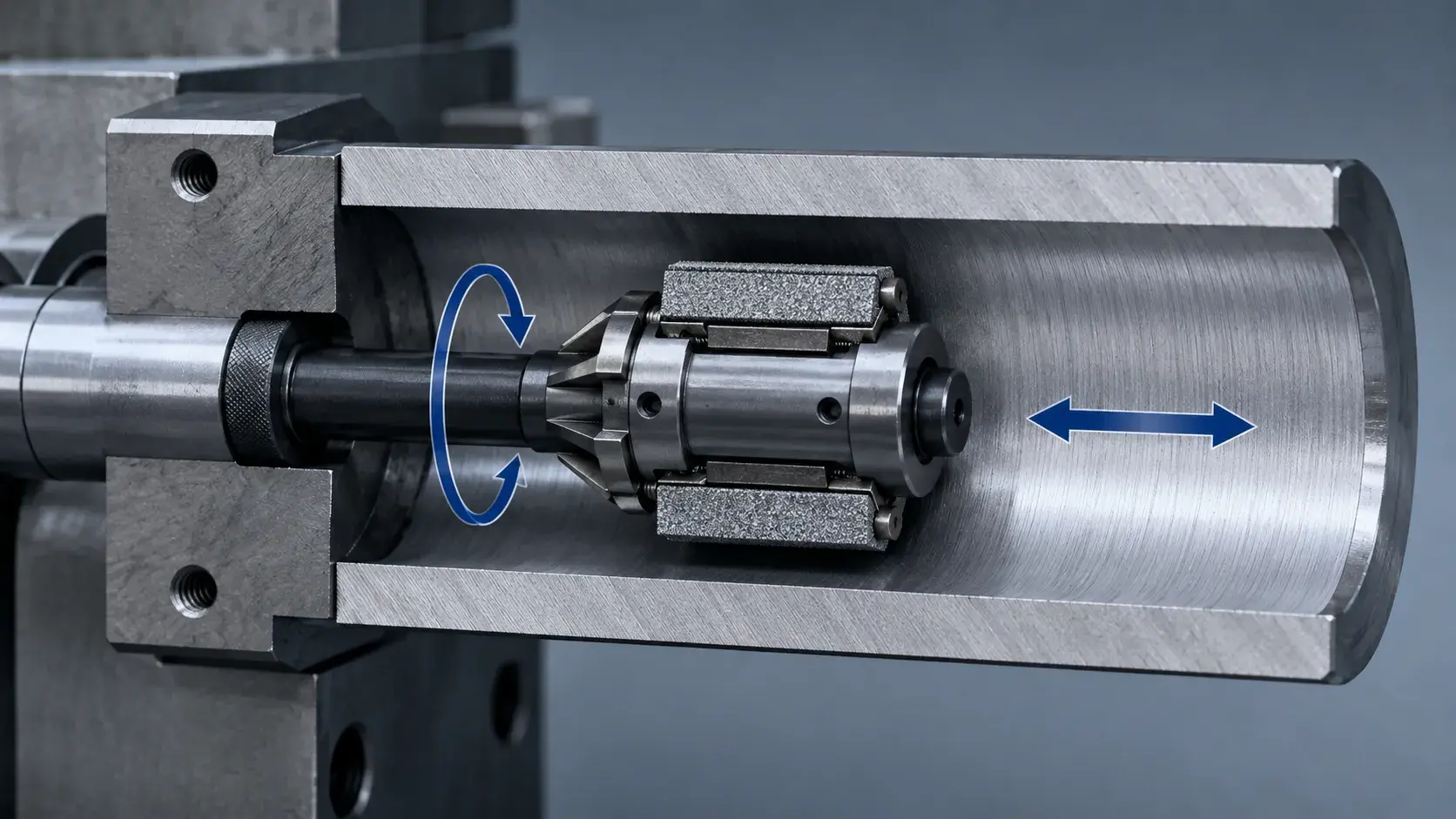
A typical honing tool contains several abrasive stones positioned around a mandrel or honing head.
During machining, the stones are pressed outward against the internal surface of the bore.
The process generally works in four steps.
1. The Honing Tool Enters the Bore
The honing head is inserted into a previously drilled, bored, reamed, or ground hole.
The hole is already close to its required final diameter before honing begins.
2. The Abrasive Stones Expand
The honing stones expand outward until they contact the bore wall.
Controlled pressure keeps the abrasive stones in contact with the surface during machining.
3. The Tool Rotates and Reciprocates
The honing head rotates while also moving back and forth along the axis of the bore.
These two movements cause the abrasive stones to cross over the same surface from different directions.
4. Small Amounts of Material Are Removed
The abrasive grains gradually remove surface peaks and correct small geometric errors.
The finished bore can have better size consistency, roundness, straightness, and surface quality than the previous machining operation.
What Is a Cross-Hatch Pattern?
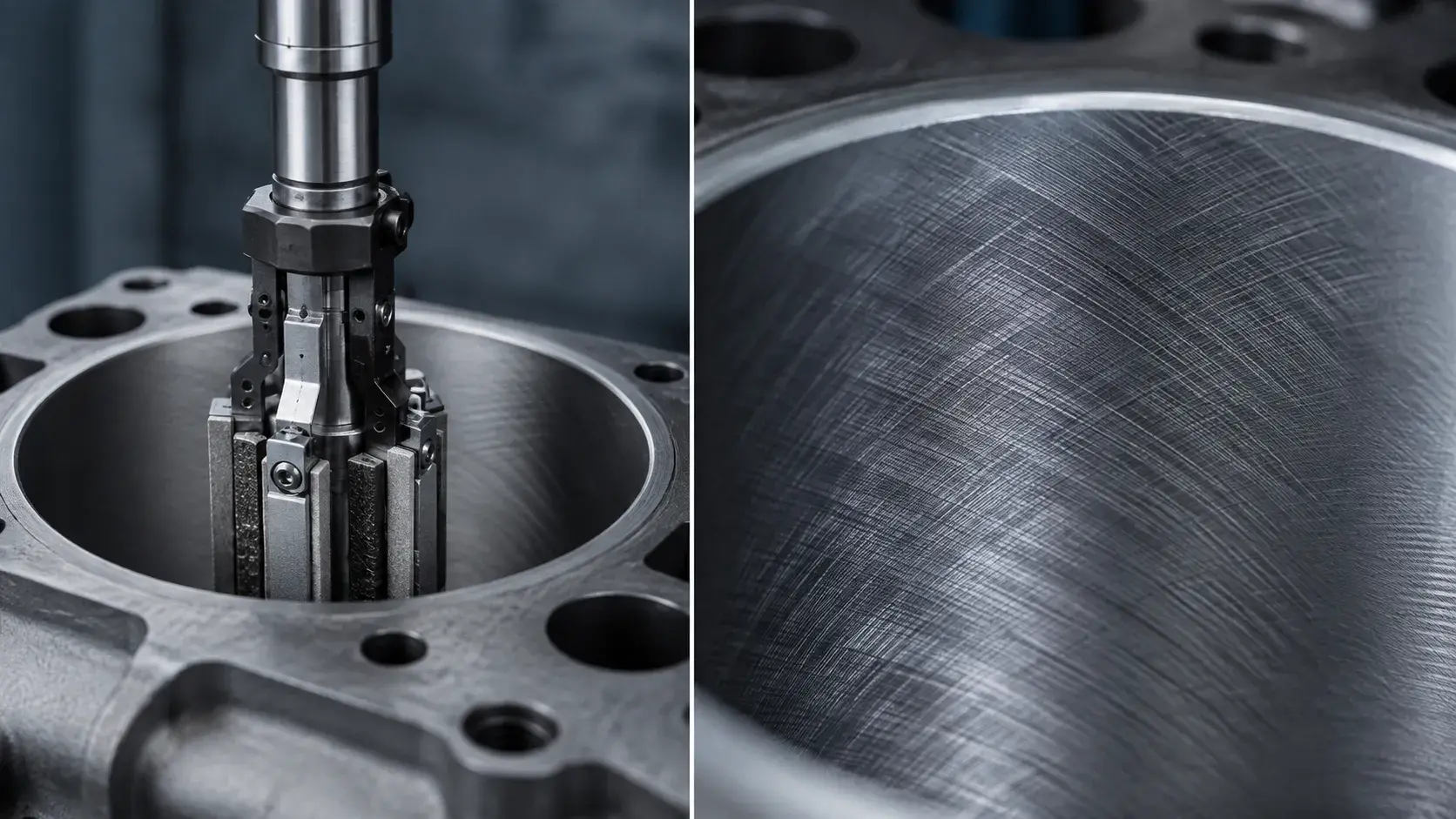
One of the most recognizable features of honing is the cross-hatch pattern left on the bore surface.
Because the honing tool rotates while moving axially, the abrasive stones create intersecting diagonal lines.
The result looks like a fine X-shaped pattern across the surface.
This texture is especially important in applications such as engine cylinders because the small grooves can help retain lubricant while allowing the sliding surface to remain relatively smooth.
The final cross-hatch angle depends on factors such as spindle speed and stroke speed.
A poorly controlled honing process can produce an unsuitable surface pattern even if the bore diameter is correct.
What Can Honing Improve?
Honing is useful because it can improve both the size and geometry of a previously machined hole.
Bore Diameter
Honing can gradually enlarge a bore until it reaches the required final dimension.
Because material removal is controlled and relatively small, the process is suitable for fine dimensional correction.
Roundness
Drilling and boring can sometimes leave a hole slightly out of round.
Honing can remove high spots around the circumference and improve roundness.
Straightness
Long bores may contain small deviations along their length.
The reciprocating movement of the honing tool helps improve bore straightness and diameter consistency.
Taper
A bore may be slightly larger at one end than the other.
Proper honing can reduce this taper and create a more consistent diameter throughout the hole.
Bell-Mouth and Barrel Shape
Some machining processes can leave the ends of a bore oversized or make the center slightly larger.
Honing can help correct these form errors when enough machining allowance remains.
Surface Finish
The abrasive action removes machining marks and sharp surface peaks.
Depending on the process, honing can produce a smooth surface or a controlled cross-hatched texture designed for lubrication.
Types of Honing
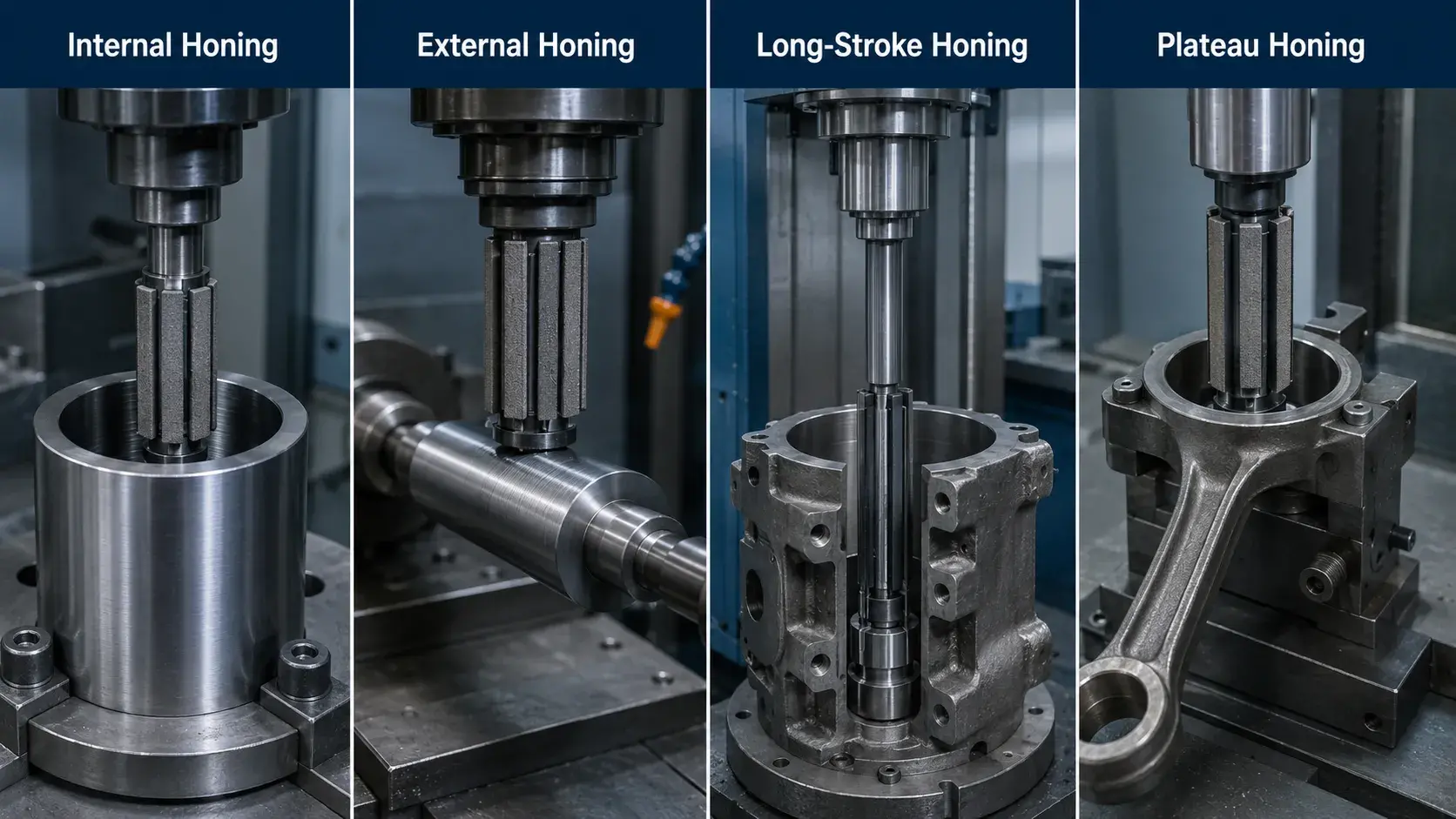
Several honing methods are used depending on the shape of the part, required surface condition, and production volume.
Internal Honing
Internal honing is the most common type.
It is used to finish the inside diameter of holes and bores in components such as hydraulic cylinders, engine blocks, bushings, sleeves, and valve bodies.
External Honing
External honing applies the same abrasive finishing principle to cylindrical external surfaces.
It is less common than internal honing but may be used where highly controlled outside diameter geometry and surface quality are required.
Long-Stroke Honing
Long-stroke honing uses a honing head that reciprocates through a significant portion of the bore length.
It is widely used for long cylindrical bores, including hydraulic and pneumatic cylinders.
The long stroke helps improve straightness and overall bore geometry.
Single-Pass Honing
Single-pass honing uses a tool that passes through the bore with progressively sized abrasive sections.
Instead of repeatedly stroking the same area, the tool normally completes the finishing operation in one controlled pass or a small number of passes.
It is well suited to high-volume production where part geometry is already stable and repeatability is important.
Plateau Honing
Plateau honing is commonly associated with engine cylinder finishing.
The process removes sharp surface peaks while leaving deeper valleys in the surface.
The flatter areas provide a good bearing surface, while the valleys help retain lubricant.
Honing Tools and Abrasives
A honing system normally consists of a machine spindle, honing head or mandrel, abrasive stones, an expansion mechanism, and honing fluid.
Honing Head
The honing head holds the abrasive stones and keeps them positioned against the workpiece.
Different mandrel designs are available for different bore diameters and lengths.
Honing Stones
Honing stones contain abrasive particles held together by a bonding material.
Common abrasives include:
- aluminum oxide;
- silicon carbide;
- diamond;
- cubic boron nitride, or CBN.
The correct abrasive depends on the material being honed and the required removal rate and surface finish.
Honing Oil or Coolant
Honing fluid helps remove abrasive particles and metal debris from the contact area.
It also reduces heat and helps prevent the honing stones from loading with removed material.
Proper fluid selection can significantly affect tool life and surface quality.
Honing Tolerance and Surface Finish
Honing is mainly selected when normal drilling, boring, or reaming cannot consistently produce the required bore geometry or finish.
The exact achievable tolerance depends on:
- bore diameter;
- bore length;
- material;
- machine condition;
- honing tool;
- abrasive type;
- starting hole geometry;
- amount of stock left for honing.
Precision honing can make corrections at the micron level when the machine and process are properly controlled.
Surface finish can also be very fine, but the lowest possible roughness is not always the goal.
For example, an engine cylinder often requires a controlled cross-hatched surface rather than a mirror finish because the surface must retain lubricant.
Honing vs Grinding vs Reaming vs Lapping
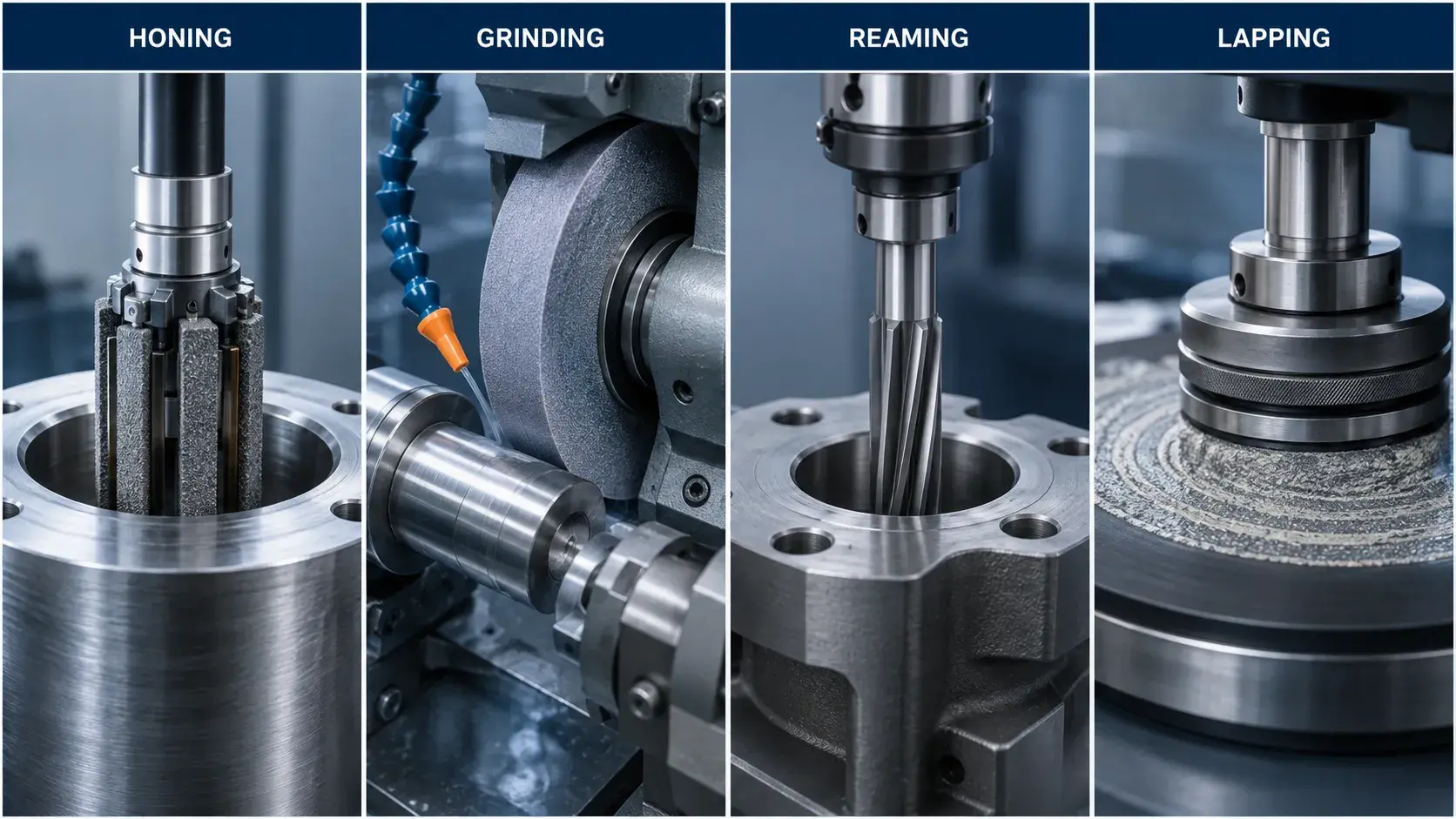
Honing is sometimes confused with other precision finishing operations.
The main difference is what each process is designed to improve.
| Process | Main Purpose | Material Removal | Common Application |
|---|---|---|---|
| Honing | Improve bore geometry and surface | Very low | Precision internal bores |
| Grinding | Shape and finish hard surfaces | Low to medium | Internal and external surfaces |
| Reaming | Bring a drilled hole to size | Low | General precision holes |
| Lapping | Produce extremely fine finish and flatness | Extremely low | Sealing and mating surfaces |
Honing vs Grinding
Grinding normally uses a rigid abrasive wheel moving at relatively high speed.
Honing uses abrasive stones with a slower combined rotating and reciprocating motion.
Internal grinding is effective for producing accurate bores, while honing is especially useful for correcting small bore geometry errors and producing a controlled surface texture.
Honing vs Reaming
Reaming is usually performed after drilling to improve hole size and finish.
A reamer follows the existing hole closely, so its ability to correct certain shape errors is limited.
Honing removes material from high areas within the bore and can further improve roundness, taper, straightness, and surface texture.
Honing vs Lapping
Lapping generally uses loose abrasive particles between two surfaces.
It is mainly used when extremely fine surface finish, flatness, or close mating contact is required.
Honing uses bonded abrasive stones and is more commonly used for cylindrical bores.
Common Applications of Honing
Honing is widely used for components where the quality of an internal bore directly affects fit, sealing, friction, or service life.
Typical applications include:
- engine cylinders;
- hydraulic cylinders;
- pneumatic cylinders;
- bearing bores;
- connecting rod bores;
- valve bodies;
- compressor components;
- precision sleeves;
- bushings;
- fuel-system components;
- gearbox components;
- brake cylinders.
In many of these parts, the bore must maintain a consistent diameter while also meeting strict requirements for roundness and surface condition.
When Should You Use Honing After CNC Machining?
Honing is useful when a CNC-machined bore is already close to final size but still needs better geometry or surface control.
For example, a hole may be bored or reamed first and then honed when the final part requires tighter:
- bore diameter consistency;
- roundness;
- straightness;
- cylindricity;
- surface roughness;
- cross-hatch requirements.
Honing is usually not the best choice for removing large amounts of material.
If the hole is significantly undersized or badly positioned, boring or another machining process should normally be used first.
Honing works best as a controlled finishing operation.
Conclusion
Honing is a precision finishing process used mainly to improve internal bores after drilling, boring, reaming, or grinding.
Its combined rotating and reciprocating motion can improve diameter accuracy, roundness, straightness, cylindricity, and surface texture while removing only a small amount of material.
For precision CNC parts, honing is especially useful when the bore is already close to final size but requires tighter geometry or a more controlled working surface.
Frequently Asked Questions
Yes. Honing is an abrasive machining process that removes a small amount of material to improve dimensional accuracy, geometry, and surface condition.
Common materials include cast iron, carbon steel, alloy steel, stainless steel, aluminum, and some hard or wear-resistant materials.
The abrasive and process parameters must be matched to the workpiece material.
Honing normally removes only a small amount of material because it is a finishing process.
The required stock allowance depends on the bore size, starting geometry, material, and final tolerance.
Not always.
Reaming is faster and more economical when the main goal is simply to size a hole after drilling.
Honing is better when the bore also requires improved roundness, straightness, cylindricity, or a controlled surface texture.
Yes, within limits.
Because the abrasive stones contact high areas of the bore, honing can improve out-of-roundness and other small geometric errors.
Engine cylinders are honed to control bore geometry and create a cross-hatched surface.
The texture helps retain lubricating oil and supports proper interaction between the cylinder wall and piston rings.



