

Aluminum is generally considered a non-magnetic metal.
Under normal circumstances, magnets do not attract aluminum the way they attract steel, so most people assume that aluminum is “non-magnetic.”
However, from a strictly materials science perspective, aluminum is not entirely non-magnetic; rather, it is a type of metal known as a “paramagnetic material”.
This means:
- Ordinary magnets can hardly attract aluminum.
- Aluminum does not retain its magnetism over the long term.
- Aluminum cannot be magnetized to become a permanent magnet.
- Under extremely strong magnetic fields, aluminum may exhibit a very weak magnetic response.
For the vast majority of industrial and everyday applications, aluminum can be considered a non-magnetic material.
Comparison of the Magnetic Properties of Common Metals
| Material | Clearly Magnetic? |
|---|---|
| Iron | Yes |
| Carbon Steel | Yes |
| Nickel | Yes |
| Cobalt | Yes |
| Stainless Steel (Some Grades) | Sometimes |
| Aluminum | No |
| Copper | No |
| Brass | No |
| Titanium | No |
As can be seen from the table, aluminum, like copper, brass, and titanium, is a common non-magnetic engineering material.
Do magnets attract aluminum?
No.
If you bring a regular magnet close to an aluminum sheet, aluminum rod, or aluminum part, the magnet will usually not be attracted to it.
This is because aluminum does not possess ferromagnetism, unlike iron, nickel, and cobalt.
For example:
- Aluminum doors and windows
- Aluminum profiles
Aluminum radiators - CNC-machined aluminum parts
- Aluminum alloy cell phone cases
None of these products will be attracted by a standard magnet.
In fact, many people use a magnet to quickly distinguish between aluminum and steel:
- If it is clearly attracted by a magnet → It is likely steel
- If it is not attracted at all → It is likely aluminum, copper, or brass
However, it’s important to note that relying solely on a magnet test cannot 100% confirm the type of material, as some stainless steels may also exhibit weak or no magnetic properties.
Why doesn’t aluminum exhibit noticeable magnetism?
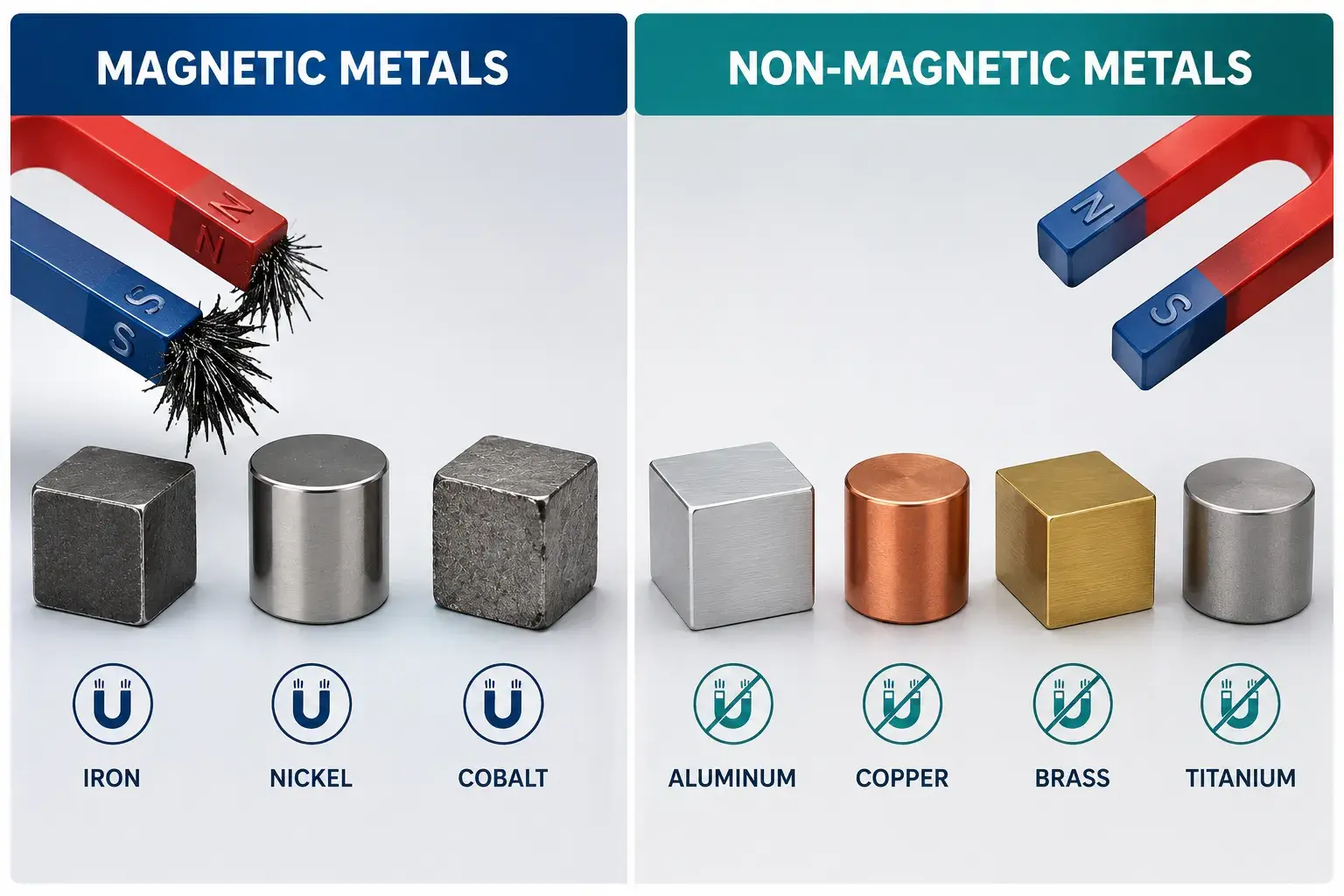
To understand this question, we first need to know what kinds of metals are magnetic.
What makes metals magnetic?
The magnetic metals we are familiar with mainly include:
- Iron
- Nickel
- Cobalt
The arrangement of electrons within these metals allows them to form stable magnetic domains.
When exposed to an external magnetic field, these magnetic domains align in the same direction, resulting in noticeable magnetism.
This is why magnets can easily attract these materials.
Why is aluminum different?
Aluminum’s electronic structure is completely different from that of iron.
Although aluminum is theoretically affected by magnetic fields, this effect is extremely weak.
Consequently:
- It is not attracted by ordinary magnets.
- It does not develop permanent magnetism.
- It does not become magnetized like steel.
In materials science, this property is known as:
Paramagnetism
Paramagnetic materials exhibit a weak response to magnetic fields, but this response is typically so faint that it is almost imperceptible to humans.
This is why many sources classify aluminum directly as a non-magnetic material.
Can aluminum become a magnetic material?
Under normal circumstances, no.
However, in certain special environments, aluminum may exhibit phenomena related to magnetic fields.
Strong Magnetic Field Environments
In laboratories or large-scale scientific research facilities, extremely strong magnetic fields may exert a weak force on aluminum.
Although this phenomenon exists, it is nowhere near as strong as the force with which a magnet attracts steel.
Therefore, in practical engineering applications, it can generally be ignored.
Eddy Current Effect
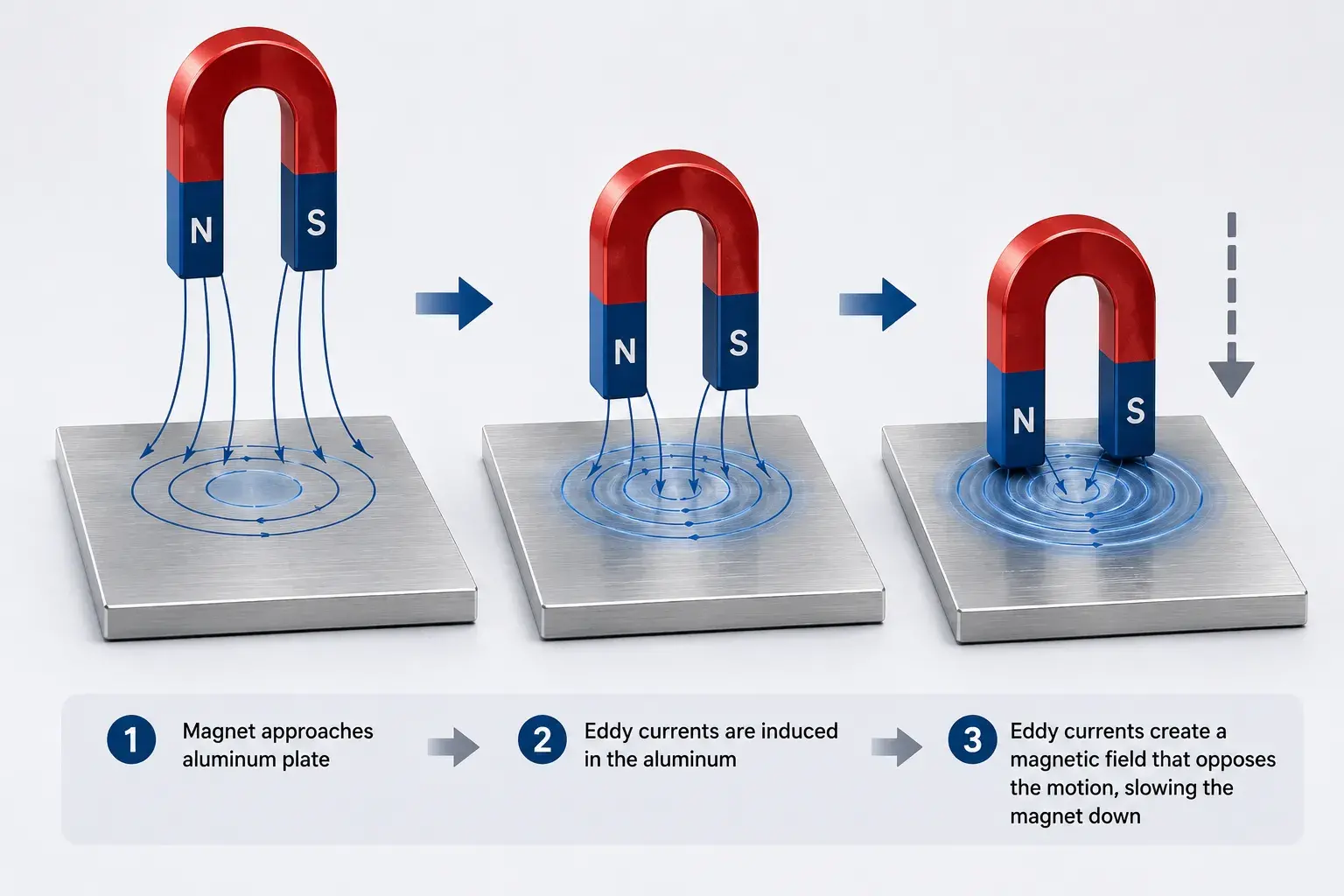
This is a more common occurrence in industrial settings.
When a magnet is moved rapidly across the surface of an aluminum plate, induced currents (eddy currents) are generated within the aluminum.
These eddy currents create a counter-magnetic field, which in turn generates resistance.
Many people have conducted the following experiment:
Slide a strong magnet down the surface of a vertically placed aluminum plate.
The result is that:
the magnet’s descent speed noticeably slows down.
This is not because aluminum is magnetic, but because the eddy current effect generates a braking force.
This principle is widely applied in:
- Maglev systems
- High-speed train braking systems
- Electromagnetic braking devices
- Industrial inspection equipment
Are aluminum alloys magnetic?
Since pure aluminum is generally considered a non-magnetic material, are common industrial aluminum alloys also non-magnetic?
The answer is:
The vast majority of aluminum alloys are also non-magnetic materials.
Although alloying elements such as magnesium, silicon, copper, zinc, and manganese are added to aluminum alloys to improve strength, corrosion resistance, or machinability, these elements typically do not alter aluminum’s fundamental magnetic properties.
Therefore, whether in the aerospace, automotive, or CNC machining industries, most aluminum alloys retain their non-magnetic properties.
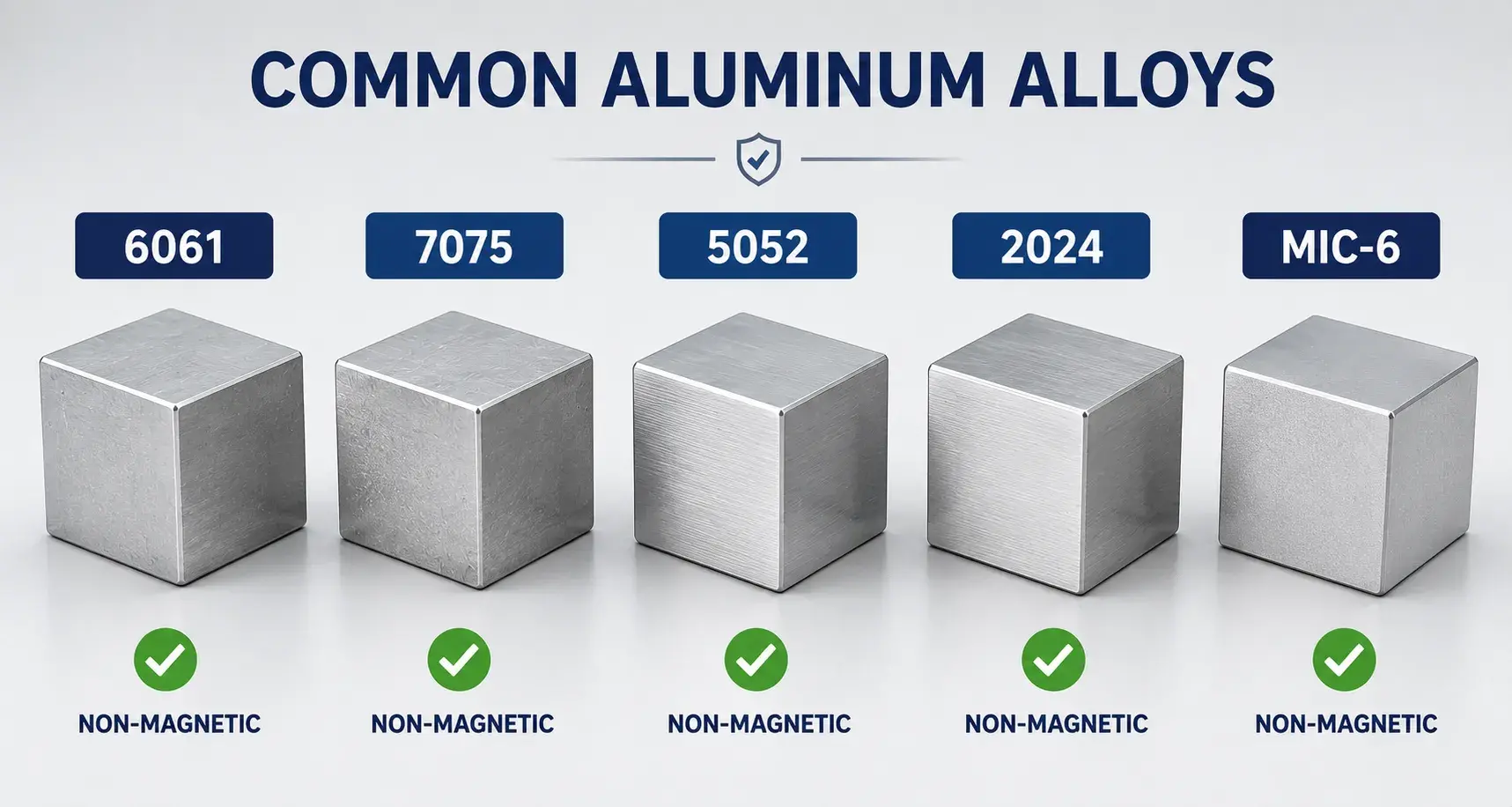
Magnetic Properties Comparison of Common Aluminum Alloys
| Aluminum Alloy | Clearly Magnetic? | Common Applications |
|---|---|---|
| 6061 | No | Structural components, automation equipment |
| 7075 | No | Aerospace parts |
| 5052 | No | Sheet metal enclosures, housings |
| 2024 | No | Aircraft structural components |
| MIC-6 | No | Precision fixtures, tooling plates |
For applications where magnetic interference must be avoided—such as electronic devices, medical equipment, and precision instruments—aluminum alloys are typically an ideal choice.
Does anodizing change the magnetic properties of aluminum?
Anodizing is a common surface treatment process that uses an electrochemical reaction to form a hard oxide layer on the surface of aluminum, thereby improving corrosion resistance, wear resistance, and aesthetic quality.
However, this process only alters the surface structure and does not change the internal material composition of the aluminum.
Therefore:
- Regular aluminum does not become magnetic as a result of anodizing.
- 6061 aluminum remains non-magnetic after anodizing.
- 7075 aluminum remains non-magnetic after anodizing.
- Anodizing does not affect the magnetic properties of aluminum.
This is particularly important for products that require both anodizing and non-magnetic properties, such as electronic device housings, medical device parts, and aerospace components.
Aluminum vs. Stainless Steel: Which Is More Magnetic?
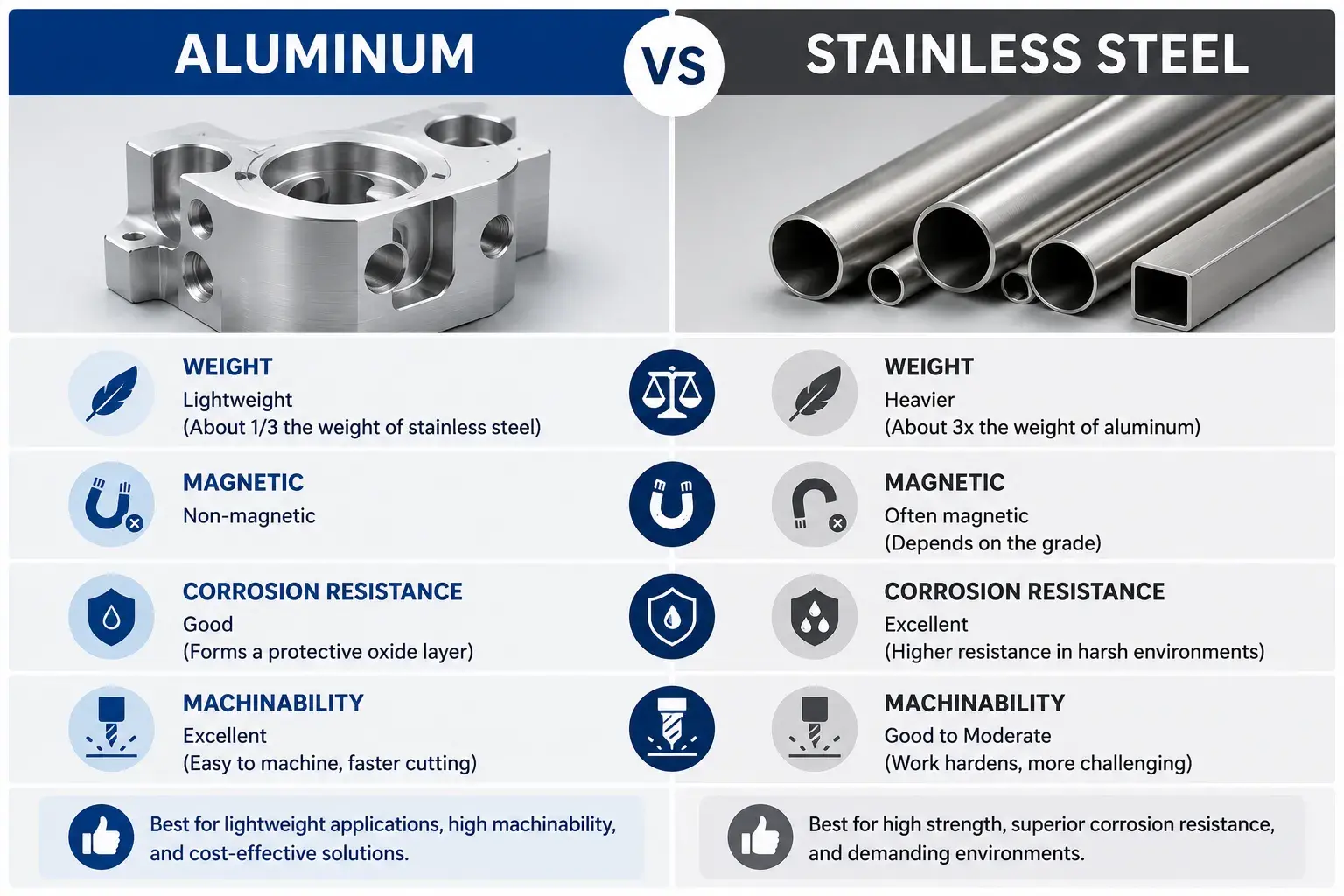
Many people believe that, like aluminum, stainless steel is not attracted to magnets, but this is not actually the case.
Whether stainless steel is magnetic depends on its specific grade and microstructure.
For example:
- 304 stainless steel is typically weakly magnetic
- 316 stainless steel is typically almost non-magnetic
- 430 stainless steel is distinctly magnetic
- Martensitic stainless steel is typically strongly magnetic
In contrast, aluminum—whether pure aluminum or most industrial aluminum alloys—generally remains non-magnetic.
Comparison of the Magnetic Properties of Aluminum and Stainless Steel
| Property | Aluminum | Stainless Steel |
|---|---|---|
| Magnetic Properties | Non-Magnetic | Depends on Grade |
| Weight | Lightweight | Heavier |
| Corrosion Resistance | Excellent | Excellent |
| Thermal Conductivity | Excellent | Moderate |
| Machinability | Excellent | More Difficult to Machine |
If a project is weight-sensitive and requires materials that are not affected by magnetic fields, aluminum is generally a better choice than stainless steel.
Can aluminum shield magnetic fields?
This is a commonly misunderstood issue.
Many people believe:
Since aluminum is non-magnetic, it should be able to block magnetic fields.
In reality, this is not the case.
For static magnetic fields, aluminum cannot shield magnetic field lines as effectively as materials with high magnetic permeability.
Therefore:
- Aluminum cannot effectively block the magnetic field generated by a permanent magnet
- Aluminum cannot replace specialized magnetic shielding materials.
- Aluminum is not an ideal material for magnetic field isolation.
However, aluminum has good electrical conductivity.
In high-frequency electromagnetic environments, aluminum can help shield against some electromagnetic interference (EMI) and radio frequency interference (RFI).
This is one of the key reasons why many:
- Communication devices
- Electronic enclosures
- Industrial control systems
- Semiconductor equipment
One of the main reasons why aluminum housings are used.
Why is non-magnetic aluminum so important in the engineering field?
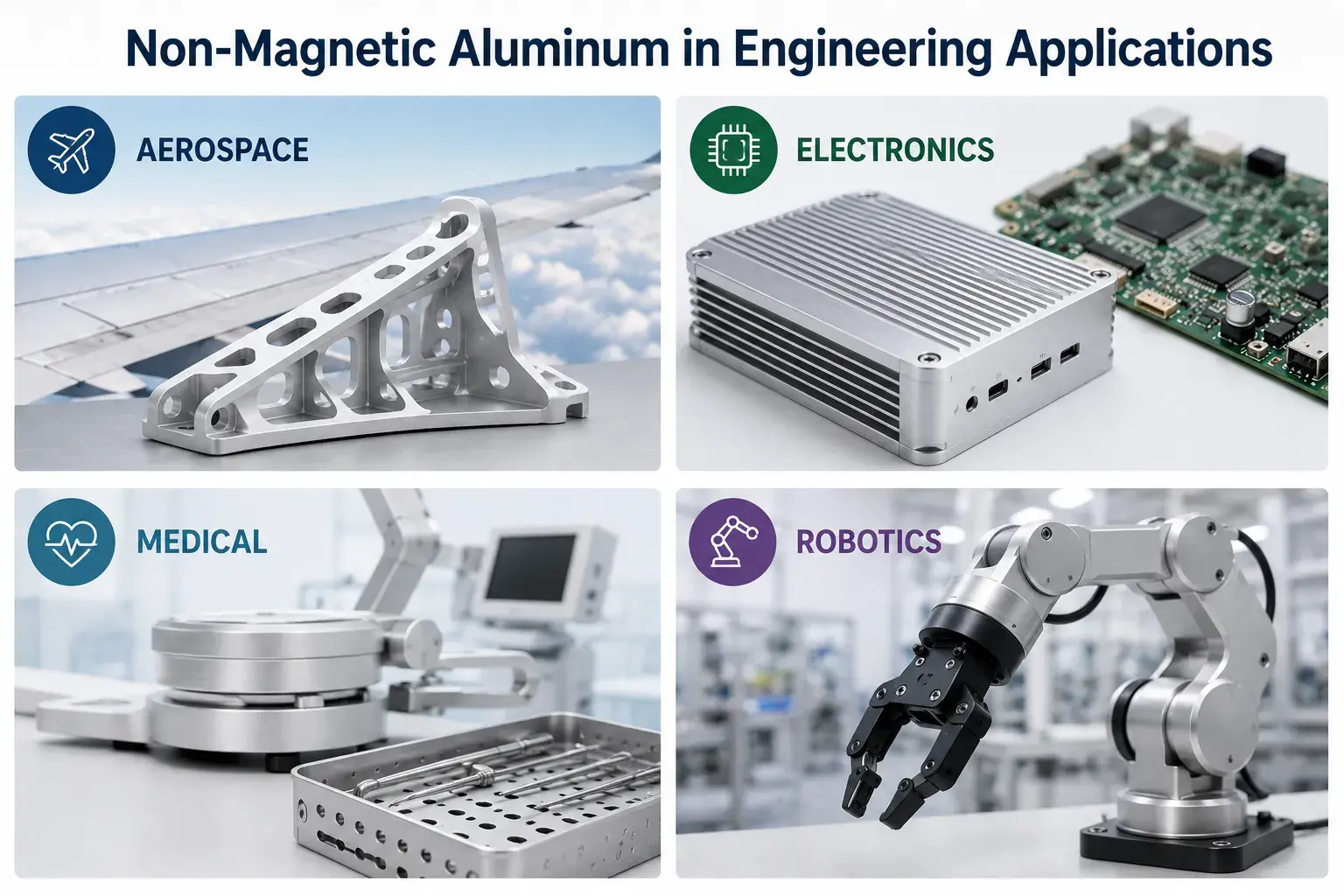
In modern manufacturing, aluminum’s non-magnetic property is not merely a material characteristic; it often directly affects product performance and the application environment.
Aerospace Industry
The aerospace sector has long relied heavily on 6061, 2024, and 7075 aluminum alloys.
In addition to their lightweight advantages, aluminum’s resistance to magnetic field interference is another key reason for their widespread use.
Typical applications include:
- Aircraft structural components
- Avionics enclosures
- Satellite components
- Drone frames
Electronics Industry
Sensors, circuit boards, and precision components in electronic devices typically require protection from the effects of external magnetic fields.
Aluminum is not only lightweight but also offers:
- Non-magnetic properties
- Good heat dissipation
- Excellent corrosion resistance
As a result, it is widely used in:
- Server enclosures
- Communication equipment
- Industrial control cabinets
- Power supply housings
Medical Device Industry
Around MRI machines and high-precision medical devices, magnetic materials may interfere with equipment operation.
Consequently, many medical devices prioritize the use of:
- Aluminum alloy frames
- Aluminum brackets
- Non-magnetic structural components
to reduce the risk of magnetic interference.
Semiconductor and Automation Equipment
Semiconductor equipment and automation systems contain a large number of sensors and precision measuring devices.
Aluminum’s non-magnetic properties help to:
- Improve measurement stability
- Reduce magnetic interference
- Enhance equipment reliability
Consequently, it has become an essential material for equipment frames and precision parts.
Need Custom Aluminum CNC Parts?
Upload your drawing and our engineering team will review your material, tolerance, and machining requirements within 24 hours.
Get a Free QuoteWhy is aluminum one of the most popular materials in CNC machining?
In addition to its non-magnetic properties, aluminum is also one of the most widely used materials in the global CNC machining industry.
Reasons include:
Excellent machinability:Aluminum is easy to machine, offers high machining efficiency, and allows for the production of complex structures and high-precision dimensions.
Lightweight advantage: Aluminum has a density of only about one-third that of steel, making it ideal for products that require weight reduction.
Good corrosion resistance: A natural oxide film effectively protects the material’s surface.
Relatively Low Cost: Compared to high-performance materials such as titanium alloys, aluminum offers better cost advantages.
Currently, the most common aluminum materials used in CNC machining include:
- Aluminum 6061
- Aluminum 7075
- Aluminum 5052
- MIC-6 Cast Aluminum Plate
These materials are widely used in the aerospace, robotics, medical equipment, automation, and electronics industries.
In Conclusion
Overall, aluminum is a typically non-magnetic metal.
Neither pure aluminum nor most industrial aluminum alloys are typically attracted by ordinary magnets, nor do they exhibit noticeable magnetic properties like steel.
Although aluminum may exhibit a weak response under extremely strong magnetic fields, it can be considered a non-magnetic material for the vast majority of engineering and everyday applications.
Precisely because it combines the advantages of light weight, corrosion resistance, ease of machining, and non-magnetic properties, aluminum has become one of the most important engineering materials in the aerospace, electronics, medical devices, semiconductor equipment, and CNC precision machining industries.
Frequently Asked Questions
No. Ordinary magnets will not stick to aluminum the way they stick to iron or carbon steel. This is because aluminum does not possess strong ferromagnetic properties.
No. Pure aluminum is not magnetic. It belongs to a group of materials known as paramagnetic metals, which exhibit only a very weak response to magnetic fields.
Most commercial aluminum alloys remain non-magnetic. Common grades such as 6061, 7075, 5052, and 2024 are all considered non-magnetic and are widely used in aerospace, electronics, and precision manufacturing.
Not effectively. Aluminum cannot shield static magnetic fields like specialized magnetic shielding materials. However, it can help reduce electromagnetic interference (EMI) in certain electronic applications.
Yes. Because aluminum is non-magnetic, it is commonly used in medical equipment, support structures, and components located near MRI systems where magnetic interference must be minimized.
Several commonly used engineering metals are generally non-magnetic, including:
- Aluminum
- Copper
- Brass
- Titanium
- Zinc
- Lead
Some stainless steel grades, such as 304 and 316, may also exhibit little or no magnetic attraction.



