

Use the thread size charts below to quickly find thread pitch or TPI, major diameter, and common tap drill sizes for UNC, UNF, metric, NPT, and BSP threads.
If you already know the thread designation, such as 1/4-20 UNC, M6 × 1.0, or 1/4-18 NPT, you can go directly to the corresponding chart.
How to Read a Thread Size

Thread designations look different depending on the thread standard.
Here are three common examples:
| Thread | What It Means |
|---|---|
| 1/4-20 UNC | 1/4 in nominal diameter, 20 threads per inch, UNC coarse thread |
| M6 × 1.0 | 6 mm nominal diameter, 1.0 mm thread pitch |
| 1/4-18 NPT | 1/4 nominal pipe size, 18 threads per inch |
For inch threads such as UNC and UNF, TPI (threads per inch) tells you how many thread peaks occur within one inch.
For metric threads, pitch is the distance from one thread crest to the next, measured in millimeters.
For example:
- M6 × 1.0 has a 1.0 mm pitch.
- M6 × 0.75 is a finer thread with a 0.75 mm pitch.
- 1/4-20 UNC has 20 threads per inch.
- 1/4-28 UNF has 28 threads per inch.
Pipe threads such as NPT and BSP are different because the nominal size does not directly equal the measured outside diameter.
UNC and UNF Thread Size Chart
UNC and UNF are part of the Unified Thread Standard commonly used in the United States and other inch-based applications.
UNC (Unified National Coarse) threads have fewer threads per inch and a larger pitch. They are widely used for general fastening.
UNF (Unified National Fine) threads have more threads per inch and a smaller pitch. They are useful where finer adjustment, greater engagement in thin sections, or a smaller thread helix angle is required.
Machine Screw Thread Sizes
| Thread Size | Series | TPI | Major Diameter (in) | Common Tap Drill (in) |
|---|---|---|---|---|
| #0-80 | UNF | 80 | 0.060 | 0.052 |
| #1-64 | UNC | 64 | 0.073 | 0.0625 |
| #2-56 | UNC | 56 | 0.086 | 0.073 |
| #2-64 | UNF | 64 | 0.086 | 0.076 |
| #4-40 | UNC | 40 | 0.112 | 0.089 |
| #5-40 | UNC | 40 | 0.125 | 0.1015 |
| #5-44 | UNF | 44 | 0.125 | 0.104 |
| #6-32 | UNC | 32 | 0.138 | 0.1065 |
| #6-40 | UNF | 40 | 0.138 | 0.113 |
| #8-32 | UNC | 32 | 0.164 | 0.136 |
| #8-36 | UNF | 36 | 0.164 | 0.136 |
| #10-24 | UNC | 24 | 0.190 | 0.1495 |
| #10-32 | UNF | 32 | 0.190 | 0.159 |
| #12-24 | UNC | 24 | 0.216 | 0.177 |
| #12-28 | UNF | 28 | 0.216 | 0.182 |
Note: Tap drill sizes are common starting values. The final drill diameter may change depending on the required thread percentage, material, tap type, and machining process.
Common Fractional UNC and UNF Threads
| Nominal Size | UNC | UNF | Major Diameter (in) |
|---|---|---|---|
| 1/4 | 1/4-20 | 1/4-28 | 0.250 |
| 5/16 | 5/16-18 | 5/16-24 | 0.3125 |
| 3/8 | 3/8-16 | 3/8-24 | 0.375 |
| 7/16 | 7/16-14 | 7/16-20 | 0.4375 |
| 1/2 | 1/2-13 | 1/2-20 | 0.500 |
| 9/16 | 9/16-12 | 9/16-18 | 0.5625 |
| 5/8 | 5/8-11 | 5/8-18 | 0.625 |
| 3/4 | 3/4-10 | 3/4-16 | 0.750 |
| 7/8 | 7/8-9 | 7/8-14 | 0.875 |
| 1 | 1-8 | 1-12 | 1.000 |
The first number gives the nominal thread diameter, while the second number gives the TPI.
For example:
3/8-16 UNC means a 3/8-inch nominal thread with 16 threads per inch.
3/8-24 UNF has the same nominal diameter but uses 24 threads per inch.

Metric Thread Size Chart
Metric threads are normally written as:
M diameter × pitch
For example:
M8 × 1.25
means:
- Nominal diameter = 8 mm
- Thread pitch = 1.25 mm
When the pitch is omitted, such as simply M8, the standard coarse pitch is normally implied.
Common Metric Coarse Threads
| Thread Size | Nominal Diameter (mm) | Coarse Pitch (mm) | Common Tap Drill (mm) |
|---|---|---|---|
| M1.6 | 1.6 | 0.35 | 1.25 |
| M2 | 2.0 | 0.40 | 1.60 |
| M2.5 | 2.5 | 0.45 | 2.05 |
| M3 | 3.0 | 0.50 | 2.50 |
| M4 | 4.0 | 0.70 | 3.30 |
| M5 | 5.0 | 0.80 | 4.20 |
| M6 | 6.0 | 1.00 | 5.00 |
| M8 | 8.0 | 1.25 | 6.80 |
| M10 | 10.0 | 1.50 | 8.50 |
| M12 | 12.0 | 1.75 | 10.20 |
| M14 | 14.0 | 2.00 | 12.00 |
| M16 | 16.0 | 2.00 | 14.00 |
| M18 | 18.0 | 2.50 | 15.50 |
| M20 | 20.0 | 2.50 | 17.50 |
| M22 | 22.0 | 2.50 | 19.50 |
| M24 | 24.0 | 3.00 | 21.00 |
A simple rule often used when estimating a metric tap drill is:
Tap drill diameter ≈ nominal diameter − thread pitch
For example:
M8 × 1.25
8 − 1.25 = 6.75 mm
A standard 6.8 mm drill is therefore commonly used.
This is a useful quick estimate, but the actual drill size should still be selected according to the required thread engagement, material, tap type, and manufacturing specification.
Common Metric Fine Threads
The same nominal diameter may also have one or more fine pitches.
| Thread Size | Common Fine Pitch (mm) | Typical Tap Drill (mm) |
|---|---|---|
| M4 × 0.5 | 0.50 | 3.50 |
| M5 × 0.5 | 0.50 | 4.50 |
| M6 × 0.75 | 0.75 | 5.20 |
| M8 × 1.0 | 1.00 | 7.00 |
| M10 × 1.25 | 1.25 | 8.80 |
| M12 × 1.5 | 1.50 | 10.50 |
| M14 × 1.5 | 1.50 | 12.50 |
| M16 × 1.5 | 1.50 | 14.50 |
| M20 × 1.5 | 1.50 | 18.50 |
| M24 × 2.0 | 2.00 | 22.00 |
Coarse metric threads are normally the default choice for general-purpose fastening. Fine threads may be selected when a design requires a smaller pitch, finer adjustment, or more thread engagement within a limited axial length.
NPT Thread Size Chart
NPT is a tapered pipe thread standard widely used for pipes, fittings, pneumatic systems, hydraulic connections, and fluid-handling components.
One important point is that NPT size is nominal.
For example, a 1/4 NPT thread does not measure 0.250 inch across its outside diameter.
NPT threads also use a taper, so their diameter changes along the thread length.
The quick-reference chart below covers the most commonly used NPT sizes.
Common NPT Thread Sizes
| NPT Size | TPI | Approx. Outside Diameter (in) | Common Tap Drill |
|---|---|---|---|
| 1/8 NPT | 27 | 0.405 | R |
| 1/4 NPT | 18 | 0.540 | 7/16 in |
| 3/8 NPT | 18 | 0.675 | 37/64 in |
| 1/2 NPT | 14 | 0.840 | 23/32 in |
| 3/4 NPT | 14 | 1.050 | 59/64 in |
| 1 NPT | 11.5 | 1.315 | 1-5/32 in |
| 1-1/4 NPT | 11.5 | 1.660 | 1-1/2 in |
| 1-1/2 NPT | 11.5 | 1.900 | 1-47/64 in |
| 2 NPT | 11.5 | 2.375 | 2-7/32 in |
NPT threads use a 60° thread angle and a standard taper of 1:16 on diameter. Their outside diameter is larger than the nominal pipe size, so measuring only the nominal designation can be misleading.
For a complete table covering NPT dimensions, TPI, outside diameter, taper, drill sizes, and NPT vs NPTF, see our NPT Thread Size Chart.
BSP Thread Size Chart
BSP stands for British Standard Pipe and is widely used in Europe, Asia, Australia, and many industrial fluid systems.
The two common forms are:
- BSPP – parallel thread
- BSPT – tapered thread
BSP threads use a 55° Whitworth thread profile, which is one of the main differences from the 60° profile used by NPT threads.
Common BSPP Thread Sizes
BSPP threads are commonly designated with the letter G.
| BSPP Size | TPI | Pitch (mm) | Major Diameter (mm) |
|---|---|---|---|
| G 1/8 | 28 | 0.907 | 9.728 |
| G 1/4 | 19 | 1.337 | 13.157 |
| G 3/8 | 19 | 1.337 | 16.662 |
| G 1/2 | 14 | 1.814 | 20.955 |
| G 5/8 | 14 | 1.814 | 22.911 |
| G 3/4 | 14 | 1.814 | 26.441 |
| G 7/8 | 14 | 1.814 | 30.201 |
| G 1 | 11 | 2.309 | 33.249 |
| G 1-1/4 | 11 | 2.309 | 41.910 |
| G 1-1/2 | 11 | 2.309 | 47.803 |
| G 2 | 11 | 2.309 | 59.614 |
The nominal BSP size does not directly equal the measured thread diameter.
For example, a G 1/2 thread has a major diameter of about 20.955 mm, not 12.7 mm.
BSPT Thread Designations
BSPT uses tapered threads and is commonly designated using R or Rc:
- R – tapered external thread
- Rc – tapered internal thread
- Rp – parallel internal pipe thread used in certain ISO 7 connections
Common BSPT sizes use the same general Whitworth thread form and pitch series as corresponding BSP pipe sizes.
| BSPT Size | TPI | Pitch (mm) | Approx. Major Diameter (mm) |
|---|---|---|---|
| R 1/8 | 28 | 0.907 | 9.73 |
| R 1/4 | 19 | 1.337 | 13.16 |
| R 3/8 | 19 | 1.337 | 16.66 |
| R 1/2 | 14 | 1.814 | 20.96 |
| R 3/4 | 14 | 1.814 | 26.44 |
| R 1 | 11 | 2.309 | 33.25 |
BSPP and BSPT should not be selected only by nominal size. The sealing method, thread form, taper, and mating component must also be considered.
NPT vs BSP: Are They Interchangeable?
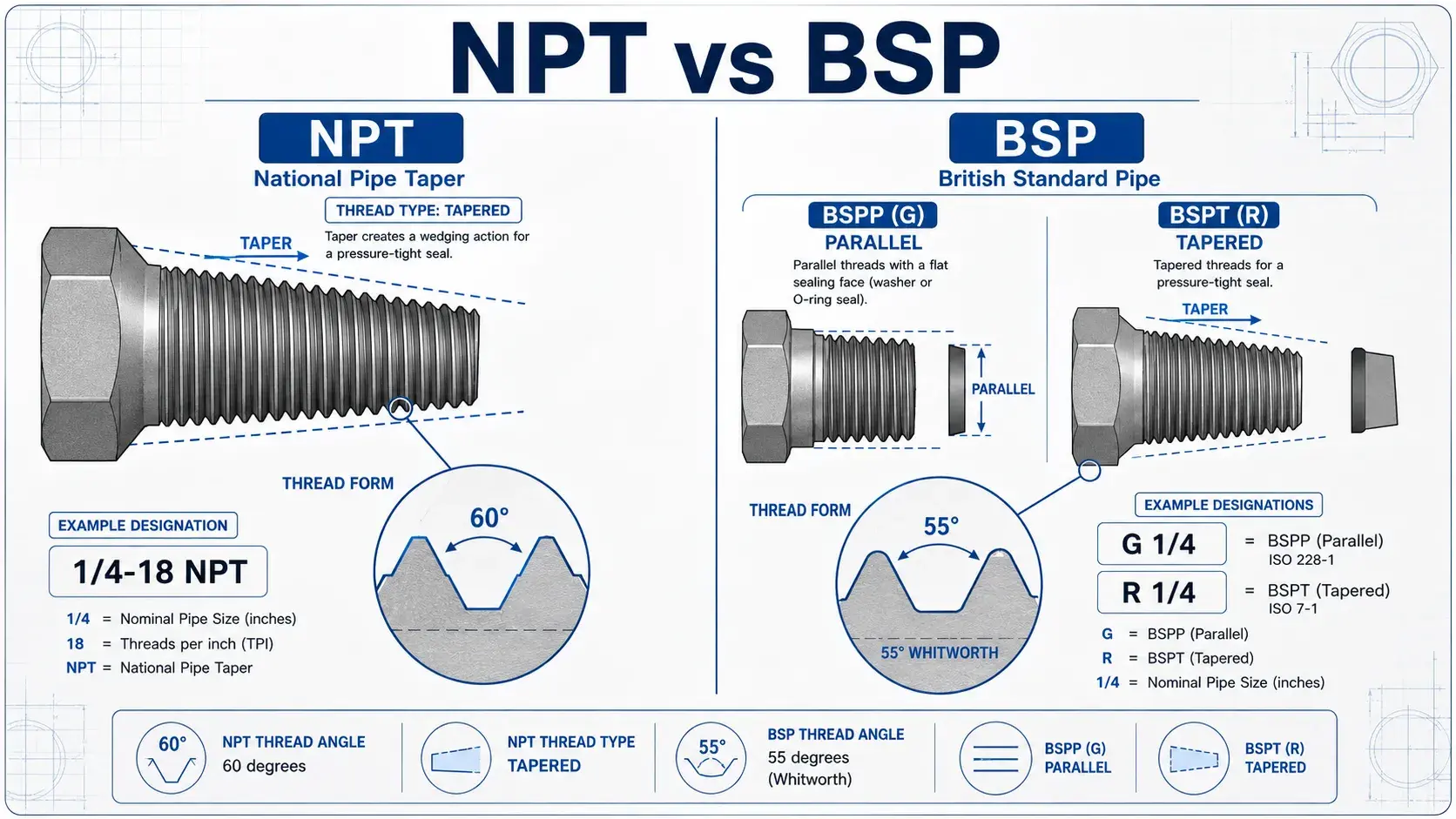
NPT and BSP threads may look similar, but they should generally not be treated as interchangeable.
The main differences are:
| Feature | NPT | BSP |
|---|---|---|
| Thread angle | 60° | 55° |
| Thread form | American pipe thread | Whitworth pipe thread |
| Common region | United States | Europe, Asia, Australia |
| Tapered version | NPT | BSPT |
| Parallel version | NPS | BSPP |
| Common designation | 1/4-18 NPT | G 1/4 or R 1/4 |
Another important difference is TPI.
For example:
- 1/4 NPT = 18 TPI
- G 1/4 BSPP = 19 TPI
Because the thread angle and pitch are different, forcing these threads together can damage the threads or create an unreliable seal.
Some nominal sizes may appear to engage for a few turns, but that does not mean the connection is correctly matched.
Which Thread Type Should You Use?
The correct thread depends on the component, mating hardware, industry standard, and region.
As a general guide:
Use UNC for general-purpose inch fasteners where coarse threads provide reliable assembly and good resistance to damage.
Use UNF where finer pitch, more threads within a short engagement length, or finer adjustment is required.
Use metric coarse threads for most general metric fastening applications.
Use metric fine threads where a finer pitch is specified by the design or application.
Use NPT for tapered pipe connections designed around the American NPT standard.
Use BSPP or BSPT when the mating component uses the British/ISO pipe thread system.
The thread callout on the engineering drawing should always identify the required standard rather than giving only a nominal diameter.
Thread Design Tips for CNC Machined Parts
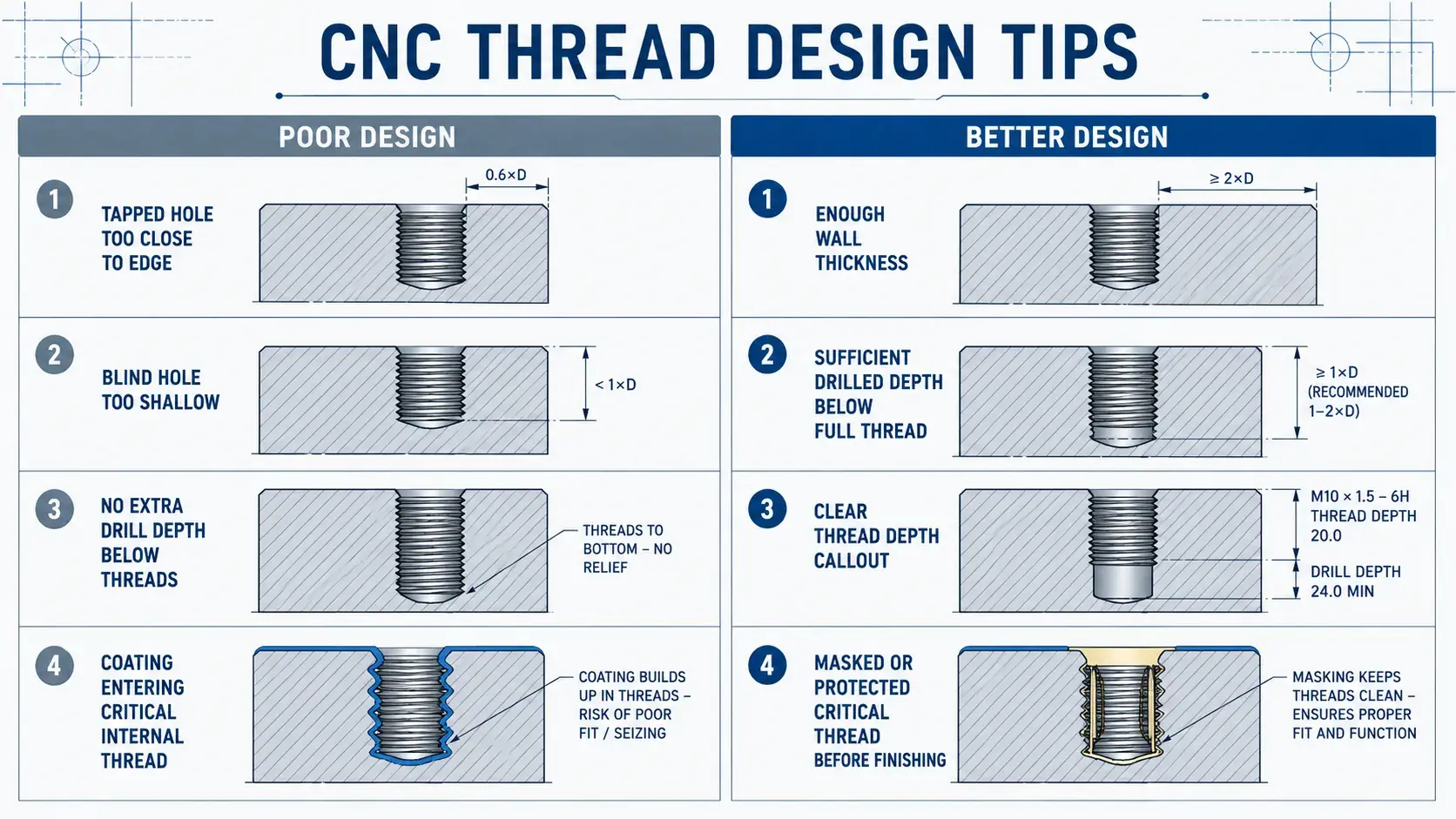
Thread dimensions affect both machinability and final assembly. A few simple design decisions can prevent common production problems.
Use Standard Thread Sizes Where Possible
Standard UNC, UNF, metric, NPT, and BSP sizes are easier to machine and inspect because taps, thread mills, gauges, and mating hardware are readily available.
Custom pitches should only be used when there is a specific engineering reason.
Provide Enough Thread Engagement
Very shallow threads can strip or fail under load.
The required engagement depends on the materials and load. Threads in softer materials such as aluminum or plastic may require greater engagement than threads in steel.
Leave Enough Material Around Tapped Holes
Avoid placing tapped holes too close to an edge or thin wall.
Insufficient surrounding material may cause:
- Wall distortion
- Cracking
- Breakout
- Reduced thread strength
Consider Blind-Hole Depth
A blind tapped hole needs additional depth below the usable thread because the drill point and tap lead cannot produce full threads all the way to the bottom.
The drawing should distinguish between:
- Full thread depth
- Drilled hole depth
These values should not automatically be the same.
Consider Surface Finishing
Anodizing, plating, powder coating, and other finishes can change the effective thread dimensions.
Critical threads may require:
- Masking before finishing
- Post-process chasing
- Plug or ring gauge inspection
This is especially important for tight-fitting internal threads.
FAQs
1/4-20 means the thread has a nominal diameter of 1/4 inch and 20 threads per inch.
If the designation is 1/4-20 UNC, it is a Unified National Coarse thread.
Thread pitch is the distance between adjacent thread crests.
Metric threads normally specify pitch in millimeters.
TPI means threads per inch and is commonly used for inch-based threads.
A higher TPI means a finer thread.
They can have the same nominal diameter but different pitches.
For example:
- 1/4-20 UNC
- 1/4-28 UNF
Both have a nominal diameter of 1/4 inch, but the UNF version has more threads per inch.
No.
NPT uses a 60° thread angle, while BSP uses a 55° Whitworth profile. Their TPI can also differ, so they should not normally be considered interchangeable.
The tap drill should leave enough material for the tap to form the required thread without creating excessive tapping torque.
For metric threads, a quick estimate is:
Tap drill ≈ nominal diameter − pitch



