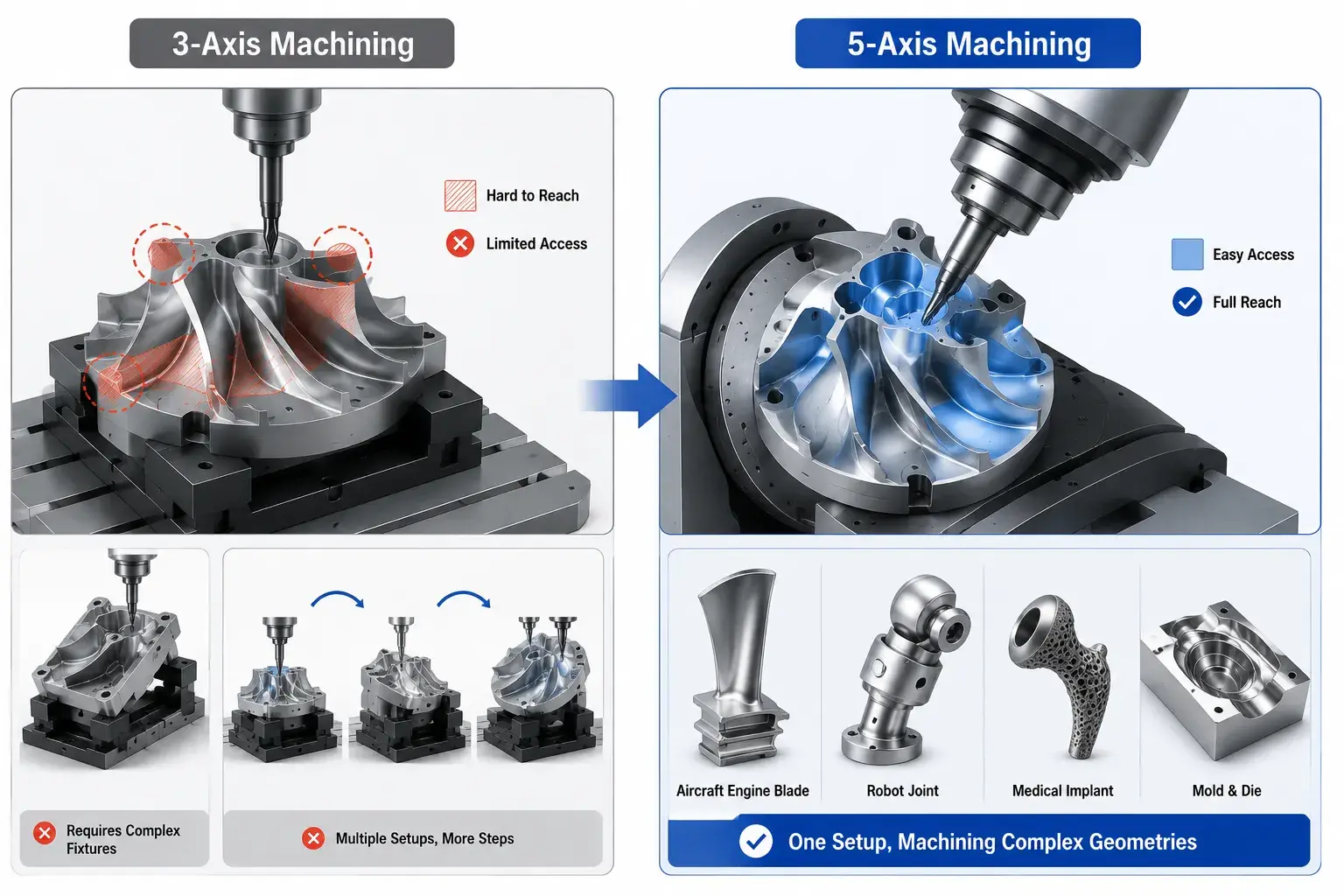
For parts with complex structures and high precision requirements, traditional 3-axis machining typically requires multiple setups, which not only increases machining time but also tends to result in cumulative positioning errors.
In contrast, 5 axis CNC machining can complete more machining operations in a single setup, making it widely used in the manufacturing of complex parts for industries such as aerospace, medical devices, and robotics.
So, what exactly are the advantages of 5-axis machining? This article will analyze, using real-world machining scenarios, how it improves machining quality, production efficiency, and overall manufacturing benefits.
Why Complex Parts Benefit More from 5-Axis Machining
Not every component needs to be machined using a 5-axis machine.
For parts that have simpler designs—like flat plates, brackets, and basic enclosures—machining with a 3-axis or 4-axis machine is typically adequate and more cost-efficient.
However, when a part has intricate surfaces, multiple angled holes, deep recesses, impellers, turbine blades, or requires precise positioning, using multiple setups can result in longer machining times and potential accumulation of dimensional errors.
The main advantage of 5-axis machining is not the number of axes it provides, but its ability to perform more complex operations in fewer setups.
This helps to enhance part quality, boost machining efficiency, and improve the consistency of the manufacturing process.
3-Axis vs 5-Axis for Complex Parts
Why does 5 axis machining offer higher precision and efficiency? The answer actually lies in the differences between it and 3-axis machining.
| Feature | 3-Axis CNC Machining | 5-Axis CNC Machining |
|---|---|---|
| Number of Setups | Often requires multiple setups | Can complete more operations in one setup |
| Machining Complexity | Best for simple and 2.5D parts | Ideal for complex geometries and multi-sided parts |
| Accuracy | Repeated setups may introduce positioning errors | Fewer setups help improve dimensional accuracy |
| Surface Finish | Limited tool angles may affect surface quality | Better surface finish through optimized tool orientation |
| Tool Accessibility | Difficult to reach deep cavities and angled features | Easier access to complex and hard-to-machine areas |
| Tool Length | Longer tools are often required | Shorter tools improve rigidity and machining stability |
| Production Efficiency | More setup time and manual intervention | Higher efficiency with fewer machining operations |
| Typical Applications | Plates, brackets, simple housings | Aerospace parts, impellers, medical implants, robotic components |
As shown in the table above, the advantages of 5-axis machining are not limited to the addition of two axes of motion; rather, during the machining of complex parts, they comprehensively improve part quality and production efficiency by reducing the number of setups, optimizing tool orientation, and enhancing machining stability.
Top Advantages of 5-Axis CNC Machining
Complete More Machining in a Single Setup
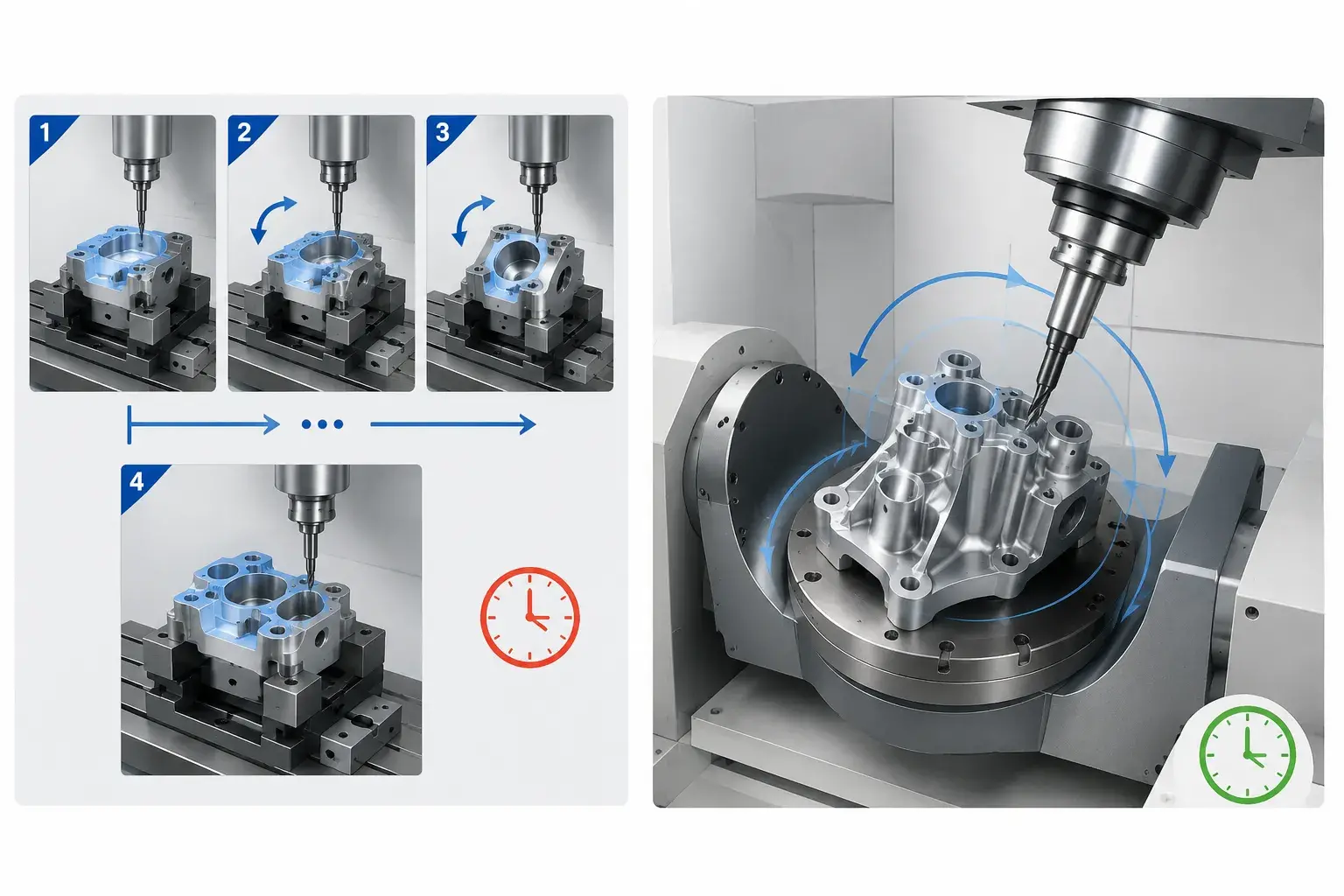
Completing more machining tasks in a single setup is one of the key benefits of 5-axis machining.
In traditional 3-axis machining, the workpiece often needs to be flipped several times to machine different surfaces.
Each time it is re-clamped, time is lost, and there is a higher chance of positioning errors.
With 5-axis machining, the cutting tool can reach the workpiece from various angles.
This allows most, or even all, machining operations for complex parts to be completed in one setup.
For complex components, this approach not only cuts down on unnecessary time but also greatly improves production efficiency.
Higher Machining Accuracy
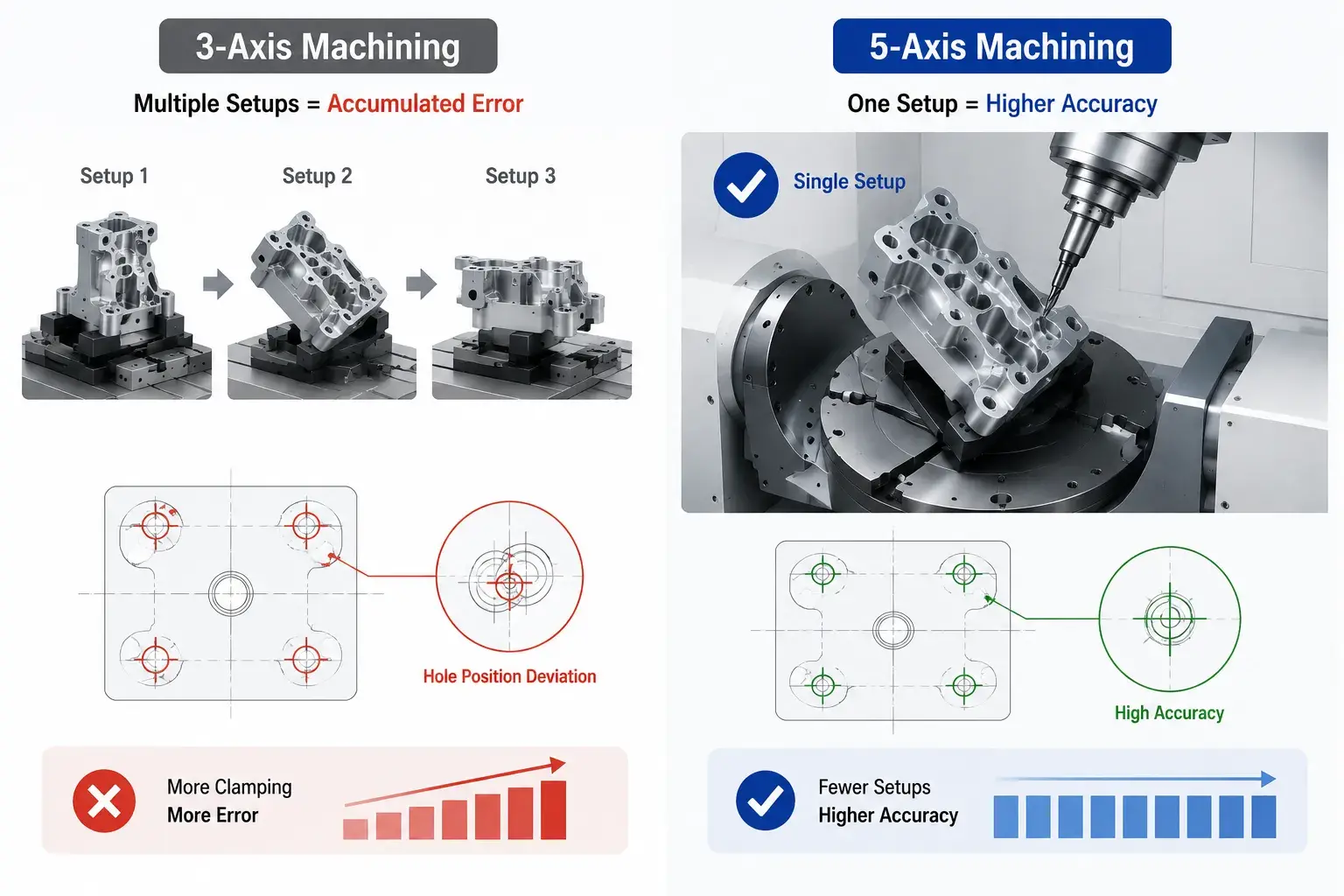
Machining accuracy is influenced not just by the machine tool but also by the number of times the workpiece is clamped.
Every time the workpiece is re-clamped, there is a risk of introducing new reference errors.
These errors can build up over time, which may lead to issues with hole positioning, accuracy in placement, and overall consistency in dimensions.
Because 5-axis machining requires fewer repositioning steps, it helps keep the machining reference more consistent.
This makes it easier to achieve high precision and meet strict tolerance requirements for complex parts.
This is especially significant in industries such as aerospace, medical devices, and precision equipment.
Better Surface Finish on Complex Surfaces
Traditional machining has always found it difficult to handle complex surfaces.
Five-axis machining helps keep the cutting angle as efficient as possible throughout the process, allowing for better contact between the tool and the workpiece.
Additionally, since shorter tools can be used, which are more rigid and produce less vibration during cutting, a smoother and more precise surface finish is achieved.
This benefit is especially noticeable when machining parts with complex shapes, such as molds, impellers, and medical implants.
Machine More Complex Geometries

Many parts have complex features such as deep recesses, angled openings, detailed curved surfaces, or regions that are hard for standard cutting tools to reach.
Using three-axis machining typically involves creating complicated fixtures and may require splitting the process into several steps.
On the other hand, five-axis machining allows both the workpiece and the tool to be repositioned, which makes it simpler for the tool to reach difficult areas and produce shapes that are hard to achieve with traditional methods.
This is a major reason why five-axis machining is commonly used in manufacturing parts like aircraft engine blades, robot joints, medical implants, and high-quality molds.
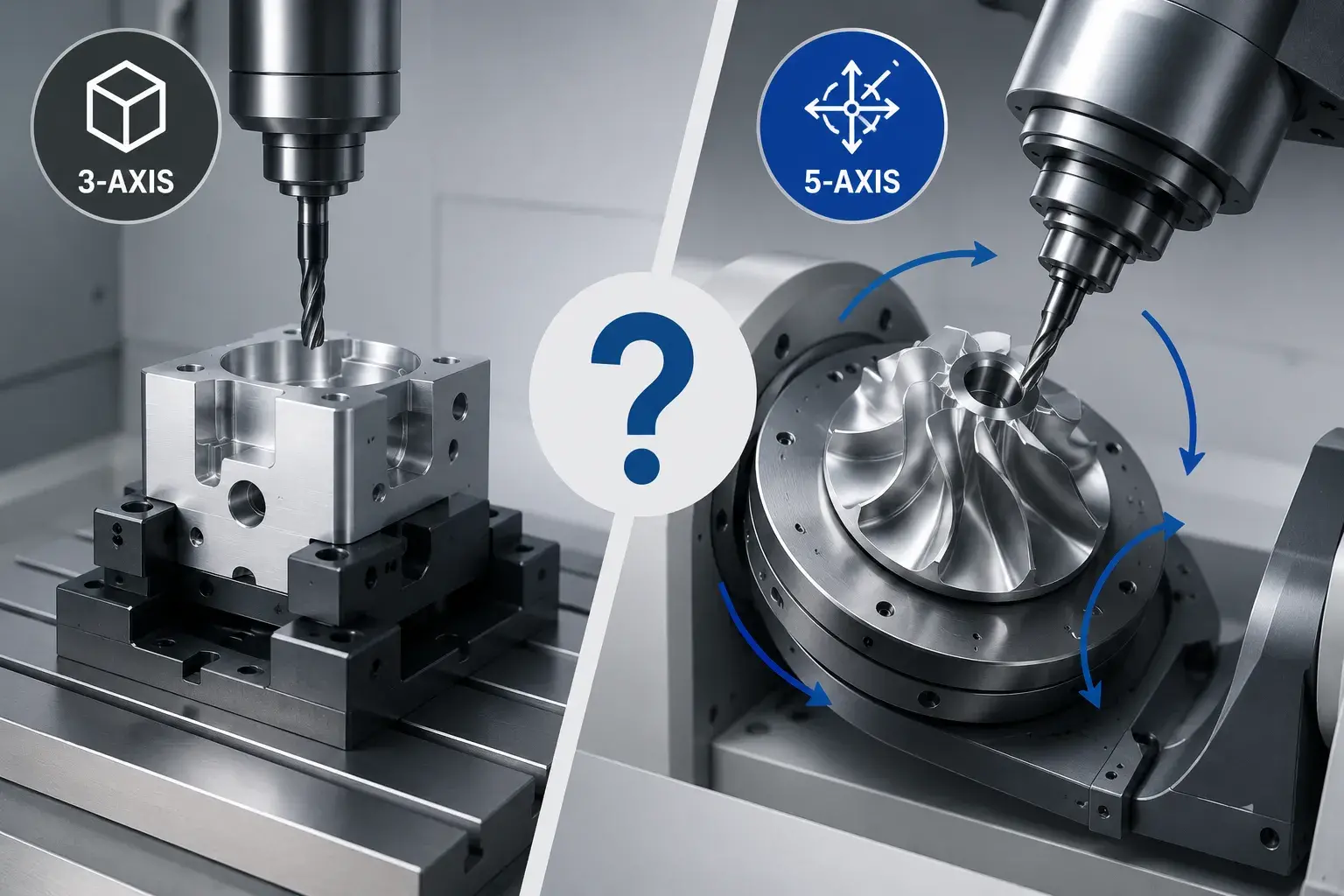
Shorter Cutting Tools and Better Stability
When machining deep-cavity parts, three-axis machines usually need longer cutting tools to access the machining area.
Longer cutting tools are more likely to experience vibration, tool contact, and runout.
These issues can impact the dimensional accuracy of the part and also lead to a lower surface finish quality.
Five-axis machining enables the cutting tool to be positioned closer to the workpiece by adjusting the tool’s angle.
This allows the use of shorter, more stable tools.
Improved tool rigidity leads to a more stable cutting process and also contributes to a longer tool lifespan.
Improved Productivity and Shorter Lead Time
Although 5-axis machine tools are generally more costly, they typically offer much greater machining efficiency compared to traditional methods.
This increased efficiency is achieved by reducing the number of setups, decreasing the need for tool changes, minimizing manual adjustments, and lowering the rate of rework, all of which contribute to a shorter overall production cycle.
In applications such as prototype development, small-batch production, and projects with strict deadlines, the benefits of this efficiency often outweigh the cost of the machine tool itself.
Lower Overall Manufacturing Cost
Many people think that 5-axis machining is always more expensive.
In reality, when looking just at the hourly cost of the machine, 5-axis machines are generally more costly than 3-axis machines.
But when you take into account the whole manufacturing process, 5-axis machining can cut down on expenses related to making fixtures, manually loading and unloading parts, inspecting quality, and fixing defects.
It also helps reduce the number of defective parts caused by errors during machining.
So, for complex components, even though the cost per unit might be higher, the total cost of making the project could end up being lower.
When Is 5 Axis CNC Machining Worth It?

Five-axis machining is not always the best option for every part.
If a part has a simple design, made up of flat surfaces, standard holes, and two-dimensional shapes, then three-axis machining is typically adequate and more cost-efficient.
On the other hand, when a part includes complex surfaces, angled features, precise positioning needs, or requires fewer setups, five-axis machining can provide considerable benefits.
Thus, when deciding on a machining method, it is important to carefully assess factors such as the part’s complexity, required accuracy, production quantity, and budget, rather than choosing a method solely based on the number of axes it uses.
Typical Complex Parts That Benefit from 5-Axis Machining
Five-axis machining is especially suitable for a variety of intricate parts, including:
- Aerospace structural components
- Turbine blades and impellers
- Medical implants
- Robotic joint components
- Semiconductor equipment components
- Precision mold cavities
- Multi-angle hydraulic valve blocks
- High-precision automation equipment components
These components often require complex surfaces, precise positioning of holes, or machining from multiple sides, making them the most typical uses for five-axis machining.
How YUANYI Supports Complex 5-Axis CNC Projects
YUANYI supports complex 5-axis CNC projects by offering specialized machining services for precision parts.We provide a full range of manufacturing solutions, from initial prototyping to large-scale production, tailored for industries like aerospace, medical devices, robotics, and automation.
Our 5-axis CNC machines are capable of handling parts with dimensions up to 600 × 910 × 450 mm and can work with a variety of materials, including aluminum alloy, stainless steel, titanium alloy, brass, copper, and various engineering plastics.
Backed by a team of experienced engineers, we achieve machining accuracy within ±0.005 mm and maintain high standards through a complete quality inspection process.This ensures our customers receive high-quality complex components along with detailed documentation such as CMM inspection reports, material certificates, and first article inspection reports.
Need Precision 5-Axis CNC Machining for Complex Parts?
From prototypes to production, YUANYI delivers precision 5-axis CNC machining for complex parts with tight tolerances, fast lead times, and consistent quality.
- ✓ 24-Hour Quote
- ✓ No MOQ
- ✓ ±0.005 mm Precision
- ✓ CMM Inspection Reports
- ✓ Prototype to Production
Conclusion
5 axis CNC machining provides major benefits in terms of accuracy, productivity, and the capability to create complex shapes.
It reduces the need for multiple setups and enhances the consistency of the machining process, making it the preferred choice for producing high-precision parts in industries like aerospace, medical, robotics, and industrial equipment.
If your project involves intricate components that require tight tolerances, selecting a skilled 5-axis machining partner is just as crucial as selecting the appropriate machining method.
At YUANYI, we use state-of-the-art 5-axis CNC machines, skilled engineers, and strict quality control processes to ensure reliable machining solutions from the prototype stage through to full production.
Frequently Asked Questions
Yes.
While 5-axis machining usually has a higher hourly cost compared to other methods, it can lead to lower overall project costs.This is because it reduces the number of setups needed, lowers the need for rework, decreases the rate of defective parts, and speeds up the production of complex components.
No.
In addition to common metals such as aluminum, stainless steel, titanium, brass, and copper, 5-axis CNC machining is also widely used for various engineering plastics like PEEK, Delrin (POM), Nylon, PTFE, and PC.
Industries that need intricate shapes and precise measurements benefit the most from 5-axis CNC machining.
These include aerospace, medical devices, robotics, semiconductor equipment, automotive, and industrial automation sectors.
Yes.
It is suitable for both creating prototypes quickly and for full-scale production.Many manufacturers use 5-axis machining to test and refine complex designs before moving on to mass production.
Not always.
Some parts can be made efficiently using 3-axis or 4-axis machining.The best choice depends on the shape of the part, the required precision, the number of units to be produced, and the budget available.
To get an accurate quote, it’s best to provide a 3D CAD model, specify the material to be used, the quantity of parts required, the tolerance levels needed, the desired surface finish, and any special inspection or certification requirements.
If your part involves multiple machining surfaces, deep cavities, complex curves, angled holes, or requires high precision, 5-axis machining is often the most effective and dependable option.
An experienced machining supplier can review your design and suggest the best manufacturing method for your needs.