

Transition metals are metallic elements found mainly in the d-block of the periodic table. They have partially filled d electron subshells in their atoms or can form ions with partially filled d subshells. Common examples include iron, titanium, nickel, copper, and chromium.
These metals are important because of their varied strength, conductivity, chemical behavior, and ability to form useful alloys. They are widely used in aerospace, electronics, medical devices, and industrial manufacturing. However, their properties differ significantly, making each suitable for different applications.
What Are Transition Metals?
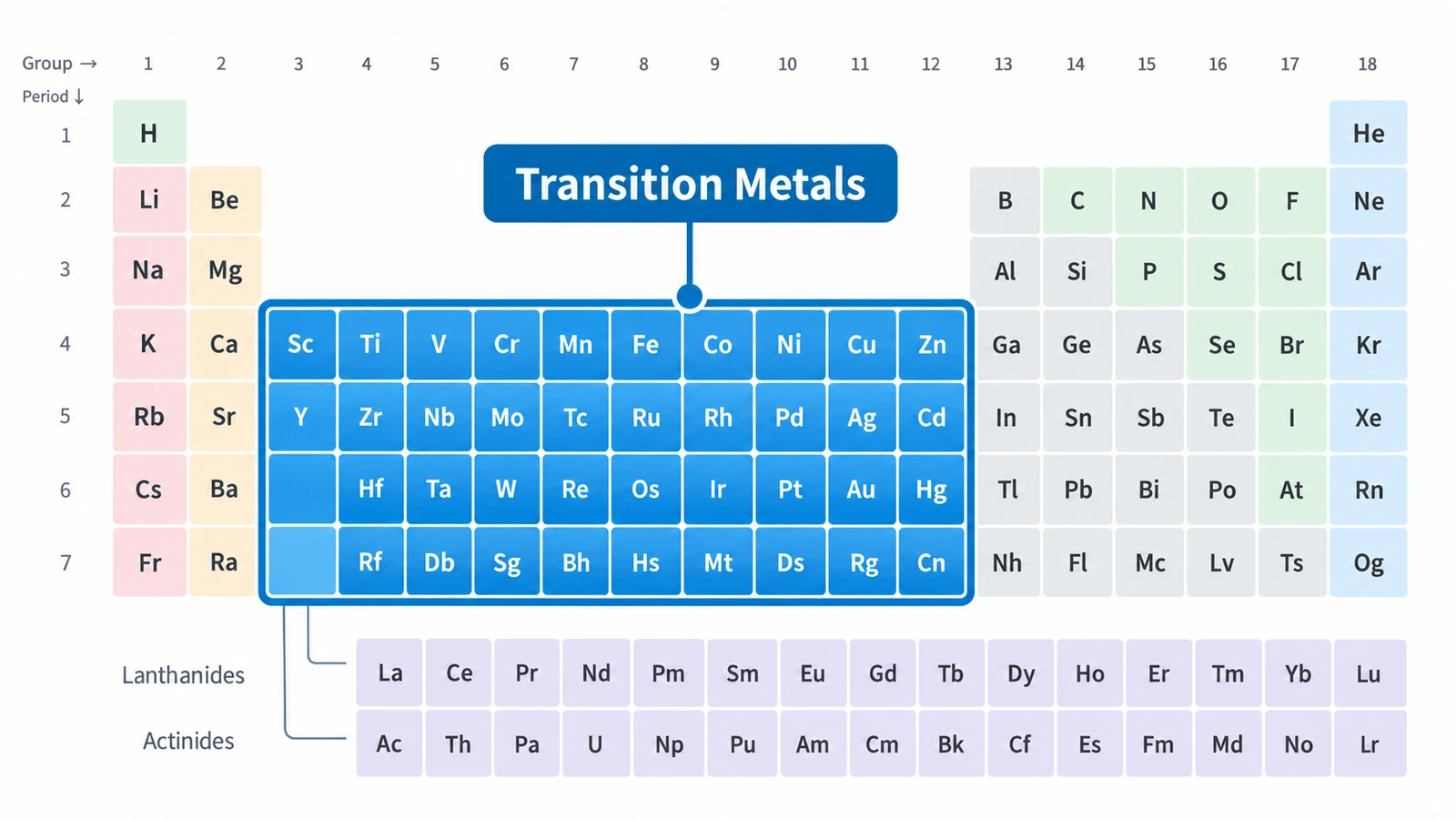
Transition metals are elements whose atoms have an incomplete d subshell or can form positive ions with an incomplete d subshell, according to the IUPAC definition.
Their electron structures help explain several characteristic chemical behaviors, including variable oxidation states, formation of coordination compounds, and catalytic activity.
For example, iron commonly forms Fe²⁺ and Fe³⁺ ions, while copper forms Cu⁺ and Cu²⁺ ions.
However, not every transition metal shares the same properties. Iron is widely used for structural strength, while copper is valued mainly for electrical conductivity.
Where Are Transition Metals on the Periodic Table?
Transition metals occupy the central region of the periodic table, mainly within Groups 3–11 of the d-block.
They are commonly divided into transition series:
- First series (Period 4): Scandium through copper
- Second series (Period 5): Yttrium through silver
- Third series (Period 6): Includes hafnium through gold, with Group 3 classification depending on convention
- Fourth series (Period 7): Includes several radioactive and synthetic elements
The lanthanides and actinides are generally treated separately as inner transition elements.
Not all d-block elements qualify as transition metals under the strict definition. Zinc, cadmium, and mercury have filled d subshells in their atoms and common ions, so they are generally excluded.
Which Elements Are Transition Metals?
Transition metals include familiar structural metals, precious metals, and specialized materials used in advanced engineering.
The following table lists representative transition metals and their typical applications.
| Element | Symbol | Key Property | Common Application |
|---|---|---|---|
| Titanium | Ti | High strength-to-weight ratio | Aerospace, medical implants |
| Vanadium | V | Strengthens alloys | High-strength steels |
| Chromium | Cr | Improves corrosion resistance in alloys | Stainless steel |
| Manganese | Mn | Important alloying element | Structural steels |
| Iron | Fe | Versatile alloy base | Machinery, construction |
| Cobalt | Co | High-temperature alloy performance | Superalloys, cutting tools |
| Nickel | Ni | Heat and corrosion-resistant alloys | Turbines, chemical equipment |
| Copper | Cu | High electrical conductivity | Electrical components |
| Zirconium | Zr | Corrosion resistance | Chemical processing |
| Molybdenum | Mo | High-temperature performance | Tool steels |
| Palladium | Pd | Catalytic activity | Catalytic converters |
| Silver | Ag | Excellent electrical conductivity | Electronic contacts |
| Tantalum | Ta | Corrosion resistance | Chemical equipment |
| Tungsten | W | Very high melting point | Cutting tools, heating components |
| Platinum | Pt | Chemical stability and catalytic activity | Catalysts, sensors |
| Gold | Au | Corrosion resistance | Electronic connectors |
This is a representative list rather than a complete list of all transition elements.
Many engineering applications use alloys or compounds containing transition metals rather than the pure elements themselves.
What Are the Properties of Transition Metals?
Transition metals exhibit several common physical and chemical characteristics, although individual elements can behave differently.
1. Strength and Hardness
Many transition metals and their alloys offer high strength and wear resistance. Iron-based alloys, for example, can be heat-treated to achieve different hardness levels.
However, copper, silver, and gold are relatively soft compared with hardened steels.
2. High Melting Points
Most transition metals have relatively high melting points.
Tungsten melts at approximately 3,422°C, while titanium melts at 1,668°C. These properties make certain transition metals useful in high-temperature environments.
3. Electrical and Thermal Conductivity
Many transition metals conduct electricity and heat effectively.
Copper and silver are especially good conductors, while titanium and many nickel alloys have much lower thermal conductivity.
These differences affect material selection for electronics, heat-transfer systems, and manufacturing.
4. Variable Oxidation States
Many transition metals can form ions with different oxidation states.
Examples include iron (+2, +3), copper (+1, +2), and manganese (+2, +4, +7).
This contributes to their diverse chemical reactions and compound formation.
5. Colored Compounds and Catalytic Activity
Many transition-metal compounds are colored because of their electronic structures. Copper(II) compounds, for instance, are often blue or green.
Several transition metals also act as catalysts. Platinum and palladium are used in catalytic converters, while nickel is used in industrial hydrogenation reactions.
Not all transition-metal compounds are colored, and catalytic behavior varies by element and chemical environment.
Transition Metals vs. Main-Group Metals
Transition metals differ from main-group metals primarily in their electron structures and chemical behavior.
| Property | Transition Metals | Main-Group Metals |
|---|---|---|
| Periodic table position | Mainly d-block | s-block and p-block |
| Electron structure | Incomplete d subshell in atoms or possible cations | Primarily s and p valence electrons |
| Oxidation states | Often multiple | Frequently fewer common states |
| Melting points | Often high | Highly variable |
| Hardness | Many are hard | Varies considerably |
| Catalytic activity | Common among several elements | Less common but possible |
| Engineering applications | Steels, superalloys, catalysts | Aluminum structures, tin coatings |
For example, aluminum is not a transition metal, but aluminum alloys are widely used in aerospace and precision manufacturing because of their low weight and good mechanical performance.
Therefore, belonging to the transition-metal group does not automatically mean a material is stronger or more suitable for engineering applications.
What Are Transition Metals Used For?
Transition metals are used across industries because of their different mechanical, electrical, thermal, and chemical properties.
| Industry | Common Metals | Typical Applications |
|---|---|---|
| Aerospace | Titanium, nickel | Structural components, turbine parts |
| Automotive | Iron, chromium, vanadium | Gears, shafts, structural steels |
| Electronics | Copper, gold, silver | Connectors, electrical contacts |
| Medical | Titanium, cobalt, chromium | Implants, surgical instruments |
| Manufacturing | Iron, tungsten, molybdenum | Cutting tools, dies, machine components |
| Chemical processing | Nickel, platinum, palladium | Catalysts, corrosion-resistant equipment |
Aerospace: Titanium alloys provide high strength at relatively low weight, while nickel-based superalloys retain useful mechanical properties at elevated temperatures.
Electronics: Copper is widely used for conductive components. Gold coatings help protect electrical contacts from corrosion.
Medical: Titanium and cobalt-chromium alloys are used in selected implants because of their mechanical properties, corrosion resistance, and biocompatibility.
Manufacturing: Iron-based steels provide structural strength, while tungsten carbide is widely used for cutting tools due to its hardness and wear resistance.
These applications illustrate why transition metals are valuable, but actual material performance depends on the specific grade, alloy composition, and processing condition.
How Do Transition Metals Affect CNC Machining?
Transition metals are widely used in precision manufacturing, but their chemical classification does not determine their machinability.
Machinability depends on the specific alloy, hardness, microstructure, cutting conditions, and component geometry.
For example, titanium and copper are both transition metals, yet they behave very differently during machining.
| Material | Main Machining Challenge | Typical Consideration |
|---|---|---|
| Titanium alloys | Heat concentration, tool wear | Tool selection, cooling, rigidity |
| Nickel-based alloys | Work hardening, high cutting forces | Controlled cutting parameters |
| Carbon steel | Hardness varies by grade | Material condition, tool selection |
| Stainless steel | Work hardening, burr formation | Sharp tooling, stable cutting |
| Pure copper | Burrs, material adhesion | Tool geometry, chip control |
| Hardened tool steel | High cutting forces, tool wear | Wear-resistant tools, machining sequence |
Titanium’s low thermal conductivity can concentrate heat near the cutting edge, increasing tool wear. Nickel-based superalloys may work-harden during cutting, requiring careful control of feed rates and tool engagement.
Copper conducts heat efficiently, but its ductility can contribute to burr formation and material adhesion.
For precision components, engineers should therefore evaluate strength, corrosion resistance, operating temperature, machining difficulty, and material cost rather than relying solely on the transition-metal classification.
At YUANYI, material selection and machining strategies are evaluated according to component geometry, tolerance requirements, and the properties of each alloy.
For components requiring a high strength-to-weight ratio and corrosion resistance, our Titanium CNC Machining Services support custom precision parts in commonly used titanium grades.
Conclusion
Transition metals are metallic elements with distinctive d-electron structures and a wide range of useful properties. They play essential roles in engineering, electronics, aerospace, medicine, and manufacturing.
Although many transition metals share chemical characteristics, their mechanical properties and manufacturing behavior differ significantly. Choosing the right metal or alloy requires evaluating its actual performance and the requirements of the application.
Frequently Asked Questions
No, not under the strict IUPAC definition. Zinc belongs to Group 12 of the d-block, but its atom and common Zn²⁺ ion have completely filled d subshells.
The name reflects their position between the s-block and p-block regions of the periodic table, where electrons progressively occupy d subshells.
No. Iron, cobalt, and nickel are ferromagnetic at room temperature, but many other transition metals are not. Magnetic behavior depends on the element and material conditions.
Prices vary considerably. Iron is relatively inexpensive, while platinum, palladium, and gold are much more costly. Purity, availability, and processing requirements also affect cost.
Yes. Transition metals and their alloys are widely used in precision parts. Material suitability depends on the required strength, corrosion resistance, temperature performance, and machinability.



