

CNC stands for Computer Numerical Control. It means using a computer program to automatically control a machine’s movement, speed, position, and machining operations.
In manufacturing, CNC technology is commonly used to control milling machines, lathes, routers, grinders, EDM machines, and other automated equipment. Instead of relying entirely on manual operation, the machine follows programmed numerical instructions to produce parts accurately and repeatedly.
What Does CNC Mean?
The meaning of CNC becomes easier to understand when the term is broken into three parts:
| Term | What It Means |
|---|---|
| Computer | Reads and processes the machining program |
| Numerical | Uses numerical values such as coordinates, speeds, depths, and feed rates |
| Control | Controls how the machine moves and performs operations |
So, Computer Numerical Control means controlling a machine through computer-based numerical instructions.
For example, a CNC program may tell a machine to move a cutting tool to a specific X, Y, or Z position, rotate the spindle at a certain speed, and move through the material at a defined feed rate.
That is the basic idea behind CNC.
What Does CNC Stand For?
CNC stands for Computer Numerical Control.
The term describes a method of controlling machines rather than one specific type of machine.
This is why you may see terms such as:
- CNC milling machine
- CNC lathe
- CNC router
- CNC grinder
- CNC EDM machine
- CNC laser cutting machine
All of these machines can use computer numerical control, even though they perform different manufacturing operations.
A useful way to think about it is:
CNC is the control system, while the machine performs the physical manufacturing process.
What Is a CNC Machine?
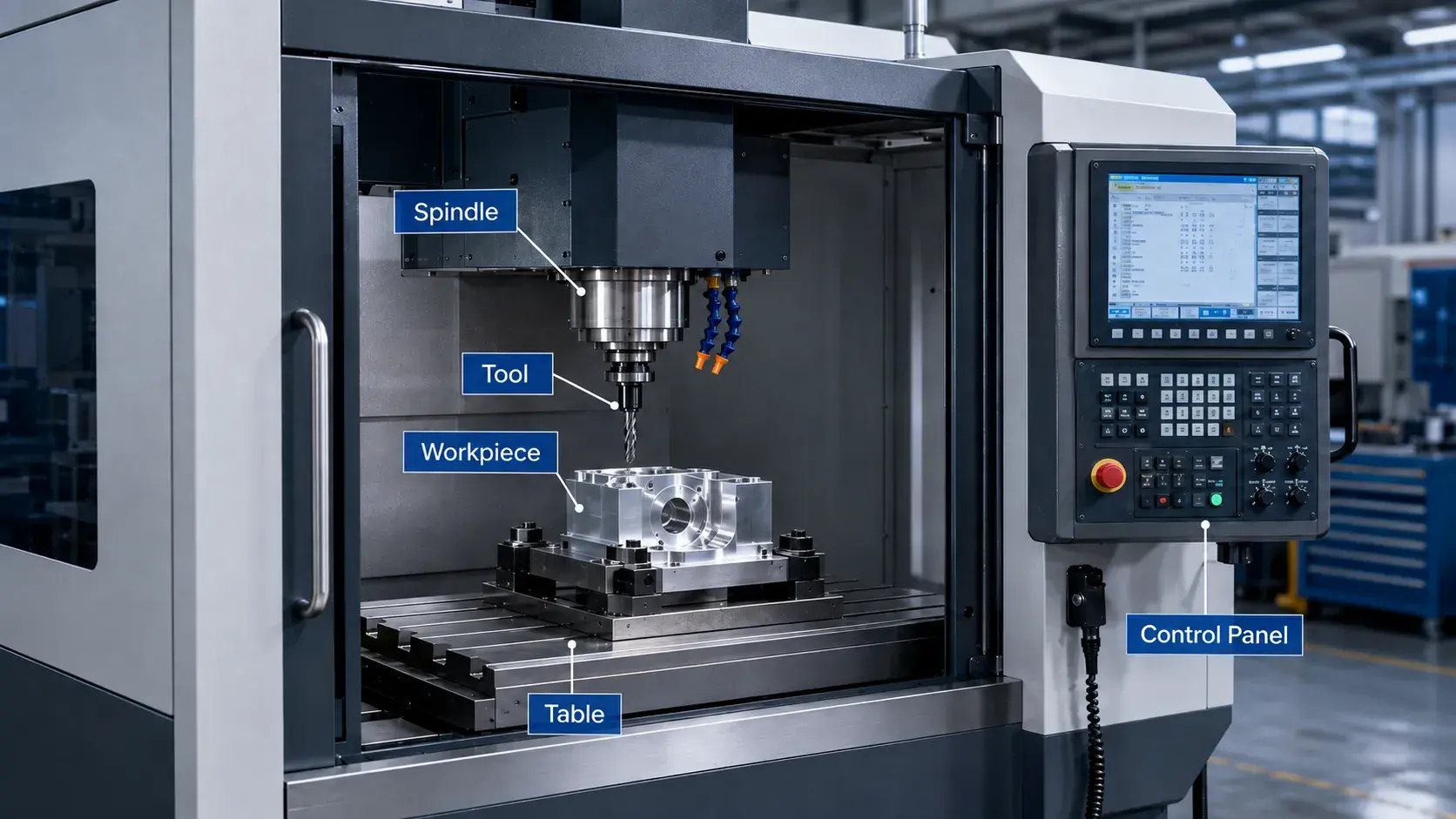
A CNC machine is a machine controlled by programmed computer instructions.
Instead of an operator manually controlling every movement, the CNC controller reads a program and sends commands to the machine.
Depending on the equipment, CNC may control:
- Axis movement
- Tool position
- Spindle speed
- Feed rate
- Cutting depth
- Tool changes
- Coolant
- Drilling and tapping cycles
For example, a CNC milling machine moves cutting tools along controlled axes to create holes, pockets, slots, surfaces, and complex features.
A CNC lathe works differently. The workpiece rotates while cutting tools move into position to create cylindrical features such as shafts, threads, grooves, and bores.
What Does “Numerical Control” Actually Mean?
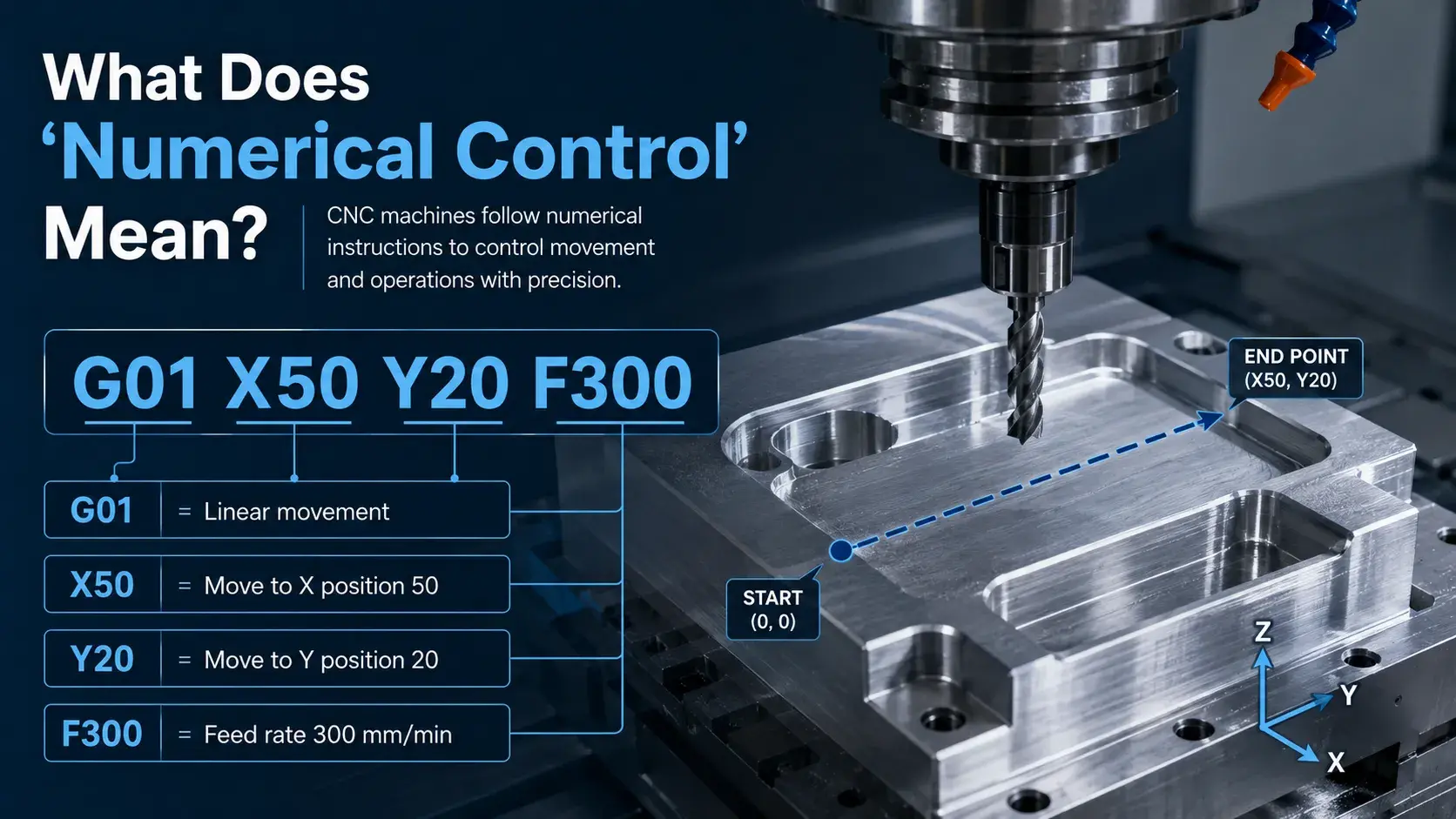
The words numerical control refer to controlling a machine using numbers and coded instructions.
A very simple CNC command might look like this:
G01 X50 Y20 F300
This command contains numerical information that tells the machine what to do.
For example:
- G01 tells the machine to make a controlled linear movement.
- X50 tells it to move to a position on the X axis.
- Y20 defines the Y-axis position.
- F300 defines the feed rate.
The exact meaning depends on the machine and programming system, but the basic principle is the same.
The machine is not simply being told “move to the right.”
It is being given precise numerical instructions about where to move, how fast to move, and what operation to perform.
That is where the name Computer Numerical Control comes from.
How Does CNC Work?
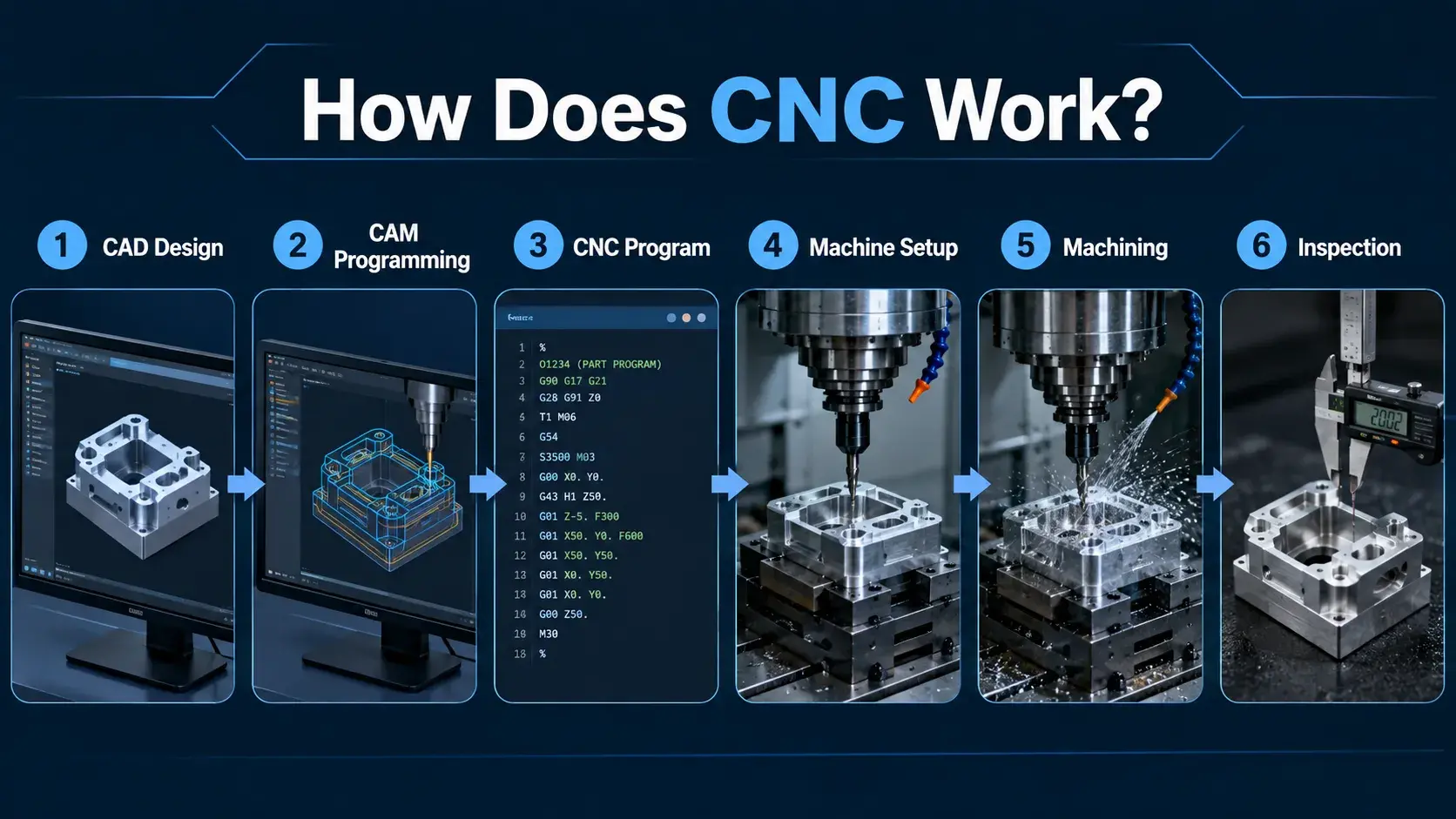
A typical CNC manufacturing process starts with a digital design and ends with a finished physical part.
The basic workflow is:
CAD Design → CAM Programming → CNC Program → Machine Setup → Machining → Inspection
First, the part is designed using CAD software. CAM software is then used to create the machining toolpath and define cutting tools, speeds, feeds, and machining strategies.
The toolpath is converted into CNC instructions that the machine controller can read. After the workpiece and tools are set up, the machine follows the programmed movements to manufacture the part.
The finished component is then inspected to confirm that it meets the required dimensions and tolerances.
CNC improves repeatability and automation, but final accuracy still depends on correct programming, tooling, fixturing, machine condition, material, and inspection.
CNC vs Manual Machining
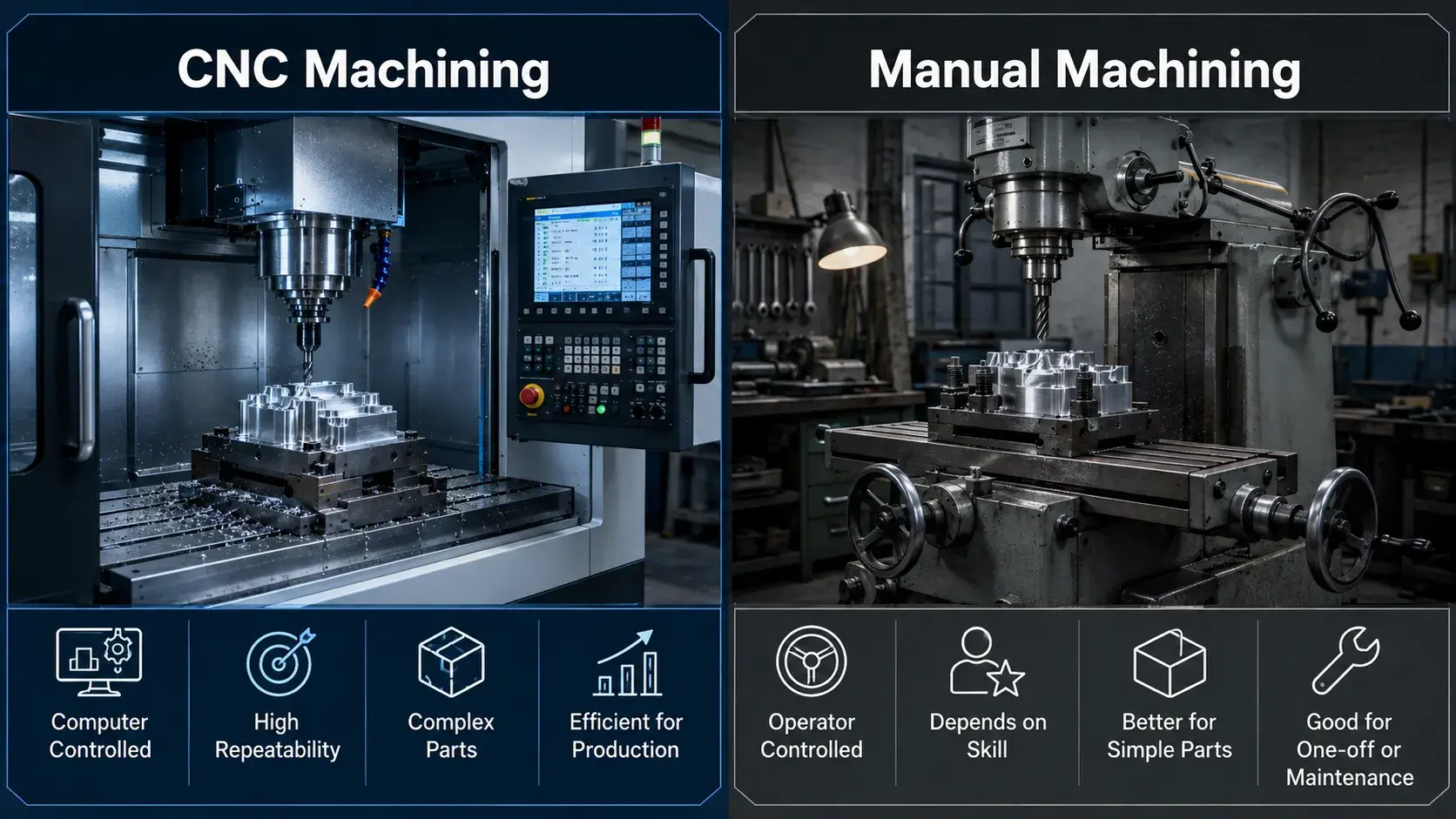
The biggest difference between CNC machining and manual machining is how machine movement is controlled.
| CNC Machining | Manual Machining |
|---|---|
| Controlled by a computer program | Controlled directly by the operator |
| Movement follows programmed coordinates | Movement is adjusted manually |
| High repeatability | More dependent on operator skill |
| Suitable for complex geometry | Best suited to simpler operations |
| Efficient for repeated production | Useful for one-off adjustments and simple work |
| Programs can be reused | Operations must often be repeated manually |
Manual machines are still useful for maintenance, repair, simple machining, and certain low-volume jobs.
However, CNC machines are usually preferred when parts require complex geometry, repeatability, automation, or larger production quantities.What Is the Difference Between CNC and CNC Machining?
CNC and CNC machining are related, but they do not mean exactly the same thing.
CNC is a control technology.
CNC machining is a manufacturing process that uses CNC-controlled machine tools to remove material from a workpiece.
For example, CNC technology can be used in:
- Milling
- Turning
- Grinding
- Routing
- EDM
- Laser cutting
- Plasma cutting
- Bending
- Other automated manufacturing processes
Therefore, not every CNC machine is necessarily a CNC machining center.
A CNC laser cutter uses CNC control, but it removes material using a laser rather than a traditional cutting tool.
Common Types of CNC Machines
Different CNC machines are designed for different manufacturing operations.
| CNC Machine | Main Use |
|---|---|
| CNC Milling Machine | Machines pockets, holes, slots, flat surfaces, and complex 3D features |
| CNC Lathe | Produces cylindrical parts such as shafts, pins, bushings, and threads |
| CNC Router | Cuts wood, plastics, composites, foam, and some soft metals |
| CNC Grinder | Produces precise dimensions and fine surface finishes |
| CNC EDM Machine | Machines hard metals and difficult internal features using electrical discharge |
| CNC Laser or Plasma Cutter | Cuts sheet metal or plate along programmed paths |
Modern CNC machining centers may also use 3, 4, or 5 controlled axes depending on the complexity of the part.
Why Is CNC Used in Manufacturing?
CNC is widely used because it improves automation, repeatability, and production consistency.
Its main advantages include:
- Repeatability: the same program can produce similar parts repeatedly.
- Complex geometry: multiple axes can be coordinated to machine difficult features.
- Higher productivity: programmed operations reduce continuous manual control.
- Consistency: machine movements can be repeated from part to part.
- Automation: tool changes, probing, coolant, and other functions can be integrated into the machining cycle.
However, CNC does not automatically guarantee a precise part.
Accuracy also depends on the machine, tooling, fixture, programming, cutting parameters, material stability, and inspection process.
Where Is CNC Used?
CNC technology is used across many manufacturing industries, including:
- Aerospace
- Automotive
- Medical
- Robotics
- Electronics
- Industrial machinery
- Consumer products
Typical CNC-made parts include brackets, housings, shafts, connectors, prototypes, molds, medical components, and precision machine parts.
CNC is especially useful when manufacturers need complex parts that can be produced consistently from digital designs.
Is CNC the Same as CAD?
No.
CAD and CNC perform different functions.
CAD, or Computer-Aided Design, is used to create the digital design of a part.
CNC controls the physical machine that manufactures the part.
A typical process may look like this:
CAD → CAM → CNC Machine
CAD defines what the part should look like.
CAM determines how it should be manufactured.
The CNC machine then follows the generated instructions to make the physical component.
Does CNC Always Mean Machining?
No.
CNC means Computer Numerical Control, and the technology can control many different types of manufacturing equipment.
CNC is commonly associated with milling and turning, but it can also control:
- Lasers
- Plasma cutters
- Routers
- Press brakes
- Grinding machines
- EDM equipment
- Waterjet cutters
Therefore, CNC is broader than CNC machining.
Does a CNC Machine Run Completely by Itself?
Not usually.
CNC machines automate many movements and machining operations, but skilled people are still required.
Depending on the job, CNC manufacturing may involve:
- CAD designers
- CAM programmers
- CNC programmers
- Machine setup technicians
- CNC operators
- Tooling engineers
- Quality inspectors
Operators also need to install tools, set up workpieces, establish machine offsets, check cutting conditions, replace worn tools, and inspect finished parts.
Automation reduces manual control, but it does not eliminate the need for manufacturing knowledge.
Conclusion
CNC means Computer Numerical Control.
It is a method of controlling machines using computer programs and numerical instructions rather than relying entirely on manual operation.
In modern manufacturing, CNC technology is used to control mills, lathes, grinders, routers, EDM machines, laser cutters, and many other types of equipment.
The simplest way to remember it is:
CNC tells the machine where to move, how to move, and what operation to perform.
CNC machining is one of the most common applications of this technology, allowing manufacturers to produce complex and repeatable parts from digital designs.



