What Is a 4 Axis CNC Machine?

Simply put, a 4 axis CNC machine tool is a standard 3-axis vertical or horizontal machining center equipped with a rotary table capable of precise angular control, or a spindle head with swivel capability, transforming the relative motion between the cutting tool and the workpiece from a linear relationship to a “linear plus rotational” relationship.

Main Components of a 4 Axis CNC Machine

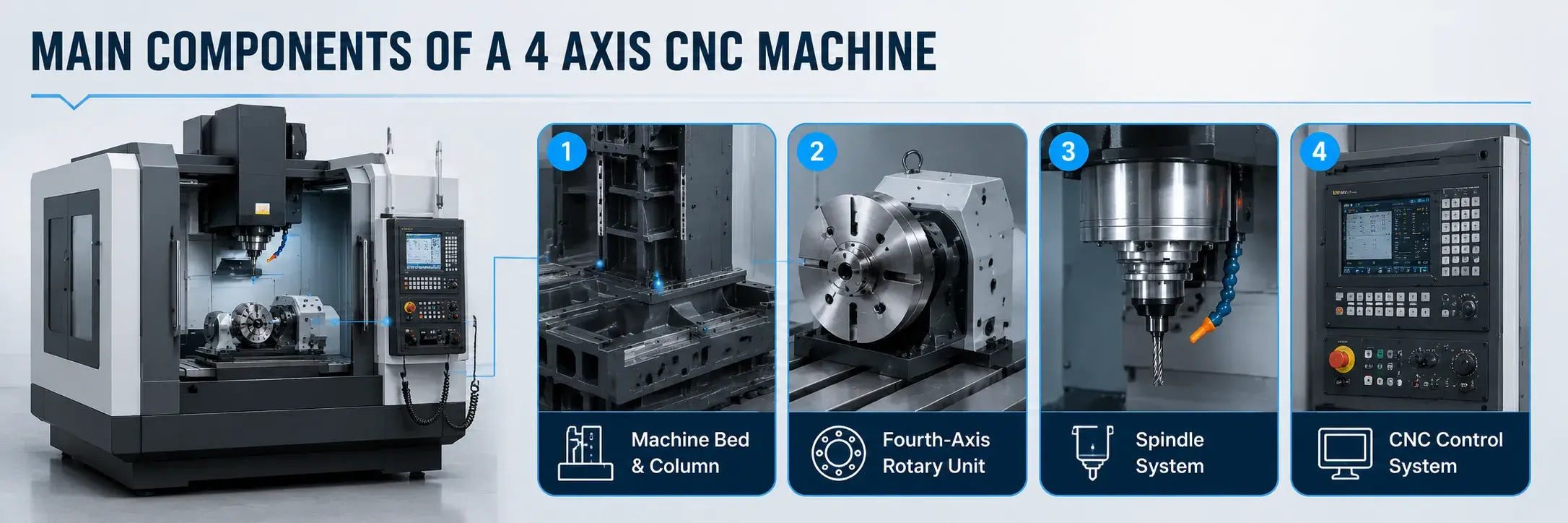
A 4-axis CNC machine tool primarily consists of the machine bed, the fourth-axis rotary unit, the spindle system, and the control system.
Main Components of a 4 Axis CNC Machine

Machine Bed and Column

The bed and column provide rigid support for the entire machine. Industrial-grade machines typically feature a high-strength cast iron structure to minimize vibration and maintain long-term machining accuracy.

Fourth-Axis Rotary Unit

The fourth-axis rotary unit is the core component that distinguishes a 4-axis machine tool from a 3-axis machine tool. Driven by a servo motor, it rotates the workpiece to a set angle via a rotary table or chuck. Depending on the equipment configuration, it can support indexing machining or continuous interpolation machining.

Spindle System

The spindle system is responsible for mounting and driving the cutting tool. Common configurations include BT40, BT50, and HSK series spindles, capable of meeting various requirements such as drilling, milling, boring, and contour machining.

CNC Control System

The control system coordinates the motion of the four axes: X, Y, Z, and A. Common industrial control systems include brands such as FANUC, Siemens, Mitsubishi, and Heidenhain, which determine the machine tool’s control accuracy, interpolation capabilities, and machining stability.

How Does a 4-Axis CNC Machine Work?

The operation of a 4-axis CNC machine is relatively straightforward. First, the workpiece is mounted on the fourth-axis rotary table or chuck, and the coordinate setup and tool setting are completed. The control system then follows the program instructions to simultaneously control the movement of the X, Y, Z, and A axes, executing the preset machining path.

There are two common operating modes.

The first is indexed machining: 

Where the fourth axis rotates to a specified angle and locks in place, after which the three linear axes complete the machining of that face. This method is widely used for multi-surface drilling, tapping, and milling operations.
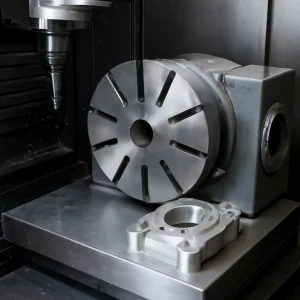
indexed machining

The second is continuous 4-axis machining:

In which the fourth axis rotates continuously during the cutting process and moves synchronously with the X, Y, and Z axes to machine helical grooves, cam profiles, and other complex curved features.continuous 4-axis machining
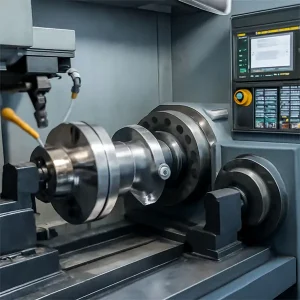
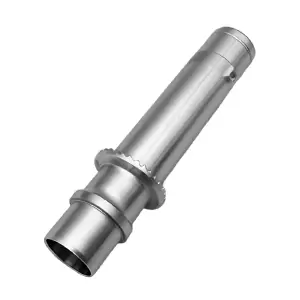
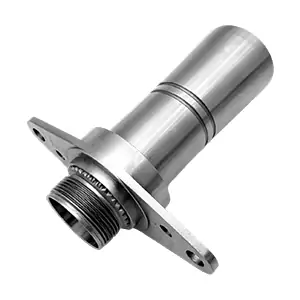
By combining rotational and linear motion, 4-axis CNC machines can perform many machining tasks that would require multiple setups on traditional 3-axis equipment.
Types of 4-Axis CNC Machines

The 4-axis CNC machines available on the market can be broadly categorized into several different types.

The most common type is a vertical machining center equipped with a fourth-axis rotary table. This configuration is relatively low-cost and is the most frequently adopted solution when many factories upgrade from 3-axis to 4-axis machines. It is particularly suitable for machining shaft-type parts, helical grooves, and workpieces that require drilling and milling on multiple sides.

Horizontal machining centers typically come equipped with a rotary table, enabling the machining of multiple surfaces in a single setup, making them widely used for box-type parts and in batch production.

Based on their motion capabilities, 4-axis CNC machines can also be categorized into Indexed 4 Axis CNC Machines and Continuous 4 Axis CNC Machines. The former is primarily used for indexed positioning and offers higher rigidity; the latter supports simultaneous four-axis interpolation and is better suited for machining helical grooves, cams, and complex curved surfaces.

What Can a 4-Axis CNC Machine Produce?

4-axis CNC machines are capable of machining a wide variety of parts that require multi-sided or rotary machining.

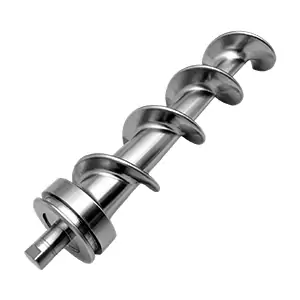
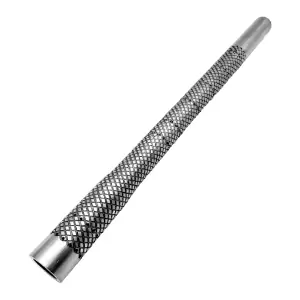
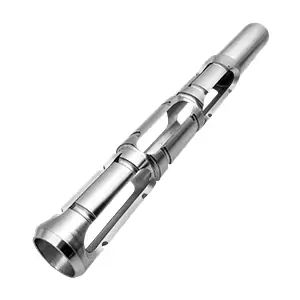
Common applications include camshafts, helical gears, valve bodies, medical device components, optical mounts, and various cylindrical parts. For workpieces that require drilling, tapping, or milling features on multiple sides, 4-axis machines can significantly reduce the number of setups and improve positioning accuracy.

Compared to traditional 3 axis machining, 4-axis equipment is particularly well-suited for machining features on cylindrical surfaces, helical structures, and complex multi-sided parts, making it widely used in the aerospace, medical, automation equipment, and industrial manufacturing sectors.

Advantages of a 4-Axis CNC Machine Fewer Setups

One of the greatest advantages of a 4-axis CNC machine is the reduction in the number of setups required. Many parts that previously required multiple turnarounds can now be completed in a single setup, thereby reducing positioning errors and improving production efficiency.

Higher Accuracy

By eliminating the need for repeated setups and re-alignment, it becomes easier to maintain consistent relative positional accuracy across all machined surfaces of a part, making it particularly suitable for parts with high requirements for coaxiality and positional accuracy.

Increased Productivity

Automatic workpiece rotation reduces manual intervention time and improves machine utilization. This advantage is particularly evident in batch production.

More Complex Geometries

4-axis machines can machine helical grooves, cam profiles, and many complex features that are difficult to achieve on 3-axis machines, while costing significantly less than 5-axis machining.

4 Axis CNC Machine vs 3 Axis CNC Machine

Feature3 Axis CNC Machine4 Axis CNC Machine
Number of Axes34
Rotary MotionNoYes
Multi-Side MachiningLimitedExcellent
Setup ChangesMultipleFewer
Cylindrical FeaturesDifficultEasy
ProductivityLowerHigher
Machine CostLowerHigher

For simple flat parts and basic machining tasks, 3-axis machines are usually sufficient. However, for projects requiring multi-sided machining, cylindrical features, or higher production efficiency, 4-axis CNC machines are often the better choice.

Our 4 Axis CNC Machining Capabilities

Yuanyi possesses 13 years of CNC machining experience, 4-axis CNC machining is one of our core manufacturing capabilities. We support everything from prototype development and low-volume production to full-scale manufacturing projects.

Our equipment supports rotary machining capacities up to Ø350 mm and can consistently achieve tolerances as tight as ±0.005 mm, helping customers produce high-precision components with confidence.

✓

4 Axis CNC Machining Services

✓

Tolerance up to ±0.005 mm

✓

Rotary Capacity up to Ø350 mm

✓

No MOQ Requirement

✓

Inspection Reports Available

✓

Fast Quotation Within 24 Hours

Need Reliable 4 Axis CNC Machining Support?

Send us your drawings or CAD files and receive a detailed quotation within 24 hours.

Request a Quote

Frequently Asked Questions

The fourth axis typically refers to the A-axis, which is a rotational axis added to the three linear axes (X, Y, and Z) to rotate the workpiece.


A 5-axis CNC machine has one more rotational axis than a 4-axis machine, enabling it to machine more complex spatial surfaces and undercut features; however, it also involves higher costs and greater programming complexity.

Common parts include camshafts, valve bodies, helical gears, medical device components, optical mounts, and various multi-surface machined parts.

Industrial-grade 4-axis CNC machines typically maintain stability within ±0.01 mm, while high-precision equipment can achieve ±0.005 mm.

Yes, we offer professional 4-axis CNC machining services, supporting projects ranging from prototype development to mass production.

Table of Contents
Discuss Your Complex Machining Requirements

Need Custom CNC Machined Parts?

From rapid prototypes to low-volume production, our engineering team can review your drawings and provide a manufacturing quote.

  • 24-Hour Quotation
  • DFM Engineering Support
  • No Minimum Order
  • ISO 9001 Certified
Request A Quote
Upload your drawing and get a quote within 24 hours.