
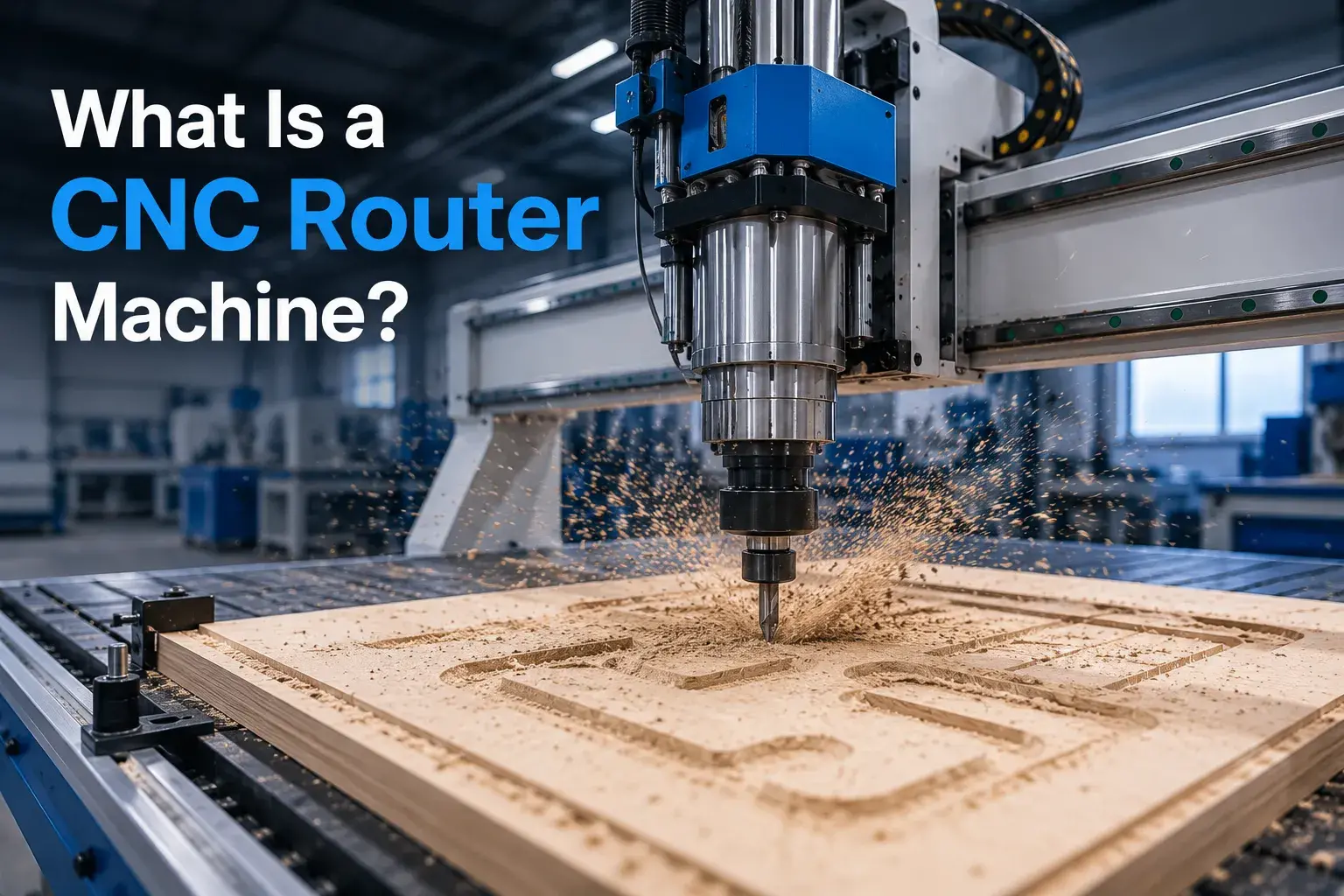
What Is a CNC Router Machine? Everything You Need to Know

What Is a CNC Router Machine

A CNC router is a machining device that uses computer programs to automatically control the movement of cutting tools. It is primarily used for cutting, engraving, routing, and shaping various sheet materials, such as wood, MDF, plywood, acrylic, plastic, and certain soft metals.

Many people confuse CNC routers with CNC milling machines. Although both are types of CNC machining equipment, their intended purposes, machining capabilities, and suitable materials are not entirely the same.

This article will provide you with a comprehensive overview of CNC router machines, including how they work, their main components, the materials they can process, common applications, and how they differ from CNC milling machines—helping you determine which type of machine is best suited for your project.

What Is a CNC Router Machine?

A CNC router can be understood as a type of numerically controlled machine capable of automatically performing cutting and engraving tasks.

Its most notable feature is that it uses a computer to control the cutting tool as it moves along a pre-set path, rather than relying on manual operation. The operator only needs to design the product, import the machining program, and secure the material; the machine will then automatically complete the entire machining process.

During the machining process, the cutting tool mounted on the spindle rotates at high speed while moving in the X, Y, and Z directions to cut the material, thereby producing various shapes, holes, contours, and complex patterns.

Due to the CNC router’s high machining speed, large processing area, and ability to operate continuously and stably, it is particularly well-suited for the mass production of sheet-material products.

How Does a CNC Router Work?

Although a CNC router is capable of performing complex machining tasks, its workflow is actually quite straightforward.
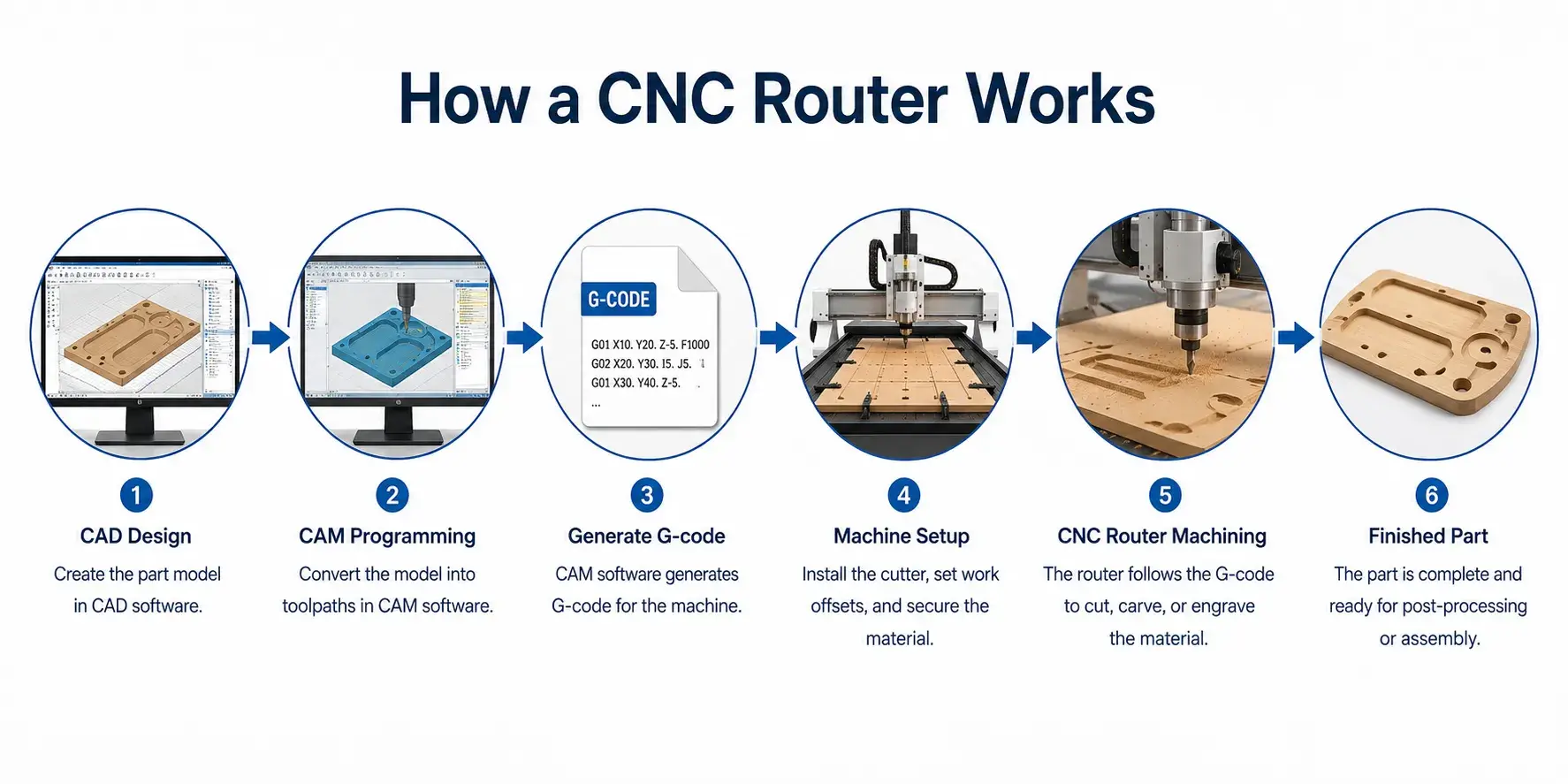
How a CNC router works

The entire machining process can generally be broken down into the following steps.

Step 1: Create the Design

First, an engineer uses CAD software to draw product blueprints or create 3D models.

The blueprints determine the part’s final dimensions, shape, and the areas to be machined, and serve as the foundation for the entire machining process.

Step 2: Generate the Machining Program

Once the design is complete, the CAD file is imported into CAM software.

The CAM software automatically plans the toolpath based on the material, cutting tools, and machining requirements, and generates G-code that the machine can recognize.

G-code can be thought of as the CNC router’s “operating instructions”; it tells the machine where to move at each step, how deep to cut, and how fast the spindle needs to rotate.

Step 3: Set Up the Machine

Before machining begins, the material must be securely clamped to the worktable, and the appropriate cutting tools must be installed.

Next, the operator performs preparatory tasks such as tool setting, establishing the machining origin, and verifying the machining program to ensure the entire machining process proceeds smoothly.

Step 4: Automatic Machining

Once the program starts running, the control system uses the G-code to control the movement of each axis while driving the spindle to rotate at high speed.

The cutting tool continuously cuts the material along the preset path, performing operations such as cutting, engraving, slotting, drilling, and contour machining.

The entire process requires virtually no manual intervention; as long as the program is correct, the machine can continuously produce products that are completely identical.

Step 5: Finishing

Once machining is complete, only simple cleaning, deburring, or surface treatment is required before most products can proceed to the next process or be put into use immediately.

Main Parts of a CNC Router Machine

Although CNC routers of different brands and models vary in structure, most machines consist of the following core components.
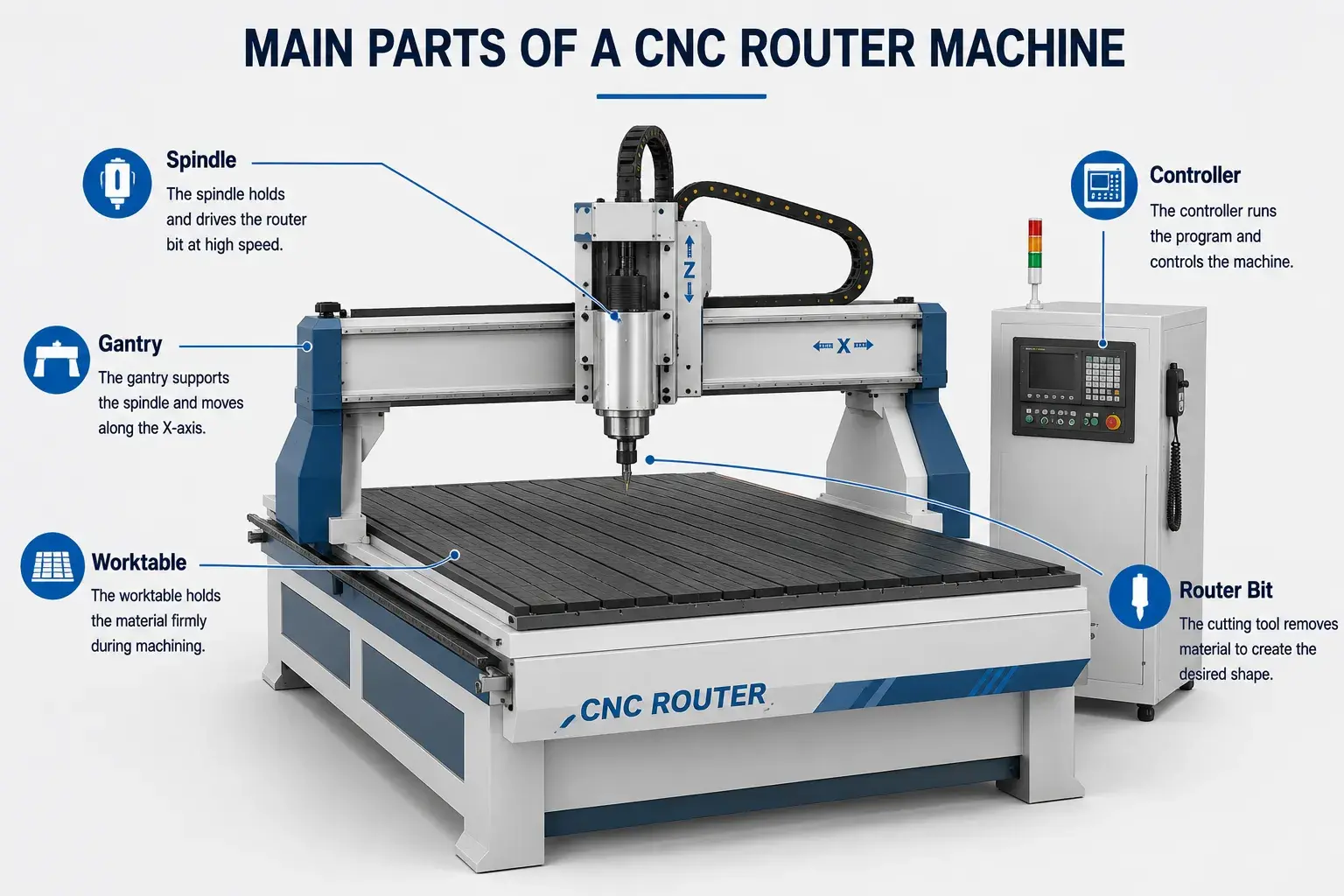
Main parts of a CNC router machine

Frame

The frame serves as the foundation of the entire machine.

It supports all mechanical components and ensures the machine maintains sufficient stability during high-speed machining. The stiffer the frame, the less vibration occurs during machining, and the more consistent the machining quality tends to be.

Spindle

The spindle is arguably one of the most important components of a CNC router.

It drives the cutting tool to rotate at high speeds, performing various machining operations by cutting through the material.

Spindles with different power ratings and rotational speeds are suitable for different materials. For example, high-speed spindles are typically used for machining wood, while machining aluminum alloy requires more stable cutting parameters.

Router Bit

The router bit is the cutting tool that actually performs the cutting work.

Depending on the machining requirements, different types of cutters can be selected, such as flat-bottom cutters, ball-end cutters, V-cutters, and engraving cutters; each type is suited for specific machining applications.

Motion System

The motion system controls the movement of the cutter.

It typically consists of three coordinate axes—X, Y, and Z—and uses lead screws, racks, or linear guides to drive the cutter for precise positioning.

The precision of the motion system directly affects the dimensional accuracy and machining quality of the final part.

Controller

The controller acts as the “brain” of the entire machine.

It reads the G-code and coordinates the synchronized operation of the spindle, drive motors, and each coordinate axis, enabling the entire machining process to be completed automatically according to the program.

Vacuum Table or Clamping System

To prevent the material from shifting during machining, the workpiece must be securely clamped in place.

Industrial-grade CNC routers typically use a vacuum table, while some machines employ clamping fixtures for securing the workpiece.

Stable clamping not only improves machining accuracy but also reduces the risk of material scrap.
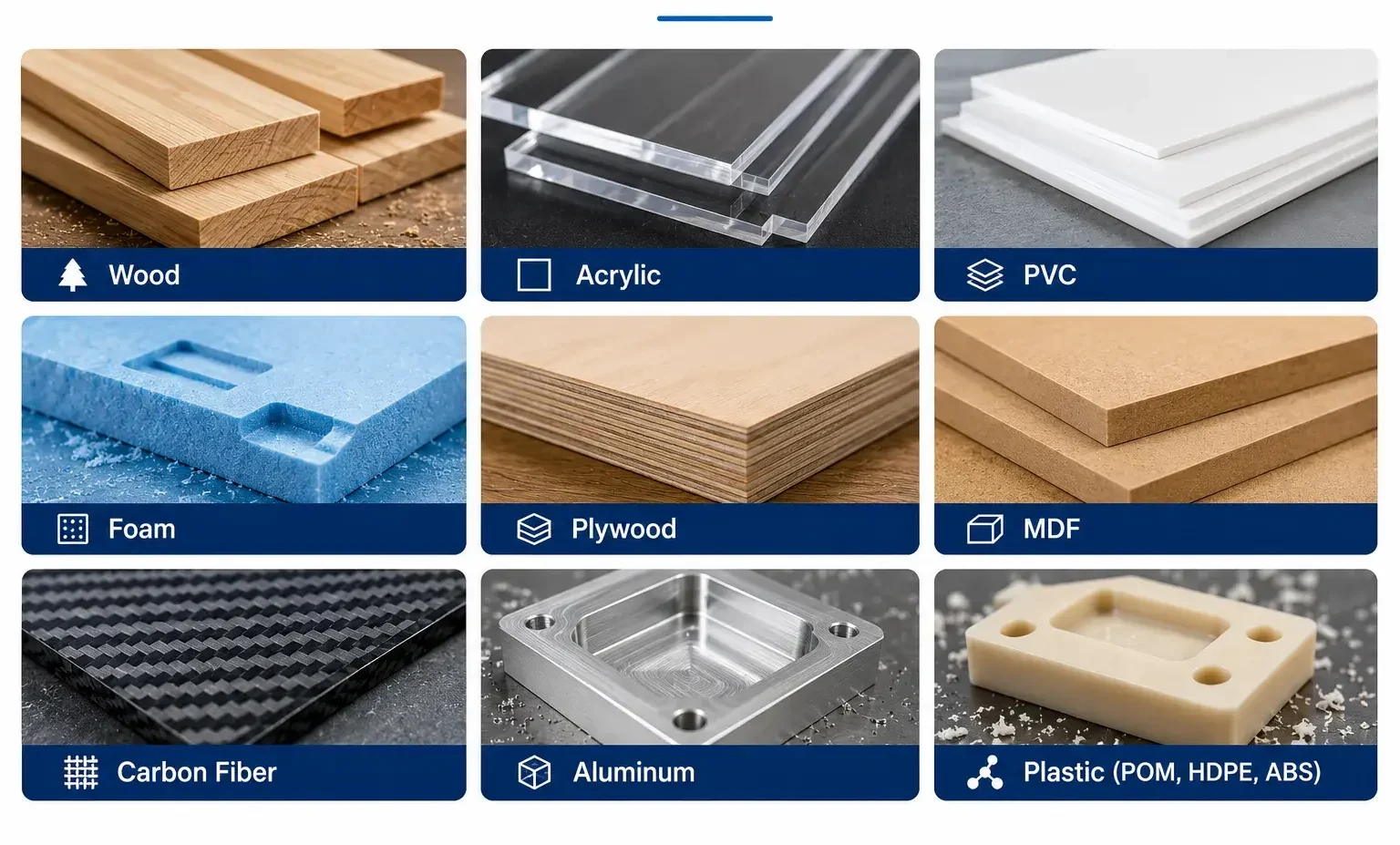
What Materials Can a CNC Router Cut?

Materials for CNC Routing Applications

When learning about CNC routers, many people ask, “What materials can it actually machine?”

In fact, CNC routers are best suited for machining wood, plastics, and various sheet materials. Depending on the machine’s rigidity, spindle power, and tooling configuration, common materials that can be machined include:

  • Wood – Including hardwood, softwood, MDF, medium-density fiberboard, plywood, and particleboard. These are the most common materials processed by CNC routers and are widely used in furniture, cabinetry, and woodworking.
  • Plastics – Such as engineering plastics like acrylic, PVC, ABS, POM, and HDPE, which can be used for advertising signage, display stands, industrial panels, and various plastic parts.
  • Foam – Including foam materials such as PU foam, EPS, and XPS, commonly used for architectural models, packaging molds, display models, and sculpture production.
  • Composite Materials – Such as carbon fiber panels, fiberglass panels, and other composite materials, which are suitable for model aircraft, automotive parts, and certain industrial products.
  • Soft Metals – Some industrial-grade CNC routers can also machine softer metals, such as aluminum alloy, brass, and copper, but are generally better suited for light cutting and shallow machining depths.

It is important to note that while CNC routers can machine some soft metals, for high-hardness materials such as stainless steel, titanium alloys, and tool steel, CNC milling machines are generally recommended due to the limited rigidity and cutting capacity of CNC routers. CNC milling machines offer higher machining accuracy, greater machining stability, and longer tool life.

MaterialCan a CNC Router Cut It?Typical Applications
WoodYes, excellentFurniture, cabinets, doors, panels
MDF & PlywoodYes, excellentCabinet making, signage, decorative panels
AcrylicYes, excellentSigns, displays, light boxes
PVCYes, excellentAdvertising boards, industrial panels
FoamYes, excellentModels, molds, packaging inserts
Carbon FiberYes, with proper toolingAutomotive parts, aerospace panels, custom components
AluminumYes, but mainly light cuttingPlates, panels, signs, light-duty parts
BrassLimitedDecorative parts, engraving, nameplates
Stainless SteelNot recommendedUse CNC milling instead
TitaniumNot recommendedUse CNC milling instead

Common Applications of CNC Router Machines

Thanks to their high speed, high efficiency, and large working area, CNC routers are widely used across multiple industries.

The most common applications include:

Furniture Manufacturing

The furniture industry is one of the largest application areas for CNC routers.

Various cabinet bodies, tabletops, door panels, and decorative furniture components can all be quickly cut and engraved using a CNC router.

Cabinet Making

Cabinet making typically involves a large number of repetitive machining operations on sheet materials, and CNC routers can quickly perform cutting, routing, drilling, and contour machining, significantly improving production efficiency.

Sign Making

The signage industry frequently uses CNC routers to process acrylic, PVC, and aluminum-plastic composite panels for the production of signs, illuminated letters, display boards, and various commercial signage.

Architectural Decoration

Carved panels, partitions, feature walls, and decorative panels in architectural decoration are also extensively processed using CNC routers.

Model Making

Architectural models, product prototypes, and display models can all be quickly shaped using a CNC router.

Industrial Manufacturing

In addition to the woodworking industry, some industrial enterprises also use CNC routers to process plastic panels, insulation boards, composite materials, and certain lightweight aluminum alloy parts.

Although it cannot completely replace a CNC milling machine, a CNC router often offers higher processing efficiency and lower processing costs when it comes to machining large-sized panels.

Why Use a CNC Router?

More and more companies are choosing CNC routers, not only because of their fast processing speed, but also because they strike a good balance between production efficiency, machining precision, and cost.

Compared to traditional manual machining, CNC routers can produce parts continuously using the same set of programs, significantly reducing human error and maintaining consistent product dimensions. At the same time, it can easily handle complex contours, engraved patterns, and various sheet material machining tasks, making it ideal for industries such as furniture manufacturing, advertising signage, cabinetry, and model making.

For machining sheet materials such as wood, plastic, acrylic, and composite materials, a CNC router is typically a highly efficient and cost-effective solution. However, if you need to machine high-precision metal parts or high-hardness materials, a CNC milling machine is generally a better choice.

Need Precision CNC Machined Parts?

While CNC routers are ideal for cutting wood, plastics, and sheet materials, high-precision metal parts often require professional CNC milling and turning. Upload your CAD file today and receive expert machining advice and a fast quote within 24 hours.

Upload Your Drawing

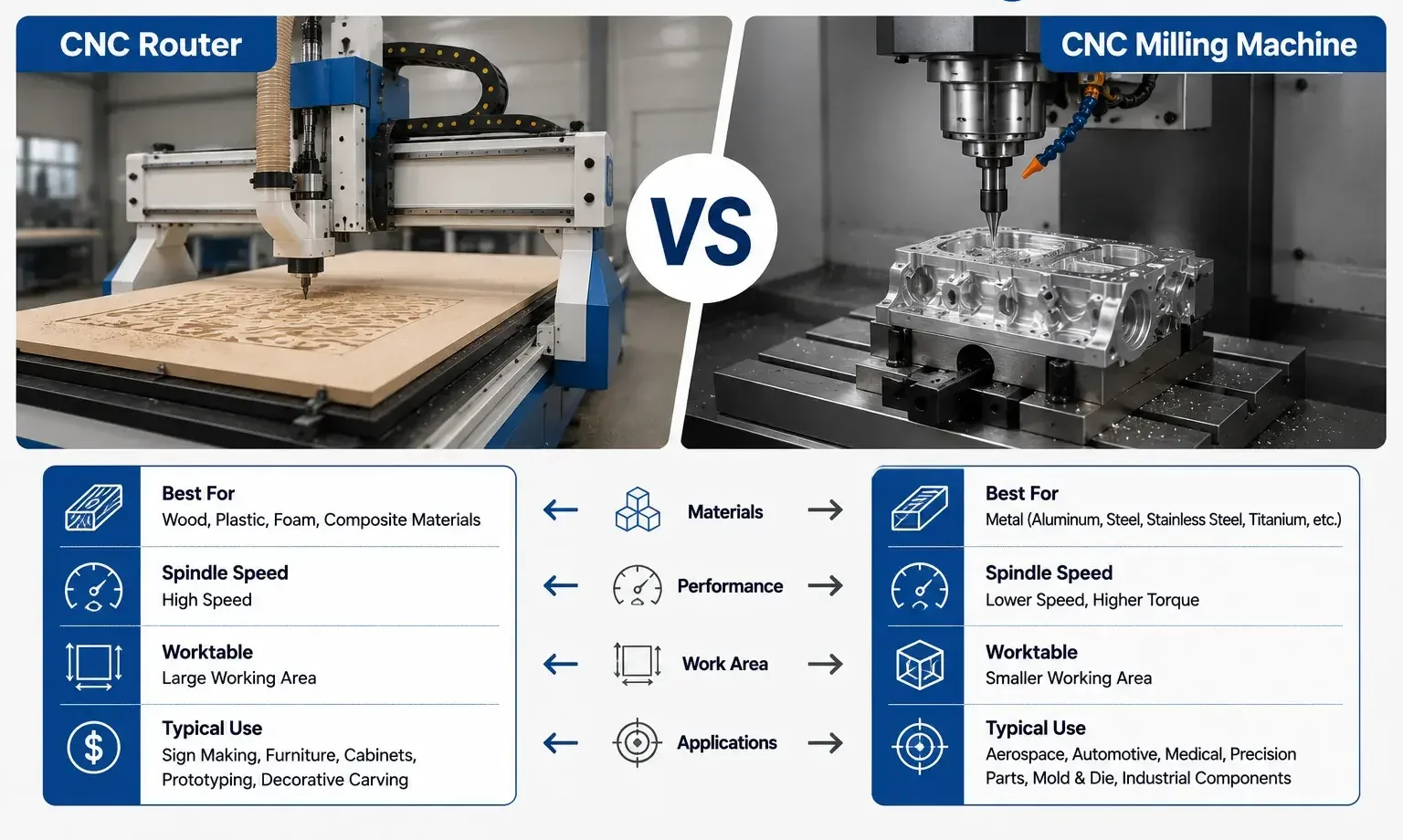
CNC Router vs CNC Milling Machine

CNC router vs CNC milling machine

When people first encounter CNC machining, many assume that a CNC router and a CNC milling machine are the same type of equipment. In fact, although both use computer programs to control cutting tools for machining, their design purposes and applications differ significantly.

A CNC router is better suited for high-speed machining of sheet materials such as wood, plastic, acrylic, foam, and composite materials. It typically features a large worktable and high spindle speed, enabling it to quickly perform cutting, engraving, and contouring operations, making it ideal for furniture manufacturing, signage, and the decorative arts industries.

Quickly understand the main differences between the two:

FeatureCNC RouterCNC Milling Machine
Primary MaterialsWood, MDF, Plastic, Acrylic, FoamAluminum, Steel, Stainless Steel, Titanium, Brass
Machine RigidityMediumHigh
Cutting ForceLight-duty CuttingHeavy-duty Cutting
Typical AccuracyGoodVery High
Working AreaUsually LargerUsually Smaller
Best ForWoodworking, Sign Making, Cabinetry, Plastic PartsPrecision Metal Parts, Aerospace, Medical, Automotive
CostLowerHigher

Simply put, if your project primarily involves woodworking, plastic sheet materials, or sign making, a CNC router is usually the more cost-effective and efficient choice; if you need to machine high-precision metal parts, a CNC milling machine is more suitable.

Limitations of CNC Router Machines

Although CNC routers offer advantages such as fast machining speeds and lower costs, they are not the best choice for all machining projects.

Since the overall rigidity of these machines is typically lower than that of CNC milling machines, vibration can easily occur when machining thick materials or high-hardness metals, affecting machining accuracy and surface quality. Additionally, prolonged heavy-duty cutting accelerates tool wear and reduces machining stability.

For projects requiring strict dimensional tolerances, complex 3D surfaces, or high-precision metal machining, CNC routers often cannot fully meet these requirements; therefore, specialized CNC milling machines are typically chosen to complete the machining.

When Should You Choose CNC Milling Instead?

If your project meets the following criteria, it is generally recommended to choose a CNC milling machine:

You need to machine high-hardness materials such as stainless steel, titanium alloys, and tool steel.
Parts require tight dimensional tolerances, such as ±0.01 mm or higher precision.
The product features deep cavities, complex curved surfaces, or multi-faceted machining features.
Tapping, precision drilling, or complex cavity machining is required.
The application is in the aerospace, medical device, automation equipment, or other precision manufacturing industries.

How YUANYI Supports Precision CNC Machining

Although CNC routers are ideal for machining wood, plastic, and sheet materials, professional CNC machining centers offer more consistent and reliable machining quality for the production of high-precision metal parts.

At YUANYI, we specialize in precision CNC machining, offering 3-axis, 4-axis, and 5-axis CNC milling, CNC turning, Swiss machining, and mill-turn machining services. We can machine aluminum alloys, stainless steel, titanium alloys, brass, copper, and a variety of engineering plastics.

If you are unsure whether to choose a CNC router or CNC milling for your project, our engineering team can provide professional advice based on your part drawings, materials, and precision requirements to help you select the most suitable machining solution.

Ready to Start Your CNC Machining Project?

Whether you need a prototype or high-volume production, our experienced engineering team is ready to help. Send us your CAD file today and receive a fast quotation, DFM feedback, and professional machining support within 24 hours.

Request a Free Quote

Conclusion

A CNC router is a highly efficient, flexible, and easily automatable machining device that is ideal for cutting, engraving, and contouring wood, plastic, acrylic, and other sheet materials. As a result, it is widely used in industries such as furniture manufacturing, advertising signage, architectural decoration, and model making.

However, it cannot completely replace a CNC milling machine. For machining high-precision metal parts or high-hardness materials, a CNC milling machine remains the more reliable choice.

Understanding the differences between the two and selecting the appropriate equipment based on material, machining precision, and product requirements is essential to achieving optimal machining quality and production efficiency.

Frequently Asked Questions

Yes. Industrial CNC routers can cut soft metals such as aluminum and brass. However, for stainless steel, titanium, or other hard metals, a CNC milling machine is usually the better choice.

The accuracy depends on the machine, material, and setup. Industrial CNC routers provide good repeatability for wood, plastics, and sheet materials, while CNC milling machines offer higher precision for metal parts.

Yes. With the right tooling and CAM programming, a CNC router can produce 3D carvings, molds, prototypes, and other complex shapes, especially in wood, foam, and plastics.

Common file formats include STEP, IGES, DXF, DWG, and STL. These files are converted into G-code using CAM software before machining.

It depends on your project. CNC routers are ideal for wood and sheet materials, while CNC milling machines are better for precision metal parts and tighter tolerances.

Yes. YUANYI provides custom CNC machining services for prototypes and production parts, with fast quotes, engineering support, and comprehensive quality inspection.

Table of Contents
Discuss Your Complex Machining Requirements

Need Custom CNC Machined Parts?

From rapid prototypes to low-volume production, our engineering team can review your drawings and provide a manufacturing quote.

  • 24-Hour Quotation
  • DFM Engineering Support
  • No Minimum Order
  • ISO 9001 Certified
Request A Quote
Upload your drawing and get a quote within 24 hours.


