

If we compare a CNC machine to the human body, then the CNC system is equivalent to its brain. It is responsible for converting G-code instructions into actions that the machine can execute, guiding the cutting tool along a predetermined path to complete the machining process, and ensuring high precision, repeatability, and stability throughout the entire process.
This article will provide a detailed overview of what a CNC system is, its main functions, operating principles, and components, as well as the differences between it, a CNC machine, and a CNC controller, to help you gain a comprehensive understanding of how modern CNC machining equipment achieves automated manufacturing.
What Is a CNC System?
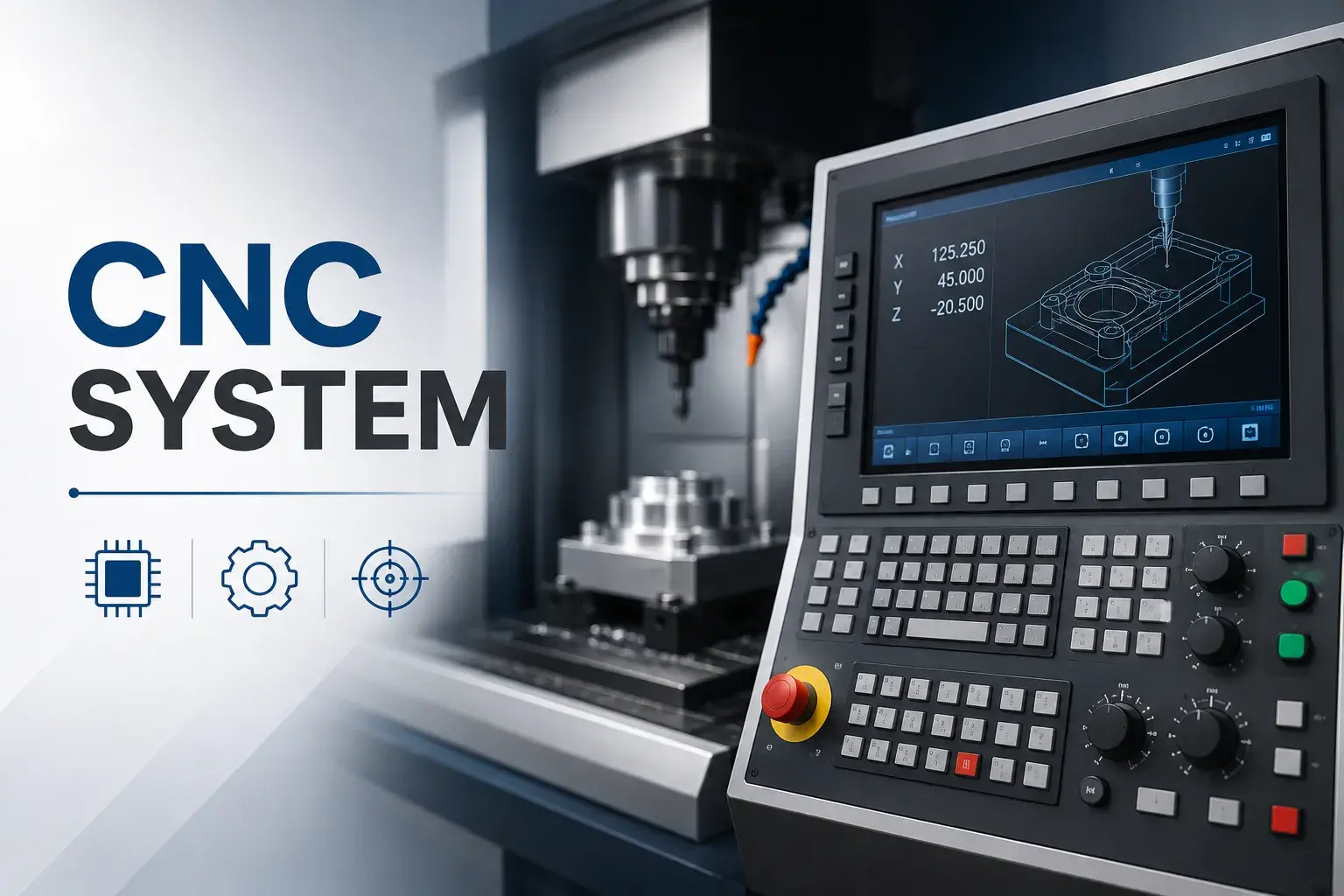
The CNC system can be thought of as the “brain” of a CNC machine tool. It is responsible for reading machining programs, such as G-code, and converting these digital instructions into actions that the machine tool can execute.
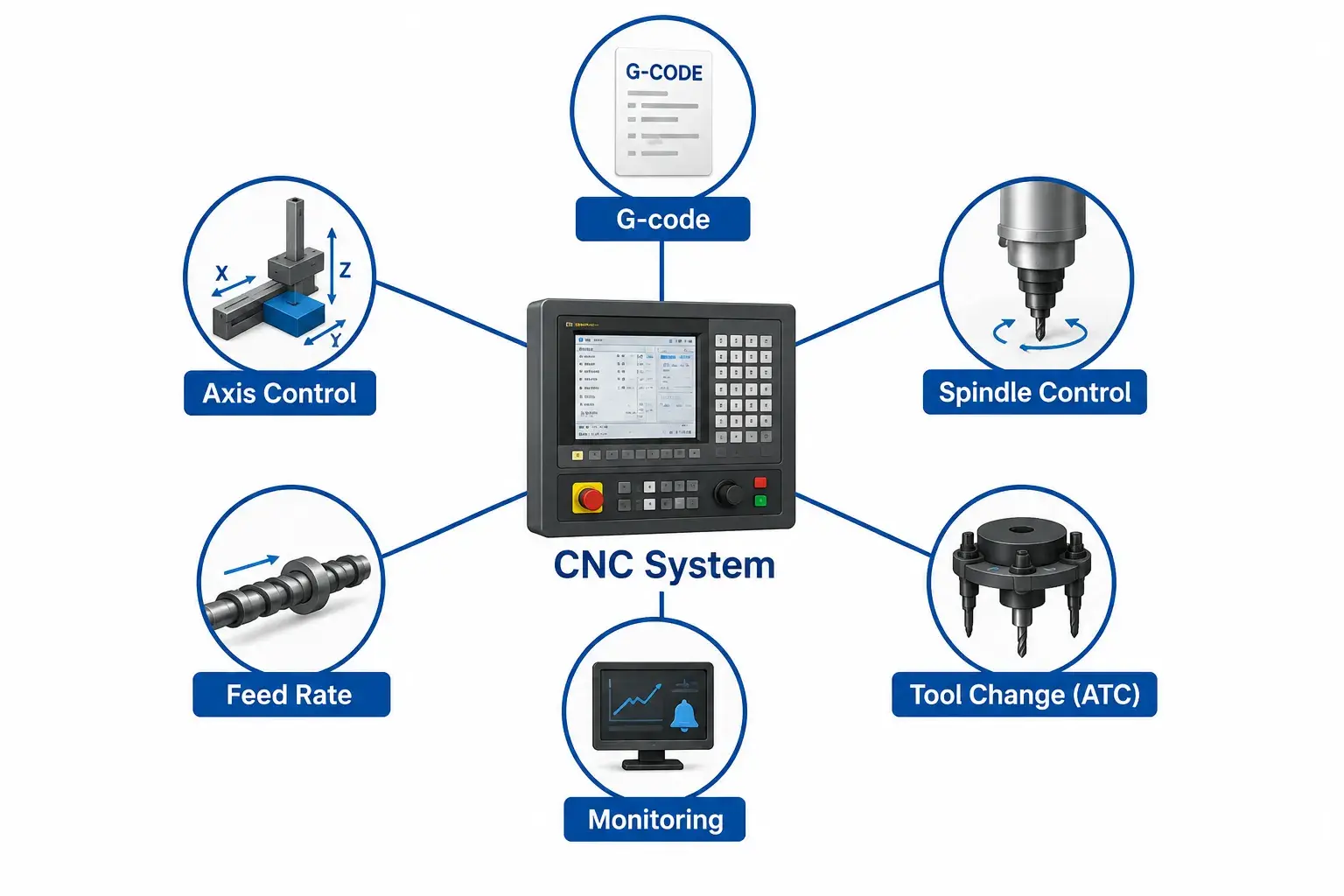
During the machining process, the CNC system controls the movement of the axes, spindle speed, feed rate, tool changes, and coolant flow, enabling the machine tool to automatically complete the cutting process along the set path.
CNC systems from different brands may vary in terms of interface and functionality, but their core purpose remains the same: to enable CNC machine tools to perform automated machining stably and accurately.
The primary functions of a CNC system include:
- Reading and parsing G-code machining programs
- Calculating the motion paths of each axis
- Controlling the motion of the X, Y, Z, and rotary axes
- Adjusting spindle speed and feed rate
- Controlling automatic tool change (ATC) and other auxiliary functions
- Monitoring the machining status in real time and providing error feedback
- Coordinating the operation of various systems to ensure machining accuracy and stability
Through these functions, the CNC system is able to accurately convert digital models generated by CAD/CAM software into actual parts, making it the key to achieving high precision, high efficiency, and automated production in modern CNC machining.
What Does a CNC System Do?
The primary function of a CNC system is to receive machining programs and convert these digital instructions into actions that the machine tool can execute. From the start of part machining to its final completion, virtually all key operations are coordinated and controlled by the CNC system.
It not only determines how the cutting tool moves but also controls the speed, position, and various auxiliary functions during the machining process, ensuring that the entire process proceeds accurately and stably.
Read and Interpret G-code
Before machining begins, the CNC system reads the G-code program and parses each instruction, such as tool paths, machining coordinates, spindle speed, and feed rate.
After these instructions are calculated, they are converted into motion commands that the machine tool can execute.
Control Machine Axis Movement
The CNC system controls the movement of the machine tool’s various axes, including the X, Y, and Z axes, as well as the rotary axes in four- and five-axis machining centers.
By precisely controlling the position and motion paths of each axis, the tool can perform machining operations such as drilling, milling, and turning along the set paths.
Control Spindle Speed and Feed Rate
Different materials and machining processes require different cutting parameters.
The CNC system controls the spindle speed (RPM) and feed rate according to the program, helping the machine maintain stable cutting conditions and improving machining quality and efficiency.
Coordinate Tool Changes
For CNC machines equipped with an automatic tool changer (ATC), the CNC system automatically selects and changes the required tools according to the program, without the need for manual intervention.
This not only improves machining efficiency but also reduces errors caused by human operation.
Monitor the Machining Process
Modern CNC systems also monitor the machine tool’s operating status in real time, including the positions of each axis, motion feedback, and alarm information.
If an anomaly is detected, the system promptly issues an alarm and, if necessary, halts machining to protect the machine tool, cutting tools, and workpiece.
The CNC system is not only responsible for “telling the machine tool how to machine,” but also for ensuring that the entire machining process runs stably and consistently according to the program. This is the key reason why CNC machining can achieve high precision and repeatability.
How Does a CNC System Work?
When an operator imports a G-code program into a CNC machine tool, the CNC system begins reading and parsing each machining instruction. It then calculates the tool’s path and sends control signals to the various drive systems, enabling the machine tool to complete the machining process as specified by the program.
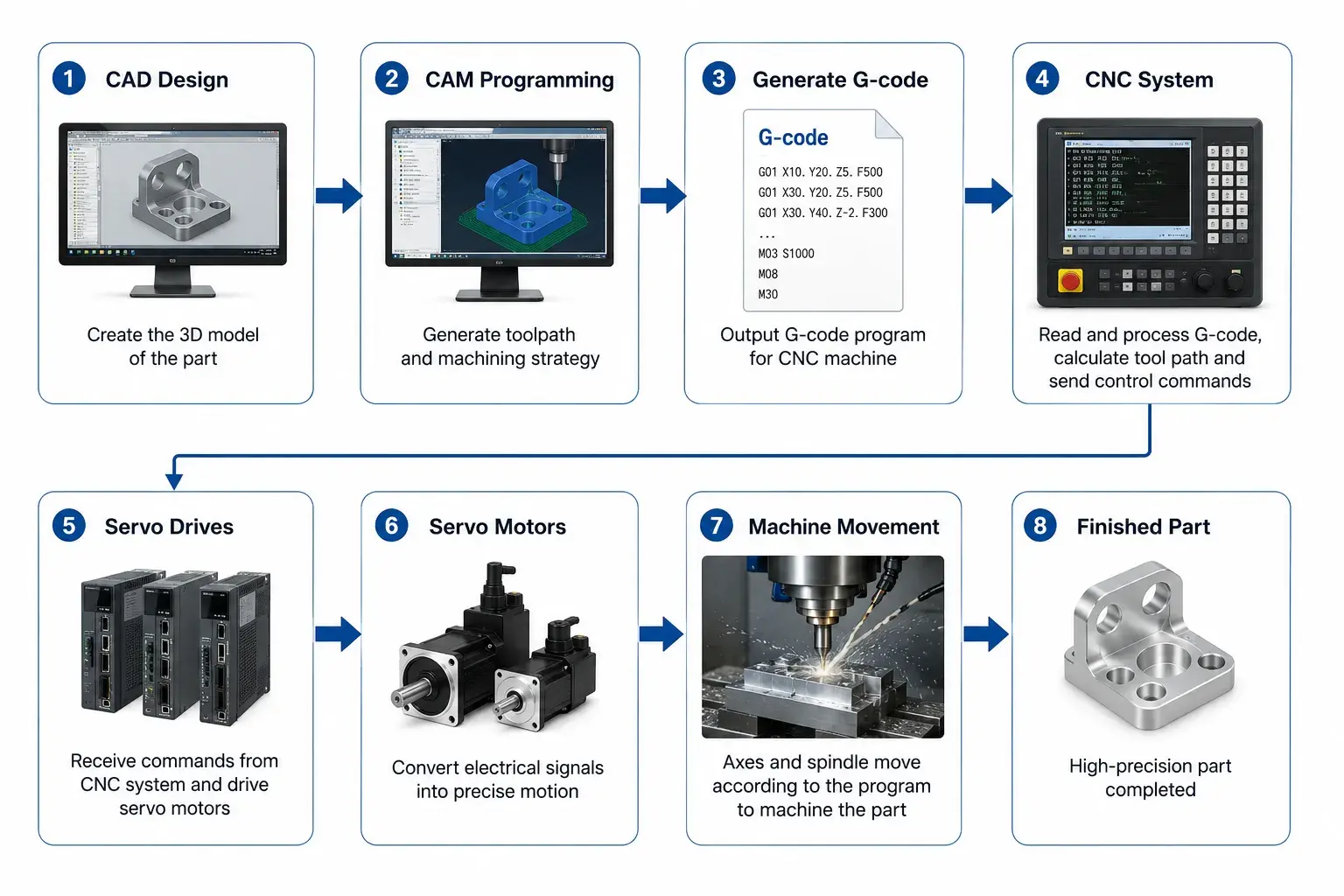
The entire process can generally be divided into the following steps:
Step 1: Create the CAD Model
First, an engineer uses CAD software to design a 3D model of the part and defines the product’s dimensions, structure, and tolerance requirements.
Step 2: Generate G-code with CAM Software
Once the design is complete, the CAD model is imported into CAM software to generate a G-code program that the CNC machine tool can recognize.
The G-code contains various pieces of information required for machining, such as tool paths, coordinate positions, spindle speed, feed rate, and tool change instructions.
Step 3: Read and Process the Program
Once machining begins, the CNC system reads the G-code and analyzes and calculates the program.
It determines where the tool should move, how fast it should operate, and how each movement should be coordinated with the others.
Step 4: Send Commands to the Servo Drives
Once the calculations are complete, the CNC system sends control signals to the servo drives.
The drives then control the servo motors, causing the machine tool’s axes to move along the set paths.
Step 5: Machine the Part
As the axes, spindle, and cutting tool operate synchronously according to the program, the machine tool begins cutting the workpiece, ultimately producing a part that meets the requirements of the drawing.
Throughout the process, the CNC system continuously monitors the machine tool’s operating status and constantly adjusts position and motion based on feedback signals to ensure machining accuracy and stability.
Main Components of a CNC System
Although CNC systems from different brands vary slightly in design, most modern CNC systems consist of the following core components. These components work together to ensure that the machine tool can perform every machining task accurately and reliably.
| Component | Function |
|---|---|
| CNC Controller | Reads and processes G-code and coordinates the entire machining process. |
| HMI (Control Panel) | Allows operators to input programs, set parameters, and monitor machine status. |
| Servo Drives | Receive control signals from the CNC system and drive the servo motors. |
| Servo Motors | Move the machine axes and spindle for precise motion control. |
| Encoder | Provides real-time position and speed feedback to improve machining accuracy. |
| PLC | Controls auxiliary functions such as tool changes, coolant, and clamping systems. |
CNC System vs CNC Machine
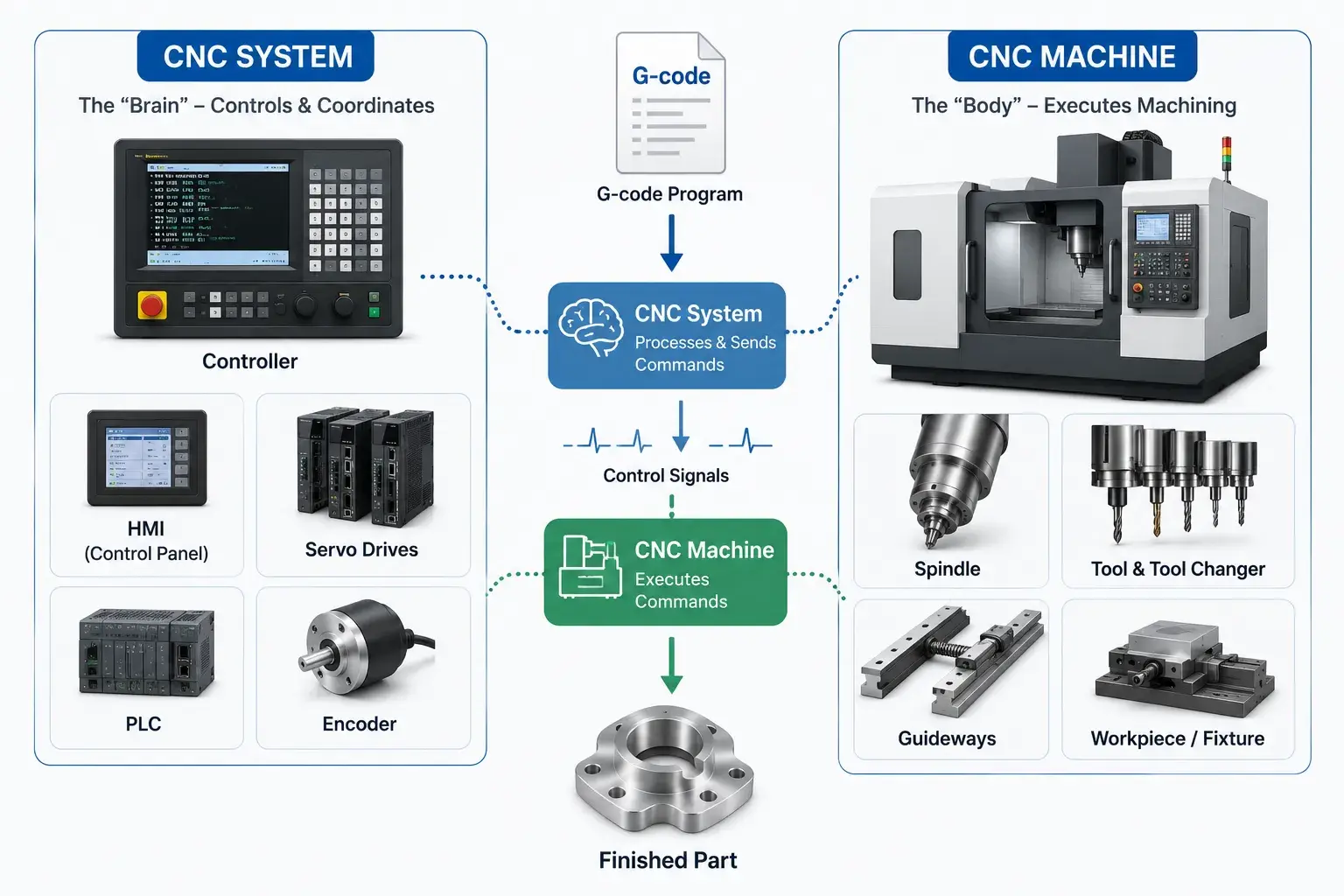
Many people treat the CNC system and the CNC machine as the same thing, but in reality, they refer to two distinct components.
Simply put, the CNC system is the “brain” responsible for controlling the machining process, while the CNC machine is the equipment responsible for carrying out the machining. Only by working together can they achieve automated machining.
For example, when the CNC system reads G-code, it calculates the tool’s path and sends control commands to the machine tool; the CNC machine then drives the movement of the tool and workpiece according to these commands, ultimately completing the machining of the part.
| Feature | CNC System | CNC Machine |
|---|---|---|
| Definition | Computerized control system | Physical machining equipment |
| Main Role | Controls and coordinates machining | Performs the actual machining |
| Includes | Controller, HMI, servo drives, PLC | Frame, spindle, guideways, tool changer |
| Function | Reads G-code and sends commands | Cuts and shapes the workpiece |
| Can It Work Alone? | No | No |
Types of CNC Systems
CNC systems are typically classified into open-loop CNC systems and closed-loop CNC systems based on their control methods.
Open-loop CNC System
An open-loop CNC system has a relatively simple structure. After the system sends control commands, the motor moves according to those commands but does not provide real-time feedback on its actual position.
This type of system is less expensive and is commonly found in entry-level equipment or simple applications that do not require high precision.
Closed-Loop CNC System
A closed-loop CNC system uses feedback devices, such as encoders, to detect the position of the motor or machine tool axis in real time and transmits this feedback information back to the CNC system.
If there is a deviation between the actual position and the programmed position, the system makes timely corrections, thereby improving machining accuracy and stability.
Therefore, most modern industrial CNC machine tools—particularly machining centers, five-axis machines, CNC lathes, and through-spindle lathes—typically employ closed-loop control systems.
Popular CNC System Brands
Currently, there are many brands of CNC systems commonly used in the global manufacturing industry, and each brand has its own unique features in terms of control functions, machining accuracy, and application areas. Below are several of the more common CNC systems.
| Brand | Country / Region | Key Features & Typical Applications |
|---|---|---|
| Siemens | Germany | Advanced and scalable CNC technology, widely used in complex machining, high-end manufacturing, and automated production systems. |
| FANUC | Japan | Known for excellent reliability and global support, widely used in CNC machining centers, turning centers, and general industrial machining. |
| Heidenhain | Germany | Recognized for ultra-high precision control and advanced feedback systems, especially suitable for 5-axis machining and complex surface machining. |
| Mitsubishi Electric | Japan | A reliable mid- to high-end CNC brand, commonly used in precision machining, industrial equipment, and EDM control applications. |
| Beckhoff / Bosch Rexroth | Germany | PC-based and open control platforms with strong automation integration, suitable for Industry 4.0 and smart manufacturing environments. |
| Syntec / LNC | Taiwan | Cost-effective and versatile CNC solutions, widely used in Asia for machining centers, routers, engraving machines, and automation equipment. |
| HNC / GSK | China | Fast-growing domestic CNC brands, increasingly used in mid- to high-end machining markets and general CNC manufacturing applications. |
| Mazak MAZATROL / OKUMA OSP / Brother | Japan | Proprietary CNC systems integrated with specific machine tools, offering optimized control performance for their own machining platforms. |
Advantages of Modern CNC Systems
Modern CNC systems offer far more than just automatic control of machine tools. They improve machining accuracy, boost production efficiency, and ensure consistent part quality, making them an indispensable part of today’s manufacturing industry.
Key advantages include:
- Higher precision—Precise control of machine tool motion enables tighter tolerance requirements and consistent part quality.
- Better repeatability—The ability to consistently produce identical parts, making them ideal for mass production.
- Higher production efficiency—Automation of machining operations reduces setup time and improves manufacturing efficiency.
- Reduced human error—Minimizing manual intervention reduces operational mistakes and enhances product quality.
- Support for complex machining—Capable of easily handling multi-axis machining, complex geometries, and precise toolpaths.
- Flexible automation—Supports automatic tool changing, continuous machining, and integration with modern manufacturing workflows.
How YUANYI Uses Advanced CNC Systems for Precision Machining
At YUANYI, we utilize proven CNC control systems from FANUC, Mitsubishi, Syntec, and others, combined with modern CNC machining equipment, to provide our customers with reliable, high-precision machining services.
We offer CNC milling, CNC turning, through-spindle machining, and turn-mill machining, supporting everything from prototype development to mass production. We can machine a wide range of materials, including aluminum alloys, stainless steel, titanium alloys, brass, copper, and engineering plastics.
Every project undergoes rigorous quality control, and we provide dimensional inspection reports and material certificates to ensure that parts meet customers’ drawings and quality requirements.
Need Precision CNC Machining Services?
Send us your CAD files or drawings. Our engineering team will review your project and provide a fast quote with professional machining advice.
Upload Your DrawingConclusion
The CNC system is the core of every CNC machine tool; it is responsible for reading machining programs, controlling the machine’s movements, and coordinating the entire machining process. From simple 2D machining to complex 5-axis simultaneous machining, modern CNC systems provide stable and precise motion control, ensuring the production of high-quality parts.
As the manufacturing industry continues to evolve toward automation and intelligent manufacturing, the performance of CNC systems has become increasingly important. Whether it is machining accuracy, production efficiency, or product consistency, all are closely related to the control capabilities of the CNC system.
Frequently Asked Questions
CNC stands for Computer Numerical Control. It means that the machine is controlled by digital instructions instead of manual operation.
A CNC controller is one important part of a CNC system. The complete CNC system also includes the HMI, servo drives, motors, encoder, PLC, and other control components.
The main components usually include the CNC controller, HMI, servo drives, servo motors, encoder, PLC, and power supply.
The CNC system reads G-code, calculates tool paths, and sends signals to servo drives and motors. These motors then move the machine axes according to the programmed path.
Yes, some CNC systems can be upgraded, but it depends on the machine structure, electrical system, servo compatibility, and control requirements.
Yes. Our engineering team can review your CAD files or drawings and recommend the most suitable machining process, materials, and manufacturing approach based on your part requirements.
Yes. We provide 100% dimensional inspection, and can also supply CMM reports, material certificates, and other quality documents based on your project requirements.



