
What Is a CNC Wire Cut Machine? Wire EDM Process Explained

Wire EDM is like slowly cutting through a metal material with a “live wire.” Its cutting path is controlled by a CNC system, so it can produce very precise and complex shapes.

A CNC wire-cut machine is also commonly referred to as a wire EDM machine. Instead of using a cutting tool, it employs a very fine metal wire to cut conductive materials through electrical discharge. Because there are no traditional cutting forces involved in the process, it is particularly well-suited for machining hard materials, high-precision contours, and precision parts that are prone to deformation.

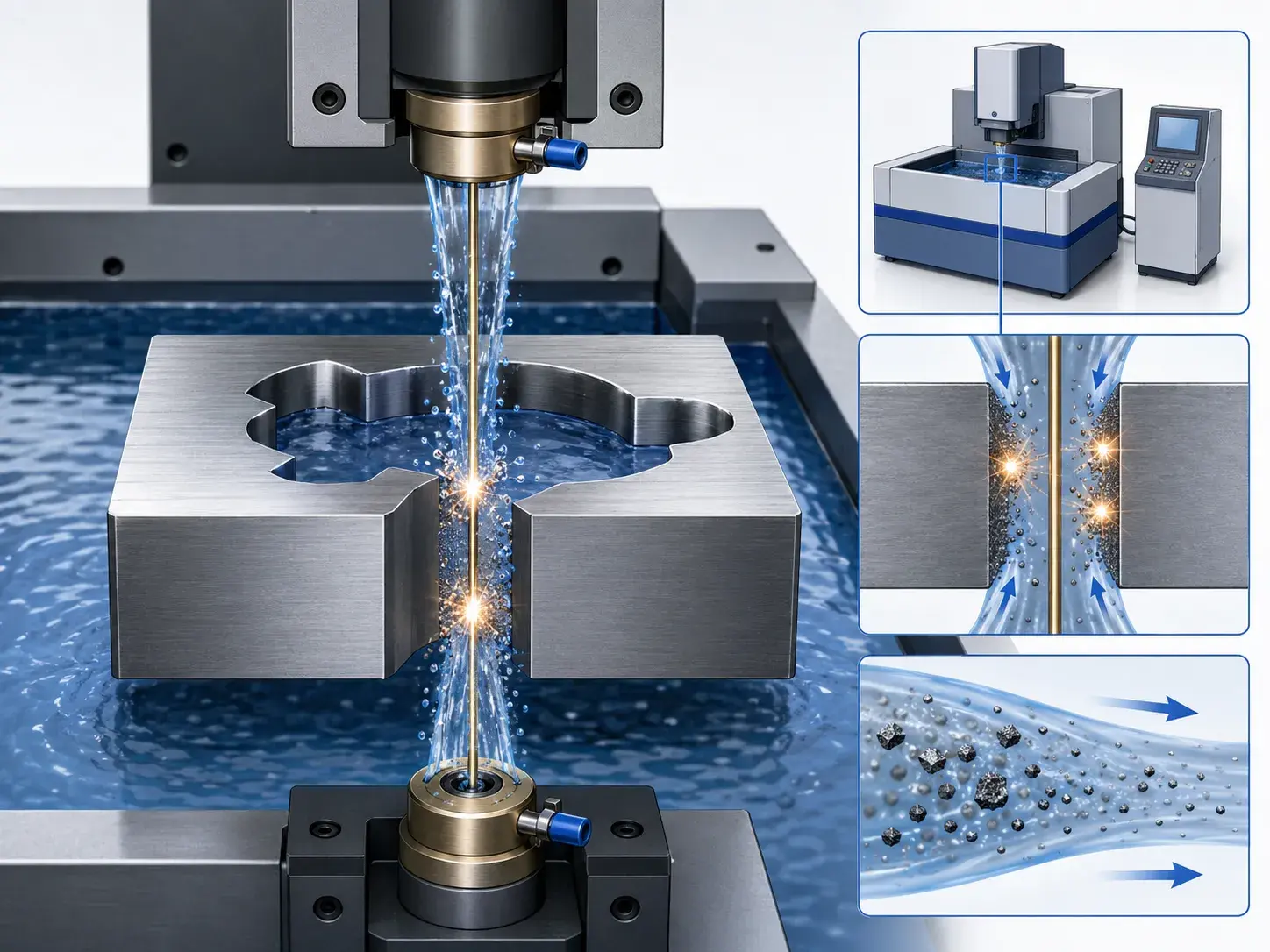
CNC wire EDM machine cutting a metal workpiece in a precision machining workshop

What Is a CNC Wire Cut Machine?

A CNC wire cut machine is a type of EDM machine that uses a continuously moving wire electrode to cut conductive materials with electrical discharge.

Its core process is not mechanical cutting, but electrical discharge machining. During machining, there is no direct contact between the fine metal wire and the workpiece; instead, electrical sparks are generated within a very small gap. These sparks instantly produce high temperatures, causing localized melting or vaporization of the material, after which the fine particles are flushed away by the working fluid.

Because the entire process is CNC-controlled, it can cut complex contours, precision holes, narrow slots, irregular edges, and high-precision parts according to drawings or programs.

CNC wire cutting is commonly used for molds, stamped parts, precision mechanical components, tool steel parts, parts made of hard materials, and structures that are difficult to machine with conventional cutting tools.

However, it is important to note that wire EDM can only process conductive materials. Non-conductive materials, such as common plastics, ceramics, or composite materials, cannot be cut directly using wire EDM.

How Does a CNC Wire Cut Machine Work?

The operating principle of a CNC wire-cut machine is completely different from that of conventional milling.

In CNC milling, the cutting tool comes into direct contact with the material and removes material through rotational cutting. In contrast, wire EDM uses a thin metal wire—typically brass or a coated wire—as an electrode to cut the workpiece.

During machining, the wire moves continuously along a path defined by the CNC program. An electrical current creates rapid discharges between the wire and the workpiece, with each discharge removing a tiny amount of material. Countless tiny discharges accumulate to form the complete cut contour.
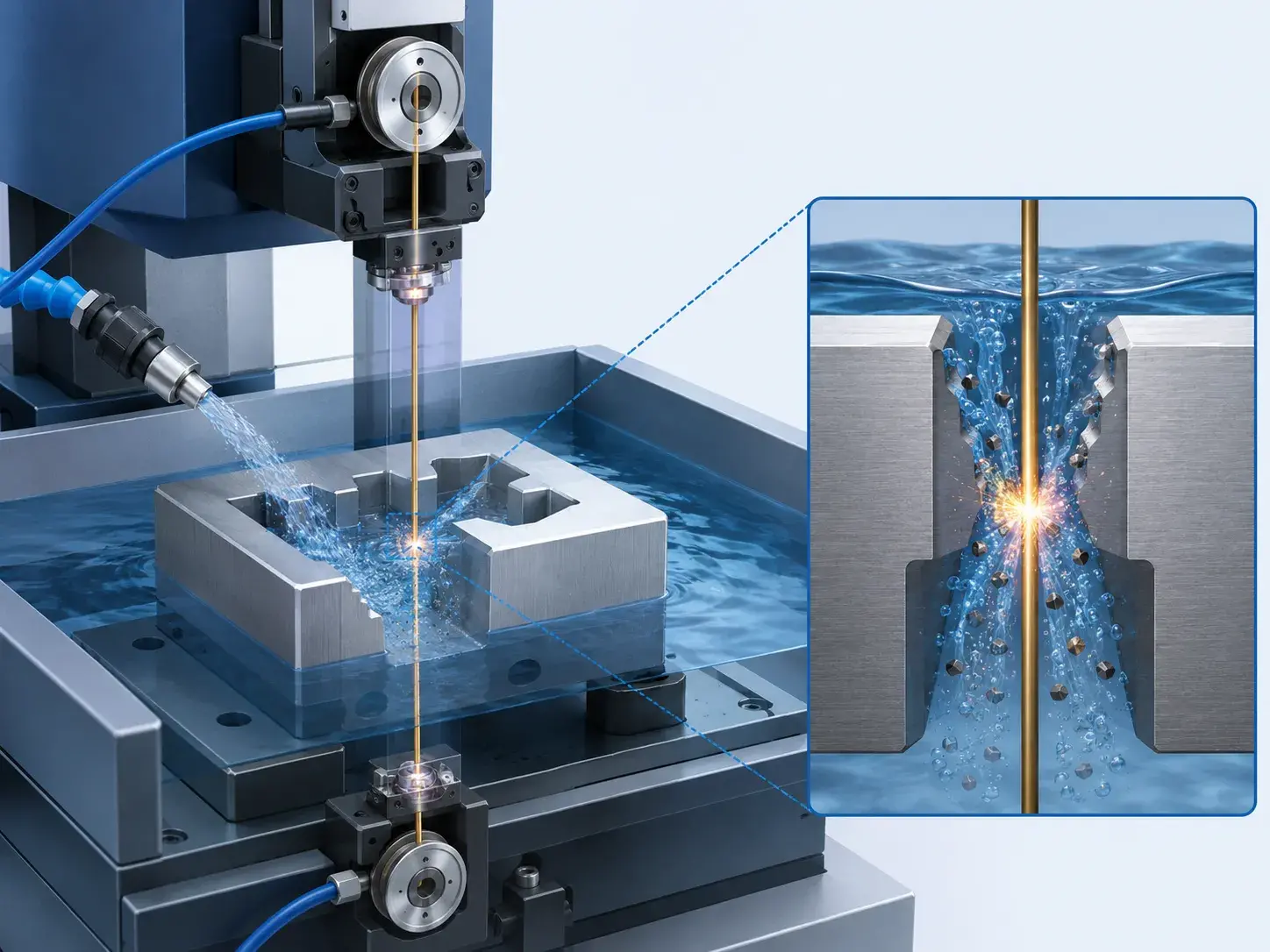
Technical illustration showing how CNC wire cutting works with wire electrode and electrical sparks

The entire machining process typically takes place in deionized water. The working fluid cools the workpiece, flushes away machining debris, and helps control the discharge gap.

The cutting mechanism of Wire EDM is more akin to “slowly ablating material” rather than “cutting material” in the traditional sense. This is why it is well-suited for machining high-hardness materials and precision contours.

A basic Wire EDM process typically includes:

  • Preparing conductive material
  • Securing the workpiece
    Threading the wire electrode
  • Setting the cutting path and machining parameters
  • Starting the electrical discharge cutting
  • Rinsing away machining debris
  • Inspecting dimensions and surface quality

For some high-precision parts, Wire EDM may also be divided into rough cutting and skim cutting. Rough cutting is used for rapid material removal, while skim cutting is used to improve dimensional accuracy and surface quality.

What Materials Can Wire EDM Cut?

The most important requirement for wire EDM is that the material must be electrically conductive.
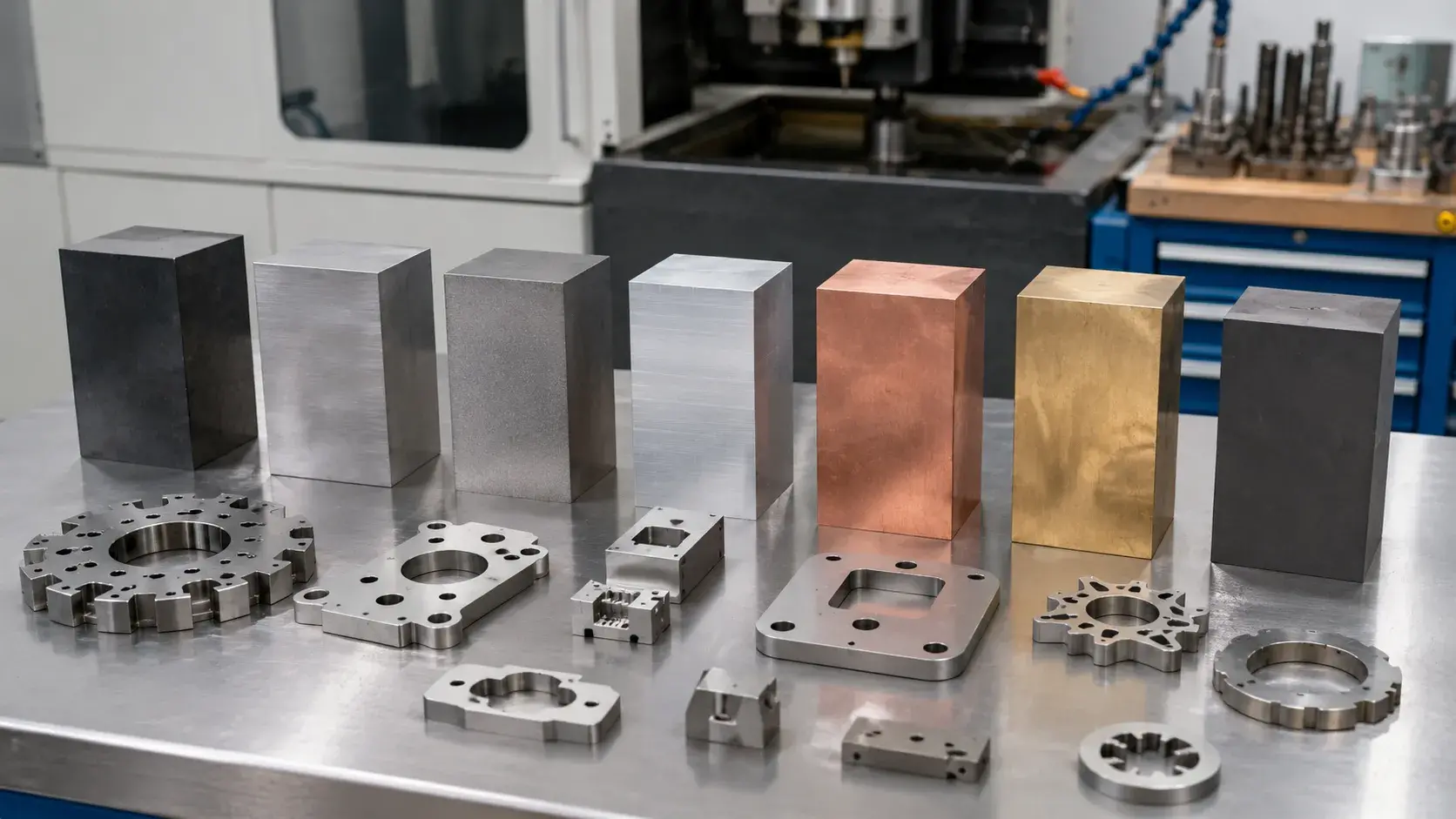
Conductive materials suitable for Wire EDM including tool steel stainless steel titanium aluminum copper brass and carbide

As long as a material has good electrical conductivity, wire EDM can machine many metal materials that are difficult to machine with traditional cutting tools, especially hard materials and heat-treated materials.

Common materials that can be machined include:

MaterialCommon Applications
Tool SteelDies, punches, molds, cutting tools
Stainless SteelPrecision parts, medical parts, corrosion-resistant components
Carbon SteelMechanical parts, plates, fixtures
TitaniumAerospace parts, medical components, lightweight high-strength parts
AluminumPrototypes, lightweight parts, precision profiles
CopperElectrodes, conductive parts, electrical components
BrassConnectors, fittings, precision components
CarbideWear-resistant parts, cutting tools, mold inserts

One of the advantages of wire EDM is that material hardness has relatively little effect on the machining process. For example, materials such as heat-treated tool steel, cemented carbide, and titanium alloys may cause rapid tool wear when machined with conventional cutting tools, but wire EDM can still achieve stable cutting.

However, engineering plastics such as POM, PEEK, nylon, and ABS are generally not suitable for wire EDM because they are non-conductive. These materials are typically better suited for CNC milling or CNC turning.

What Parts Are Suitable for CNC Wire Cutting?

CNC wire cutting is suitable for machining parts that require high precision, fine contours, through-cutting, or complex shapes.
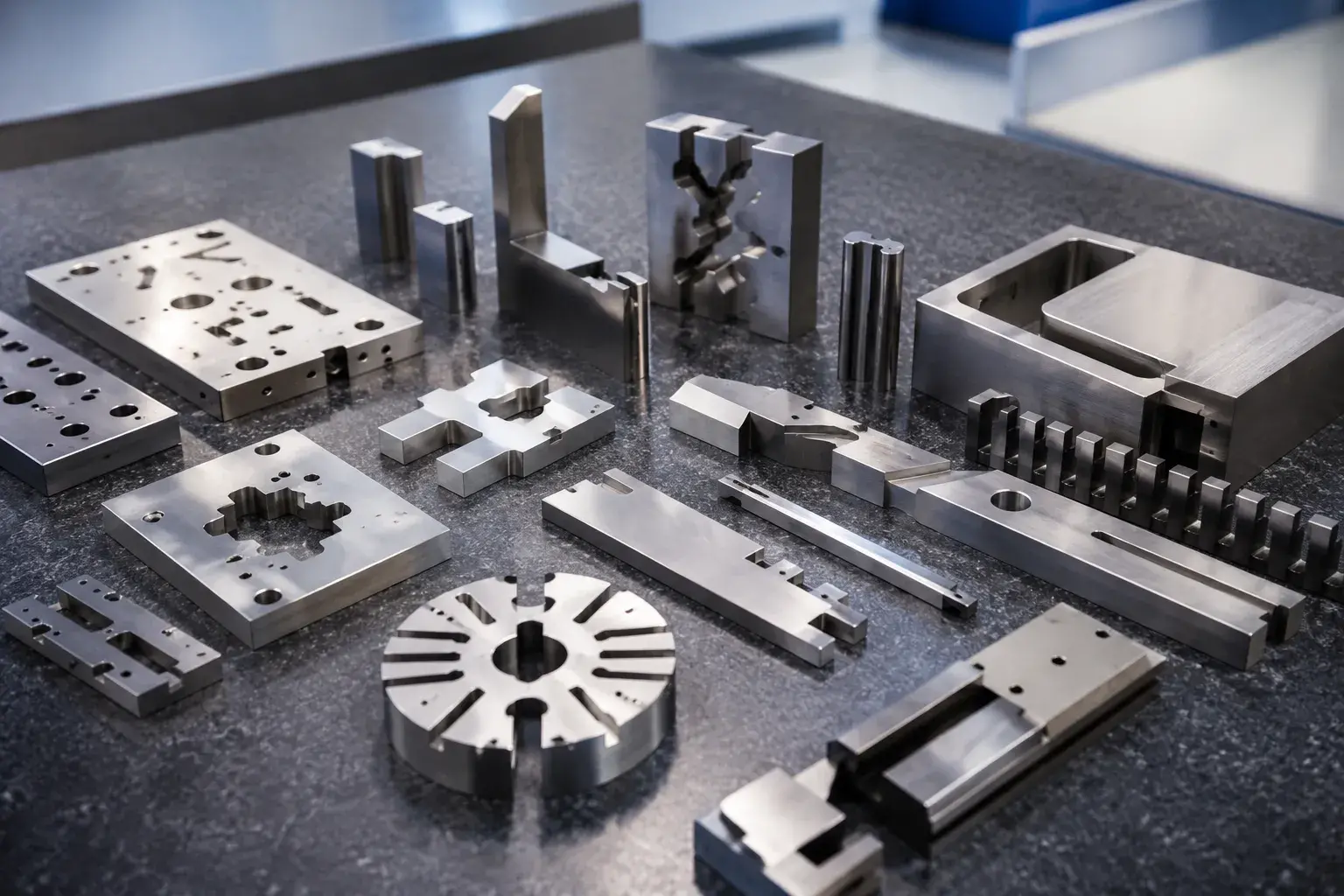
Precision metal parts made by CNC wire cutting with narrow slots and complex profiles

It is commonly used not for removing large amounts of material, but for precision contour cutting. For example, when a part requires very narrow slots, sharp internal corners, complex two-dimensional shapes, or when the material has been heat-treated to a very high hardness, wire EDM offers significant advantages.

Common parts suitable for wire EDM include:

  • Stamping die components
  • Die inserts
  • Precision sheet metal parts
  • Tool steel parts
  • Carbide parts
  • Precision shims
  • Parts with irregular contours
  • Small-batch precision parts
  • Precision components for medical or aerospace applications
  • High-precision holes or narrow slots

Wire EDM is particularly well-suited for machining “through-type features.” In other words, it is better suited for cutting all the way through the material, such as outer contours, through slots, through holes, and irregular openings.

However, if a part requires the machining of blind cavities, 3D curved surfaces, stepped surfaces, large flat surfaces, or complex spatial surfaces, CNC milling, 5-axis machining, or other machining methods may be more appropriate.

Advantages of CNC Wire Cut Machining

The advantages of wire EDM primarily lie in precision, complex contours, hard materials, and low cutting forces.

High Precision

Wire EDM can machine extremely fine contours, making it suitable for parts with tight tolerances. This is particularly important for molds, stamped parts, and precision components.

Because the wire is very thin and the machining path is controlled by a CNC system, it can cut relatively complex shapes while maintaining good dimensional consistency.

No Cutting Force

Unlike milling, which uses a cutting tool to directly remove material, wire EDM exerts virtually no traditional cutting force.

This is particularly beneficial for thin-walled parts, small parts, and parts prone to deformation. The workpiece is less likely to deform due to cutting forces and less susceptible to clamping pressures that could affect machining results.

Good for Hard Materials

Wire EDM can machine materials such as heat-treated tool steel, cemented carbide, stainless steel, and titanium alloys.

When machining hard materials with conventional cutting tools, issues such as tool wear, vibration, thermal deformation, and inconsistent surface quality often arise. Wire EDM, however, does not rely on tool hardness to cut material, giving it a distinct advantage in machining hard materials.

Suitable for Sharp Internal Corners

The internal corner radius in CNC milling is typically limited by the tool diameter, making it difficult to machine truly small internal corners. In contrast, Wire EDM uses a fine metal wire to cut, allowing for smaller internal corner radii.

This is common in molds, stamped parts, and precision-fit components.

Good Surface Finish With Skim Cuts

Wire EDM can improve surface quality and dimensional accuracy through multiple skim cuts.

After rough cutting, performing one or more finishing cuts reduces the heat-affected zone, improves surface consistency, and brings the part closer to its final dimensional requirements.

Limitations of Wire EDM

Wire EDM is highly precise, but it is not a one-size-fits-all machining method. Before choosing it, it is important to understand its limitations.

  • Only Conductive Materials Can Be Cut:Wire EDM relies on electrical discharge, so the material must be conductive. Common plastics, wood, glass, ceramics, and most composite materials are not suitable for this process.
  • Slower Than CNC Milling for Some Parts:Wire EDM typically operates at a slower speed than conventional milling, especially when cutting thick materials, long contours, or when multiple skim cuts are required.
  • Mainly for Through-Cutting Features:Wire EDM is better suited for machining through-cutting features, such as through slots, through holes, outline cuts, and two-dimensional contours.
  • Requires a Wire Start Hole for Internal Cuts:To cut a closed contour inside the material, it is usually necessary to first drill a wire start hole so that the wire can be inserted to begin cutting.
    This affects the machining process and may also impact part design.
  • Heat-Affected Layer May Need Control:Wire EDM is a thermal machining process that generates localized high temperatures in the discharge area. Although the affected area is small, for certain high-precision parts, it is still necessary to control the recast layer, microcracks, or surface integrity.

CNC Wire Cutting vs. CNC Milling

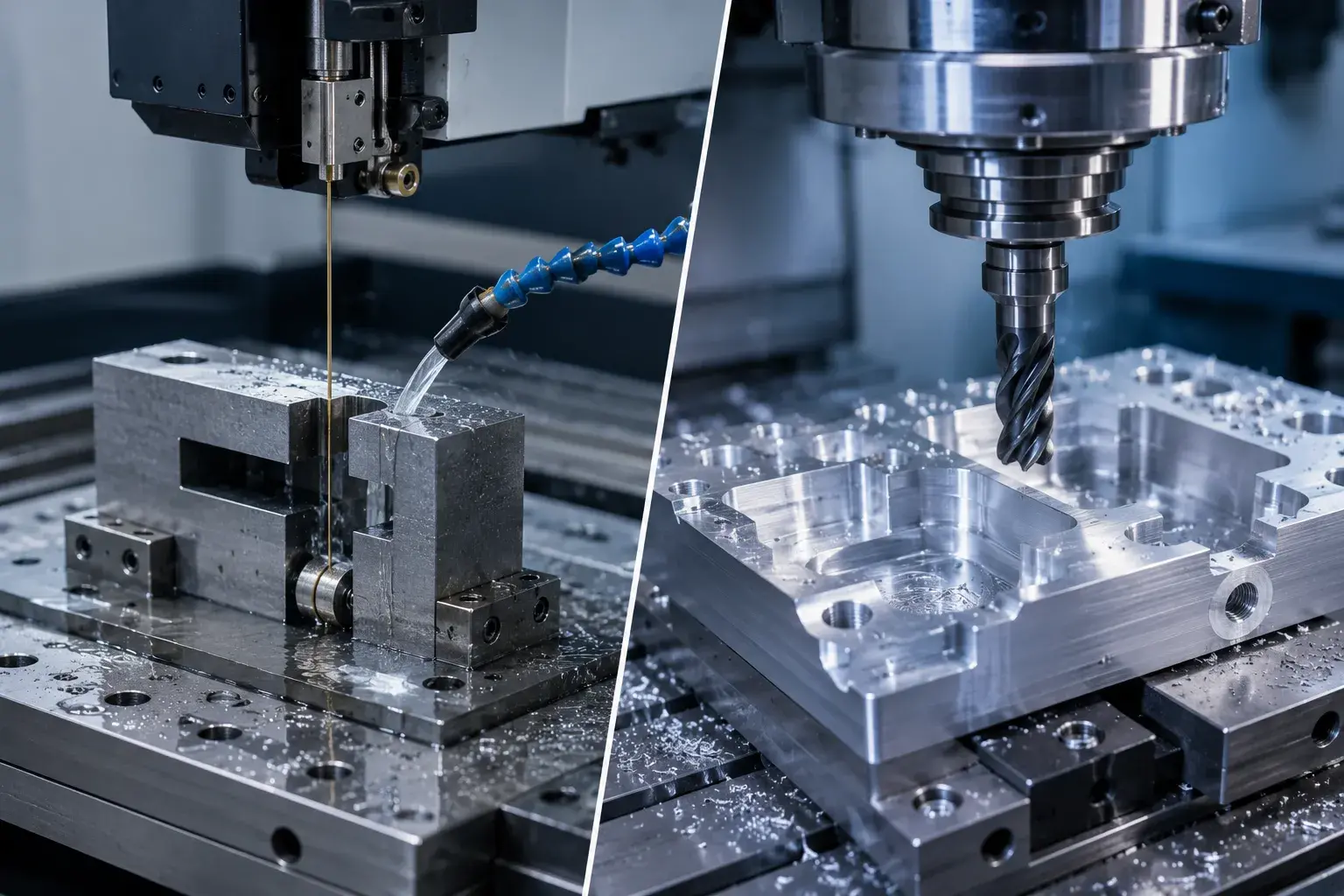
Comparison of Wire EDM and CNC milling for precision metal machining

CNC wire cutting and CNC milling are both precision machining methods, but they are suited for different types of parts.

CNC milling uses rotating cutting tools to remove material and is suitable for machining flat surfaces, steps, holes, grooves, cavities, threads, and 3D curved surfaces. It has a broader range of material compatibility and can machine both metals and engineering plastics.

Wire EDM uses electrical discharge and a fine metal wire to cut material, making it more suitable for conductive materials, hard materials, high-precision contours, narrow grooves, small internal angles, and through-hole irregular structures.

ComparisonCNC Wire Cut / Wire EDMCNC Milling
Cutting MethodElectrical discharge with wire electrodeRotating cutting tool
Material RequirementConductive materials onlyMetals and plastics
Cutting ForceVery low / almost no cutting forceCutting force exists
Best ForPrecise profiles, hard materials, narrow slotsPockets, surfaces, holes, 3D features
Internal CornersSmaller internal radius possibleLimited by tool diameter
SpeedSlower for many general partsFaster for many common features
3D GeometryLimitedStronger for 3D shapes
Blind FeaturesNot suitable for most blind cavitiesSuitable

If a part requires high-precision straight-line contours, narrow slots, small internal angles, or cutting through hard materials, wire EDM may be more suitable.

If a part has a large number of flat surfaces, cavities, holes, threads, curved surfaces, or multi-faceted features, CNC milling is usually more suitable.

In many cases, these two processes are not mutually exclusive but are used in conjunction. For example, a complex part can first be machined using CNC milling to create the main structure, followed by wire EDM to machine precise narrow slots or critical contours.

Wire EDM vs Sinker EDM

Wire EDM and Sinker EDM are both types of EDM, or electrical discharge machining, but they use different machining methods.

Wire EDM uses a continuously moving fine metal wire as the electrode and is primarily used for cutting through-contours. It is more like “cutting along the material.”

Sinker EDM uses a shaped electrode, such as a copper or graphite electrode, to replicate the electrode’s shape onto the workpiece through electrical discharge. It is better suited for machining blind cavities, complex concave structures, deep grooves, and mold cavities.

A simple comparison:

ComparisonWire EDMSinker EDM
Electrode TypeMoving wire electrodeShaped copper or graphite electrode
Best ForThrough profiles, slots, contoursBlind cavities, mold cavities, complex pockets
Start Hole NeededOften needed for internal cutsNot usually needed
Electrode CostWire is continuously consumedCustom electrode must be made
Common UsePrecision profiles, dies, punchesMold cavities, deep ribs, complex recesses

When Should You Choose CNC Wire Cutting?

Not every part is suitable for CNC wire cutting. In general, Wire EDM is a good choice when your part has one or more of these requirements:

  • High-precision external profiles
  • Narrow slots or small internal corners
  • Complex 2D contours
  • Hardened steel, carbide, titanium, or other conductive hard materials
  • Thin or small parts that may deform under cutting force
  • Through-cut features such as slots, holes, openings, die profiles, or punch profiles

However, Wire EDM is usually not the best option for 3D surfaces, deep cavities, large flat areas, threads, or non-conductive materials. In those cases, CNC milling, CNC turning, 5-axis machining, or another process may be more suitable.

Need Help Choosing the Right Process?

Send us your drawing, material, tolerance, and quantity. YUANYI can help review whether Wire EDM, CNC milling, or another CNC process is the better choice.

Send Your Drawing

Conclusion

CNC wire-cut machines, also known as Wire EDM, are suitable for machining high-precision contours, narrow slots, small internal angles, hard materials, and through-hole structures in conductive materials.

However, they are not suitable for all parts, such as non-conductive materials, blind cavities, 3D curved surfaces, and large flat surfaces. In such cases, CNC milling, CNC turning, or 5-axis machining are typically the better options.

In actual projects, it is best to determine the machining method based on the material, structure, tolerances, and quantity to ensure the selection of a more suitable and reliable manufacturing solution.

FAQ About CNC Wire Cut Machines

For a Wire EDM quote, it is best to send a 2D drawing and a 3D CAD file. The drawing should include material, thickness, tolerance, surface finish, quantity, and any critical features such as narrow slots, internal profiles, or small corner radii.

Yes. Wire EDM can be used for prototype parts, especially when the design includes precise profiles, tight tolerances, hard materials, or features that are difficult to machine with standard cutting tools.

Yes. Wire EDM is often suitable for low-volume precision parts because it does not require expensive custom cutting tools. For small batches of complex profiles, it can be a practical and accurate manufacturing method.

Wire EDM can achieve high accuracy, but the final tolerance depends on material type, part thickness, machine condition, cutting strategy, and inspection control. If your part has tight tolerance requirements, these should be clearly marked on the drawing before quoting.

Wire EDM usually produces very clean edges compared with many mechanical cutting methods. However, edge condition still depends on material, cutting parameters, thickness, and finishing requirements. For precision parts, deburring or edge finishing can be added when needed.

The main cost factors include material, thickness, cutting length, tolerance, number of internal cuts, start holes, surface finish requirements, quantity, and inspection needs. Complex profiles with long cutting paths usually take more time.

In most cases, yes. If the wire needs to cut an internal closed profile, a start hole is usually required so the wire can pass through the workpiece before cutting begins.

Yes. Many precision parts use more than one process. For example, CNC milling may be used to machine pockets, surfaces, holes, and 3D features, while Wire EDM is used for narrow slots, precise profiles, or small internal corners.

The easiest way is to send your drawing, material, quantity, and tolerance requirements to an experienced machining supplier. YUANYI can review your part and help decide whether Wire EDM, CNC milling, 5-axis machining, or a combined process is more suitable.

Table of Contents
Discuss Your Complex Machining Requirements

Need Custom CNC Machined Parts?

From rapid prototypes to low-volume production, our engineering team can review your drawings and provide a manufacturing quote.

  • 24-Hour Quotation
  • DFM Engineering Support
  • No Minimum Order
  • ISO 9001 Certified
Request A Quote
Upload your drawing and get a quote within 24 hours.

