

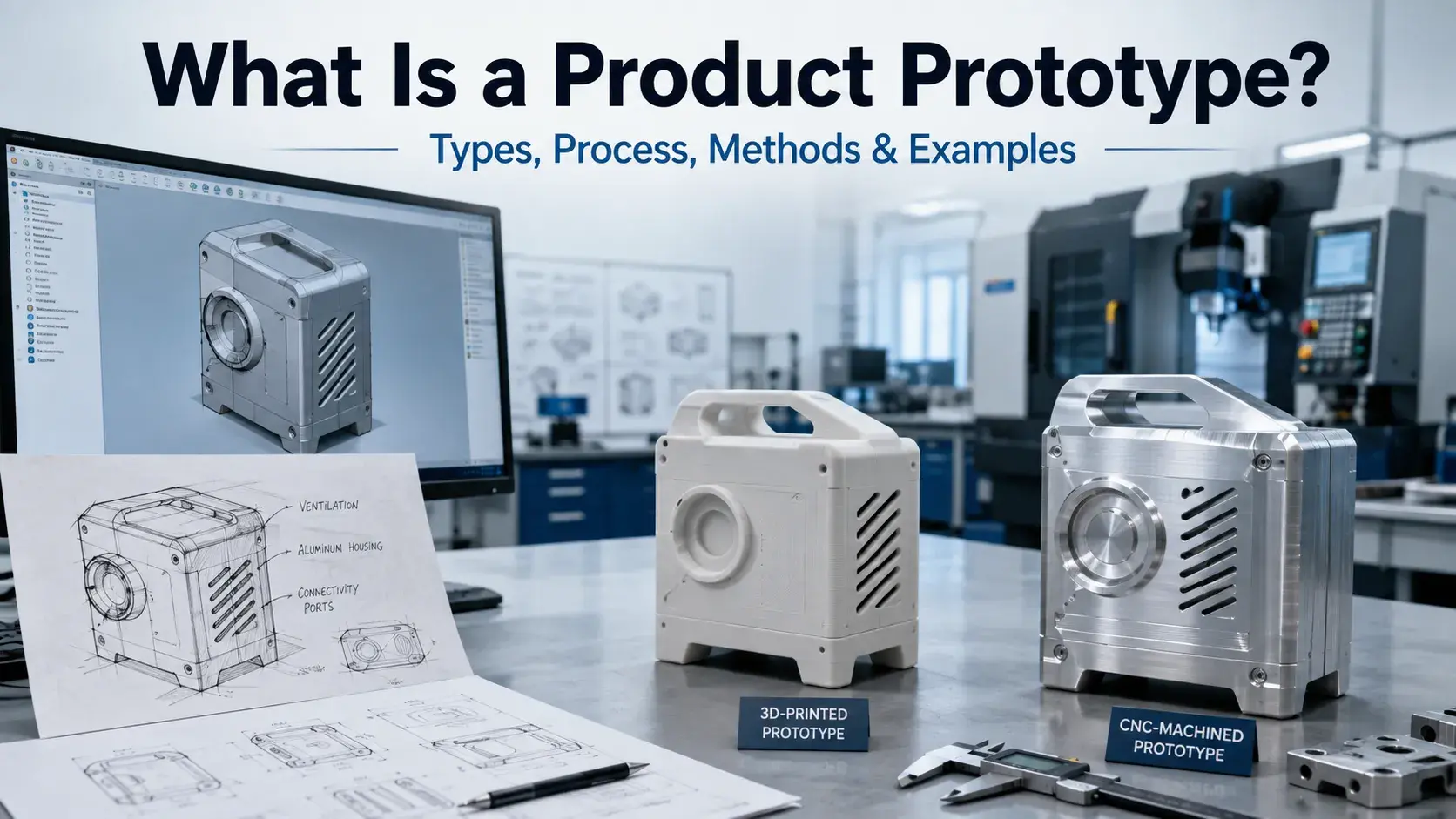
A product prototype is an early version of a product used to test its design, function, fit, usability, or manufacturability before full production.
A prototype can be as simple as a visual model or as advanced as a fully functional CNC-machined part made from production-grade material.
What Is a Product Prototype?
A product prototype is a physical or digital model created before the final product enters mass production.
Its purpose is to test one or more important aspects of the design, such as:
- appearance;
- dimensions;
- function;
- assembly;
- ergonomics;
- material behavior;
- manufacturability.
Not every prototype needs to look or perform exactly like the finished product.
An early concept prototype may only show shape and size, while a functional or engineering prototype may use real materials, tight tolerances, moving parts, electronics, or production-like finishes.
This is why product prototyping is usually an iterative process rather than a single step.
Why Are Product Prototypes Important?
Product prototypes allow design problems to be discovered before expensive tooling or full-scale production begins.
They give engineers, designers, customers, and manufacturers something physical or functional to evaluate.
The main benefits include:
Validate the Design
A prototype helps confirm whether the product actually matches the original design intent.
Dimensions, appearance, ergonomics, and part relationships can be checked before production.
Test Function
Functional prototypes can be used to test movement, loads, electrical performance, thermal behavior, sealing, assembly, and other real operating conditions.
This is especially important for mechanical products where CAD models alone cannot fully predict real-world behavior.
Check Fit and Assembly
For products made from multiple components, prototypes can reveal interference, alignment, tolerance, and assembly problems.
This allows engineers to correct the design before producing larger quantities.
Improve Manufacturability
A prototype can also show whether a part is difficult, expensive, or impractical to manufacture.
For example, testing a CNC-machined prototype may reveal unnecessarily deep pockets, very thin walls, difficult undercuts, or tolerances that are tighter than the application requires.
Reduce Production Risk
Making changes during prototyping is usually much easier than changing a product after tooling, production fixtures, molds, or large quantities of parts have already been made.
Types of Product Prototypes
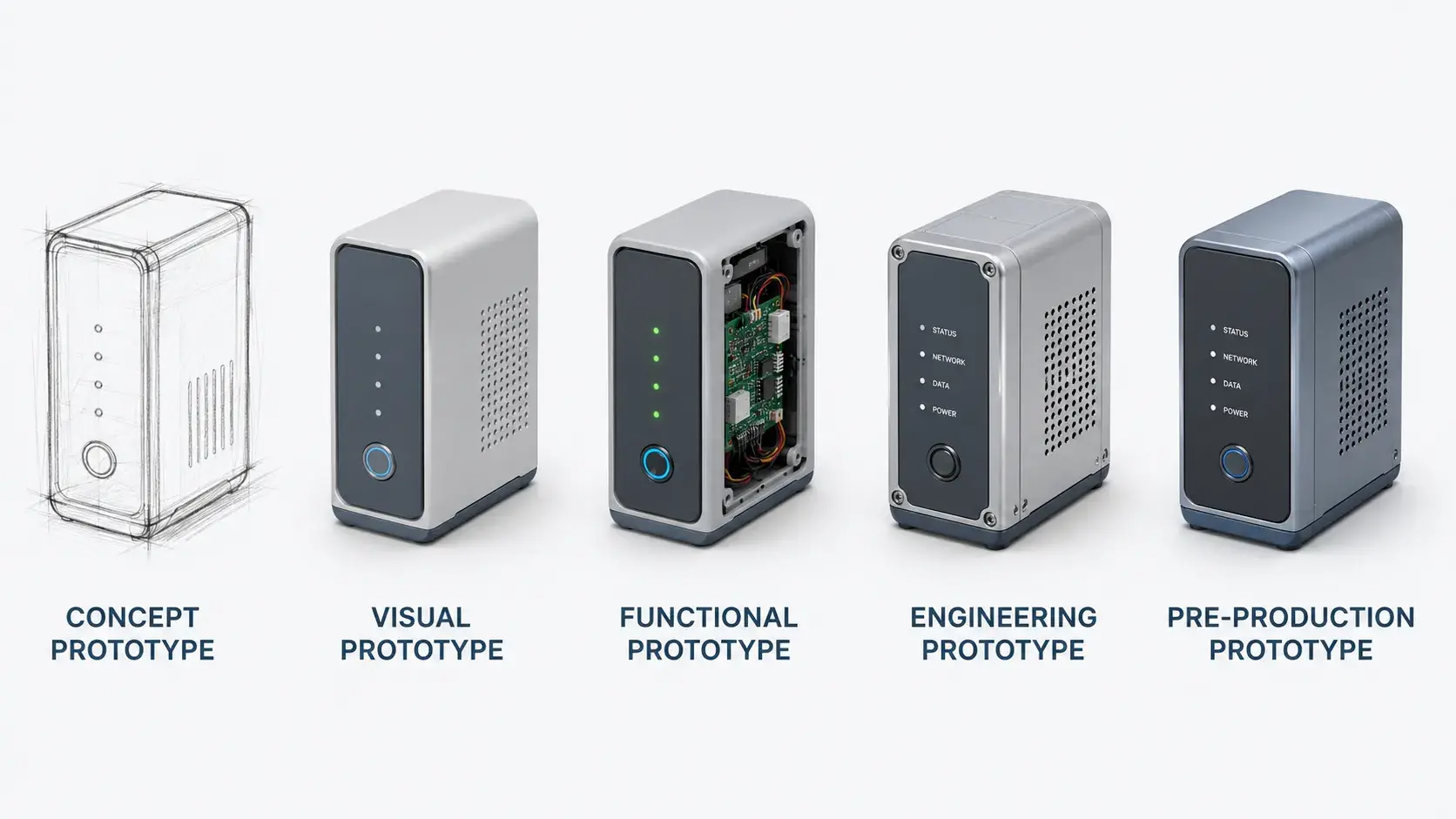
There are several types of product prototypes, and each one is created for a different stage of product development.
Concept Prototype
A concept prototype is an early model used to explore a basic product idea.
It may be made from foam, cardboard, simple 3D prints, or other inexpensive materials.
The goal is usually to evaluate:
- overall shape;
- size;
- basic layout;
- ergonomics;
- design direction.
It does not normally need to use the final material or provide full functionality.
Visual Prototype
A visual prototype focuses mainly on appearance.
It can show the final product’s shape, surface texture, color, branding, and overall presentation without necessarily working like the finished product.
Visual prototypes are often used for:
- design reviews;
- presentations;
- marketing photography;
- customer approval;
- exhibition samples.
Functional Prototype
A functional prototype is built to test how the product works.
It may include moving components, electronic systems, mechanical features, fasteners, seals, or other working elements.
The appearance may not be final, but the important functions should be close enough to the real product for meaningful testing.
Engineering Prototype
An engineering prototype is usually more advanced and is designed to test technical performance.
It may use production-grade materials and tighter dimensional requirements so engineers can evaluate:
- mechanical strength;
- fit;
- tolerance;
- heat;
- vibration;
- wear;
- assembly;
- performance under load.
CNC machining is commonly used for engineering prototypes because it can produce accurate parts from real metals and engineering plastics.
Pre-Production Prototype
A pre-production prototype is one of the final stages before mass production.
It should closely represent the intended final product in material, dimensions, function, assembly, and often surface finish.
This type of prototype can be used to verify that the design is ready for production and that manufacturing methods can consistently produce the required result.
Prototype vs Mockup vs MVP vs Proof of Concept
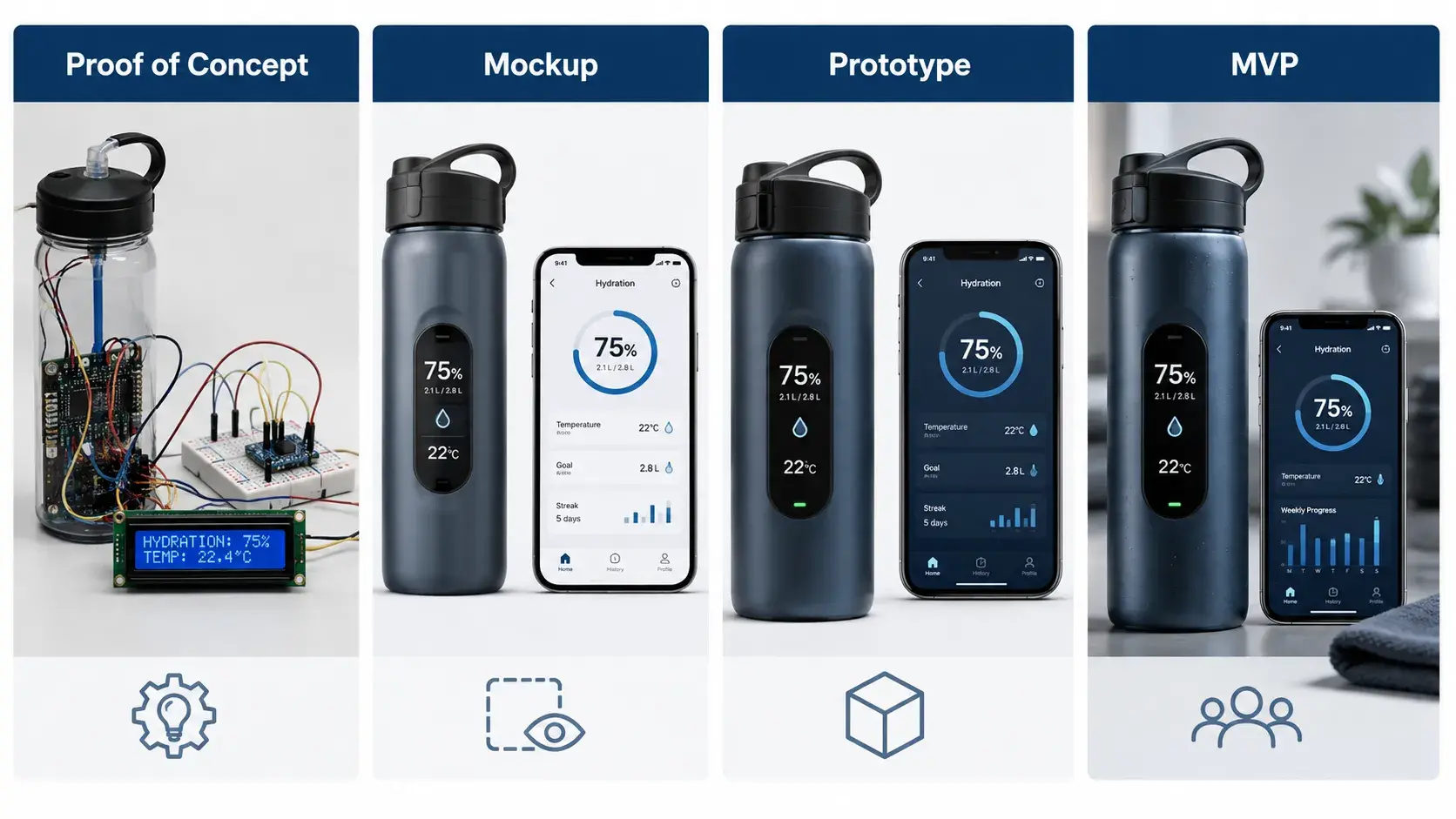
These terms are often used during product development, but they are not the same.
| Term | Main Purpose | Typical Stage |
|---|---|---|
| Proof of Concept | Prove that an idea or technology can work | Very early |
| Mockup | Show appearance, layout, or size | Early design |
| Prototype | Test design, function, fit, or manufacturability | Development |
| MVP | Deliver a minimum usable product to real users | Early market launch |
| Pre-Production Sample | Verify that the product is ready for production | Final validation |
Prototype vs Mockup
A mockup is mainly used to show what a product will look like.
A prototype goes further and may be used to test function, fit, materials, assembly, or performance.
For example, a painted non-functional housing may be a mockup, while a CNC-machined housing with working fasteners and internal components is a functional prototype.
Prototype vs MVP
A prototype is mainly created for testing and validation, while an MVP is a simplified product that can actually be released to users.
An MVP normally includes only the essential features needed to solve the core user problem and collect real market feedback.
A company may build several prototypes before creating an MVP.
Prototype vs Proof of Concept
A proof of concept answers a basic question:
Can this idea technically work?
A prototype answers a broader question:
How well will the actual product design work?
A proof of concept may only test one technical principle, while a prototype may include the actual product geometry, materials, assembly, and functions.How to Make a Product Prototype
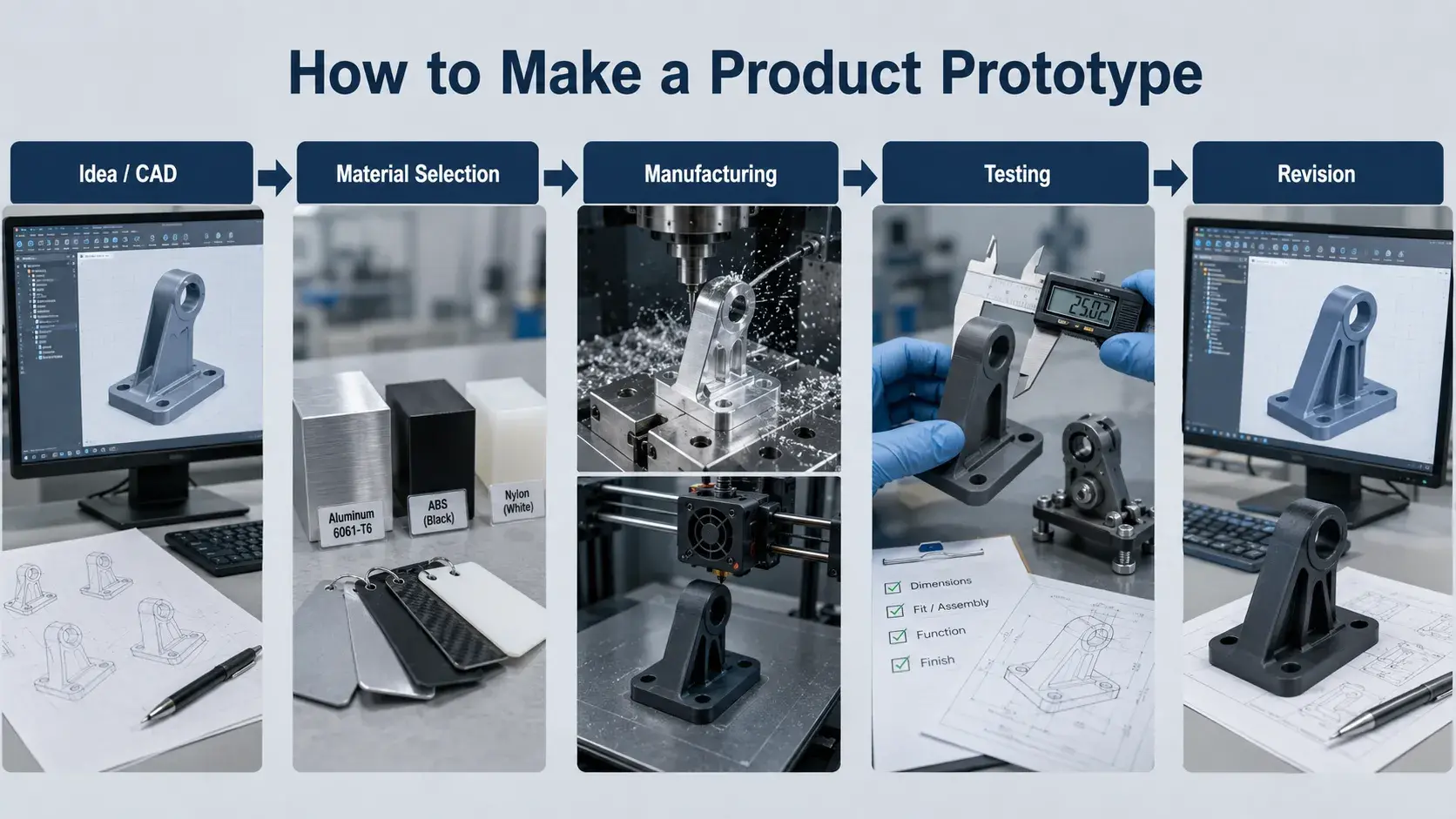
The product prototype process depends on what you need to test.
A prototype for appearance does not need the same material or precision as a prototype used for mechanical testing.
1. Define What You Need to Test
Before manufacturing anything, decide what the prototype is supposed to prove.
You may need to test:
- appearance;
- size;
- ergonomics;
- fit;
- assembly;
- movement;
- strength;
- sealing;
- thermal performance;
- manufacturability.
Trying to test everything with the first prototype can make the project unnecessarily expensive.
2. Create the CAD Model
Most modern product prototypes begin with a 3D CAD model.
The model defines the geometry, dimensions, interfaces, holes, threads, assembly features, and other details needed for manufacturing.
For engineering prototypes, drawings may also specify tolerances, surface finish, materials, and critical dimensions.
3. Choose the Prototype Material
The right material depends on the purpose of the prototype.
For visual models, inexpensive plastics or resins may be sufficient.
For functional testing, it is often better to use a material with properties close to the final product, such as:
- aluminum;
- stainless steel;
- steel;
- brass;
- copper;
- ABS;
- nylon;
- POM;
- PEEK.
Using production-grade materials makes it easier to evaluate actual strength, weight, wear, temperature resistance, and machining behavior.
4. Choose a Prototyping Method
The manufacturing method should match the geometry, quantity, material, accuracy, and purpose of the prototype.
Common product prototyping methods include:
- CNC machining;
- 3D printing;
- vacuum casting;
- sheet metal fabrication;
- laser cutting;
- urethane casting;
- prototype injection molding.
There is no single best method for every prototype.
5. Manufacture the Prototype
Once the design, material, and process are confirmed, the prototype can be manufactured.
Simple prototypes may be completed as a single part, while more complex products may require several components, surface treatments, hardware, electronics, and final assembly.
6. Test and Evaluate
After the prototype is made, it should be tested against the original objectives.
Check whether the design:
- fits correctly;
- assembles easily;
- functions as intended;
- meets dimensional requirements;
- survives expected loads;
- provides acceptable user experience.
The test results should be documented so the design team knows exactly what needs to change.
7. Revise and Build the Next Version
Product prototyping is normally iterative.
The first prototype often reveals issues that were difficult to identify in CAD.
The design can then be updated and another prototype produced until the product is ready for final validation or production.
Common Product Prototyping Methods
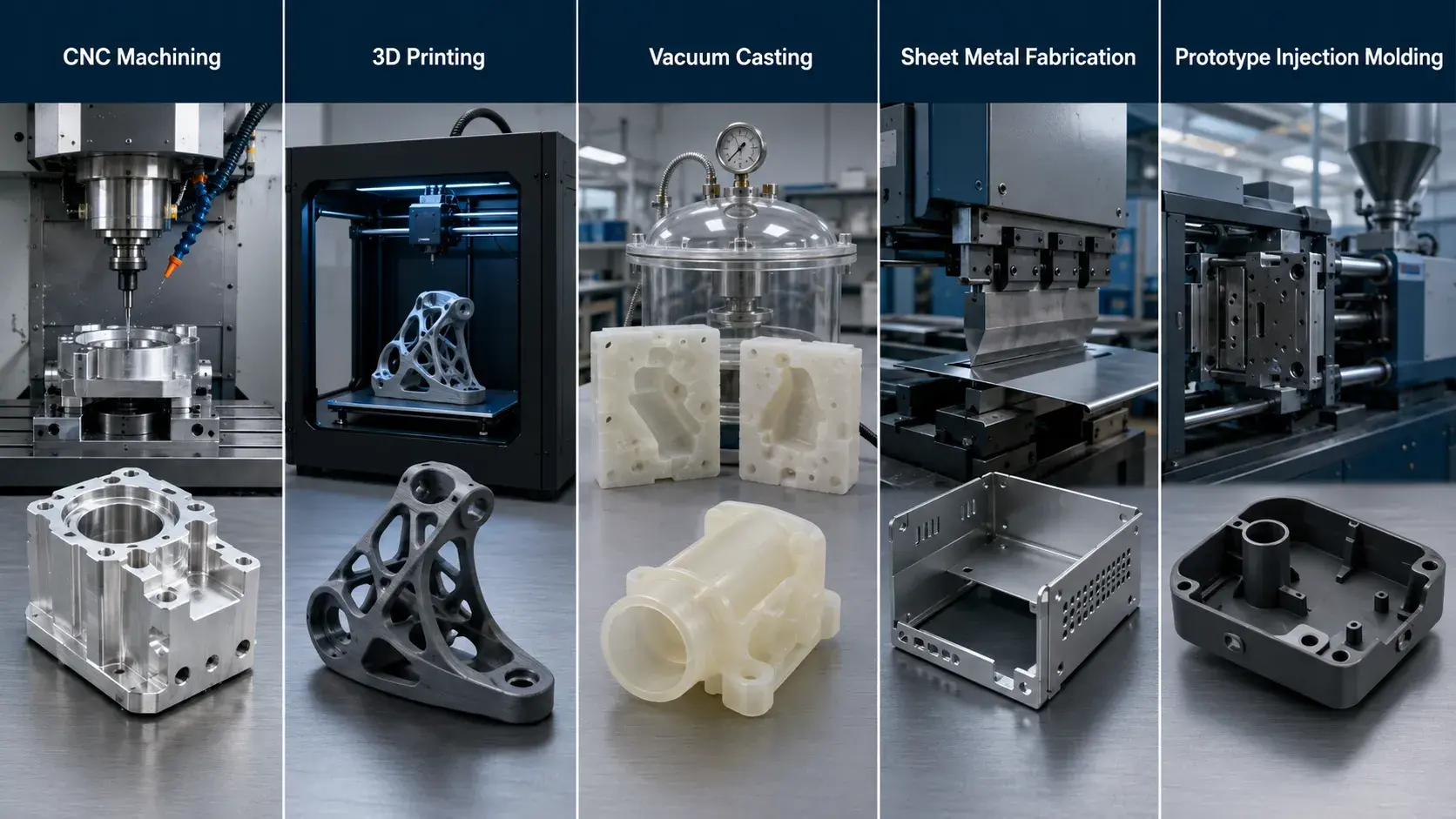
Different prototype manufacturing methods are suitable for different materials, quantities, geometries, and testing requirements.
The right method depends on whether the prototype is mainly for appearance, fit, function, engineering validation, or pre-production testing.
| Prototyping Method | Best For | Typical Materials | Main Advantage |
|---|---|---|---|
| CNC Machining | Functional and engineering prototypes | Aluminum, steel, stainless steel, brass, plastics | High accuracy and production-grade materials |
| 3D Printing | Fast design iterations and complex shapes | Resin, nylon, ABS-like plastics, metal powders | Fast and flexible |
| Vacuum Casting | Small batches of plastic prototypes | Polyurethane resin | Good cosmetic quality |
| Sheet Metal Fabrication | Enclosures, brackets, panels | Aluminum, steel, stainless steel | Real formed metal parts |
| Laser Cutting | Flat parts and profiles | Metal, plastic, acrylic | Fast for 2D geometries |
| Prototype Injection Molding | Production-like plastic parts | Thermoplastics | Closely represents molded production parts |
CNC Machining
CNC machining is widely used for functional prototypes and engineering prototypes.
It removes material from a solid block to create the required geometry and can achieve tight tolerances, accurate holes, threads, pockets, and mating features.
A major advantage is that the prototype can be made from the same or similar material planned for the final product.
Typical CNC prototype materials include:
- aluminum;
- stainless steel;
- carbon steel;
- titanium;
- brass;
- copper;
- POM;
- PEEK;
- nylon.
CNC prototyping is especially useful when dimensional accuracy, mechanical strength, surface finish, or assembly fit needs to be tested.
3D Printing
3D printing builds prototypes layer by layer directly from a digital model.
It is often one of the fastest options for early product development and is particularly useful for complex shapes that would be difficult or expensive to machine.
Common applications include:
- concept models;
- visual prototypes;
- ergonomic testing;
- internal channels;
- complex housings;
- fast design iterations.
However, a 3D-printed prototype may not always have the same mechanical properties, dimensional accuracy, or surface finish as a production part.
Vacuum Casting
Vacuum casting is commonly used to make small batches of plastic prototypes from a master model.
A silicone mold is created around the master, and polyurethane resin is then cast into the mold.
This process is useful when several similar parts are needed with good appearance and relatively low tooling cost.
It is often used for housings, covers, consumer products, and presentation samples.
Sheet Metal Prototyping
Sheet metal fabrication is suitable for products that will eventually be made from bent or formed sheet.
Typical processes include:
- laser cutting;
- punching;
- bending;
- welding;
- riveting.
It is commonly used for electronic enclosures, brackets, chassis, panels, cabinets, and industrial equipment.
Using real sheet metal during prototyping makes it easier to verify bend geometry, mounting positions, assembly, and stiffness.
Prototype Injection Molding
Prototype injection molding is useful when plastic parts need to closely represent the final molded product.
It can be used to test:
- production material;
- wall thickness;
- ribs;
- bosses;
- snap fits;
- shrinkage;
- assembly.
CNC Prototype vs 3D Printed Prototype
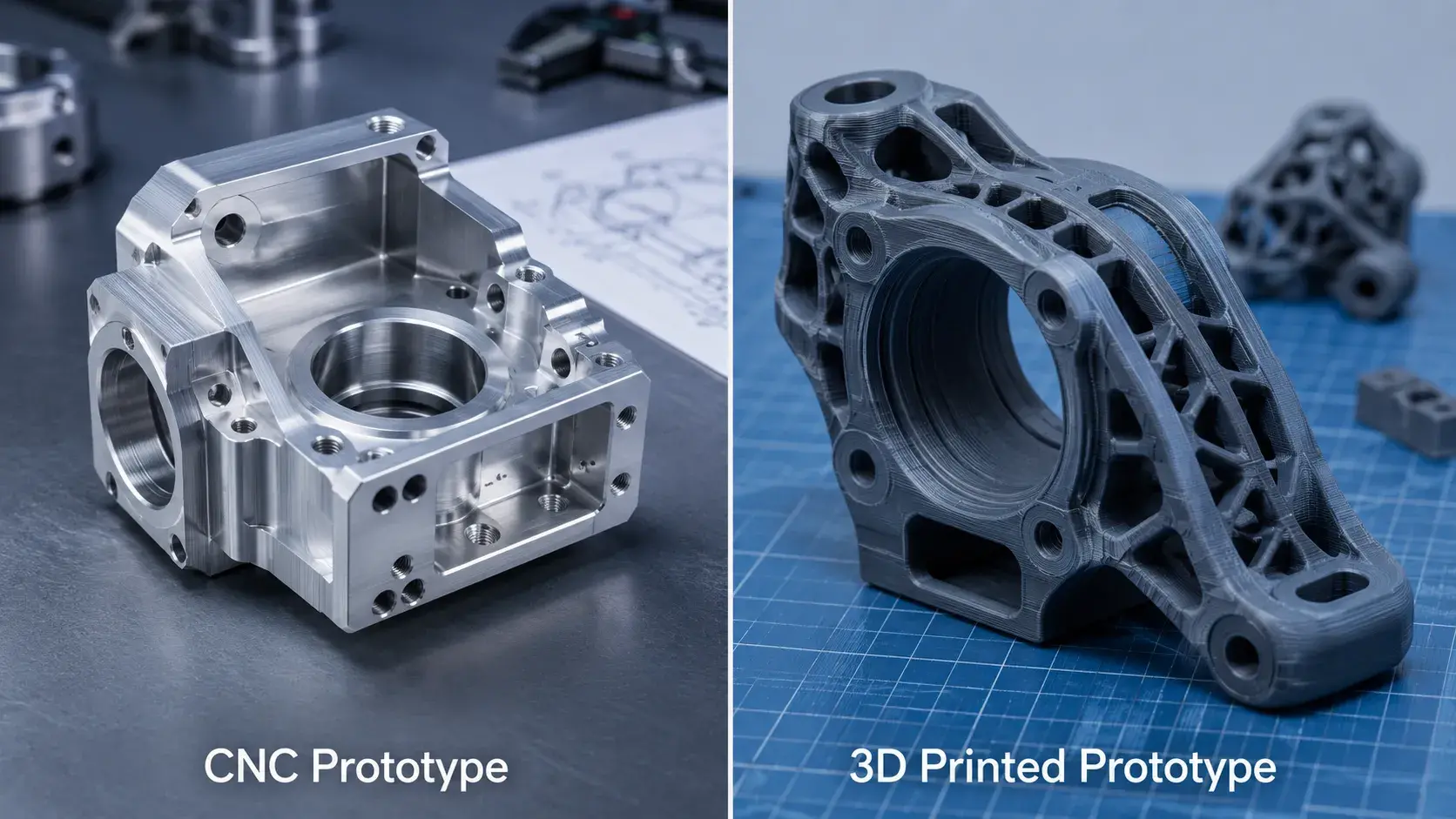
CNC machining and 3D printing are two of the most common methods for product prototyping, but they are suited to different needs.
| Factor | CNC Prototype | 3D Printed Prototype |
|---|---|---|
| Material | Production-grade metals and plastics | Mainly printable plastics, resins, and some metals |
| Accuracy | Generally high | Depends on printing process |
| Mechanical Properties | Close to final material | May differ from final product |
| Surface Finish | Good to excellent | Often requires post-processing |
| Complex Internal Geometry | More limited | Very good |
| Speed | Fast for many simple parts | Very fast for many early-stage models |
| Best Use | Functional and engineering testing | Concept and design iteration |
When Should You Choose CNC Machining?
CNC machining is usually the better choice when you need to test:
- real material behavior;
- tight tolerances;
- mechanical strength;
- threaded features;
- mating surfaces;
- sealing surfaces;
- precision assembly;
- production-like surface finish.
For metal product development, CNC prototypes are often especially useful before moving into larger production volumes.
When Should You Choose 3D Printing?
3D printing is often better when speed and design flexibility are more important than final material properties.
It is particularly useful for:
- early concepts;
- shape validation;
- ergonomic testing;
- complex geometries;
- rapid design changes;
- low-cost visual models.
In many product development projects, both methods are used.
A team may first use 3D printing to evaluate several design versions, then move to CNC machining for a more accurate functional prototype.Need a CNC Prototype?
Send us your CAD files and requirements. We can help manufacture accurate functional prototypes in metal or engineering plastics.
Get a Prototype QuoteHow Much Does a Product Prototype Cost?
The cost of a product prototype varies widely depending on the design, material, process, quantity, and testing requirements.
A simple visual prototype may cost relatively little, while a complex functional prototype with tight tolerances, multiple parts, special materials, and surface finishing can cost much more.
The main cost factors include:
- part size;
- geometric complexity;
- material;
- manufacturing method;
- tolerance requirements;
- surface finish;
- quantity;
- assembly;
- testing or inspection.
For CNC prototypes, complex features such as deep pockets, thin walls, tight tolerances, multiple setups, and difficult materials can increase machining time and cost.
For 3D printed prototypes, cost is usually influenced more by part volume, print time, material, and post-processing.
The best way to estimate prototype cost is to define exactly what the prototype needs to test before selecting the process.
How Long Does It Take to Make a Product Prototype?
Prototype lead time depends on the manufacturing method and the complexity of the product.
A simple 3D printed model may be produced within a few days, while a CNC-machined engineering prototype may take several days depending on material, tolerance, quantity, and finishing.
More complex assemblies can take longer because they may require:
- multiple manufacturing processes;
- purchased components;
- surface treatments;
- assembly;
- inspection;
- functional testing.
Fast prototyping is useful, but speed should not come at the expense of the features that actually need to be validated.
When Should You Build a Product Prototype?
A product prototype should usually be built once the concept is developed enough to test, but before committing to expensive tooling or full production.
Good times to build a prototype include:
- after the first workable CAD design is complete;
- before ordering production tooling;
- before committing to a large production run;
- when important fit or assembly questions remain;
- when material performance needs to be tested;
- when customer or stakeholder approval is required.
For many products, several prototypes are built during development.
An early prototype may verify shape and layout, a functional prototype may test performance, and a pre-production prototype may confirm that the design is ready for manufacturing.
Conclusion
A product prototype is an early version of a product used to test design, function, fit, materials, usability, or manufacturability before full production.
Product prototyping can range from simple concept models to accurate CNC-machined engineering prototypes and production-like samples.
The most important step is to define what needs to be tested first, then choose the right material and prototype manufacturing method for that goal.
Frequently Asked Questions
A prototype itself does not automatically give patent protection.
Patent protection depends on whether the underlying invention meets patent requirements and whether a patent application is filed. If the product may be patentable, it is usually better to consider intellectual property protection before publicly disclosing the design.
Not always, but prototypes are highly recommended for new or untested products.
For simple, well-understood parts, production may begin directly from validated drawings. For new assemblies, complex geometry, tight fits, or functional products, prototyping can reduce the risk of expensive production changes.
Yes, but it depends on the purpose and condition of the prototype.
Some prototypes are suitable for demonstrations, customer testing, or limited use, while others are only intended for engineering evaluation and may not meet final safety, cosmetic, or production requirements.
Product prototypes may be built by in-house engineering teams, prototype manufacturers, CNC machine shops, 3D printing companies, model makers, or product development firms.
The right supplier depends on the material, geometry, quantity, accuracy, and type of testing required.
Most manufacturing suppliers need a 3D CAD file such as STEP or IGES.
For precision parts, a 2D drawing may also be needed to define tolerances, threads, surface finish, material, critical dimensions, and inspection requirements.



