

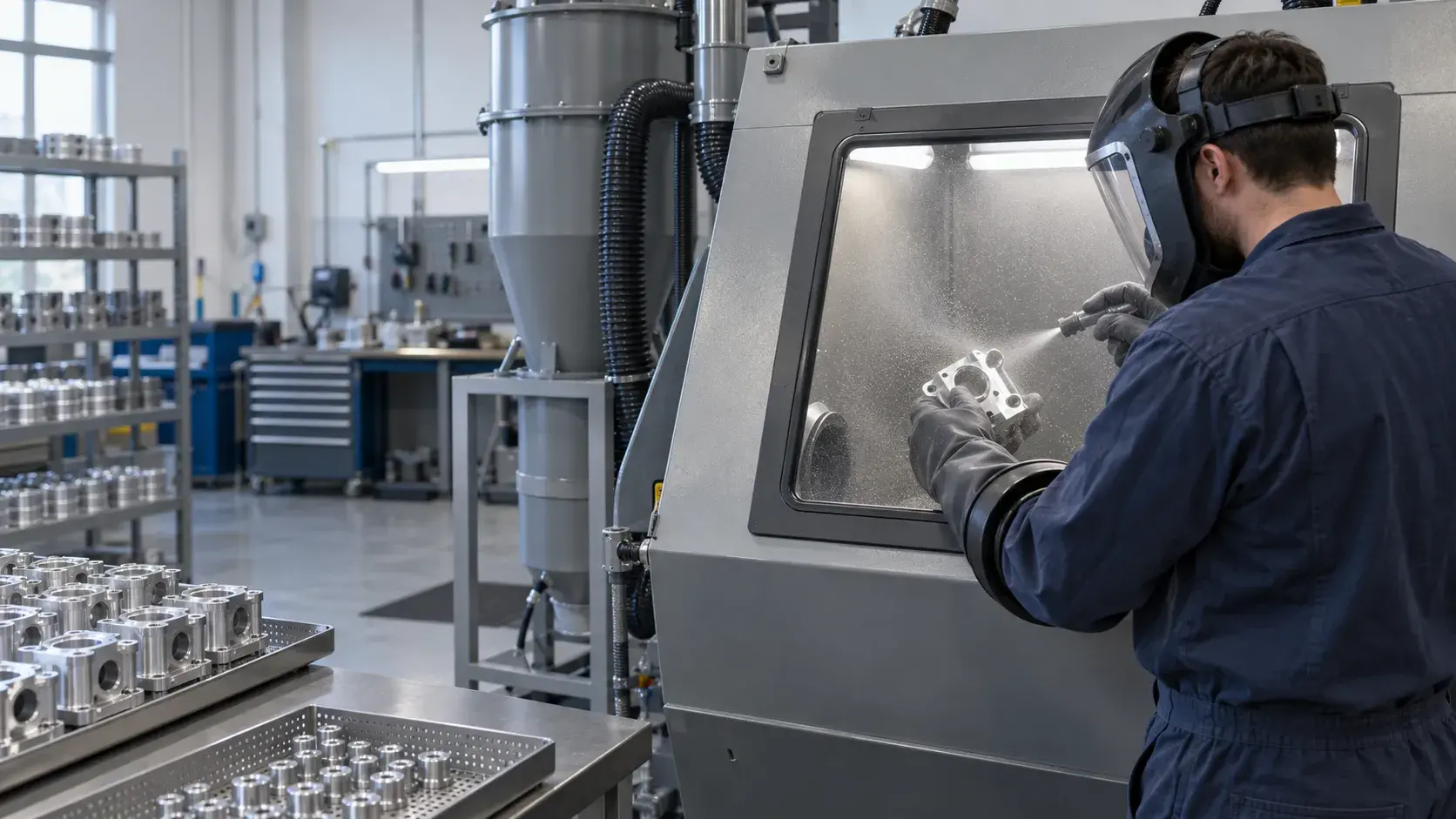
Bead blasting is a surface finishing process that uses compressed air to propel small spherical media—most commonly glass beads—against a component. The repeated impacts clean the surface, reduce the visibility of light machining marks, and create a uniform matte or satin appearance.
It is widely used on CNC-machined aluminum and stainless-steel parts, as well as selected plastics and 3D-printed components. However, the final result depends on the material, media, air pressure, blasting distance, exposure time, and original surface condition. This guide explains how bead blasting works, which materials it suits, its advantages and limitations, and how to specify the finish for a manufacturing project.
What Is Bead Blasting?
Bead blasting is a type of abrasive or media blasting. During the process, a blast gun accelerates small particles toward a workpiece using compressed air. Unlike angular abrasives that cut into the surface, spherical beads mainly strike and dimple it. Thousands of overlapping impacts alter the way the surface reflects light, producing a consistent, low-gloss texture.
Glass beads are the most common choice because they provide a relatively gentle finish while preserving the underlying color of the material. Depending on bead size and process settings, the result can range from a fine matte texture to a more noticeable satin finish.
Bead blasting can remove light contamination and make minor tool marks less visible, but it does not fill scratches or repair damaged surfaces. Deep scratches, dents, pits, and heavy oxidation normally require grinding, polishing, or a more aggressive cleaning process first.
How Does Bead Blasting Work?
A typical bead blasting process includes the following steps:
- Review the requirements:The manufacturer identifies cosmetic surfaces, protected features, roughness requirements, and any subsequent finishing operations.
- Clean and inspect the part:Oil, grease, loose debris, and significant oxidation are removed. Existing defects are recorded before blasting.
- Select the media:The media material and particle size are chosen according to the base material and desired texture.
- Mask critical features:Threads, precision bores, sealing faces, bearing fits, and other functional areas may need protection.
- Set the process parameters:The operator adjusts air pressure, nozzle distance, spray angle, and pass speed.
- Blast the specified surfaces:Controlled, overlapping passes help produce even coverage.
- Clean the finished part:Residual particles and dust are removed, especially from holes and internal channels.
- Inspect the result:Appearance, surface roughness, cleanliness, and critical dimensions are checked as required.
Several parameters influence the result. Fine beads generally create a finer texture, while larger beads produce a more pronounced finish. Increasing air pressure or exposure time makes the impact more aggressive, but excessive settings can round edges, alter critical dimensions, or distort thin parts. Nozzle distance and angle also affect coverage, especially around corners, pockets, and complex geometry.
The original surface matters as much as the blasting settings. Two parts blasted with identical parameters may look different if their alloys, machining patterns, or initial roughness differ.
Types of Bead Blasting Media
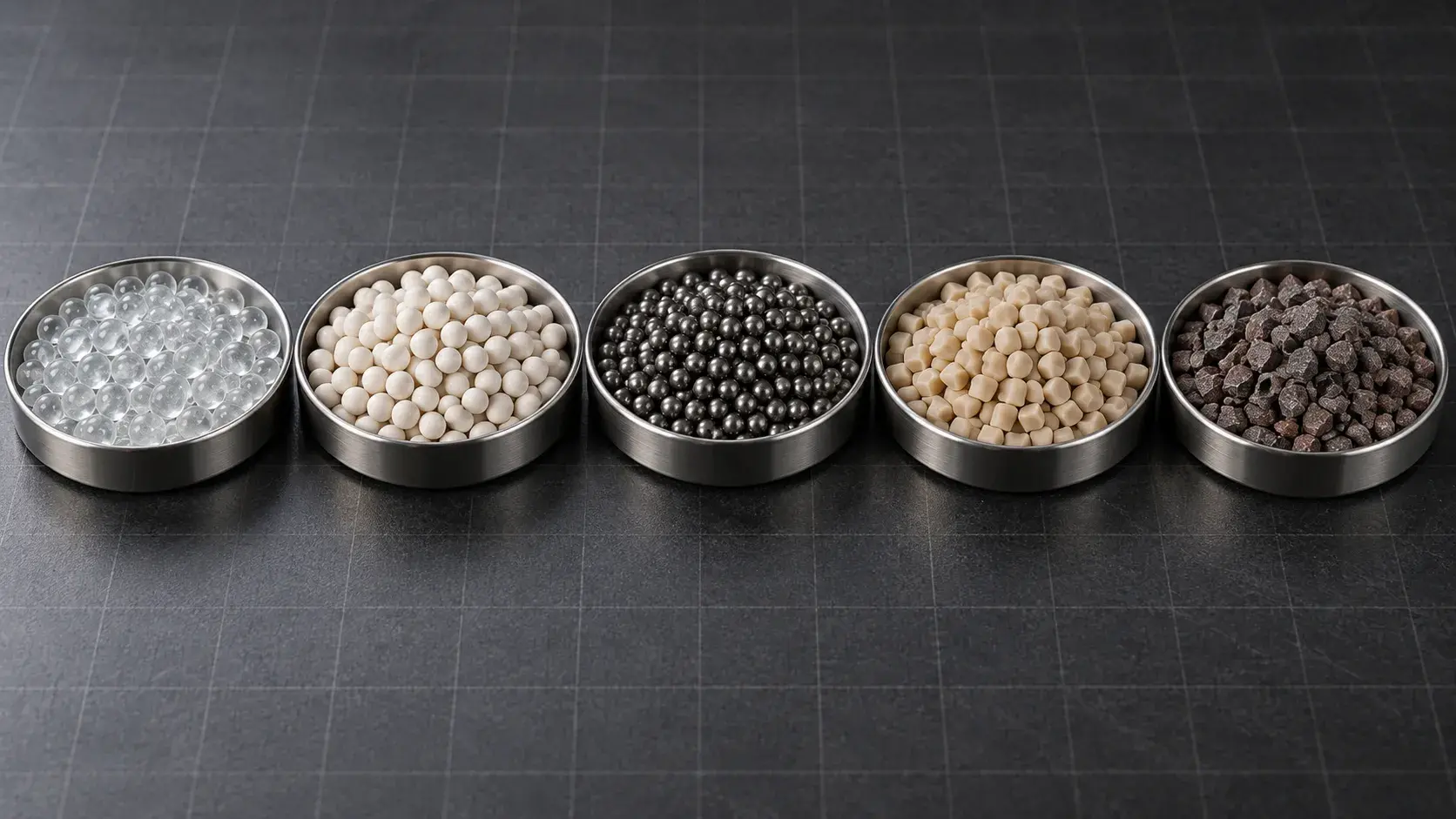
Different media produce different levels of cleaning, texture, and surface impact.
| Media | Characteristics | Typical use |
|---|---|---|
| Glass beads | Spherical, relatively gentle, reusable | Matte or satin cosmetic finishes |
| Ceramic beads | Harder and more durable than glass | Controlled finishing and longer media life |
| Steel shot | Strong and highly durable | Hard metal parts and stronger surface impact |
| Plastic media | Lightweight and relatively gentle | Sensitive materials and coating removal |
| Aluminum oxide | Angular and aggressive | Rust removal, etching, and coating preparation |
Glass Beads
Glass beads, usually made from lead-free soda-lime glass, are the standard choice for bead-blasted CNC parts. They produce a bright, uniform matte or satin surface with less cutting action than angular abrasives. Although glass beads can be recycled, they gradually break down. A high proportion of worn or broken media may change the texture, so media condition must be controlled for repeat production.
Ceramic Beads
Ceramic beads are harder and usually last longer than glass beads. They are useful when a controlled finish and extended media life are important, although their cost may be higher.
Steel Shot and Plastic Media
Steel shot produces a stronger impact and is suitable only when it is compatible with the workpiece. It can contaminate some materials and should not automatically be treated as equivalent to controlled shot peening. Plastic media provides gentler action for selected plastics, soft substrates, or coating-removal applications.
Aluminum oxide is frequently used in blasting cabinets, but it is normally angular rather than spherical. It cuts more aggressively and is better classified as abrasive blasting media. It may be more suitable than glass beads when the objective is to remove heavy oxidation, rust, or an existing coating.
Materials Suitable for Bead Blasting
Aluminum
Aluminum is one of the most common materials for bead blasting. The process can reduce the visibility of milling marks and create a clean, uniform appearance on housings, enclosures, brackets, and other CNC parts.
Thin walls and delicate edges require conservative settings because aluminum is relatively soft. Bead blasting also influences the appearance of subsequent anodizing. Changes in the blasted texture affect how the anodized surface reflects light, while alloy and raw-material variations can create visible color differences. When several parts must match, it is best to control the material, blasting process, and anodizing batch and to approve a physical sample before production.
Stainless Steel
Bead blasting can give stainless steel a uniform, low-reflection finish. Cleanliness is essential: media previously used on carbon steel may embed free iron in the stainless surface and cause rust staining. Dedicated equipment or verified clean media should be used where contamination is a concern. Cleaning or passivation may also be required by the application.
Other Metals, Plastics, and 3D-Printed Parts
Titanium, brass, and copper can be bead blasted, but media cleanliness and pressure must be carefully controlled. Brass and copper are softer and may pit or develop an overly heavy texture under aggressive conditions.
Selected engineering plastics can also be blasted, although whitening, erosion, heat buildup, or deformation may occur. A trial part is advisable. For SLS, MJF, or metal 3D-printed components, blasting can remove loose powder and make the surface more uniform. Internal channels must be designed and cleaned so that media cannot remain trapped.
Bead-Blasted Finish and Surface Roughness
A bead-blasted finish is normally described as matte or satin. Matte surfaces have low gloss and diffuse reflected light, while satin surfaces retain a soft sheen. These terms are subjective: one supplier’s “fine matte” may not match another supplier’s result.
Surface roughness, often expressed as Ra, provides useful numerical information but does not fully define appearance. Parts with similar Ra values may still differ in gloss, color, and texture because of media shape, surface direction, alloy, and lighting. For cosmetic parts, an approved physical sample is often more reliable than a roughness value alone.
A practical drawing note could state:
BEAD BLAST EXTERNAL COSMETIC SURFACES TO A UNIFORM MATTE FINISH. USE GLASS BEADS. MASK THREADS, PRECISION BORES, SEALING SURFACES, AND DATUM FEATURES. FINAL APPEARANCE TO MATCH THE APPROVED SAMPLE.
If roughness is functionally important, specify the target Ra range, measurement areas, and inspection method separately. Avoid applying an unnecessarily narrow Ra tolerance to every surface, as this may increase cost without improving part performance.
Advantages and Limitations of Bead Blasting
Bead blasting offers several benefits:
- Creates a consistent matte or satin appearance
- Reduces the visibility of light machining marks
- Cleans light surface contamination
- Works with many metals and selected plastics
- Processes complex external shapes efficiently
- Can prepare parts for certain secondary finishes
- Is relatively quick and economical for batch production
- Uses media that may be recycled several times
However, it also has important limitations:
- It may remove a small amount of material or round sharp edges.
- Tight-tolerance features may require masking and post-process inspection.
- Thin walls and soft materials may deform under excessive pressure.
- The process depends on line-of-sight access, making deep holes, undercuts, and enclosed cavities difficult to finish uniformly.
- Media can become trapped in threads, intersecting holes, and internal channels.
- Manual blasting, nozzle wear, media condition, and raw-material variation can cause batch-to-batch differences.
- It cannot repair deep scratches, dents, pits, or major machining defects.
For these reasons, bead blasting should be treated as a controlled manufacturing operation rather than a universal cosmetic fix.
Design Guidelines for Bead-Blasted CNC Parts
Good drawing and part design help manufacturers deliver a consistent finish.
First, identify which surfaces are cosmetic. If different areas have different visual requirements, classify them—for example, primary visible surfaces, secondary visible surfaces, and non-cosmetic surfaces. This prevents unnecessary processing and inspection.
Second, identify features that require masking. Common examples include:
- Threads and threaded inserts
- Precision bores and bearing fits
- Sealing faces and O-ring grooves
- Datum and measurement surfaces
- Electrical contact areas
- Areas intended for welding, bonding, or laser marking
Third, consider geometry and cleaning access. Deep pockets, narrow slots, blind holes, and internal passages may not receive the same texture as exposed surfaces. These features may also retain media. Where cleanliness is critical, provide an accessible path for air cleaning or specify an appropriate post-process cleaning method.
Finally, approve a sample before volume production when appearance is important. A master sample establishes acceptable color, texture, gloss, and treatment coverage more effectively than subjective phrases such as “smooth finish.”
Bead Blasting Before Anodizing or Coating
Bead blasting is often used before another surface treatment. For aluminum components, a common sequence is:
CNC machining → deburring and cleaning → bead blasting → anodizing
The blasted texture remains visible beneath the anodized layer and influences the final gloss and apparent color. Parts that must match should use consistent material and process conditions.
Bead blasting may also precede painting or powder coating, but glass beads do not always produce the best surface for coating adhesion. If the main purpose is to create a strong mechanical anchor, angular abrasive media may be more suitable. The blasting process should therefore be selected according to the coating specification rather than appearance alone.
Parts must be thoroughly cleaned before plating, welding, brazing, soldering, or adhesive bonding. Residual media, dust, or incompatible contamination can reduce adhesion and joint quality. Functional joining surfaces may need to be masked.
Bead Blasting vs. Sandblasting
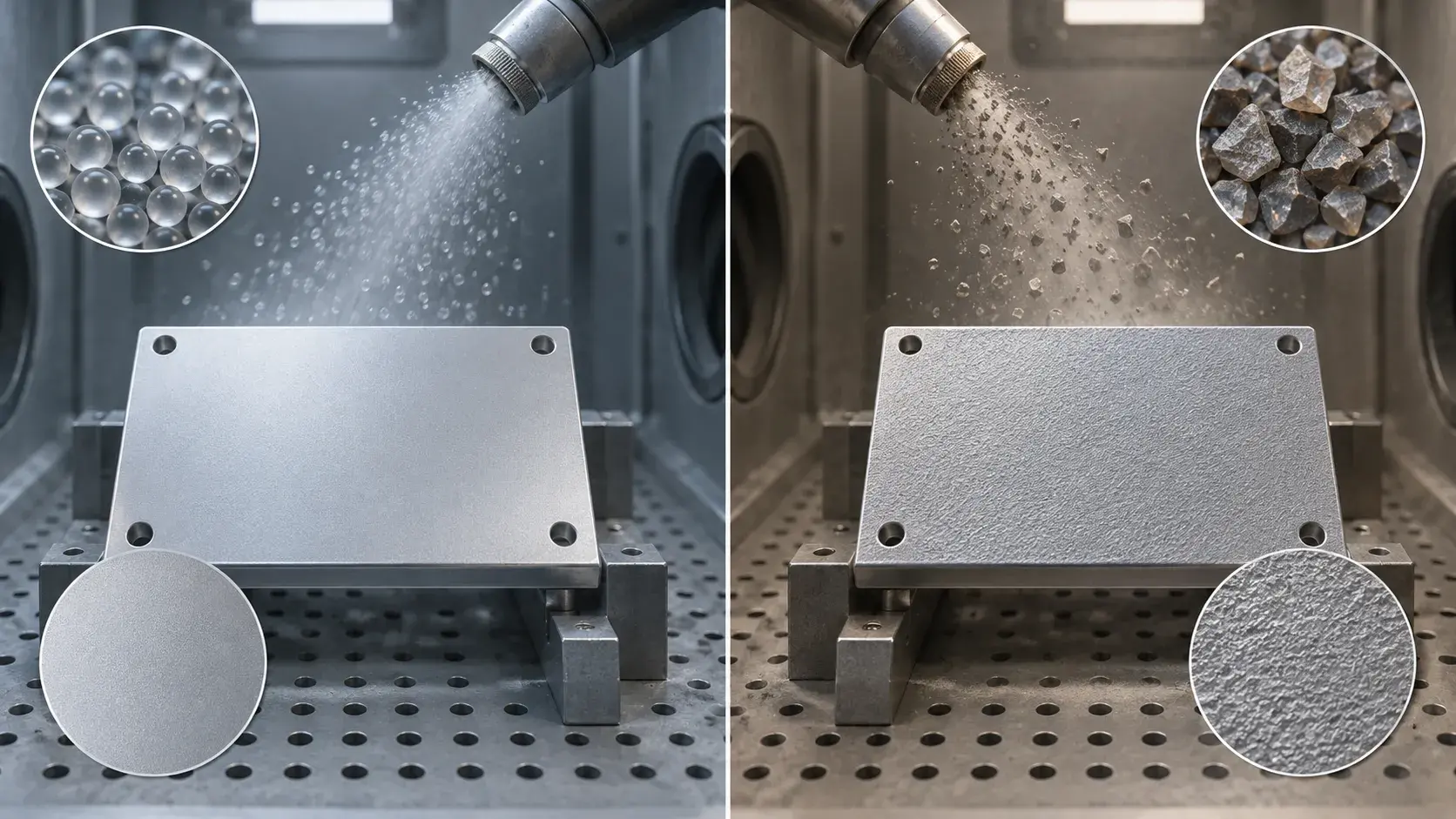
The main difference is the shape and aggressiveness of the media.
| Factor | Bead blasting | Sandblasting / abrasive blasting |
|---|---|---|
| Media shape | Usually spherical | Usually angular |
| Surface action | Gentler impact and dimpling | More aggressive cutting |
| Typical finish | Uniform matte or satin | Rougher, etched texture |
| Material removal | Relatively low | Generally higher |
| Main purpose | Cosmetic finishing and light cleaning | Rust, coating removal, and surface preparation |
| Common media | Glass or ceramic beads | Aluminum oxide and other angular abrasives |
Bead blasting is generally preferred when the objective is an attractive, consistent finish with limited material removal. Sandblasting or angular abrasive blasting is often better for removing heavy rust, scale, paint, or creating a rough surface before coating.
Neither term alone defines an exact result. The drawing or RFQ should identify the media, protected surfaces, required appearance, and any roughness or inspection requirements.
Common Applications
Bead blasting is used across many industries and manufacturing processes:
- Consumer electronics:Aluminum housings, control panels, and decorative components
- Automotive:Brackets, housings, and parts requiring cleaning or a consistent texture
- Aerospace:Low-glare components and surfaces prepared under controlled specifications
- Medical and laboratory equipment:Instruments and enclosures requiring a uniform finish and controlled cleanliness
- Robotics and automation:Frames, covers, end-effectors, and sensor housings
- 3D printing:Loose-powder removal and surface-texture improvement
- General CNC machining:Prototypes and production parts requiring a professional matte appearance
Application-specific requirements still apply. Bead blasting alone should not be assumed to provide corrosion resistance, biocompatibility, fatigue improvement, or coating adhesion without suitable validation and subsequent processing.
Quality Inspection for Bead-Blasted Parts
Inspection should reflect the purpose of the finish. Cosmetic inspection typically checks for uniform texture, streaks, shadows, scratches, exposed machining marks, gloss variation, and inconsistent coverage. Viewing conditions should be defined for demanding appearance requirements.
A surface roughness tester can verify Ra when the drawing specifies it. A gloss meter or colorimeter may help control visible variation across production batches. Physical limit samples are particularly useful when numerical measurements cannot describe the complete appearance.
Critical dimensions, bores, threads, flatness, and sealing features should be checked after blasting when they could be affected. Parts with internal passages should also be inspected for residual media and dust before assembly or secondary finishing.
How to Specify Bead Blasting in an RFQ
To receive an accurate quotation and avoid misunderstandings, provide:
- A 3D CAD file and 2D drawing
- Material and alloy
- Order quantity
- Surfaces to be bead blasted
- Features requiring masking
- Desired matte or satin appearance
- Media type or bead size, if required
- Target surface roughness and measurement location, if functional
- Critical dimensions and inspection requirements
- Subsequent anodizing, plating, painting, or powder coating
- Reference photographs or an approved physical sample
If the appropriate media or parameters are unknown, describe the functional and cosmetic goals rather than guessing a specification. An experienced manufacturer can recommend a process and produce a sample for approval.
Conclusion
Bead blasting is an effective way to give CNC-machined and 3D-printed parts a clean, uniform matte or satin finish. Achieving a repeatable result requires more than selecting glass beads: the manufacturer must control the media condition, pressure, distance, angle, exposure time, masking, cleaning, and inspection method.
For cosmetic or tight-tolerance components, define the treated surfaces, protected features, secondary finishes, and acceptance standard before production. An approved sample is often the most reliable reference for appearance.
Frequently Asked Questions
No. Bead blasting normally uses spherical media to create a relatively smooth matte or satin finish. Sandblasting generally uses angular abrasives that cut the surface more aggressively and are better suited to rust, coating removal, and surface preparation.
It can remove a small amount of material and alter sharp edges or precision features. The effect is usually limited under controlled conditions, but tight-tolerance surfaces, threads, sealing faces, and precision bores may require masking and inspection.
Yes. Bead-blasted and anodized aluminum is widely used for cosmetic CNC parts. The blasted texture affects the final color and gloss, so matching parts should use consistent alloys, parameters, and approved appearance samples.
It can reduce the visibility of light tool marks and minor cosmetic inconsistencies. It will not remove deep scratches, dents, chatter marks, or major surface defects, which may require additional machining, grinding, or polishing.
There is no single standard value. The final roughness depends on the starting surface, material hardness, media, particle size, air pressure, distance, angle, and exposure time. When Ra is critical, define the target range and validate it on the actual part.
Threads, bearing seats, precision bores, sealing surfaces, O-ring grooves, electrical contacts, datum surfaces, and other critical interfaces often need protection. The required masking depends on the part and should be identified on the drawing.



