

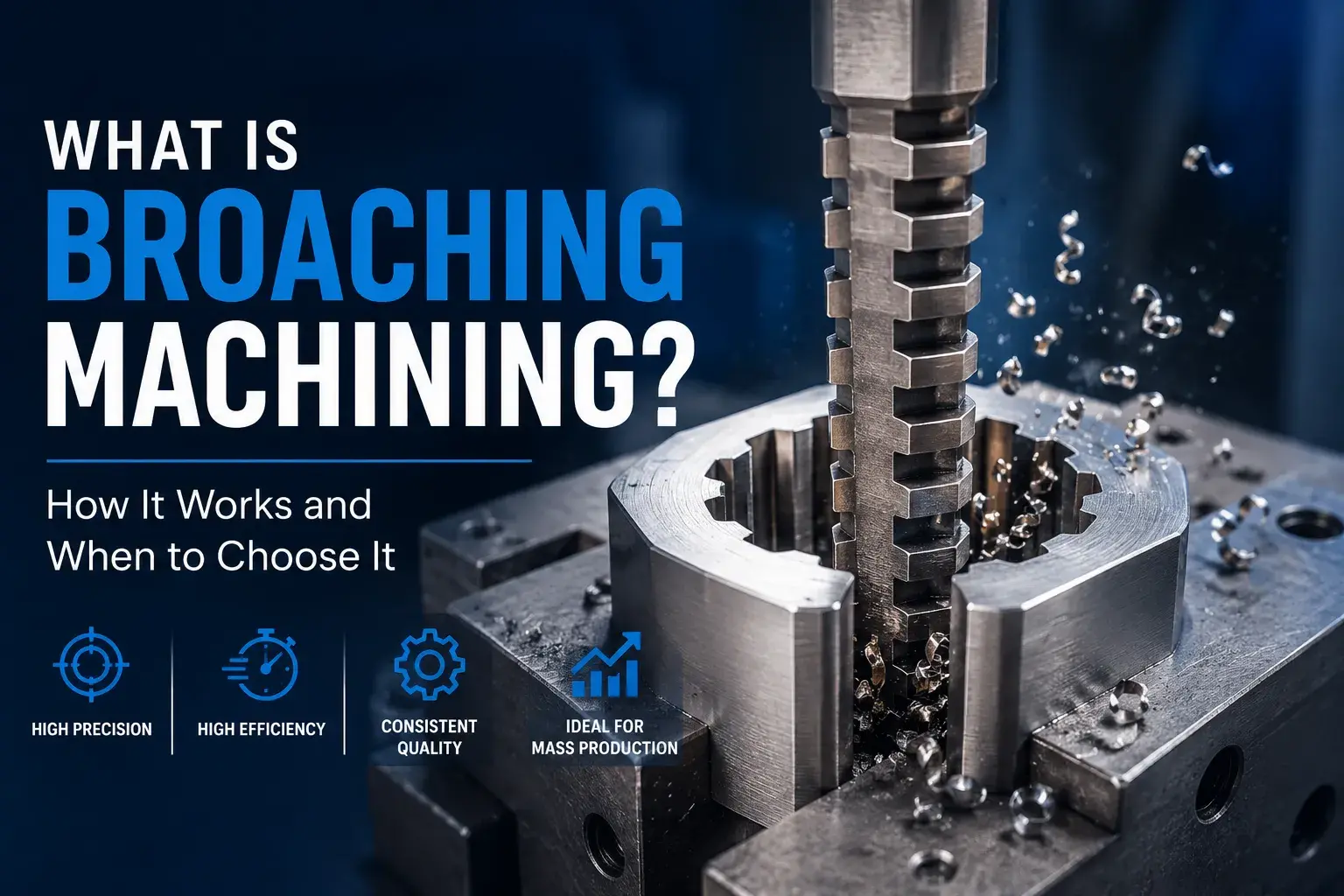
In modern mechanical manufacturing, CNC milling and CNC turning are widely known, while broaching machining is often overlooked. In fact, it is a highly efficient and precise cutting process that is particularly well-suited for machining fixed profiles such as keyways, splines, and hexagonal sockets, and is widely used in the automotive, aerospace, and industrial equipment manufacturing sectors.
So, what exactly is broaching machining? How does it work? What advantages does it offer over CNC milling, and for which parts is it suitable? This article will provide you with a comprehensive understanding of the working principles of broaching, its common types, application scenarios, and how to determine if it is suitable for your project.
What Is Broaching in Machining?
Broaching in machining is a precision machining process that removes material using a specialized broach tool. Unlike machining methods such as milling and turning, which require multiple passes, broaching typically completes the entire contour in a single linear stroke, resulting in high production efficiency and excellent dimensional consistency.
This process is primarily used for machining keyways, splines, hex holes, square holes, and other profiles with a fixed cross-section.
Although the cost of broaching machining tools is relatively high, for the repetitive production of identical parts, broaching often significantly reduces machining time and provides consistent machining quality, making it a critical machining process for many high-volume manufacturing projects.
How Does Broaching Machining Work?
The principle behind broaching machining is actually quite simple; its most distinctive feature is the use of a specially designed broach to complete the entire cutting process in a single pass.
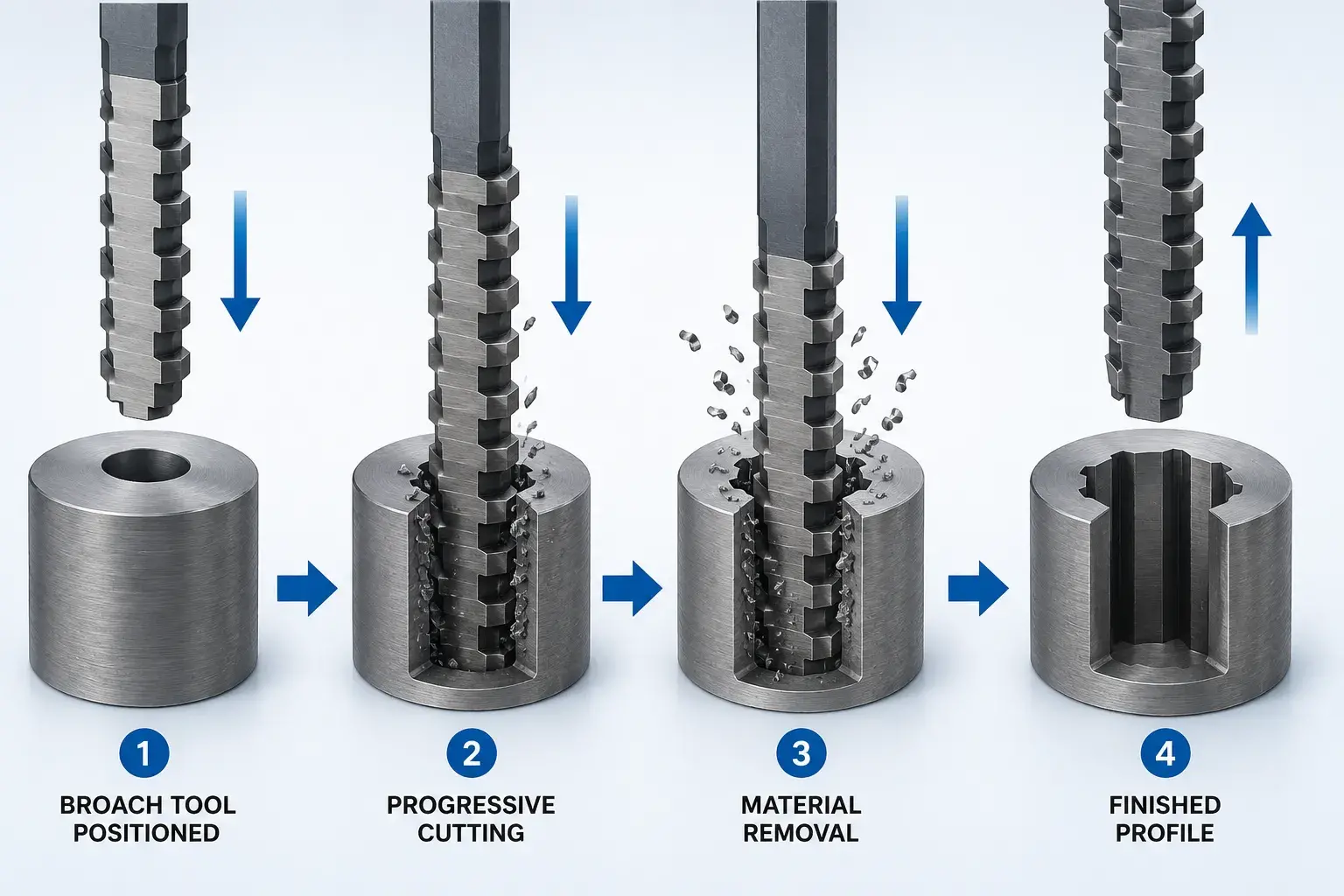
The entire machining process can generally be divided into the following steps:
Step 1: Secure the Workpiece
First, securely clamp the workpiece in a fixture or on the machine tool table to ensure it does not move during machining.
For internal broaching, the workpiece usually needs to have a pilot hole pre-machined to allow the broach to enter smoothly.
Step 2: Position the Broach Tool
Next, align the broach tool with the workpiece.
Depending on the equipment, cutting can be performed using either pull machining broaching or push broaching; however, pull broaching is more common in industrial production because it provides more stable force on the tool during the process.
Step 3: Progressive Teeth Remove Material
This is the most critical step in broaching.
Each tooth on the broach is slightly taller than the one before it, and typically removes only a few micrometers to several tens of micrometers of material per tooth.
As the broach advances:
- The front teeth perform rough machining;
- The middle teeth gradually approach the final dimensions;
- The rear teeth perform finish machining and surface finishing.
Since the cutting volume handled by each tooth is very small, the entire machining process is smoother and achieves better dimensional accuracy.
Step 4: Complete the Profile in One Pass
Once the last tooth has passed over the workpiece, the entire profile is completed in a single pass.
Unlike milling, which requires repeated passes, most machining broaching processes achieve the final shape without multiple passes—a key reason for its high machining efficiency.
Step 5: Inspect the Finished Part
After machining is complete, the part is typically inspected for dimensional accuracy and surface quality.
For precision parts, gauges, coordinate measuring machines (CMMs), or other inspection equipment are also used to verify that critical dimensions meet the requirements specified in the drawings.
Why Is a Broach Tool So Efficient?
Broaching achieves high machining efficiency largely due to its unique tool design.
A complete broach tool typically consists of three parts:
- Roughing Teeth:These are responsible for quickly removing the majority of the material and are the area with the highest material removal rate during the entire machining process.
- Semi-Finishing Teeth:These teeth further refine the dimensions, reduce the marks left by roughing, and prepare the workpiece for final machining.
- Finishing Teeth:The final few rows of teeth perform minimal material removal; instead, they ensure dimensional accuracy and improve surface finish.
This step-by-step approach, progressing from roughing to finishing, enables broaching to achieve stable and consistent machining quality while maintaining high efficiency.
Main Types of Broaching Machining
Although the basic principle of broaching involves the gradual removal of material using a multi-tooth broach, it can be divided into several types based on the machining location and method.
Understanding the different types of broaching helps determine which process is best suited for your specific part.
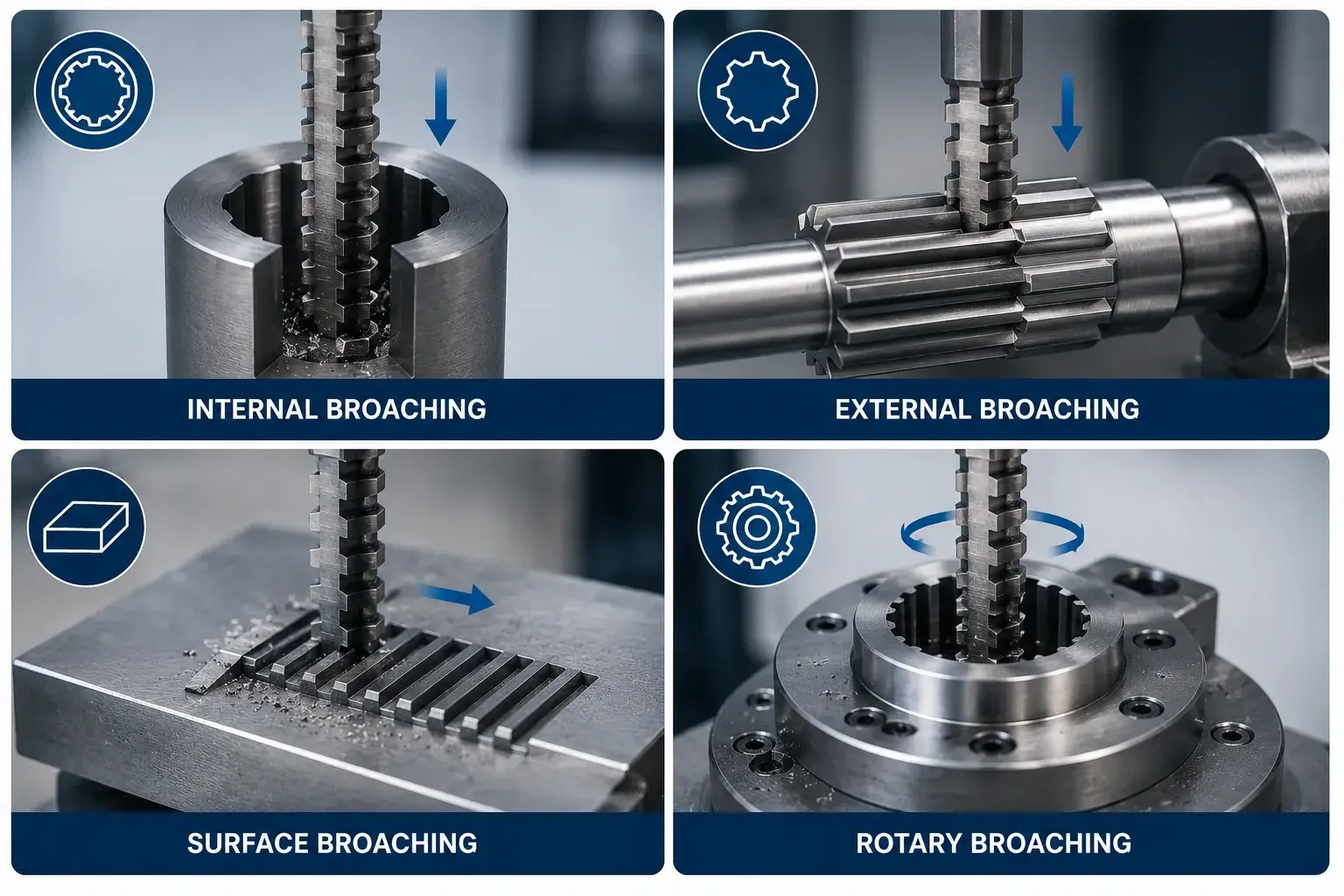
Internal Broaching
Internal broaching is the most widely used form of broaching and is primarily used to machine internal contours of workpieces.
For example:
- Keyways
- Splines
- Hex socket holes
- Square holes
- Special internal hole profiles
During machining, the broach passes through a guide hole pre-drilled inside the workpiece and is then drawn axially through the entire workpiece, forming the internal profile in a single pass.
Because it achieves high dimensional accuracy and consistency, internal broaching is widely used in the production of automotive gears, bushings, couplings, and hydraulic components.
External Broaching
External broaching is primarily used to machine the external contours of workpieces.
For example:
- Flat surfaces
- External teeth
- External splines
- Steps
- Special contour shapes
Compared to internal broaching, external broaching typically does not require a pre-machined guide hole; instead, cutting is performed directly along the workpiece surface. Therefore, it is particularly well-suited for machining regular, highly repeatable contour structures.
Surface Broaching
Surface broaching is primarily used to machine various flat surfaces or open contours.
For example:
- Guideways
- Slideways
- Locating surfaces
- Flat grooves
Since the entire surface can be machined in a single pass, surface broaching often offers higher production efficiency than traditional milling when large quantities of identical parts need to be machined repeatedly.
Rotary Broaching
Rotary broaching is a machining method that differs from traditional straight broaching.
It is typically mounted on a CNC lathe or a turn-mill combination machine, where the tool and workpiece are held at a slight angular offset to gradually form the target profile as they rotate.
Rotary broaching is commonly used to machine:
- Hex socket holes
- Torx holes
- Twelve-point holes
- Other polygonal holes
Since it does not require specialized, large-scale broaching machines, rotary broaching is particularly well-suited for small- to medium-volume production and is increasingly being adopted in modern CNC machining.
Common Applications of Broaching Machining
The greatest advantage of machining broaching lies in its ability to quickly and consistently machine features with a fixed cross-sectional shape; therefore, it is widely used in the manufacture of various parts that require high consistency and high production efficiency.
Common machined features include:
- Keyways: Used for power transmission between shafts and components such as gears, pulleys, and couplings; this is one of the most typical applications of broaching.
- Splines: These provide a larger contact area and higher torque transmission capacity than standard keyways and are widely used in automotive transmissions, drive shafts, and aerospace components.
- Hex Holes: Commonly found in various fasteners, tool interfaces, and drive mechanisms, these can be machined efficiently using either rotary broaching or internal broaching.
- Square Holes: Used in special fasteners, positioning mechanisms, and certain mechanical components; compared to milling or EDM, broaching is more efficient for mass production.
- Serrations and Special Profiles: For parts requiring special cross-sectional shapes, broaching can achieve the desired form in a single operation, eliminating the need for multiple machining steps.
In addition to these typical applications, machining broaching is also widely used in the following industries:
- Automotive
- Aerospace
- Hydraulic & Pneumatic Systems
- Industrial Equipment
- Agricultural Machinery
- Heavy Equipment
For these industries, the value of broaching lies not only in its high machining speed but, more importantly, in its ability to maintain consistent dimensions over the long term, making it particularly well-suited for medium- to large-volume production environments.
Advantages of Broaching
Broaching has been widely used in the manufacturing industry for a long time, primarily because it balances machining efficiency, precision, and consistency. Especially in medium- to large-volume production, machining broaching often enables the machining of identical parts faster and more reliably than traditional machining methods.
- High Production Efficiency: Most contours can be machined in a single pass, significantly reducing the machining time per part.
- High Machining Accuracy: Broaching typically achieves machining tolerances of approximately ±0.01 mm, with some applications capable of even higher precision.
- Excellent Surface Quality: The surface roughness of machined parts typically ranges from Ra 0.8 to 1.6 μm, eliminating the need for secondary finishing on many parts.
- Roughing and Finishing in a Single Pass: A single broach can progressively complete roughing, semi-finishing, and finishing operations, reducing the number of machining steps.
- High dimensional consistency: Dedicated broaches can consistently produce parts with identical dimensions and profiles, making them ideal for products requiring interchangeability.
- Suitable for high-volume production: Although tooling costs are relatively high, the per-unit machining cost decreases significantly as production volume increases.
- Capable of machining a variety of fixed profiles: Suitable for keyways, splines, hex socket holes, square holes, and other complex profiles with fixed cross-sections.
Limitations of Broaching
Although machining broaching offers many advantages, it is not the best choice for all machining projects. Before selecting the broaching process, it is necessary to comprehensively consider the part’s geometry, production batch size, and overall manufacturing costs.
- High tooling costs: Each profile typically requires a custom broach, resulting in significant upfront tooling investment.
- Not suitable for small-batch production: For small production runs, the cost of specialized tools is difficult to amortize, and the overall machining cost is typically higher than that of CNC milling.
- Machining dimensions are limited by equipment: Both broaching machines and broaches have size limitations, making this method unsuitable for oversized workpieces.
- Can only machine profiles with a fixed cross-section: Broaching is not suitable for complex 3D surfaces or continuously varying profiles.
- Strict workpiece clamping requirements: The workpiece must be securely positioned during machining; otherwise, dimensional accuracy and surface quality may be compromised.
Broaching vs. CNC Milling: What's the Difference?
Both broaching and CNC milling are common metal-cutting processes, but there are distinct differences in their machining methods and applications.
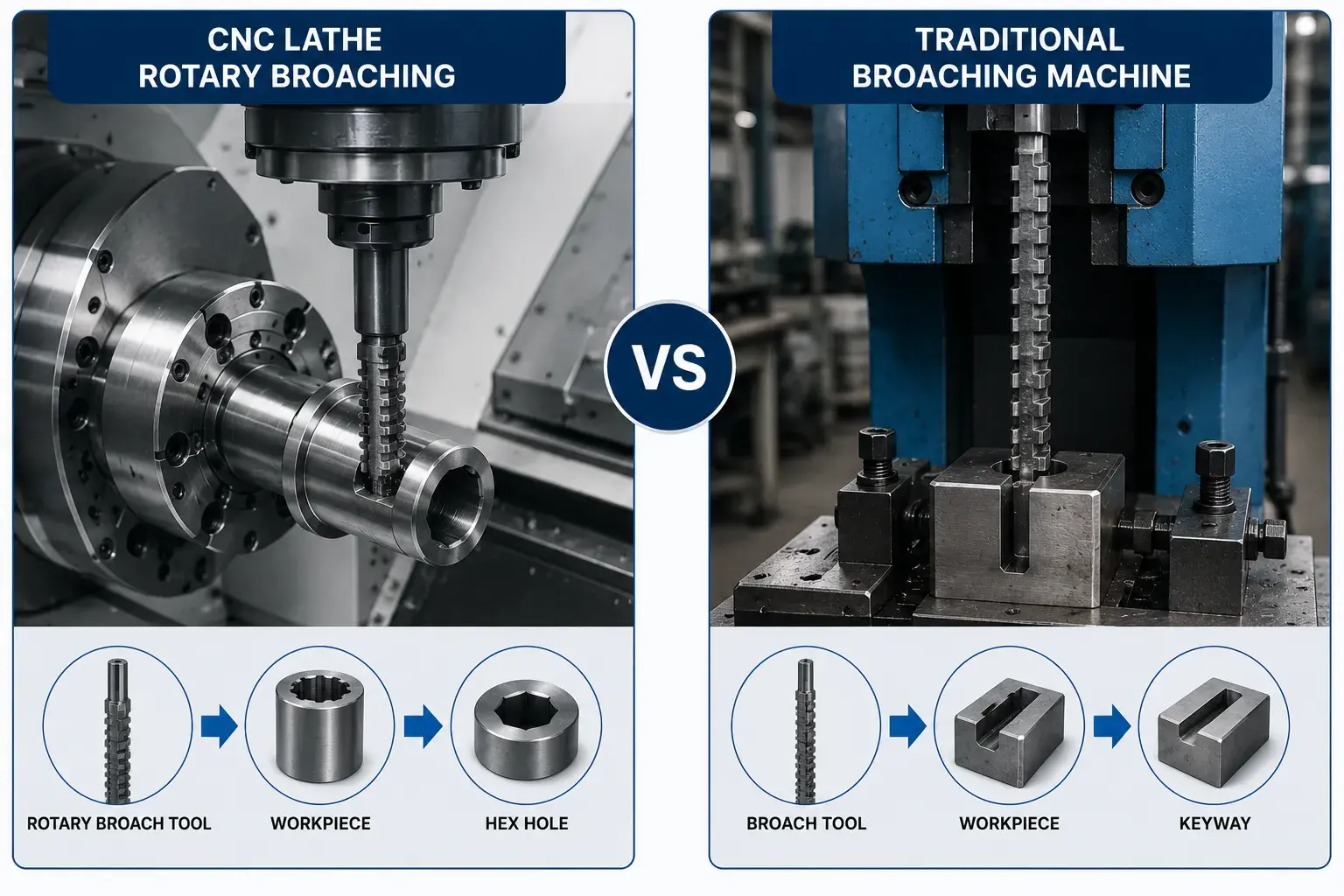
The main difference is that broaching uses a specialized broach to complete the entire contour in a single pass, while CNC milling removes material incrementally by rotating the cutting tool, offering greater machining flexibility.
| Feature | Broaching | CNC Milling |
|---|---|---|
| Machining Method | One-pass cutting with a broach tool | Rotary cutting with end mills |
| Efficiency | Very high for repetitive parts | Suitable for various part geometries |
| Tooling Cost | High | Lower |
| Flexibility | Limited | Excellent |
| Best Production Volume | Medium to high volume | Prototype to mass production |
| Typical Features | Keyways, splines, hex holes | Complex 2D & 3D parts |
Simply put, if you need to machine large quantities of identical keyways, splines, or hex socket holes over the long term, broaching is often more efficient; whereas for parts with complex structures, frequent design changes, or small-batch production, CNC milling is typically the more flexible solution.
Can CNC Machines Perform Broaching?
Many people believe that broaching requires the use of a dedicated broaching machine, but this is not entirely correct.
With the advancement of modern CNC technology, certain types of broaching can now be performed on CNC machines, the most common of which is rotary broaching.
Rotary broaching is typically mounted on CNC lathes or mill-turn machines. By applying a slight angular offset between the cutting tool and the workpiece, the desired profile is gradually formed during rotation.
This method is particularly well-suited for machining:
- Hex socket holes
- Torx holes
- Square holes
- Dodecagonal holes
- Other polygonal holes
However, for large splines, long keyways, or parts requiring long-distance machining in a single pass, a dedicated broaching machine is still necessary to achieve optimal machining efficiency and quality.
Therefore, the choice between CNC broaching and traditional broaching primarily depends on the part’s geometry, machining dimensions, and production batch size.
When Is Broaching the Best Choice?
Broaching is not a one-size-fits-all machining method, but in the right applications, it can offer significant efficiency advantages.
Generally speaking, broaching is a viable option when your parts meet the following criteria:
- You need to machine fixed-cross-section profiles such as keyways, splines, and hex socket holes.
- The product has entered a stable production phase, requiring long-term, repetitive machining of the same parts.
- High demands for machining efficiency and dimensional consistency.
- A desire to reduce the unit cost for medium- to large-volume production.
Conversely, if a project is still in the product development phase, or if production volumes are low and designs are frequently revised, CNC milling, wire EDM, or other more flexible machining methods are typically more cost-effective.
How YUANYI Supports Precision Machining Projects
At YUANYI, we not only provide high-precision CNC machining services, but also assist in evaluating the most suitable manufacturing processes based on the structure, production volume, and performance requirements of our customers’ parts.
For parts featuring special geometries such as keyways, splines, and internal hex holes, we can combine machining processes—including CNC milling, CNC turning, and subsequent broaching—to develop more efficient and cost-effective production solutions. From prototype development to mass production, we consistently prioritize machining precision, cost control, and delivery efficiency to help our customers achieve consistent and reliable part quality.
Need Help Choosing the Right Machining Process?
Whether your part requires broaching, CNC milling, CNC turning, or a combination of multiple machining processes, our engineering team can help you determine the most efficient and cost-effective manufacturing solution based on your design, tolerance requirements, and production volume.
- ✓ Free DFM & Manufacturing Advice
- ✓ 24-Hour Fast Quotation
- ✓ Prototype to Mass Production
- ✓ Precision CNC Machining up to ±0.005 mm
Conclusion
Broaching is a machining process that combines high efficiency, high precision, and high consistency. It is particularly well-suited for medium- to large-volume production of features with fixed cross-sections, such as keyways, splines, and internal hexagonal holes.
Although it requires specialized broaches and involves a relatively high initial investment, it typically results in higher production efficiency and lower unit costs for the long-term, repetitive production of identical parts.
If you need to select an appropriate machining process for your parts, we recommend comprehensively considering the part’s structure, production batch size, precision requirements, and overall manufacturing costs to determine whether broaching, CNC milling, or another machining method is best suited for your project.
Frequently Asked Questions
Broaching can be used on many materials, including carbon steel, stainless steel, aluminum, brass, bronze, cast iron, and some titanium alloys. The material must have sufficient machinability for the broach tool.
Generally, no. Because broaching requires custom tooling, CNC milling or EDM is usually a more cost-effective option for prototypes and low-volume production.
Push broaching pushes the tool through the workpiece, while pull broaching pulls the tool through it. Pull broaching is more common because it provides better tool stability and accuracy.
Tool life depends on the workpiece material, cutting conditions, and maintenance. With proper use and sharpening, a broach tool can machine thousands or even tens of thousands of parts.
Traditional broaching is mainly used for through holes. Blind-hole features usually require other machining methods, such as CNC milling or EDM.
Yes. Many precision parts are first machined by CNC milling or turning and then finished with broaching to create keyways, splines, or internal profiles.
If your part requires repeated production of fixed-profile features such as keyways, splines, or hex holes, broaching may be an efficient solution. An experienced manufacturer can help evaluate the best process based on your design and production volume.



