


CNC milling is a computer-controlled subtractive manufacturing process that uses a rotating multi-blade tool to remove material from a workpiece, shaping it into precise forms and dimensions. Simply put, you first secure a piece of raw material (such as a metal or plastic blank) to the worktable, then guide a high-speed rotating milling cutter along a pre-programmed path to remove excess material layer by layer, ultimately producing the desired part.
How Does CNC Milling Work?
To understand the CNC milling process, we can break it down into four key steps.
CAD Design and CAM Programming
It all starts with the design. Engineers first use CAD software (such as SolidWorks or Fusion 360) to create a 3D digital model of the part. This model includes all dimensions, tolerances, and surface finish requirements. Next, CAM software comes into play: it reads the CAD model and automatically calculates the tool’s path—where the tool enters, how fast it moves, how deep it cuts, and what cutting strategy to use (such as layered roughing and contour finishing). The CAM program ultimately outputs a G-code file, a language that CNC machines can “understand,” consisting of lines of instructions containing coordinates, spindle speeds, and feed rates.
Machine Setup and Tool Selection
The operator secures the appropriate raw material (such as a block of aluminum alloy) to the milling machine’s table using a vise or fixture. Next, the operator selects the cutting tools based on the part’s features: a large-diameter end mill with strong chip-clearing capability for roughing; a ball-nose end mill or small-diameter end mill for finishing; a drill bit for drilling; and a tap for tapping. The tools are mounted in the spindle, and the operator must also set the workpiece coordinate system “zero point”—typically a corner or center point of the workpiece—to tell the machine, “This is your starting point.”
The CNC Milling Process
Once everything is ready, the operator loads the G-code into the CNC controller and presses the start button. The spindle begins to rotate at high speed (typically ranging from several thousand to tens of thousands of revolutions per minute), and coolant is sprayed onto the cutting area to provide cooling and lubrication. In three-axis machining, the workpiece remains stationary while the tool moves in the X, Y, and Z directions: the X and Y axes control the contour on the horizontal plane, and the Z axis controls the depth. On 4-axis and 5-axis machines, the workpiece or tool can also rotate, allowing multiple surfaces to be machined in a single setup. The milling cutter removes material layer by layer, starting with roughing at a deep cut to quickly remove material, and finishing with fine machining at a shallow cut to achieve the final dimensions. The entire process runs fully automatically; the operator only needs to monitor the status.
Inspection and Surface Treatment
Once machining is complete, the parts are removed from the machine tool. Calipers, micrometers, or a coordinate measuring machine (CMM) are used to verify that critical dimensions fall within tolerance. If a smoother surface or a more precise fit is required, post-processing steps such as deburring, sandblasting, anodizing, or hand polishing may be performed.

Types of CNC Milling Machines
Different types of milling machines are suited for different part shapes and production requirements.
Vertical CNC Milling Machines
This is the most common type, with the spindle oriented vertically downward, resembling a powerful drill press. The worktable moves horizontally, and the tool cuts from top to bottom. Vertical milling machines feature a compact design and intuitive operation, making them suitable for machining flat parts, mold cavities, and components requiring vertical walls. Three-axis vertical milling machines are standard equipment in most machine shops.
Horizontal CNC Milling Machines
The spindle is arranged horizontally, and the tool cuts into the workpiece from the side. Horizontal milling machines are typically equipped with a rotary indexing table, allowing multiple surfaces to be machined in a single setup. Because chips fall naturally under the force of gravity and do not easily accumulate, these machines are suitable for deep cavities, heavy-duty cutting, and high-efficiency production lines. The drawbacks are that the equipment is more expensive and requires a larger footprint.
Comparison of 3-Axis, 4-Axis, and 5-Axis CNC Milling

| Axis Type | Motion Axes | How It Works | Typical Applications | Advantages | Limitations |
|---|---|---|---|---|---|
| 3-Axis CNC Milling | X, Y, Z three linear axes | The cutting tool moves in three perpendicular directions while the workpiece remains fixed. | Face milling, straight slots, drilling, and simple contours | Lower machine cost, simpler programming, and easier operation | Requires multiple setups for multi-side machining and cannot efficiently machine complex curved surfaces or deep cavities |
| 4-Axis CNC Milling | Adds one rotary axis to 3-axis machining, allowing the workpiece to rotate automatically to different angles. | Multiple faces on cylindrical parts, helical slots, cams, and angled holes | Reduces setup times, supports rotational features, and improves efficiency compared with 3-axis machining | Requires more complex programming and has a higher machine cost than 3-axis machining | |
| 5-Axis CNC Milling | X, Y, Z + A/C or B/C rotary axes | Uses two rotary axes together with three linear axes, allowing the cutting tool to approach the workpiece from almost any angle in one setup. | Impellers, turbine blades, complex mold cavities, and aerospace structural components | High precision, fewer setups, and the ability to machine highly complex freeform surfaces | Expensive equipment, advanced programming requirements, skilled operation, and higher machining cost |
Common Types of CNC Milling Operations
Face Milling
The end teeth of a face mill or end mill are used to cut the workpiece surface, producing a flat plane. This is commonly used to machine the surface of a blank to a specified thickness or to create a reference surface for subsequent finishing operations.
Groove Milling and Pocket Milling
End mills are used to machine straight grooves, T-slots, or closed pockets on the workpiece. During roughing, “helical milling” or “spiral feed” is used to prevent tool overload; during finishing, the tool follows the contour to ensure a smooth side wall finish.
Drilling and Tapping
Drilling involves using a rotating drill bit to create cylindrical holes in the workpiece; tapping involves using a tap to cut internal threads in a pilot hole. CNC milling machines can automatically change tools to sequentially complete a full set of hole-making operations, including center drilling, hole drilling, chamfering, and tapping.
Angle Milling and Form Milling
Special-angle milling cutters or form milling cutters are used to machine inclined surfaces, V-grooves, fillets, or complex contours. For example, dovetail cutters are used to machine guideway grooves, or ball-nose cutters are used to machine three-dimensional surfaces.
What materials can be machined using CNC milling?
Aluminum Alloys
Aluminum alloys such as 6061 and 7075 are the most commonly used materials in CNC milling. They offer good machinability, are lightweight, and provide sufficient strength, making them suitable for aerospace, automotive, and electronic enclosures. Aluminum alloy chips do not break easily, requiring sharp cutting tools and a high flow rate of coolant.
Carbon Steel and Stainless Steel
Steels such as 45 steel and 304 stainless steel are hard and tough, making them suitable for structural components and tooling fixtures. Stainless steel is prone to work hardening during machining, requiring slower feed rates, harder cutting tools (such as coated carbide), and adequate cooling.
Titanium Alloys and High-Performance Alloys
Titanium alloys (such as Ti-6Al-4V) have extremely high specific strength and corrosion resistance, but they have poor thermal conductivity, generate high cutting temperatures, and cause rapid tool wear. They are commonly used in medical implants and aircraft engine components. Machining requires machine tools with excellent rigidity, low-speed, deep-cut strategies, and high-pressure coolant.
Engineering Plastics
Plastics such as ABS, polyoxymethylene (POM, also known as Acetal), nylon, and PEEK are easy to mill, but care must be taken to avoid overheating and melting. Plastic parts are lightweight, insulating, and corrosion-resistant, and are used in electronic enclosures, insulating gaskets, and medical disposables.
What parts can be manufactured using CNC milling?
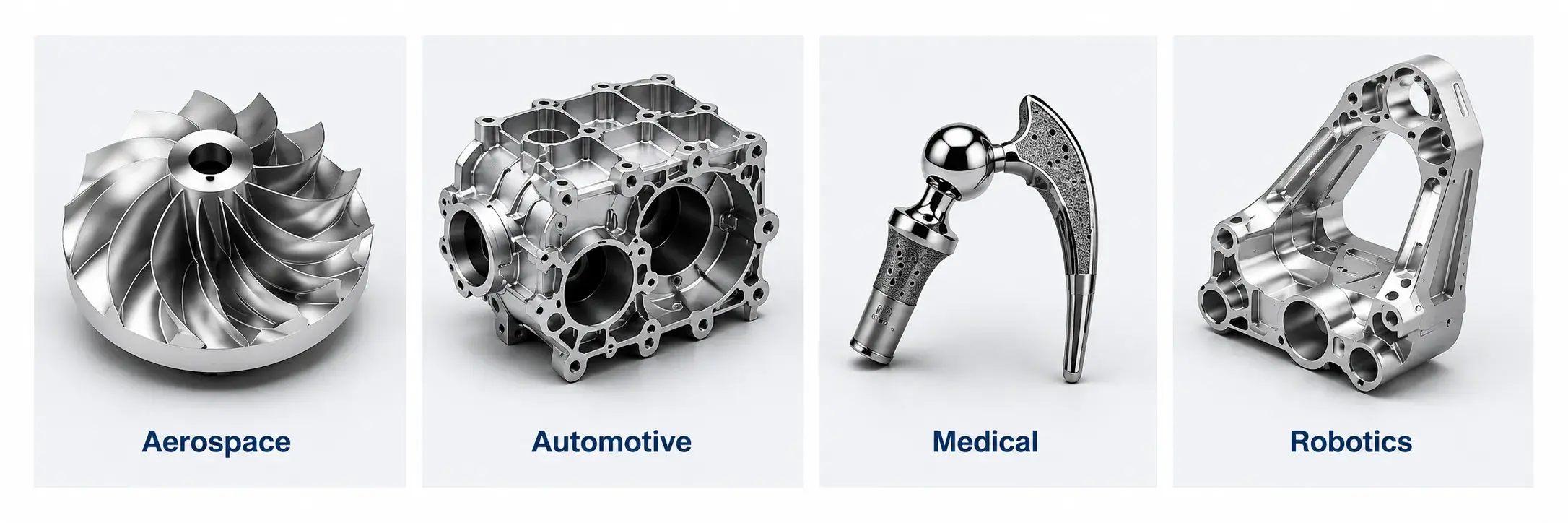
Aerospace Components
Turbine blades, engine mounts, wing ribs, and fuselage joints—these parts require extremely high strength and reliability while minimizing weight as much as possible. Five-axis CNC milling can “carve” aerospace components with complex surfaces and internal weight-reduction channels from a solid block of material.
Automotive Components
Engine blocks, cylinder heads, transmission housings, suspension arms, and brake calipers. Whether for prototype development or small-batch racing parts, CNC milling delivers metal components quickly. High-performance tuning shops commonly use CNC milling to produce intake manifolds and wheel hubs.
Medical and Electronic Components
Orthopedic plates, hip stems, dental implants—these biocompatible parts require complex curves and smooth surfaces. In the electronics industry, smartphone frames, computer heat sinks, and precision connector housings also rely heavily on CNC milling.
Industrial and Custom Precision Parts
Robotic joints, pneumatic valve bodies, tooling fixtures, mold cavities, gear pump housings… and even mechanical watch plates or aluminum models crafted by hobbyists. As long as a shape can be cut from solid material, a CNC milling machine can produce it.
Advantages of CNC Milling
High Precision and Tight Tolerances
CNC milling machines can achieve repeatable positioning accuracy of ±0.005 mm or even ±0.001 mm. This means you can design a 3D part and produce it with virtually no discernible difference between batches.
Capability to Machine Complex Parts
Three-axis milling machines can machine parts with inclined and curved surfaces; five-axis milling machines can produce geometries—such as turbine blades and artificial joints—that are nearly impossible to achieve using traditional methods. Concave surfaces, deep narrow slots, and non-vertical holes are all within their capabilities.
Excellent Repeatability
Whether machining 1,000 parts or just one using the same program on the same machine, dimensional consistency remains extremely high. This is crucial for high-volume production—the first and last parts are interchangeable.
Rapid Prototyping and Production Flexibility
Modifying a CNC part requires only updating the CAD model in software and regenerating the G-code; a physical part can be obtained within hours. Small-batch production eliminates the need for expensive molds, significantly shortening product iteration cycles.
CNC Milling vs. CNC Turning
How CNC Milling Works
The cutting tool rotates while the workpiece remains stationary. Milling excels at machining flat surfaces, grooves, holes, complex contours, and multiple features. It can be understood as “shaping stationary material with a rotating cutting tool.”
How CNC Turning Works
The workpiece rotates while the tool remains stationary (or moves along two axes). Lathes (or turning centers) are primarily used to machine cylindrical parts, such as shafts, discs, threads, and spherical heads. The tool cuts along the generatrix of the rotating workpiece, producing circular, symmetrical features.
When to Use Milling vs. Turning?
Use milling: Parts with flat surfaces, square contours, irregular curved surfaces, holes or slots on multiple faces, or non-rotationally symmetric parts (such as brackets or housings).
Use turning: Parts that are cylindrical or conical, such as screws, pins, flanges, and rollers. Turning is more efficient for parts with concentric features.
When should both processes be combined?
Many parts (such as motor shafts and hydraulic fittings) have both a cylindrical body and milled flat surfaces or radial holes on the sides. In such cases, a turning-milling machining center can be used—a single machine that can rotate the workpiece to turn the outer diameter while simultaneously milling the sides with a rotating tool. All operations are completed in a single setup, resulting in higher precision and production efficiency.
How much does CNC milling cost?
Material Costs
Aluminum costs tens of yuan per kilogram, while titanium alloys can cost hundreds of yuan. The material dimensions typically need to be larger than the part dimensions to account for clamping allowances and cutting paths. The more expensive and difficult-to-machine the material, the higher the proportion of material costs.
Part Complexity and Machining Time
Machining time is the primary cost driver. Milling a simple drilled surface on an aluminum block may take only 10 minutes, while a complex five-axis impeller may require several hours. Programming time, the number of tool changes, and whether multi-station clamping is required all affect the total cost.
Tolerance and Surface Finish Requirements
Machining to a general tolerance of ±0.1 mm is quick; however, a requirement of ±0.005 mm may necessitate multiple finishing passes, measurement compensation, and slower cutting speeds, resulting in a significant increase in time. Similarly, a standard surface with a Ra of 1.6 μm requires no additional treatment, whereas a mirror finish with a Ra of 0.4 μm requires superfinishing.
Prototyping vs. Mass Production
The fixed costs (programming, setup, and tools) for a single prototype cannot be spread out, resulting in a high unit price. When producing 100 parts, these fixed costs are averaged out, and the price per part may be as low as one-tenth of the prototype’s cost or even lower.
Design Tips for CNC Milling Parts
Avoid Deep, Narrow Cavities
If the depth of a cavity exceeds three times its width, it is recommended to modify the design—for example, by splitting it into two separate parts and assembling them, or by adding a draft angle. Deep, narrow cavities require tools with a very high length-to-diameter ratio, which can lead to vibration and tool breakage.
Use Appropriate Internal Radius Sizes
Internal right angles (the root where two perpendicular surfaces meet) cannot be machined because milling cutters are circular. When designing internal radii, the radius should be slightly larger than the radius of the standard milling cutter used (e.g., R2, R3, R5). Avoid designing non-standard sizes such as R1.3, as this would require custom tools or EDM root clearance, which is very costly.
Simplify Complex Features
Ask yourself: Does this complex surface really need to be milled as a single solid? Could it be achieved using arrays or mirroring of standard shapes? A 10% increase in programming time for a single feature may be manageable, but if every feature is complex, the total cost could double.
Use Standard Hole Sizes Whenever Possible
When designing threaded holes, dowel holes, or through holes, prioritize standard drill diameters (e.g., Φ3.2, Φ4.8, Φ6.5). Non-standard diameters (e.g., Φ4.7) require additional procurement or custom sharpening of drills and are not recommended unless there is a specific reason.
Why Choose YuanYI CNC Milling Services?
If you have parts that need prototyping or mass production, choosing the right manufacturer is more important than simply comparing prices. YuanYI has accumulated years of hands-on experience in the field of CNC milling. We don’t want to lure you in with empty promises—here are a few concrete reasons why you should choose us.
Custom CNC Milling Parts: From Prototypes to Mass Production
Whether you need a prototype to validate your idea or a batch of 500 parts, we treat every order with the same care. You won’t face the hassle of “small orders being turned down” or the frustration of “large orders taking too long.” You provide the 3D model; we ensure your parts arrive on time and meet your specifications.
Support for Aluminum, Stainless Steel, Brass, Copper, Titanium Alloys, and Plastics
We’re well-versed in a wide range of materials:
Aluminum Alloys (6061, 7075)
Stainless Steel (304, 316, 17-4)
Brass, Copper
Titanium Alloys (TC4/Gr5)
Engineering Plastics (POM, ABS, Nylon, PEEK, Polycarbonate)
We have established process parameters for difficult-to-machine materials, so you don’t have to go through trial and error.
One-stop service for CNC milling, CNC turning, and surface treatment
A single part may require milling for flat surfaces and slots, turning for cylindrical sections, and finally surface treatment. If you source these from three different factories, there’s a high risk of disputes over lead times and tolerances. At Yuanyi, we combine 3-axis, 4-axis, and 5-axis milling, CNC turning, and surface treatments (anodizing, sandblasting, passivation, zinc plating, and polishing) into a single quote with a unified delivery schedule. You only need to coordinate with one point of contact.
Pre-production engineering review: We don’t just dive in headfirst
Many machining shops start production immediately upon receiving drawings, only to discover halfway through that an internal corner radius is too small or a wall thickness is too thin. We review your design during the engineering phase and proactively offer manufacturability suggestions—such as “Increasing the fillet radius to R2 here can save 20% of the time” or “This tolerance can actually be relaxed a bit.” You save money; we save time.
Get a CNC Milling Quote
It’s simple: send your 3D model (STEP, IGES, STP, or X_T formats are all accepted) and 2D drawings to our email or upload them via our website. You’ll typically receive a formal quote with pricing and lead times within 24 hours—no hidden fees.
Frequently Asked Questions About CNC Milling
No. CNC machining is a general term for computer numerical control (CNC) processing, which includes milling, turning, drilling, and more. CNC milling is just one type of CNC machining; it specifically refers to a machining method where the tool rotates and the workpiece remains stationary.
In milling, the cutting tool rotates while the workpiece remains stationary, making it suitable for flat surfaces, grooves, and complex shapes; in turning, the workpiece rotates while the cutting tool remains stationary, making it suitable for cylindrical parts.
Designing internal corners as right angles, creating deep pockets exceeding five times the tool diameter, ignoring deformation in thin-walled parts, specifying overly tight tolerances, and failing to conduct a manufacturability review.
Standard precision is ±0.05 mm, while high precision can reach ±0.005 mm. For most parts, ±0.05 mm is sufficient; avoid setting overly tight tolerances unnecessarily.
Simple parts: 1–2 days; moderately complex parts: 3–5 days; complex 5-axis parts: 1–2 weeks. The exact duration depends on part complexity, tolerances, and surface finish requirements.
Relax unnecessary tolerances, avoid deep cavities and thin walls, use standard fillet radii, reduce the number of setups, and choose an appropriate batch size. The most effective method: have the supplier conduct a manufacturability review before machining.



