
Why 5 Axis CNC Machining Is Critical for Aerospace Parts?

5-axis CNC machining is becoming increasingly important in the aerospace industry because many aircraft components feature complex geometries while also requiring high precision, lightweight construction, and long-term stability.

Traditional 3-axis machining struggles to efficiently produce complex surfaces, deep cavities, thin-walled features, and multi-angle structures, whereas 5-axis machining enables simultaneous machining in multiple directions, reducing clamping errors and improving surface quality and machining stability.

Consequently, whether for aircraft engine blades, integral blisks, satellite structural components, or aircraft brackets, 5-axis machining has become one of the core processes in aerospace manufacturing.

Why Is Machining Aerospace Parts So Challenging?

The key difference between aerospace parts and ordinary industrial parts lies in the fact that aerospace parts not only require high dimensional accuracy but also must operate reliably over the long term.

Many parts must function continuously in high-temperature, high-pressure, and high-vibration environments. therefore, even minor machining errors can affect part lifespan and assembly stability.

At the same time, the aerospace industry is placing increasing emphasis on lightweight design, leading to the widespread adoption of the following features in many parts:
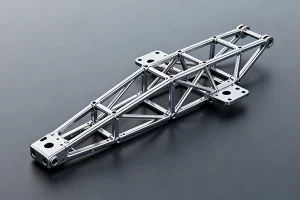
Aerospace parts

  • Thin-walled structures
  • Deep-cavity weight-
  • reduction designs
  • Complex surfaces
  • Monolithic structures

While these designs reduce weight, they also significantly increase machining complexity.

This is particularly true for machining titanium alloys and nickel-based superalloys. These materials have poor thermal conductivity, leading to concentrated cutting heat and significant work hardening. If the machining process is not optimized, issues such as part deformation, tool wear, and surface waviness can easily arise.

This is why aerospace precision machining increasingly relies on 5-axis CNC machining.

How Does 5-Axis CNC Machining Enhance Aerospace Manufacturing Capabilities?

Improving Tool Accessibility and Machining Stability

Compared to traditional three-axis machining, 5-axis machines feature two additional rotational axes, allowing the tool to approach the workpiece from a wider range of angles.

This is particularly important for deep cavities, inclined surfaces, complex blades, and internal flow channels found in aerospace components.

Traditional 3-axis machining often requires the use of extra-long tools, which are prone to vibration when machining titanium alloys.

In contrast, 5-axis machining allows for the adjustment of tool axis angles to reduce tool overhang, thereby improving cutting stability and surface quality.

Reducing Clamping Errors

Many aerospace parts feature numerous high-precision holes and mounting surfaces.
Frequent flipping and re-clamping during machining can easily lead to cumulative errors.

5-axis machining enables machining in multiple directions within a single setup, thereby improving the relative positional accuracy between different features.

This is particularly important for engine casings, aerospace structural components, and complex bracket-type parts.

Better Suited for Complex Curved Surface Machining

A aerospace precision machining of parts in the aerospace industry feature complex free-form surfaces, such as:

  • Blisks
  • Turbine blades
  • Impellers
  • Fluid system components

These parts are not only structurally complex but also demand extremely high standards for surface continuity and surface quality.

5-axis machining allows the tool to maintain a more optimal cutting angle at all times, making it better suited for machining such complex curved surfaces.

Improved Surface Quality and Fatigue Life

In the aerospace industry, the focus is often not only on dimensional accuracy but also on surface integrity.

This is because microcracks, chatter marks, or burn marks on the surface can all reduce a part’s fatigue life.

Through a more stable cutting process, 5-axis machining effectively reduces vibration and chatter marks, thereby improving surface quality and long-term reliability.

Common Five-Axis Machined Parts for the Aerospace Industry

5-axis is widely used for a variety of highly complex aerospace parts machining, such as:

  • Turbine blades and integral blade discs (Blisk)
  • Aviation engine casings
  • Impellers and fluid system components
  • Aerospace structural brackets
  • Thin-walled lightweight structural components
  • Precision components for satellites and spacecraft
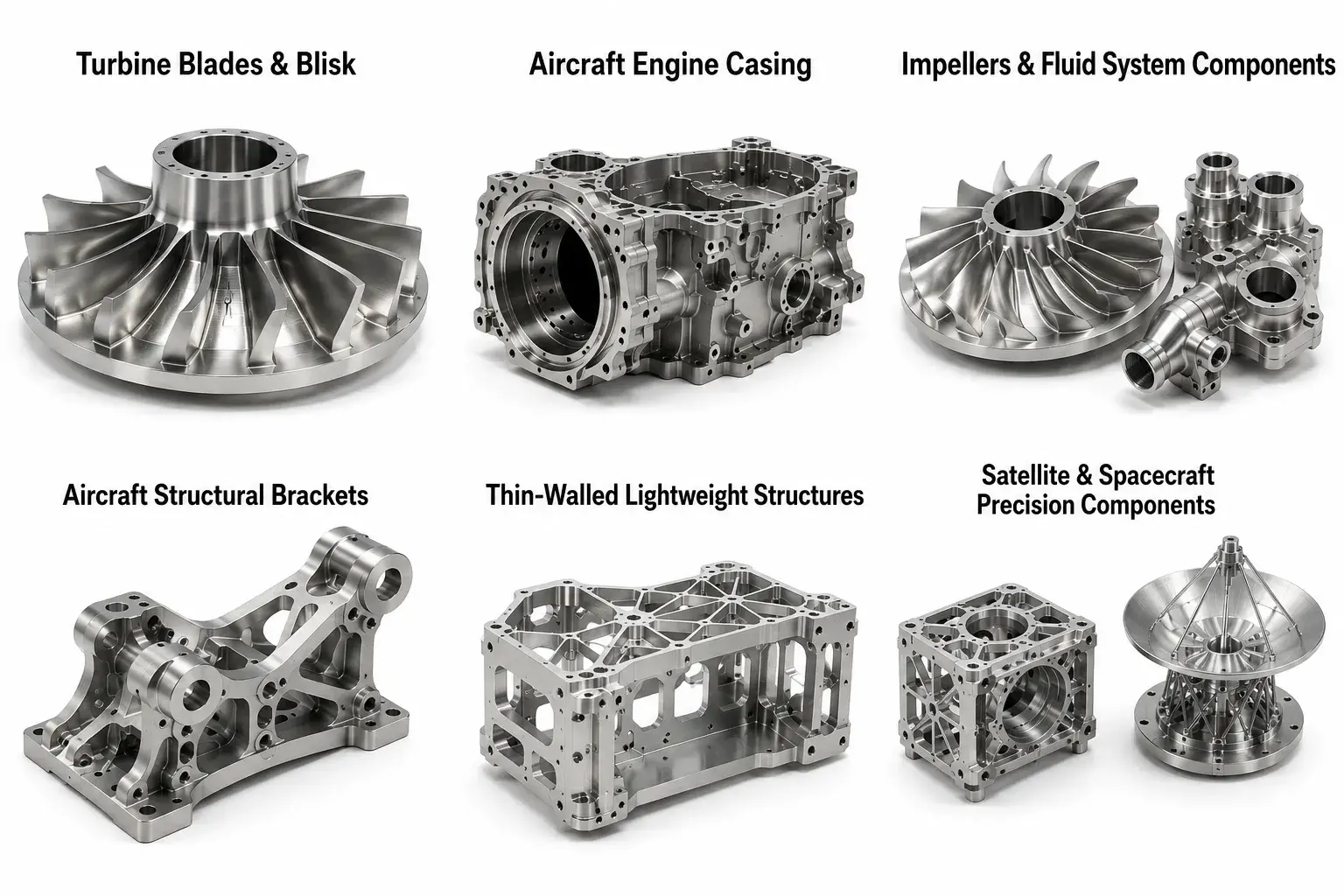
5-Axis Machined Components for the Aerospace Industry

These parts typically feature complex surfaces, multi-angle geometries, deep cavities, or high-precision mounting features, making them highly dependent on five-axis machining capabilities.


Common Materials Used in Five-Axis Machining for the Aerospace Industry

Titanium Alloys

Titanium alloys are among the most common high-performance materials used in the aerospace industry, and they play a critical role in titanium aerospace machining due to their high strength, low density, and excellent heat resistance.

Among them, Ti-6Al-4V is the most widely used. it offers high strength, low density, and excellent high-temperature resistance, but it is also extremely difficult to machine.

Aviation Aluminum Alloys

High-strength aluminum alloys such as 7075-T6, 2024, and 6061-T6 are widely used in aerospace structural components.

These materials are lightweight and offer high machining efficiency, but some grades are prone to stress-induced deformation.

Nickel-Based Superalloys

Materials such as Inconel 718 are typically used in high-temperature areas of aircraft engines.

These materials are extremely difficult to machine, placing very high demands on machine tool stability and cutting tool performance.

The Differences Between 3-Axis, 4-Axis, and 5-Axis Machining in the Aerospace Industry

 3-axis machining is primarily suitable for flat surfaces, simple contours, and basic hole drilling.

4-axis machining adds a rotational axis, enabling the machining of partially rotary parts and side features; in the aerospace industry, it is commonly used for machining relatively simple cylindrical structural components.

However, as aerospace parts become increasingly complex, many parts now require more than just “rotational machining”; they require continuous, coordinated cutting at multiple angles.

Therefore, five-axis machining is generally more suitable for integral blisks, complex impellers, aerospace structural components, and parts with multiple curved surfaces.

5-axis machining allows the tool angle to be adjusted simultaneously via two rotary axes, thereby reducing setup time, improving surface quality, and enhancing machining stability for complex structures.

Is 5-Axis Machining Worth It for the Aerospace Industry?

5-axis machining equipment and engineering costs are typically high.


Not only is programming complex, but it also demands higher standards for machine setup, cutting tools, and engineering expertise.

However, for the aerospace industry, the true value of 5-axis machining lies not merely in increased efficiency, but in:

  • Higher precision
  • Fewer clamping errors
  • More stable machining of complex structures
  • Greater consistency
  • Lower long-term manufacturing risks

For high-value aerospace components, avoiding a single scrap can often offset a significant portion of the machining costs.

Need a reliable aerospace machining partner?

Get engineering support and a fast quote for your aerospace CNC machining project today.

FAQ

Yes. We can provide the following based on project requirements:

  • CMM inspection reports
  • Dimensional inspection reports
  • Material certificates
  • Surface roughness testing
  • First Article Inspection (FAI)
  • Complete quality traceability documentation

For high-precision aerospace projects, we can also support 100% inspection of critical dimensions.

The aerospace materials we commonly machine include:

  • Ti-6Al-4V titanium alloy
  • 7075-T6 aerospace aluminum
  • 2024 aluminum alloy
  • Inconel 718
  • Stainless steel
  • Superalloys

We also support the machining of certain high-performance engineering plastics.

We offer:

  • Single-unit prototyping
  • Small-batch trial production
  • Mass production

Many aerospace projects begin with prototypes in the early stages, so there are typically no strict MOQ requirements.

Lead times generally depend on part complexity, material, and inspection requirements.

Generally speaking:

  • Rapid prototyping: 3–7 days
  • Small-batch production: 7–15 days
  • Complex aerospace projects: To be confirmed based on process evaluation

For urgent projects, we can also arrange expedited production.

We ensure product consistency and long-term stability through:

  • Process standardization
  • In-process inspection
  • Final inspection using CMM
  • Tool life management
  • Engineering process control

To ensure product consistency and long-term stability.

Table of Contents
Discuss Your Complex Machining Requirements

Need Custom CNC Machined Parts?

From rapid prototypes to low-volume production, our engineering team can review your drawings and provide a manufacturing quote.

  • 24-Hour Quotation
  • DFM Engineering Support
  • No Minimum Order
  • ISO 9001 Certified
Request A Quote
Upload your drawing and get a quote within 24 hours.
