Why Complex Impellers Require 5 Axis CNC Machining

Complex impellers typically require 5-axis CNC machining because their blades and internal flow channels are highly intricate. Many impellers feature not only twisted surfaces but also deep, narrow internal spaces. Conventional three-axis machines struggle to machine these features stably from multiple angles; long cutting tools are prone to vibration, which can cause tool marks on the surface or even deform the blades.

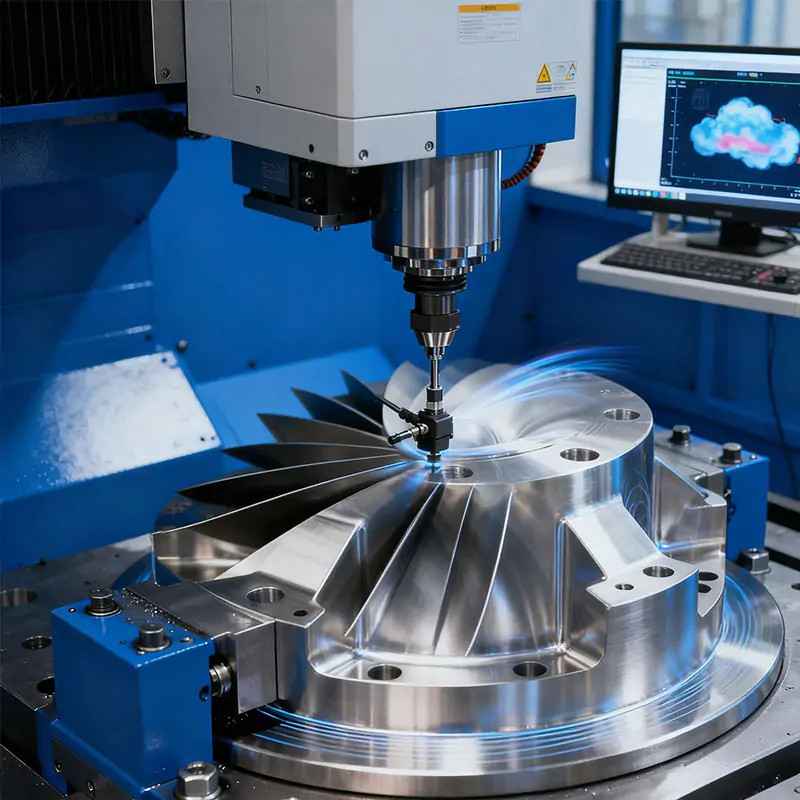
5 axis impeller machining allows the tool to rotate while cutting, approaching the impeller from various angles. This not only facilitates the machining of deep cavities and complex surfaces but also reduces errors caused by repeated clamping.

The resulting blades offer higher precision and smoother surfaces, ensuring greater stability during high-speed rotation. For this reason, 5-axis CNC machining is widely used for complex impellers in aerospace, compressor, and turbine systems.

What is an impeller?

5 axis impeller machining

An impeller is a core mechanical component that conveys, compresses, or accelerates fluids through rotation. It is widely used in centrifugal pumps, compressors, turbochargers, aircraft engines, and various fluid systems.

The primary function of an impeller is to convert mechanical energy into fluid energy. Different blade angles, flow channel structures, and hub designs directly affect fluid flow rate, pressure, efficiency, and operational stability.

Therefore, an impeller is not merely a mechanical component but a functional part that relies heavily on geometric precision and fluid dynamic performance.

Why is 5 axis cnc impeller machining machining so complex?

The primary reason impellers are difficult to machine lies in their complex geometric structure. Most impellers feature:

  • Continuously twisted free-form blades
  • Deep and narrow internal flow channels
  • Transition areas with small radii
  • High aspect ratio structures
  • Complex surfaces with multiple angles
  • Extremely high requirements for geometric symmetry

These characteristics make it difficult to achieve continuous machining with traditional 3-axis machining. Tool accessibility is limited, and multiple setups are required, which can easily lead to cumulative errors.

Therefore, impellers are considered typical parts for 5-axis CNC machining.

Common Impeller Types

Open, Semi-Open, and Closed Impellers

Open impellers lack a complete outer cover plate, leaving the blades exposed. They offer relatively ample machining space, so they are generally easier to manufacture. They are commonly used in sewage pumps, low-pressure fluid equipment, and certain industrial pump housings.

Semi-open impellers feature a cover plate on one side, balancing structural strength with fluid performance. Compared to open impellers, their blades offer greater rigidity, but the access space for cutting tools is more restricted, placing higher demands on tool length and path planning.

Closed impellers are among the most challenging types to machine. They feature complete upper and lower cover plates as well as an enclosed internal flow channel. Cutting tools must perform complex machining operations within a confined space, typically requiring five-axis machining or even special long-neck tools.

Radial, Axial, and Mixed-Flow Impellers

Radial impellers are primarily used in centrifugal pumps and compressors; fluid enters at the center and is ejected radially, and the blades typically have a high degree of curvature.

Axial impellers resemble propeller structures, with fluid flowing axially; they are commonly found in aircraft engines and large fans.

Mixed-flow impellers combine the characteristics of both radial and axial flow. They have a more complex structure and place higher demands on blade angles and flow path continuity.

Impellers typically require 5-axis CNC machining

For impellers, the core value of 5-axis machining impeller is primarily reflected in the following aspects.

First is the machining of continuous blade surfaces. Impeller blades typically feature complex free-form surfaces that require continuous tool movement in multiple directions; five-axis machining ensures surface continuity and contour accuracy.

Second is the issue of deep cavities and tool accessibility. The internal space of a closed impeller is confined. With three-axis machining, extra-long tools are usually required, but long tools are prone to vibration and tool deflection. Five-axis machining, however, can reduce tool overhang by tilting the tool axis, thereby improving stability.

Additionally, the small-radius transition areas between the blades and the hub present extremely high machining demands. If these transition areas are not sufficiently smooth, it will directly affect fluid efficiency and may even lead to localized stress concentrations.

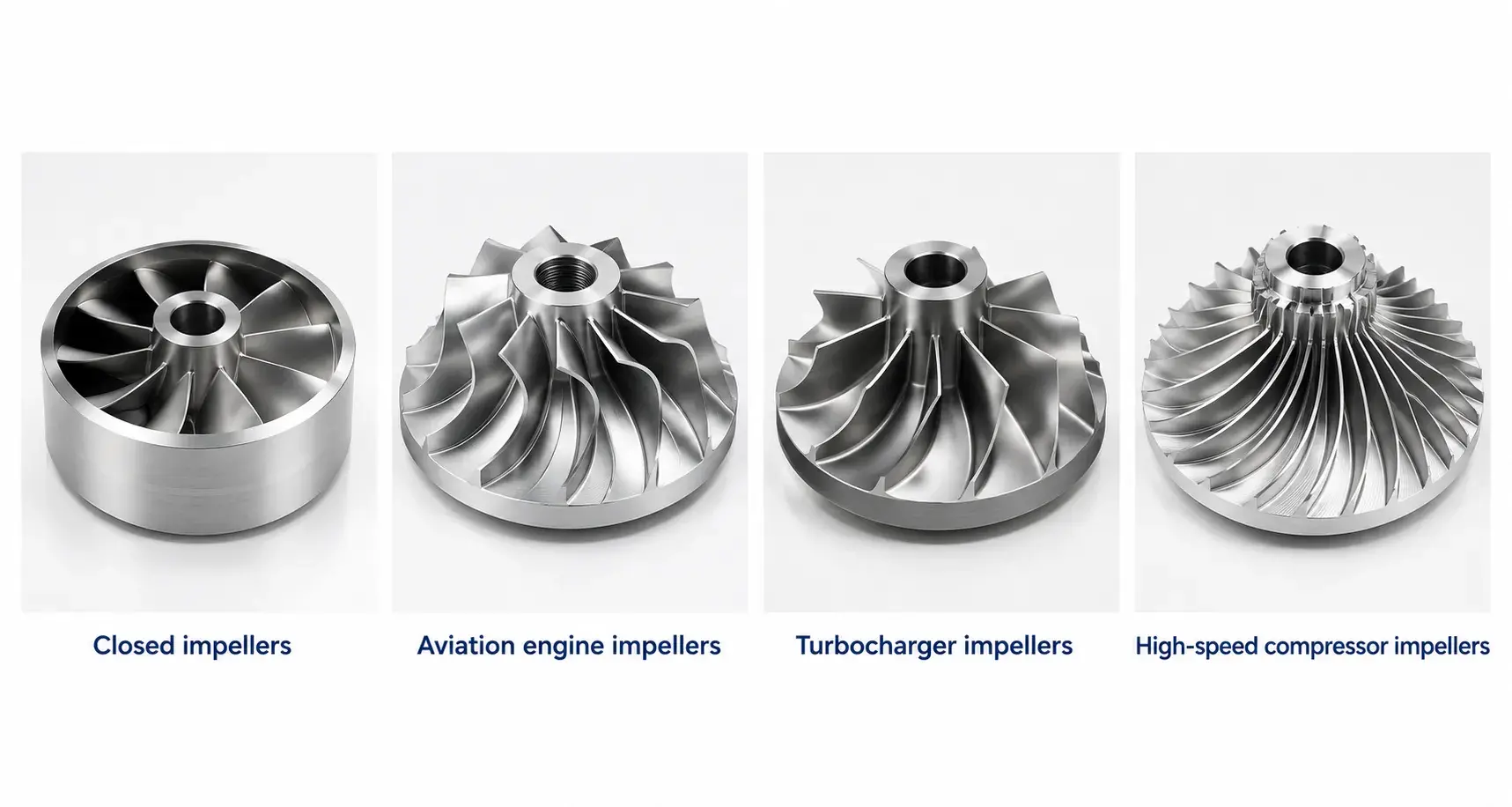
Compared to three-axis machining and 3+2-axis positioning machining, true five-axis simultaneous machining offers significant advantages in the manufacture of complex impellers, and is particularly suitable for:

  • Closed impellers
  • Aviation engine impellers
  • Turbocharger impellers
  • High-speed compressor impellers
  • High-precision fluid system components
5-axis machining impeller

Typical Machining Process for a 5-Axis machining Impeller

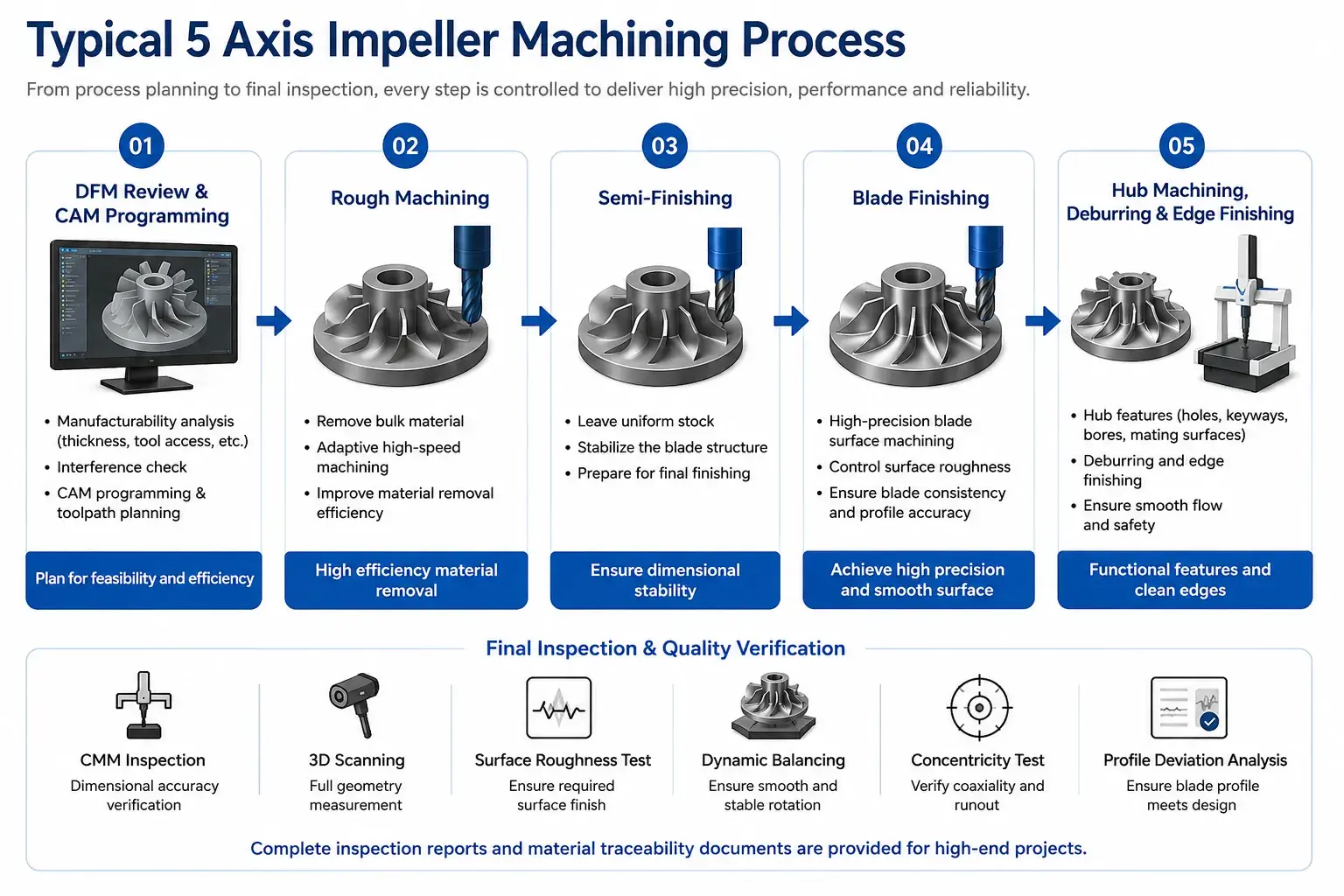
Impeller machining typically begins with a DFM review and CAM toolpath planning to analyze tool accessibility and machining stability in advance.

Subsequently, surface accuracy and surface quality are progressively controlled through rough machining, semi-finishing, and blade finishing.

After completing hub machining and deburring, the impeller’s accuracy and operational stability are finally verified through CMM inspection, 3D scanning, and dynamic balancing tests.

5-Axis Impeller Machining Process

Common Materials for Impeller Manufacturing

Aluminum Alloys, Stainless Steel, and Titanium Alloys

Aluminum alloys are among the most common materials used for impellers, offering advantages such as light weight, good machinability, and high processing efficiency.
Common grades include:

  • 6061-T6
  • 7075-T6
  • 2024

Stainless steel impellers are better suited for corrosive environments. Common materials include:

  • 304
  • 316L
  • 17-4PH

Titanium alloys are widely used in aerospace and high-performance compressor impellers.
Ti-6Al-4V is one of the most common grades.

Nickel-based superalloys, bronze, and brass

Nickel-based superalloys are typically used in high-temperature environments, such as aircraft engines.
Common materials include:

  • Inconel 718
  • Hastelloy
  • Rene series alloys

Bronze and brass are more commonly used in marine vessels, offshore equipment, and certain specialized fluid systems.

How to Choose a Reliable 5-Axis Impeller Machining Supplier?

Complex impeller machining relies not only on advanced equipment but also on engineering expertise accumulated over many years. For high-precision, highly complex parts like impellers, the true determinant of machining quality is often whether the supplier possesses the consistent capability to handle complex surfaces, deep-cavity flow channels, and thin-walled blades.

When selecting a 5-axis impeller machining supplier, the first consideration should be whether they possess genuine 5-axis simultaneous machining capabilities and mature CAM programming expertise. This is because for many complex impellers, it is not enough to simply “be able to machine them”; what matters more is the ability to consistently control blade uniformity, surface quality, and overall dynamic balance.

At the same time, inspection capabilities are equally critical. Established impeller machining suppliers typically maintain a comprehensive quality control system, including CMM (coordinate measuring machine) inspection, 3D scanning, dynamic balancing tests, and surface roughness measurement, to ensure that complex blade profiles and critical dimensions meet specifications.

Furthermore, practical project experience is vital. Experience with complex impeller projects in sectors such as aerospace, compressors, turbines, and energy equipment often directly impacts machining stability and the ability to resolve issues.

about yuanyi cnc

Ready to Start Your Impeller Project?

Get engineering support, fast quotation, and precision 5 axis impeller machining from YUANYI CNC MACHINING.

About Impellers FAQ

We can machine open, semi-open, and closed impellers, as well as complex 5-axis impeller components for aerospace, compressors, turbines, and fluid systems.

For high-precision 5-axis impeller projects, we can typically maintain a tolerance of around ±0.005 mm, depending on the part dimensions, structural complexity, and material type.

Yes, we can provide CMM test reports, surface roughness test reports, material certificates, and dynamic balance test reports based on project requirements.

We support everything from single-unit samples and rapid prototyping to small-batch and mass production, with no strict MOQ requirements.

Simple impeller samples can usually be completed in about 3–7 days, while complex 5-axis impeller projects will vary depending on the design and materials.

Table of Contents
Discuss Your Complex Machining Requirements

Need Custom CNC Machined Parts?

From rapid prototypes to low-volume production, our engineering team can review your drawings and provide a manufacturing quote.

  • 24-Hour Quotation
  • DFM Engineering Support
  • No Minimum Order
  • ISO 9001 Certified
Request A Quote
Upload your drawing and get a quote within 24 hours.