

Die casting and injection molding are both high-volume manufacturing processes that inject molten material into a reusable mold, but they are used for very different types of parts.
Die casting is mainly used for metal components made from aluminum, zinc, and magnesium alloys, while injection molding is mainly used for plastic parts made from materials such as ABS, PC, PP, PA, POM, and PEEK.
If a part requires high stiffness, thermal conductivity, EMI shielding, or durable metal features, die casting is usually the better starting point. If low weight, electrical insulation, snap-fit features, molded color, or complex plastic geometry are more important, injection molding is often more suitable.
Die Casting vs Injection Molding at a Glance
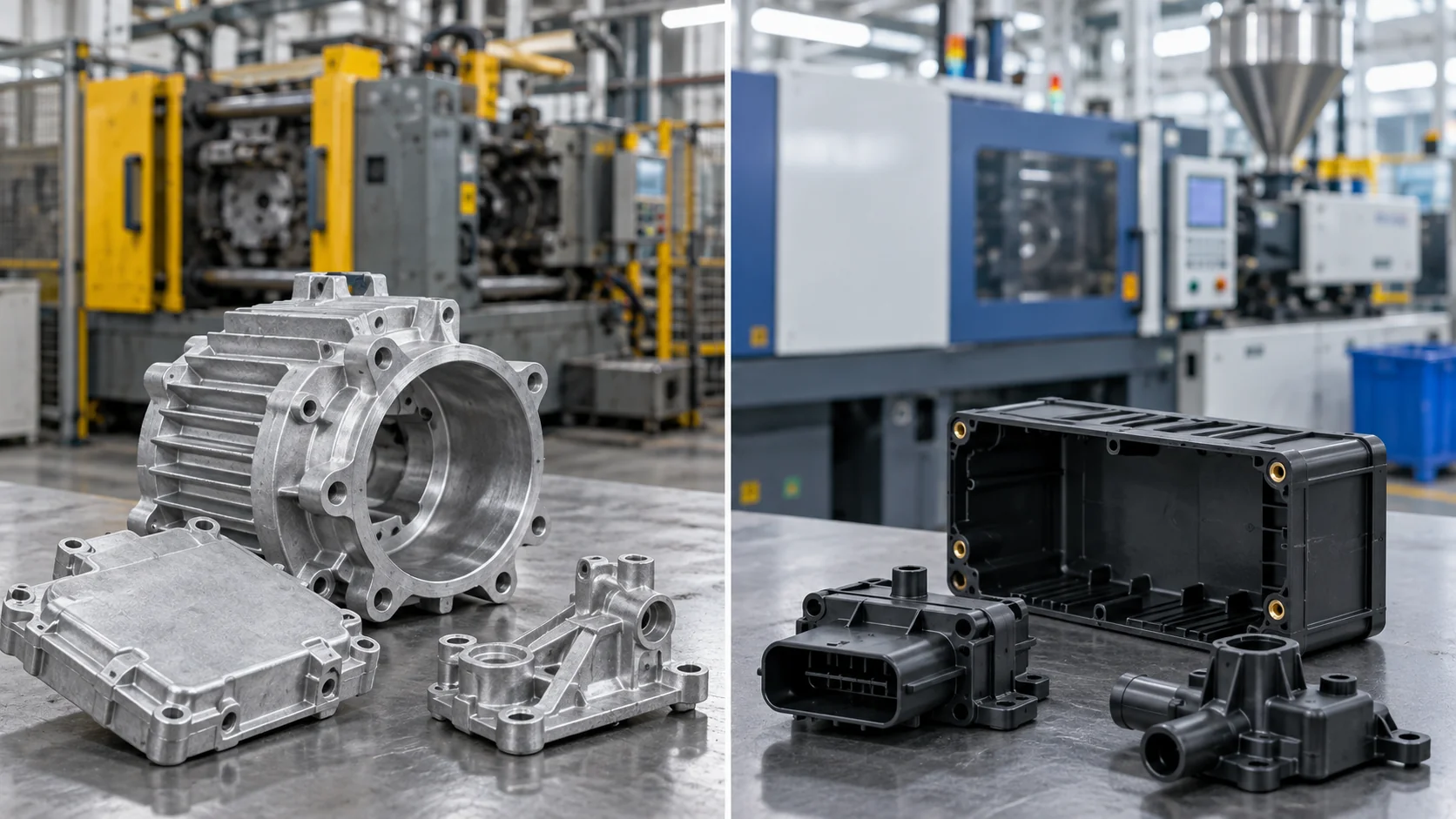
The table below summarizes the main differences between the two processes.
| Factor | Die Casting | Injection Molding |
|---|---|---|
| Main Materials | Aluminum, zinc, magnesium | ABS, PC, PP, PA, POM, PEEK and other plastics |
| Typical Parts | Metal housings, structural components, heat-dissipation parts | Plastic housings, covers, connectors, clips |
| Weight | Higher | Lower |
| Strength / Stiffness | Generally higher | Lower, material dependent |
| Heat Resistance | Generally higher | Polymer dependent |
| Thermal Conductivity | High | Low |
| Electrical Insulation | Poor | Excellent for many plastics |
| Tooling Cost | High | High |
| Production Volume | Medium to high | Medium to very high |
| Threads | Often machined or added with inserts | Molded, self-tapping, or inserts |
| Snap Fits | Limited | Excellent |
| Secondary Machining | Common on critical features | Usually limited |
| Prototype Method | CNC machining | CNC machining / 3D printing |
| Best Fit | High-volume functional metal parts | High-volume lightweight plastic parts |
The comparison is only useful when both material systems could realistically meet the product requirements. If the part must be metal, injection molding is usually not a direct substitute.
What Is Die Casting?
Die casting is a manufacturing process in which molten metal is injected into a hardened steel mold under high pressure.
The process is commonly used with non-ferrous alloys such as:
- Aluminum
- Zinc
- Magnesium
Die casting can produce complex shapes, thin walls, ribs, bosses, and near-net-shape features at high production volumes.
It is widely used for:
- Automotive housings
- Motor housings
- Electronics enclosures
- Gearbox housings
- Lighting components
- Industrial equipment parts
There are several die casting methods, including hot-chamber and cold-chamber die casting. The exact process depends on the alloy, part size, and production requirements.
What Is Injection Molding?
Injection molding is a process in which molten plastic is injected into a metal mold, cooled, and ejected as a finished or near-finished part.
Common injection molding materials include:
- ABS
- Polycarbonate
- Polypropylene
- Nylon
- POM
- PEEK
- TPE and other engineering polymers
The process is especially suitable for producing lightweight parts with complex geometry, thin walls, snap fits, clips, bosses, internal ribs, and integrated cosmetic features.
Typical applications include:
- Electronic housings
- Automotive interior parts
- Medical device components
- Connectors
- Consumer products
- Plastic brackets and covers
This article compares die casting with plastic injection molding. Metal injection molding, or MIM, is a different manufacturing process.
Die Casting vs Injection Molding: 10 Key Differences
1. Materials
Material is the most fundamental difference.
Die casting uses molten metal, mainly aluminum, zinc, or magnesium alloys.
Injection molding uses polymers, including both commodity and engineering plastics.
This means the two processes are not always direct alternatives.
If a part requires:
- Metal stiffness
- High-temperature performance
- Heat dissipation
- EMI shielding
- Strong threaded features
die casting is usually more suitable.
If a part requires:
- Lightweight construction
- Electrical insulation
- Integrated clips
- Flexible features
- Molded color
injection molding may be the better option.
2. Strength and Stiffness
Die-cast metal parts generally provide higher stiffness and structural strength than plastic injection-molded parts.
This makes die casting suitable for components such as:
- Motor housings
- Transmission housings
- Mounting structures
- Structural brackets
- Mechanical enclosures
Injection-molded plastics can still provide excellent functional performance, especially when reinforced with glass fiber or carbon fiber.
However, plastic parts usually require more careful wall, rib, and boss design to achieve equivalent stiffness.
3. Weight
Injection molding usually produces much lighter parts.
This is one of the main reasons plastics are widely used in:
- Consumer electronics
- Automotive interiors
- Handheld products
- Portable devices
Die-cast aluminum and magnesium can still provide good strength-to-weight performance, but they remain denser than most plastics.
If product weight is a major design target, injection molding often has an advantage.
4. Heat Resistance and Thermal Performance
Die-cast metals generally perform better at elevated temperatures.
They also conduct heat efficiently.
This makes die casting especially useful for:
- Heat sinks
- LED housings
- Motor housings
- Power electronics enclosures
- Automotive components near heat sources
Most plastics are thermal insulators rather than conductors.
High-performance polymers such as PEEK can tolerate elevated temperatures, but they still behave very differently from metal.
5. Electrical Properties
Plastic injection molding has a major advantage when electrical insulation is required.
Many plastics are naturally non-conductive and are commonly used for:
- Electrical housings
- Connectors
- Insulating covers
- Switch components
Die-cast metal parts are conductive.
That can be an advantage for EMI shielding and grounding, but it may require insulation strategies in certain electrical assemblies.
6. Tolerances
Both processes can produce good dimensional consistency in high-volume production.
However, achievable tolerances depend on:
- Material
- Part size
- Wall thickness
- Mold design
- Cooling behavior
- Geometry
Die casting can produce near-net-shape metal parts, but critical features often still require CNC machining.
Typical examples include:
- Bearing bores
- Precision mounting holes
- Sealing faces
- Threads
- Datum surfaces
Injection molding can also hold tight tolerances, but plastic shrinkage and warpage must be carefully controlled.
7. Surface Finish
Both processes can produce good cosmetic surfaces directly from the mold.
Die-cast parts can be:
- Painted
- Powder coated
- Plated
- Anodized in suitable alloys
- Machined on functional surfaces
Injection-molded parts can incorporate:
- Mold textures
- Gloss finishes
- Matte finishes
- Molded-in color
- Logos and surface patterns
Injection molding usually offers more cosmetic flexibility without additional finishing.
8. Tooling
Both processes require dedicated tooling.
Die casting dies are usually expensive because they must withstand:
- High pressure
- High temperatures
- Repeated thermal cycling
- Metal erosion
Injection molds are also significant investments, particularly for:
- Multi-cavity molds
- Hot-runner systems
- Complex slides
- Lifters
- Unscrewing features
Tooling cost therefore becomes more economical as production volume increases.
9. Cycle Time
Both die casting and injection molding can achieve fast cycle times after tooling is complete.
Injection molding cycles can be very fast for small plastic parts.
Die casting also supports high production rates, but cycle time is affected by:
- Metal temperature
- Filling time
- Solidification
- Ejection
- Trimming
Cycle time alone should not determine process selection because material and functional requirements come first.
10. Production Volume
Both processes are designed for repeat production.
The biggest economic challenge is the upfront mold cost.
For low volumes, the tooling investment may be difficult to justify.
This is why CNC machining is often used for:
- Prototypes
- Engineering validation
- Early production
- Bridge production
Once the design is stable and production volume increases, tooling can become more economical.
Design Differences Between Die Casting and Injection Molding
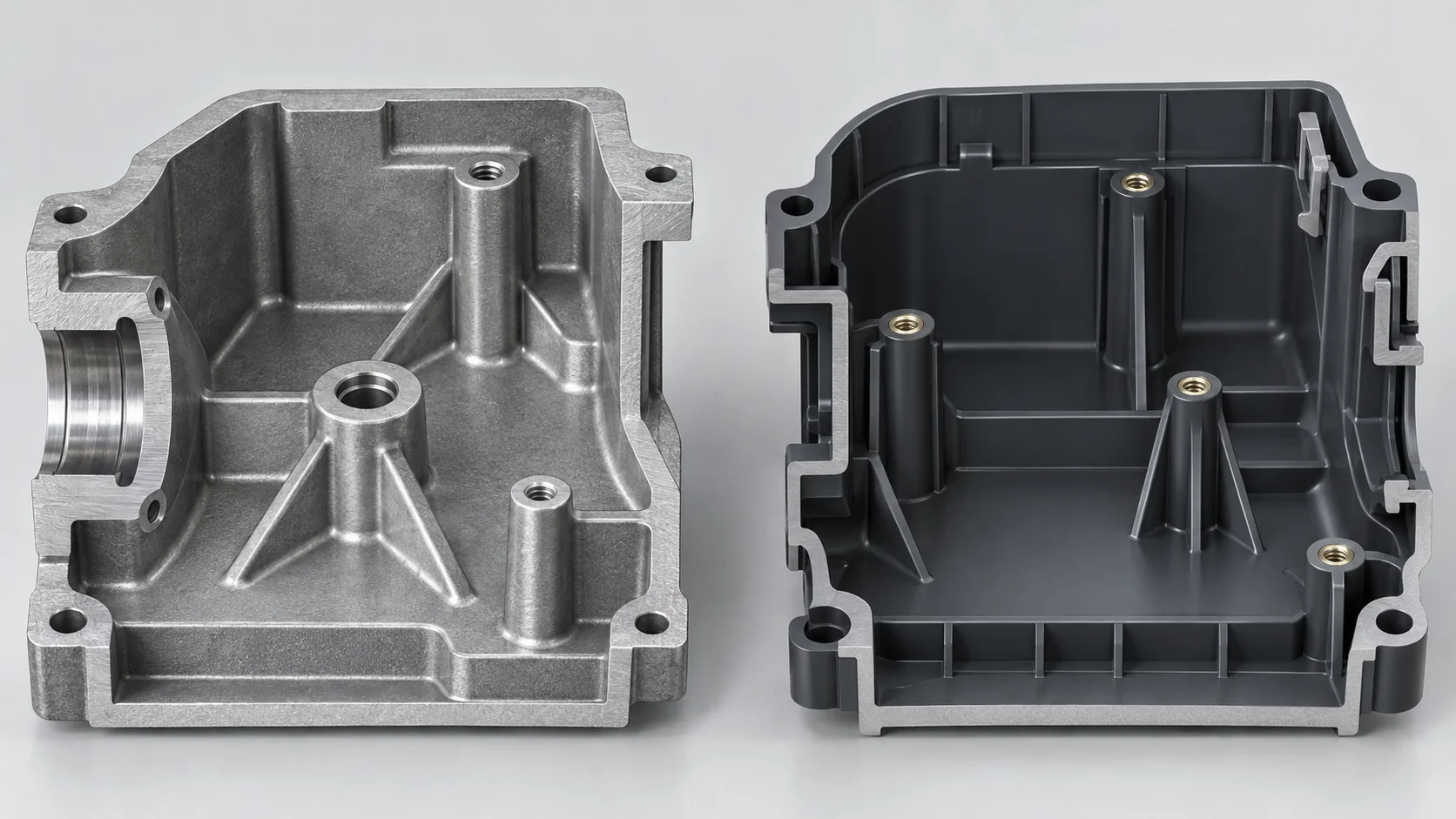
A common mistake is assuming the same CAD model can simply be manufactured in either metal or plastic.
In reality, die casting and injection molding require different design strategies.
| Design Feature | Die Casting | Injection Molding |
|---|---|---|
| Wall Thickness | Thin and uniform metal walls | Thin and uniform plastic walls |
| Draft | Required | Required |
| Ribs | Used to increase stiffness | Widely used to improve stiffness |
| Bosses | Must consider metal flow and wall mass | Common for screws and assembly |
| Snap Fits | Rare | Very common |
| Threads | Often machined or inserted | Molded, self-tapping, or inserts |
| Undercuts | Increase tooling complexity | Slides and lifters are common |
| Heat Dissipation | Excellent | Limited |
| EMI Shielding | Natural metal advantage | Often requires additional coating |
| Integrated Flexibility | Limited | Excellent with suitable plastics |
Wall Thickness
Uniform wall thickness is important for both processes.
In die casting, thick sections can increase porosity, shrinkage, and uneven cooling.
In injection molding, inconsistent wall thickness can increase sink marks, warpage, and internal stress.
The optimal wall thickness depends strongly on material and geometry, so a metal part should not simply be converted into plastic without redesign.
Ribs and Bosses
Plastic parts frequently rely on ribs and bosses to improve stiffness without increasing wall thickness.
Die-cast parts can also use ribs, but rib size and location must consider:
- Metal flow
- Fill behavior
- Thermal mass
- Ejection
- Tooling access
Bosses in die-cast parts are often used for mounting features, but critical holes or threads may still be CNC machined after casting.
Snap Fits and Integrated Features
Injection molding is much better suited for snap fits and flexible integrated features.
Plastic parts can often combine:
- Clips
- Hinges
- Cable guides
- Snap fits
- Covers
- Assembly features
into a single molded component.
Metal die-cast parts usually depend more on screws, inserts, machined threads, or additional fasteners.
Threads
Threads are another important design difference.
Plastic injection-molded parts may use:
- Molded threads
- Self-tapping screws
- Heat-set inserts
- Molded-in inserts
Die-cast parts may include basic cast thread forms in certain cases, but precision or load-bearing threads are often machined afterward.
When Does a Die-Cast Part Need CNC Machining?
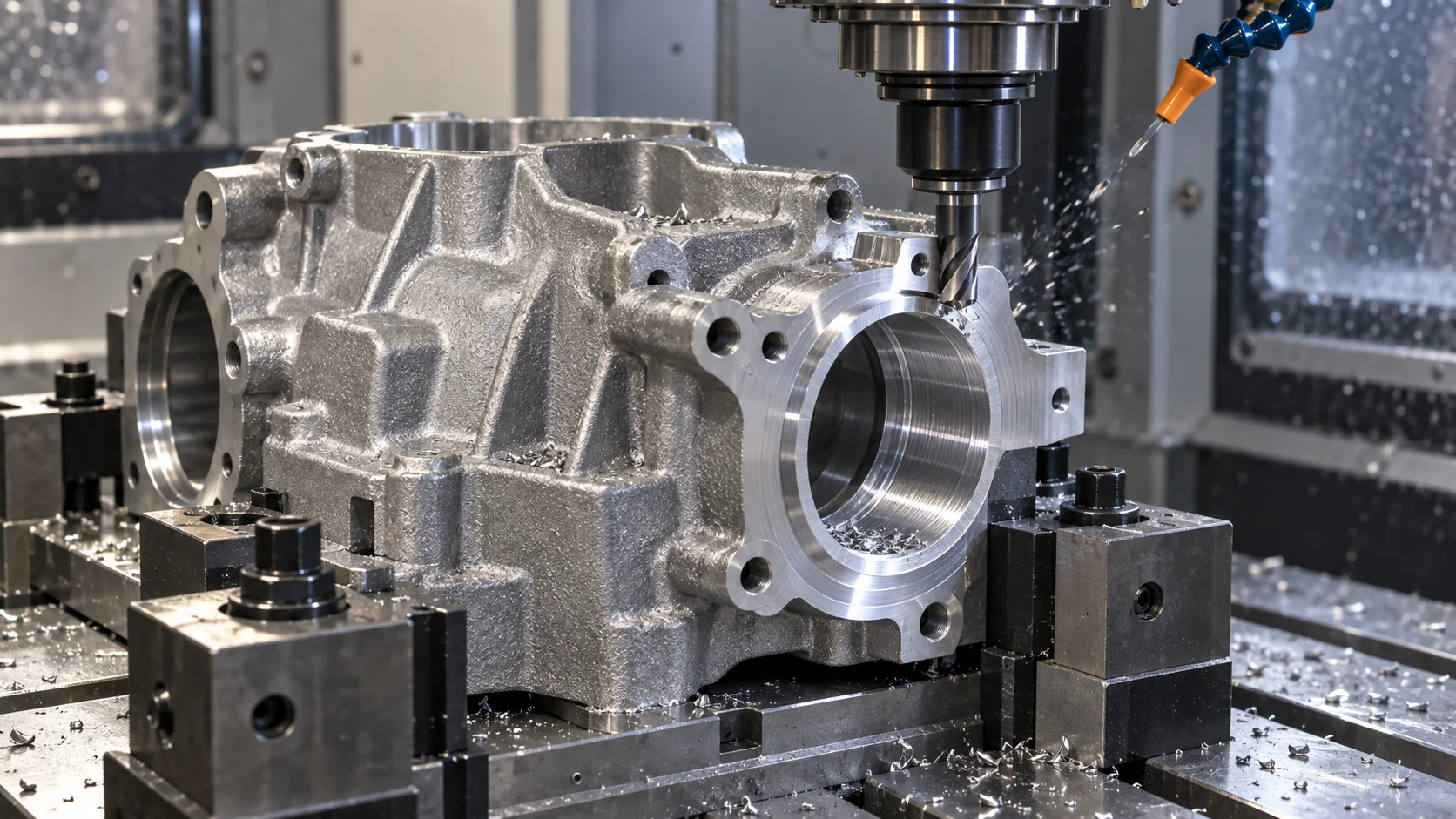
Die casting can produce near-net-shape parts efficiently, but it does not always eliminate machining.
CNC machining is commonly used when the part requires critical functional features such as:
- Bearing bores
- Precision dowel holes
- Tapped holes
- Sealing surfaces
- Datum faces
- High-flatness mounting faces
- Tight concentricity
- Tight positional tolerances
- Precision mating surfaces
A better manufacturing question is often not:
Die casting or CNC machining?
but:
Which features should be cast, and which features should be machined afterward?
For example, a die-cast motor housing may be cast close to final geometry, then CNC machined on:
- Bearing seats
- Shaft bores
- Mounting faces
- Bolt patterns
This combination can reduce material waste while still achieving functional accuracy.
Die Casting vs Injection Molding vs CNC Machining
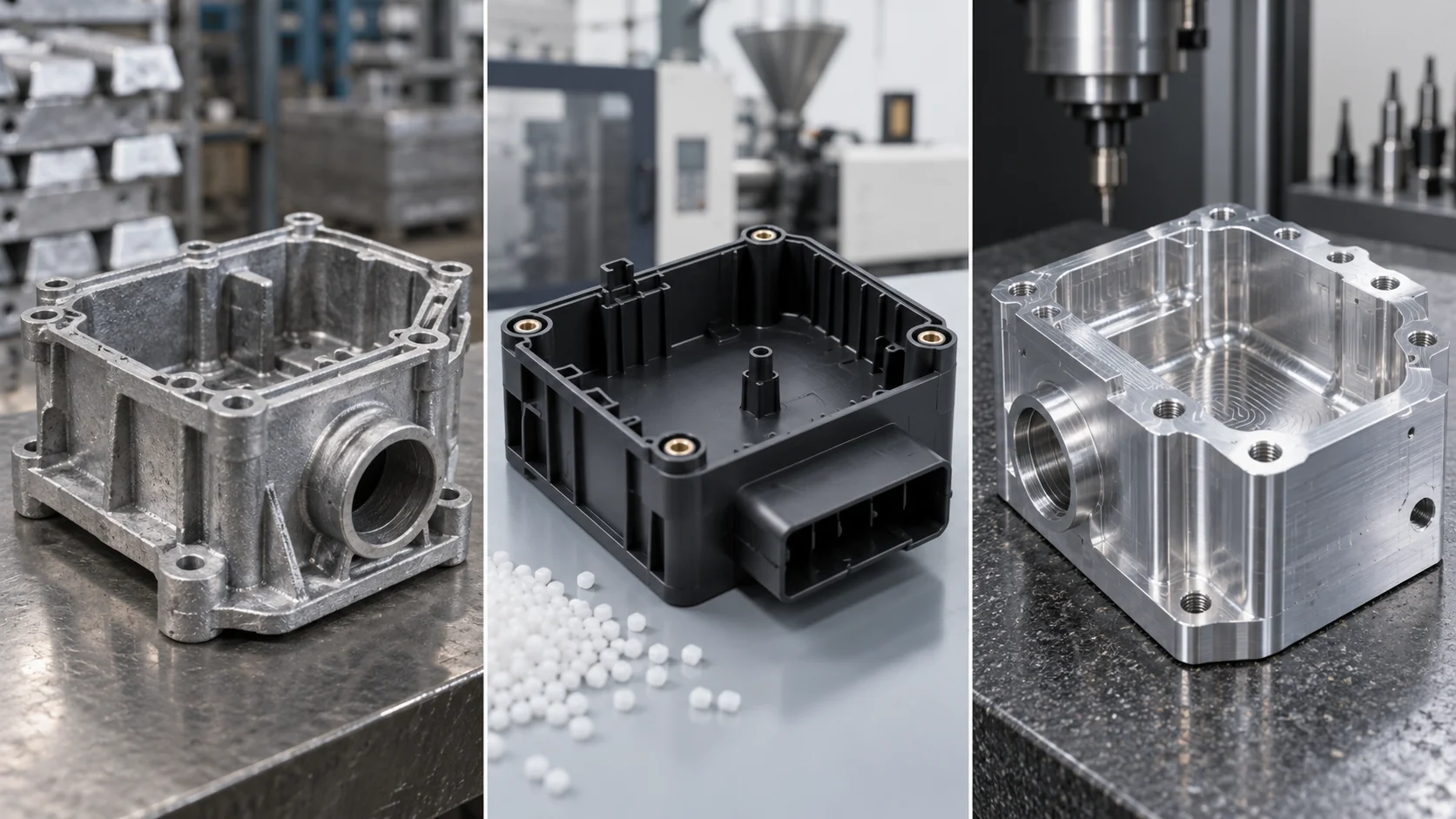
CNC machining is not always a direct replacement for either process, but it plays an important role during product development and precision finishing.
| Factor | Die Casting | Injection Molding | CNC Machining |
|---|---|---|---|
| Main Materials | Non-ferrous metals | Plastics | Metals and plastics |
| Dedicated Mold | Required | Required | Not required |
| Upfront Tooling | High | High | Low |
| Low-Volume Economics | Usually poor | Usually poor | Strong |
| Design Changes | Expensive after tooling | Expensive after tooling | Easy |
| Prototype Lead Time | Longer | Longer | Short |
| Tight Precision Features | Often machined afterward | Mold dependent | Excellent |
| Best Stage | Mass production | Mass production | Prototype, bridge production, precision finishing |
CNC Machining for Prototypes
Before committing to expensive tooling, many companies produce CNC-machined prototypes.
This allows engineers to evaluate:
- Fit
- Assembly
- Strength
- Tolerances
- Surface finish
- Functional geometry
without building a production mold.
For metal products, CNC machining can use materials similar to the intended die-cast alloy.
For plastic products, CNC machining can also be used with engineering plastics for early functional testing.
CNC Machining for Bridge Production
Bridge production is useful when:
- Tooling is not ready
- Demand is uncertain
- The design is still evolving
- Early customers require parts
CNC machining can produce low-volume parts while final tooling is being developed.
Once production volume increases and the design stabilizes, die casting or injection molding can take over.
CNC Machining After Die Casting
This hybrid process is extremely common.
Die casting creates the overall geometry efficiently, while CNC machining finishes precision features.
Typical sequence:
Die Casting → Trimming → CNC Machining → Finishing → Inspection
This approach combines the production efficiency of casting with the accuracy of machining.
Die Casting vs Injection Molding Cost
The cheapest process cannot be determined from tooling cost alone.
A better comparison is:
Total Part Cost = Tooling + Material + Machine Cycle + Labor + Scrap + Finishing + Secondary Machining + Inspection
Tooling Cost
Both die casting and injection molding require substantial initial tooling investment.
Complex tooling becomes more expensive when the part includes:
- Multiple cavities
- Slides
- Lifters
- Complex undercuts
- Fine textures
- Tight dimensional requirements
The tooling cost must therefore be amortized across total production volume.
Material Cost
Plastic materials are usually lighter and often less expensive per finished part, but engineering plastics can still be costly.
Metal alloys are generally more expensive by weight and produce heavier parts.
However, comparing only material cost can be misleading if the product requires properties that plastic cannot provide.
Secondary Operations
Secondary operations can significantly affect die-cast part cost.
They may include:
- CNC machining
- Drilling
- Tapping
- Reaming
- Deburring
- Polishing
- Powder coating
- Plating
- Inspection
Injection-molded parts often require fewer machining operations, although they may still require inserts, painting, assembly, or special finishing.
Production Volume
Higher production volume spreads tooling cost across more parts.
For example, an expensive mold may be difficult to justify for a few hundred pieces but highly economical across tens of thousands of parts.
This is why production forecast is a critical part of process selection.
Common Parts: Which Process Is Usually Used?
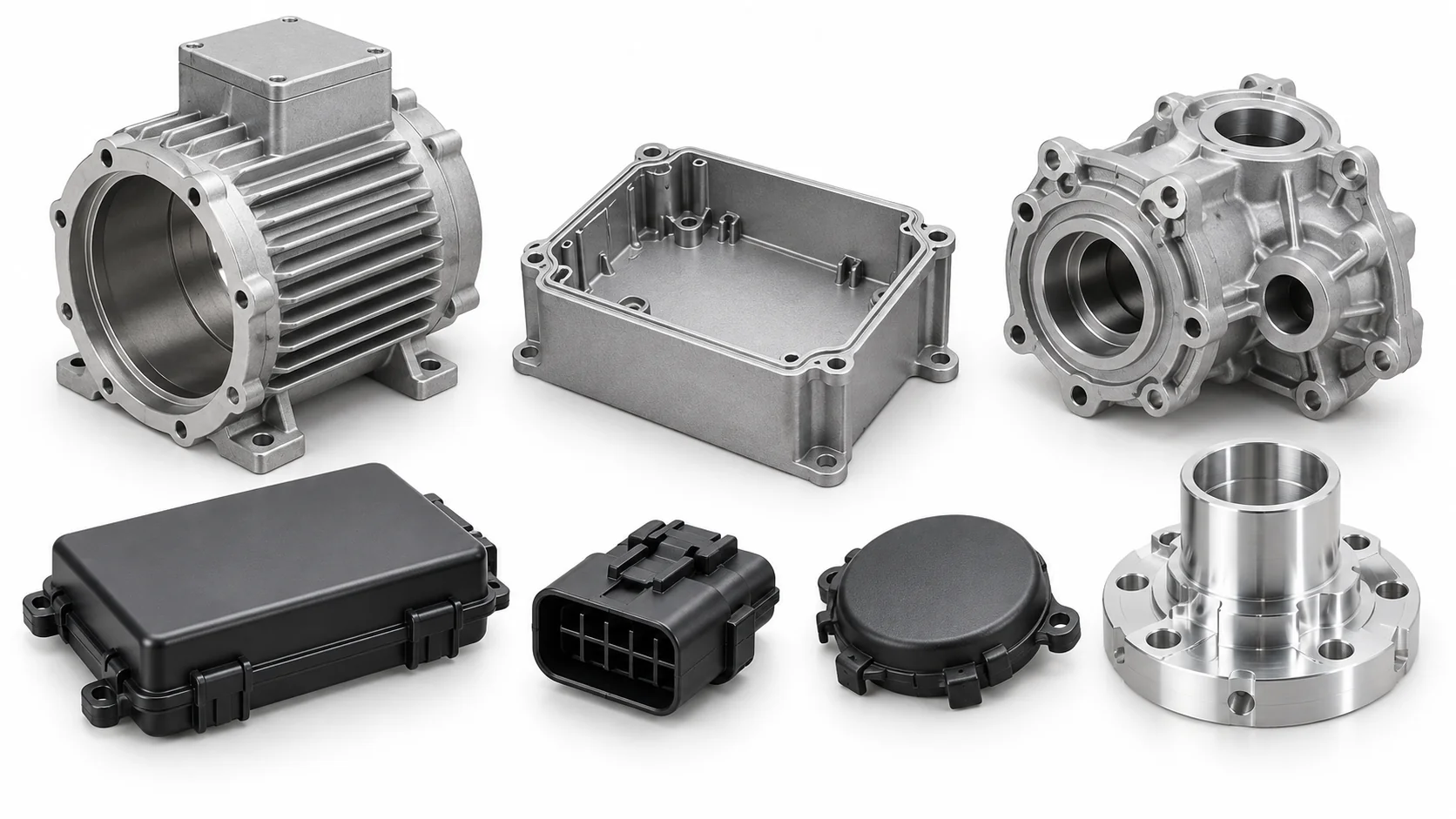
The table below shows typical process choices for common part types.
| Part | Typical Process | Why |
|---|---|---|
| Aluminum electronics housing | Die Casting | Heat dissipation and EMI shielding |
| Plastic electronics enclosure | Injection Molding | Lightweight and electrical insulation |
| Automotive transmission housing | Die Casting | Structural metal performance |
| Plastic connector housing | Injection Molding | Insulation and high-volume production |
| Motor housing | Die Casting | Rigidity and thermal performance |
| Snap-fit cover | Injection Molding | Integrated flexible features |
| Precision bearing housing | Die Casting + CNC | Casting efficiency plus machined bore |
| Metal prototype housing | CNC Machining | No dedicated mold |
| Plastic prototype housing | CNC / 3D Printing | Fast design validation |
These are general guidelines. Actual selection depends on material requirements, geometry, tolerances, and production volume.
How to Choose Between Die Casting and Injection Molding
A practical selection sequence is:
Material → Function → Geometry → Production Volume → Tolerance → Total Cost
Choose die casting when the part requires:
- Metal strength
- High stiffness
- Thermal conductivity
- EMI shielding
- High-temperature performance
- Durable metal mounting features
- Medium-to-high production volume
Choose injection molding when the part requires:
- Low weight
- Electrical insulation
- Integrated snap fits
- Molded color or texture
- Complex plastic geometry
- High-volume production
- Reduced assembly through integrated features
Choose CNC machining first when:
- Production volume is low
- The design is still changing
- Tooling risk is high
- A functional prototype is required
- Tight precision features dominate the part
For many metal components, the final solution may not be one process alone.
A common production strategy is:
CNC Prototype → Design Validation → Die Casting → CNC Finish Machining
This reduces tooling risk while maintaining precision in production.
Final Thoughts
Die casting and injection molding are both efficient high-volume processes, but they solve different manufacturing problems.
Die casting is primarily a metal production process, while injection molding is primarily a plastic production process.
The best choice depends first on material and functional requirements, then on geometry, tooling, production volume, tolerances, and total cost.
For products still in development, CNC machining can reduce tooling risk by supporting prototypes and low-volume validation before mass production.
For high-volume metal parts, a combination of die casting and CNC machining is often the most practical solution when the overall geometry can be cast efficiently but critical features require higher precision.
At YUANYI Precision Manufacturing, we support CNC milling, CNC turning, multi-axis machining, and precision secondary machining for cast metal parts and prototype development.
Frequently Asked Questions
Die-cast metal parts generally provide higher stiffness and structural strength than plastic injection-molded parts. However, reinforced engineering plastics can still provide excellent performance for many applications.
Standard injection molding is used for plastics. Metal injection molding, or MIM, is a separate process that combines metal powder with a binder and later uses debinding and sintering.
Not completely. Die casting is efficient for producing near-net-shape parts at volume, while CNC machining is better for prototypes, low-volume production, and tight-tolerance functional features.
Yes. Die-cast parts are commonly CNC machined to finish bearing bores, mounting surfaces, threads, sealing faces, precision holes, and other critical features.
CNC machining is usually more practical because it does not require dedicated production tooling and allows design changes to be made quickly.
Both can require expensive tooling. Actual cost depends on mold size, cavity count, material, complexity, slides, lifters, hot runners, and expected tool life.
It can be used for lower volumes, but tooling cost often makes CNC machining more economical when quantities are small or the design is still changing.



