

Plastics are used throughout modern vehicles because they can reduce weight, resist corrosion, provide electrical insulation, and form complex shapes that would be difficult or expensive to produce from metal.
Common plastics used in the automotive industry include polypropylene (PP), ABS, nylon (PA), polycarbonate (PC), POM, PBT, polyethylene (PE), PMMA, PEEK, and PVC.
These materials are found in everything from dashboards and bumpers to gears, electrical connectors, fluid-system components, lighting parts, and under-hood assemblies.
This guide compares the most widely used automotive plastics, where they are used, and which materials are particularly suitable for CNC-machined automotive prototypes and low-volume components.
Automotive Plastics at a Glance
| Plastic | Key Properties | Typical Automotive Applications | Relative Cost | CNC Machinability |
|---|---|---|---|---|
| PP | Lightweight, chemical resistant, flexible | Bumpers, interior panels, battery housings | Low | Fair |
| ABS | Impact resistant, easy to process | Dashboard parts, trim, housings | Low | Good |
| Nylon / PA | Strong, wear resistant, heat resistant | Gears, bushings, engine components | Medium | Good |
| PC | High impact strength, transparent grades available | Headlamp lenses, housings, interior parts | Medium | Good |
| POM | Low friction, dimensional stability | Gears, clips, valves, precision parts | Medium | Excellent |
| PBT | Heat and electrical resistance | Connectors, sensors, electrical housings | Medium | Good |
| PE / HDPE | Chemical resistant, lightweight | Fuel tanks, fluid containers, liners | Low | Fair |
| PMMA | Excellent optical clarity | Light covers, lenses, displays | Medium | Good |
| PEEK | High temperature and chemical resistance | High-performance mechanical and electrical parts | Very High | Excellent |
| PVC | Chemical resistant and electrically insulating | Cable insulation, trim, seals | Low | Fair |
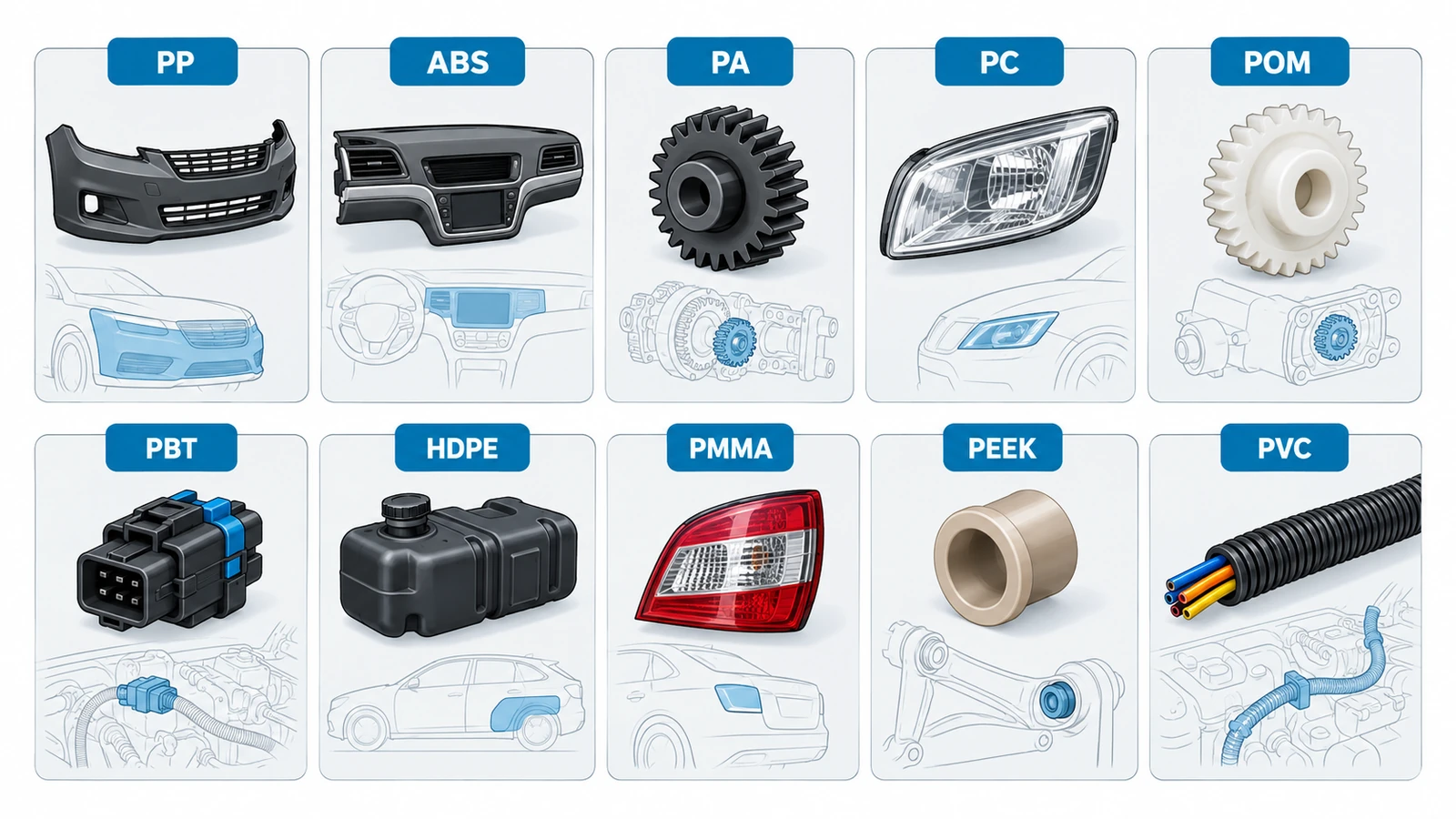
1. Polypropylene (PP)
Polypropylene is one of the most widely used plastics in automotive manufacturing because it is lightweight, inexpensive, chemically resistant, and easy to mold.
It is commonly used for bumper covers, interior trim, door panels, battery cases, wheel-arch liners, dashboard components, and underbody covers.
PP can also absorb moderate impact without adding much vehicle weight, making it especially attractive for large non-structural components.
Glass-filled and mineral-filled polypropylene grades may be used when greater stiffness or dimensional stability is required.
The main limitation of PP is that it is not as rigid, wear resistant, or temperature resistant as engineering plastics such as nylon, POM, or PEEK.
For high-volume automotive production, PP parts are normally injection molded rather than CNC machined.
2. ABS
Acrylonitrile butadiene styrene, or ABS, combines toughness, impact resistance, good appearance, and relatively easy processing.
Automotive manufacturers commonly use ABS for:
- Dashboard components
- Interior trim
- Console parts
- Protective covers
- Switch housings
- Decorative components
ABS machines relatively well and is therefore also useful for automotive prototypes and low-volume parts.
Compared with PP, ABS generally offers better rigidity and surface quality. It can also be painted, coated, or finished relatively easily.
However, standard ABS does not perform well under very high temperatures or prolonged outdoor UV exposure unless modified grades are used.
For parts requiring greater impact strength or heat resistance, engineers may instead select PC-ABS blends.
3. Nylon / Polyamide
Nylon, including PA6 and PA66, is one of the most important engineering plastics used in mechanical automotive components.
Its combination of strength, wear resistance, fatigue resistance, and moderate heat resistance makes it suitable for parts that experience repeated movement or mechanical loading.
Typical automotive applications include:
- Gears
- Bushings
- Bearings
- Engine covers
- Cable guides
- Clips
- Brackets
- Under-hood components
Glass-fiber reinforced nylon, such as PA66-GF30, provides significantly greater stiffness than unfilled nylon and is widely used in structural and under-hood applications.
One important consideration is moisture absorption. Nylon can absorb moisture from the surrounding environment, which may affect dimensions and mechanical properties.
For tight-tolerance components, this should be considered during both design and machining.
4. Polycarbonate (PC)
Polycarbonate is known for its exceptionally high impact resistance and availability in transparent grades.
In automotive applications, PC is commonly used for:
- Headlamp lenses
- Lighting components
- Instrument panels
- Protective covers
- Interior housings
- Transparent safety components
Compared with acrylic, polycarbonate offers significantly better impact resistance, although its surface is generally softer and can scratch more easily.
PC can also be CNC machined for prototype lenses, transparent housings, covers, and mechanical test parts.
Machining parameters must be controlled carefully because excessive heat can cause local melting or poor surface quality.
For components where transparency and impact resistance are both important, polycarbonate is often one of the first materials engineers consider.
5. POM / Acetal
Polyoxymethylene, commonly called POM or acetal, is particularly useful for automotive components that require low friction, dimensional stability, and wear resistance.
Common examples include:
- Precision gears
- Bushings
- Sliding components
- Fuel-system parts
- Clips
- Valves
- Mechanical linkages
POM has relatively low moisture absorption compared with nylon, helping it maintain more stable dimensions in changing environments.
It also machines extremely well, which makes it suitable for precision prototypes and low-volume automotive components.
For engineers comparing acetal grades, both POM-H and POM-C are commonly available, with differences in thermal behavior, chemical resistance, and dimensional stability.
For more information, see our POM CNC machining service.
6. Polybutylene Terephthalate (PBT)
PBT is an engineering thermoplastic commonly used in automotive electrical and electronic systems.
It provides good electrical insulation, chemical resistance, dimensional stability, and heat resistance.
Typical applications include:
- Electrical connectors
- Sensor housings
- Ignition components
- Switch bodies
- EV electrical components
- Electronic enclosures
Glass-filled PBT grades are often selected when additional strength and stiffness are required.
Compared with PP or ABS, PBT is generally chosen for more demanding electrical or under-hood environments rather than decorative interior components.
As vehicles continue adding sensors, electronic control systems, and electrified powertrains, materials such as PBT have become increasingly important in automotive component design.
7. Polyethylene and HDPE
Polyethylene is widely used where chemical resistance, low weight, and low material cost are more important than high stiffness.
High-density polyethylene, or {L_HDPE}, is particularly common in automotive fluid-management applications.
Typical uses include:
- Fuel tanks
- Fluid reservoirs
- Protective liners
- Ducting
- Containers
- Underbody components
HDPE resists many fuels and chemicals and does not corrode like metal.
However, polyethylene is relatively soft and can be difficult to machine to very tight tolerances because it may deform during clamping and cutting.
For this reason, PE is usually molded or formed for high-volume automotive applications, while CNC machining is mainly used for prototypes, fixtures, test parts, and low-volume components.
8. PMMA / Acrylic
PMMA, commonly known as acrylic, is primarily used when optical clarity and appearance are important.
Automotive applications include:
- Lighting lenses
- Indicator covers
- Interior display components
- Decorative transparent parts
- Instrument lighting systems
Compared with polycarbonate, PMMA generally provides excellent transparency and surface appearance but lower impact resistance.
Acrylic also machines well when correct cutting tools and feeds are used.
For prototype lighting assemblies and transparent automotive components, CNC machining allows designers to test shape, fit, and optical appearance before committing to production tooling.
When impact resistance is the main requirement, PC may be preferred. When optical quality and surface appearance are more important, PMMA can be a better option.
9. PEEK
PEEK is a high-performance engineering plastic used in automotive applications where conventional plastics cannot provide enough heat resistance, strength, wear resistance, or chemical stability.
Potential automotive applications include:
- High-temperature bushings
- Seals
- Electrical insulation components
- Bearing components
- Fluid-system parts
- EV and power-electronics components
- Lightweight high-performance mechanical parts
PEEK is significantly more expensive than PP, ABS, POM, or nylon, so it is generally reserved for demanding applications where its performance justifies the material cost.
It also offers excellent CNC machinability when appropriate tooling, workholding, and thermal control are used.
For prototype and precision PEEK components, see our PEEK CNC machining service.
10. PVC
PVC is commonly used in automotive applications because of its chemical resistance, flexibility options, electrical insulation, and relatively low cost.
Typical applications include:
- Wire and cable insulation
- Protective sleeves
- Interior trim
- Seals
- Floor coverings
- Flexible protective components
PVC can be formulated as either rigid or flexible material depending on the application.
Unlike POM, nylon, or PEEK, PVC is generally not selected for precision mechanical components exposed to high mechanical loads.
Its main role in vehicles is in electrical protection, flexible trim, sealing, and protective applications.
Where Are Plastics Used in a Car?
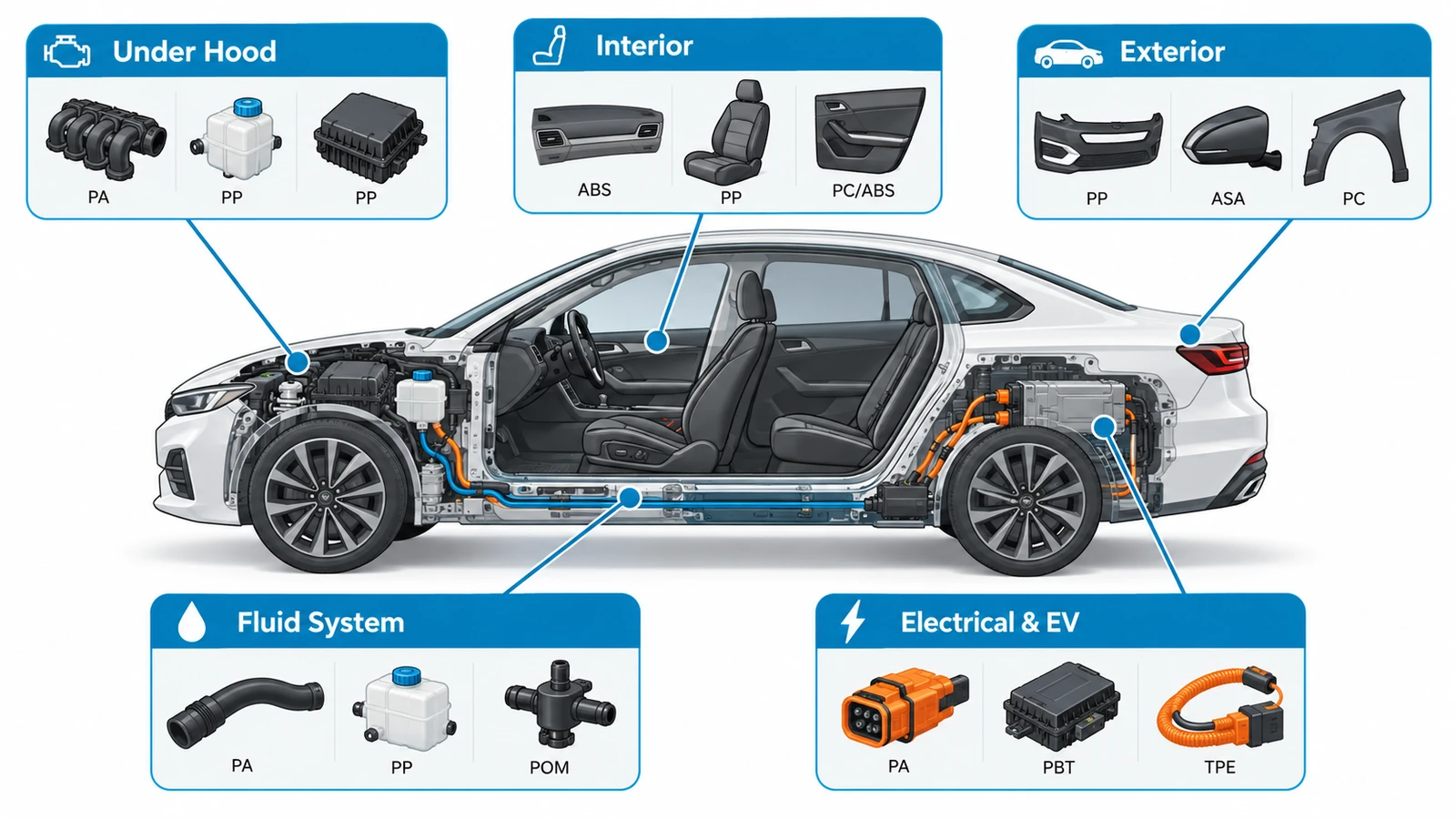
Different sections of a vehicle place very different demands on plastic materials.
Interior Components
Interior components prioritize appearance, impact resistance, low weight, and manufacturing cost.
Common materials include:
PP, ABS, PC-ABS, PMMA, and PC
These materials are used in dashboards, consoles, trim panels, switches, displays, and covers.
Exterior Components
Exterior plastics must tolerate impact, weather exposure, temperature changes, and moisture.
Common materials include:
PP, PC, PMMA, ASA, and reinforced engineering plastics
Typical parts include bumper covers, lighting components, exterior trim, and protective housings.
Under-the-Hood Parts
Under-hood materials need better temperature resistance, strength, and chemical resistance.
Typical choices include:
PA6, PA66, glass-filled nylon, PBT, POM, and PEEK
These materials may be used for brackets, gears, connectors, housings, guides, and fluid-system components.
Fuel and Fluid Systems
Fuel and fluid components require strong resistance to oils, fuels, coolants, and other automotive chemicals.
Common materials include:
HDPE, POM, nylon, and PEEK
The exact material should always be selected according to the specific fluid, temperature, pressure, and regulatory requirements.
Electrical and EV Components
Electric and hybrid vehicles require growing numbers of plastic parts for insulation, connectors, sensors, battery systems, and power electronics.
Materials frequently considered include:
PBT, nylon, PC, PEEK, and other flame-retardant engineering plastics.
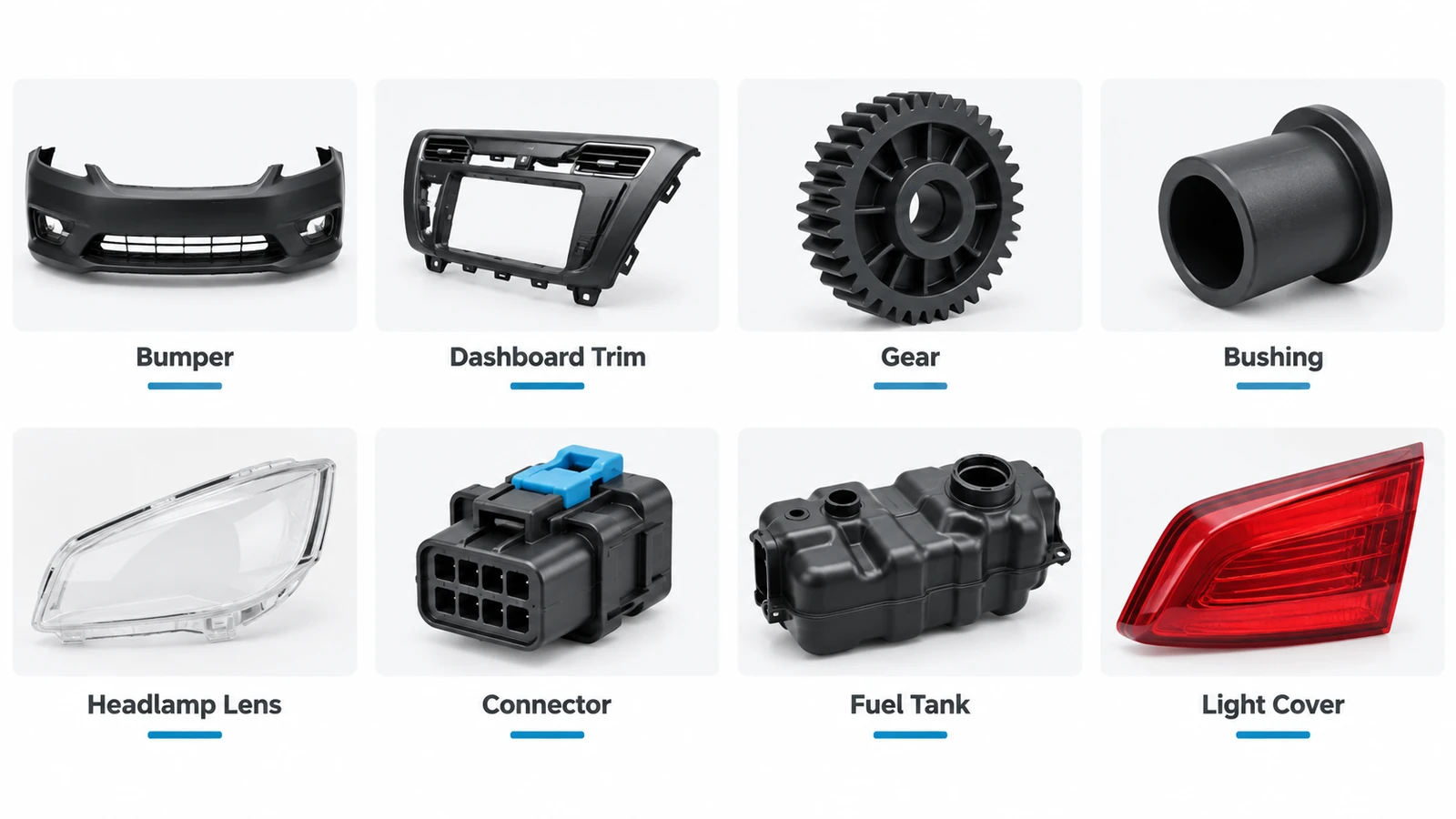
How to Choose the Right Automotive Plastic
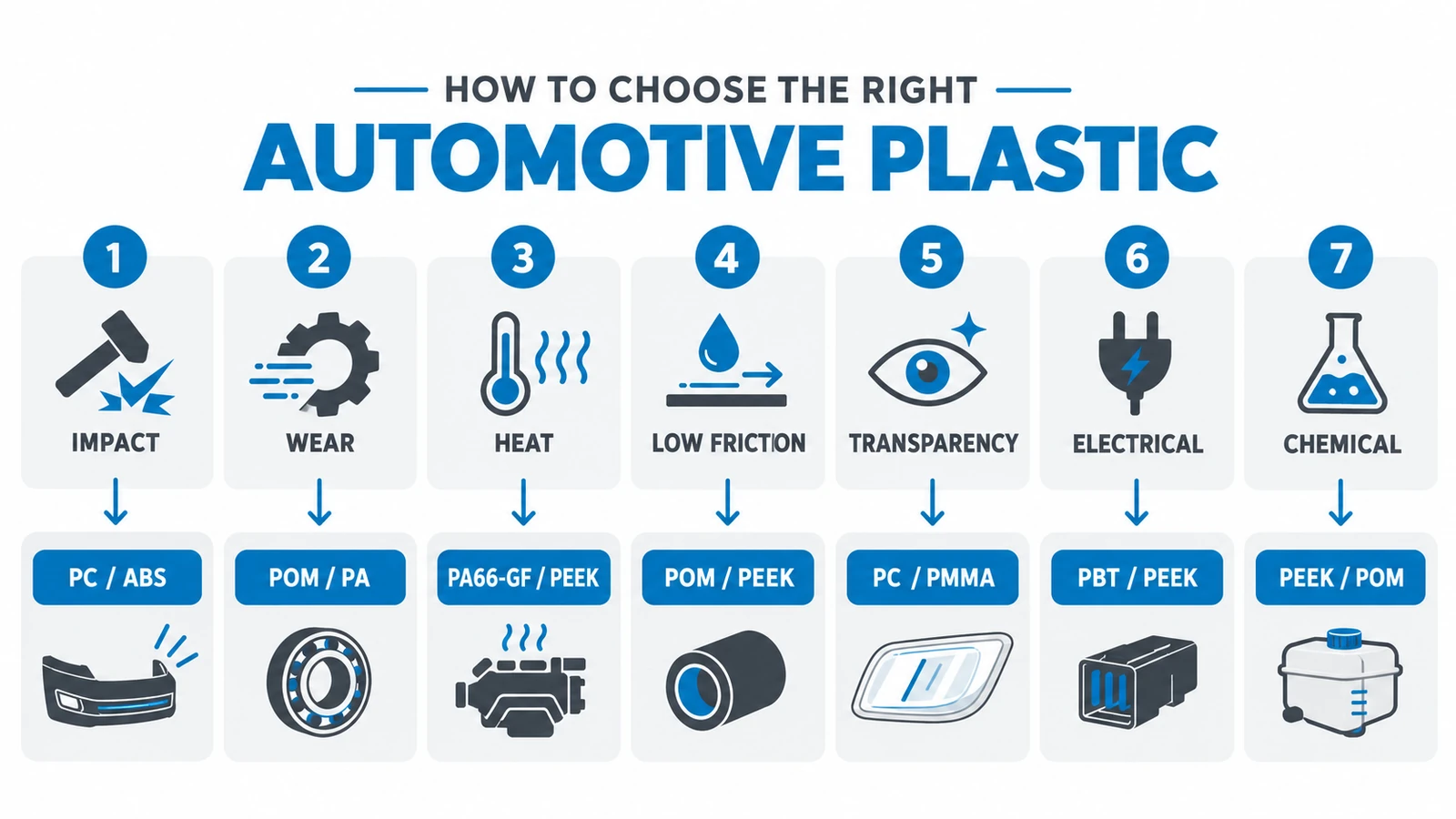
Automotive plastic selection should start with the operating conditions of the component rather than the material price alone.
| Requirement | Common Material Choices |
|---|---|
| Low material cost | PP, ABS, PE |
| High impact resistance | PC, ABS |
| Wear resistance | POM, Nylon |
| Low friction | POM, PEEK |
| High temperature resistance | Reinforced Nylon, PEEK |
| Dimensional stability | POM, PBT, PEEK |
| Optical transparency | PC, PMMA |
| Electrical insulation | PBT, PC, PEEK |
| Chemical resistance | PEEK, POM, PE |
| Lightweight large parts | PP, PE |
Other factors should also be considered, including:
- Operating temperature
- Mechanical load
- Chemical exposure
- UV exposure
- Moisture absorption
- Required tolerance
- Surface finish
- Production quantity
- Manufacturing method
- Material cost
For example, a dashboard panel and a precision transmission gear may both be plastic components, but their material requirements are completely different.
Which Automotive Plastics Are Best for CNC Machining?
Not every automotive plastic is equally suitable for CNC machining.
Large-volume parts such as bumper covers, dashboard panels, and fluid tanks are normally produced using injection molding, blow molding, thermoforming, or other mass-production processes.
CNC machining is more useful for:
- Engineering prototypes
- Functional testing parts
- Low-volume production
- Precision gears and bushings
- Sensor housings
- Electrical insulators
- Custom brackets
- Fixture components
- EV development parts
Materials particularly suitable for CNC machining include:
POM, PEEK, nylon, polycarbonate, PMMA, and ABS.
POM is especially useful for precision mechanical components because it combines good machinability with low friction and dimensional stability.
Nylon works well for wear-resistant components, while PEEK is suitable for high-temperature and chemically demanding applications.
PC and PMMA are commonly machined for transparent housings and prototype lighting components.
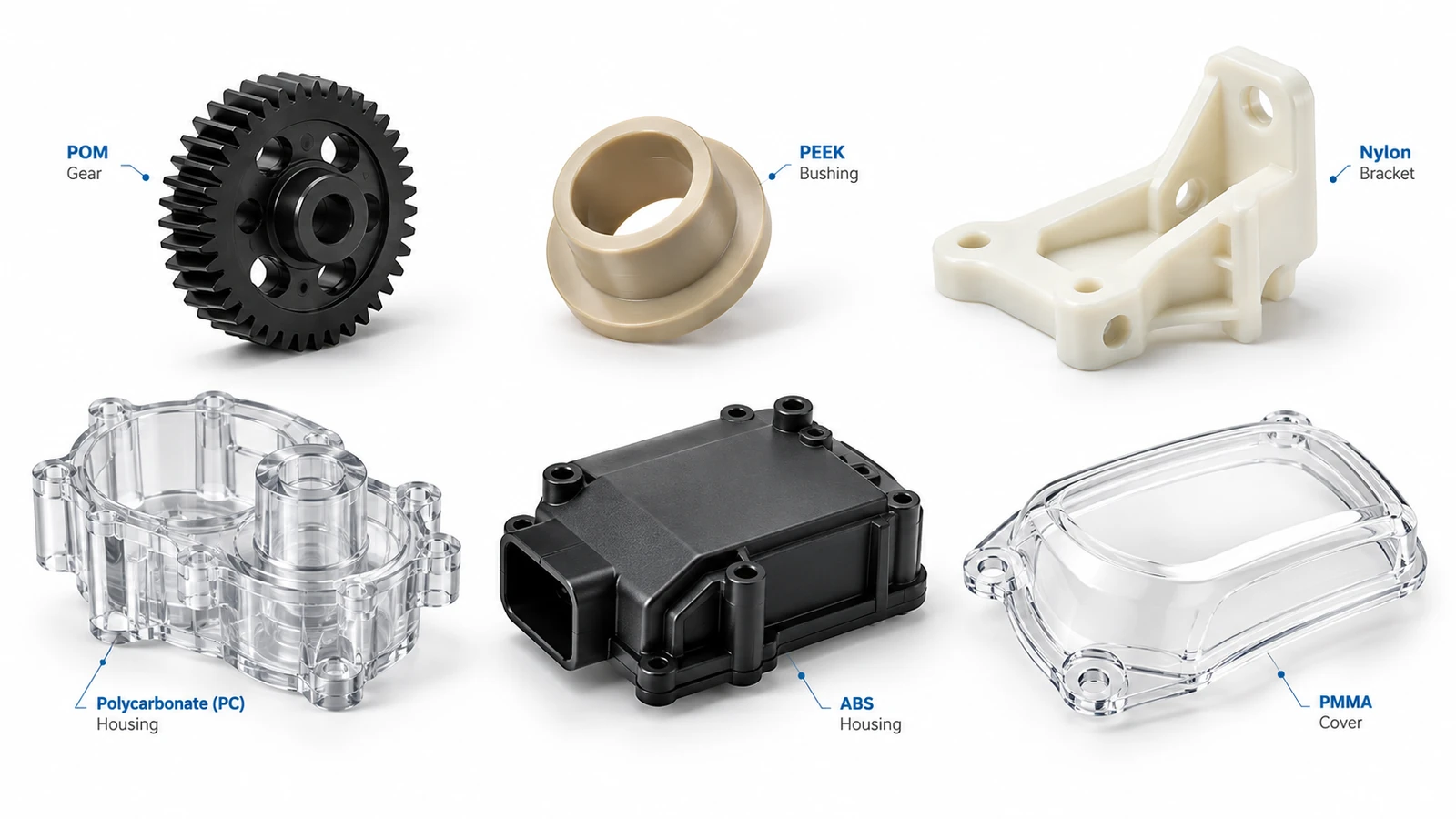
CNC machining also allows automotive engineers to manufacture functional plastic parts without waiting for injection molding tooling, making it useful during design validation and low-volume product development.
Plastic vs Metal in Automotive Components
Plastics do not completely replace aluminum, steel, or other automotive metals.
Instead, engineers select each material according to the functional requirements of the component.
Plastics offer advantages such as:
- Lower weight
- Corrosion resistance
- Electrical insulation
- Lower tooling cost for some applications
- Complex geometry
- Reduced part count
- Lower friction
Metals remain preferable when components require:
- Very high structural strength
- Extreme temperature resistance
- High stiffness
- Heavy load capacity
- Metal-to-metal wear performance
Many modern vehicles therefore use a combination of metals and engineering plastics rather than relying on one material family.
CNC Machining Automotive Plastic Parts
Automotive plastics range from low-cost polypropylene used in large molded panels to high-performance PEEK used in demanding mechanical and electrical applications.
The best material depends on the part’s temperature, mechanical load, chemical environment, friction requirements, dimensional tolerance, and production volume.
For prototypes and low-volume precision components, POM, nylon, PC, PMMA, ABS, and PEEK are among the most practical plastics for CNC machining.
YuanYi provides CNC milling and turning for custom plastic automotive components, including prototypes, functional test parts, housings, gears, bushings, insulators, and other low-volume precision parts.
If you are developing an automotive plastic component, send us your drawing or 3D model for machining review and DFM feedback.



